Private Label, White Label, Wholesale partnerships available - EU, USA and UK - Free shipping from €75

How Much Reconstitution Solution: 2026 Dosage Guide
The vial is open, the diluent is measured, and the label says to add a specific volume. The calculation appears simple: add the liquid, divide the labeled mass by that amount, and proceed. That shortcut is where many otherwise careful preparations go wrong.
The amount added to a lyophilized product is not automatically the final volume. Dissolved solids occupy space, so the finished solution can contain more liquid than the volume introduced. Anyone deciding how much reconstitution solution to use must therefore follow the product-specific protocol, distinguish added volume from final volume, and document the calculation before preparation begins.
Table of Contents
- Understanding Reconstitution Volumes
- Mastering the Addition Formula
- Calculating Concentration and Dose
- Selecting the Right Solution Format
- Applying Math to Real Lab Scenarios
- Ensuring Accuracy and Safety
Understanding Reconstitution Volumes
A vial may call for 10 mL of diluent, yet the finished preparation may contain more than 10 mL. That difference can change the withdrawal volume and the calculated dose. The governing rule is reconstitution volume is product-specific, not universal. FDA labeling guidance requires injectable-product instructions to identify the compatible diluent and the volume required for reconstitution. FDA labeling guidance establishes why a product label or approved protocol must take priority over a routine such as always adding the same amount of sterile water.
The volume introduced and the final solution volume are separate values. Dissolved solids occupy space, so the finished volume can exceed the amount drawn into the vial. For concentrated preparations, overlooking that difference can affect withdrawal volumes, assay calculations, dose calculations, and reproducibility between laboratories.
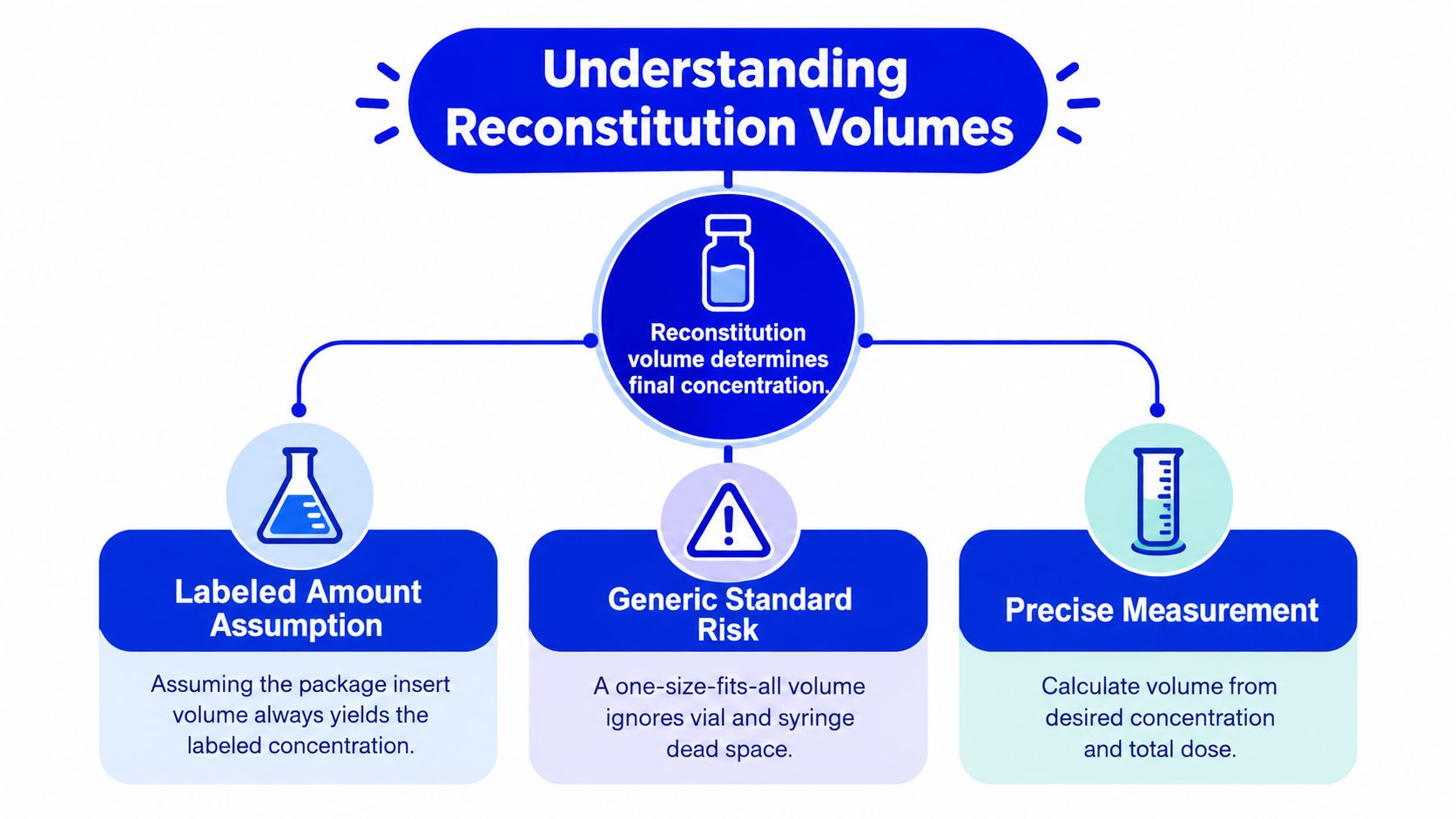
The label controls the starting point
The preparation record should identify the product name, lot, labeled mass, specified diluent, required added volume, final concentration, and any required transfer or dilution step. Recording these fields keeps the calculation tied to the material in hand rather than to a remembered rule from another vial.
TEPEZZA shows why the product protocol matters. Each 500 mg lyophilized vial is reconstituted with 10 mL of Sterile Water for Injection, producing 10.5 mL of solution at a final concentration of 47.6 mg/mL. The FDA instructions require withdrawal of the full 10.5 mL to obtain the labeled dose, followed by dilution to 100 mL for doses below 1,800 mg or 250 mL for doses of 1,800 mg or more. The FDA TEPEZZA instructions make the operational consequence clear: use the stated product procedure rather than substituting a universal volume rule.
Practical rule: Record both the volume introduced and the final volume stated or derived by the product protocol. Do not substitute one for the other in a worksheet.
Why measurement matters
Accuracy starts before the syringe enters the vial. Confirm the diluent identity, inspect the vial and closure, select an appropriate measuring device, and independently check the arithmetic. FDA inspection guidance treats fill volume as a measurable quality attribute and identifies frequent monitoring of filling performance as good practice. FDA inspection guidance for lyophilized parenterals also frames reconstitution compatibility as a product requirement, not merely a packaging decision.
A 3 mL vial may suit a preparation that needs only a small amount, while 10 mL or larger formats may fit workflows requiring several milliliters per lyophilized vial. These are handling and procurement considerations, not dosing rules. The applicable label or validated protocol still determines the required volume.
Mastering the Addition Formula
A vial receives 5 mL of diluent, yet the dissolved preparation finishes at approximately 6.5 mL. That difference is the mathematical trap behind many reconstitution errors. The liquid level after dissolution is not automatically the same as the volume drawn into the syringe.
Use this relationship as a starting model:
Final solution volume = volume of diluent added + volume contributed by dissolved solids
The formula explains the hidden volume contribution, but it does not authorize an estimate for clinical or regulated work. Follow the product-specific protocol. Use its stated final volume, validated formulation data, or an approved calculation method. The solid contribution can change with composition, density, formulation, and concentration.
A worked volume example
Per the FDA guidance cited earlier, a technical example contains 1.5 g of solids reconstituted with 5 g of water, producing approximately 6.5 mL of solution. The example calculates concentration as 500 mg divided by 6.5 mL, giving 76.9 mg/mL. Dividing by the water added alone would use the wrong denominator.
The calculation follows this sequence:
- Record the diluent added. The example uses 5 g of water, treated as approximately 5 mL for that calculation.
- Allow for dissolved solids. The dry formulation adds volume after it dissolves.
- Use the protocol's resulting volume. The stated result is approximately 6.5 mL, not exactly 5 mL.
- Calculate from the finished solution. The stated mass and final volume produce 76.9 mg/mL.
The distinction matters when a preparation is concentrated or a small withdrawal must contain a defined amount. If a worksheet uses the added solvent volume while the product protocol uses final volume, every later dose calculation can shift.
What does not work
A remembered volume from another product is not a substitute for the applicable instructions. Filling to a visual mark is also unreliable unless the protocol specifies whether that mark represents added volume, final volume, or a manufacturer-defined endpoint. Powder displacement can make a neat-looking calculation disagree with the actual concentration.
Write the formula beside the vial record, retain the manufacturer's stated values, and do not invent a displacement factor without validation. If the final volume is unavailable and precision matters, refer the preparation to the responsible laboratory, pharmacy, or quality function. Product protocols take priority over a universal addition rule.
Calculating Concentration and Dose
A syringe can contain the intended mass and still reflect the wrong concentration if the calculation uses the volume of diluent added rather than the protocol's final solution volume. Once that final volume is established, use:
Concentration = total mass ÷ final solution volume
Keep the units visible. Mass in milligrams divided by volume in milliliters produces milligrams per milliliter. If a product protocol specifies a final volume, use that value. If a validated laboratory method defines a different calculation basis, record it beside the formula and follow that method. There is no universal reconstitution denominator.
For the TEPEZZA example, the stated 500 mg vial produces 10.5 mL of reconstituted solution:
500 mg ÷ 10.5 mL = 47.6 mg/mL
That result links three separate quantities, the labeled mass, the concentration after reconstitution, and the volume withdrawn for the prescribed use. The product instructions cited earlier specify how the prepared solution is handled. They should govern the calculation rather than a general rule copied from another vial.
Reversing the calculation
To find the volume containing a target mass, use:
Withdrawal volume = required mass ÷ concentration
For a target amount of 95.2 mg at 47.6 mg/mL, the arithmetic is:
95.2 mg ÷ 47.6 mg/mL = 2 mL
This is a worked calculation, not a dosing direction for another product, vial, route, or application. The operator must confirm that the target mass, concentration, withdrawal method, and permitted use belong to the same product protocol. A mathematically correct answer can still be procedurally wrong.
A worksheet should show each unit through the calculation, retain precision during intermediate steps, and round only to a level supported by the protocol and measuring device. A calculator such as the accurate mg/mL calculations resource can organize concentration and draw-volume arithmetic, but it cannot determine which product instructions apply.
Keep units consistent
Milligrams, micrograms, milliliters, and liters must be converted before division. For example, a target recorded in micrograms cannot be divided directly by a concentration recorded in milligrams per milliliter. Convert one quantity first, then check that the resulting unit is the volume the procedure asks the operator to measure.
Record whether the calculation uses the product's nominal mass or a corrected content value required by a validated assay or certificate. Use the basis specified by the responsible procedure. A tidy decimal does not prove that the preparation is correct, particularly when dissolved material changes the final volume.
A short video may reinforce the relationship between mass, volume, and concentration, but it does not replace the applicable product instructions or laboratory procedure.
Selecting the Right Solution Format
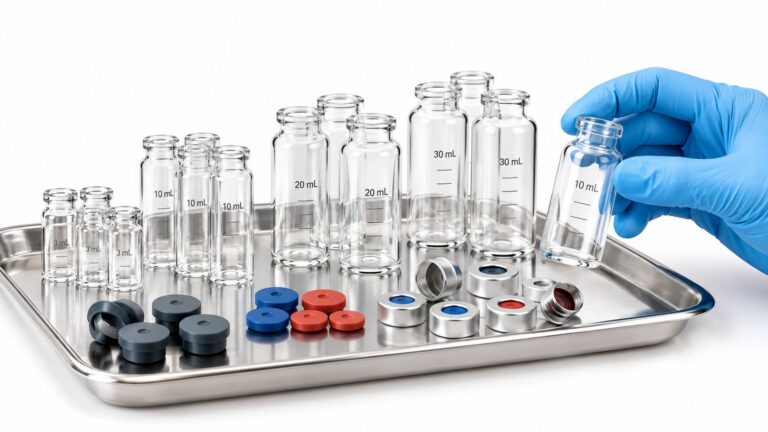
The right vial format depends on the volume required per preparation, the number of preparations, the handling pattern, and the amount of leftover material the procedure can tolerate. A small vial can improve control when the workflow uses little diluent. A larger vial can reduce interruptions when multiple preparations need the same solution. Neither format changes the reconstitution requirement stated by the product protocol.
| Vial Size | Typical Use Case |
|---|---|
| 3 mL | Small-scale preparations or workflows where tight volume control matters |
| 10 mL | Preparations requiring several milliliters of diluent per vial |
| 20 mL | Higher-volume laboratory workflows or repeated preparation needs |
| 30 mL | Bulk-oriented workflows where the procedure supports a larger container |
These formats are procurement options rather than universal dosing categories. A 3 mL vial may be poorly matched to a protocol requiring 10 mL per lyophilized vial, because running short during preparation creates a preventable interruption. Conversely, a larger container can leave more unused solution and may introduce additional handling considerations if the workflow doesn't require that volume.
Comparing small and large formats
Small formats support closer alignment between purchased volume and immediate need. They can be useful when the laboratory wants to limit open-container exposure, simplify inventory, or dedicate a vial to a narrow preparation sequence. Their disadvantage is operational. Multiple small containers may increase labeling, storage, and stock-management work.
Larger formats make sense when a documented workflow uses more solution or when several preparations occur under the same controlled handling conditions. They can reduce the frequency of opening new containers, but the decision must account for the protocol's in-use requirements and the laboratory's contamination controls. Bigger isn't automatically more economical if substantial material remains unused.
Match the purchase to the protocol
A practical purchasing check asks four questions:
- Required volume: How much diluent does the approved protocol require for each lyophilized vial?
- Preparation count: How many equivalent preparations will the workflow perform?
- Handling window: Will the solution be used in a single controlled event or accessed repeatedly?
- Documentation: Does the supplier provide the lot and quality information required by the laboratory?
Herbilabs offers reconstitution solution in a 10 mL format, alongside other stated vial sizes and research-use laboratory supply options. That makes it one possible procurement choice for workflows whose documented volume requirement fits the format. The product selection still belongs after protocol review, not before it.
The cheapest container is the one that matches the approved preparation without forcing a mid-process substitution or creating avoidable leftover volume.
Applying Math to Real Lab Scenarios
The hidden error often appears after the calculation: the volume added to a vial is not always the volume available in the finished solution. Powder displacement, container geometry, and the product's preparation method can make final volume differ from the measured diluent volume. Record both values whenever the approved instructions provide them.
A product with no stated final volume requires a different approach. Do not divide the labeled mass by the amount added and present that result as the finished concentration. Use the product-specific technical method, validated laboratory procedure, or other approved instruction that defines how concentration and usable volume are established. A universal reconstitution standard cannot replace those requirements.
A complete calculation sequence
Step 1, verify the inputs. Confirm the product, vial strength, named diluent, volume to add, stated final volume, handling limits, and any later dilution. The worksheet should distinguish added volume from final volume before any arithmetic begins.
Step 2, identify the governing protocol. Product instructions control the preparation. The FDA label cited earlier remains the reference for that product, while another vial or formulation may specify different volumes, concentrations, or handling steps.
Step 3, calculate only from the approved final volume. If the record gives a final volume, use that value as the denominator. If it does not, stop and obtain the approved method instead of estimating from the volume added. This prevents a plausible-looking concentration from being used without support.
Step 4, test the result against the vial record. Multiply the calculated concentration by the stated final volume and confirm that it returns the labeled mass, allowing only the tolerance defined by the applicable procedure. A mismatch can indicate a transcription error, an incorrect vial strength, or use of the wrong volume.
Step 5, check the preparation sequence. Confirm that reconstitution, mixing, withdrawal, and any subsequent dilution follow the stated order. A correct formula applied to the wrong stage still produces the wrong preparation.
A bench-side verification checklist
Before use, a second person or approved checking process should confirm:
- Identity: Product, strength, and lot match the record.
- Compatibility: The selected diluent is named by the applicable protocol.
- Volumes: Added and final volumes are recorded separately.
- Arithmetic: Mass, concentration, and any withdrawal calculation agree.
- Units: Each value uses compatible units.
- Sequence: Steps occur in the required order.
- Record: Actual preparation details are documented.
This checklist adds value where a repeated vial walkthrough does not. It catches the mathematical trap between liquid added and solution produced, while keeping the laboratory tied to the product-specific method.
Ensuring Accuracy and Safety
Correct arithmetic doesn't protect a preparation from contamination or an incompatible diluent. The FDA inspection guidance identifies Sterile Water for Injection as the appropriate reconstitution solution in its lyophilized parenteral guidance, even when product labeling may mention Bacteriostatic Water for Injection. The applicable product instructions still control, so the operator must verify the named diluent before opening the container.
Use aseptic technique, inspect closures and solution appearance, minimize unnecessary vial entries, and document lot information. Fill-volume controls, traceability, and controlled procedures matter because reproducibility depends on both the calculation and the handling. Laboratories building broader quality systems can also review how automation ensures GMP quality for context on process control and documented manufacturing practices.
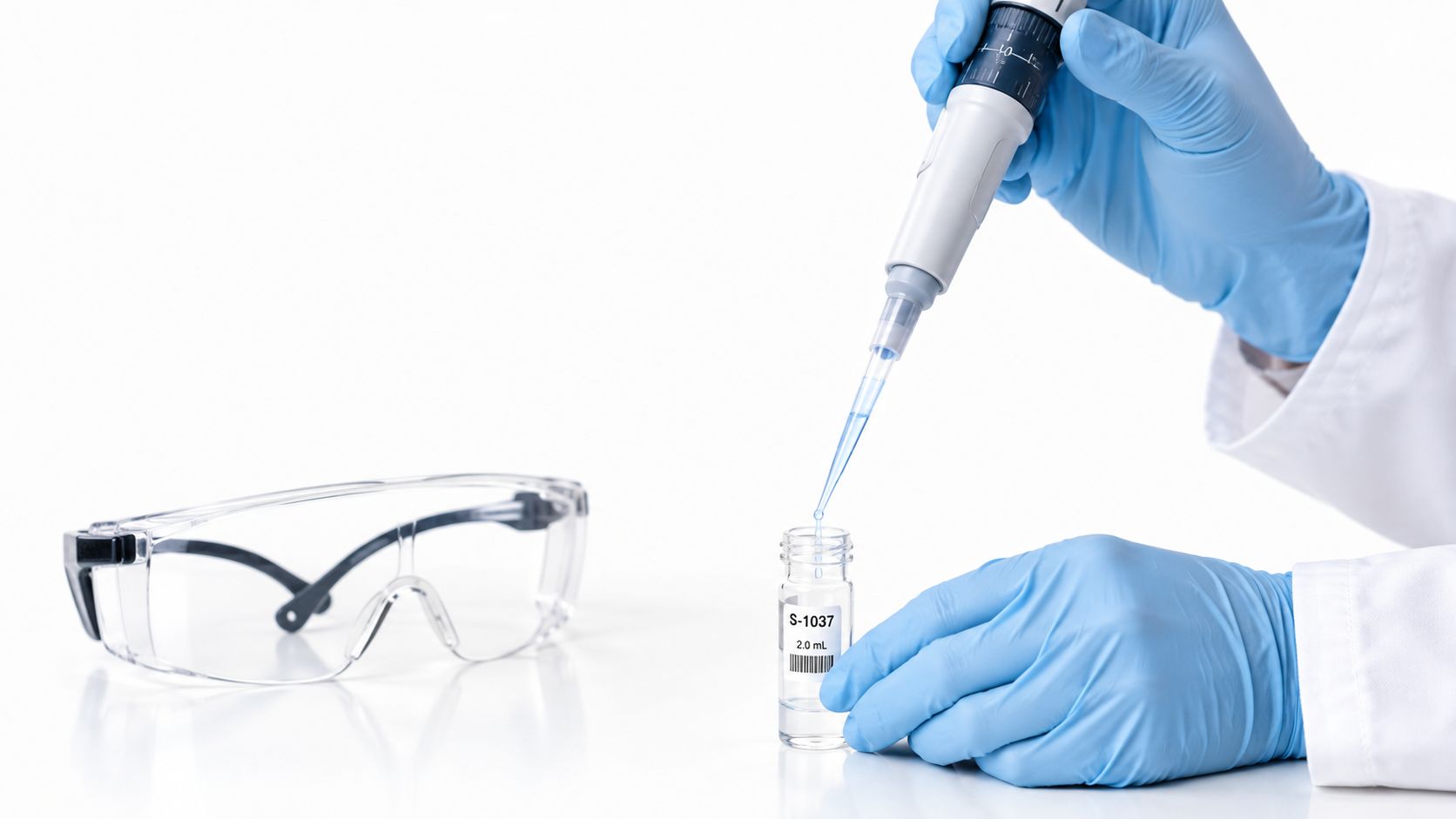
For workflows considering bacteriostatic water, compatibility and the intended handling procedure should be confirmed rather than assumed. The final record should state the added volume, final volume, concentration basis, operator, lot, and protocol reference.
Herbilabs supplies research-use sterile diluents and reconstitution solutions in multiple vial formats, with lot-specific documentation for laboratory records. Visit Herbilabs to review the available options and match the container format to the approved reconstitution workflow.