Private Label, White Label, Wholesale partnerships available - EU, USA and UK - Free shipping from €75

What Is Lyophilized Peptide: Freeze-Dry Guide 2026
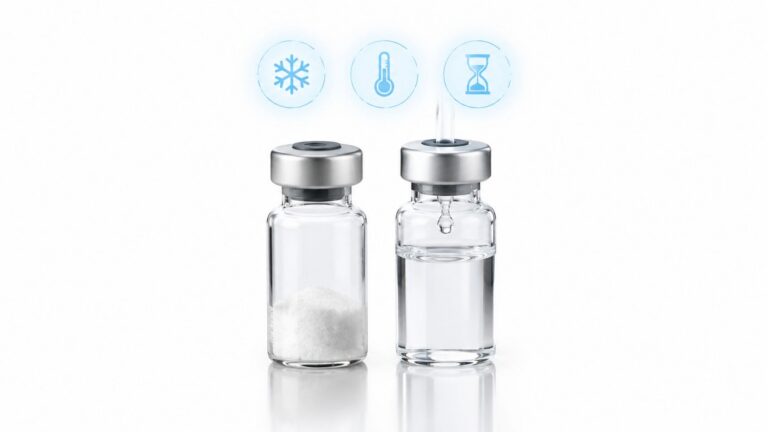
Lyophilized peptides are the freeze-dried form of a peptide solution, a frozen material dried under vacuum so water sublimates straight from ice to vapor. Lyophilized describes a manufacturing state, not a quality claim, so the label alone doesn't tell a researcher whether the vial is fit for a specific experiment.
Table of Contents
- What Is a Lyophilized Peptide
- How Lyophilization Actually Works
- Why Lyophilized Peptides Stay Stable Longer
- Proper Storage and Residual Moisture Limits
- The Lyophilized Label Does Not Equal Quality
- Reconstitution Best Practices for Lab Use
- Putting It All Together for Reliable Results
What Is a Lyophilized Peptide
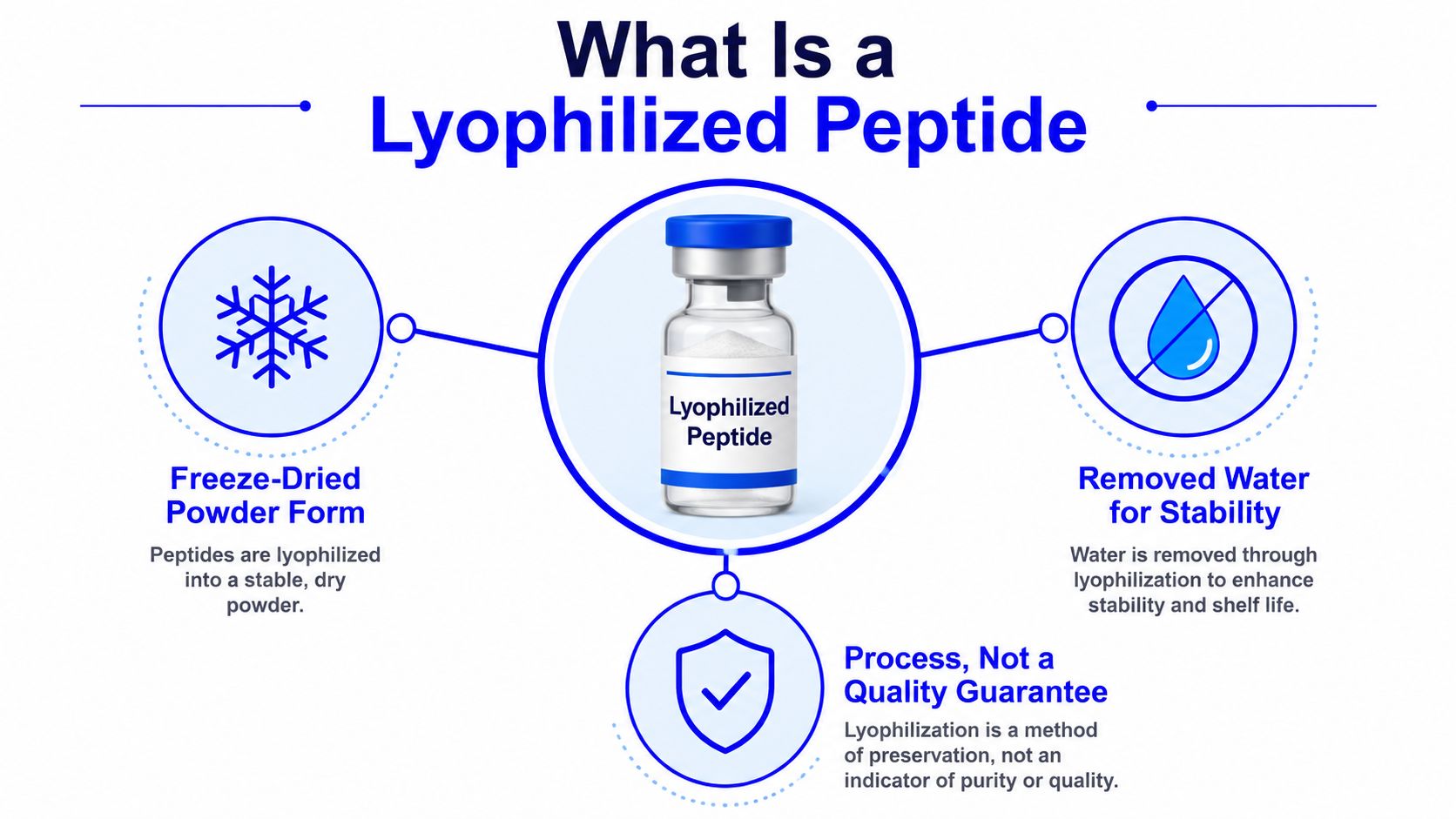
Many hear lyophilized peptide and assume it means “premium” or “fully stable.” That's the wrong shortcut. The plain answer is simpler, a lyophilized peptide is a freeze-dried powder form of a peptide solution, prepared so the peptide can sit in a dry state until the moment it's needed. The term tells a buyer how the material was made, not whether the batch is pure enough, sterile enough, or appropriate for a given assay.
A lab supervisor would treat the vial like a packed instrument, not a finished verdict. Two vials can both be lyophilized and still behave very differently once they're opened, reconstituted, and used at the bench. That's why the label matters, but only as the starting point for storage, documentation, and handling decisions.
Why the label causes confusion
The confusion comes from marketing shorthand. Suppliers often use lyophilized as if it were a seal of quality, when it really refers to the manufacturing step that removed water from the peptide solution. A powder can still carry impurities, residual moisture, or formulation differences that affect performance after reconstitution.
Practical rule: treat “lyophilized” as a storage format, then check the lot-specific data before assuming anything about experimental suitability.
That distinction matters because the question in the lab is not just whether the peptide is dry. It's whether the vial is documented well enough, stored correctly enough, and handled carefully enough to support reproducible work. The label alone can't answer that.
How Lyophilization Actually Works
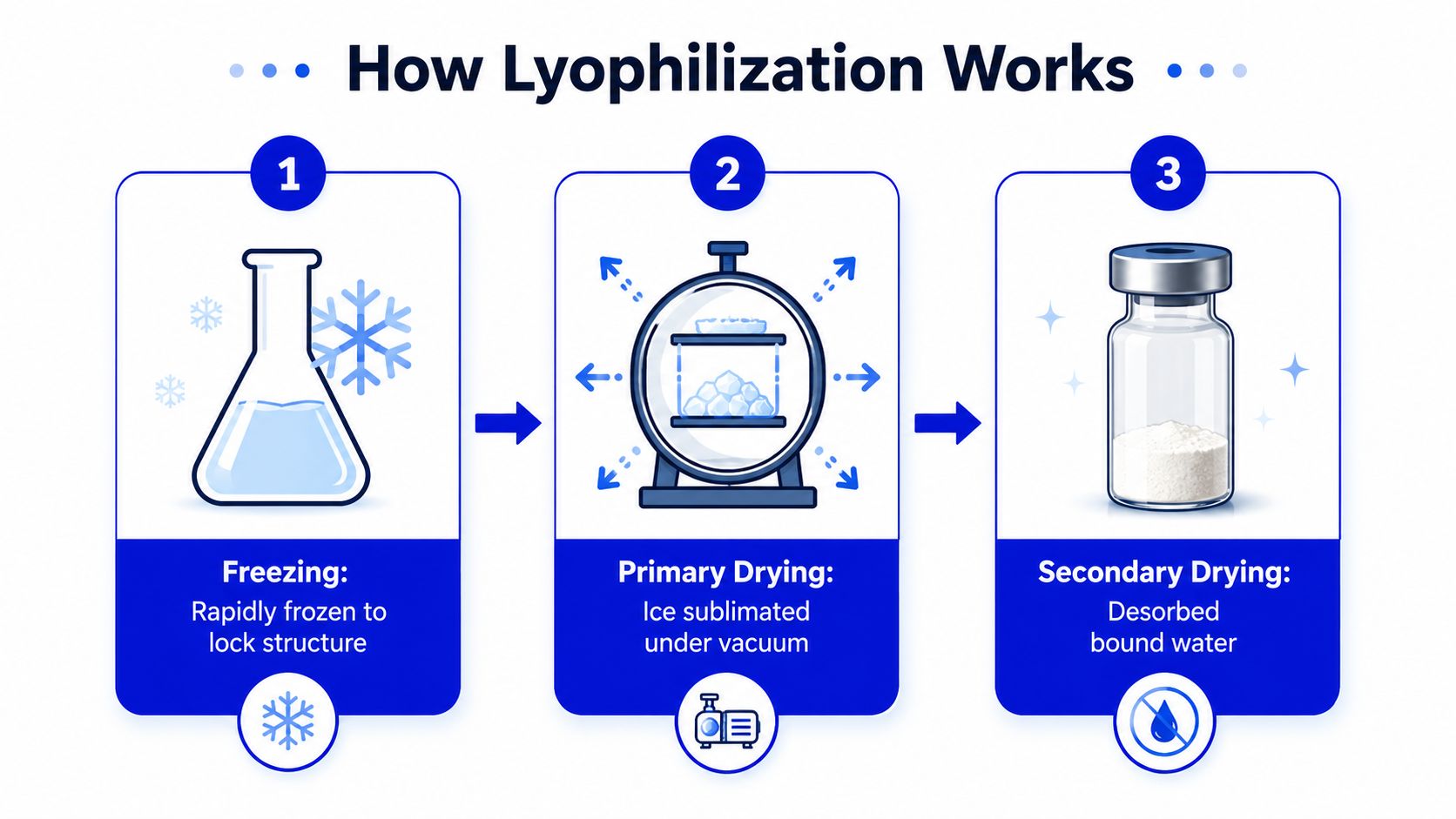
Freezing locks the sample in place
Lyophilization starts by freezing the peptide solution. That step matters because the water has to become ice before it can be removed by sublimation, and the frozen state keeps the sample from behaving like a liquid during the rest of the cycle. In plain bench terms, the peptide is locked into a rigid starting point before drying begins.
If the freezing step is rushed or poorly controlled, the final cake can be harder to reconstitute later. The frozen structure sets up the rest of the run, so the cycle is never just “dry it out.”
Primary drying removes ice under vacuum
During primary drying, the chamber is pulled under vacuum so ice goes directly from solid to vapor. That's the core of freeze-drying, and it's why lyophilization is different from simple air-drying. The peptide isn't baked in an oven, it's held in conditions that let water leave without forcing the sample through a full liquid phase.
Secondary drying removes the bound water
After the visible ice is gone, some water still clings to the material. Secondary drying removes that remaining bound water and brings the product closer to the low-moisture state needed for storage. That final dry-down is where the shelf life of the powder is really won.
The dry cake that comes out of the vial is usually a solid amorphous or partially crystalline matrix, not just “dehydrated powder.” That physical state is the reason lyophilized material behaves differently from a peptide left in solution. For transport and cold-chain planning, the same logic used in cold chain compliance guidance applies, because the material's state and the shipping conditions have to match the job.
Why Lyophilized Peptides Stay Stable Longer
Water is the problem in solution
A peptide in water is exposed to the reactions that gradually wear it down. The verified data points to hydrolysis, deamidation, oxidation, and aggregation as the major pathways that slow down once water is removed. That's the whole reason freeze-drying became such a standard format for peptide reagents and therapeutics.
The storage gap is large. A 2023 review summarized that lyophilized peptides retained more than 95% purity after 24 months at 2 to 8°C, while the same peptides in solution fell to about 60 to 75% purity after only 6 months under the same refrigerated conditions, according to the cited review in the brief (verified peptides review). The same source reports that with proper formulation and low residual moisture, lyophilized peptides can exceed 99% purity retention for 36+ months at -20°C (verified peptides review).
Why the industry settled on powder for shipping
That stability advantage explains why many therapeutic peptide drugs are supplied as lyophilized powder and then reconstituted before injection. A 2024 review in PMC reported that worldwide sales of therapeutic peptide drugs were about USD 20 billion in 2017 and were expected to surpass USD 50 billion by 2024, with a cited compound annual growth rate of 9.10% over that period (PMC review). The same review notes that approved PLGA-based peptidic products are usually supplied in lyophilized powder form and then reconstituted before injection (PMC review).
Dry format buys time, liquid format spends it.
That's the cleanest way to think about it in the lab. The powder is the storage state, the solution is the working state. If a project needs months of holding and shipping flexibility, lyophilized material is the more forgiving starting point.
Proper Storage and Residual Moisture Limits
Temperature protects the dry cake
For long-term handling, lyophilized peptides are commonly stored at -20°C, and the verified data notes that this temperature can support 2 to 5+ years of stability depending on the sequence and formulation (PMC review). Refrigerated reconstituted material, by contrast, is often limited to roughly 14 to 30 days depending on the peptide and preservative conditions (PMC review).
That's why a dry vial still needs cold, dry storage. Freeze-dried doesn't mean immune to damage, it means the material is in a form that tolerates storage better when the environment is controlled.
Moisture limits separate success from failure
The most useful technical benchmark is residual moisture. Expert guidance in the brief says the target is typically 1 to 3% w/w, and values above about 5% are a red flag for lyophilization cycle failure (Absolute Biolab guide). That matters because residual water is described as the primary driver of solid-state degradation kinetics (Absolute Biolab guide).
A vial can look dry and still be too wet for reliable long-term storage. That's why desiccation and light protection still matter, even after freeze-drying. Moisture uptake from the air during repeated access can push the product away from the condition it had when it left the lyophilizer.
For broader storage handling, a lab guide such as best practices for reagent storage is useful because peptide vials follow the same basic rule, keep them cold, sealed, and dry.
The Lyophilized Label Does Not Equal Quality
Manufacturing state is not the same as product quality
The most common mistake is treating lyophilized as a proxy for quality. It isn't. A peer-facing lab guide explicitly says the term does not establish identity, quantity, stability, sterility, or suitability for a particular experiment (Peptide Scientific Labs guide). That line should reset expectations for anyone buying or handling peptide reagents.
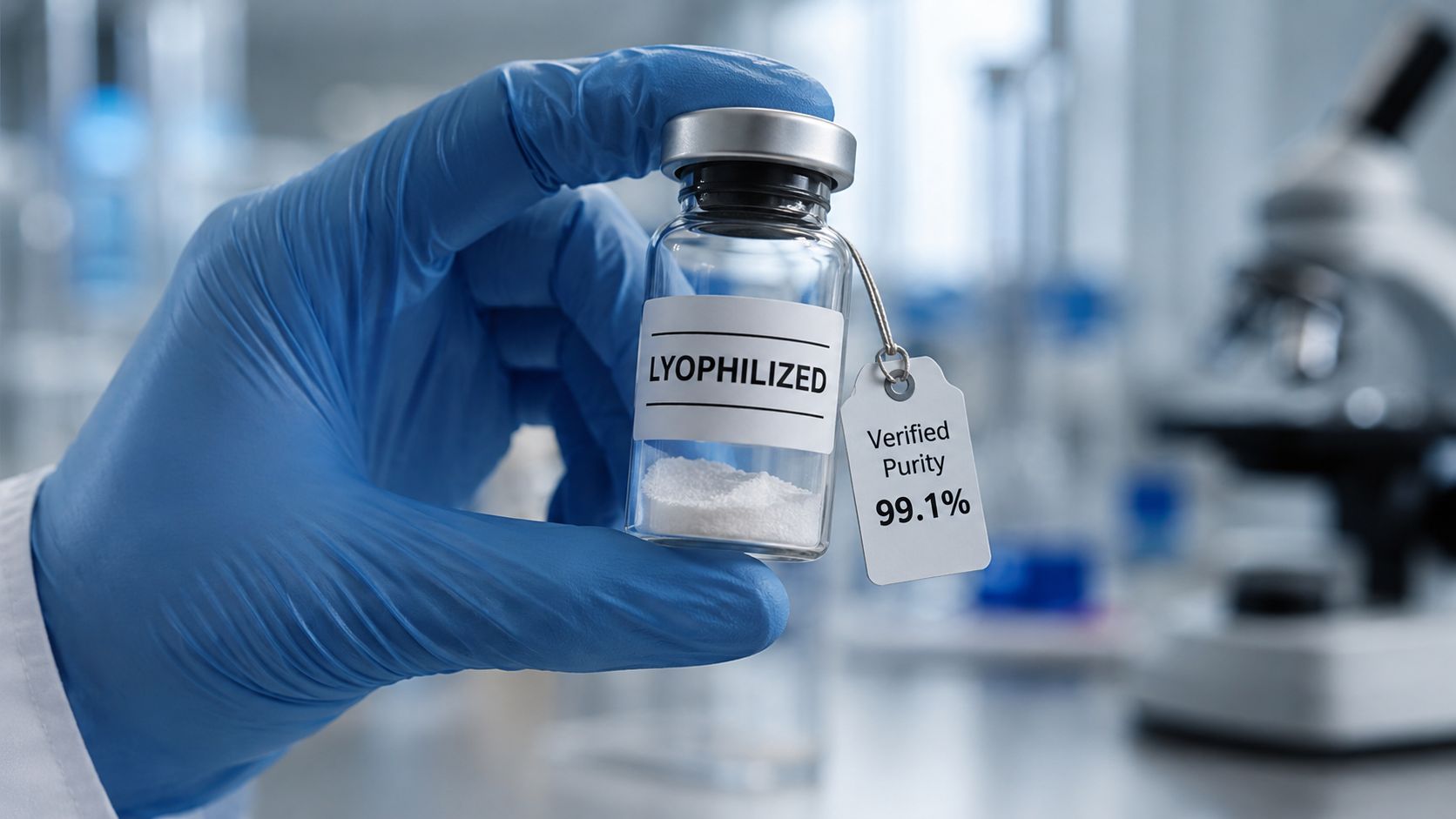
Two vials can both be freeze-dried and still differ in purity, formulation, or residual moisture. That's why a Certificate of Analysis and lot-specific documentation matter more than the label on the front of the tube. The lab has to know what was made, not just how it was dried.
Why reproducibility depends on more than the powder
Controlled documentation starts to matter. A lyophilized vial from one supplier can reconstitute cleanly while another can leave cloudiness, slow dissolution, or inconsistent assay behavior, even though both were sold as freeze-dried. The label doesn't show how the material was formulated or how much moisture stayed behind.
That's also why quality systems matter in the background. Good manufacturing controls, batch review, and traceability help reduce the chance that a dried vial masks a process problem, which is the kind of issue that strong quality systems are built to catch. For readers who want a practical overview of that layer, how automation supports GMP compliance gives useful context on how process control supports batch consistency.
Herbilabs' ISO quality overview at https://herbilabs.com/iso-9001-quality-systems/ is relevant here because it shows the kind of documentation mindset that helps users judge a product beyond the freeze-dried label.
Reconstitution Best Practices for Lab Use
Start with the right solvent, not the fastest one
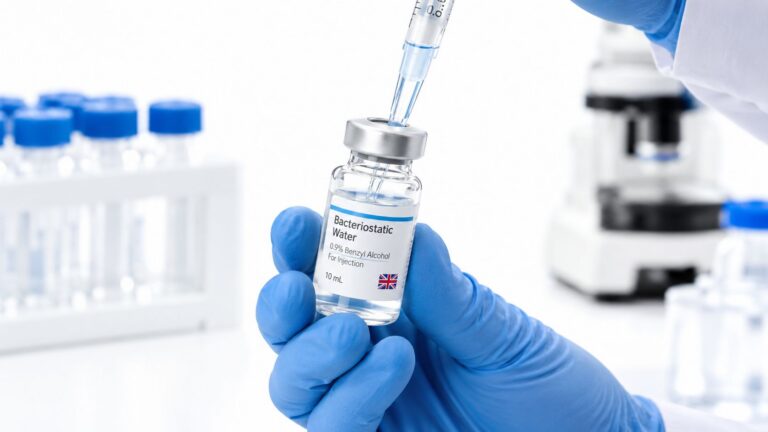
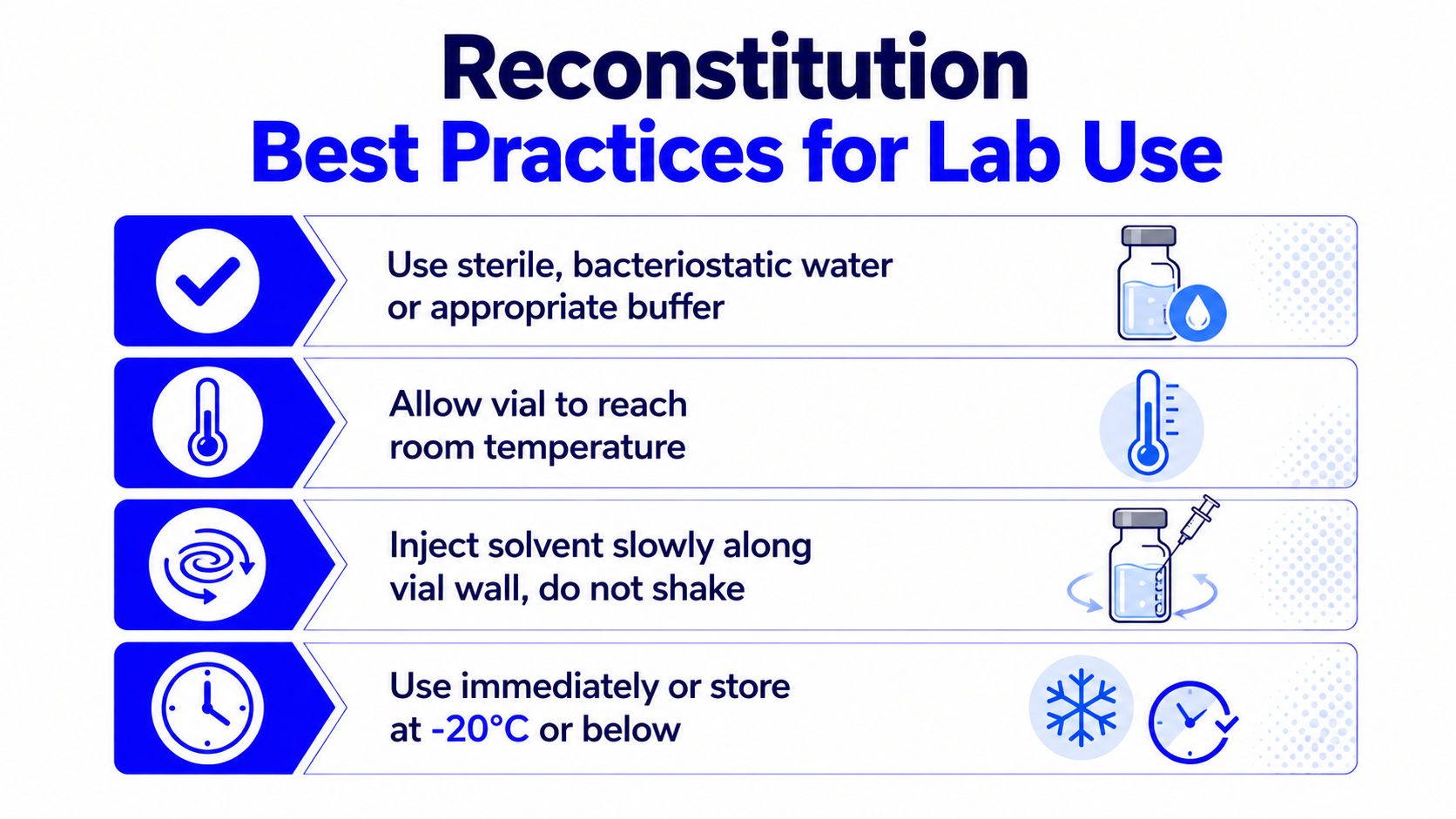
Reconstitution isn't just “add water.” Available guidance says common choices include sterile water, saline, or bacteriostatic water, and the right pick depends on the peptide chemistry and the intended use (BC9 detailed guide). Some peptides are more comfortable in acidic, basic, or buffered solutions, while hydrophobic sequences may need an organic co-solvent before dilution, as noted in the background research from LifeTein.
The first solvent decision affects solubility, pH stress, and downstream assay behavior. A wrong choice can leave the peptide cloudy, aggregated, or partly undissolved before the experiment even starts.
Handle the vial gently and keep it clean
Gentle swirling beats shaking. The brief's guidance says the solvent should be added slowly, with care to reduce foaming and adsorption losses, and that repeated vial access raises contamination risk (BC9 detailed guide). That's a bench issue, not a theory issue. A peptide that looks fine in the vial can still suffer if the solution is whipped full of bubbles or exposed too often.
- Use sterile diluent: sterile water, bacteriostatic water, or the buffer that fits the assay.
- Warm the vial first: let it reach room temperature before opening to reduce condensation.
- Add liquid slowly: let it run down the vial wall instead of blasting the cake.
- Treat the solution as temporary: use it promptly, or hold it cold under the correct conditions.
Match the working solution to the job
Reconstituted peptide behaves like a short-lived working material. The same brief notes that refrigerated bacteriostatic-water solutions may remain usable for roughly 14 to 30 days, while repeated access creates contamination risk (BC9 detailed guide). That's why a dry vial and a liquid vial can't be managed the same way.
For routine RUO workflows, a sterile multi-dose diluent can support repeated draws, which is why a product such as Herbilabs' Reconstitution Solution 10ml fits this use case in practical terms. A related lab guide, reconstituting lyophilized powder, is useful for users who need a step-by-step handling reference.
Putting It All Together for Reliable Results
A peptide workflow only works when each step supports the next one. The dry format helps with shipping and storage, but the benefit depends on low residual moisture, cold handling, and a sealed container that doesn't keep breathing room air every time the cap comes off. Once the vial is opened, the reconstitution step takes over, and the solvent choice, handling technique, and contamination control start shaping the result.
The key mistake is to stop at the word lyophilized. That word says the peptide was freeze-dried, not that it is automatically fit for a particular assay or batch-comparable across suppliers. The quality picture comes from the combination of manufacturing state, documentation, moisture control, and how carefully the user reconstitutes the material.
If reproducibility matters, each link in the chain has to hold, from the sealed dry vial to the final working solution.
That's the practical way to evaluate peptide material in the lab. Check the documentation, protect the powder from moisture, pick the solvent for the chemistry, and handle the liquid phase as a short-lived working sample. That sequence is what keeps a lyophilized peptide useful instead of merely convenient.
If a lab needs sterile diluents, documented batch handling, and a practical reconstitution workflow for lyophilized materials, Herbilabs supplies RUO products built for that purpose. Visit Herbilabs to review the reconstitution solution range and match the format to the way peptides are handled at the bench.