Private Label, White Label, Wholesale partnerships available - EU, USA and UK - Free shipping from €75

Operating Temperature Range for Lab Storage and Monitoring
Herbilabs bacteriostatic water is labelled for storage at 15–25 °C, and that labelled range governs routine storage. Controlled room temperature is a broader and different reference: it describes a thermostatically maintained environment with its own excursion allowances, not the specification printed on the vial.
The most repeated advice on this subject is to keep the material "at room temperature." That phrase is where storage records start to fail, because room temperature isn't a number and a room isn't a shelf. A wall display by the door can read a steady 22 °C while the shelf beside a window swings between 14 °C overnight and 29 °C at midday, and the material sits on the shelf.
What separates a clean audit trail from a messy one is knowing which range governs the material and which ranges merely inform a deviation review. A reading of 27 °C means something different depending on which of those two questions is being asked, and the answer decides whether the event is a note in a log or a documented quality decision.
Table of Contents
- Operating Temperature Range Values at a Glance
- Operating Range Versus Controlled Room Temperature
- How to Set Up Monitoring for 15–25 °C Storage
- Tracking the Temperature Clock From Receipt to First Puncture
- Recording Temperature Data for Audit-Ready Logs
- Handling Excursions and Making the Disposition Call
- Post-Puncture Storage and the 28-Day In-Use Convention
- Build Your Storage SOP Around the 15–25 °C Range
Operating Temperature Range Values at a Glance
Herbilabs bacteriostatic water is stored at room temperature between 15 and 25 °C, and that band is the working limit for routine storage. It isn't one option among several standards, and it doesn't flex because a distribution guideline elsewhere allows more room.
Most confusion comes from mixing documents. The table below lines up the ranges a laboratory encounters, so the reader can find the row that matches the paper in hand instead of averaging the numbers into a band that appears in no specification at all.
| Reference | Temperature range | Typical use | Excursion handling |
|---|---|---|---|
| Herbilabs bacteriostatic water label | 15–25 °C | Routine storage of sealed and in-use vials | Record and assess any deviation under the lab SOP |
| USP controlled room temperature | 20–25 °C normal, 15–30 °C excursions | Thermostatically maintained storage environment | Brief spikes assessed against stated conditions |
| Japanese Pharmacopoeia, European Pharmacopoeia, WHO room temperature | 15–25 °C | Room-temperature storage of materials | Evaluated under the applicable monograph or label |
| WHO temperature-controlled storage area | +15 °C to +25 °C | Storage above refrigerated or frozen conditions | Excursion duration and extremes recorded |
| ICH Q1A(R2) long-term stability | 25 ± 2 °C or 30 ± 2 °C | Stability study condition | Not applicable: test condition, not a storage instruction |
| ICH Q1A(R2) accelerated stability | 40 ± 2 °C at 75 ± 5% RH | Stress test condition | Not applicable: test condition, not a storage instruction |
Reading down a single column is the mistake this table is designed to prevent. The label row tells a bench worker where the vial goes. The pharmacopoeial rows describe environments and the tolerances built into them. The ICH rows are study conditions, and treating 25 ± 2 °C from a stability protocol as a storage instruction expands the label's ceiling.
The pharmacopoeial split is real rather than a rounding difference. A NIST-published review of storage-temperature definitions records a 5 °C gap in the normal lower boundary between the traditional US definition of controlled room temperature and the broader international convention used by the Japanese Pharmacopoeia, the European Pharmacopoeia and the World Health Organization.
Why 20 °C keeps turning up in reference documents
The 20 °C reference point has a longer paper trail than most specifications. In 1911 the directors of the national laboratories of Germany, Great Britain and the United States agreed to work toward a common temperature scale, and on April 17, 1931 the International Committee of Weights and Measures unanimously adopted 20 °C as the standard reference temperature for industrial dimensional measurements, as the record of the international temperature scale sets out.
A range means little unless it's traceable to a scale everyone reads identically, which is why a storage specification belongs in a controlled document rather than in a verbal handover at shift change.
The rule to apply today: the labelled 15–25 °C band is the working limit, the wider references only inform how a documented deviation is assessed, and ambient-temperature shipping doesn't widen the storage range after delivery. A carton that travels at ambient temperature still goes straight into 15–25 °C storage on receipt.
Operating Range Versus Controlled Room Temperature
An operating temperature range is the band a material must be held in. Controlled room temperature is a description of an environment, thermostatically maintained, with a customary working band and its own excursion allowances. The two get used interchangeably in procurement conversations and they shouldn't be.
The ISPE review of temperature and humidity requirements for pharmaceutical storage sets out the USP position: controlled room temperature normally spans 20–25 °C (68–77 °F), with excursions recognised between 15 °C and 30 °C provided the mean kinetic temperature does not exceed 25 °C, and brief spikes up to 40 °C permitted for no more than 24 hours under the stated conditions.
A 15–25 °C product specification doesn't inherit that envelope. Its ceiling matches the top of the USP normal band, its floor sits 5 °C below the USP normal floor, and none of the excursion latitude carries over. The label is a narrower promise, not a summary of a distribution standard.
A worked reading of 27 °C
Say a storeroom logger reports 27 °C for two hours on a Thursday afternoon. The reading sits inside the general 15–30 °C room-temperature excursion allowance, so someone reading only the distribution guidance would wave it through.
Against the label, it is out of range. The event must be recorded with the maximum reading, the start and end times and the duration, then assessed before the affected vials return to routine use. Nothing visible happens to the material in those two hours, and that's precisely why the record matters more than the appearance.
The practical test: if the document in your hand is the product label, the label's band governs. If the document is a deviation report, the pharmacopoeial excursion rules are evidence you can cite inside it.
A warehouse or distribution standard written around controlled room temperature doesn't authorize routine storage outside the labelled band. It describes how a supplier's facility may be run. It says nothing about how a laboratory shelf should be run, and it can't be borrowed to justify a daily operating temperature above 25 °C.
Routine handling decisions, from wiping a stopper to returning a vial to the shelf, follow the same logic in these lab best practices for handling bacteriostatic water.
How to Set Up Monitoring for 15–25 °C Storage
Monitoring turns a stated range into a record. WHO describes a temperature-controlled storage area as one maintained within predefined limits above refrigerated or frozen conditions, with a typical range of +15 °C to +25 °C, according to WHO guidance on temperature-controlled storage. Defined limits are the whole point: a storage area without a number attached can't produce a deviation, because nothing is ever out of range.
Set the store up in this order.
Choose the position first. Keep storage away from windows, heaters, loading doors and ceiling vents, because those four features create the largest swings in a working room. The common slip is placing a cabinet against an external wall in summer and discovering a 6 °C overnight drift in the download.
Calibrate a continuously recording data logger against a traceable reference before first use. An uncalibrated logger makes every later reading unverifiable, and a QA reviewer who can't see a calibration date has to treat the whole file as unproven.
Place loggers at the warmest and coldest points of the shelf, not only at the door. Door-mounted sensors record the moment of opening rather than the conditions where vials sit, which is the most frequent blind spot in small labs.
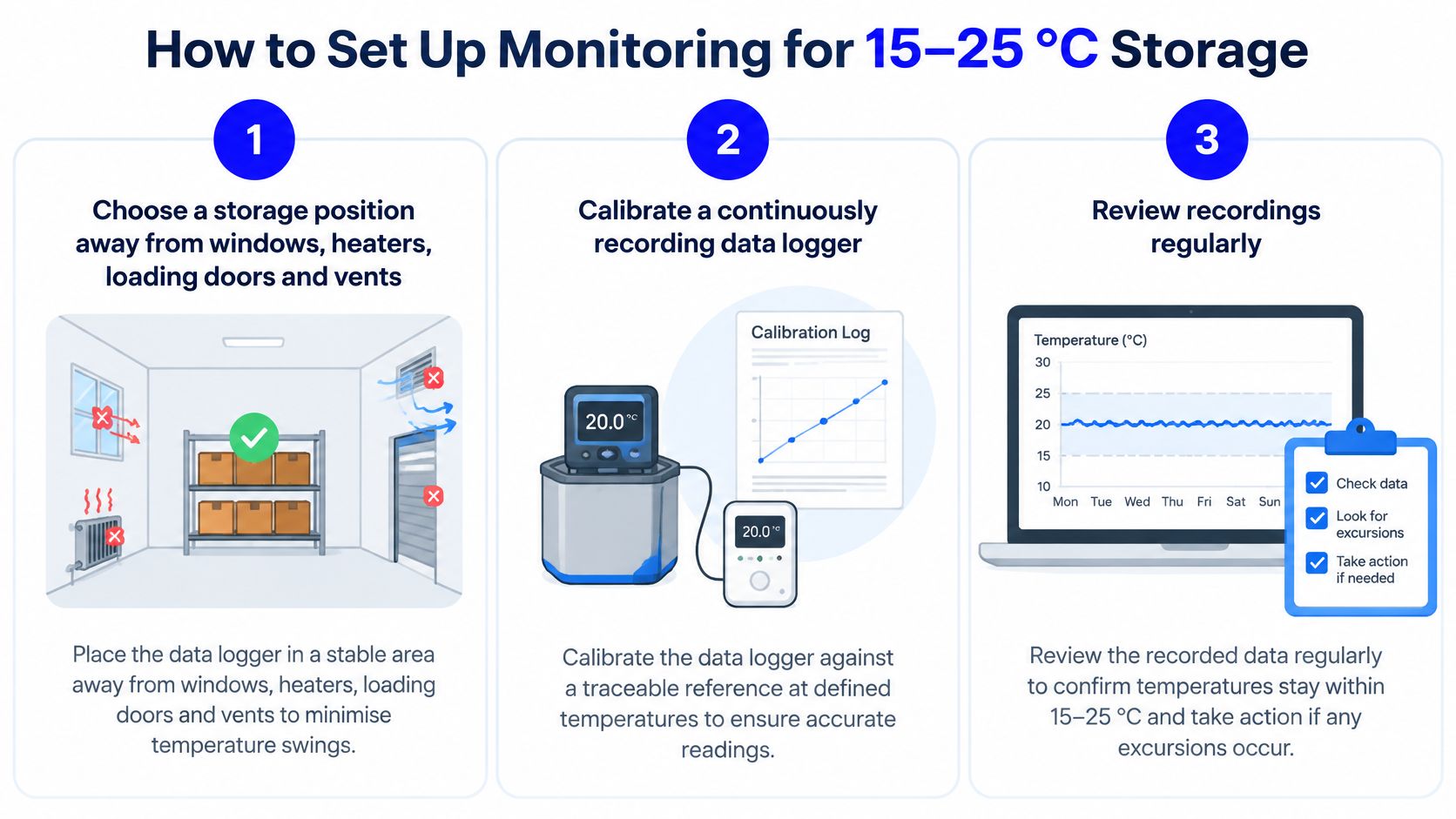
Set a normal target near the middle of the band, around 20 °C, with alarm limits at 15 °C and 25 °C. Alarms at the limit give no reaction time; alarms set at the boundary of the excursion allowance give a false sense of the specification.
Keep the material away from extreme temperatures and protect it from contamination. The product guidance asks for both, and a vial stored correctly next to a contaminated work surface still fails on handling.
Review the logger download and alarm history on a fixed schedule. Periodic manual readings catch the moment someone walks past with a thermometer and miss the weekend, which is when equipment tends to fail.
Write the logger identifier, its calibration date and the reviewer's name into the SOP. Without those three entries, the record can't be reconstructed by anyone who wasn't there.
A correctly set-up store produces boring output: readings that stay inside the band, alarms that trigger before the limit is breached, and a download that a reviewer can follow without asking a question.
Tracking the Temperature Clock From Receipt to First Puncture
A carton arrives on a Tuesday morning. It sits in a loading bay for forty minutes while paperwork is matched, moves to the store, is unpacked onto a shelf, and later comes out for a session at the bench. Each of those stages runs a different temperature clock, and the record has to say which one was running.
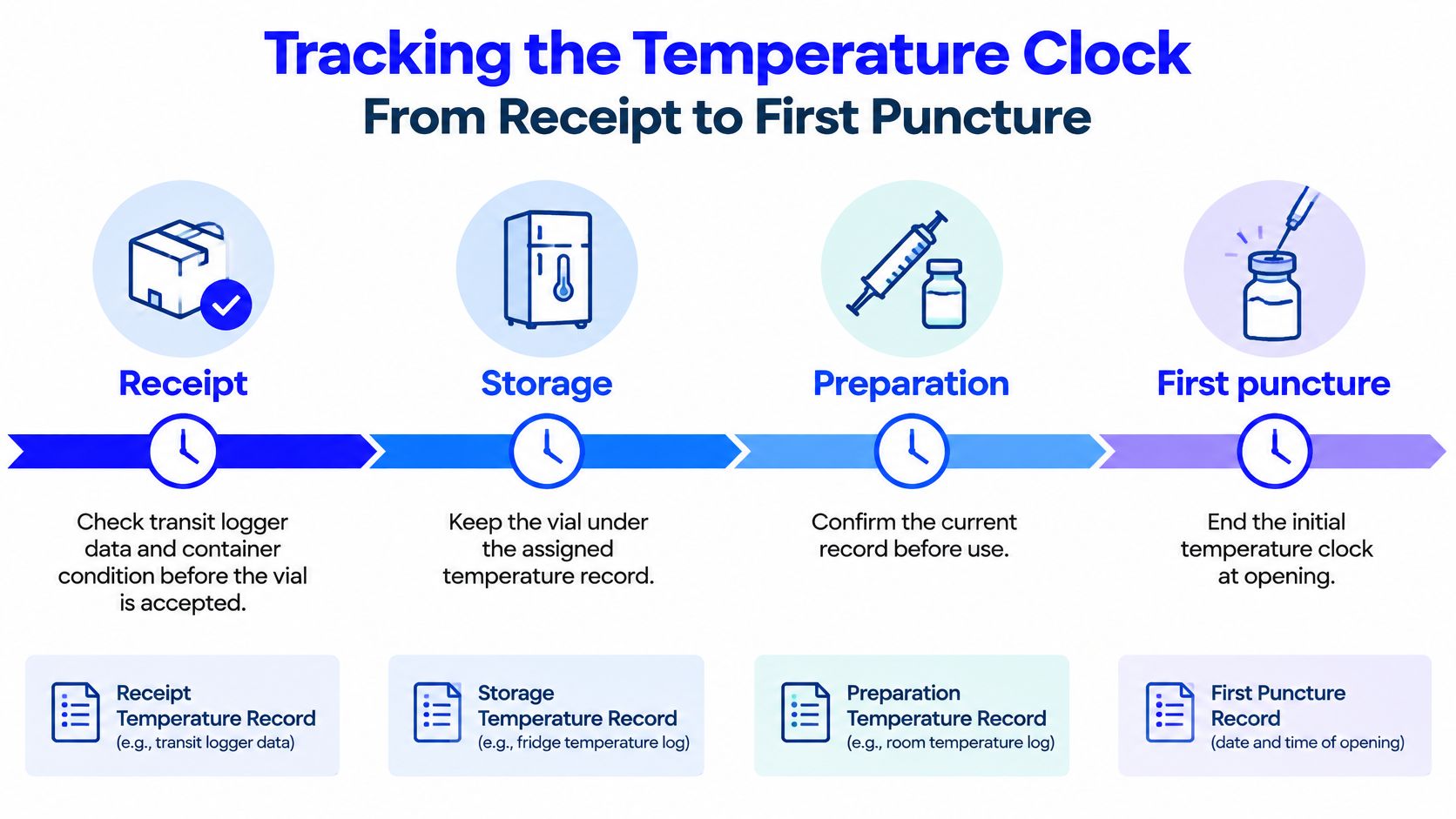
Shipment condition is checked before anything else, which is the reasoning behind protecting RUO labware in transit: transit logger data and container state are reviewed while the material is still in goods-in, because an argument about a dented carton is easier to settle at the door than a week later.
The question at the bench isn't whether a vial can be left out for a while. It's which clock applies at each stage and what evidence supports moving from one stage to the next. FDA stability guidance states that actual temperature and humidity should be monitored during stability storage, that unavoidable short door-opening spikes may be accepted, and that excursions longer than 24 hours should be described and assessed for their effect on stability, as the FDA stability guidance explains. The same document's excursion framework applies outside a stated range only through the applicable monograph, label or manufacturer stability data.
The stage table
| Stage | Temperature clock | What to record |
|---|---|---|
| Shipment receipt | Transit condition checked before storage | Logger data when available, arrival time, container state |
| Sealed storage | 15–25 °C continuously | Logger readings, storage location, alarm history |
| Bench handling | Time out of storage, started at removal | Removal time, bench temperature, return time |
| Return to storage | Time until the first reading back inside 15–25 °C | Return time, first in-range reading, reviewer |
| After first puncture | 15–25 °C storage plus the 28-day in-use convention | First-puncture date, discard date, handling conditions |
Buyers who work with distribution documents often read controlled room temperature as permission for unrestricted ambient storage, and the stage table is the antidote. It shows that a bench session is a bounded event with a removal time and a return time, not an open-ended period that ends when someone remembers the vial.
Record the labelled range from the vial in hand, any shipment logger data, the time at the bench, the return-to-storage time and the moment the stopper was first punctured. Those five entries turn a scattered set of readings into a defensible history.
Recording Temperature Data for Audit-Ready Logs
A storage log has one job: let a reviewer who wasn't present reconstruct what happened. Every field below earns its place for that reason.
- Logger identifier and calibration date: ties the numbers to a device whose accuracy can be checked later.
- Storage location: distinguishes the shelf, cabinet or room the reading refers to when a lab runs more than one.
- Minimum and maximum readings with timestamps: captures the excursion that a spot check misses.
- Alarm events and the person who acknowledged them: shows that someone acted, not only that the device sounded.
- Reviewer initials and review date: makes the review itself auditable.
- The time a lot was received, moved out or returned: links the temperature history to a physical vial.
- Corrective action for any reading outside 15–25 °C: a reading with no action beside it is an unfinished record.
- Lot number linked to its certificate of analysis: lets the specification and the storage history refer to the same material.
USP <659> asks for the same discipline: keep storage equipment within the range using a calibrated, continuously recording data logger, place it where temperature risk is greatest, review alarm history rather than relying on periodic manual readings, and document any excursion with the minimum and maximum temperature, duration, affected lot or vial, equipment status and disposition decision, as set out in USP <659> packaging and storage definitions.
A weekly review line can be short enough to copy. Week 12: min 16.8 °C, max 23.9 °C, no alarms, reviewed by QA tells a reader more than a paragraph of narrative, and a monthly summary built from those lines lets a lab manager scan a quarter in under a minute.
Keep downloads with the lot record rather than leaving them on the logger, and match the lot number on the certificate with the storage log using the certificate of analysis page and the lot tracking for lab traceability record. A storage log never replaces the product specification or the certificate; it shows whether the material was held where the specification says it should be.
Handling Excursions and Making the Disposition Call
The most common mistake in excursion handling is treating a brief out-of-range reading as harmless because nothing visible changed. A clear liquid looks identical at 26 °C and at 22 °C, so appearance carries no information about thermal exposure and shouldn't be part of the reasoning.
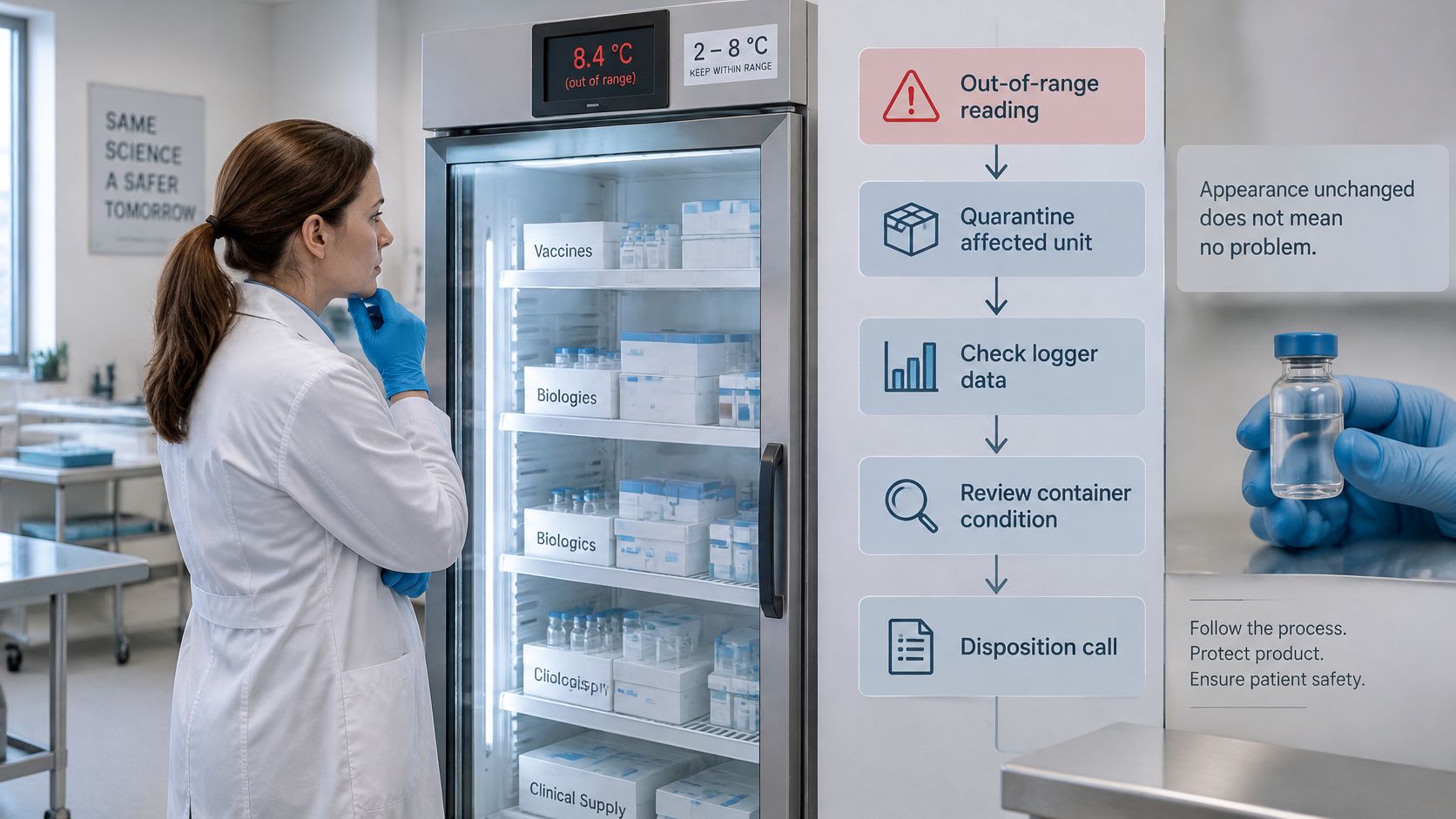
Run the same four moves every time.
- Quarantine the affected material so nothing is drawn from it while the assessment is open.
- Return it to the labelled 15–25 °C range and let the container settle.
- Record the maximum or minimum temperature, the start and end times and the duration from the logger rather than from memory.
- Pass the event to QA for assessment against the product's own stability evidence and the supplier's instructions.
ICH stability practice explains why the numbers need defining in the first place. ICH Q1A(R2) specifies long-term testing at either 25 ± 2 °C/60 ± 5% relative humidity or 30 ± 2 °C/65 ± 5% relative humidity, with accelerated testing at 40 ± 2 °C/75 ± 5% relative humidity, and it advises avoiding terms such as "ambient conditions" and "room temperature" as insufficiently specific, as the ICH Q1A(R2) stability guidance records. Those figures define a test, not a shelf. They can't be read backwards to conclude that a specific vial survived a specific afternoon.
Where mean kinetic temperature fits
Mean kinetic temperature weighs cumulative thermal exposure instead of treating every reading as equally damaging, and it can support a qualified deviation assessment. It shouldn't automatically override a 15–25 °C requirement on a label. The label's number, the product's stability data and the lot's documentation outrank a calculated average that makes an excursion look smaller.
| Deviation | Immediate action | Record and disposition basis |
|---|---|---|
| Brief reading outside 15–25 °C, back in range quickly | Quarantine the affected vials, confirm the logger, return to range | Maximum or minimum reading, duration, lab SOP and product stability data |
| Door-opening or bench spike of short duration | Return to storage promptly and note the removal time | Removal and return times, reviewer decision, COA check |
| Sustained deviation beyond 24 hours | Keep quarantined pending QA review | Full logger download, mean kinetic temperature if used, QA disposition |
| Alarm with unknown temperature history | Quarantine and download logger data before any use | Alarm time, logger history, documented QA decision |
An SOP that makes this repeatable carries a normal target near the middle of the band, action limits set before 15 °C or above 25 °C, and a documented review of exposure duration and cumulative history. Humidity deserves a line of its own even when the liquid's labelled range is temperature-only, because packaging, labels and stopper protection all respond to it.
No universal safe exposure period exists without product-specific stability evidence, the certificate of analysis and the supplier's instructions.
The disposition decision belongs to the lab's QA review, not to the bench worker holding the vial. That split protects both: the person who found the alarm reports it, and the person accountable for release decides.
Post-Puncture Storage and the 28-Day In-Use Convention
Once a multi-use vial is punctured, the first-puncture date becomes the anchor for everything after it. FDA guidance states that an opened or entered multiple-dose container, including a needle-punctured vial, generally has a 28-day beyond-use period unless the manufacturer specifies otherwise on the label, and it notes that multiple-dose containers are expected to meet antimicrobial-effectiveness requirements, as the FDA guidance on multiple-dose containers explains. The same guidance is clear that the period isn't a universal product guarantee.
For Herbilabs material, 28 days after first puncture with aseptic handling is a common laboratory convention. It's a handling rule that labs adopt, not a promise that holds regardless of the label, the SOP or the conditions the vial has seen.
Two things run in parallel after puncture, and neither resets the other. The 15–25 °C storage range continues to apply to the vial, and the day count continues from the puncture date. A vial that spends six days in use doesn't earn a fresh storage window.
Discard earlier than the date in four situations.
- Visible cloudiness or particles in the solution, whatever the calendar says.
- A suspected break in aseptic technique, such as a dropped stopper or a swabbed septum left uncovered.
- A shorter period stated on the label or in the laboratory SOP, which takes precedence over the general convention.
- An excursion that QA review has not cleared, because unresolved exposure and an open deviation don't belong in a vial still in use.
Write the first-puncture date, the discard date and the handling conditions on the vial or in the log at the time of puncture. A date reconstructed afterwards is a guess with a signature.
Build Your Storage SOP Around the 15–25 °C Range
A storage SOP earns its keep by settling questions before they're asked at 5 p.m. on a Friday.
Open the certificate for the lot and match the lot number to the material in hand. The storage log and the specification then refer to the same vials, which is the first thing an auditor checks.
Write 15–25 °C into the SOP as the governing limit, with pharmacopoeial figures listed only as excursion references. Labels differ between products, so copy the range from the vial in hand: official DailyMed labelling for bacteriostatic water directs storage at 20–25 °C and specifies 0.9% (9 mg/mL) or 1.1% (11 mg/mL) benzyl alcohol, according to the DailyMed label for bacteriostatic water, and a remembered figure from another product is how a shelf ends up governed by the wrong document.
Point the SOP to the logger, alarm and review settings rather than restating them, so a change of device updates one document instead of two.
Require first-puncture and discard dates on every opened vial, using the 28-day convention or the shorter label period, whichever is stricter.
Set a quarterly review that checks alarm history, excursion records and the current certificate for each lot in use. Quarterly is often enough to catch a drifting cabinet and rare enough that the review happens.
For small-volume work inside the same band, a Herbilabs 10 mL reconstitution solution vial, stored at 15–25 °C, fits the routine above without a separate set of storage rules.
This article was prepared by the Herbilabs team. Herbilabs bacteriostatic water is sterile water with 0.9% benzyl alcohol in multi-use glass vials, supplied for research use only, and it is not for human or veterinary use.
Storage decisions get simpler when the governing range is on the label and the records match it. Herbilabs supplies bacteriostatic water in multi-use glass vials labelled for storage at 15–25 °C, with a certificate of analysis published for every lot so a storage log, a specification and a vial can all point to the same batch. The 10 mL vial and the 10 x 10 mL kit ship from the EU to the US, the UK and the EU, and every order is for research use only. Visit Herbilabs to review the certificates and match a lot to its documentation before the next delivery arrives.