Private Label, White Label, Wholesale partnerships available - EU, USA and UK - Free shipping from €75

Reconstituting Lyophilized Powder: 2026 Lab Guide
Master reconstituting lyophilized powder with our 2026 lab guide. Ensure proper techniques for optimal results in your research and experiments.
TL;DR:
- Proper reconstitution involves equilibrating lyophilized powders to room temperature before carefully injecting solvent down the vial wall, avoiding shaking, and performing gentle mixing to preserve compound integrity. Selecting the appropriate solvent, like bacteriostatic water for multi-dose stability, and storing reconstituted solutions correctly at 2–8°C without freezing are essential for reliable results. Precise technique and meticulous documentation prevent degradation and ensure reproducibility in peptide research.
Reconstituting lyophilized powder is the process of dissolving a freeze-dried compound into a suitable solvent to restore it for laboratory use, preserving its biological activity and structural integrity. The term “reconstitution” is the standard industry term for this procedure, though researchers also refer to it as rehydrating freeze-dried powder or lyophilized powder preparation. Done correctly, the process delivers a homogeneous solution at a precisely calculated concentration, ready for downstream assays, bioactivity studies, or peptide research. Done incorrectly, it causes irreversible compound degradation. This guide covers every critical step, from solvent selection and aseptic technique to storage protocols, so your results remain reproducible.
What do you need for reconstituting lyophilized powder?
Successful lyophilized powder preparation depends on having the right tools and solvents assembled before you open a single vial. Improvising mid-procedure introduces contamination risk and measurement error.
Core equipment
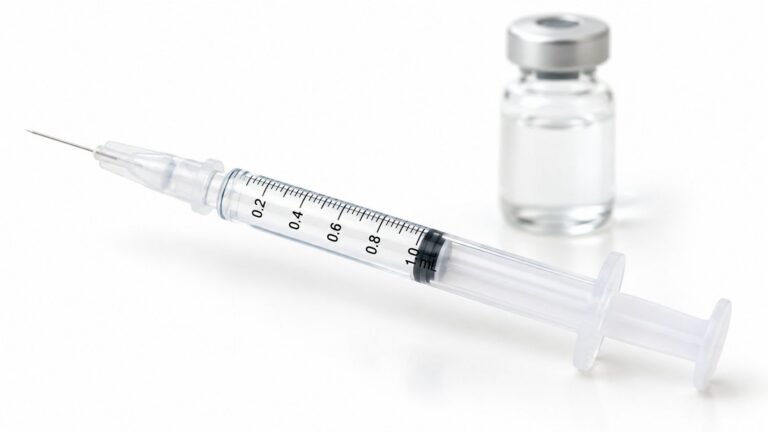
- Sterile syringes: Use a fresh, individually wrapped syringe for every reconstitution. A 1 ml or 3 ml luer-lock syringe gives adequate volume control for most peptide vials.
- Needles: A 23–25 gauge needle minimizes septum coring and reduces mechanical stress on the compound during injection.
- Alcohol wipes: 70% isopropyl alcohol swabs are the standard for septum decontamination before every needle insertion.
- Calibrated pipettes or graduated syringes: Volume accuracy during reconstitution directly impacts concentration and experimental reliability, so use calibrated equipment rather than estimating.
- Labeling materials: Permanent markers and pre-printed labels for recording compound name, concentration, reconstitution date, and user initials.
Solvent selection at a glance
The solvent you choose determines shelf life, stability, and usability of the final solution. The table below summarizes the most common options.
| Solvent | Preservative | Recommended Storage | Typical Use Case |
|---|---|---|---|
| Bacteriostatic water (0.9% benzyl alcohol) | Yes | Up to 28 days at 2–8 °C | Most peptides, multi-dose vials |
| Sterile water for injection | No | Use within 24 hours | Single-use, immediate assays |
| Dilute acetic acid (0.1–1%) | No | 24–48 hours at 2–8 °C | Poorly soluble or acidic peptides |
| Phosphate-buffered saline (PBS) | No | 24–48 hours at 2–8 °C | Cell-based assays requiring physiological pH |
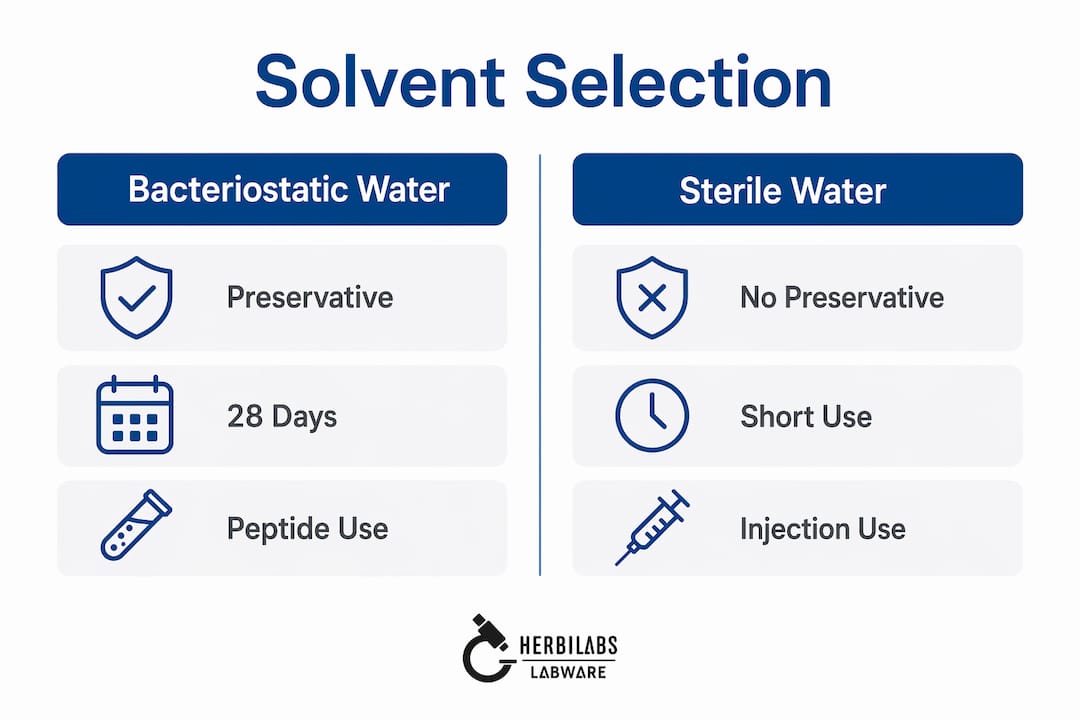
Bacteriostatic water containing 0.9% benzyl alcohol is the standard solvent for most peptide reconstitution work, providing approximately 28 days of refrigerated shelf life. Sterile water carries no preservative and requires use within 24 hours, making it unsuitable for multi-dose protocols.
Pro Tip: Select a 23 gauge needle for standard peptide vials. Finer gauges reduce shear stress on the compound during injection, which matters for fragile peptide structures.
How do you reconstitute lyophilized powder step by step?
The following procedure reflects current best practices for aseptic, low-stress rehydration of freeze-dried compounds. Follow each step in sequence. Skipping or reordering steps is the most common source of preventable errors.
-
Equilibrate the vial to room temperature. Allow lyophilized vials to reach room temperature for 15–20 minutes before adding solvent. Cold vials cause condensation on the stopper, which introduces volume inaccuracies and contamination risk.
-
Prepare your workspace. Work on a clean, flat surface. If a biosafety cabinet is available, use it. Lay out your syringe, needle, alcohol wipes, and solvent vial before starting.
-
Sanitize the vial septum. Wipe the rubber stopper of both the lyophilized vial and the solvent vial with a 70% isopropyl alcohol swab. Allow 15–30 seconds for complete drying before piercing. Wet alcohol on the needle tip can carry surface contaminants into the vial.
-
Measure the solvent volume precisely. Draw the calculated volume of solvent into your syringe. Confirm the measurement against a calibrated scale or graduated syringe. A 1 mg vial reconstituted with 1 ml of solvent yields a 1 mg/ml solution. Adjust the volume to match your target working concentration.
-
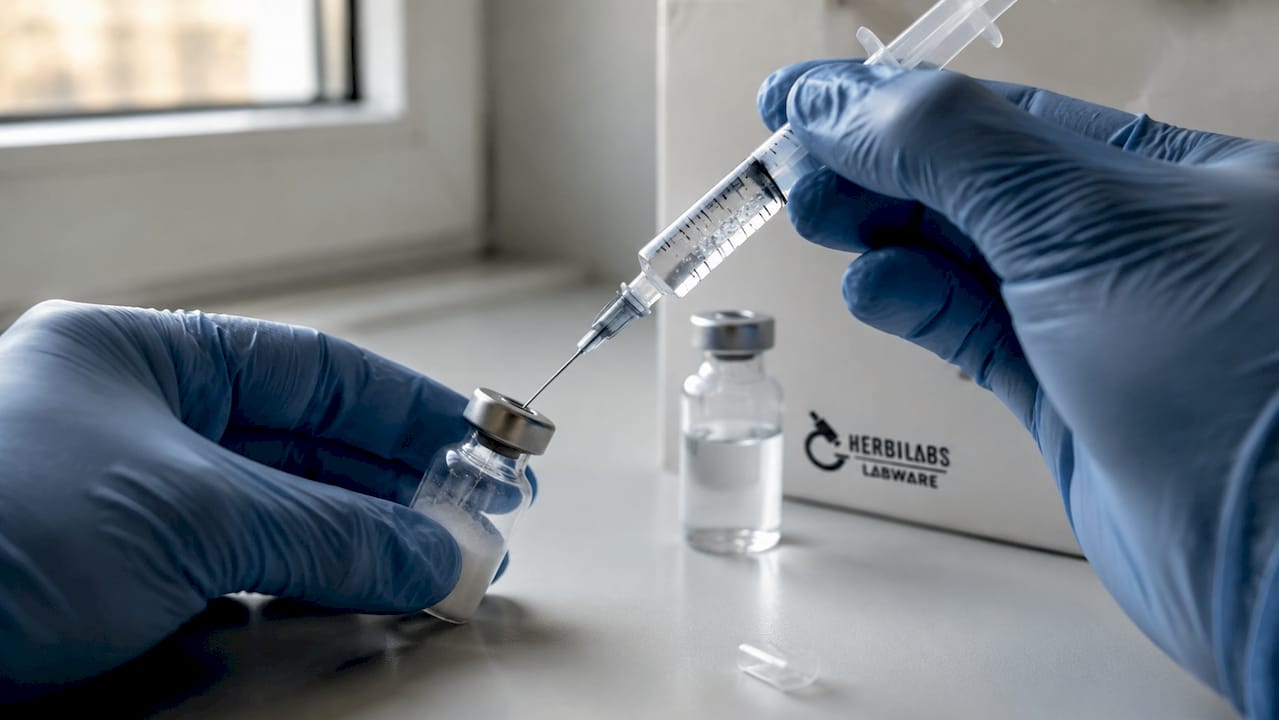
Inject solvent against the vial wall. Insert the needle at an angle so the solvent stream flows down the vial wall rather than directly onto the powder. Direct injection onto the lyophilized cake creates shear forces that damage peptide structure and reduce bioactivity.
-
Dissolve with gentle agitation. Gentle swirling or rolling for 1–5 minutes is standard for most compounds. Some peptides require 15–30 minutes of incubation at room temperature for complete dissolution. Roll the vial between your palms rather than shaking it.
-
Perform a visual quality check. A properly reconstituted solution is clear and colorless. Persistent cloudiness or foam indicates degradation or contamination. Discard any solution that does not pass this check.
-
Label the vial immediately. Record compound name, concentration, reconstitution date, and your initials before setting the vial down.
Common mistakes to avoid
- Injecting solvent directly onto the powder rather than down the vial wall
- Shaking the vial to speed dissolution, which causes foaming and protein denaturation
- Using an incorrect solvent volume, which shifts the final concentration and invalidates downstream data
- Skipping the septum sanitization step, which introduces microbial contamination
- Reconstituting a cold vial straight from the freezer without equilibration
Pro Tip: Calculate your target concentration before touching the vial. Write the formula on a sticky note: concentration (mg/ml) = mass (mg) divided by volume (ml). Confirm the math twice, then proceed.
Bacteriostatic water vs. sterile water: which solvent is better?
Solvent choice is not a minor detail. It determines how long your reconstituted solution remains usable and how reliably it maintains compound integrity across multiple withdrawals.
Bacteriostatic water contains 0.9% benzyl alcohol as a preservative. Benzyl alcohol inhibits microbial growth, which is why multi-dose vials reconstituted with bacteriostatic water remain stable for up to 28 days when stored at 2–8 °C. This makes it the default choice for peptide research protocols where a single vial is accessed repeatedly. You can read a detailed breakdown of the bacteriostatic vs. sterile water comparison for laboratory applications on the Herbilabs resource page.
Sterile water for injection carries no preservative. Once a vial is reconstituted with sterile water, microbial contamination can begin within hours at room temperature. The 24-hour use window is not a conservative guideline. It reflects the actual point at which contamination risk becomes significant. Sterile water is appropriate for single-use preparations where the entire reconstituted volume will be consumed in one session.
Specialty solvents address compounds with poor aqueous solubility. Dilute acetic acid at 0.1–1% is commonly used for peptides that aggregate or precipitate in neutral water. PBS is preferred when downstream assays require a physiological pH environment. The lyophilization reconstitution guide for researchers from Peptides From China provides additional context on solvent selection for difficult compounds.
The key principle is this: match the solvent to the compound’s chemical properties and your protocol’s storage requirements. Using sterile water for a multi-dose vial is a protocol error, not a cost-saving measure.
How should you store and handle reconstituted solutions?
Storage conditions after reconstitution are as critical as the reconstitution procedure itself. A perfectly prepared solution can degrade within hours if stored incorrectly.
- Temperature: Store reconstituted solutions at 2–8 °C in a dedicated laboratory refrigerator. Do not store them in the refrigerator door, where temperature fluctuates with each opening.
- Light protection: Wrap vials in aluminum foil or store them in opaque containers. Many peptides are photosensitive, and UV exposure accelerates degradation even through glass.
- Freeze-thaw cycles: Reconstituted peptides should not be frozen, as freeze-thaw cycles induce aggregation and structural degradation. If long-term storage is required, keep the compound in its lyophilized form and reconstitute only the volume needed for each experiment.
- Dose withdrawal: Use fresh sterile syringes for every dose withdrawal. Reusing syringes introduces particulates and microbial contamination that compromise the remaining solution.
- Labeling and traceability: Label vials with compound name, concentration, reconstitution date, and user initials to support traceability in multi-user laboratory environments. This practice also prevents accidental use of expired solutions.
Signs that a solution’s integrity is compromised include visible cloudiness, particulate matter, unexpected color change, or persistent foam after gentle agitation. Any of these findings requires disposal of the vial. Attempting to use a compromised solution produces unreliable data and risks contaminating downstream equipment.
Pro Tip: Keep a reconstitution log in your laboratory notebook or electronic lab notebook (ELN). Record the vial lot number, solvent batch, volume used, calculated concentration, and storage location. This takes two minutes and saves hours of troubleshooting when results are inconsistent.
Key takeaways
Precise technique at every stage of lyophilized powder preparation, from solvent selection through storage, determines whether your reconstituted solution delivers reproducible, reliable results or introduces irreversible compound degradation.
| Point | Details |
|---|---|
| Solvent selection is critical | Bacteriostatic water extends shelf life to 28 days; sterile water requires use within 24 hours. |
| Inject solvent down the vial wall | Direct injection onto the powder causes shear damage and reduces compound bioactivity. |
| Never shake the vial | Gentle rolling or swirling for 1–5 minutes prevents foaming and protein denaturation. |
| Store at 2–8 °C, avoid freezing | Freeze-thaw cycles degrade reconstituted peptides; refrigerated storage is the correct protocol. |
| Label every vial immediately | Record compound name, concentration, date, and initials to maintain traceability and prevent errors. |
What most researchers get wrong about reconstitution
I have reviewed a significant number of failed reconstitution protocols over the years, and the pattern is consistent. The errors are rarely about missing equipment or wrong solvents. They are almost always about speed. Researchers who are under time pressure skip the room temperature equilibration step, inject solvent directly onto the powder because it seems faster, and shake the vial because rolling feels inefficient. Each of those shortcuts introduces a different failure mode, and none of them save meaningful time.
The second pattern I see regularly is overconfidence in visual inspection. A solution that looks clear is not automatically a good solution. If the solvent volume was miscalculated, the concentration is wrong regardless of how clear the liquid appears. Reconstitution is a precise mathematical process where solvent volume accuracy directly impacts experimental reproducibility. The visual check confirms the absence of gross contamination or aggregation. It does not confirm correct concentration.
My practical recommendation is to treat reconstitution as a two-person verification step whenever possible. One researcher prepares the solution; a second confirms the volume calculation and the visual result before the vial is labeled and stored. In single-researcher settings, writing the calculation on paper before drawing solvent into the syringe achieves the same error-reduction effect. The bacteriostatic water stability and risks guide is worth reading for anyone who wants a deeper understanding of why preservative choice affects long-term solution reliability.
The reconstitution stage is critical for reactivating lyophilized compounds without damaging their biological activity. Improper technique causes permanent loss of functionality, and no downstream correction can recover a degraded sample. Precision at this stage is not optional.
— Ragnar
Herbilabs reconstitution solutions for peptide research
Reliable reconstitution starts with verified, high-purity solvents. Herbilabs manufactures bacteriostatic water and sterile reconstitution solutions to strict quality standards in a dedicated facility, supplying research institutions, universities, and independent researchers across the UK and Europe.

Every Herbilabs product undergoes rigorous quality control to confirm purity and the absence of contaminants before dispatch. For researchers who need a trusted solvent source, the top reconstitution solutions for 2026 page provides a comparative overview of available options with specifications. If you are selecting between solvent types for a new protocol, the sterile diluents guide covers the full range of laboratory-grade options with storage and compatibility details.
FAQ
What is the standard solvent for reconstituting lyophilized peptides?
Bacteriostatic water containing 0.9% benzyl alcohol is the standard solvent for most peptide reconstitution work. It provides up to 28 days of refrigerated shelf life due to its preservative content.
Why should you never shake a reconstituted vial?
Shaking generates shear forces and foam, which cause protein denaturation and aggregation. Gentle rolling or swirling between the palms for 1–5 minutes achieves complete dissolution without damaging the compound.
How do you calculate the concentration of a reconstituted solution?
Divide the mass of the compound in milligrams by the volume of solvent added in milliliters. A 1 mg vial reconstituted with 2 ml of solvent yields a 0.5 mg/ml solution.
Can you freeze a reconstituted peptide solution for long-term storage?
Freezing reconstituted solutions is not recommended. Freeze-thaw cycles induce aggregation and structural degradation. Store the compound in lyophilized form and reconstitute only the volume required for each experimental session.
How do you know if a reconstituted solution has failed?
A properly reconstituted solution is clear and colorless. Cloudiness, visible particulates, unexpected color change, or persistent foam after gentle agitation all indicate degradation or contamination, and the solution should be discarded.