Private Label, White Label, Wholesale partnerships available - EU, USA and UK - Free shipping from €75
ISO 9001 Quality Systems Explained for Labware Manufacturing
A small sterile diluent plant can look fine on paper and still feel fragile on the floor. One operator knows how to run the 0.22 µm filtration skid, another knows the vial fill sequence, and the QA folder has good intentions but weak discipline. Then a reseller asks for documented controls, a new customer asks about lot traceability, and the team realizes that informal know-how is not the same thing as a quality system.
That is where ISO 9001 quality systems become useful. The standard gives a common management framework for turning daily production habits into repeatable, reviewable work, and ISO says the standard now has more than one million certificates issued across 189 countries ISO 9001 standard overview. That scale matters in labware because buyers, auditors, and suppliers already recognize the language of documented process control.
For a producer of sterile diluents and labware, the point is not to decorate the wall with a certificate. The point is to make sure the next batch of glass vials, the next in-process check, and the next release decision follow the same rules every time. That's also why teams looking for a practical QA reference often compare their own documentation habits with broader quality examples, including resources like implement QA in Microsoft projects, then adapt the ideas to production instead of software.
If the operation also needs a structured accreditation roadmap, a good starting point is the laboratory accreditation guide, because ISO 9001 works best when it sits inside a larger compliance mindset rather than as a standalone checklist.
Table of Contents
- Why Quality Systems Matter in Labware and Sterile Diluent Production
- The Seven Quality Management Principles Behind ISO 9001
- Core Requirements That Drive Labware Manufacturing
- Documentation, Traceability, and Batch Records in Practice
- How ISO 9001 Connects With ISO 13485 and GMP
- Why ISO 9001 Implementations Stall in Smaller Operations
- Building ISO 9001 Into a Labware Production Workflow
- Turning ISO 9001 Into Real Performance Gains
Why Quality Systems Matter in Labware and Sterile Diluent Production
A small sterile diluent manufacturer usually feels the pressure first when volume starts rising. More vial formats go out the door, more customers ask for proof of control, and more resellers want confidence that every lot is handled the same way. At that point, a shared quality system stops being administrative overhead and starts becoming the structure that keeps the floor stable.
The core requirement of ISO 9001 is to show the ability to consistently provide products and services that meet customer and applicable statutory or regulatory requirements, while increasing customer satisfaction through control and continual improvement ISO 9001 requirements PDF. In a labware plant, that means the same things every shift, including proper material receipt checks, controlled sterile filtration, correct vial fill volumes, and QA review before release.
What the customer is really buying
Customers rarely buy a certificate. They buy confidence that the lot they receive matches the lot that was made. A researcher reconstituting a peptide, a reseller shipping to multiple markets, or a lab that needs a consistent sterile diluent all need the same thing, predictable output backed by traceable records.
Practical rule: if a process cannot be explained to a new hire, traced on paper, and repeated without tribal knowledge, it is not yet a true quality system.
That is why ISO 9001 matters before a product ever reaches the market. It creates the common language for suppliers, customers, and internal teams to talk about controlled processes without guessing. For a producer of sterile diluents and related labware, that language is what turns “we usually do it this way” into “this is how the batch was made, checked, and released.”
The Seven Quality Management Principles Behind ISO 9001
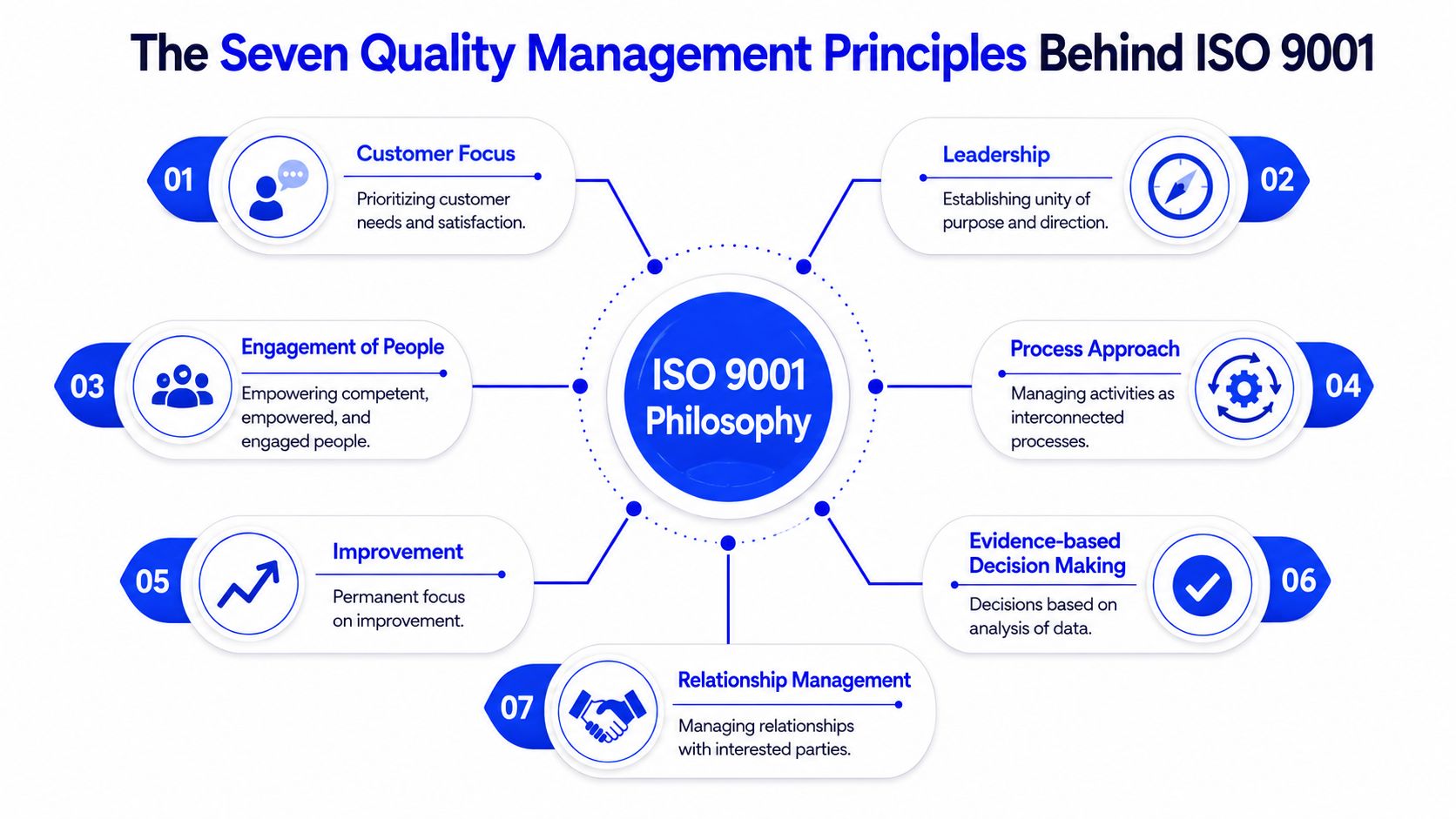
ISO 9001 works because it rests on a philosophy, not just clauses. The seven principles are easier to remember when they show up on a production floor, especially where operators handle sterile filtration, vial staging, and release documentation under time pressure. The ISO standards for labs explained guide helps frame that broader standards mindset, but the day-to-day logic still comes down to practical control.
Customer focus and leadership on the floor
Customer focus means the plant protects the outcome the customer needs, not just the paperwork. For sterile diluent, that could mean watching fill accuracy, keeping the pH within specification, and making sure the label and COA agree before release. Leadership means supervisors and managers make those controls essential, even when production is busy.
People, process, and improvement
Engagement of people matters because the operator at the filling line often sees the problem before QA does. A team that understands why a record matters is more likely to spot a line clearance miss or a filtration deviation early. Process approach keeps production from turning into isolated tasks, so receipt, compounding, filtration, fill, inspection, and release connect as one controlled flow.
Improvement, evidence-based decision making, and relationship management round out the system. Improvement keeps the plant from repeating the same defect pattern. Data keeps decisions from becoming guesswork. Supplier relationships matter because a weak incoming component can damage an otherwise strong batch.
Data should support the decision, not decorate the report.
A labware manufacturer that understands these seven ideas can read ISO 9001 clauses with far less confusion. The clauses stop looking like abstract requirements and start looking like the rules that keep a production floor stable.
Core Requirements That Drive Labware Manufacturing
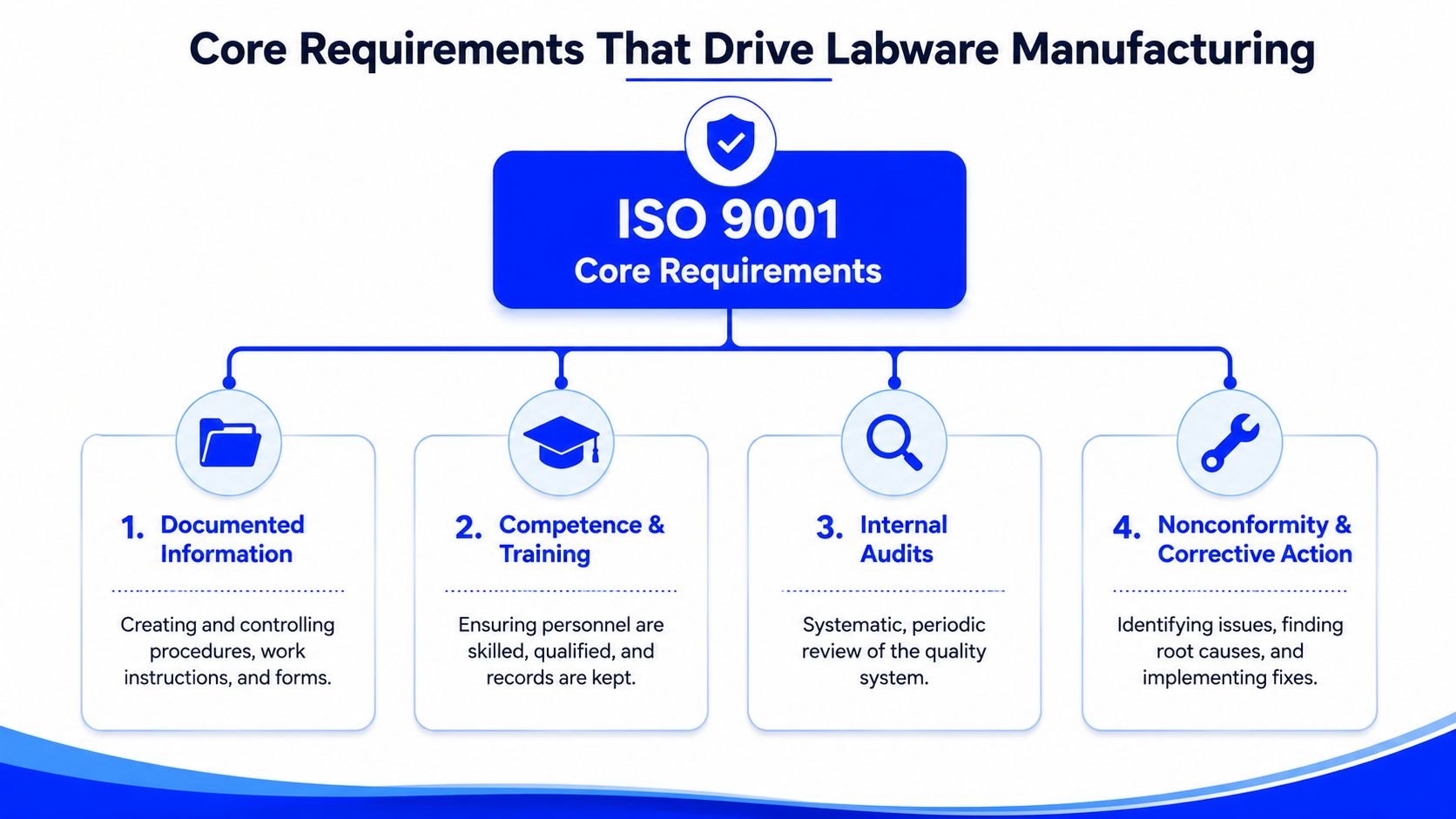
A shift starts on the floor, not in a policy binder. A sterile diluent batch can look fine on the line and still fail if the procedure is unclear, the operator training is stale, or the review step is incomplete. ISO 9001 turns those everyday risks into controlled work, so documented process maps, training records, internal audits, and controlled documented information do the job they are meant to do, not just fill a file drawer.
Documented information that people can actually use
A procedure only helps when the operator can find it, follow it, and trust that it is current. In a labware facility, that means controlled work instructions for aseptic filling, cleaning, label reconciliation, and batch review. It also means forms that capture the right data the first time, so QA does not have to rebuild the batch history after the fact.
Clear documentation works like a clean bench layout. If every tool has a place, the task runs with less confusion. The same logic applies to records, because a good form should guide the work and leave a usable trail for review.
Competence, audits, and corrective action
Competence records show that the right people were trained on the right task before they touched product. That matters just as much on a vial filling line as it does at a diluent compounding station, because an untrained hand can miss a line clearance step or misread a label check. Internal audits test whether the written system matches what happens on the floor.
Corrective action closes the loop when a deviation, documentation error, or process failure happens. A missed signature, an out-of-date instruction, or a filtration record with gaps should trigger a response that fixes the cause, not only the paper trail.
If a team wants help keeping review cycles tight, a tool such as automate docs reviews in Git can support version control and review discipline, but it still has to sit inside a real QA process.
A release decision in sterile diluent manufacturing often depends on the basics being visible at once. Was the filtration record complete? Did QA review the lot-specific COA? Was the operator trained on the current version of the procedure? ISO 9001 asks for those answers so the company can prove consistency instead of hoping for it.
Documentation, Traceability, and Batch Records in Practice
Documentation in a labware plant is not about building a mountain of forms. It is about making sure one vial can be traced back through the process without anyone guessing. The distinction between controlled documented information and clutter matters here, because a procedure nobody reads is just as weak as no procedure at all.

What good traceability looks like
A strong batch record links raw materials, filtration, filling, inspection, and release in one chain. For sterile diluent, that usually means the lot of water or solution base is recorded, the 0.22 µm filtration step is documented, the vial count is reconciled, and the QA reviewer signs off before shipment. The same file should also show the lot-specific Certificate of Analysis and the final disposition of the batch.
The product itself creates useful documentation prompts. Herbilabs' own product descriptions note 0.22 µm filtration, premium glass multi-dose vials, a typical pH 4.5 to 7.0 range, and an in-use period up to 28 days when aseptic technique is maintained. Those are the kinds of product facts that need to connect cleanly to the batch record, because a claim on a label has to match the controlled process behind it.
What belongs in the record set
- Material traceability: who supplied the raw material, when it arrived, and which lot went into which batch.
- Aseptic filling logs: who filled the units, under which controlled conditions, and with what in-process checks.
- Environmental monitoring records: proof that the room status was controlled during the run.
- COAs and release notes: the evidence that QA reviewed the lot before it left the site.
- Deviation and rework records: the trail that shows how unusual events were handled.
A record set like this makes customer questions easier to answer. It also protects the team during investigations, because the facts are already in one place instead of scattered across notebooks, spreadsheets, and memory.
How ISO 9001 Connects With ISO 13485 and GMP
ISO 9001 does not replace medical-device or pharmaceutical discipline, it sits beside it as the management-system layer. For a labware producer operating in regulated or semi-regulated markets, that matters because the standards solve different problems. ISO 9001 gives the general framework for control and continual improvement, ISO 13485 adds medical-device-specific requirements, and GMP pushes production discipline deeper into the manufacturing environment. A useful overview of GMP expectations is available in the GMP compliance guide for pharma professionals.
| Standard | Primary Focus | Typical Labware Artifact |
|---|---|---|
| ISO 9001 | General quality management system and continual improvement | Quality manual, internal audit schedule, management review record |
| ISO 13485 | Medical device quality management with stronger regulatory control | Design and process validation file, device-specific complaint records |
| GMP | Controlled production and contamination-aware manufacturing discipline | Batch record, cleaning log, environmental monitoring record |
Where the overlap helps
The overlap is useful because a labware plant does not want three separate systems fighting each other. A controlled batch record can satisfy part of ISO 9001, support GMP-style production control, and provide the traceability expected in an ISO 13485 environment if the product line crosses into medical-device supply chains. The same basic discipline, document control, training, change control, and release review, appears in all three.
Where the standards are different
ISO 9001 is broader and more management-focused. ISO 13485 is stricter about medical-device expectations. GMP cares intensely about what happens during production, sanitation, and release. A sterile diluent team that understands this layering can stop asking which standard is “better” and start asking which risk each one is controlling.
That layered view is useful for resellers and manufacturers alike. It lets the organization keep one quality backbone while adapting the detail to the market it serves.
Why ISO 9001 Implementations Stall in Smaller Operations
A small labware or sterile diluent team can pass an audit and still struggle on the floor. A certificate on the wall does not mean corrective actions close properly, trend review happens on time, or planning keeps the line steady when orders change. Reviews of adoption barriers keep pointing to the same trouble spots, weak knowledge, limited resources, resistance to change, superficial adoption, documentation burden, weak leadership commitment, and weak support around the system ISO 9001 barriers review.
The usual failure pattern
Smaller operations often build the binder before they build the habit. The files may look complete, but operators still rely on verbal instructions, supervisors still approve changes informally, and QA only sees problems after release. In a sterile diluent room, that can mean the paper trail looks tidy while the process itself stays loose.
Older audit-based research also found weak spots in corrective and preventive actions, data analysis, and production planning. Those are the same places where a plant can clear certification and still miss the daily discipline that keeps labware and sterile diluent output consistent.
Why the system stalls
- Documentation overload: Teams write procedures they never train against.
- Weak leadership follow-through: Managers ask for compliance, then reward speed over discipline.
- Poor use of data: Batch trends, deviations, and complaints never turn into decisions.
- Superficial adoption: The company certifies the system but does not live it on the floor.
CQI's standards review points to another gap. It notes that future topics remain undercovered in ISO 9001:2015, including resilience, collaborative supply chains, agility, and the use of organizational data CQI standards review. That matters for smaller plants, because those are the exact areas that help a labware or sterile diluent operation stay steady when suppliers slip, schedules shift, or a batch needs extra scrutiny.
The problem is simple. A quality system fails when people treat it as an audit event instead of a working operating method. In a production room, ISO 9001 has to act like the instructions at the bench, not a folder that only appears when an auditor asks for it.
Building ISO 9001 Into a Labware Production Workflow
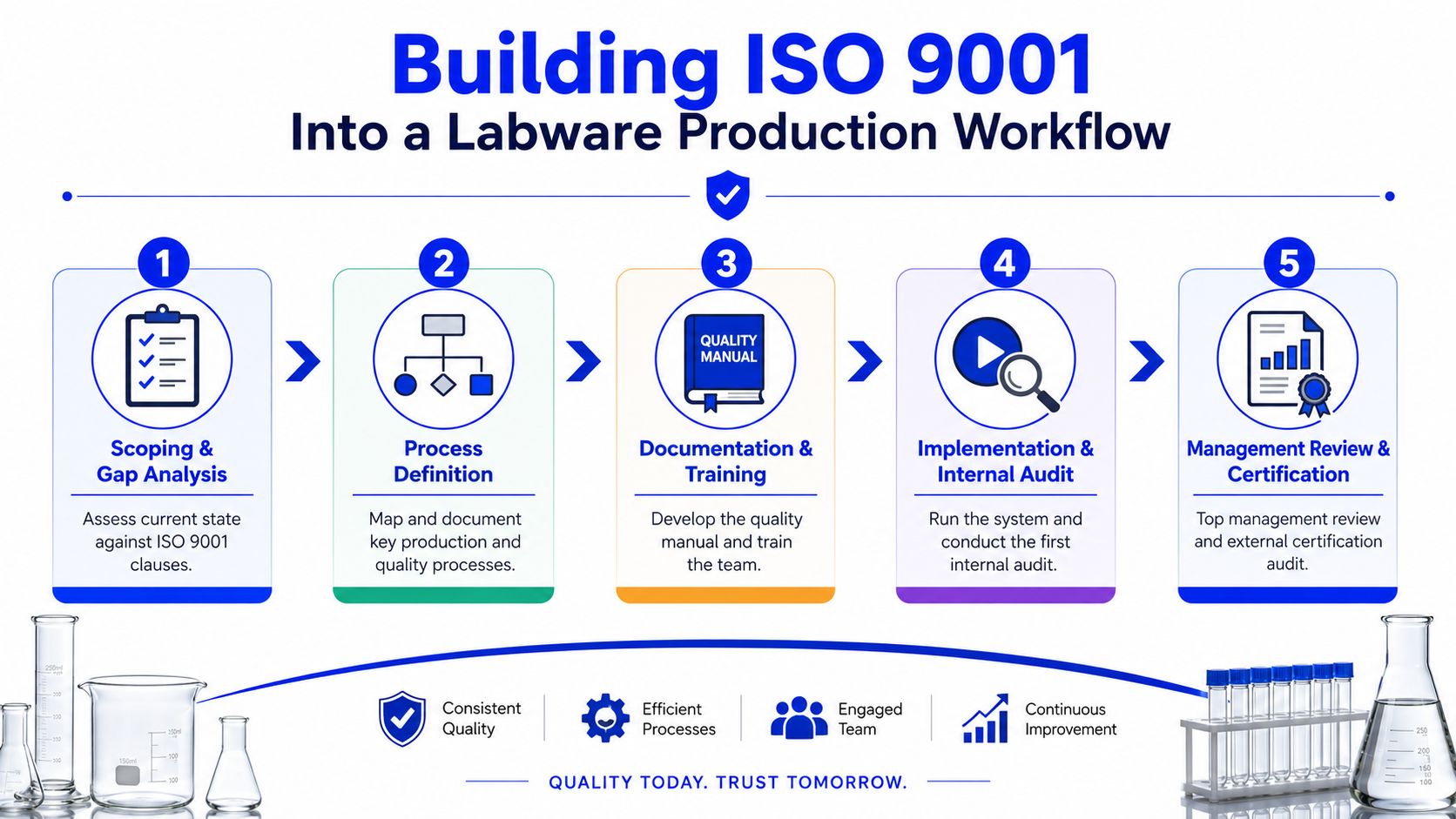
A practical rollout starts with scope, not paperwork. A small sterile diluent manufacturer should map the live process first, receipt, compounding, sterile filtration, filling, inspection, release, and shipping, then decide which records prove each step happened the right way. That sequence keeps the system anchored to the line instead of the filing cabinet.
A phased build that people can follow
The first phase is gap analysis, where the team compares what happens on the floor with what the system claims to do. The second phase is process definition, where each key activity gets a controlled owner, a record, and a review point. The third phase is training, because a procedure without competence is just a document.
The fourth phase is implementation and internal audit. That is where the plant finds out whether the new batch record works under pressure, whether the line clearance is repeatable, and whether the supplier controls are strong enough to support the product. The final phase is management review, where leaders decide what to fix, what to keep, and what to escalate.
A small operation does not need to perfect everything on day one. It needs to make the critical records reliable, make the handoffs visible, and make QA decisions based on evidence instead of habit.
Turning ISO 9001 Into Real Performance Gains
ISO 9001 starts paying back when the system makes work easier to control. In a labware plant, that shows up as repeatable batch consistency, cleaner handoffs between production and QA, and faster onboarding when a new vial format or product variant is added. The certificate matters less than the discipline behind it.
A good quality system also makes supplier management less fragile. It gives the company a way to review incoming materials, flag process drift earlier, and keep changes from slipping through as “minor” adjustments. That is the difference between a plant that can explain its output and one that just ships it.
For labware and sterile diluent manufacturers, the advantage is credibility. Customers trust the documentation because it reflects the way the floor runs, and internal teams trust the records because they know the records are kept under control. That is what ISO 9001 quality systems are supposed to do, and it's why they keep showing up wherever repeatability matters.
Herbilabs supports that kind of disciplined production with sterile diluents, lot-specific COAs, QA review, and controlled manufacturing for research use only. For teams building a tighter supplier base or reviewing a quality system around labware and sterile filling, visit Herbilabs and look at how its documentation and product handling fit into a practical ISO 9001 mindset.