Private Label, White Label, Wholesale partnerships available - EU, USA and UK - Free shipping from €75

Why Batch Testing Is Essential for Lab Accuracy
Discover why batch testing is essential for lab accuracy. Ensure quality and consistency in your experiments by mastering this vital practice.
TL;DR:
- Batch testing involves evaluating representative samples from entire production lots to ensure quality, safety, and consistency before product release or use in experiments. It detects variability, contamination, and process drift that single-unit tests may miss, supporting scientific rigor and regulatory compliance. Proper sampling, method validation, and documentation are essential for reliable results and reproducible research outcomes.
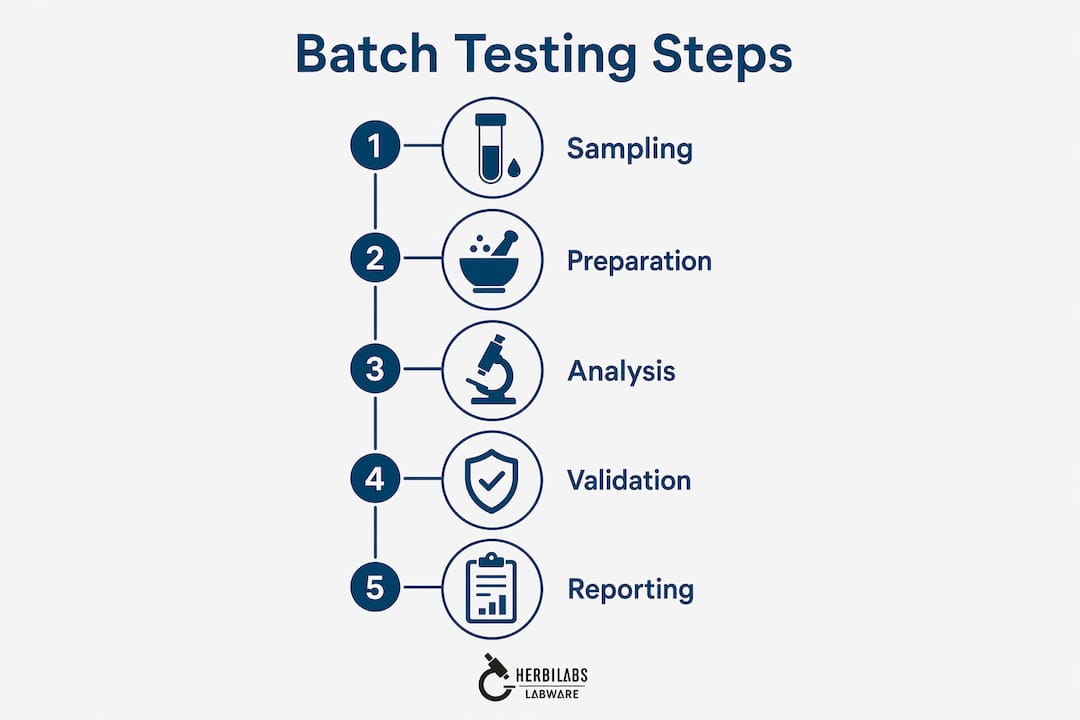
Batch testing is the process of evaluating a representative sample from an entire production lot to verify quality, safety, and consistency before release or use in downstream experiments. For laboratory professionals and researchers working with sterile reagents, reconstitution solutions, or biological assays, this practice is not optional. It is the primary mechanism by which variability, contamination, and process drift are detected before they compromise experimental outcomes. Regulatory frameworks including FDA CGMP under 21 CFR 211.167 and USP sterility testing protocols under USP <71> are built on the assumption that batch-level verification occurs systematically and is documented with full traceability.
Why batch testing is essential for scientific accuracy and reproducibility
Batch testing reveals variability and process drift that single-sample or single-record tests cannot detect. When an assay is validated on one unit or one preparation, it captures performance under a narrow set of conditions. Testing at batch scale exposes how assay performance changes with throughput, sample preparation variation, instrument load, and reagent lot differences. This is the core argument for why the importance of batch testing extends beyond regulatory compliance into fundamental scientific rigor.

A well-documented example of batch testing uncovering systematic quality failures comes from NOW’s 2026 evaluation of commercial lavender essential oils. Testing across 28 brands found that only 3 met ISO authenticity criteria, and 55% showed inconsistent chromatographic profiles. This result was only possible because testing occurred at batch scale across multiple lots. A single-unit test of any one bottle would have produced a result that appeared acceptable in isolation.
The benefits of batch testing in a research context include:
- Detection of inter-lot variability in reagents, buffers, and reconstitution solutions that affect assay sensitivity and specificity
- Prevention of false confidence from single-unit validation, which cannot represent the statistical distribution of a full production lot
- Identification of contamination events that affect a subset of units within a batch but would be missed by spot-checking
- Support for reproducibility claims in published research, where reviewers increasingly expect batch-level QC documentation
Pro Tip: When working with lyophilized peptides or sterile diluents, retain a reference sample from each batch and log its lot number against every experimental run. If results drift over time, you can trace the source to a specific lot rather than an uncontrolled variable.
What are the best practices for representative sampling in batch testing?
Representative sampling is the foundation of any valid batch test. If the samples drawn do not accurately reflect the composition and variability of the full batch, even the most sophisticated analytical methods will produce misleading results. Fixed sample sizes independent of batch size break statistical assurance and undermine reproducibility claims. This is a recurring observation in GMP inspection findings, where laboratories apply the same sample count regardless of whether a batch contains 100 or 10,000 units.
A scientifically sound sampling plan follows these steps:
- Define the batch boundaries clearly. Identify the lot number, production date, manufacturing site, and any sub-lots before sampling begins. Ambiguous batch definitions are a primary source of traceability failures.
- Scale sample size to batch size. Sampling plans must be written and scientifically justified per GMP and FDA/EMA expectations. A risk-based approach considers the product type, historical defect rates, and the consequences of releasing a non-conforming batch.
- Control the sampling environment. For sterile products, sampling must occur under conditions that prevent contamination of the sample itself. Use approved tools, sterile containers, and documented personnel training records.
- Maintain chain of custody. Every sample must be labeled with lot number, sampling date, sampler identity, and storage conditions. Analytical results are only as reliable as the traceability of the sample they came from.
- Document acceptance and rejection criteria in advance. Criteria defined after results are known introduce bias. Written specifications must precede sampling and testing.
Operationalizing sampling plans with strong contamination controls is critical because even analytically precise results are meaningless if the sample does not represent the batch. This principle applies equally to pharmaceutical manufacturing and to academic research laboratories preparing reagent stocks for multi-week experimental campaigns.
Pro Tip: For small research labs without a formal QC department, adopt the square root of N plus one as a minimum sampling rule for non-sterile reagent batches. It is not a regulatory requirement in all contexts, but it provides a defensible statistical baseline when batch sizes vary.
Why is method validation critical for accurate batch test results?
Method validation determines whether a test procedure can reliably detect the quality attributes it is designed to measure within the specific product matrix being tested. Without validation, a test may produce reproducible results that are reproducibly wrong. This distinction is particularly significant in sterility testing, where the product matrix itself can inhibit microbial growth and generate false negative sterility results that appear to confirm product safety.
USP <71> and FDA guidance require method suitability testing, specifically bacteriostasis and fungistasis (B/F) testing, to confirm that a sterility assay can detect microbial contamination in the presence of the product being tested. If the product contains preservatives, antimicrobial peptides, or other inhibitory substances, the standard sterility test method may fail to recover viable organisms even when contamination is present. The regulatory consequence is clear: a sterility test that cannot detect contamination provides no quality assurance value.
Key considerations for method validation in batch testing include:
- Matrix specificity: A method validated on one product formulation does not automatically transfer to another. Assuming that sterility assay validation transfers across batch types without updated suitability testing is a documented source of invalid results.
- Sensitivity and specificity thresholds: The method must detect the target analyte at concentrations relevant to the acceptance criteria. For microbiological methods, this means demonstrating recovery of specified challenge organisms at defined inoculum levels.
- Instrument and personnel qualification: Validated methods require qualified instruments and trained analysts. A method validated on one HPLC system does not automatically perform identically on another without instrument qualification.
- Revalidation triggers: Changes in raw material suppliers, formulation composition, manufacturing scale, or analytical equipment require reassessment of method suitability. Continuous validation is not a one-time event.
The infrastructure requirements for validated batch testing are substantial. Laboratories conducting sterility testing under GMP conditions require ISO-classified cleanrooms or isolator technology, qualified personnel with documented aseptic technique training, and environmental monitoring programs that verify background contamination levels. For research institutions that lack this infrastructure, partnering with a contract sterility testing laboratory is the operationally sound choice.
How does batch release testing fit within quality control and regulatory frameworks?
Batch release testing serves as the final quality gate verifying that a product meets all specified attributes before it is distributed or used. Under FDA CGMP, specifically 21 CFR 211.165(b) and 211.167, batch disposition decisions must be supported by testing outcomes. This means that releasing a batch without documented test results that meet pre-defined acceptance criteria is a regulatory violation, not merely a procedural gap.
The Certificate of Analysis (CoA) issued for each batch is the primary instrument of batch release documentation. It records test methods, specifications, and results for each quality attribute tested, from identity and potency to sterility and endotoxin levels. Researchers sourcing reagents or reconstitution solutions from suppliers should treat the CoA as a minimum requirement, not a courtesy document. A supplier that cannot provide a batch-specific CoA with traceable lot numbers is not operating under GMP-equivalent quality standards.
The table below summarizes batch testing expectations across major regulatory frameworks:
| Regulatory framework | Key requirement | Scope |
|---|---|---|
| FDA CGMP (21 CFR 211) | Batch disposition requires documented test results | Pharmaceuticals, biologics, sterile products |
| USP <71> | Sterility testing with method suitability validation | Sterile drug products and reagents |
| EMA GMP Annex 1 | Sterility assurance via validated aseptic processes and testing | Sterile medicinal products in EU |
| ICH Q6A/Q6B | Specification setting and batch release testing criteria | Chemical and biological drug substances |
For biologics and parenteral pharmaceuticals, the consequences of releasing a non-conforming batch are severe. Contaminated injectables have caused patient fatalities, and the regulatory response to such events consistently identifies inadequate batch testing as a root cause. This context explains why quality testing in biotech labs is treated as a non-negotiable operational requirement rather than an optional quality enhancement.
Key takeaways
Batch testing is the only reliable mechanism for detecting variability, contamination, and method failures across an entire production lot before release or experimental use.
| Point | Details |
|---|---|
| Batch scale reveals true variability | Single-unit tests cannot detect inter-lot drift or contamination affecting a subset of units. |
| Sampling must scale with batch size | Fixed sample sizes break statistical assurance; plans must be written, justified, and traceable. |
| Method validation is non-negotiable | Sterility assays require bacteriostasis/fungistasis testing to confirm detection capability in the product matrix. |
| CoA documentation is the quality record | Batch release decisions must be supported by documented test results meeting pre-defined acceptance criteria. |
| Regulatory frameworks align globally | FDA CGMP, USP <71>, and EMA GMP Annex 1 all mandate batch-level testing before product disposition. |
Batch testing as a scientific discipline, not just a compliance checkbox
The framing of batch testing as a regulatory obligation is accurate but incomplete. In my experience working with laboratory professionals across pharmaceutical manufacturing and research settings, the most consequential failures occur not because teams ignore regulations, but because they treat batch testing as a documentation exercise rather than a scientific one.
The sampling plan is where this distinction becomes visible. A plan that exists on paper but is executed inconsistently by undertrained personnel produces data that looks compliant and is scientifically worthless. The contamination-free lab practices that support valid sampling are not separable from the testing itself. They are the same activity.
Method validation deserves the same scrutiny. I have seen laboratories apply sterility test methods validated on one product class to an entirely different matrix without updated suitability testing, then report clean results with full confidence. The results were reproducible. They were also unreliable. Reproducibility without validity is a false standard.
The practical advice I offer to research teams is this: invest in your sampling infrastructure and your method qualification before you invest in more sophisticated analytical instrumentation. A validated method on a basic HPLC system outperforms an unvalidated method on the most advanced platform available. And if your facility lacks the cleanroom infrastructure for sterility testing, use a qualified contract laboratory partner rather than approximating the conditions. Batch testing done correctly builds experimental confidence. Batch testing done approximately builds liability.
— Ragnar
Support your batch testing with research-grade reagents from Herbilabs

Accurate batch testing depends on the quality of the reagents and solutions used throughout the process. Herbilabs supplies research-grade bacteriostatic water, sterile diluents, and reconstitution solutions manufactured to strict purity standards, each accompanied by batch-specific documentation to support your QC workflows. Whether you are reconstituting lyophilized peptides for assay preparation or sourcing sterile diluents for multi-lot experimental campaigns, the starting material quality directly determines the reliability of your results. Explore Herbilabs’ high-purity reconstitution solutions and review the reagent selection guide to identify the right products for your batch testing protocols.
FAQ
What is batch testing in a laboratory context?
Batch testing is the systematic evaluation of a representative sample drawn from an entire production lot to verify that the lot meets defined quality, safety, and identity specifications before release or use. It differs from single-unit testing by capturing variability across the full batch.
Is batch testing necessary for research-grade reagents?
Batch testing is necessary for any reagent where lot-to-lot variability could affect experimental outcomes. Sterile diluents, reconstitution solutions, and biological buffers all require batch-level verification because inter-lot variability in these materials directly affects assay sensitivity and reproducibility.
How does batch testing improve quality in sterility assays?
Batch testing improves sterility assay quality by requiring method suitability validation, specifically bacteriostasis and fungistasis testing, to confirm that the assay can detect microbial contamination within the specific product matrix being tested, as mandated by USP <71>.
What documentation should accompany a tested batch?
Every tested batch should be accompanied by a Certificate of Analysis that records the lot number, test methods applied, acceptance criteria, and actual results for each quality attribute. Under FDA CGMP requirements, this documentation is the basis for the batch disposition decision.
How does sample size affect batch testing reliability?
Sample size must scale proportionally with batch size to maintain statistical validity. Applying a fixed sample count to batches of varying size, a common GMP inspection finding, means that larger batches are systematically under-sampled and contamination or defects affecting a small percentage of units will go undetected.