Private Label, White Label, Wholesale partnerships available - EU, USA and UK - Free shipping from €75

What Is Endotoxin Testing? a Plain-English Lab Guide
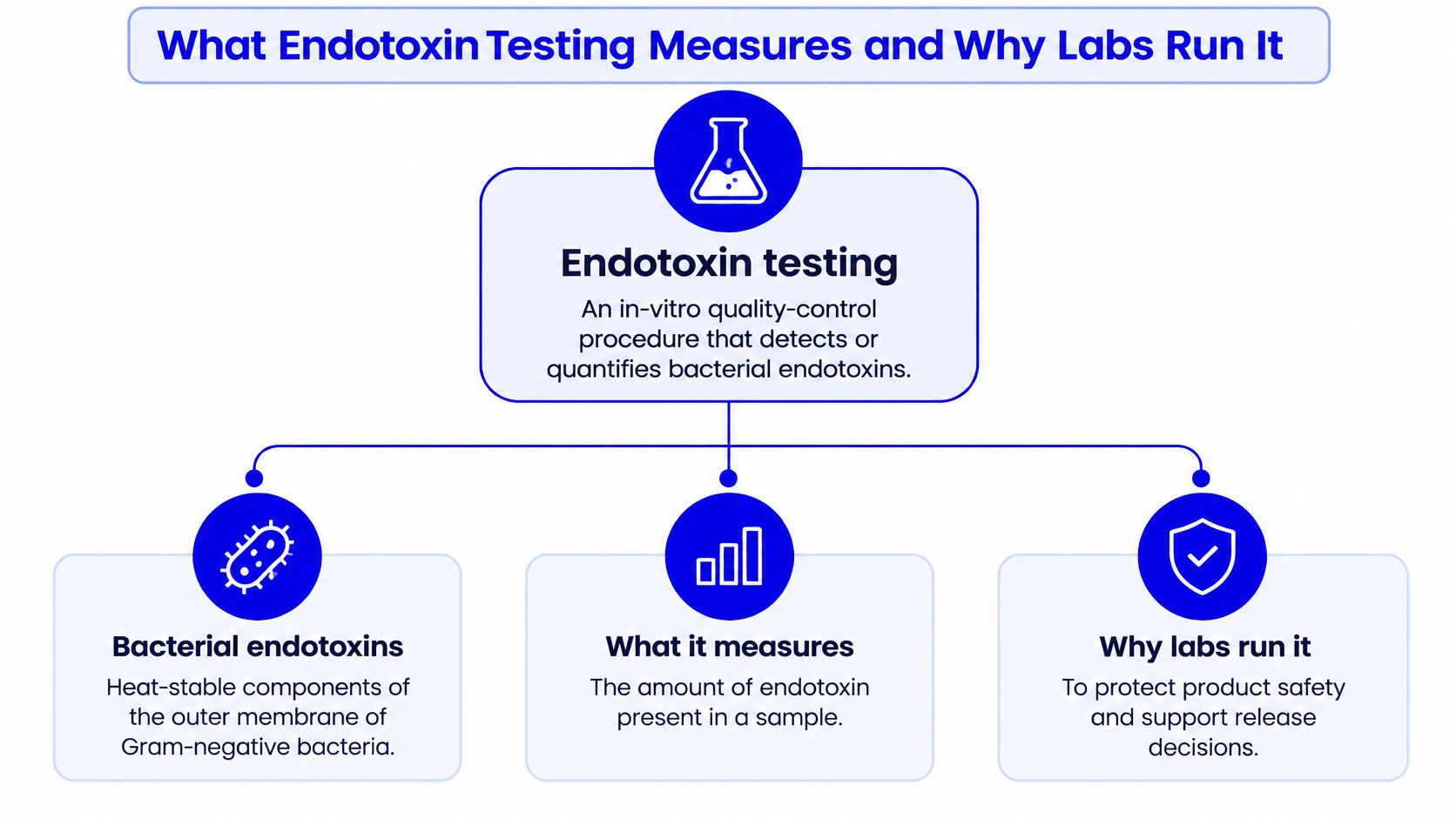
Endotoxin testing is an in-vitro quality-control procedure that detects or quantifies bacterial endotoxins, the heat-stable outer-membrane components of Gram-negative bacteria, in a material or diluent.
If a laboratory finds no living bacteria, what could still be left behind? That question explains why a clean sterility result doesn't close every contamination question. Bacterial components can remain after the organisms themselves are gone, and the material being tested can affect whether the assay detects them reliably.
By Herbilabs
Table of Contents
- What Endotoxin Testing Measures and Why Labs Run It
- Endotoxin Test Formats and Report Terms
- Why Endotoxin Testing Is Not Sterility Testing
- Running an Endotoxin Test Step by Step
- How Sample Matrix and Controls Can Change the Answer
- Documentation and Release Decisions for Endotoxin Records
What Endotoxin Testing Measures and Why Labs Run It
Endotoxin testing measures bacterial material, not bacterial life. Think of soot on a wall after a fire has been extinguished: the fire is gone, but something from it remains. Endotoxin is a lingering component of Gram-negative bacteria, although its presence doesn't reveal exactly when or where contamination occurred.
Consider a laboratory preparing to release a batch of diluent. The quality specialist needs evidence about the contents, the container, and the batch history, rather than a single reassuring label. An endotoxin result adds a distinct piece of evidence to that review.
From bacterial trace to measurable reaction
The foundational Limulus Amebocyte Lysate test, usually called LAL, uses lysate derived from horseshoe-crab blood cells; endotoxin activates a clotting cascade in that reagent, as described in the FDA technical guide on bacterial endotoxins and pyrogens.
The laboratory observes the resulting reaction using its selected assay format. A meaningful result depends on controlled sample preparation and demonstrated method suitability, not just on whether an instrument displays a value.
Why the result belongs with the lot
For the diluent batch, the analyst records the endotoxin finding beside sterility information, container-closure checks, and other release records. These checks answer different questions, so none should stand in for another.
Pyrogenic bacterial material can matter to research workflows even when viable organisms are absent. The Herbilabs guide to non-pyrogenic water provides context for interpreting water-related terminology without treating sterile and non-pyrogenic as interchangeable.
Practical distinction: The target is endotoxin, the principle is a reagent reaction, and the lot record connects the finding to the material tested.
Endotoxin Test Formats and Report Terms
A laboratory report may show a pass-or-fail conclusion, a concentration, or an assay-specific readout. Those outputs aren't interchangeable. Understanding what is endotoxin testing in practice means knowing what the laboratory measured and how it converted that observation into a reportable result.
How the formats differ
Gel-clot testing works rather like jelly setting. After controlled incubation, the analyst inverts the tube and observes whether a firm gel remains intact. A limit test can support a pass-or-fail decision, while a dilution-based approach can provide semi-quantitative information.
Turbidimetric testing resembles fog developing in clear water. The instrument follows increasing cloudiness during the reaction and compares the response with an endotoxin standard. The useful information comes from the controlled reaction, not from judging whether the original sample looks cloudy.
Chromogenic testing produces a color change, rather like a color-changing test strip. A photometer measures that reaction, and the laboratory relates the measurement to a standard. The analogy explains the signal, but the assay still requires controlled preparation and interpretation.
Endotoxin test formats and how they read
| Format | How the reaction is read | Result type | Typical use |
|---|---|---|---|
| Gel-clot | Tube is inverted to see whether a firm gel forms | Qualitative or semi-quantitative | Pass or fail checks against a set limit |
| Turbidimetric | Increasing cloudiness measured over time against a standard | Quantitative in EU/mL | Measuring endotoxin levels across a range |
| Chromogenic | Color change from the reaction read by a photometer | Quantitative in EU/mL | Routine quantitation with a plate reader |
A plate reader doesn't automatically make a method more appropriate than a tube-based test. The appropriate choice is the method that can assess the material against its specification with suitable controls.
Reading the language on the report
An endotoxin unit, abbreviated EU, expresses activity relative to a reference endotoxin standard. For liquids, EU/mL means endotoxin units per milliliter. It isn't a count of bacterial cells, and it doesn't identify a bacterial species.
The endotoxin limit is the acceptance criterion assigned to the material. The maximum valid dilution, or MVD, is the greatest permitted dilution at which that limit can still be assessed; the FDA endotoxin testing guidance relates its calculation to the endotoxin limit, sample concentration, and assay sensitivity.
- Spike recovery: The percentage of a known endotoxin addition that the assay measures back after accounting for the unspiked sample.
- Reagent blank: A background control containing the assay reagents and test water, without the product sample or added endotoxin.
- Lot: The identified production batch to which the tested sample and reported result belong.
A report should also make clear whether its concentration refers to the diluted test preparation or has already been corrected to the original material. Otherwise, an apparently straightforward comparison can use the wrong basis.
A gel-clot pass doesn't mean zero endotoxin. It means the material met the applicable decision criterion under the documented test conditions. Likewise, a chromogenic value needs its units, dilution basis, and acceptance limit before it supports a conclusion.
Exposure-based limits used for regulated products aren't universal specifications for laboratory materials. Copying a familiar limit into a research-material specification without a justified rationale creates a number, not a defensible quality requirement.
Why Endotoxin Testing Is Not Sterility Testing
A sterile result doesn't rule out endotoxin. Sterility testing looks for viable microorganisms, typically through growth under specified conditions. Endotoxin testing looks for bacterial components, so the organisms don't need to remain alive for the assay to register a signal.
The distinction resembles checking a room for intruders versus checking for footprints. An empty room answers whether someone remains inside. It doesn't establish that nobody entered or left anything behind.
What a clean result actually establishes
Say a laboratory heat-treats a material using a process that kills bacteria. That doesn't automatically establish endotoxin removal, because the bacterial components are heat-stable. Ordinary microbial killing and validated endotoxin removal aren't the same process.
Sterility testing compared with endotoxin testing
| Question | Sterility testing | Endotoxin testing |
|---|---|---|
| What it detects | Viable microorganisms | Pyrogenic bacterial components |
| Do dead bacteria register? | No, the test relies on growth | Yes, their endotoxin components can persist |
| Typical output | Growth or no growth | Result in EU/mL or a gel, cloud, or color readout |
| Role in the lot record | Supports confirmation of no living contamination under the test conditions | Supports confirmation that the endotoxin load is within limit |
The limits of the wording matter. A no-growth finding applies to the tested sample and method conditions; it isn't proof that every part of a batch is free from every possible contaminant. An acceptable endotoxin result is similarly specific, rather than a universal cleanliness certificate.
Sterility and endotoxin findings complement each other. Neither replaces the other.
The Herbilabs guide to lab sterility addresses the handling and contamination-control side of that distinction. A quality specialist keeps those practices alongside analytical evidence, rather than treating a successful test as permission to relax aseptic handling.
Running an Endotoxin Test Step by Step
A routine run starts with the specification, not the reader. The analyst follows an approved, material-specific procedure and the reagent instructions, with acceptance criteria established before results are generated.
From preparation to reaction
Confirm the specification. Identify the endotoxin limit, reporting units, assay sensitivity, and validated MVD for the material. For a liquid reported in EU/mL, the method must assess that concentration basis reliably.
Prepare the sample using endotoxin-free water and pyrogen-free tubes. Apply the validated dilution without exceeding the MVD, and record the preparation so another analyst can reconstruct it.
Establish suitability in the product. Add a known amount of endotoxin to a sample preparation and assess recovery. Failed recovery requires investigation and a justified change, such as an appropriate dilution or validated neutralization, before the product result can be used.
Set up the reagent blank, positive product control, and reference standards required by the selected format. Quantitative assays need the appropriate standard series; gel-clot testing uses its specified control and sensitivity checks.
From reaction to report
Add reagent and incubate under the method's specified conditions. Read gel-clot tubes by inversion, follow cloudiness for turbidimetric testing, or measure the chromogenic reaction with a photometer. Timing and temperature follow the approved procedure, not an improvised universal setting.
Calculate quantitative results from the accepted standard curve, apply the dilution factor, and report the original material's concentration in EU/mL. For gel-clot testing, report the supported limit-test or semi-quantitative conclusion instead of inventing a numerical concentration.
The analyst reviews control acceptance before interpreting the sample. A visually convincing reaction or plausible concentration can't rescue a run with failed controls.
Release safeguard: A result above the specification triggers a documented investigation, not an unrecorded repeat until a passing value appears.
How Sample Matrix and Controls Can Change the Answer
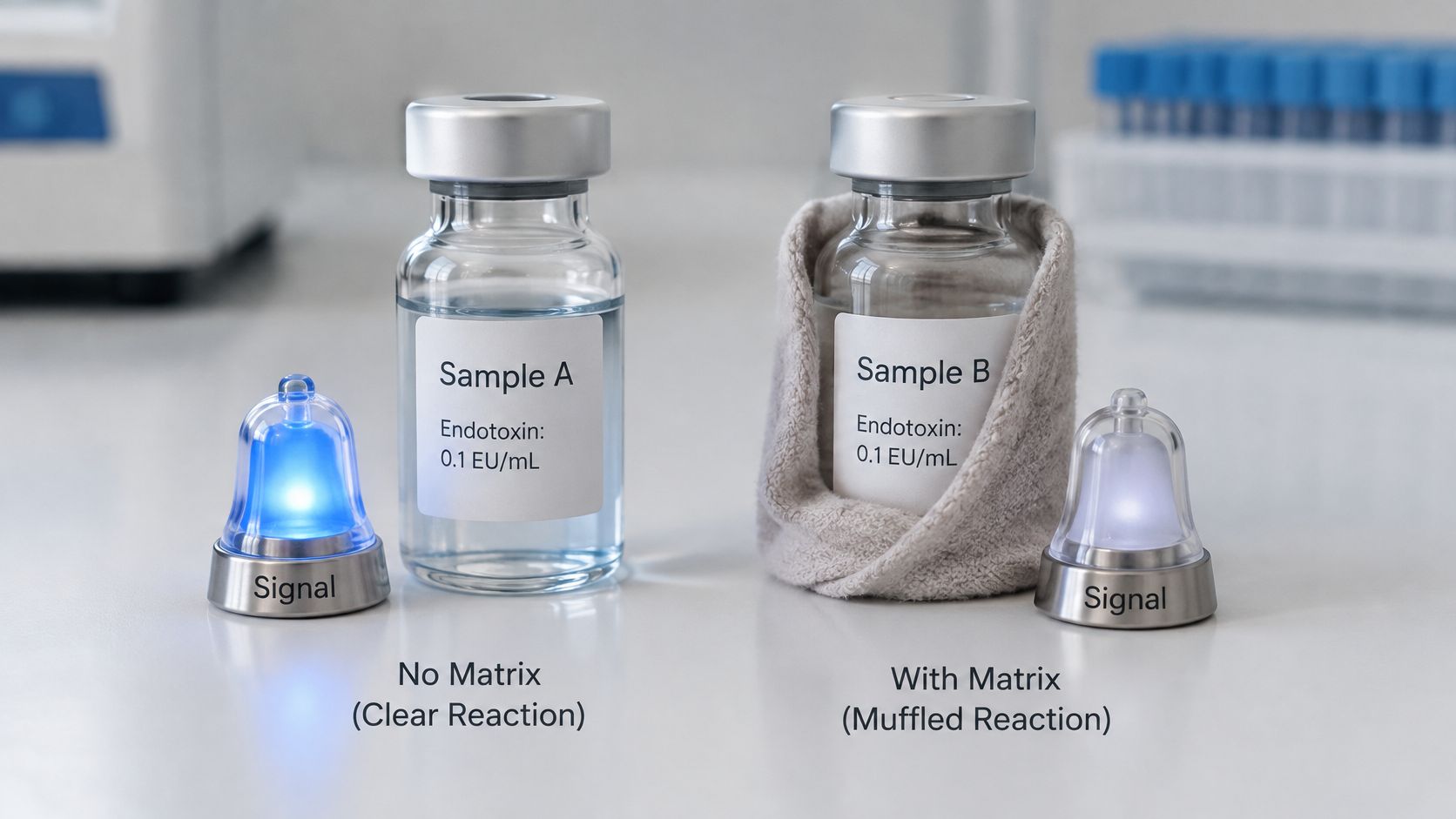
The sample matrix is everything in the material apart from the target being measured. It can act like a blanket over a bell: the bell rings, but the blanket muffles the sound. In an endotoxin assay, matrix inhibition can weaken the response and make contamination appear lower than it is.
The opposite can happen too. Matrix enhancement can increase the reaction and make a sample appear to contain more endotoxin than the assay should report. The underlying endotoxin concentration need not have changed.
Testing whether the material interferes
Product-specific suitability testing checks the reaction in the actual material, rather than assuming that performance in clean water transfers unchanged. The FDA questions and answers on pyrogen and endotoxin testing explains the need to address product interference and demonstrate that the selected method is suitable.
The analyst compares an endotoxin-spiked product preparation with the expected response. If recovery fails, the sample result may be analytically unreliable, even when its displayed value looks reasonable. A failed check doesn't prove that the product contains excessive endotoxin; it establishes that the current conditions don't support trustworthy measurement.
Why dilution needs a boundary
Dilution may reduce interference, but it also reduces the endotoxin signal presented to the assay. Insufficient dilution can leave inhibition or enhancement unresolved; excessive dilution can prevent the laboratory from assessing the original material against its limit.
The analyst therefore needs a preparation that both passes suitability and stays within the permitted dilution boundary. If that combination isn't achievable, a validated neutralization or another justified treatment may be necessary.
Routine controls and what their failure means
| Control | What it confirms | If it fails |
|---|---|---|
| Reagent blank | Reagents add no unacceptable signal of their own | Suspect reagent or water contamination, investigate, and rerun after correction |
| Positive product control or spike recovery | The material permits acceptable recovery of added endotoxin | Investigate matrix interference; adjust dilution or use a validated neutralization step |
| Standard series | The assay response matches the reference standard within acceptance criteria | Check calibration, remake standard dilutions, and repeat the affected run |
These controls answer different questions. A clean blank can't show that a product permits recovery, and acceptable product recovery can't compensate for an invalid standard series.
A result is only as credible as the controls that ran with it. The useful question isn't merely whether the number is low, but whether the laboratory demonstrated that the method could measure endotoxin in that preparation.
Documentation and Release Decisions for Endotoxin Records
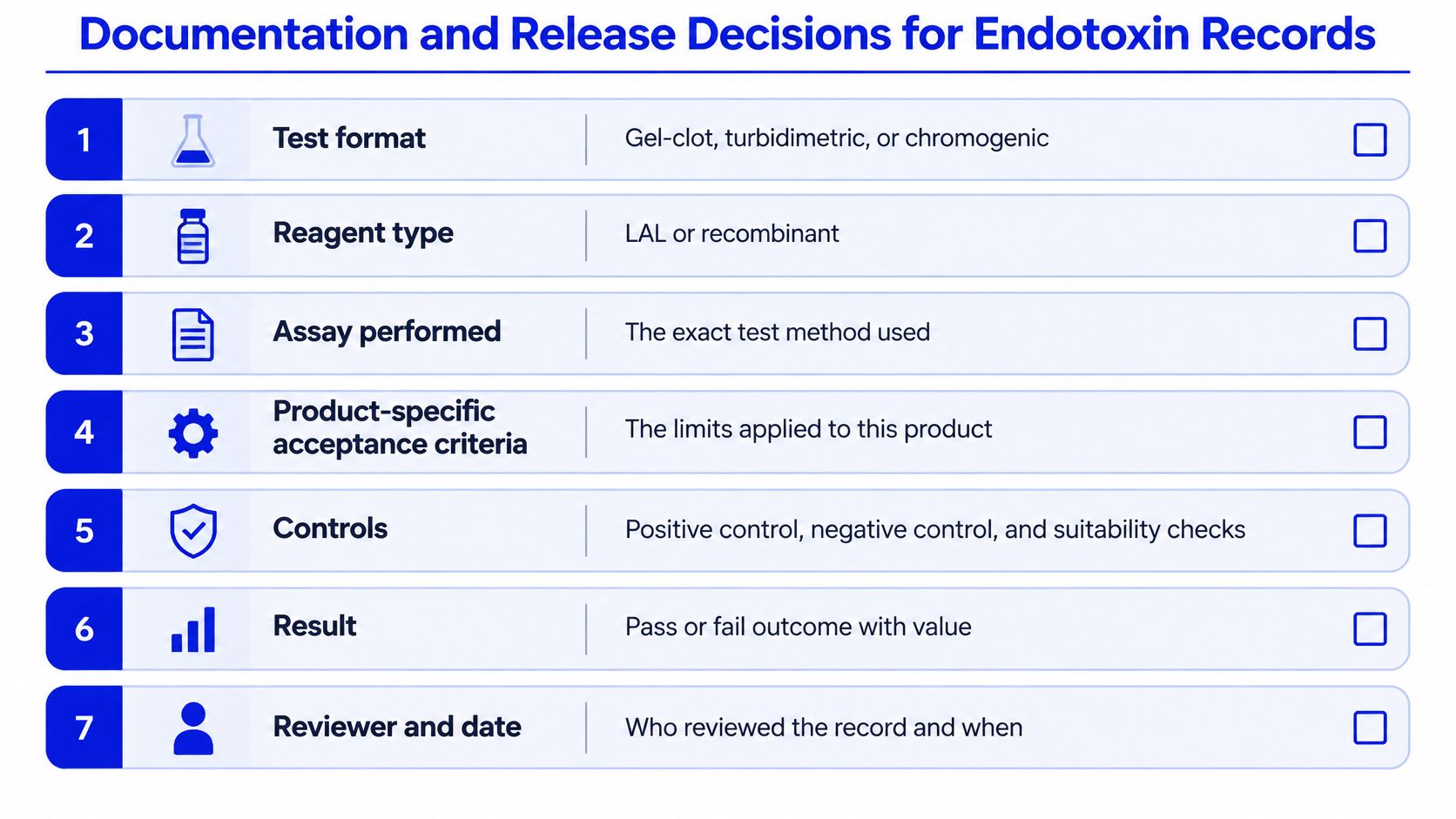
A complete endotoxin record connects the sample, method, controls, and release decision. A certificate containing only a concentration leaves the reviewer without enough context to judge how that number was obtained.
What the record should contain
- Test format: Gel-clot, turbidimetric, or chromogenic, as applicable.
- Reagent type: LAL or the identified recombinant reagent.
- Assay performed: The exact method and procedure reference.
- Suitability results: Product-specific evidence supporting the preparation tested.
- Controls: The controls performed and their acceptance outcomes.
- Acceptance limit: The specification and matching units.
- Sample identity: Material name and lot number.
- Testing details: Test date, testing laboratory, reported result, and review information.
Herbilabs reviews and tests each batch for cleanliness, consistency, and suitability for research and laboratory use. Each lot undergoes lot-specific Certificate of Analysis and quality assurance review before release. Each Reconstitution Solution lot has its own Certificate of Analysis, available on the COA page.
Method changes don't remove validation duties
USP Chapter <86>, published in May 2025, expanded recognition of recombinant-reagent approaches, while revised FDA guidance removed LAL-specific wording; the European Pharmacopoeia scheduled removal of its rabbit pyrogen chapter from 1 January 2026, with these changes discussed in the FDA clarification on pyrogen and endotoxin testing.
Method selection still depends on risk and suitability. Available approaches include bacterial endotoxin testing, recombinant Factor C, and the monocyte-activation test, but they don't all answer identical questions. Animal-free doesn't mean validation-free, and endotoxin-specific methods won't detect non-endotoxin pyrogens.
For procurement review, a certificate should identify the method, reagent type, assay format, suitability evidence, and acceptance limit. A generic claim of LAL testing provides less useful evidence than a traceable, material-specific record.
Document review also benefits from separating completeness checks from substantive evaluation. For teams formalizing that distinction, Documind's explanation of the stages of legal document review offers an organizational analogy, not a laboratory testing standard. Laboratory-specific practices belong in the quality system, supported by resources such as the research quality control guidance from Herbilabs.
A release check that connects the evidence
- Identify the method: Confirm that the record names the format and reagent type.
- Verify performance: Confirm that suitability and controls passed for the specific material.
- Compare correctly: Assess the result against the acceptance limit using matching units and the correct dilution basis.
- Preserve traceability: File the reviewed record with the corresponding lot.
For the endotoxin portion of release, the number, method, controls, and limit must agree on a traceable record. Overall lot release also depends on the remaining applicable quality requirements.
Herbilabs offers laboratory research diluents supported by lot-specific Certificates of Analysis and quality assurance review before release. Researchers and laboratory buyers can visit Herbilabs to review available materials and locate the documentation for the relevant lot before making a research-use purchasing decision.