Private Label, White Label, Wholesale partnerships available - EU, USA and UK - Free shipping from €75
Sterile Non Pyrogenic Water: A Practical Lab Guide
You can have a vial that says sterile and still lose a reconstitution because the result carried a pyrogen problem instead of a microbial one. That's the part that catches researchers off guard at the bench. The label looks reassuring, but the work still depends on whether the water is fit for the exact workflow, the exact container, and the exact number of times that stopper gets punctured.
Table of Contents
- What Sterile Non Pyrogenic Water Means at the Bench
- How Sterile Non Pyrogenic Water Is Made
- The Two Quality Attributes That Matter
- Where RUO Labs Use It and Why Format Matters
- Reading a COA and Spec Sheet Line by Line
- Regulatory and Quality Signals Beyond the Label
- Practical Checklist for Your Next Purchase
What Sterile Non Pyrogenic Water Means at the Bench
A researcher reaches for a vial, sees sterile on the label, and assumes the diluent is suitable for a sensitive reconstitution. The next day, the assay throws an unexpected signal, and the first question is whether the water was fit for that step. That confusion happens because sterility and non-pyrogenicity are separate claims, and both matter in high-sensitivity work.
Two claims, not one
Sterile means the product has been processed so viable microorganisms are not present at the time of release. Non-pyrogenic means it has been controlled to avoid fever-triggering contaminants, especially bacterial endotoxins, which can still matter even when no living microbes are detected. The historical reason this distinction exists is clear in the early pharmaceutical literature on water quality, where pyrogen control became a distinct quality concern, not just a side note to sterilization patent history and early pyrogen work.
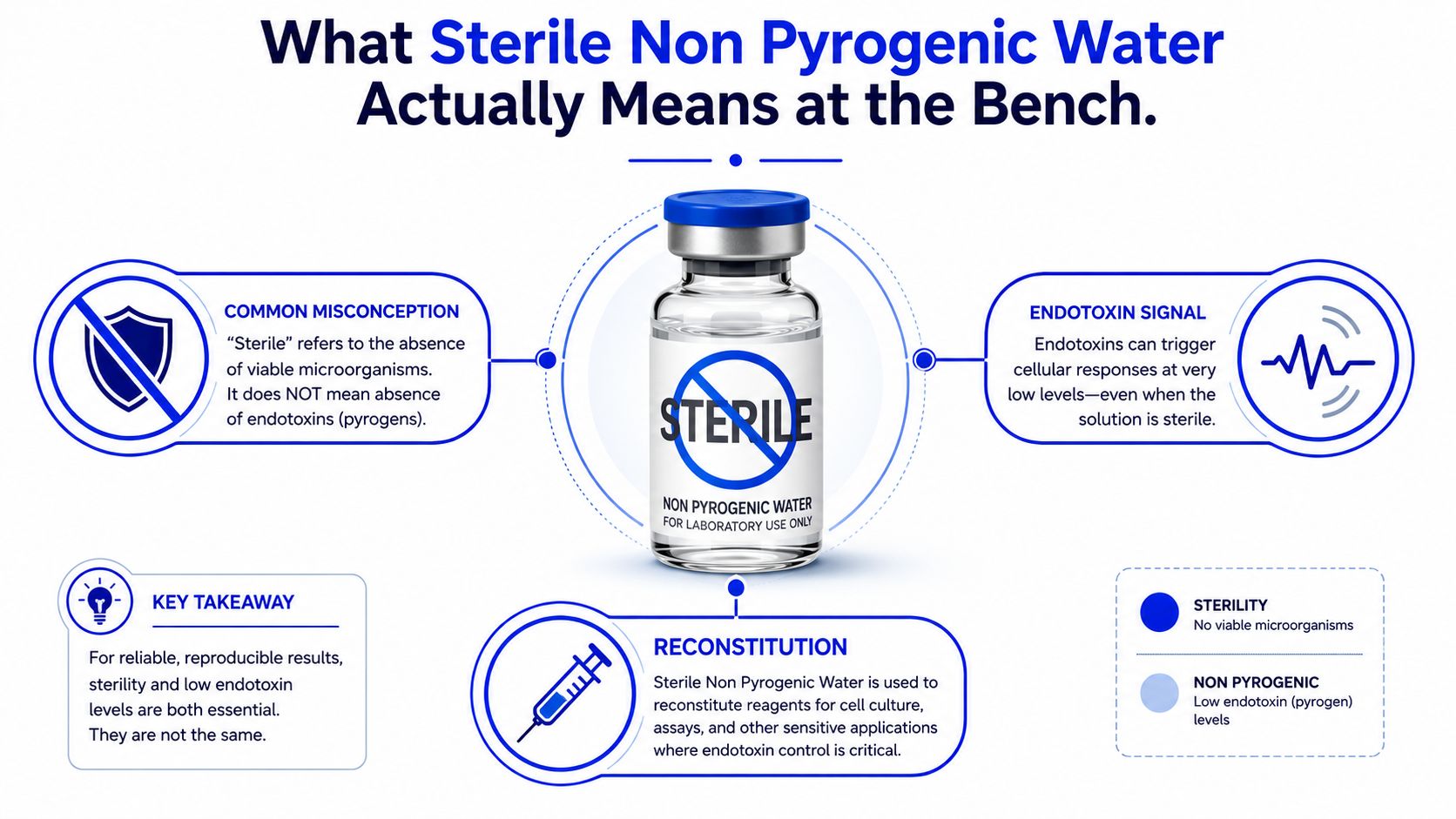
A clean-looking vial does not guarantee that the material inside is appropriate for reconstitution of peptides, proteins, antibodies, or other lyophilized reagents. A lab can have a sterile fluid and still end up with an unusable prep if endotoxin control was not part of the spec. The practical standard in RUO and labware work is the combination of microbiological control and pyrogen control, not one or the other.
Practical rule: if a workflow is sensitive enough that endotoxin matters, the label has to answer two questions, not one. Is it sterile, and is it non-pyrogenic?
Vocabulary that shows up on labels
Buyers also run into terms like Water for Injection, WFI, and bacteriostatic water for injection. Those words matter because they describe both the intended use and the quality logic behind the product, not just the bottle shape. A product described as ultrapure is being positioned for parenteral and sterile pharmaceutical use, which is why the same language keeps appearing in lab and clinical supply chains sterile water background.
A common source of confusion is the 0.22 µm filtration claim. In practice, that filter size is the final sterilizing barrier for many heat-sensitive aqueous solutions, but the claim only means something when the whole process is controlled. If the filtration step is not paired with aseptic filling, clean equipment, and release testing, the label becomes marketing instead of QA.
How Sterile Non Pyrogenic Water Is Made
The manufacturing chain starts long before the water reaches a vial. Feed water has to be purified, then processed through controls that remove contaminants, reduce microbial risk, and keep the final fill consistent lot after lot. For heat-sensitive aqueous products, filtration is favored because it avoids the damage that can come from harsher terminal heat treatment, while still supporting a sterile claim when the rest of the process is controlled.
From purified water to aseptic fill
A typical sterile-water process uses purified feed water, then a final sterilizing filtration step, often 0.22 µm, before aseptic filling into glass vials. That filling step matters because the water itself is only part of the product. The stopper, vial, environment, operator technique, and transfer steps all have to support the same sterile claim.
The product stops being “just water” and becomes a controlled manufactured article. A supplier's batch record, environmental controls, and operator training are part of the claim, because the bottle on the shelf is the result of a process, not an abstract purity idea. One reason labs ask for documentation is that the process has to be traceable if a lot ever behaves oddly in use.
The commercial language around these products can sound simple, but the production logic is not. An aseptic fill reduces the chance of post-filtration contamination, while release testing checks whether the lot meets the written specification. A sterile claim without documented process controls is too thin to trust in a sensitive workflow.
For a product example in this category, Sterile Water for Injection is one of the formulations buyers may encounter in RUO discussions, but question is never only the name on the page. The question is whether the lot was produced, filled, and released under a system that can stand behind that name.
Why the process has to be documented
Quality systems exist because the same fill line can produce a reliable lot one day and a problem the next if controls slip. ISO and GMP-style procedures matter here because they force records around cleaning, personnel qualification, environmental monitoring, and release review. Those records are the only way to tell whether the sterile claim came from a controlled process or from a generic product description.
A sterile bottle is the output. The QA file is the evidence.
The historical background also explains why pyrogen control never disappeared from the spec sheet. Early work on fever-producing substances in distilled water showed that microorganisms weren't the whole story, which is why modern product development still treats pyrogens as a separate risk class patent history and early pyrogen work. That logic still governs the way labs evaluate sterile, non-pyrogenic diluents today.
The Two Quality Attributes That Matter
A product page can sound reassuring and still leave the bench scientist with the key question unanswered. Sterility and non-pyrogenicity are separate checks, and they answer separate risks. One asks whether viable microbes were found. The other asks whether the water is likely to carry a fever-triggering burden that could disturb a sensitive system.
What sterility testing tells you
Sterility testing looks for viable organisms, not for every weakness in the bottle's history. Depending on the product and the method, the test may use membrane filtration or direct inoculation. The practical value of the result is straightforward. It shows whether growth was detected under the test conditions tied to that lot.
That result still leaves room for failure in use. A lot can pass sterility testing and still be a poor fit if the workflow is exposed to pyrogens, or if the downstream assay reacts badly to residues. For that reason, a sterile-only claim can be too narrow for peptides, proteins, antibodies, and other materials that need tighter contamination control.
A useful comparison is the difference between a sterile diluent and a preservative-containing option such as bacteriostatic water versus sterile water. The choice is not academic. It changes whether repeated access is supported by a preservative system or whether the product is meant to stay preservative-free for the next step in the workflow.
What pyrogen testing tells you
Non-pyrogenicity goes beyond the absence of live organisms, because endotoxins can remain after microbes are no longer viable. In QA language, the LAL test and the endotoxin result on a COA become the parts people inspect first. Buyers often look for results in EU/mL, because that unit shows the pyrogen burden measured for the lot under test conditions.
A tighter injectable-style specification usually treats conductivity, total organic carbon, and bacterial endotoxins as proxy controls for ionic, organic, and pyrogen burden. A commonly cited Water for Injection reference point includes conductivity around ≤1.1–1.3 μS/cm at 25°C, total organic carbon ≤500 ppb, and bacterial endotoxins ≤0.25 EU/mL WFI specification references. Those figures help a buyer judge whether the spec sheet is tightly written or just dressed up with technical language.
Useful shortcut: if a spec sheet lists sterility but gives no endotoxin result, it is not answering the whole question for sensitive work.
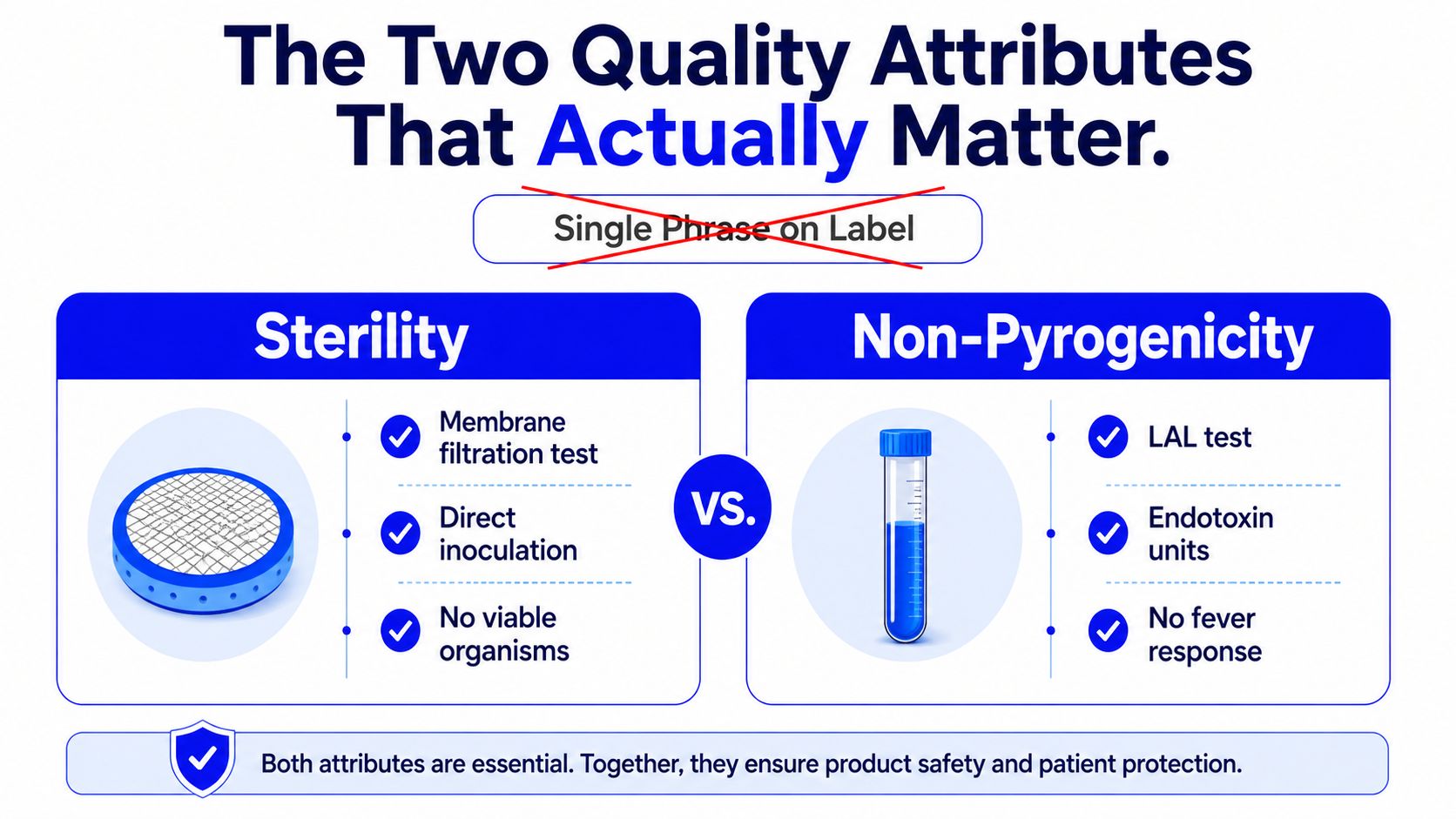
The cleanest way to read the two claims is this. Sterility says the vial did not carry viable contamination at release. Non-pyogenicity says the same lot also cleared the part of quality control that matters when fever-causing contamination would spoil the result.
Where RUO Labs Use It and Why Format Matters
A researcher usually meets sterile water at one of three moments. A lyophilized peptide needs reconstitution, a concentrated stock needs a working dilution, or an analytical method needs a blank matrix that will not add avoidable noise. Those are routine tasks, but the format choice changes the risk profile in a way that is easy to miss.
Single-dose and multi-dose are not interchangeable
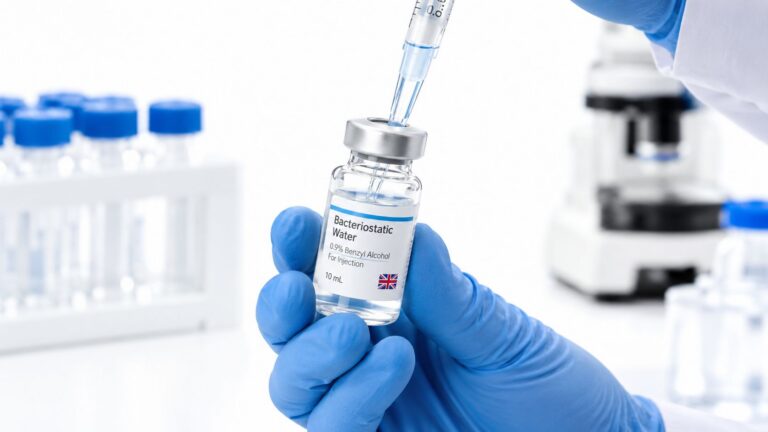
The biggest practical split is between sterile water without preservative and bacteriostatic water. The preservative form contains 0.9% (9 mg/mL) benzyl alcohol and is described as sterile, nonpyrogenic water for injection, with the preservative system supporting repeated aseptic withdrawals sterile water background multi-dose use window. That detail matters because repeated access is where contamination risk creeps in.
If the same vial will be punctured more than once, a preservative can make the workflow more forgiving, but it also creates a compatibility problem for downstream assays or formulations that must remain preservative-free. In those cases, the single-dose sterile option is the better fit, even if it is less convenient.
Matching format to the job
The use case should drive the choice, not habit. Reconstituting a peptide for immediate use is a different decision from keeping a vial open for serial withdrawals over several days. The first case often points toward preservative-free sterile water, while the second often points toward the bacteriostatic format.
That is also why vial size matters. A 3 mL vial, a 10 mL vial, a 20 mL vial, and a 30 mL vial do more than change how much liquid sits on the shelf. They change how often the stopper gets punctured, how long the lot will sit after first access, and how much waste the lab creates when only small withdrawals are needed.
A supplier may also offer multi-pack kits, which can help a lab separate openings by project or by analyst. For one RUO market option in this category, HerbiLabs sterile water vials are sold in formats built around that sort of workflow planning, but the important decision stays the same, preserve the format that matches the use, not the format that looks cheapest at checkout.
A bench example
A peptide lab that opens one vial, draws several small aliquots over a week, and needs to avoid repeated contamination risk has a strong reason to choose the preservative system. A protein assay lab that needs a blank diluent for a sensitive downstream method does not want benzyl alcohol in the mix. The wrong choice can create a problem long after the product looked fine on receipt.
Reading a COA and Spec Sheet Line by Line
A COA is the document that turns a vague product description into a lot-specific decision. The trick is to read it as a set of questions, not as a badge of quality. A good COA tells a buyer what this exact batch showed, not what the brand hopes people will assume.
Start with the fields that matter
| Field | Typical expectation | Why it matters |
|---|---|---|
| Appearance | Clear, colorless, no visible particles | Flags gross contamination or handling problems |
| pH | Often around 5.0 to 7.0 for injectable-grade water | Helps the buyer judge compatibility with the intended use |
| Benzyl alcohol assay | Present only when the product is bacteriostatic | Confirms the preservative system that drives multi-dose use |
| Endotoxin result | Reported in EU/mL | Shows whether the lot met non-pyrogenic expectations |
| Sterility result | Passed or equivalent lot result | Indicates whether viable organisms were detected |
| Conductivity or particulate data | Low values or compliant result | Helps reveal ionic load, residue, or handling issues |
The first thing to separate is the specification from the result. A specification is the limit the product must meet. A result is what that batch showed.
What to do with borderline or missing information
If pH is outside the expected window, that doesn't automatically make a lot unusable, but it does mean the buyer needs a reason to trust the product in the intended workflow. If endotoxin is reported only as “passes” with no method or numeric value, the result is less useful than it looks. If sterility is listed without the lot number, the document can't be tied cleanly back to the vial in hand.
Practical checkpoint: a COA that cannot be tied to a specific lot is not much better than a product page.
A few red flags deserve immediate attention. Missing lot number, no stated test method, results that only say passes without a number, and a manufacturing date that doesn't fit the stated shelf life all deserve a follow-up before the vial is used. In RUO work, the cost of asking for clarification is usually much smaller than the cost of repeating a failed prep.
Regulatory and Quality Signals Beyond the Label
A bottle can say sterile and still leave plenty unanswered about how trustworthy the supplier is. That's why the buying decision should include the quality system around the product, not just the finish on the label. For RUO workflows, the strongest signal is often the supplier that can show how the product was made, reviewed, and released.
What supplier controls are really telling you
An ISO 13485:2016 or GMP-aligned setting tells a buyer that the supplier is operating inside a documented quality structure, not improvising lot by lot. ISO 9001:2016 procedures, batch reviews, material traceability, and employee training all strengthen the same point, which is that the water in the vial came through a process with records. In a compounding or aseptic environment, that's more meaningful than a generic claim of cleanliness.
Supply continuity matters too. In October 2024, Olympus warned customers about a sterile water and saline shortage and noted that it had not tested non-sterile fluid sources, which underscored how fragile sterile-fluid access can be when a lab depends on a consistent supply Olympus shortage statement. For a researcher, a short supply interruption can delay a reconstitution plan just as quickly as a bad lot.
Questions to ask a supplier
- Is the COA lot-specific, and does it include the test method?
- Does the product have batch review and traceability records?
- What water quality is used for the final rinse and related manufacturing steps? EMA guidance states that the final rinse for equipment, containers, or closures should use the same water quality as the relevant manufacturing stage or excipient, which shows how far water controls extend beyond the finished bottle.
- Can the supplier support stable fulfillment across your region?
- Does the documented preservative system match the way the lab opens and uses the vial?
The last question matters more than it sounds. A good product can still be the wrong operational fit if the lab needs preservative-free reconstitution, or if the vial will be punctured repeatedly in a setting that needs stronger in-use protection. Quality isn't just what the bottle contains, it's how the supplier's system supports the way the bottle will be used.
Practical Checklist for Your Next Purchase
Before ordering, match the format to the workflow, not the other way around. Check whether the COA is lot-specific, whether endotoxin is reported numerically, and whether the preservative system fits the number of planned punctures. Then confirm the supplier can document manufacturing controls, traceability, and dependable fulfillment.
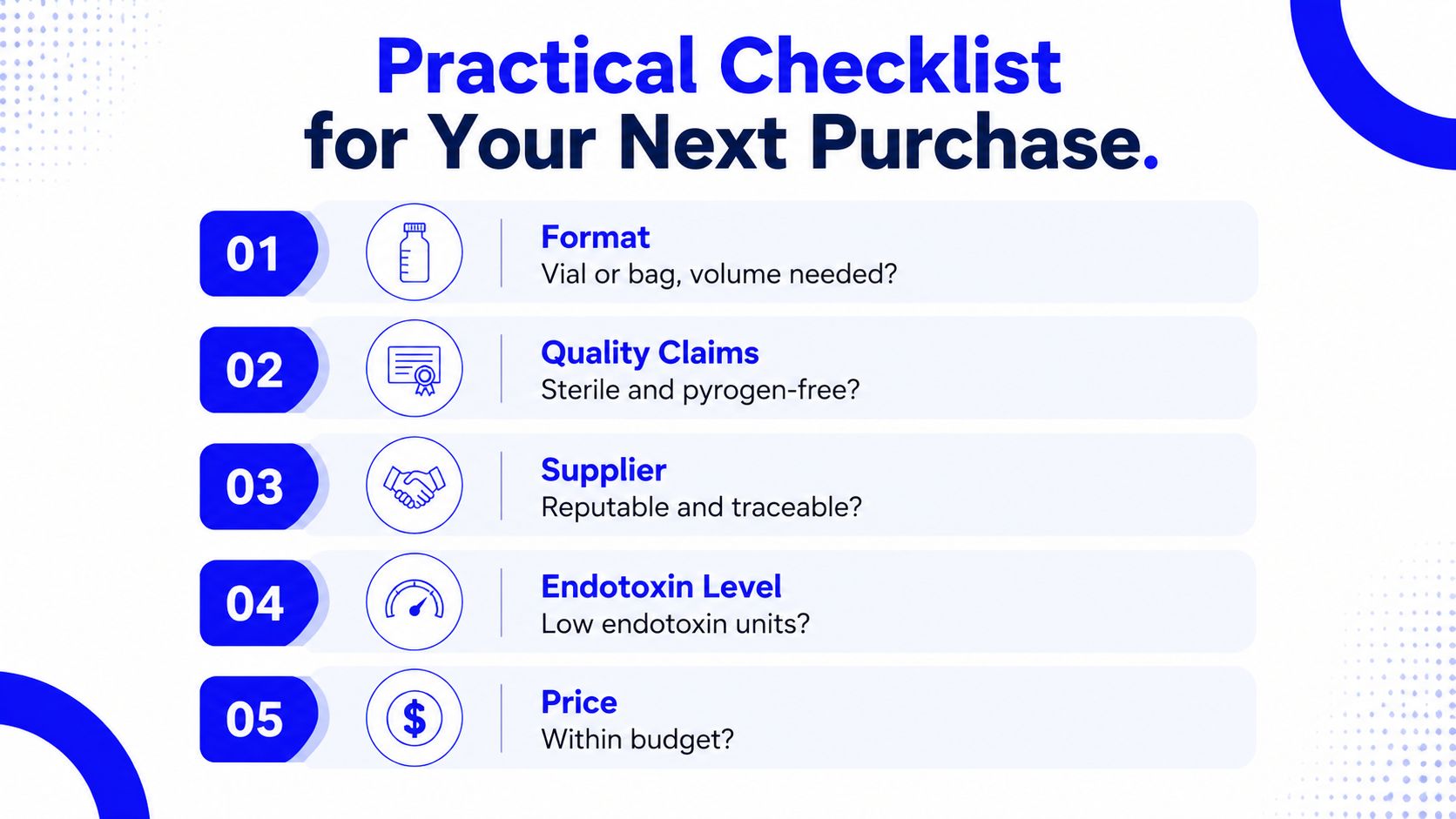
Avoid the common traps, assuming sterile means non-pyrogenic, treating a single-dose vial like a multi-dose one, or buying on lead time alone. The safest purchase is the one that fits the assay, the access pattern, and the documentation the bench needs.
Herbilabs supplies RUO sterile diluents and related labware with lot-specific documentation, controlled production, and vial formats that fit reconstitution and repeated-access workflows. For a lab that needs to compare preservative-free and bacteriostatic options with clear QA paperwork, Herbilabs is a practical place to review product formats, COA support, and supply options before the next order.