Private Label, White Label, Wholesale partnerships available - EU, USA and UK - Free shipping from €75
Easy Touch Insulin Syringes, Needles, and Safety
Easy Touch insulin is a family of U-100 insulin syringes and insulin pen needles, not one syringe size. The syringes measure insulin formulated at 100 units per milliliter; pen needles attach to a pen that measures the dose.
Choosing whichever package has the easiest-to-read markings isn't enough. A clear scale can still be the wrong scale, and a fine needle can still be the wrong length or connection for a particular pen.
By Herbilabs
Table of Contents
- What Easy Touch Insulin Products Are
- U-100 Syringe Capacities and Needle Pairings
- Pen Needle Gauges and Lengths
- How Easy Touch Compares With Similar Devices
- How an Easy Touch Pen Injection Is Done
- Safety Limits and Final Setup Check
What Easy Touch Insulin Products Are
The distinction most listings blur is syringe versus pen needle. EasyTouch is a product line associated with MHC Medical Products, rather than a single barrel size or an insulin medicine.
Consider someone comparing a box of insulin syringes with a box of pen needles. Both packages may carry the EasyTouch name, but they solve different problems. A syringe draws insulin from a vial and measures it on the barrel; a pen needle provides the passage through which a pen delivers its selected dose.
The measuring-cup distinction
A useful analogy is a measuring cup with a straw. The syringe is the cup and straw together, while an insulin pen supplies the cup and its detachable needle supplies only the straw. Buying the straw doesn't provide a measuring device.
The product-family diagram separates those branches.
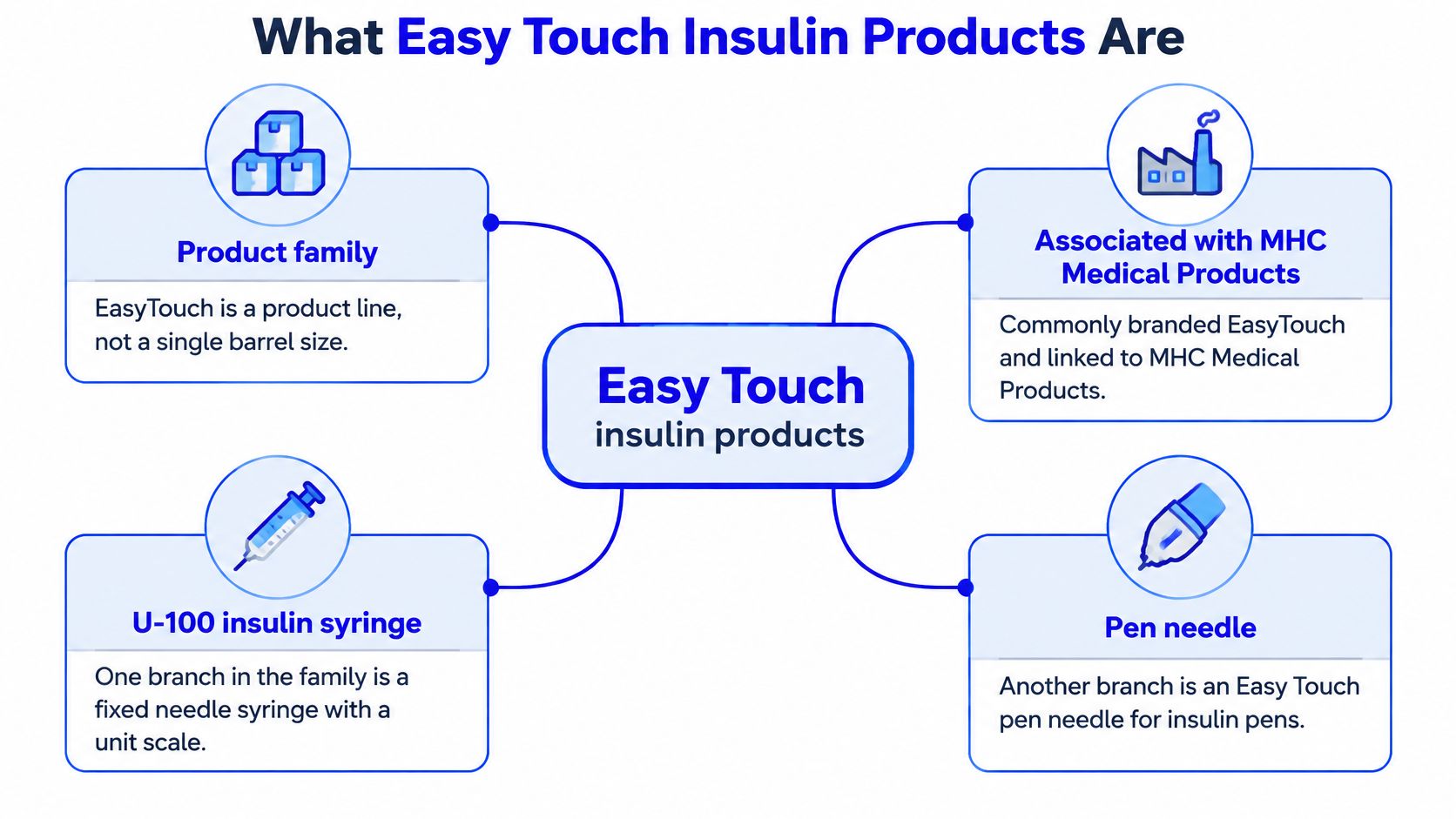
The syringe descriptions discussed here identify sterile, disposable devices with fixed needles, polypropylene barrels, and insulin-unit graduations. The pen-needle descriptions identify surgical-steel cannulas that attach to compatible insulin pens. Neither device changes the insulin's strength, and the syringe models described here aren't safety-engineered needles.
What the package needs to establish
- Product type: The package should clearly identify a syringe or a pen needle.
- Measuring capacity: A syringe package needs a barrel volume and an insulin-scale designation.
- Needle geometry: Both thickness and length matter, not merely a description such as fine or short.
- Single-use condition: Each injection requires a new needle.
Readable markings aren't evidence that a syringe suits another concentration or a non-insulin liquid. The Carewell EasyTouch syringe listing identifies a concentration-specific insulin device, not a universally calibrated measuring tool. Positive customer comments don't establish accuracy outside that intended application.
U-100 Syringe Capacities and Needle Pairings
Capacity and needle size are separate specifications. The Express Medical Supply EasyTouch syringe specifications document U-100 calibration and capacities of 0.3 mL, 0.5 mL, and 1 mL, corresponding to maximum capacities of 30, 50, and 100 U-100 units. On that scale, the insulin-unit value equals the volume in milliliters multiplied by 100.
Easy Touch U-100 syringe capacities and documented needles
| Configuration | Volume | Max U-100 units | Documented needle | Reading note |
|---|---|---|---|---|
| Low-dose syringe | 0.3 mL | 30 units | 30G, 1/2 inch | Smallest barrel supports low-dose reading |
| Mid-range syringe | 0.5 mL | 50 units | 30G, 1/2 inch or 30G, 5/16 inch | Covers moderate doses |
| Full-unit syringe | 1 mL | 100 units | 30G, 1/2 inch; 31G, 5/16 inch; or fixed 31G × 8 mm | Small doses can be harder to distinguish |
| Longer 1 mL option | 1 mL | 100 units | 28G × 12.7 mm | Listed no-dead-space design |
| Shared syringe build | Any listed size | Scale is U-100 only | Fixed needle, non-safety | Sterile disposable polypropylene barrel |
The additional 1 mL fixed 31G × 8 mm and 1 mL 28G × 12.7 mm configurations appear in the EasyTouch product listing, which describes the latter as having no dead space. These are documented options, not a promise that every seller stocks every combination.
Why the barrel matters
A smaller barrel can make a low prescribed dose easier to distinguish. A larger barrel holds more insulin, but that extra capacity offers no reading advantage when the dose occupies only a small portion of its scale. The actual graduation interval still needs checking on the individual syringe.
The practical selection rule is the smallest suitable capacity that holds the prescribed dose, with markings the user can reliably read. Herbilabs's guide to measuring 1cc across different syringe sizes provides additional context for distinguishing barrel capacity from the position of a plunger.
Needle thickness doesn't determine barrel capacity. For readers also managing a veterinarian-prescribed insulin regimen, Bandana Rx's guide to understanding syringe gauge for canine insulin offers related gauge terminology. Veterinary concentration and device choices still require veterinary confirmation.
Measurement rule: A readable insulin-unit scale remains concentration-specific. Visibility doesn't make it interchangeable with a general volume scale.
Drawing boundaries and dead space
Dead space is liquid left within a device after the plunger is fully depressed. A no-dead-space description suggests reduced residual insulin, but a product listing isn't an independently measured residual-volume tolerance. It shouldn't be treated as a quantified accuracy guarantee.
Before draw-up, the vial must say U-100, and the syringe's unit scale must match the prescribed dose. With the insulin prepared as its labeling directs, the plunger is drawn to the prescribed unit mark; the barrel is tapped and the plunger pressed gently to clear bubbles, then the dose is rechecked at eye level. Air removal can change the reading, so the final check matters.
A different vial strength, an unfamiliar scale, or a reconstituted non-insulin liquid is a reason to stop before drawing a dose. A pharmacist should resolve that mismatch rather than the user improvising a conversion.
Pen Needle Gauges and Lengths
A pen needle doesn't have a dose-measuring barrel. Its main selection variables are gauge, length, and pen compatibility.
Gauge runs in reverse: a higher gauge number means a finer cannula. The Express Medical Supply EasyTouch pen-needle specifications list an overall range of 29G to 32G and 4 mm to 12.7 mm, including the combinations below.
Easy Touch pen needle gauge and length options
| Gauge and length | Relative thickness | Typical depth role | Selection caution |
|---|---|---|---|
| 32G × 4 mm | Finest listed | Short subcutaneous option | Match the pen connection first |
| 32G × 5–6 mm | Finest listed | Short subcutaneous option | Confirm the exact millimeter length on the box |
| 31G × 5–8 mm | Fine | Short to intermediate length | The longer end isn't a default short needle |
| 30G × 8 mm | Intermediate thickness | Greater penetration | Use only if that length was directed |
| 29G × 12.7 mm | Thickest listed | Longest listed reach | Greater risk of muscle entry in some people |
Thickness and depth solve different problems
A finer cannula may improve comfort, but it can also increase resistance to insulin flow. A comfortable skin entry therefore doesn't automatically mean the pen button will feel easiest to depress. Thin-wall construction can help preserve the internal passage without making the outside of the needle equally thick.
Length determines how far the needle can reach. Short options commonly support subcutaneous administration, meaning delivery into the tissue beneath the skin. Longer options penetrate farther and should be used only when a clinician has specifically directed that length because they can enter muscle in some people.
The distinction matters when comparing packages that share a gauge. Matching thickness doesn't establish matching depth. Likewise, selecting a longer needle solely because it seems more likely to deliver the insulin confuses deeper penetration with appropriate placement.
Construction isn't a personal prescription
EasyTouch product information describes surgical-steel cannulas, triple-bevel tips, thin walls, and electro-polished surfaces intended to support penetration and flow. Those features describe how the needle is made. They don't establish that a particular model is the most comfortable choice for every user or appropriate for every injection technique.
Compatibility must be checked against the exact pen model and its manufacturer's instructions. A familiar brand name or a connection that appears similar isn't enough to establish a match.
The selection sequence is straightforward:
- Pen compatibility first: The connection must be approved for that pen.
- Directed length second: The length should match the clinician's instruction and the user's taught technique.
- Manageable gauge third: Among suitable options, a finer gauge may be considered if the user can still operate the pen comfortably.
These rows describe device options, not a personal prescription. If button resistance interferes with steady operation, a pharmacist or diabetes educator should assess the pen, needle, and technique rather than the user changing several specifications at once.
How Easy Touch Compares With Similar Devices
EasyTouch U-100 syringes belong to the same broad class as comparable fixed-needle insulin syringes. Meaningful differences include capacity, graduation interval, gauge, length, residual-space claims, and safety engineering, not the name printed on the carton.
The comparison graphic shows the shared features of comparable fixed-needle devices.
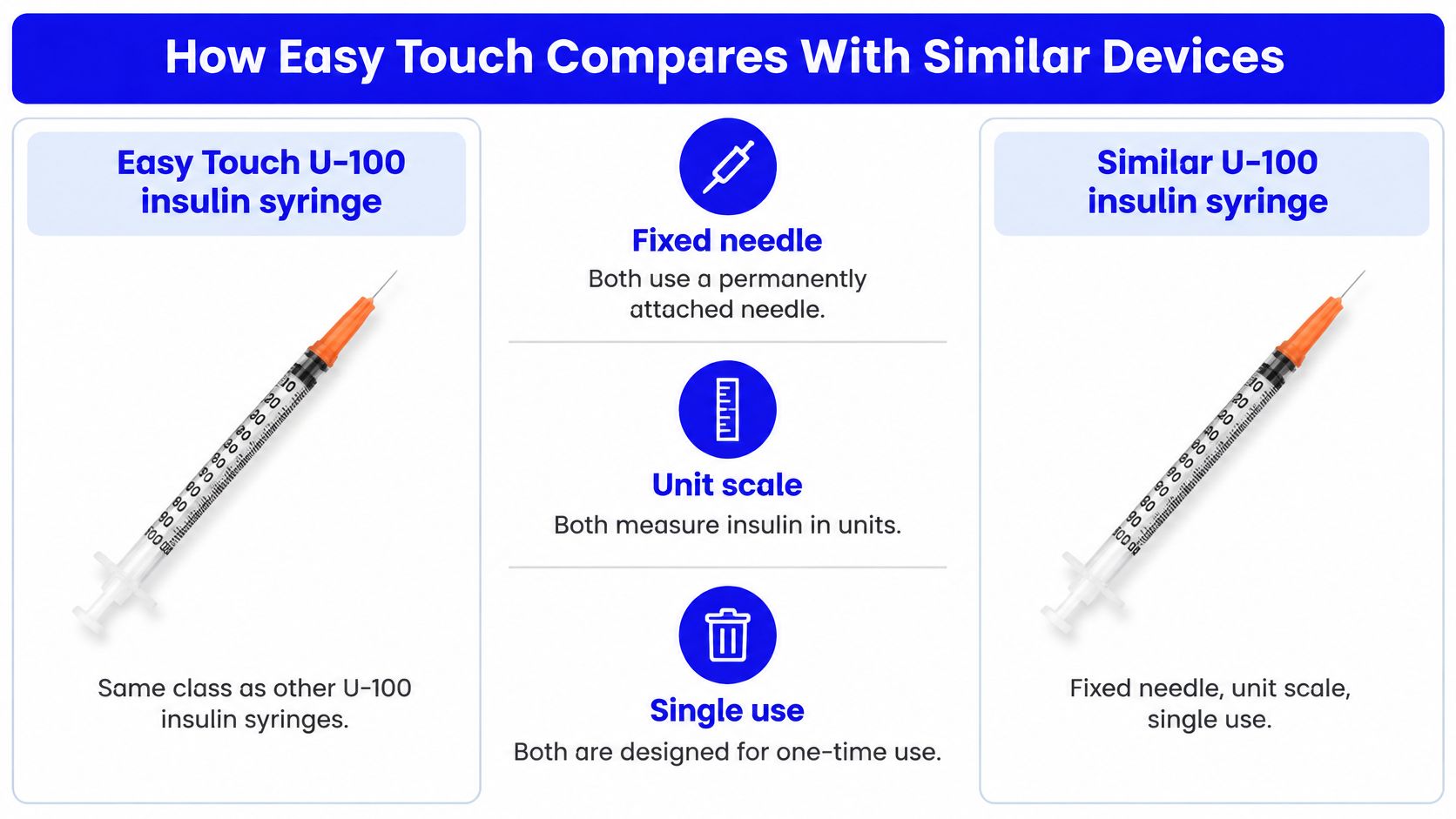
Comparing functions rather than brands
A vial-and-syringe setup exposes the drawn amount on the barrel. A pen stores insulin and uses a dialed dose mechanism; the detachable EasyTouch pen needle supplies the cannula, not the measurement.
A milliliter-marked syringe for another medicine uses a different measuring language. For nonclinical work, syringe selection for RUO lab workflows concerns equipment chosen for a validated laboratory method, not repurposing an insulin-unit scale.
Pens also have an ownership restriction beyond needle disposal. The CDC injection-safety guidance states that blood can remain inside a used pen, so changing its needle doesn't make sharing safe. Pens should be assigned to one person, labeled, and used with a new needle for each injection; FDA labeling likewise carries a single-patient-use warning.
The accompanying video provides a visual reference for insulin-pen handling.
A dated price check
Documented Easy Touch syringe prices in 2024 and 2026
| Listing | Year | Pack | Price shown |
|---|---|---|---|
| 31G, 1.0 cc, 5/16 inch, Pricehistory.app | 2024 | 100 count | $21.99 current at capture; $16.86 reported average; $26.99 high |
| 27G, 1 cc, 5/8 inch, Diabetic Overstock | 2024 | 100-count box | $24.99 |
| 28G, 1 cc, 1/2 inch, Diabetes Supply Store | 2026 | Case of five boxes | $95.74 versus $134.04 reference |
| Individually wrapped syringes, Cardiac Direct | 2026 | 100 count; 30 count | $39.50; $12.99, respectively |
The final row groups the seller's two pack listings rather than implying that they're interchangeable purchases. These are historical seller snapshots, not live quotes or a best-price ranking. Pack format, needle geometry, and seller all affect whether a comparison is useful.
Monitoring is another separate decision. The explanation of CGM benefits from ProMD Health Bethesda offers context for glucose tracking, but monitoring equipment doesn't validate an injection-device match.
The right comparison starts with concentration compatibility and needle geometry, not the lowest box price. A residual-volume marketing claim also shouldn't substitute for a measured tolerance when low-volume accuracy matters.
How an Easy Touch Pen Injection Is Done
An EasyTouch pen needle is an attachment used with a compatible insulin pen, not evidence of a particular pen brand or dosing mechanism. The pen's own instructions take priority when its priming or hold procedure differs from general guidance.
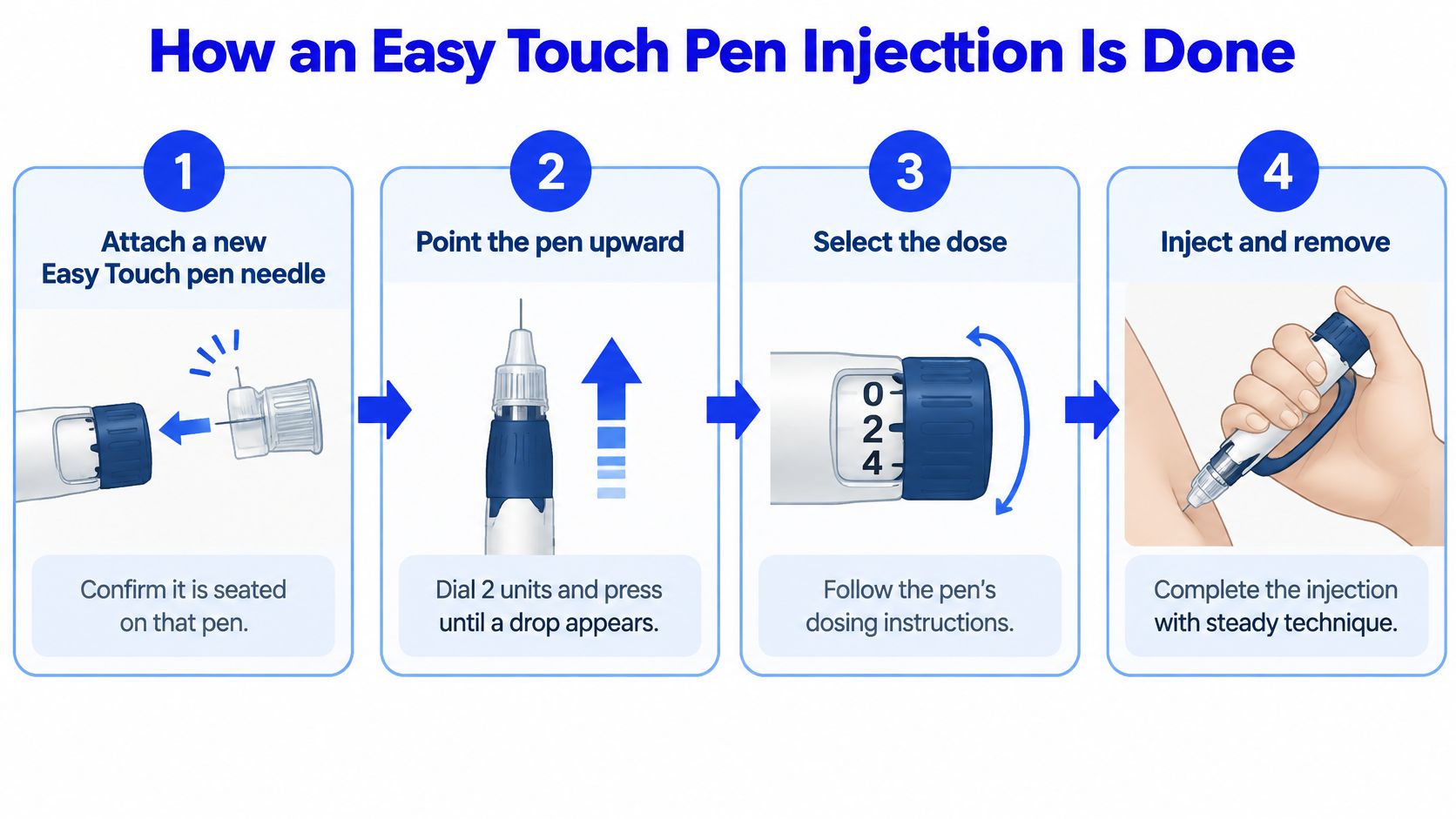
The sequence is prepare, prime, select, insert, press, and hold. It's a technique sequence, not permission to change the prescribed dose.
The illustration shows the broad sequence; the details below explain the pause and hand position.
Prime before selecting the treatment dose
Attach a new needle. After hand hygiene and checking the prescribed insulin, the user attaches a compatible EasyTouch pen needle and confirms that it's seated correctly. Protective caps are removed according to the device instructions.
Prime with the pen pointing upward. Diabetes UK's injection guidance describes dialing 2 units and pressing until a drop appears, repeating the prime if no drop appears. This clears air and confirms flow before the prescribed dose is selected.
Dial only the prescribed dose. The priming amount isn't an extra treatment dose. Failure to obtain flow calls for the pen's troubleshooting instructions or pharmacist assistance, not an assumed correction to the prescription.
Insert fully before pressing
Use the taught insertion angle and skinfold technique. The Mayo Clinic Proceedings injection recommendations30321-4/fulltext) describe inserting a 4 mm needle at 90 degrees, with or without a lifted skinfold; longer needles may require a properly lifted skinfold to reduce muscle-entry risk. The same recommendations specify pressing the thumb button only after full insertion and pushing straight along the pen's axis.
Complete the button press steadily. The counter should reach its completed-dose position. Sideways pressure or an awkward grip can interfere with controlled operation, so a user struggling to depress the button should have the technique assessed.
Hold before withdrawing. Cleveland Clinic's insulin-pen guidance describes holding the pen in place for 6–10 seconds; the slow 10-second count in the Diabetes UK sequence provides a clear general routine. NHS guidance also specifies that hold, although the particular pen's instructions remain controlling.
Withdraw and discard the needle safely. The used needle goes into an appropriate sharps container using the manufacturer's removal method. It isn't kept for the next injection.
The counter reaching its endpoint isn't a signal to pull the pen away immediately. A steady hold allows delivery to finish before withdrawal.
A rushed press followed by immediate removal can leave insulin on the skin, particularly with a larger dose. Visible leakage shouldn't prompt an improvised replacement dose because the amount already delivered is uncertain.
For syringe use, the boundary remains the prescribed U-100 dose, cleared bubbles, and an eye-level reading. Pen priming instructions aren't a substitute syringe procedure.
Safety Limits and Final Setup Check
A familiar brand and legible markings don't remove the need to inspect the packaging. EasyTouch's recall history illustrates why traceability is part of device safety, even when the reported problem isn't a visibly damaged needle.
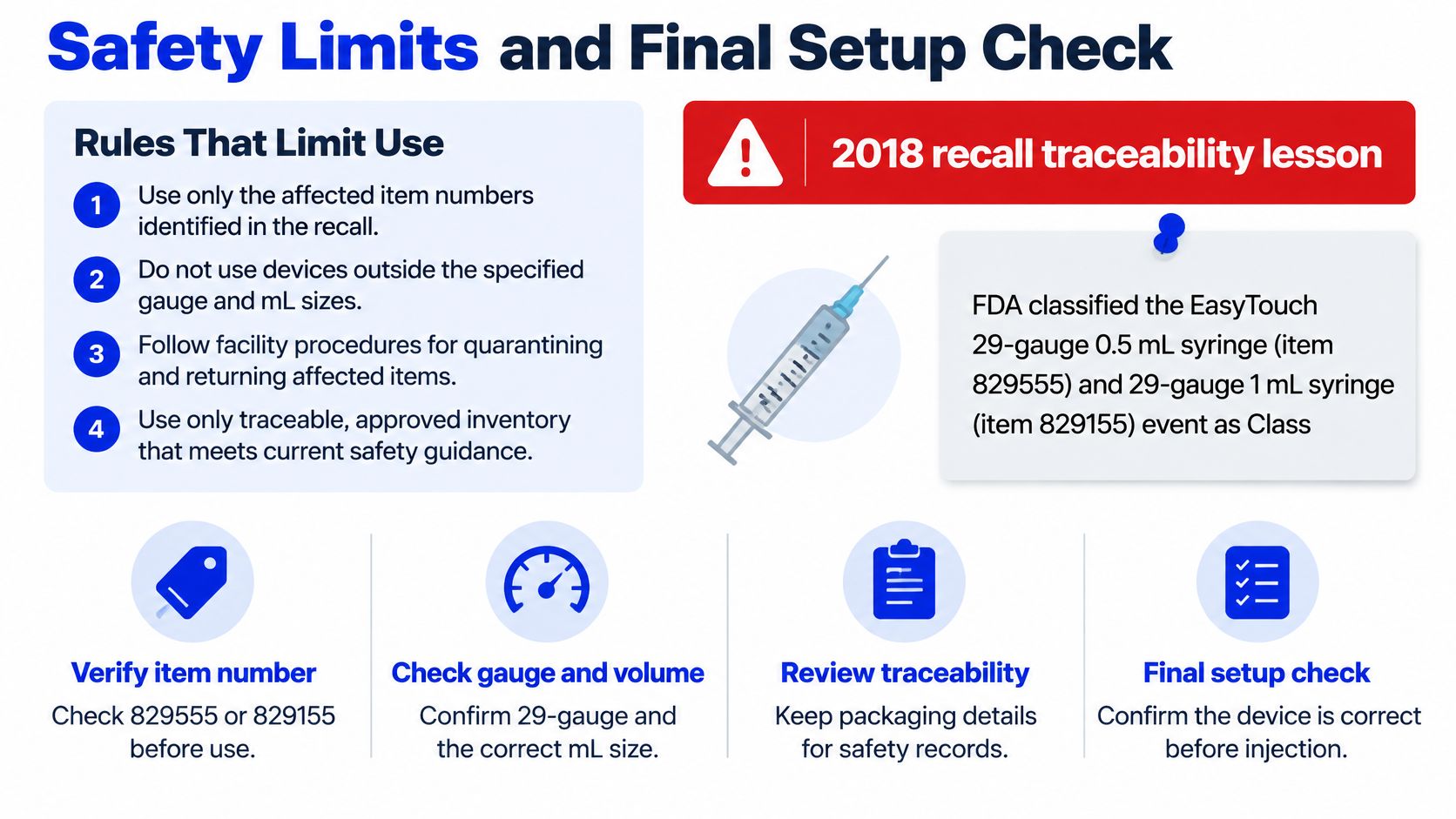
The FDA EasyTouch recall record documents a Class 2 recall initiated by MHC Medical Products LLC on April 6, 2018, involving the 29-gauge, 0.5 mL syringe, item 829555, and the 29-gauge, 1 mL syringe, item 829155. The stated problem was incorrect lot-number labeling on retail shelf cartons.
What the recall does and doesn't establish
The event was primarily an identification and traceability issue. It doesn't establish that every EasyTouch syringe was physically defective, and it shouldn't be presented as a current recall covering every product carrying the name.
Class 2 generally concerns circumstances in which exposure may cause temporary or medically reversible adverse effects, while the probability of serious harm is remote. That classification still warrants attention to the affected product identifiers and the manufacturer's corrective instructions.
Before use, the item, size, and lot information should be checked across available packaging. An unexplained mismatch between an outer carton and an inner box is a reason to set the product aside and ask a pharmacist or supplier to verify it.
The safety graphic highlights the packaging checks.
Concentration is a hard boundary
A U-100 syringe must not be casually repurposed for U-200, U-300, or U-500 insulin. Its printed units don't directly represent the insulin units in those different concentrations, so an apparently familiar mark can produce a major dosing error. Compounded formulations also require explicit confirmation of concentration, device, and prescribed measurement.
These syringes aren't for administering unapproved research substances or replacing calibrated laboratory equipment. A mathematical relationship between volume and concentration doesn't validate the device, formulation, sterility, or intended route.
The broader principle in injection equipment selection by formulation is that equipment must suit the substance and its intended use. An insulin device shouldn't be selected for another formulation merely because its needle appears convenient.
Stop condition: An unfamiliar concentration, inconsistent lot label, or proposed shared pen requires clarification before use, not an improvised workaround.
The single-patient rule remains absolute even when a fresh needle is available. A household member or caregiver should never transfer a used pen to another person.
The final setup check
- Right product type: A vial-and-syringe prescription needs a syringe; a pen needs a compatible pen needle.
- Right concentration: The syringe calibration and prescribed insulin must match.
- Right capacity or directed length: The syringe should hold the dose without unnecessary excess capacity, or the pen needle should match the directed length.
- New needle: Packaging should be intact, and the needle should be unused.
- Complete pen hold: The user should be prepared to keep the needle in place for the prescribed slow count before withdrawal.
A pharmacist or prescriber should resolve compounded insulin instructions, milliliter-based directions paired with an insulin-unit scale, uncertain markings, or a questionable lot label. Someone proposing pen sharing needs a separate pen, not reassurance that changing the needle will suffice.
The most useful preparation is to bring the actual insulin container, device package, and prescription directions to that conversation. Those items allow the professional to check the concentration, unit language, and device together rather than relying on a remembered brand name.
Herbilabs offers research-use-only reconstitution solutions and educational guides on syringe measurements and laboratory equipment selection. Readers can visit Herbilabs to compare labware information while keeping research workflows separate from clinician-directed insulin administration.