Private Label, White Label, Wholesale partnerships available - EU, USA and UK - Free shipping from €75

Na Cl 0 9 Explained: What the Lab Label Really Means
0.9% NaCl contains 0.9 g of sodium chloride per 100 mL, which equals 9 mg/mL or about 154 mmol/L, and the reader must confirm that figure on any certificate of analysis. Advice to choose a diluent because its label says 0.9% misses the decisive question: which component does the percentage describe?
A search for na cl 0 9 may lead to saline, bacteriostatic water or a preserved sodium chloride solution. Those materials aren't interchangeable experimental controls. This guide addresses research-use-only materials and laboratory workflows, with acceptance governed by the laboratory's approved standard operating procedure, or SOP.
By Herbilabs
Table of Contents
- What 0.9% NaCl Is and What the Number Means
- Telling 0.9% Salt Apart from Bacteriostatic Water
- Receiving Checks for a Bacteriostatic Water Lot
- Storage and Labeling for Research Use Only
- Reconstitution Maths Worked Through for Lab Worksheets
- Handling an Opened Multi-Use Vial and Its Four Clocks
- Common Mix-Ups and How to Fix Them
- Confirm Your Diluent Before You Reconstitute
What 0.9% NaCl Is and What the Number Means
The percent sign expresses a mass-per-volume concentration, not a direct reading in milligrams per millilitre. The regulatory composition label specifies 0.9 g per 100 mL, equivalent to 9 g/L or 9 mg/mL, with a molar concentration of approximately 154 mmol/L. Reading the percentage as 0.9 mg/mL would produce a solution ten times too weak.
The familiar name normal saline identifies a conventional formulation. It doesn't establish the material's sterility, endotoxin status, container suitability or compatibility with a research procedure.
Sodium chloride 0.9% composition checkpoints
| Property | Value | What to check |
|---|---|---|
| Sodium chloride concentration | 9 mg/mL (0.9 g per 100 mL) | Label reads 9 mg/mL, not 0.9 mg/mL |
| Molar concentration of NaCl | About 154 mmol/L | Matches the stated specification |
| Sodium and chloride ions | 154 mmol/L each (154 mEq/L) | Both ions reported at the same level |
| Calculated osmolarity | About 308 mOsmol/L | Reported value agrees with the calculation |
| Appearance | Clear, colourless solution | Reject if cloudy, coloured or containing particles |
The reviewer should work down those checkpoints in order. First, the mass concentration must agree between the container label and certificate of analysis, or COA. Next, the molar expression must describe the same formulation rather than a different concentration written in unfamiliar units.
Sodium chloride dissociates into sodium and chloride ions. The matching ionic values provide another consistency check, while the calculated osmolarity accounts for both dissolved components. A discrepancy deserves investigation rather than a handwritten correction to make the documents agree.
Visual inspection is a screening check, not a sterility test. A clear solution can still lack the quality evidence a method requires.
The receiving record should keep material identity, concentration expression, container volume, lot identity and storage conditions in separate fields. Combining everything into a description such as saline vial makes later reconciliation unnecessarily difficult.
The same separation belongs in the specification. A concentration result answers how much salt is present; it doesn't answer whether the lot meets the laboratory's microbiological or method-specific requirements. Release should require agreement across those attributes, not merely a familiar product name.
Telling 0.9% Salt Apart from Bacteriostatic Water
A percentage doesn't name a substance. Before a laboratory compares products, the reviewer must identify the ingredient attached to that percentage and read the complete composition statement.
The identification chart separates the label questions that often get compressed into a single assumption.
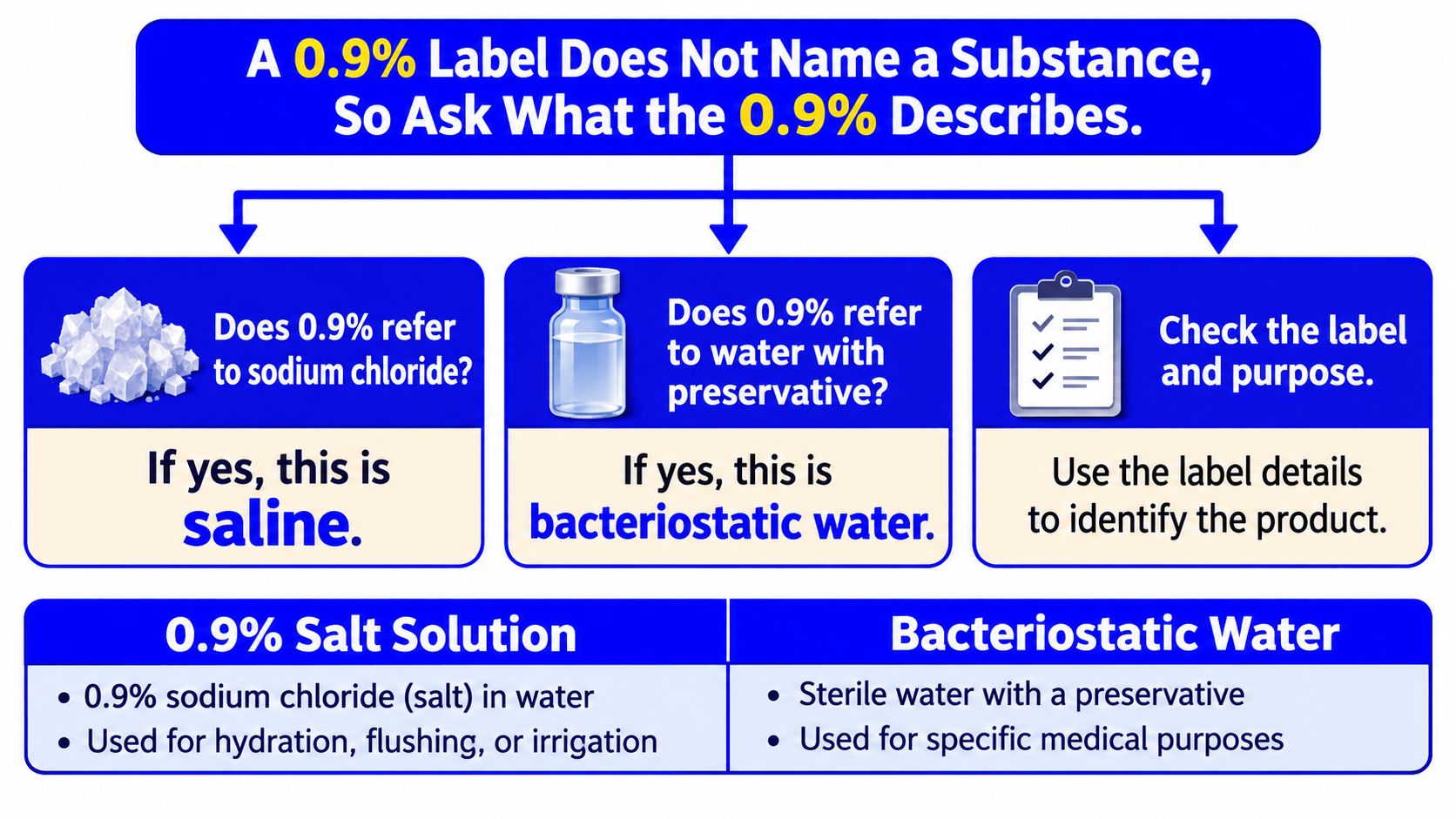
The label-reading decision
- Identify the component. Does the percentage describe sodium chloride, benzyl alcohol, or separate entries for both?
- Read the material description. Is the container labelled sterile water, sodium chloride solution or a bacteriostatic preparation?
- Match the protocol. Does that composition supply the matrix required by the assay, including its controls?
The bacteriostatic sodium chloride label describes a formulation containing both 0.9% sodium chloride and 0.9% benzyl alcohol, equivalent to 9 mg/mL of each. The distinction is chemical, not merely a difference in naming: plain saline supplies salt, bacteriostatic water supplies a preservative without the sodium chloride component, and the combined formulation supplies both.
Diluent materials compared by component
| Material | 0.9% component | Preservative | Typical lab role |
|---|---|---|---|
| 0.9% sodium chloride solution | 9 mg/mL NaCl | None listed | Isotonic salt diluent where the protocol needs salt in the matrix |
| Bacteriostatic water | 9 mg/mL benzyl alcohol | Benzyl alcohol | Reconstitution with repeated withdrawals from one vial, where validated |
| Bacteriostatic 0.9% sodium chloride | 9 mg/mL NaCl plus 9 mg/mL benzyl alcohol | Benzyl alcohol | Only where the protocol specifies both components |
| Sterile water | No additive | None | Diluent where no additive is acceptable to the method |
Isotonicity doesn't make diluents interchangeable. Matching an osmolarity description doesn't establish matching ionic strength, preservative content, pH or analytical background. A method may tolerate added salt but not a preservative, or require an additive-free matrix.
The practical trade-off is between handling convenience and experimental control. Repeated access may suit a study's workflow, but a preserved diluent introduces a component that the method must accommodate. The assessment should include benzyl alcohol safety for laboratory research alongside compatibility and interference checks.
The accompanying video provides another label-identification reference.
The selection rule is straightforward: the protocol's required experimental control determines the diluent. Neither the name normal saline nor an isolated percentage settles that decision.
Receiving Checks for a Bacteriostatic Water Lot
The regulatory bacteriostatic water labels define a sterile, nonpyrogenic water preparation containing benzyl alcohol, commonly 0.9% or 9 mg/mL, with some labelled products containing 1.1% or 11 mg/mL, in a multiple-dose container. Those alternatives make preservative strength an acceptance criterion, not a detail that can be assumed from the material name.
At receiving, the reviewer should place the vial, purchase specification and lot-specific COA together. Matching a catalogue description alone isn't enough because the acceptance decision concerns the actual lot delivered.
Receiving checks for a bacteriostatic water lot
| Checkpoint | What to confirm | Hold or reject if |
|---|---|---|
| Concentration label | Benzyl alcohol at 0.9% (9 mg/mL), or 1.1% (11 mg/mL) where labelled | Preservative strength differs from the protocol |
| Container | Multiple-dose vessel with lot identity matching the COA | Lot number missing or not matching the COA |
| Appearance | Clear solution | Cloudiness, particles or colour |
| Seal | Closure intact before first use | Broken, loose or damaged seal |
| Labelling | Research-use-only wording matching the intended use | Wording conflicts with the protocol's intended use |
| Dates | Expiry printed on the vial and first-puncture field ready to record | No expiry recorded on the vial |
A missing document usually calls for a hold pending reconciliation. A visibly compromised container calls for segregation and a rejection decision under the SOP. Neither condition should be resolved by putting the vial into usable stock while someone investigates.
The reviewer should also distinguish a measured COA result from a specification limit or a general product statement. Where the protocol requires sterility or endotoxin evidence, the release record must identify the relevant evidence rather than infer it from appearance.
The cited labels describe a different regulated diluent context; they don't replace a laboratory-specific acceptance procedure. The site's approved SOP determines which documents and release criteria apply to its research-use-only inventory.
For plain saline lots, the same receiving discipline applies to the sodium chloride concentration, lot match and absence of a listed preservative. The finished record should identify the reviewer, inspection outcome, supporting documents and disposition so another staff member can reproduce the acceptance decision at audit.
Storage and Labeling for Research Use Only
Storage decisions should start with the vial label, not a remembered rule for similar-looking materials. At receipt, the technician should compare the specified storage conditions with the available transport and temperature records, then document any gap before releasing stock.
A suspected excursion requires quarantine and assessment, not an automatic return to the shelf after the container reaches the expected temperature. Returning a vial to normal storage doesn't reconstruct its earlier history.
Separate identity from location
- Name the component. Storage records and bench sheets should identify sodium chloride or benzyl alcohol rather than carry only a percentage.
- Separate look-alike stock. Plain saline and preserved materials belong in distinct, clearly labelled positions.
- Retain traceability. The lot, operator and storage record must remain connected when a vial moves from receiving to the bench.
- Control working labels. Added labels must leave the original identity, lot and expiry readable.
The storage position should make the correct selection easy without relying on cap colour or bottle shape. A dedicated location helps prevent picking errors, but it doesn't replace checking the label against the worksheet before use.
For bacteriostatic water, the handling record should also preserve the distinction between sealed stock and material already entered. Vials should remain sealed until needed and return promptly to their specified storage conditions after withdrawal.
Unknown storage history is a disposition issue. QA must resolve it before the material returns to usable stock.
Research-use-only wording on the carton or vial must match the study's permitted use. These materials belong exclusively in laboratory research workflows.
The SOP should define when staff record time out of storage and which temperature evidence accompanies each handling event. If that evidence can't demonstrate acceptable storage, the material remains quarantined until QA records its disposition.
Reconstitution Maths Worked Through for Lab Worksheets
A concentration label is only useful when the worksheet shows which mass and volume produced it. The basic relationships are volume = mass ÷ target concentration, concentration = mass ÷ volume, and mass = concentration × volume. These are the general calculator relationships described in the reconstitution calculator guidance.
Keep units visible
For example, 500 µg ÷ 100 µg/mL = 5 mL. Keeping units in each step helps catch mismatches between the material label and worksheet before a value is transferred.
The following hypothetical worksheet cases use the same arithmetic. They illustrate concentration calculations, not recommended experimental amounts.
Reconstitution volumes for common targets
| Starting mass | Target concentration | Volume to add | Resulting concentration |
|---|---|---|---|
| 500 µg | 100 µg/mL | 5 mL | 100 µg/mL |
| 500 µg | 50 µg/mL | 10 mL | 50 µg/mL |
| 500 µg | 250 µg/mL | 2 mL | 250 µg/mL |
| 250 µg | 100 µg/mL | 2.5 mL | 100 µg/mL |
Record the calculated volume separately from the actual volume transferred. If the transfer differs from the planned value, document the deviation and recalculate the resulting concentration rather than carrying the original target forward.
Reconstitution adds liquid to dried material. Dilution starts with an existing solution and lowers its concentration by adding diluent. For dilution calculations, record the starting solution concentration and the transferred aliquot.
A complete worksheet records material amount, target concentration, calculated volume, actual transferred volume, material and diluent lots, and operator review. The Herbilabs Reconstitution Calculator is a calculation aid for lab material; the worksheet remains the record of the values selected and transferred.
The result is nominal. Arithmetic alone does not establish complete dissolution, homogeneity, recovery, sterility or stability. The method should define whether the added volume represents the final solution volume and what checks are required before the preparation enters an assay.
Handling an Opened Multi-Use Vial and Its Four Clocks
A vial has separate limits for sealed storage, time after first puncture, material-specific stability, and physical integrity. The often-used 28-day in-use window does not extend the unopened expiry or establish how long a particular material remains stable after preparation. Apply the product instructions and approved SOP, and use the earliest applicable limit.
Aseptic technique applies at every entry. Clean the stopper with the approved antiseptic and let it dry for the required time. Preservation does not compensate for poor handling.
The access routine
- Inspect before handling. Check the solution and closure. An unexpectedly opened container, cloudiness, or damaged seal requires rejection or quarantine under the SOP.
- Establish the access record. Record the first puncture when the vial is initially entered. Keep later withdrawals traceable to that date.
- Verify storage status. Review the applicable temperature record before proceeding. Do not use the vial while an excursion remains unresolved.
- Prepare the stopper. Apply the approved antiseptic and allow the required drying time.
- Use fresh sterile equipment. Use a new sterile access device for each entry. Never return previously used equipment to the vial.
- Protect critical surfaces. Withdraw only the required volume without touching the access device's critical surfaces.
- Close the record. Log the date, operator, volume, and lot, then return the vial to storage.
Dating clocks for an opened multi-use vial
| Clock | Starts when | What it tells you | Action when it runs out |
|---|---|---|---|
| Unopened expiry | The printed expiry applies to sealed stock | Shelf life of sealed stock | Do not use after the printed date |
| First-puncture date | First entry into the vial | Start of the in-use window | Write it on the vial at first entry |
| In-use window | First puncture, up to 28 days | Working limit under aseptic handling | Discard at day 28 or earlier if the SOP requires |
| Early discard trigger | Visible particles, damaged closure, or uncertain storage | A possible integrity or contamination concern | Quarantine and discard before the window ends |
Which date governs
If a vial is first punctured on 3 March, a 28-day window ends on 31 March. A shorter protocol limit, an earlier printed expiry, or an integrity concern takes precedence.
Record the first-puncture date, then assign the discard date using the site's approved counting convention and applicable product instructions. A damaged stopper or uncertain handling event means the vial should be assessed under the SOP, regardless of how many days remain.
The earliest applicable stop condition governs. A clear appearance alone does not establish that a vial remains suitable for use.
Common Mix-Ups and How to Fix Them
A diluent swapped partway through a study can introduce an uncontrolled variable. When salt or preservative appears in only part of the sample set, a signal change may reflect the preparation matrix rather than the research material.
The sodium chloride formulation label documents a preservative-free formulation containing sodium chloride and water. That composition mustn't be assumed equivalent to a preserved reconstitution material merely because both labels carry a familiar concentration description.
Worksheet symptoms, likely causes and fixes
| Symptom on the worksheet | Likely cause | First fix |
|---|---|---|
| Assay signal shifts after switching diluent | Salt or preservative present in one diluent only | Keep one diluent per study and run a matched control |
| Concentration recorded as 0.9 mg/mL | Percent misread as mg/mL | Recalculate from the stated percentage in mg/mL |
| Calculated concentration does not match a measured result | Nominal calculation treated as a test result | Report the calculation as nominal and test recovery separately |
| Diluent changed without a record | Two 0.9% products stored together | Record material, lot and COA before reconstitution |
| Cloudy material after reconstitution | Contamination, incomplete mixing or wrong diluent | Quarantine, inspect the vial and retest per the SOP |
The first response to a signal shift should be a document comparison, not an adjustment to the assay result. Staff should compare the complete compositions, preparation records and controls, including any change in container or lot.
A matched diluent control should use the same diluent and lot as the corresponding samples. An additive-free blank won't isolate the background introduced by a preserved sample matrix.
A clean calculation cannot correct an uncontrolled change in composition.
Keeping one diluent specification throughout a study reduces avoidable variation. When a substitution is unavoidable, the change needs documented compatibility assessment before routine use, including relevant pH, excipients, container materials and method-specific interference.
Cloudiness deserves particular caution because appearance alone can't identify its cause. Extra mixing, filtration or a replacement diluent shouldn't become an undocumented attempt to rescue the preparation.
Persistent cloudiness or an unexplained result requires quarantine and QA review under the SOP. The investigation should preserve the original worksheet and handling history rather than overwrite them with a corrected preparation.
Confirm Your Diluent Before You Reconstitute
The release decision should pass through four gates before routine reconstitution begins. Each gate answers a different question, and passing the arithmetic gate doesn't compensate for a failed identity or handling check.
- Protocol gate. The worksheet names the required diluent and the experimental control it protects. The component-identification questions establish whether salt, preservative, both or neither belongs in the matrix.
- Identity gate. The label and COA match that requirement, including preservative strength where relevant, lot identity and research-use-only wording. The receiving record documents acceptance rather than an assumption.
- Calculation gate. The operator records the planned transfer and provides a field for the actual volume. The resulting concentration remains explicitly nominal until the method's verification requirements are met.
- Handling gate. The access record is ready, the applicable discard limit is determined, and the operator follows the approved aseptic routine.
Herbilabs Reconstitution Solution 10 mL is purified using a 0.22 µm filtration process and aseptically filled. It is for research use only and is not for administration to humans or animals; those product attributes don't replace the laboratory's compatibility assessment or handling controls.
A failed gate requires a stop. The material should remain quarantined while QA resolves the discrepancy under the approved SOP, rather than having staff alter the calculation or substitute a convenient diluent.
The practical decision is to confirm composition, documentation, arithmetic and handling status before proceeding. A familiar percentage is only the beginning of that check.
Herbilabs offers research-use-only bacteriostatic water and reconstitution solution with lot-specific certificates of analysis. Visit Herbilabs to review the available materials and compare their composition and documentation with the laboratory's approved protocol before ordering.