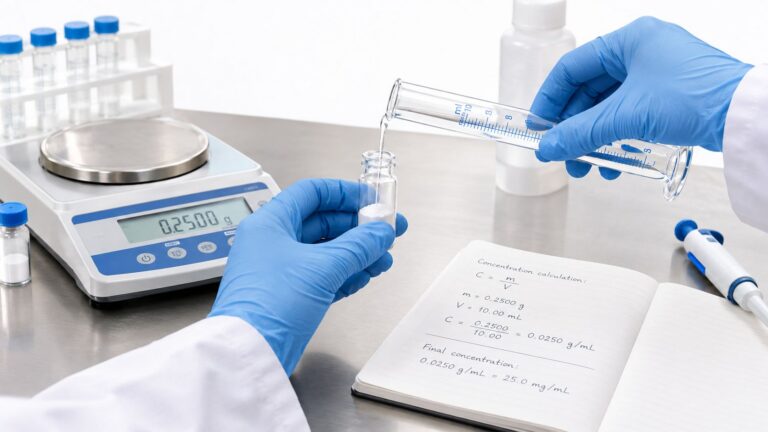
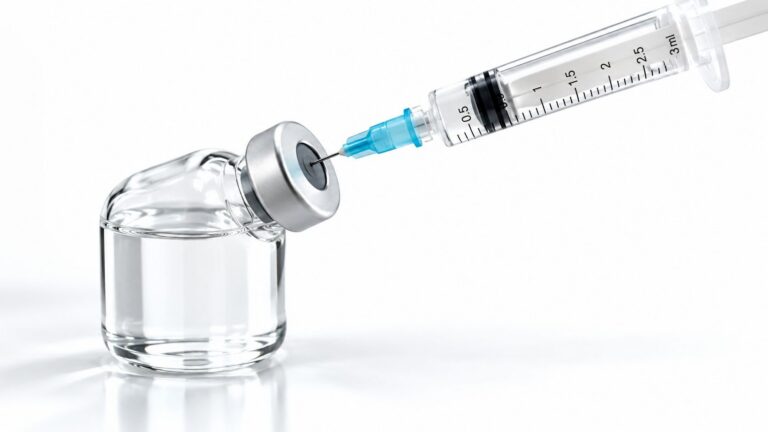
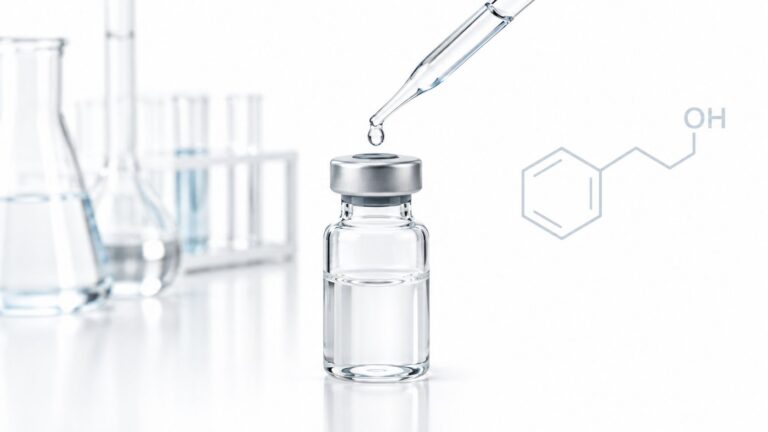
Private Label, White Label, Wholesale partnerships available - EU, USA and UK - Free shipping from €75

What Is a Multi Dose Vial and How Does It Work
A multi-dose vial is a sterile, manufacturer-labeled container designed to provide more than one withdrawal, typically using an antimicrobial preservative such as 0.9% benzyl alcohol. After the first puncture, the vial usually enters a defined 28-day in-use period, unless the product instructions require an earlier discard.
A researcher may open a vial during a morning assay, withdraw a measured aliquot, and return the container to storage. Later, another researcher may need the same material for a second experiment. The convenience is obvious, but repeated access also creates a recordkeeping and contamination challenge. The vial isn't “safe to reuse” just because it has multiple doses. Its safety depends on the container design, preservative system, handling technique, storage conditions, and documentation.
Table of Contents
- What Is a Multi Dose Vial and Why It Matters in the Lab
- How Multi Dose Vials Are Built and Filled
- The Role of Benzyl Alcohol and Other Preservatives
- Aseptic Access and the 28-Day In-Use Window
- Typical Lab Uses for Peptides, Proteins, and Antibodies
- Risks and Trade-offs of Multi Dose Vial Use
- QA Documentation and Lot Traceability for RUO Labs
- Key Takeaways and Common Questions Answered
What Is a Multi Dose Vial and Why It Matters in the Lab
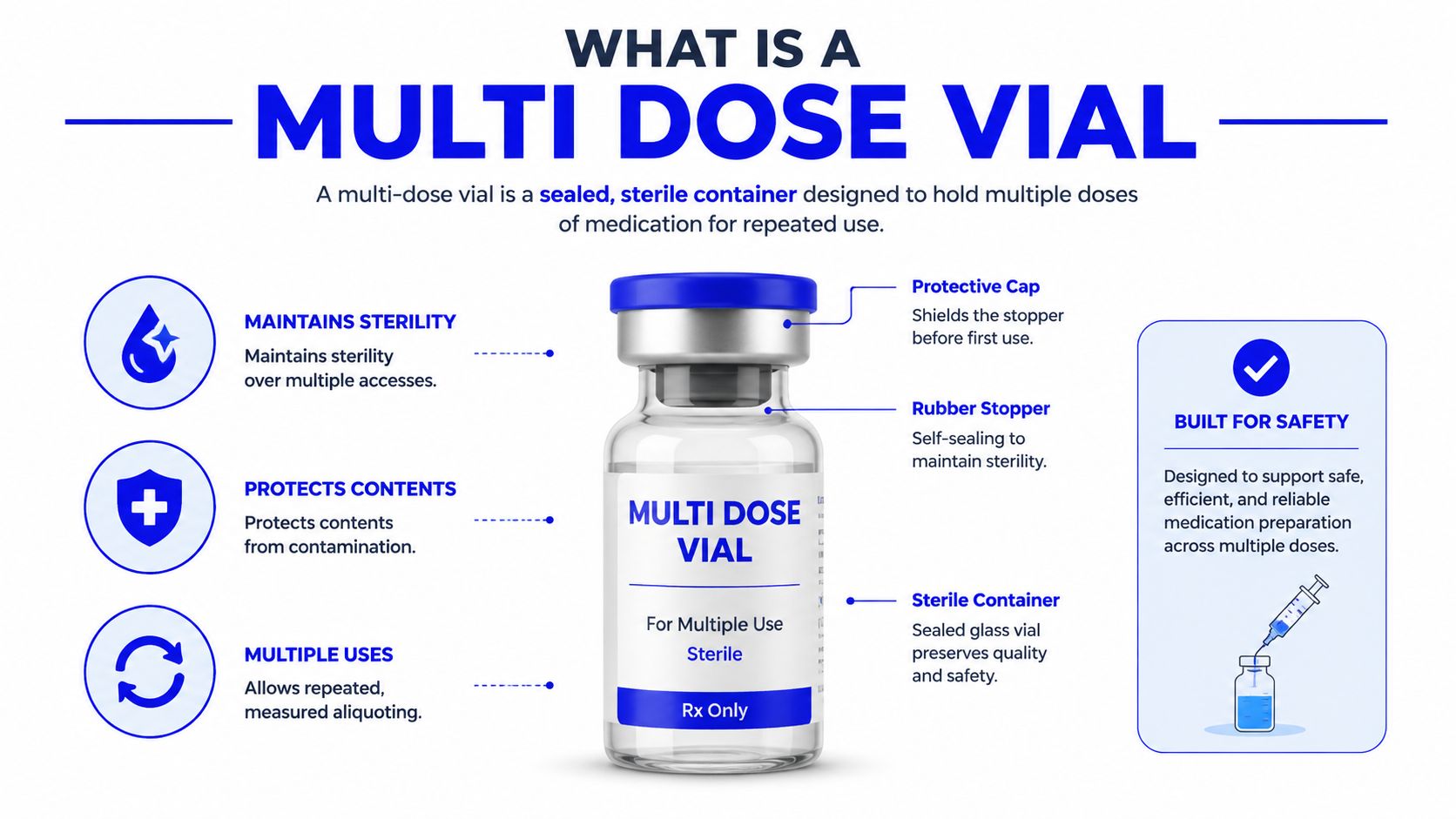
During a morning assay, a researcher may withdraw a measured aliquot from a stock vial, record the access, and return the container to storage. A colleague may need that same material for another run later. A multi-dose vial is designed for this pattern: a sealed sterile container labeled for repeated withdrawals through a closure intended to reseal after needle access. A single-use ampoule or single-dose vial is opened for one use instead.
The format suits research-use-only work because a small working volume may serve several assay runs. A peptide, protein, or antibody solution can be withdrawn in measured amounts for reconstitution, serial dilution, binding studies, or cell-based protocols. Keeping one stock available can reduce repeated preparation and support a consistent working solution, provided each access follows the laboratory's approved aseptic procedure.
The Centers for Disease Control and Prevention describes multi-dose vials as containers holding more than one dose. Its CDC injection safety guidance explains why access control matters: a contaminated needle or syringe can contaminate the remaining contents. The first puncture also starts an operational record. Staff should date the vial and manage it within the product's defined in-use period.
The container is only the starting point
A senior lab coordinator can trace each withdrawal through five connected controls:
- Container design: Glass, stopper, septum, and crimp seal form the physical barrier.
- Preservative chemistry: The formulation supports repeated withdrawals by suppressing microbial growth. Proper aseptic technique remains the primary barrier against contamination.
- Aseptic workflow: Each puncture uses a new sterile syringe and needle, a disinfected stopper, and controlled handling.
- In-use dating: The opening date starts a discard clock that must remain visible to authorized users.
- Traceability: Lot information, diluent, concentration, access time, and operator details connect every withdrawal to the original container.
This connection between the container and the workflow is the practical point. The preservative supports repeated access, while clean technique, correct storage, and an accurate record protect the material and the next assay. Researchers comparing container options can also review the broader glass injection vial format when setting up a defensible workflow and paper trail.
How Multi Dose Vials Are Built and Filled
Repeated sterile access depends on several components working together. The glass body provides the primary container, the elastomeric closure seals the opening, and the aluminum crimp holds that closure firmly in place. The visible cap is only one part of the system.
Type I borosilicate glass is commonly selected for injectable and laboratory vial bodies because it provides a strong barrier and low extractables profile. It can support liquid fills and, where the formulation requires it, freeze-dried material. The exact container and closure combination still has to be compatible with the product, because proteins and peptides can respond differently to surfaces, moisture, oxygen, and trace leachables.
The closure system
The stopper contains the central septum, the area where the needle enters. Manufacturers select elastomeric materials, including butyl rubber or laminated designs such as PTFE-facing systems, for properties such as chemical compatibility, resistance to coring, and the ability to reseal after puncture. Resealing reduces the chance of an open channel remaining after needle withdrawal, but it doesn't make a used needle safe or eliminate contamination introduced during access.
The aluminum crimp seal compresses the stopper against the vial finish. It also provides visible evidence that the closure was applied and hasn't been casually removed. A flip-off cap protects the central target area until use. Before access, the researcher should check for a damaged cap, displaced seal, cracked glass, leaking closure, or other visible defect.
How sterility enters the process
Manufacturers may achieve sterility through terminal processing where the formulation and container tolerate it, or through aseptic filling. Aseptic filling can include sterilizing filtration of the bulk solution through a 0.22 micrometer filter, followed by filling into sterilized containers under controlled conditions. The appropriate process depends on the formulation and its sensitivity to heat, filtration, adsorption, and shear.
At the bench, the user doesn't see filtration or filling. The user sees the flip-off cap, the target zone, the stopper, and the crimp ring. Those visible parts provide handling cues, while the internal design supports the repeated-withdrawal purpose. The system only performs as intended when the operator preserves the barrier before, during, and after every puncture.
The Role of Benzyl Alcohol and Other Preservatives
A multi-dose vial often contains an antimicrobial preservative because repeated needle access creates repeated opportunities for microbial introduction. The preservative is intended to suppress or slow microbial growth between withdrawals. It isn't a substitute for a sterile syringe, a clean stopper, or a controlled workspace.
For bacteriostatic water products, the DailyMed labeling for bacteriostatic water specifies 0.9% benzyl alcohol, or 9 mg/mL, as the bacteriostatic preservative. “Bacteriostatic” means the ingredient inhibits or slows bacterial growth. It doesn't mean that every organism is destroyed, and it doesn't mean that the solution remains sterile after careless handling.
Why formulation choice matters
Benzyl alcohol is used because it can interfere with microbial growth in a liquid formulation. The formulation scientist still has to consider the target product, pH, concentration, container materials, and intended use. A preservative that works in one diluent may not be appropriate for a sensitive protein or peptide.
Other preservative systems can include chlorobutanol, methylparaben combinations, or phenol derivatives. Their use depends on the specific product and its compatibility data. Researchers shouldn't assume that all multi-dose vials contain the same preservative or that a preservative-free product can follow the same handling plan.
A product such as bacteriostatic water in a 3 mL vial may fit a small-volume reconstitution workflow, but the product label and the receiving laboratory's SOP still control use. The preservative can support repeated withdrawals, while the researcher remains responsible for recording access and checking the product's stated in-use period.
Practical rule: Preservative protection lowers the risk of bacterial growth. It doesn't neutralize poor aseptic technique, damaged closures, unsuitable storage, or an incompatible formulation.
For research materials, compatibility deserves special attention. A peptide or antibody may lose performance through aggregation, adsorption, oxidation, or other chemical changes even when no visible contamination appears. Microbial control and chemical stability are separate questions, so a vial can be unsuitable for an experiment without looking obviously cloudy.
Aseptic Access and the 28-Day In-Use Window
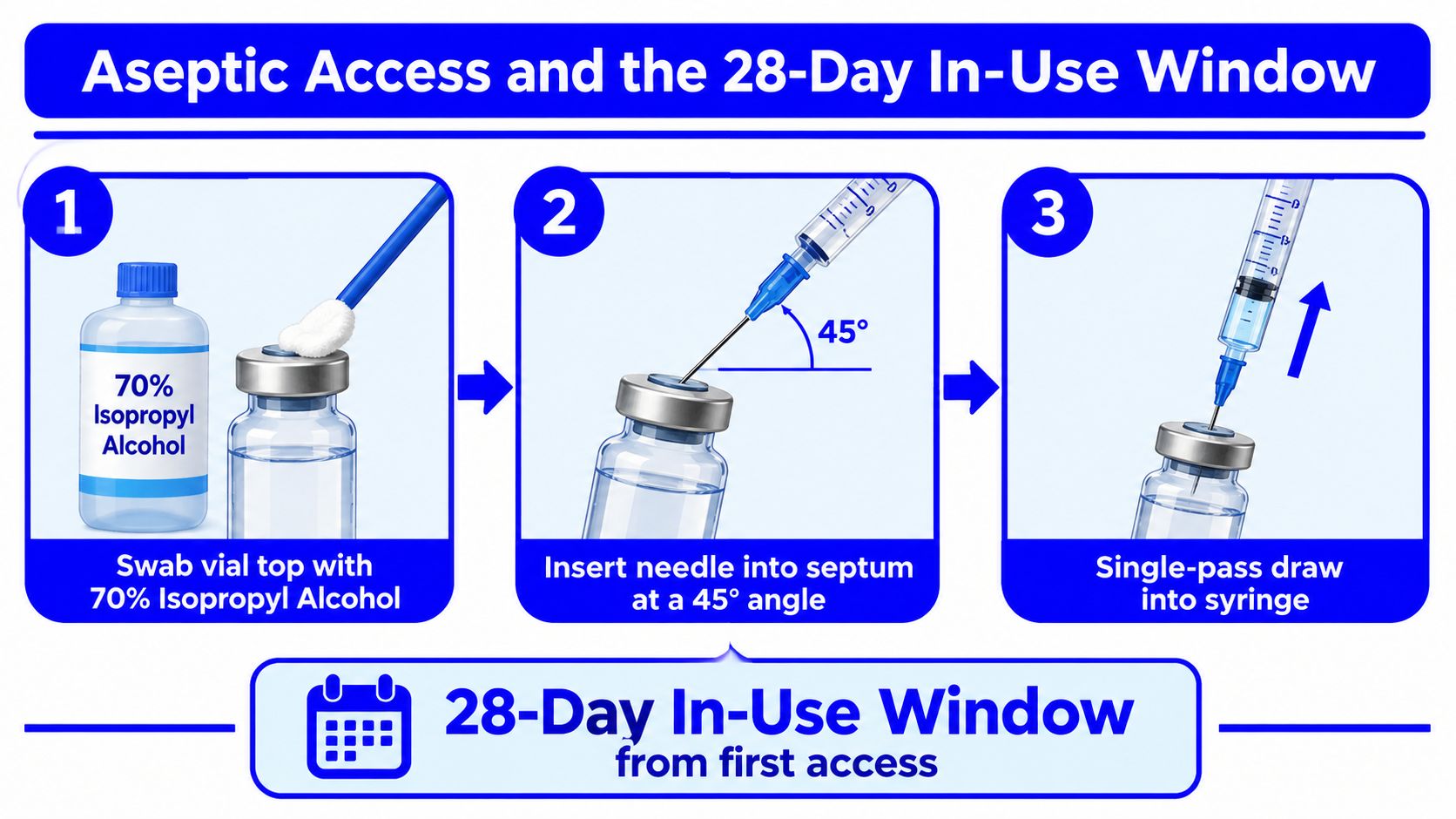
A shared vial can look routine until the syringe reaches its septum. Before access, inspect the container, remove the protective cap when required, disinfect the stopper with a 70% isopropyl alcohol swab, and let the surface dry. Wet alcohol may carry contaminants or affect the puncture surface, so drying is part of the procedure.
Use a new sterile syringe and needle for every entry. Guide the needle through the center of the septum in one controlled movement, avoiding contact that scrapes the rubber. A single-pass draw reduces unnecessary manipulation. A used needle can carry contamination back into the remaining solution and must never return to the vial.
Dating starts at first access
The first puncture starts the operational in-use period. Under the usual 28-day rule, an opened multi-dose vial should be dated and discarded within 28 days, unless the manufacturer specifies another period. The in-use date also cannot extend beyond the original expiration date. Product labeling remains the controlling reference, with the Verbex lab safety guide offering practical methods for organizing expiry tracking and reagent records.
Consider a shared bench vial. Researcher A accesses it in the morning and records the date, time, lot, and initials. Later, Researcher B checks the label and storage condition, disinfects the stopper again, and records the withdrawal in the experiment record. The clock continues from the first puncture. A different user or refrigerated storage does not restart it.
A laboratory using a 10 mL format may select bacteriostatic water in a 10 mL vial when that volume fits its planned work. The same access, storage, and dating controls still apply.
The video below provides a visual reminder of vial access technique:
Typical Lab Uses for Peptides, Proteins, and Antibodies
A common RUO workflow starts with a lyophilized peptide or protein that needs reconstitution before testing. A researcher receives the material, confirms the lot and documentation, selects the approved diluent, and adds the required volume using a sterile syringe. The reconstituted solution can then support several experimental sessions, provided the formulation, storage, and in-use instructions permit that approach.
The format is useful for dose-response work because the same working solution can support a planned series of withdrawals. It can also suit serial dilutions, antibody binding studies, assay development, and cell-based protocols where a laboratory needs repeat access to a prepared stock. The researcher still has to protect the material from light, temperature excursions, excessive agitation, and avoidable delays.
A practical research sequence
Consider a peptide reconstitution workflow without assigning a clinical dose or treatment instruction:
- Receipt: The researcher checks the vial identity, lot number, expiration date, and supplier documentation.
- Preparation: The operator cleans the work area, gathers sterile supplies, and verifies that the selected diluent is compatible with the protocol.
- Reconstitution: The diluent enters the powder vial through a disinfected septum. Gentle swirling can help dissolution where the product instructions allow it.
- Aliquoting: The researcher transfers measured volumes into appropriate working containers or withdraws them directly for scheduled assays.
- Tracking: The original vial receives the first-access date and in-use discard date, while each experiment records the material's lot and preparation details.
A single-dose format may require a new preparation event for each separate session, which can introduce more handling opportunities and more variation between working solutions. A multi-dose format can reduce those events, but it concentrates responsibility in the original vial. One labeling error or contamination event can affect every remaining withdrawal.
Research-only materials shouldn't be treated as approved clinical or diagnostic products. Protocol owners must define the permitted application, the handling controls, and the evidence needed to interpret results. Laboratories developing internal educational material may also use specialist biotech scientific content creation resources to make those procedures easier for new staff to follow, while the laboratory's own SOP remains authoritative.
Risks and Trade-offs of Multi Dose Vial Use
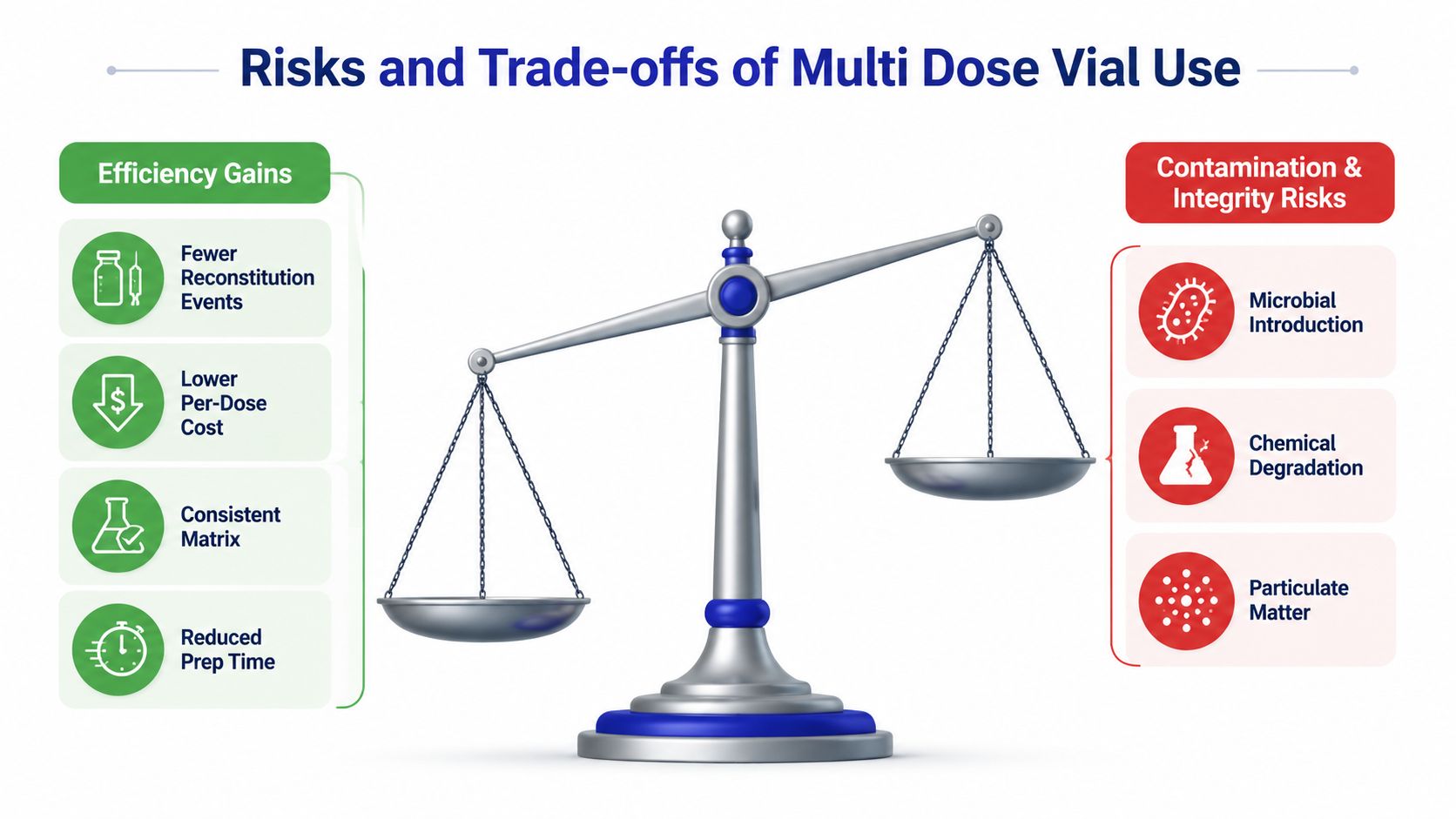
The appeal of a multi-dose vial comes from workflow efficiency. Fewer reconstitution events can mean less preparation, a consistent matrix across related experiments, and more flexible scheduling. The trade-off is that the original vial becomes a shared control point, and every additional access must be performed and recorded correctly.
A useful decision framework separates microbial risk from material integrity risk. The preservative addresses part of the first category. It doesn't guarantee that a peptide, protein, or antibody will retain its intended characteristics throughout the in-use period.
The efficiency side
- Fewer preparation events: The lab can avoid repeating the same reconstitution step for every planned session.
- Flexible aliquoting: Researchers can withdraw only the amount required for an assay or dilution series.
- Consistent source material: Related experiments can use the same lot and prepared stock, reducing one source of procedural variation.
- Simpler inventory planning: A team can coordinate work around a shared container instead of opening multiple separate presentations.
The control side
- Contamination exposure: Each puncture creates another opportunity for bacteria, fungi, particles, or foreign material to enter.
- Preservative sensitivity: Some biologics may not tolerate the preservative system, even when the vial remains visually clear.
- Chemical degradation: Adsorption to surfaces, aggregation, oxidation, and other changes can affect a peptide or protein independently of microbial growth.
- Documentation failure: An unlabeled vial or an unclear discard date makes the material's status difficult to defend.
- Shared-space variability: Multiple operators may follow different habits unless the SOP defines one method and supervisors verify it.
Decision point: A multi-dose vial is a good operational fit only when the efficiency gained is supported by validated handling, compatible formulation data, and visible ownership of the record.
The laboratory should discard the vial early after a contamination concern, damaged closure, unexpected appearance, storage deviation, or uncertainty about identity. Data integrity matters as much as material conservation. Keeping a questionable vial to avoid waste can compromise an entire experiment and make later results difficult to interpret.
QA Documentation and Lot Traceability for RUO Labs
Opening a multi-dose vial should trigger a small documentation chain, not just a handwritten date. The objective is straightforward: every withdrawal should be traceable back to the original container, its lot, its supplier record, and its preparation history.
The Certificate of Analysis, or CoA, is the starting point. Depending on the product, it may identify the lot and report testing such as assay, purity, endotoxin, or sterility-related claims. The receiving researcher or quality coordinator should reconcile the CoA with the purchase record, delivery record, product label, and internal receipt log before the material enters active use.
What belongs on the vial label
After first access, the label should remain readable in the actual storage environment. A practical RUO record commonly includes:
- Identity and lot: Product name or internal code, supplier lot, and receiving record.
- Content details: Concentration, amount, or reconstituted status, together with the diluent used.
- Access record: Date and time of first puncture, operator initials, and the applicable discard date.
- Storage instruction: Required temperature range or location, based on the product documentation and laboratory SOP.
- Status: In use, quarantined, deviation under review, or discarded.
The exact fields should match the laboratory's quality system. A small label can't carry every detail, so the vial record and electronic system should hold the full history. The physical label must still allow the next authorized researcher to determine whether the vial is eligible for use.
From receipt to discard
A simple traceability flow looks like this:
Receipt and CoA review → inventory assignment → first-access entry → withdrawal records → storage checks → deviation review if needed → final discard record.
If the vial is dropped, shows unexpected turbidity, contains visible particles, or experiences an unapproved temperature condition, the operator should stop using it and place it into the laboratory's deviation or quarantine process. The record should state what happened, who identified it, which experiments may be affected, and what disposition the QA reviewer approved.
Retention periods vary by RUO organization and project requirements. The laboratory should define its own retention policy rather than assuming that a vial label alone is sufficient. A complete record helps investigators distinguish a true assay failure from a material-handling problem and supports reproducibility when the same lot is used across multiple studies.
Key Takeaways and Common Questions Answered
A multi-dose vial is a sterile container built for repeated withdrawal. Its formulation may include a preservative such as benzyl alcohol, and every entry through the septum requires aseptic technique. The first puncture starts the in-use control period. The 28-day period represents a maximum discard boundary, not a guarantee that contents remain suitable for the full duration.
Does refrigeration reset the 28-day clock?
No. Refrigeration between uses does not restart the access clock. Temperature affects product stability, while the first puncture remains the starting event. The product label may set a shorter in-use period or different storage instruction, and the original expiration date still limits use.
Can bacteriostatic water be used for neonatal or cell-culture work?
Benzyl alcohol is unsuitable for every application or population. Neonatal use requires specific professional and product guidance. Cell culture calls for materials selected for the culture system and study design. A diluent intended for repeated RUO withdrawals should not be placed into a cell-culture protocol without confirming compatibility.
How can a failed preservative system be identified visually?
Inspection may reveal warning signs such as unexpected cloudiness, discoloration, particles, leaks, or closure damage. A clear solution does not confirm sterility or chemical integrity. If the handling history is uncertain or the container is compromised, early disposal protects the experiment and the next user.
What counts as one access?
One access is one entry through the septum to withdraw material. Multiple entries, needle repositioning, and repeated punctures increase exposure during handling. Use a new syringe and needle for every entry, including repeated work by the same researcher with the same vial.
When should the vial be discarded before day 28?
Discard early after suspected contamination, a used needle re-entering the vial, an unexplained storage excursion, damaged glass or closure, an unclear label, unexpected particles or appearance, or any doubt about identity or integrity. The Joint Commission FAQ on multi-dose vial dating illustrates why dating and clear workflow ownership matter. Its cited audit example reported that 0% of vials were dated after opening and 4.6% were already expired, although no bacterial growth was detected in that sample.
Per CDC guidance, opened multi-dose vials should be dated and discarded within 28 days unless the manufacturer specifies otherwise. Record the first-access date, follow the product's in-use instruction, document withdrawals, and discard sooner when the history or appearance raises a question. The in-use date is a control point for disposal, not evidence of continued sterility.
Herbilabs offers sterile, non-pyrogenic bacteriostatic reconstitution solutions in multi-dose vial formats for research-use-only peptide, protein, and antibody workflows, with lot-specific quality documentation. Visit Herbilabs to review available formats and select a diluent that fits the laboratory's documented aseptic process.