Private Label, White Label, Wholesale partnerships available - EU, USA and UK - Free shipping from €75

Bac Water 3mL Guide for Safe Peptide Reconstitution
A researcher has a small lyophilized vial on the bench, a protocol that calls for repeated access, and a practical question: should the diluent be a compact 3 mL bacteriostatic water vial, or a larger presentation that may leave unused liquid behind? The answer affects more than shelf space. It influences waste, access frequency, contamination control, documentation, and how neatly the supply fits a research project.
The phrase bac water 3ml usually refers to a small-volume, multi-dose bacteriostatic water presentation. It isn't a different chemical category from larger bacteriostatic water vials. The important distinction is the fixed formulation, the intended handling method, and whether the volume matches the workflow.
For research-use-only peptide, protein, antibody, and lyophilized reagent workflows, selection should begin with composition and end with supplier verification. The sections below move from the chemistry of bacteriostatic water to multi-dose handling, practical format selection, storage discipline, and lot-level quality checks. The focus is laboratory workflow, not medical dosing or instructions for human administration.
Table of Contents
- Introduction to Bac Water 3mL for Research Workflows
- What Makes Bacteriostatic Water Bacteriostatic
- How Multi-Dose Handling Works and Why It Matters
- Common Use Cases for Bac Water 3mL in Peptide Workflows
- Choosing Between 3mL 10mL 20mL 30mL and Kit Options
- Storage Stability and the 28 Day In Use Window
- How to Select and Verify Quality Bac Water 3mL
Introduction to Bac Water 3mL for Research Workflows
A small lab may need only enough diluent for one project, while a larger group may access several vials throughout a continuing experiment. A 3 mL bacteriostatic water vial can limit leftover liquid in a short workflow. A 30 mL presentation may leave more unused material behind, while a 3 mL format may require multiple units when demand is ongoing.
The useful question is therefore not “Which vial is larger?” It is “Which presentation fits the work?” Volume affects supply planning, but the formulation and handling requirements remain separate decisions. The 3 mL format is a compact multi-dose presentation, not a different chemical category from larger bacteriostatic water vials.
For research-use-only peptide, protein, antibody, and lyophilized reagent workflows, that distinction supports clearer purchasing and documentation. A smaller vial can reduce waste, simplify project-level lot tracking, and fit a protocol with limited planned use. A larger presentation can reduce container changes when a validated workflow repeatedly requires more liquid. Neither format removes the need for controlled access, in-use records, or supplier verification.
The decision behind the vial size
A lab manager assessing bac water 3ml should connect vial size to the actual workflow:
- Protocol demand: Estimate the liquid required for the project rather than choosing by container size alone.
- Access pattern: Repeated entry makes stopper handling, aseptic technique, and in-use tracking more important.
- Documentation: Research records may need the lot identifier, certificate information, supplier details, and intended RUO status.
- Leftover management: Unused liquid still requires storage and disposition according to the product labeling and institutional procedure.
A simple analogy helps: vial size works like a reagent batch size. A small batch can reduce waste when the experiment is limited, while a larger batch may suit repeated work. The right choice is the one that matches planned consumption without encouraging unnecessary storage or transfers.
This guide treats the vial as a workflow component. It examines the preservative chemistry, repeated access, format selection, storage discipline, and quality records. Product-specific instructions, institutional procedures, and applicable requirements take priority, especially when the material is labeled for research use only.
What Makes Bacteriostatic Water Bacteriostatic
A small-volume vial may suit a project that needs repeated withdrawals but has limited planned use. Its size affects handling and leftover management, while the preservative determines the formulation's bacteriostatic function. That distinction helps explain why bac water 3ml is a workflow choice, not a stronger version of the same liquid.
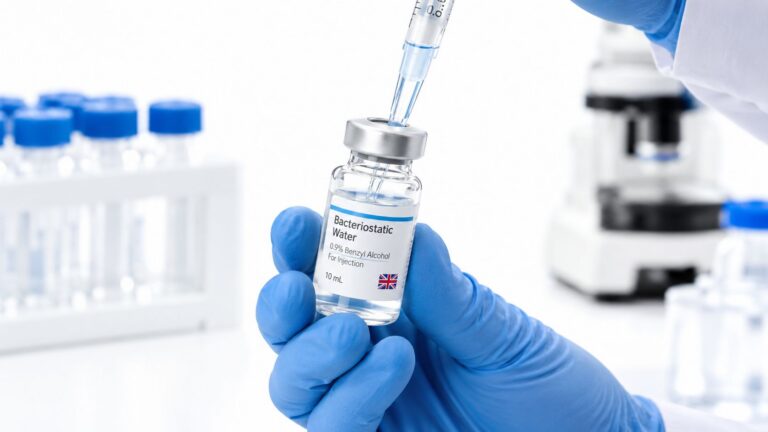
Bacteriostatic water is sterile, nonpyrogenic water for injection containing 0.9% benzyl alcohol, equivalent to 9 mg/mL. In a 3 mL vial, the labeled concentration works out to about 27 mg of benzyl alcohol in total. The concentration defines the chemistry. The vial volume defines how much material the workflow receives.
Composition and function
Each term answers a separate laboratory question:
- Sterile describes the product at release, when it is manufactured to be free from viable microorganisms.
- Nonpyrogenic concerns substances that may provoke fever-related responses.
- Water for injection identifies the diluent base.
- Benzyl alcohol supplies the preservative function that supports bacteriostatic handling.
The preservative inhibits bacterial growth during repeated withdrawals, but it does not neutralize every contaminant or make the vial reusable without limit. A sterile product can still face contamination after its stopper is entered, so the starting condition and the later handling process must be considered separately.
Preservative-free sterile water is generally handled as a single-use material after opening. Bacteriostatic water is formulated for multi-dose workflows under appropriate technique. The selected diluent still needs to match the reagent, protocol, product labeling, and research-use documentation.
Why 3 mL does not mean stronger
When the labeled concentration is the same, a 3 mL presentation contains the same type of formulation as other standard multi-dose presentations. The smaller vial is not more concentrated and does not provide extra antimicrobial protection. It changes logistics: a limited project may leave less unused liquid, while a larger format may fit a workflow with higher planned demand.
The following visual summarizes the boundary between growth suppression and indefinite sterility:
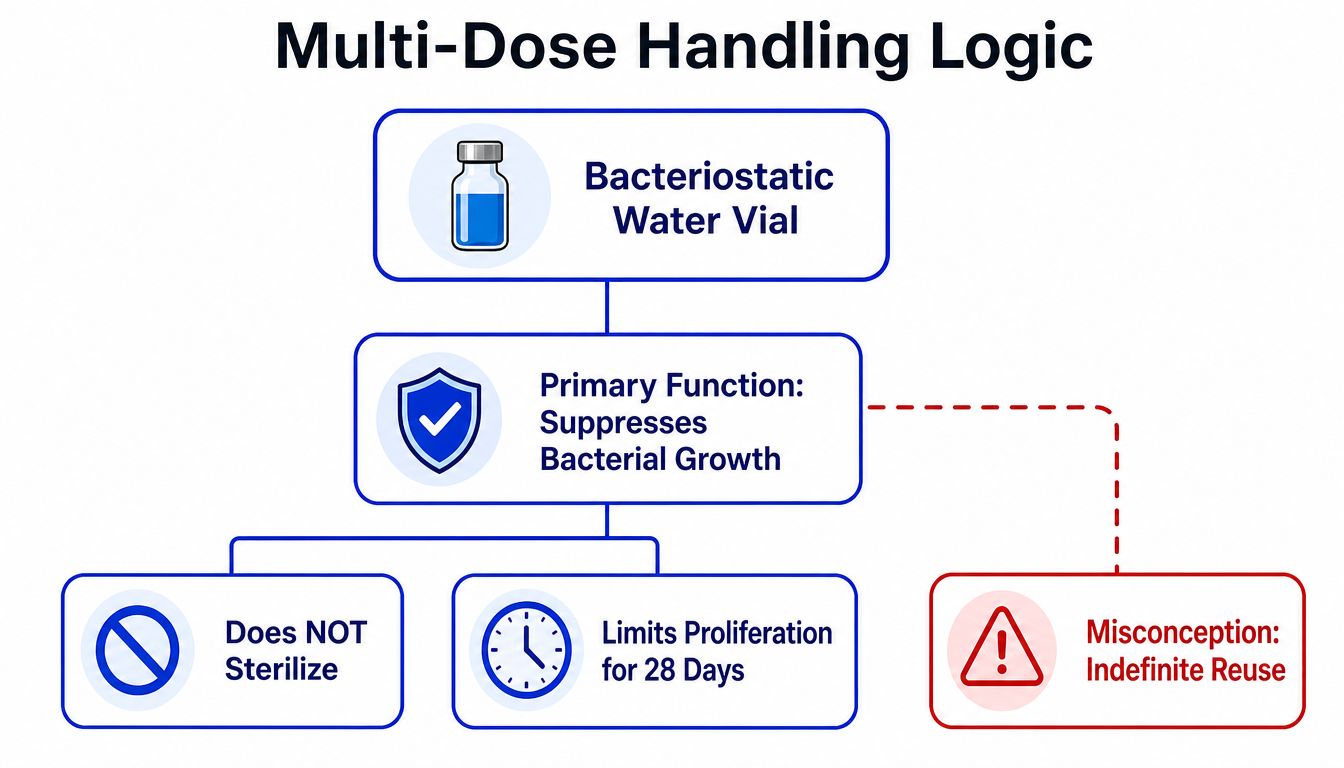
For a broader comparison of growth inhibition and microbial killing, review the difference between bacteriostatic and bactericidal products. Bacteriostatic describes suppressed growth, not permanent sterility.
The chemistry only supports a controlled workflow when access is managed. A clean stopper, sterile withdrawal device, and recorded first-entry date provide the practical controls. For RUO work, those records also connect the selected vial size with planned use, storage, and final disposition.
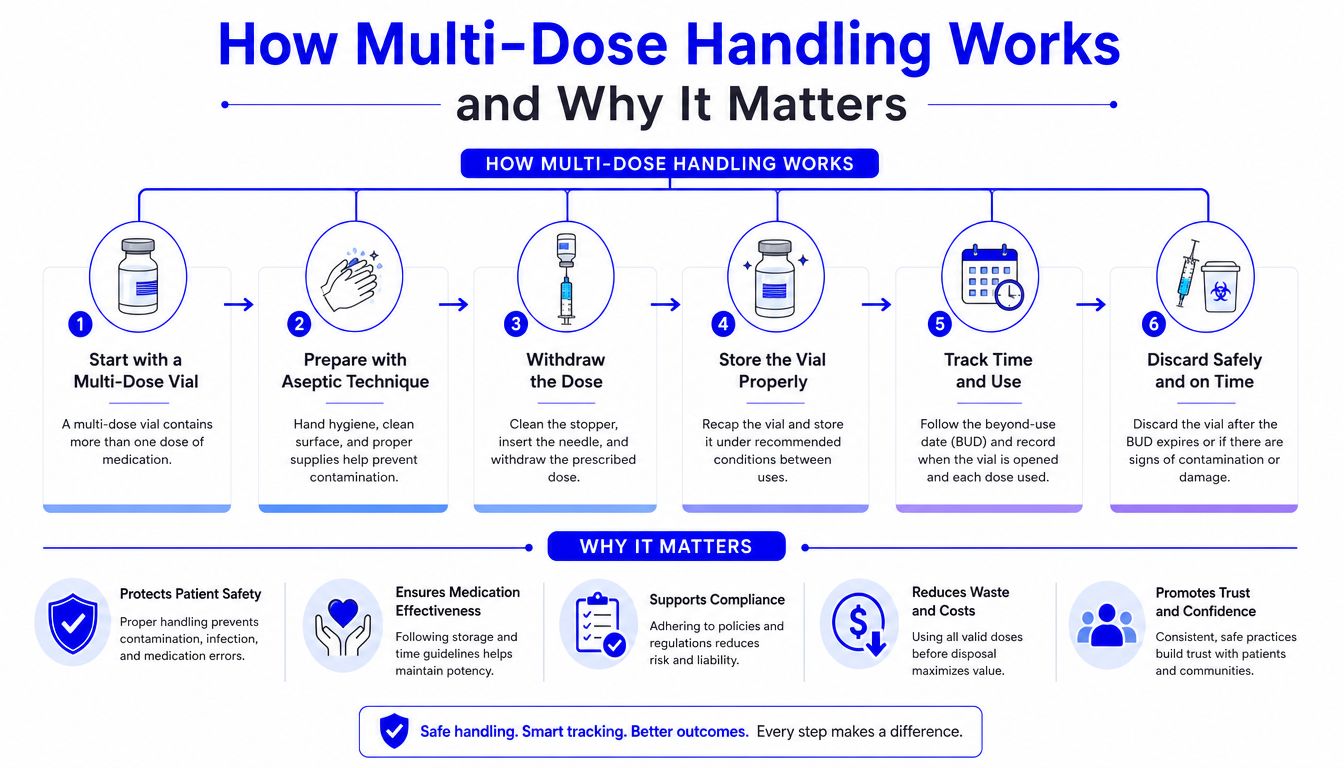
How Multi-Dose Handling Works and Why It Matters
A researcher opens a vial for a planned series of withdrawals. From that first puncture onward, the vial is no longer just a container. Each entry creates another opportunity for environmental material to reach the contents, so benzyl alcohol and careful handling perform different jobs. The preservative limits bacterial growth, while sterile technique reduces the contamination introduced during access.
FDA and DailyMed describe bacteriostatic water as a sterile, nonpyrogenic water-for-injection solution containing 0.9% benzyl alcohol, or 9 mg/mL, and list 3 mL multi-dose presentations in the product information DailyMed product information. The preservative supports repeated septum punctures by inhibiting bacterial growth after access. It does not replace disinfection, a sterile withdrawal device, or a defined recordkeeping process.
Single-use and multi-dose side by side
| Feature | Preservative-free sterile water | Bacteriostatic water |
|---|---|---|
| Preservative | None | Benzyl alcohol |
| Typical access model | Single-use after opening | Multi-dose access under controlled technique |
| Main handling concern | Discard after use | Track punctures, technique, and in-use time |
| Format decision | Match one preparation | Match repeated access and project cadence |
The table describes handling models, not permission to treat a multi-dose vial casually. Disinfect the stopper according to the laboratory's procedure, use a new sterile withdrawal device for every entry, and protect the vial from unnecessary contact. A preservative cannot correct poor technique or make a visibly compromised vial suitable for continued use.
Practical rule: Benzyl alcohol slows bacterial growth. It does not sterilize a vial after each puncture.
The clock starts at first entry
For a punctured multi-dose vial, the operational benchmark is a 28-day in-use limit after first puncture when aseptic technique is maintained. The clock begins when the stopper is first entered, not when the vial is purchased or removed from its packaging. Apply the laboratory's approved procedure and product information when they set a shorter period.
A useful record includes:
- The vial identifier and lot information.
- The date of first puncture.
- The operator or workstation, where local procedure requires it.
- The planned final discard date.
- Any deviation, visible change, or suspected breach.
Discard the vial at the end of the applicable period, even if liquid remains. That makes 3 mL a workflow choice rather than merely a size. A smaller presentation can reduce residual waste for a limited access plan, while a larger vial may suit repeated work with higher planned demand. In RUO documentation, recording the chosen volume, first entry, storage conditions, and disposition ties the container to the project record.
Common Use Cases for Bac Water 3mL in Peptide Workflows
The most useful role for a 3 mL bacteriostatic water vial is often small-volume project control. A laboratory working with a limited amount of lyophilized material may need a sterile diluent for preparation without committing to a larger container. The smaller format can also make it easier to assign one vial to one project, one batch, or one documented workstream.
In research workflows, bacteriostatic water may be used as a diluent for lyophilized peptides, proteins, antibodies, and other materials when the relevant protocol permits it. The amount added must come from the validated method for that material. Bac water 3ml isn't a universal instruction to add the entire vial, and it doesn't replace compatibility checks.
Where the small format fits
A 3 mL vial can make sense when:
- The preparation uses a limited total volume. A small batch may leave less residual diluent than a larger presentation.
- The project is exploratory. A lab testing a method or evaluating a reagent may prefer a compact supply commitment.
- The vial needs project-level traceability. Assigning one container to one workstream can simplify records.
- The lab has several independent projects. Multiple small vials can reduce the need to share one open container across unrelated activities.
- Portability matters. A compact presentation takes less bench and storage space than larger formats.
A researcher preparing a lyophilized peptide for a controlled laboratory assay might first confirm the material's solubility, target concentration, compatibility, and required final volume. The researcher then selects a diluent presentation that supplies the needed amount without creating unnecessary remainder. The vial size supports the workflow, but the protocol determines the actual preparation.
Reconstitution is more than adding liquid
A sound process keeps the calculation and the physical handling separate. The laboratory should confirm the required diluent volume before opening the vials, inspect labels and lot records, disinfect the access points, introduce the liquid slowly, and use the validated mixing method for the material. Vigorous agitation can be inappropriate for fragile materials, so the protocol should determine whether gentle swirling, resting, or another method is suitable.
The guide to mixing peptides with bacteriostatic water can help researchers understand the preparation sequence, but it shouldn't override the instructions supplied with a specific research material. Different peptides, proteins, and antibodies can have different solubility and stability requirements.
A small vial may also support sequential aliquoting during the in-use period. That advantage exists only when the laboratory records first access, maintains aseptic technique, and follows the relevant discard rule. Researchers should never assume that a preserved diluent makes a reconstituted peptide stable for the same period, because the active material has its own stability profile.
The RUO designation also matters. Research-use-only materials aren't automatically suitable for clinical, diagnostic, or human-administration purposes. Laboratory buyers should keep the product's intended use, institutional approvals, protocol controls, and material documentation aligned from procurement through disposal.
Choosing Between 3mL 10mL 20mL 30mL and Kit Options
Vial selection becomes clearer when volume is treated as a workflow variable rather than a simple price comparison. A 3 mL vial may suit a small project and reduce leftover material. A larger vial may fit a laboratory that performs repeated preparations and wants fewer container changes. The best choice depends on access frequency, expected consumption, storage space, and the lab's purchasing rhythm.
A practical comparison
| Vial Format | Best Fit Workflow | Key Consideration |
|---|---|---|
| 3 mL | Small projects, trial preparations, limited-volume work | Minimizes excess supply when the protocol needs only a compact amount |
| 10 mL | Recurring work with moderate demand | Balances container count against leftover risk |
| 20 mL | Larger or more frequent preparation workflows | Requires stronger tracking of access and remaining volume |
| 30 mL | Ongoing laboratory demand | Useful when the workflow regularly consumes larger quantities |
| 10 × 3 mL kit | Multiple small projects or distributed workstations | Supports separate project allocation without one large shared vial |
| 10 × 10 mL kit | Repeated moderate-volume demand | Supports planned inventory replenishment and supply continuity |
These formats are not interchangeable from a handling perspective. A larger vial can reduce procurement events, but it may remain open while a smaller project progresses slowly. A multi-pack can provide continuity while allowing separate vials to be assigned to different batches, operators, or time periods.
Matching format to access cadence
A lab should estimate consumption qualitatively before choosing a presentation:
- Occasional access: A 3 mL vial or a 10 × 3 mL kit may reduce unused remainder and simplify project allocation.
- Regular access: A 10 mL or 20 mL format may reduce container changes without becoming unnecessarily large.
- High-throughput work: A 30 mL format or larger planned inventory may suit a validated process with predictable demand.
- Distributed work: Multi-packs can separate workstations or projects, reducing the need to move one opened vial between areas.
The bacteriostatic water vial range illustrates how a supplier can organize 3 mL, 10 mL, 20 mL, 30 mL, and kit options around different laboratory requirements. The same selection logic applies to other suppliers, provided the formulation, intended use, packaging, and documentation meet the lab's requirements.
Cost is only one part of the equation
A lower unit price for a large vial doesn't automatically mean lower workflow cost. Waste, storage burden, access tracking, and the possibility of discarding remaining liquid can change the practical value. Conversely, buying only small vials can create more labels, containers, and receiving records than a high-volume laboratory wants to manage.
For resellers and labs purchasing at scale, private-label, white-label, and wholesale arrangements add another layer. Buyers should request clear specifications for the formulation, lot documentation, packaging configuration, fulfillment process, and research-use-only status before committing to a recurring supply model.
Storage Stability and the 28 Day In Use Window
A 3 mL vial may arrive sealed today but enter the workflow weeks later. Its storage record and its in-use record therefore answer different questions. Before first entry, keep the unopened vial under the supplier's specified, temperature-controlled conditions and within its labeled shelf life. After entry, the laboratory must track access, maintain aseptic technique, and apply the relevant in-use limit.
For a punctured multi-dose bacteriostatic water vial, the operational benchmark is 28 days after first puncture when aseptic technique is maintained, as noted earlier in the multi-dose handling guidance. The purchase date does not start this period, and neither does the manufacture date. The first puncture starts the in-use clock.
A storage checklist for lab teams
A short bench checklist helps turn the rule into a repeatable workflow:
- Receive and inspect: Confirm the label, seal, vial condition, lot information, and supplier records.
- Store unopened: Follow the product's specified temperature-controlled conditions and limit avoidable environmental stress.
- Prepare the access area: Complete the laboratory's clean-handling procedure before entering the vial.
- Record first puncture: Write the date immediately, while the event is clear.
- Track every use: Log access and project information when required by the quality system.
- Discard on schedule: Remove the vial at the end of the applicable in-use period, even if liquid remains.
Immediate labeling prevents a simple failure in recordkeeping. Without a first-entry date, an operator has to estimate the vial's age, weakening the control that makes multi-dose access workable.
Storage and shipping records
Temperature-controlled warehousing and dispatch protect product integrity before receipt. They do not replace the receiving laboratory's duties. The lab should document receipt, record shipment or packaging concerns, and use its quarantine or acceptance procedure when vial condition is uncertain.
The 3 mL format can reduce storage footprint and support clearer stock rotation when separate projects need separate supplies. It also makes inventory counts more granular. These workflow benefits still operate within defined limits: benzyl alcohol extends the practical multi-dose workflow, but it does not override time limits, contamination events, damaged packaging, or product-specific instructions.
A visible change in the solution, damaged packaging, a compromised stopper, or unknown access history should trigger the laboratory's quality procedure. The remaining volume should not be treated as usable solely because it is still present. A documented discard provides a defensible record, while an undocumented assumption leaves the material's status uncertain.
How to Select and Verify Quality Bac Water 3mL
A vial's label and volume answer only part of the procurement question. A research laboratory also needs to know who manufactured the product, which lot supplied it, what testing supports release, and whether the documentation matches the intended RUO workflow. Equivalent-looking marketplace listings can differ in traceability and quality records.
Review the lot, not just the listing
A useful supplier review asks for:
- Lot-specific documentation: The certificate should identify the lot supplied, not only describe a generic product.
- Composition confirmation: The record should support the stated benzyl alcohol concentration.
- Release review: The supplier should explain how quality assurance reviews a batch before release.
- Traceability: Materials, production records, packaging, and distribution records should connect to the supplied lot.
- Intended-use language: The product should be clearly positioned for research use only where that is the applicable status.
- Complaint and recall process: The buyer should know how quality concerns are investigated and communicated.
Independent records dated 2026 describe lot-level benzyl alcohol concentration checks and research-use-only positioning, while FDA recall history demonstrates that sterile-fill failures can create serious contamination concerns, including invasive bacterial infection risks verification and analysis record. Those records support a practical conclusion: buyers should verify manufacturing and documentation rather than assuming that every bacteriostatic water product is equivalent.
Build a repeatable purchasing decision
For a single project, the buyer may need a 3 mL presentation, a clear COA, and a documented receiving check. For a growing laboratory, the decision may include multi-pack continuity, controlled storage, batch review, and fulfillment coverage across the locations where the work occurs.
Herbilabs offers RUO bacteriostatic water and reconstitution solution in 3 mL, 10 mL, 20 mL, and 30 mL formats, along with multi-pack options, lot-specific COAs, and QA review before release. Its stated manufacturing and distribution model is designed for research workflows that need sterile diluent, format choice, and batch documentation.
The strongest selection process is therefore straightforward: define the project's volume and access pattern, confirm the formulation and intended use, request lot-level records, document receipt, and assign a first-puncture date immediately. That approach makes bac water 3ml a deliberate workflow choice instead of a guess based only on vial size.
Herbilabs provides RUO bacteriostatic water and reconstitution solutions in compact and larger vial formats, including 3 mL options and multi-packs, with lot-specific documentation for laboratory records. Researchers, labs, and resellers can review the available formats and quality information by visiting Herbilabs.