Private Label, White Label, Wholesale partnerships available - EU, USA and UK - Free shipping from €75
Bac Water and Syringes: Safe RUO Reconstitution Guide
The vial is on the bench, the freeze-dried material is waiting, and a drawer full of syringes offers several choices that look almost identical. A researcher may know the required diluent volume yet still create avoidable problems by choosing a syringe with excessive dead space, using the wrong connection, or treating a preserved vial as though it were self-sterilizing.
Bac water and syringes work as one controlled system. Bacteriostatic water supplies a sterile, nonpyrogenic diluent for repeated withdrawals from a multi-dose container, while the syringe and needle provide the access path. That access path is where contamination can be prevented, introduced, or transferred between preparations.
Table of Contents
- Why Bac Water and Syringes Are Paired in RUO Work
- How Syringes and Vials Need to Match
- Multi-Dose Vial Rules That Protect Your Work
- A Clean Aseptic Withdrawal Routine
- Choosing a Syringe That Improves Reconstitution Quality
- What Bacteriostatic Does Not Do
- What to Look for When Buying Bac Water and Syringes
- Putting It All Together Before Your Next Withdrawal
Why Bac Water and Syringes Are Paired in RUO Work
The vial is labeled, the target volume is known, and the syringe drawer still creates the first real quality decision. Two syringes may both fit a needle and both pull liquid, yet they do not control the work the same way. Graduation spacing affects how confidently a small volume can be read. Dead space affects how much liquid stays trapped after transfer. The tip and connection affect stability during access. Needle fit and handling affect how much stress reaches the stopper.
That is why bacteriostatic water and the syringe belong in the same discussion in RUO work.
Bacteriostatic water is a sterile, nonpyrogenic diluent intended for repeated withdrawals from a multi-dose container. U.S. Food and Drug Administration labeling describes Water for Injection containing either 0.9% benzyl alcohol, equivalent to 9 mg/mL, or, in some formulations, 1.1%, equivalent to 11 mg/mL (FDA labeling). That preservative helps inhibit bacterial growth after entry. It does not clean a contaminated access path. If the syringe, needle, stopper, or bench introduces contamination, the preservative is not a reset button.
The access point matters
In practice, the syringe works like a measuring device and a transfer device at the same time. Treating it as a generic disposable misses the point. Barrel scale, plunger travel, dead space, and connection type all influence whether the intended volume reaches the vial, and whether repeated vial entry stays controlled from one withdrawal to the next.
Contamination often enters through habits that look minor. Re-entering a vial with a used syringe can carry microorganisms or leftover reconstituted material back into the container. Swapping only the needle does not fully correct that error, because the syringe tip and barrel can still carry residue.
The World Health Organization identifies unsafe injection practices as a major public-health problem. Its fact sheet reports that reuse of injection devices in developing and transitional economies declined from 39.8% in 2000 to 5.5% in 2010, and estimated unsafe injections fell from 1.35 per person per year to 0.16 over the same period (WHO injection safety fact sheet/injection-safety/is_fact-sheet.pdf?sfvrsn=27f55c57_5)). RUO bench work is a different context, but the same principle applies to repeated vial access. A preservative cannot compensate for a contaminated route into the vial.
Practical rule: Treat the vial, needle, syringe, stopper, work area, and storage record as one quality system.
For that reason, the first withdrawal should be set up before the sterile package is opened. Check identity, closure condition, expiry, storage history, and intended volume first. Then choose the syringe that controls the transfer accurately and cleanly.
How Syringes and Vials Need to Match
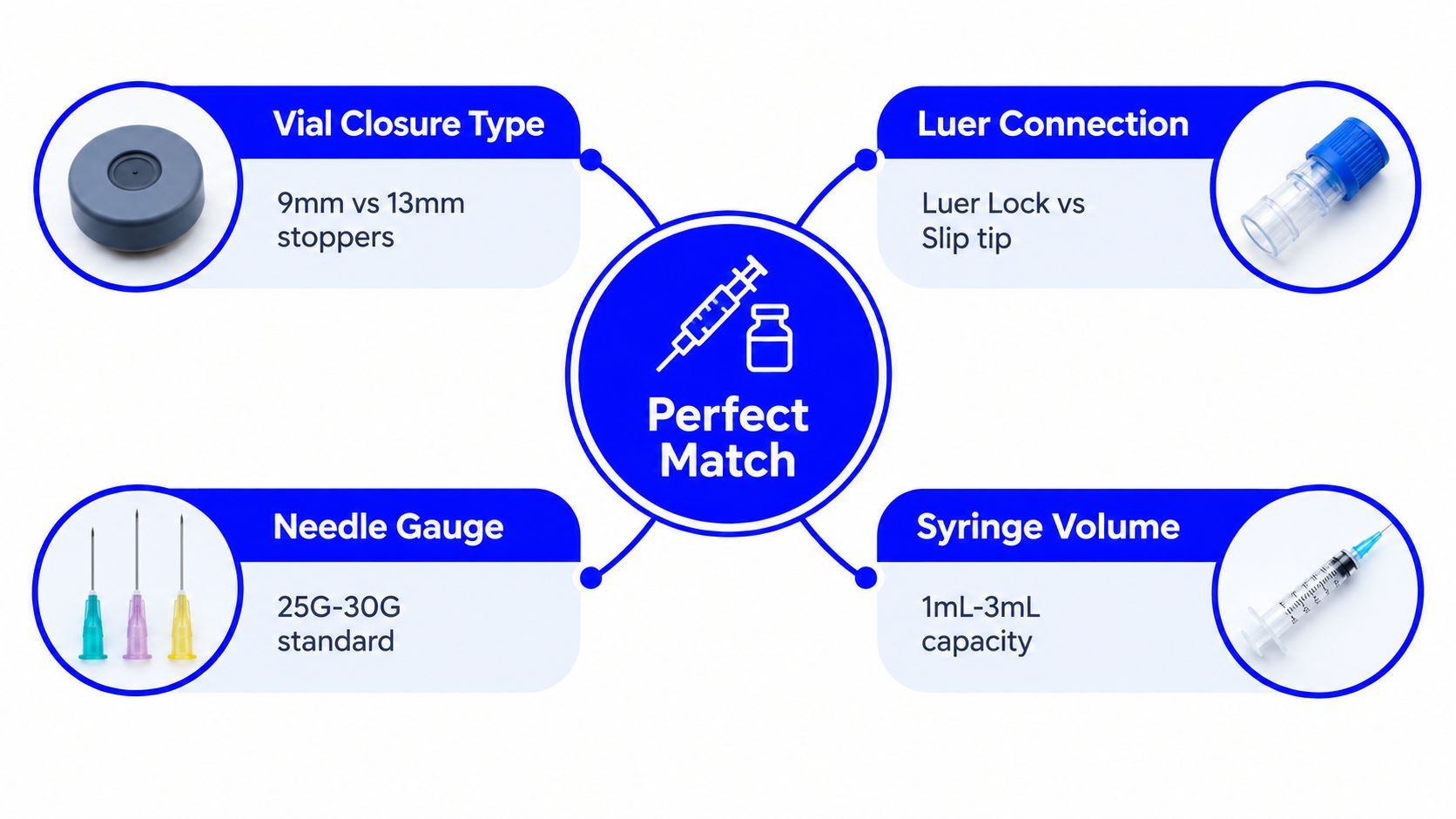
Compatibility begins at the vial closure. A crimped vial with a butyl rubber septum needs a needle that can pass through the stopper without excessive force or unnecessary coring. The exact closure specification must come from the product documentation. A closure that appears similar to another vial isn't automatically interchangeable.
The connection between syringe and needle also matters. Luer-lock fittings secure the needle by threading it into place, which helps resist loosening during controlled withdrawal. Luer-slip fittings rely on friction and can be suitable for compatible applications, but they offer less mechanical retention when the assembly is handled repeatedly. The correct choice depends on the validated device and workflow, not on habit.
Match the needle to the task
Needle gauge and length should suit the stopper, solution viscosity, and required reach. A larger internal diameter generally reduces withdrawal resistance, while excessive force can damage or core the septum. A narrower needle may offer more controlled handling, but it can make a viscous solution slower to withdraw.
The syringe barrel introduces a separate decision. The target volume should sit near the middle of the graduated scale rather than at an extreme end. That placement gives the operator more room to read the meniscus and reduces the relative effect of small reading errors.
Account for residual volume
Dead space is the liquid retained in the syringe hub and needle after the plunger has been depressed. It matters most when the working volume is small or when repeated withdrawals accumulate residual losses. A low-dead-space syringe can improve recovery, but it still has to provide suitable graduations, a compatible connection, and a sterile presentation.
A researcher selecting a syringe should therefore verify four things before opening the package:
- Closure fit: The needle passes through the septum without excessive force or visible damage.
- Connection security: The luer format matches the needle and handling conditions.
- Graduation position: The target withdrawal is readable without relying on the barrel's extreme range.
- Residual volume: Dead space won't materially distort recovery or concentration calculations.
Multi-Dose Vial Rules That Protect Your Work
You come back to a vial a few days after first use. The liquid still looks fine. That is exactly when sloppy habits do the most damage. A multi-dose label allows repeated access under control. It does not turn the vial into an open-ended supply.
Treat the vial, stopper, and syringe as one quality system. Every entry is another chance to introduce contamination, lose traceability, or shift the amount you thought you withdrew. The practical rules are simple: record the first use, store the vial under the manufacturer's stated conditions, and discard it when the in-use window ends or sterility is in doubt.
After the first puncture, date the vial and discard it within 28 days unless the manufacturer gives a different in-use period (CDC injection safety guidance). The printed expiry date still remains in force. If that date arrives first, the vial is done.
Date and location are part of quality control
A clean preparation area matters because contamination is often introduced by the setting, not by the liquid itself. Keep multi-dose vials away from sinks, waste, and unrelated bench traffic. In clinical practice, CDC advises access in a clean medication-preparation area. RUO work benefits from the same discipline. Give vial access a defined space instead of a crowded general bench.
Labeling should support an investigation, not just a calendar reminder. Record the opening date, operator, lot number, storage condition, and what material was reconstituted. If a result later looks wrong, those details help separate a material problem from a handling problem.
The syringe belongs in that quality-control picture too. A reused device, a poorly read graduation, or excess dead space can distort what entered or left the vial even when the vial itself stayed sterile. In RUO workflows, the syringe is a measuring instrument with contamination risk attached, not a throwaway accessory.
Discard the vial sooner if the stopper is torn, the container leaks, storage conditions were not maintained, or the solution shows turbidity, particles, discoloration, or another unexpected change. Do the same if you cannot confirm access with a new sterile syringe and needle. For added handling and dating guidance, see this guide to bacteriostatic water. A date supports traceability, but it does not prove sterility.
A Clean Aseptic Withdrawal Routine
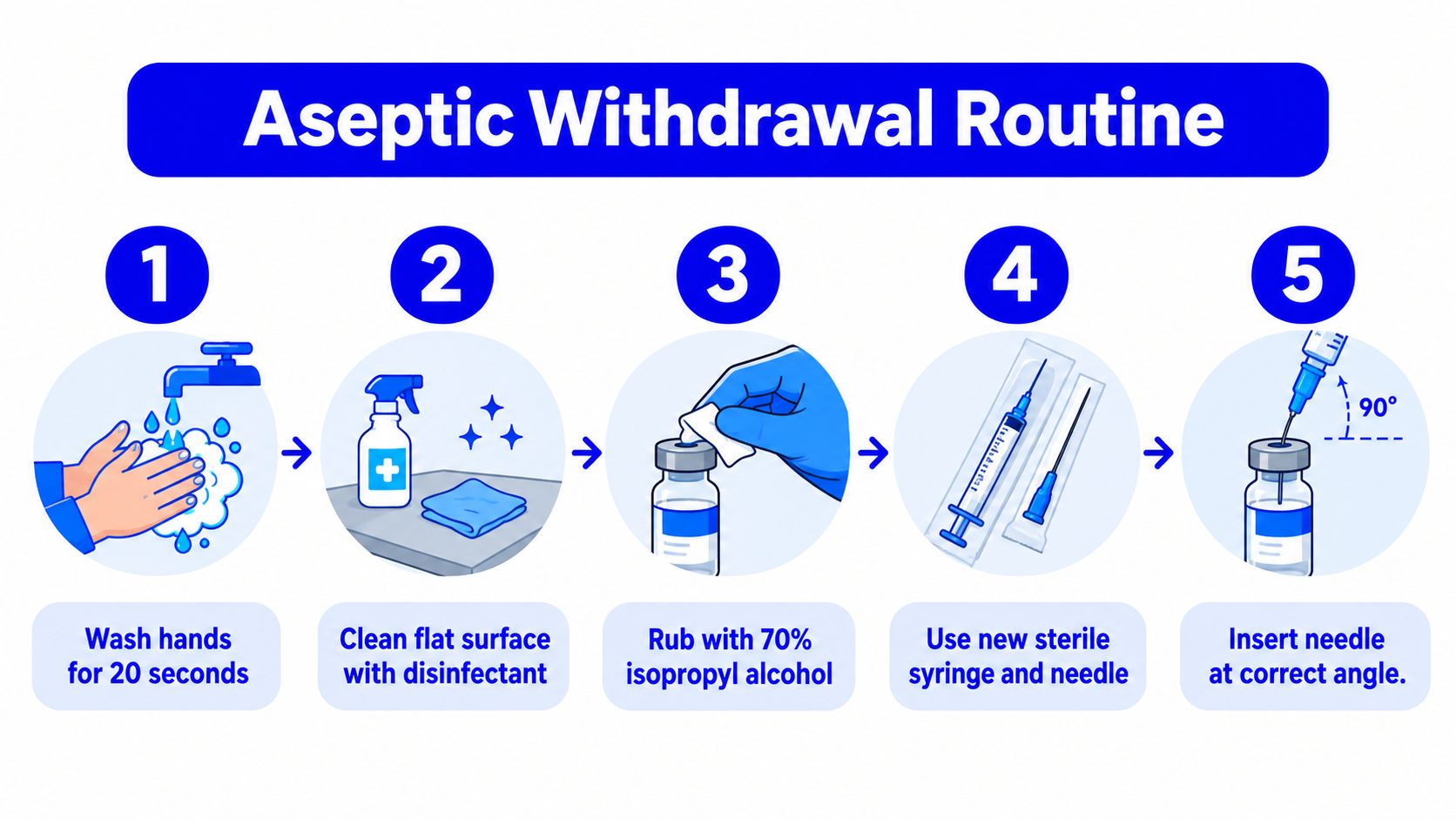
A reliable withdrawal routine starts before the vial leaves storage. The operator washes hands, clears a flat preparation surface, checks the vial for cracks or leakage, and gathers the sterile syringe, sterile needle, disinfectant, labels, and disposal container. The work area should stay free of unnecessary movement while the vial is open.
The stopper is disinfected with an appropriate alcohol swab, commonly 70% isopropyl alcohol, and allowed to dry according to the laboratory's validated procedure. Piercing a wet stopper can carry liquid and surface residue into the vial, so the operator shouldn't rush this pause.
Control the entry and withdrawal
Every vial entry requires a new sterile syringe and needle. A syringe must not be reused for another vial, another preparation, or an additional withdrawal, even if the same operator is working with the same material. WHO specifically recommends a new single-use injection device for each injection and for reconstitution of each medication unit, and warns against using the same mixing syringe for several vials (WHO injection safety guidance).
The needle should enter the septum cleanly, with the bevel positioned to reduce coring and unnecessary damage. Withdrawal should be slow enough to limit foaming and aerosol formation. The operator should avoid forceful plunging, twisting the needle inside the closure, or leaving a needle inserted in the vial between withdrawals.
A concise visual overview can help standardize the bench routine:
For laboratories building a broader equipment-control program, an overview of sterilization methods for medical devices can help distinguish product sterilization from the aseptic handling controls applied after packaging is opened.
Inspect before accepting the withdrawal
The operator should inspect the solution before use and reject it when there is turbidity, visible material, discoloration, leakage, or stopper damage. The vial should then be dated immediately, with the opening record transferred to the laboratory log.
Choosing a Syringe That Improves Reconstitution Quality
The smallest syringe on the bench isn't automatically the best syringe. A small barrel may make low-volume graduations easier to read, but it can also introduce limitations in connection choice, dead space, compatible needles, or handling stability. Selection should begin with the required volume and the tolerance the workflow can accept.
A syringe with graduations that place the target near the middle of the scale generally supports easier reading. A barrel that is much larger than necessary can make a small withdrawal occupy only a tiny portion of the scale, while a barrel that is too small may force the target close to its limit. The operator should check graduation spacing and documented accuracy rather than assuming that nominal capacity tells the whole story.
Dead space is a recovery decision
Dead space retains liquid after plunger depression. In a large-volume preparation, that retained amount may be less important. In a low-volume RUO workflow, however, repeated residual losses can affect recovery and make different operators obtain different effective amounts from the same nominal withdrawal.
Low-dead-space designs can reduce that residual, but they don't eliminate the need to document the device. A laboratory comparing results across runs should record the syringe nominal capacity, graduation pattern, connection type, and, where reproducibility matters, the device lot and expiry.
Choose the connection and needle deliberately
A luer-lock assembly offers threaded retention during repeated manipulation. A luer-slip assembly can be appropriate when validated for the task, but the operator should confirm that the needle won't loosen and that the connection remains compatible with the workflow.
Gauge and length also require a trade-off. A larger internal diameter can reduce resistance, while excessive force can damage the rubber septum. A smaller internal diameter may improve control, but it can increase withdrawal time and force. The best selection is the one that protects the closure, delivers a readable volume, and avoids unnecessary manipulation.
A syringe becomes a quality-control instrument when its capacity, graduations, dead space, connection, and needle are recorded as deliberately as the reagent lot.
What Bacteriostatic Does Not Do
Bacteriostatic refers to slowing bacterial growth. In practice, that is a narrow job. It does not sterilize a contaminated syringe, rescue a vial after poor handling, or make repeated punctures low risk just because a preservative is present.
That matters in RUO work because the syringe is part of contamination control, not just a transfer tool. A reused needle, a damaged septum, excess dead space holding residual liquid, or a loose connection can introduce variation and contamination before the diluent ever reaches the material. Once the access step is compromised, the preservative does not reverse it. It works more like a limited safeguard than a cleanup system.
Labeling also matters. The supplied product information for bacteriostatic water notes benzyl alcohol content and related safety restrictions for certain populations (FDA bacteriostatic water labeling). RUO status does not cancel the need to read those limits, match the product to the intended use, and follow institutional handling rules.
Preservation isn't stability data
Preservation and stability answer different questions. The preservative addresses bacterial growth in the diluent itself. It does not establish the chemical stability, retained concentration, aggregation behavior, or biological activity of a peptide, protein, antibody, or other reconstituted material. Those outcomes depend on the material, the formulation, the container, storage conditions, and actual validation data.
Lot control matters for the same reason. In November 2019, Hospira, a Pfizer company, recalled one lot of 30 mL bacteriostatic water, lot W20308, because sterilization could not be confirmed for some vials. The lesson is blunt. A preservative is not a substitute for sterile manufacturing, lot traceability, release review, or disciplined vial access.
What to Look for When Buying Bac Water and Syringes
Procurement should begin with the laboratory's withdrawal pattern, not with the lowest unit price. A small independent lab may prefer a smaller vial to reduce the chance of retaining an opened container beyond its usable period, while a higher-throughput operation may need a format that fits its documented cadence. The selection should match the intended RUO workflow and the supplier's product documentation.
A lot-specific Certificate of Analysis, intact packaging, manufacturer information, expiry, storage instructions, and traceability records deserve more attention than broad phrases such as “lab grade.” The buyer should also confirm that the product is a sterile, nonpyrogenic diluent and that the preservative concentration matches the labeled formulation.
Compare format with workflow
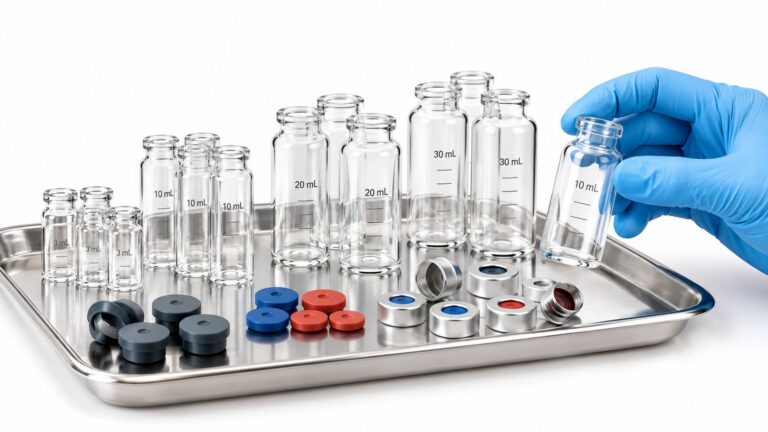
| Vial Format | Typical Use | Procurement Note |
|---|---|---|
| 3 mL | Low-volume or infrequent RUO withdrawals | Can limit retained opened material when the workflow is small |
| 10 mL | General bench reconstitution | A practical middle format for recurring preparation |
| 20 mL | Larger planned preparation sets | Requires careful dating and storage records after opening |
| 30 mL | Higher-volume or shared laboratory workflows | Lot traceability and access control become especially important |
| Multi-packs | Planned repeat work or supply continuity | Match pack size to validated use and in-use dating |
Check the evidence behind the listing
Useful purchasing questions include:
- Documentation: Does the supplier provide lot-specific COAs and release records?
- Presentation: Is the vial supplied in an intact, traceable manufacturer or brand presentation?
- Storage: Does the supplier describe controlled storage and dispatch conditions?
- Device fit: Are compatible sterile syringes and needles available separately?
- Distribution: Can delivery and regulatory requirements be confirmed for the laboratory's location?
Herbilabs supplies RUO bacteriostatic water and reconstitution solution in sterile multi-dose vial formats, including 3 mL, 10 mL, 20 mL, and 30 mL, with lot-specific COA documentation described for its products. Buyers should still match any product to the applicable label, SOP, and intended research use.
Putting It All Together Before Your Next Withdrawal
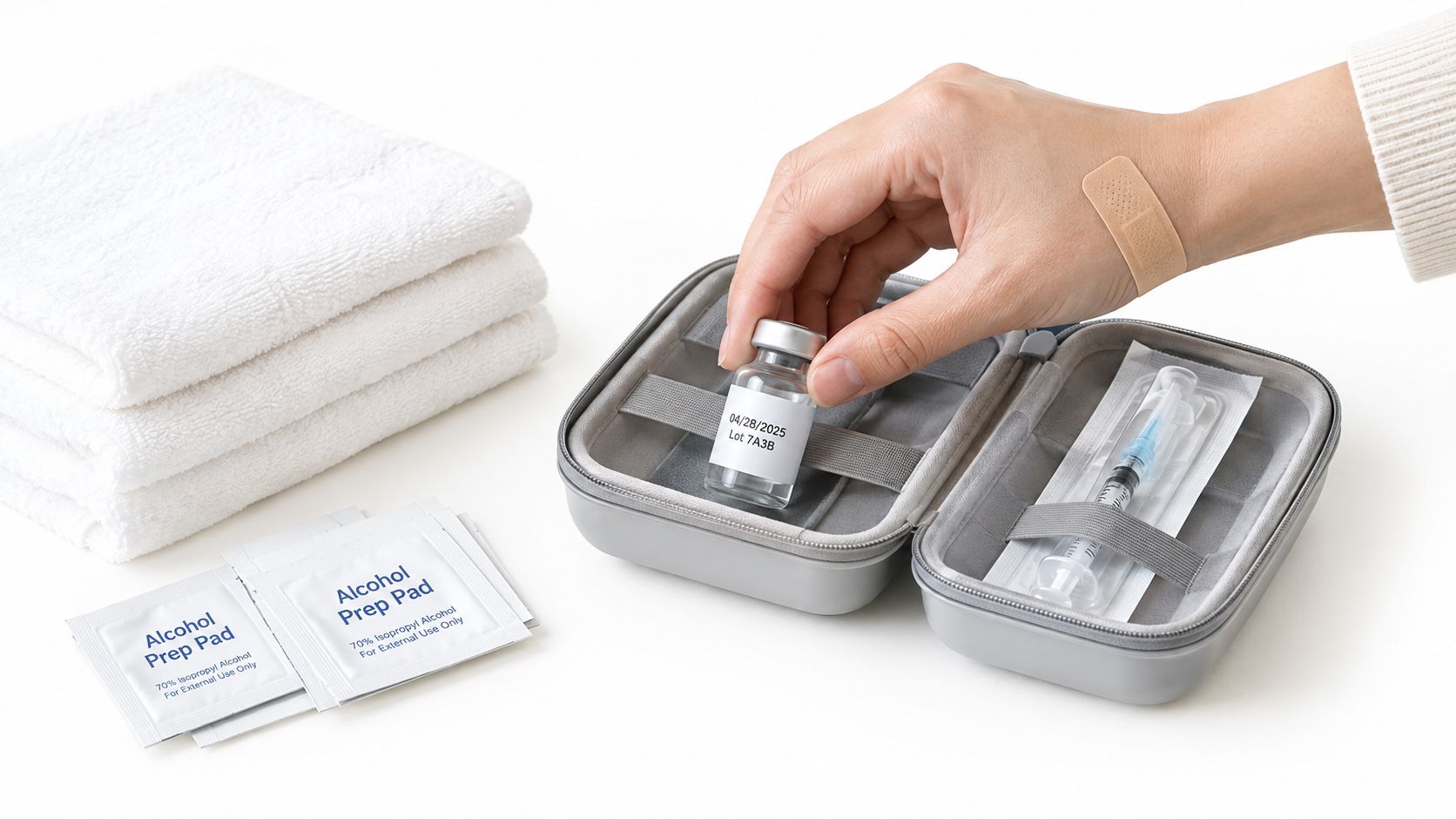
Before the next vial entry, the operator should pause at the bench and verify the complete access record. The vial needs a readable lot and expiry, a documented opening date, acceptable storage history, and an in-use period that hasn't elapsed. The work surface must be clean, the stopper intact, and the material free of visible changes.
The syringe and needle should then be selected against the closure and target volume. The connection must be secure, the graduations must make the withdrawal readable, and dead space must be acceptable for the recovery requirement. A new sterile syringe and needle are required for every entry.
Use a simple release decision
The operator can apply this readiness check:
- Identity: The diluent, lot, expiry, and intended material are confirmed.
- Condition: The vial, stopper, and solution pass visual inspection.
- Environment: The preparation area is clean and controlled.
- Device: The sterile syringe and needle match the closure and target volume.
- Record: The operator, opening date, storage condition, and withdrawal are logged.
The bacteriostatic water storage and opening guide can support the dating decision, but no calendar rule overrides uncertainty. If sterility is questionable for any reason, the vial should be discarded immediately, even when the dated in-use window remains open.
The practical default is therefore simple: if the vial, environment, device, or record cannot be trusted, stop and replace the questionable component before the withdrawal continues. That habit protects the preparation more effectively than relying on the word “bacteriostatic” alone.
For RUO teams sourcing sterile diluents and compatible labware, Herbilabs offers bacteriostatic water and reconstitution solutions in multiple vial formats with lot-specific documentation. Review the available formats and records against the laboratory's syringe selection, storage procedure, and traceability requirements before the next withdrawal.