Private Label, White Label, Wholesale partnerships available - EU, USA and UK - Free shipping from €75

9 Benzyl Alcohol
A researcher opens a multi-dose vial, draws the diluent, and notices the protocol never states which preservative is present. The label says “reconstitution solution,” the supplier mentions 9 benzyl alcohol, and the same vial may be opened repeatedly during a long experiment. That ambiguity is where preventable contamination, compatibility errors, and inappropriate safety assumptions begin.
Benzyl alcohol isn't merely a line in a formulation. In the familiar bacteriostatic-water format, 0.9% means 9 mg/mL, and that ratio has a specific purpose. It also shouldn't be confused with the historically reported 1–3% range used for some preservative applications, because concentration, route, container access, and intended use must be assessed separately (PubChem's benzyl alcohol reference).
Table of Contents
- The Multi-Dose Dilemma in Modern Labs
- How 0.9% Benzyl Alcohol Stops Bacterial Growth
- Best Practices for Handling and Storage
- Benzyl Alcohol Safety Beyond the Warnings
- Regulatory Standards for RUO Diluents
- Bacteriostatic Water vs. Sterile Water
The Multi-Dose Dilemma in Modern Labs
A researcher has prepared a lyophilized reagent and needs several withdrawals over the working life of the experiment. The vial is clean, the stopper is intact, and the first draw goes smoothly. The risk appears later, when repeated needle entries give environmental contamination another opportunity to enter.
That is why multi-dose systems need more than sterile starting material. A suitable bacteriostatic diluent helps limit bacterial multiplication after entry, provided the team still uses aseptic technique and follows the product label. It doesn't sterilize a contaminated vial, repair a damaged stopper, or compensate for a careless withdrawal.
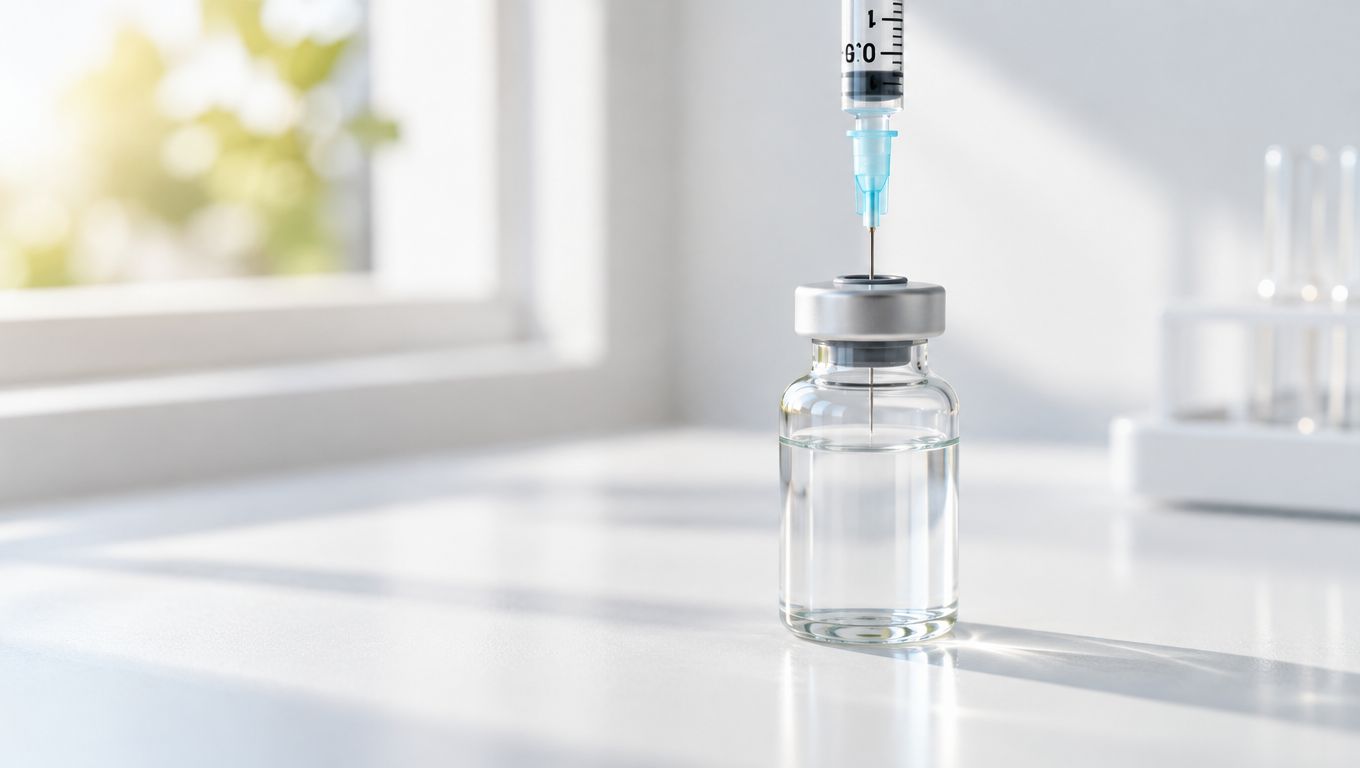
The useful distinction is operational. Sterility at release describes the condition of the unopened product. Bacteriostatic protection describes the preservative's ability to inhibit bacterial growth during appropriate repeated access. Those are related controls, not interchangeable promises.
Where the vial workflow fails
Common failures usually involve process discipline rather than exotic chemistry:
- The stopper is entered repeatedly: Each puncture creates another opportunity for contamination.
- The first-use date is missing: Staff can't reliably apply the labelled in-use period.
- The same needle is reused: This transfers material and compromises aseptic practice.
- Compatibility is assumed: A preservative can affect sensitive proteins, peptides, cells, membranes, or analytical readouts.
- RUO material is misunderstood: A research-use diluent isn't automatically an approved medicine or injectable preparation.
A practical multi-dose vial guide for researchers should be treated as a workflow aid, not a replacement for the vial's label, safety documentation, or validated protocol. The strongest routine is simple: inspect before use, disinfect the closure, use fresh sterile equipment, minimize entries, record the first puncture, and discard the vial whenever its identity, appearance, integrity, or sterility is uncertain.
How 0.9% Benzyl Alcohol Stops Bacterial Growth
A vial can look perfectly clear after repeated entries and still be one handling mistake away from a preventable contamination problem. That is why benzyl alcohol matters in a multi-dose diluent. It is there to slow bacterial growth after proper access, not to cover for poor technique or turn compromised material back into acceptable material.
At the concentration specified earlier, benzyl alcohol works as a bacteriostatic preservative. In practical terms, it interferes with bacterial membranes and the movement of materials across that boundary, which puts the cell under stress and makes multiplication harder. Growth control is the point. Complete disinfection is not.
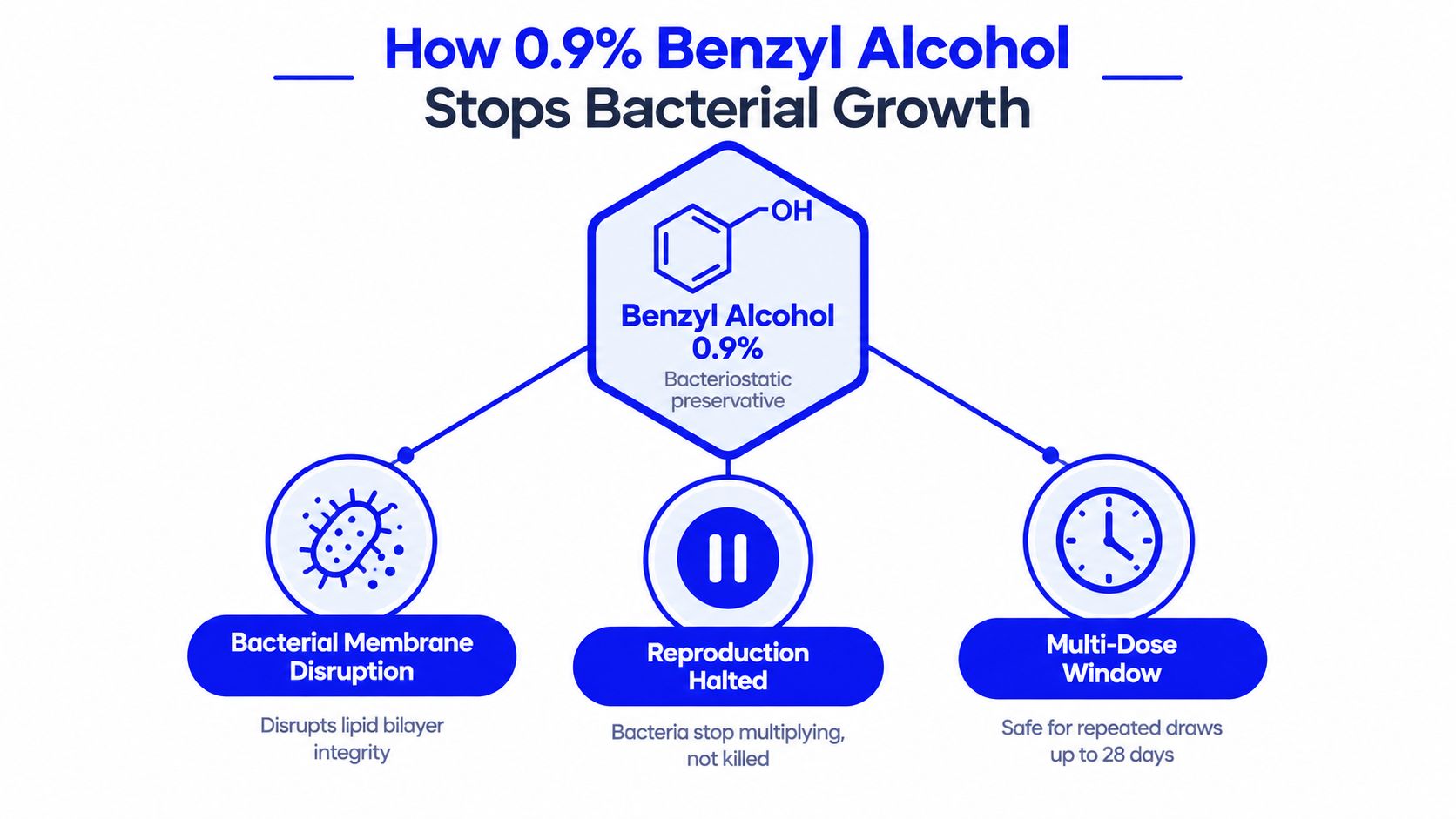
That distinction gets missed all the time. A preservative inside the vial helps limit growth introduced during appropriate multi-dose use, but it does not validate sloppy aseptic practice, dirty closures, reused equipment, or an uncertain storage history. Once the preparation is questionable, the right call is rejection, not wishful thinking about what the preservative might still handle.
Why the ratio matters
The 0.9% ratio matters because this is the formulation used in bacteriostatic water, and it should not be casually treated as interchangeable with older pharmaceutical concentrations used in other contexts. That is the part many summaries skip. For RUO work, the concern is not only whether the preservative slows microbial growth, but whether that amount changes the behavior of the material you are preparing.
Benzyl alcohol can affect membrane compatibility, protein interactions, solvent behavior, and the apparent solubility of hydrophobic components. In the lab, that means an unsuitable preservative level may leave the vial looking normal while still shifting assay performance or sample stability.
Environmental sanitation is a separate control point. Teams trying to find Living Air ozone disinfectant options are addressing room or surface treatment, not preservation inside a diluent. Both controls can matter, but they do different jobs.
For selection, read the label for concentration, intended use, container format, and stated limits. A defined product such as 0.9% bacteriostatic water with benzyl alcohol gives a clear starting point, but compatibility still has to be checked against the specific compound, matrix, or assay.
Best Practices for Handling and Storage
Good handling begins before the first puncture. Staff should verify the product identity, lot information, expiration information, container integrity, appearance, and storage instructions. A clear, colourless solution with an intact container is expected, but visual inspection can't prove sterility, chemical purity, or potency.
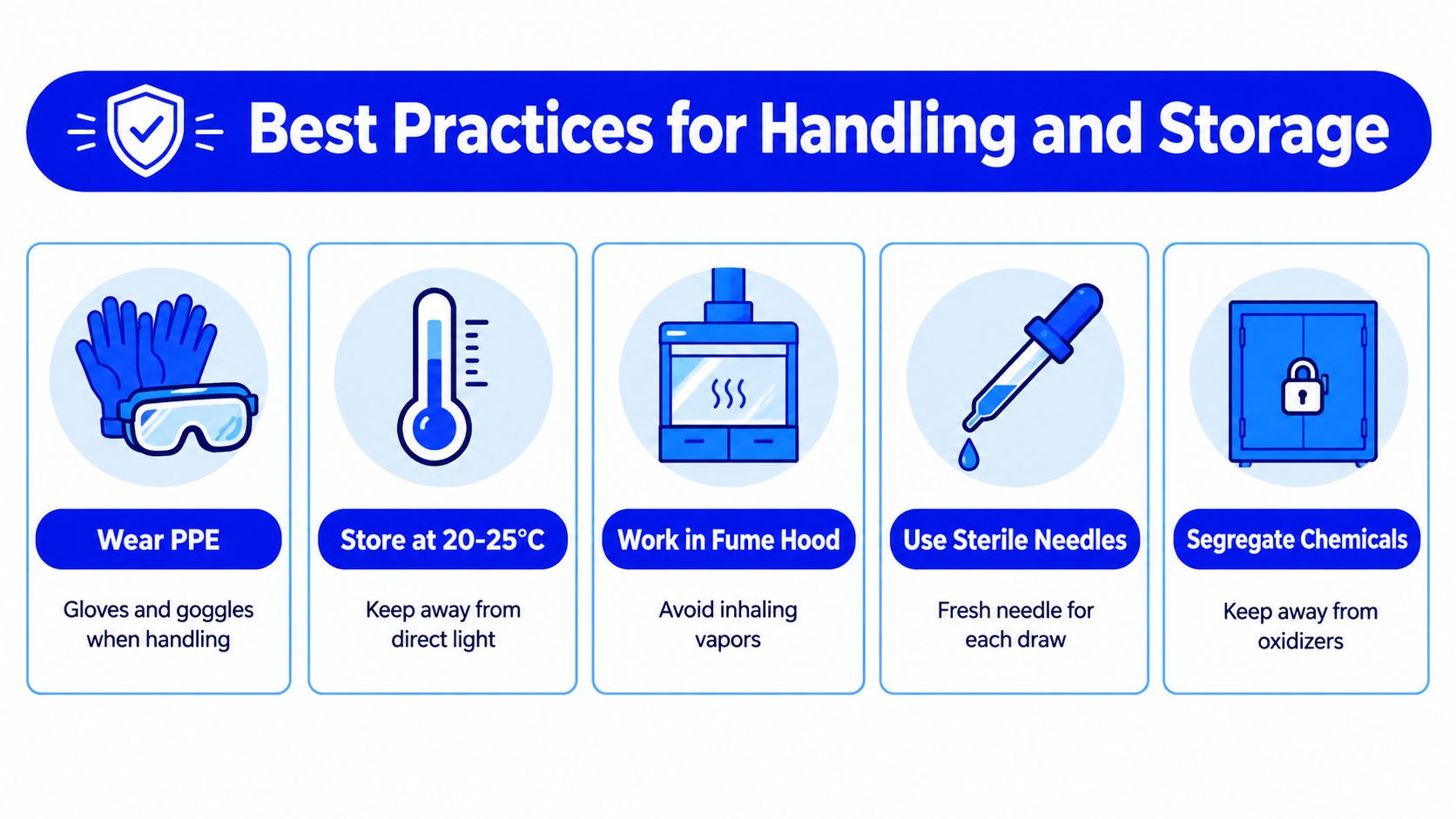
The handling record should be created at the first entry, not later when someone tries to reconstruct the timeline. Record the date, operator, vial lot, material prepared, and any required storage condition. For the vial's opened-life limit, follow the manufacturer's instructions and applicable facility policy. A commonly used multi-dose convention is 28 days after first puncture, unless the product specifies a different period (CDC multi-dose vial guidance).
A workable withdrawal routine
Prepare the area. Separate clean preparation from waste, sinks, food, and used equipment. Keep unnecessary materials away from the vial.
Inspect the container. Reject cracked glass, leaking closures, damaged seals, cloudiness, particles, unusual colour, an unknown first-entry date, or an expired product.
Disinfect and dry the stopper. Apply the facility-approved disinfectant and allow the closure to dry. A wet stopper can carry residue into the vial and makes the next step less controlled.
Use fresh sterile equipment. A new sterile needle and syringe should be used for each entry. Never return used equipment to the vial.
Withdraw gently. Avoid unnecessary foaming and forceful agitation, especially when the diluent will contact a sensitive protein or peptide.
Label immediately. Add the first-use date and any preparation details required by the laboratory record.
Store the unopened vial exactly as the label directs. Don't assume refrigeration is always required, and don't freeze the product unless the manufacturer authorizes it. Once another substance has been reconstituted, that prepared solution follows the compound's own stability and storage requirements, not merely the water vial's instructions.
Facilities also need a broader chemical-control system covering ventilation, ignition sources, segregation, and access. A general reference on chemical storage safety for facilities can support that wider program, but it shouldn't replace the product safety data sheet or local risk assessment.
For day-to-day execution, a written procedure for bacteriostatic water should make rejection criteria as clear as the withdrawal steps. Teams lose more experiments by tolerating uncertain labels and questionable appearance than by discarding a vial early.
Benzyl Alcohol Safety Beyond the Warnings
Searches for benzyl alcohol safety often lead directly to neonatal toxicity reports. Those warnings are serious, but applying them without considering route, dose, population, and intended use creates poor risk communication. The relevant question isn't whether benzyl alcohol is “safe” in the abstract. It is what exposure is possible in this specific workflow.
The most consequential safety milestone occurred in 1982, when reports associated benzyl-alcohol-preserved flush solutions with severe neonatal toxicity. FDA review documents describe 16 deaths among premature or low-birth-weight infants exposed to saline flushes containing 9 mg/mL benzyl alcohol, with estimated daily exposures of 99 to 405 mg/kg/day (FDA review document). Reported features included metabolic acidosis, gasping respirations, respiratory and central nervous system depression, hypotension, seizures, intracranial hemorrhage, and death.
That evidence concerns vulnerable infants and systemic exposure. It doesn't mean that a sealed RUO vial on a laboratory shelf creates the same exposure scenario for an adult worker. In vitro handling, incidental skin contact, inhalation, accidental ingestion, and human or veterinary administration are different pathways and require different controls.
Separate the use cases
A research-use diluent is intended for laboratory work, not for administration to people or animals. It isn't an injectable medicine just because it is sterile or packaged in a vial. The label must be read alongside the safety data sheet, and the lab should prohibit repurposing RUO material for clinical use.
For adult laboratory handling, the risk assessment should consider:
- Concentration and volume: The amount available for contact matters.
- Route: Skin, eyes, inhalation, ingestion, and systemic administration are not equivalent.
- Frequency: Repeated handling increases the need for consistent controls.
- User population: Neonates and other vulnerable populations require clinical guidance, not informal laboratory extrapolation.
- Engineering controls: Ventilation may be appropriate where vapour exposure is possible.
- PPE: Gloves and eye protection reduce avoidable contact.
Benzyl alcohol is an aromatic primary alcohol with a boiling point of approximately 200–205 °C, a flash point near 100 °C, and vapour density around 3.7 relative to air (PubChem chemical properties). Those properties don't make it equivalent to a highly volatile solvent, but they still support sensible ventilation and ignition-source control.
Practical rule: Neonatal warnings must never be generalized into clinical permission, and RUO labeling must never be treated as a clinical-use authorization.
Regulatory Standards for RUO Diluents
For a lab manager, quality documentation is part of the material. A vial that arrives without traceable identity, release information, or a clear intended-use statement creates work for procurement, quality assurance, and the scientist who must decide whether the reagent can enter a validated workflow.
Manufacturing credentials don't remove the need for incoming inspection, but they provide evidence that the supplier operates within a defined quality system. The relevant facility credentials here include ISO 13485:2016 and GMP certification, with processes operated under ISO 9001:2016 procedures. Those credentials should be reviewed as part of supplier qualification rather than treated as a substitute for the product's lot documentation.
What the release file should answer
A Certificate of Analysis should connect the specific lot to the quality attributes the laboratory needs. Depending on the product and use, that may include identity, assay or concentration, appearance, pH, sterility-related release information, and other tests defined by the manufacturer's specification.
| Attribute | Typical specification | Importance |
|---|---|---|
| Identity | Benzyl alcohol-containing sterile diluent | Confirms the material matches the ordered product |
| Preservative concentration | Label-defined formulation | Supports concentration calculations and compatibility review |
| Appearance | Clear, colourless solution without visible particles | Flags visible contamination or degradation concerns |
| pH | Product-specific documented range | Helps assess compatibility with the research material |
| Sterility documentation | Lot-specific release information | Supports the unopened product's quality record |
| Traceability | Lot number linked to COA and release review | Enables investigations, recalls, and reproducibility |
The table describes documentation categories, not a universal specification for every supplier. A laboratory should compare the COA against the product label, purchase order, approved supplier record, and internal acceptance criteria.
Quality check: A COA supports release decisions. It doesn't prove that staff handled the vial correctly after receipt.
The strongest procurement process also checks container format, closure integrity, transport conditions, storage requirements, and the supplier's change-control process. If the formulation, filling site, packaging, or test method changes, the quality team should know before the material reaches an experiment.
Bacteriostatic Water vs. Sterile Water
You are at the bench with a partially used vial, a time-sensitive prep, and one decision that can either protect the workflow or create an avoidable contamination risk. Choose the diluent by the protocol, the planned handling pattern, and the material's tolerance for preservatives.
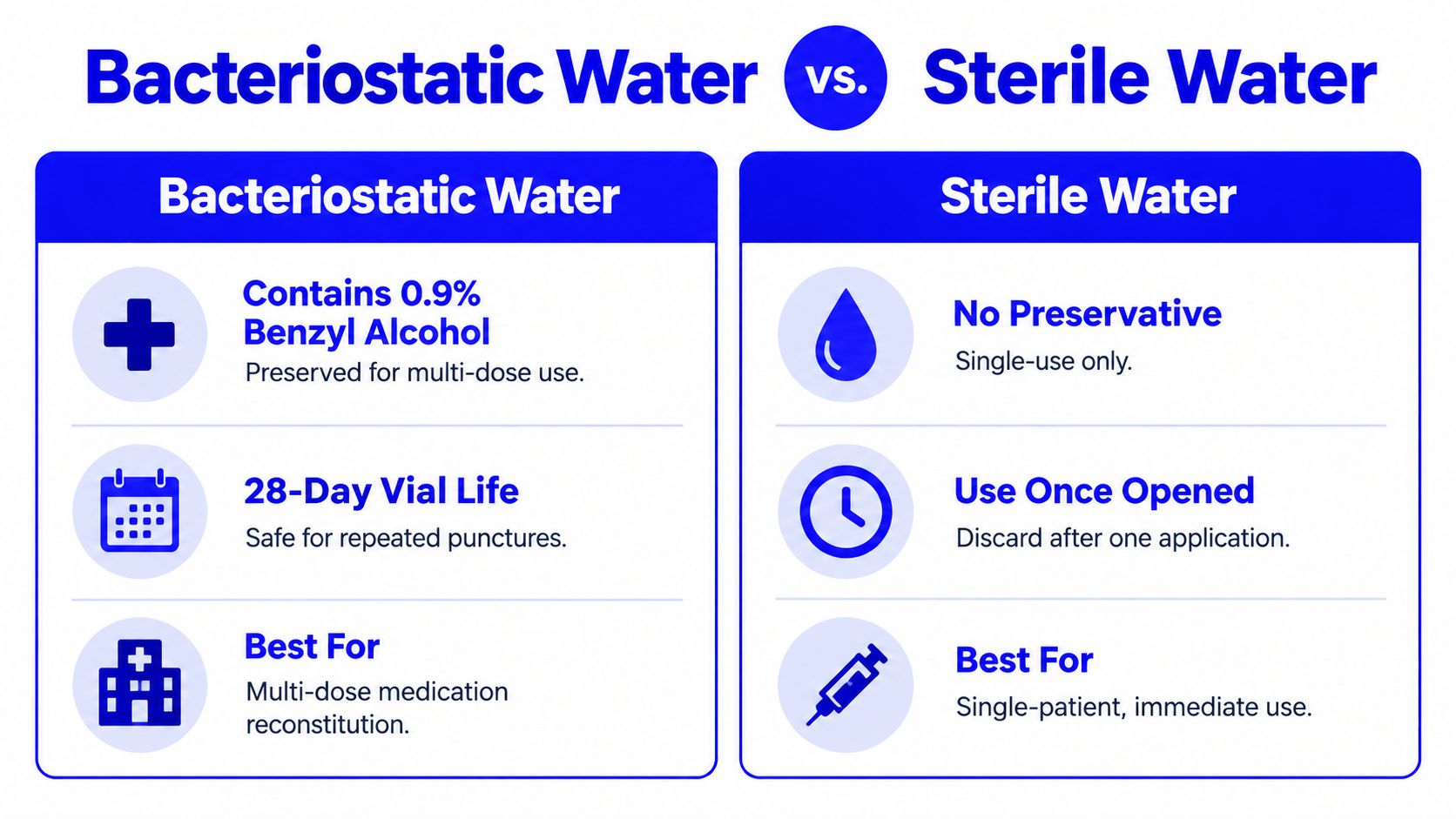
For repeated vial access, bacteriostatic water can make sense when the label, SOP, and assay all allow it. For immediate preparation and prompt use, preservative-free sterile water is often the cleaner choice. The practical distinction is not just composition. It is whether the preservative system helps the way the vial will be used, and whether that same preservative could interfere with the work.
That point gets missed often. Many summaries stop at listing ingredients. In practice, the reason the standard bacteriostatic formulation matters is that it is intended for multi-dose handling, while sterile water is typically a better fit where preservative exposure is unacceptable or unnecessary. That difference matters in RUO settings and should not be blurred with historical pharmaceutical concentrations used for other purposes.
Choose according to the failure you need to prevent
| Decision point | Bacteriostatic water | Sterile water |
|---|---|---|
| Repeated vial access | Suitable when the label and protocol allow multi-dose use | Generally unsuitable for retaining opened contents |
| Preservative exposure | Adds benzyl alcohol to the formulation | Adds no benzyl alcohol |
| Compatibility | Must be assessed for the compound and assay | May be preferable where preservatives interfere |
| Workflow | Supports a defined multi-dose process | Fits immediate, single-use preparation |
| Contamination control | Helps inhibit bacterial growth but doesn't replace aseptic technique | Provides no preservative protection after opening |
In peptide, protein, or antibody workflows, repeated withdrawals may justify bacteriostatic water if compatibility has been checked. In cell-based assays, preservative-sensitive methods, or preparations used right away, sterile water may be the safer fit. I have seen teams blame the reagent when the problem was a preservative conflict that should have been screened before reconstitution.
The diluent also solves only one part of the stability problem. After reconstitution, the material may still be affected by oxidation, hydrolysis, aggregation, adsorption, light, temperature shifts, or contamination introduced during handling.
Document the choice. Record the formulation, preservative status, intended use, compatibility basis, first-use date, preparation details, and disposal rule. If any of that is unclear, stop and confirm before proceeding.
Herbilabs supplies RUO bacteriostatic water and reconstitution solutions containing 0.9% benzyl alcohol in multiple vial formats, with lot-specific Certificates of Analysis and documented quality controls for research workflows. Review the available options and handling documentation at Herbilabs.