Private Label, White Label, Wholesale partnerships available - EU, USA and UK - Free shipping from €75

Glass Injection Vials: A Practical Selection Guide
A formulation team can spend days choosing a sterile container, then discover that the selected “10 mL vial” doesn't provide the working volume the fill line requires. The same problem appears at the bench when a peptide reconstitution workflow uses a closure that reseals poorly, or when a clear container exposes a light-sensitive formulation to unnecessary risk.
Glass injection vials aren't interchangeable bottles. The relevant decisions include glass type, hydrolytic resistance, colour, nominal and brimful capacity, wall thickness, elastomer chemistry, closure design, and how the container will be handled after opening. ISO 8362-1 defines the vial class for injectable preparations, including dimensions, capacities, and performance requirements for colourless or amber borosilicate and soda-lime containers intended for packaging, storage, or transport of injectable products. ISO 8362-1 has been updated through editions published in 2003, 2009, 2018, and 2019, reflecting continued attention to vial design and material requirements.
The practical question isn't whether glass remains relevant. It does. The better question is which glass injection vial and closure system fit the formulation, process, storage conditions, and in-use workflow.
Table of Contents
- Why Glass Injection Vials Still Matter in the Lab
- What Defines a Glass Injection Vial
- Comparing Type I Borosilicate, Type III Soda-Lime, and Amber Glass
- Glass vs Plastic Injection Vials
- Standard Vial Sizes and What Brimful Volume Really Means
- Closures, Stoppers, and the Real Source of Container Risk
- Sterility, Multi-Dose Access, and What Happens After the Vial Is Opened
- Selecting the Right Vial for Your Workflow
Why Glass Injection Vials Still Matter in the Lab
A lab selecting packaging for peptide reconstitution, sterile fill, antibody development, or lyophilized reagent storage usually needs a container that supports more than simple containment. The vial must protect the formulation, tolerate the intended sterilization or processing conditions, fit the filling equipment, and remain compatible with the stopper and seal throughout storage.
Glass remains a familiar choice because it combines chemical resistance, optical visibility, regulatory familiarity, and a strong manufacturing base. The market structure reflects that position. A 2026 estimate values the pharmaceutical glass vials and ampoules market at USD 16.89 billion, up from USD 15.85 billion in 2025, with a projection of USD 23.19 billion by 2031 and an estimated CAGR of roughly 6.54% to 6.55% over the forecast period. Research and Markets' pharmaceutical glass vials and ampoules market estimate also identifies Type I borosilicate, vaccines, and tubular glass forming as dominant parts of the category.
That scale matters to buyers because it supports broad availability of standardized formats, validated manufacturing routes, and established fill-finish equipment. It doesn't mean every vial on a supplier website is equivalent.
The three decisions that control the outcome
- Material and colour: Type I borosilicate is generally the conservative starting point for sensitive injectable formulations. Type III soda-lime may fit compatible products, while amber glass becomes more appropriate when light exposure threatens stability.
- Capacity and geometry: A vial's nominal label, such as 10 mL or 20 mL, doesn't tell the entire volume story. Brimful capacity, headspace, wall thickness, neck finish, and stopper dimensions affect filling and withdrawal.
- Closure system: The stopper, crimp or screw interface, aluminum seal, and any coating can influence container closure integrity, particulate generation, extractables, and contamination control.
Practical rule: Treat the vial, stopper, and seal as one container closure system. Selecting the bottle first and validating the closure later creates avoidable risk.
For a small research workflow, convenience and resealability may matter most. For sterile production, compatibility evidence, lot documentation, automated handling, and closure integrity carry more weight. The right choice depends on the formulation and use case, not on the vial's appearance alone.
What Defines a Glass Injection Vial
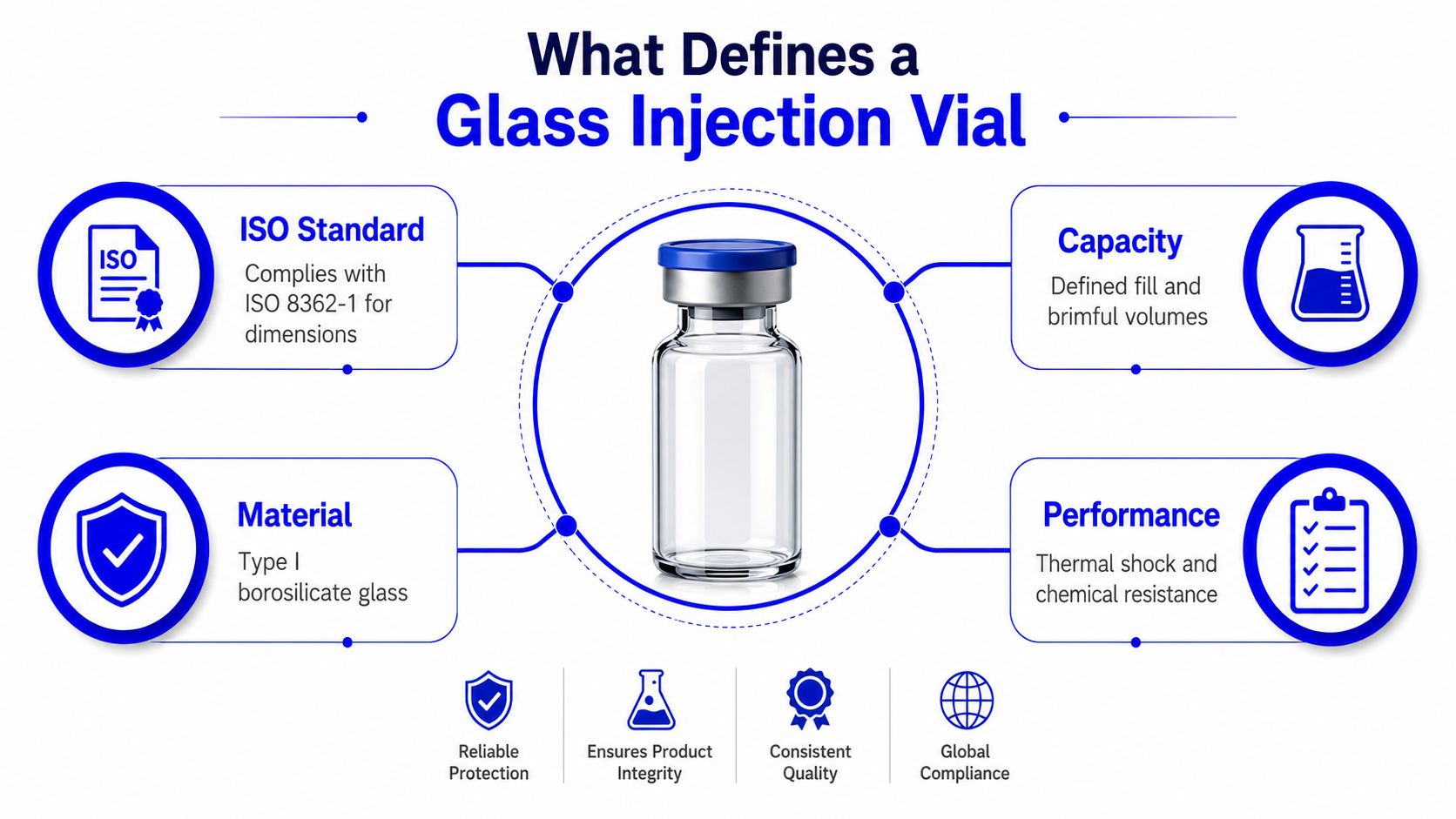
A glass injection vial is a specified medical container with controlled dimensions, capacity, material, and performance characteristics under ISO 8362-1. For procurement and process work, that reference matters less as a label than as a starting point for checking whether a supplier's specification matches the intended use.
Reading a vial specification sheet
A specification sheet should answer more than the vial's advertised size:
- Nominal capacity is the designated working volume used to identify a format, such as 10 mL, 20 mL, or 30 mL.
- Brimful capacity is the volume held when the vial is filled to the brim. It is higher than nominal capacity and helps determine actual headspace, fill settings, and the risk of overfilling.
- Neck finish defines the opening geometry and the interface for the stopper, crimp seal, screw closure, or filling equipment.
- Wall thickness affects mechanical strength, thermal response, handling, and internal volume.
- Hydrolytic resistance describes how strongly the glass resists interaction with aqueous contents. It is one practical basis for distinguishing Type I from Type III glass.
Nominal and brimful capacity answer different process questions. Nominal capacity identifies the vial format buyers request. Brimful capacity shows the container's physical limit, but it does not define a suitable fill volume. The usable fill depends on headspace requirements, withdrawal method, stopper penetration, formulation behavior, and the equipment used on the line.
Type I generally refers to highly hydrolytically resistant glass, commonly associated with borosilicate compositions. Type III identifies soda-lime glass with a different resistance profile. These designations support initial selection, but they do not replace formulation-specific compatibility, extractables and leachables, or stability work.
Why the standard's history matters
Parenteral glass containers developed from manually free-blown soda-lime bottles in the 1600s to mold-blown vial forms in the 1800s, followed by borosilicate and tubular-converted formats used in pharmaceutical packaging. The history, described in the PDA review referenced through the ISO 8362-1 standard record, helps explain why current vials combine established glassmaking methods with controlled dimensional and performance requirements.
A listing that says “clear glass vial” leaves too much unresolved. Check the applicable standard, glass type, colour, format, nominal and brimful capacities, neck finish, closure compatibility, and lot-level quality documentation before approving the container.
Comparing Type I Borosilicate, Type III Soda-Lime, and Amber Glass
Material selection should begin with the formulation, not the unit price. Type I borosilicate, Type III soda-lime, and amber glass each solve a different packaging problem, and colour and composition are separate variables. Amber glass may use a material family selected for compatibility while adding light protection, but it also changes visual inspection conditions.
The table below is a practical screening tool. It isn't a replacement for formulation-specific compatibility, extractables and leachables, stability, or container closure testing.
Glass Type Comparison
| Property | Type I Borosilicate | Type III Soda-Lime | Amber Glass |
|---|---|---|---|
| Hydrolytic resistance | High, making it the usual conservative choice for injectable formulations | Lower than Type I and more dependent on formulation compatibility | Depends on the underlying glass composition, not colour alone |
| Chemical interaction | Generally lower risk for sensitive parenteral products when properly specified | Can be more interactive with some aqueous or chemically sensitive formulations | Requires the same material and compatibility review as clear glass |
| pH and formulation effects | Often preferred where pH stability and low interaction are important | Suitable only when the formulation and storage study support its use | Light protection may help stability, but it doesn't solve chemical incompatibility |
| Light transmission | High visibility, but limited protection from light | High visibility with limited light protection | Reduced light transmission, useful for light-sensitive products |
| Thermal tolerance | Broad thermal tolerance and strong fit for demanding processing | More limited tolerance and greater dependence on process conditions | Determined by the glass composition and manufacturing specification |
| Typical use | High-value sterile injectables, biologics, peptides, and compatibility-sensitive products | Compatible formulations where the risk profile and validation support selection | Light-sensitive injectable products and formulations needing additional photoprotection |
| Main drawback | Usually carries a higher purchase cost than less resistant glass | Can introduce greater interaction risk and may be unsuitable for sensitive products | Makes visual inspection less direct and doesn't automatically indicate Type I performance |
When each option is the wrong call
Type I borosilicate is the default starting point when the formulation is sensitive, the product has a demanding stability profile, or the consequences of interaction are serious. It still needs testing. A Type I label doesn't eliminate risks from surface chemistry, delamination, stopper extractables, or long storage.
Type III soda-lime can work when compatibility data support it and the formulation doesn't place unusual demands on the container. It's a poor shortcut for a low-pH or otherwise sensitive biologic just because the vial costs less.
Amber glass is useful when light exposure is a known concern, but it can complicate visual inspection of colour, clarity, and particulate. If operators need to detect subtle appearance changes, the formulation may require controlled inspection lighting or an alternative packaging strategy.
For an uncertain formulation, Type I clear glass is usually the more defensible initial specification, followed by compatibility and stability work. The final decision should be based on the molecule, solvent system, pH, storage duration, processing temperature, light sensitivity, and closure combination.
Glass vs Plastic Injection Vials
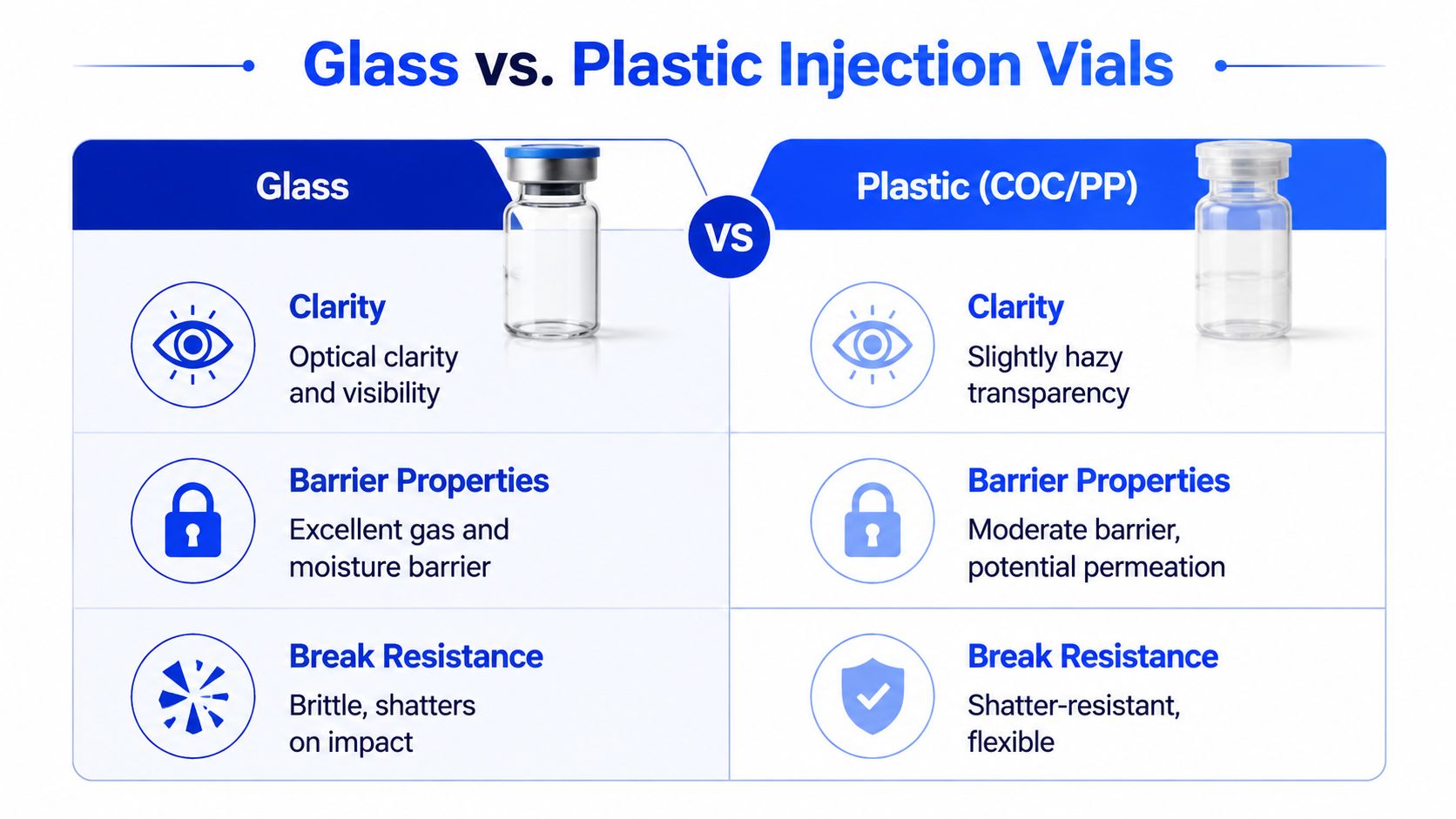
Plastic injection vials deserve a serious comparison because cyclic olefin copolymer and polypropylene can solve problems that glass cannot. Plastic is shatter-resistant, lighter to handle, and often more forgiving in transport and cold-storage workflows. Glass, however, offers strong optical clarity, an excellent gas and moisture barrier, and long regulatory familiarity.
Where glass earns its place
Glass provides a strong barrier against oxygen and moisture, which can matter for oxygen-sensitive compounds and long storage. It also tolerates high-temperature processing better than many polymers, depending on the exact glass specification and validated process. Clear glass gives operators direct visibility of the solution, while amber glass adds protection when light is a stability concern.
The disadvantages are just as practical. Glass can break during handling, create shards, add weight, and become a safety problem in busy laboratories or during transport. Mechanical shock, rapid temperature changes, and freeze-thaw handling all require attention to vial geometry and process controls.
Where plastic makes more sense
COC and polypropylene can be attractive for biologic formulations where protein adsorption, breakage, or frozen storage creates a larger concern than maximum barrier performance. Plastic's flexibility and resistance to shattering can improve operator safety, particularly in settings where vials move frequently between freezers, benches, and transport containers.
Plastic also introduces its own questions. Gas and moisture permeation can be more relevant, clarity may be less complete, and extractables and leachables must be assessed against the formulation. A polymer that performs well with one protein or buffer isn't automatically appropriate for another.
| Choose glass when | Consider plastic when |
|---|---|
| Oxygen and moisture barrier are central to stability | Break resistance is a major safety requirement |
| High-temperature processing or depyrogenation is part of the validated workflow | Frozen or cryogenic handling is central to the workflow |
| Optical clarity supports inspection | Reduced protein adsorption is a priority |
| Established pharmaceutical precedent simplifies development | Polymer performance has been demonstrated for the specific formulation |
| The product needs a rigid, dimensionally stable container | Lower weight and flexible handling offer operational value |
For a broader discussion of how material choice affects laboratory work, this guide to labware and glassware selection provides useful context. The decision should still come from formulation data and process requirements, not from a blanket preference for either material.
Standard Vial Sizes and What Brimful Volume Really Means
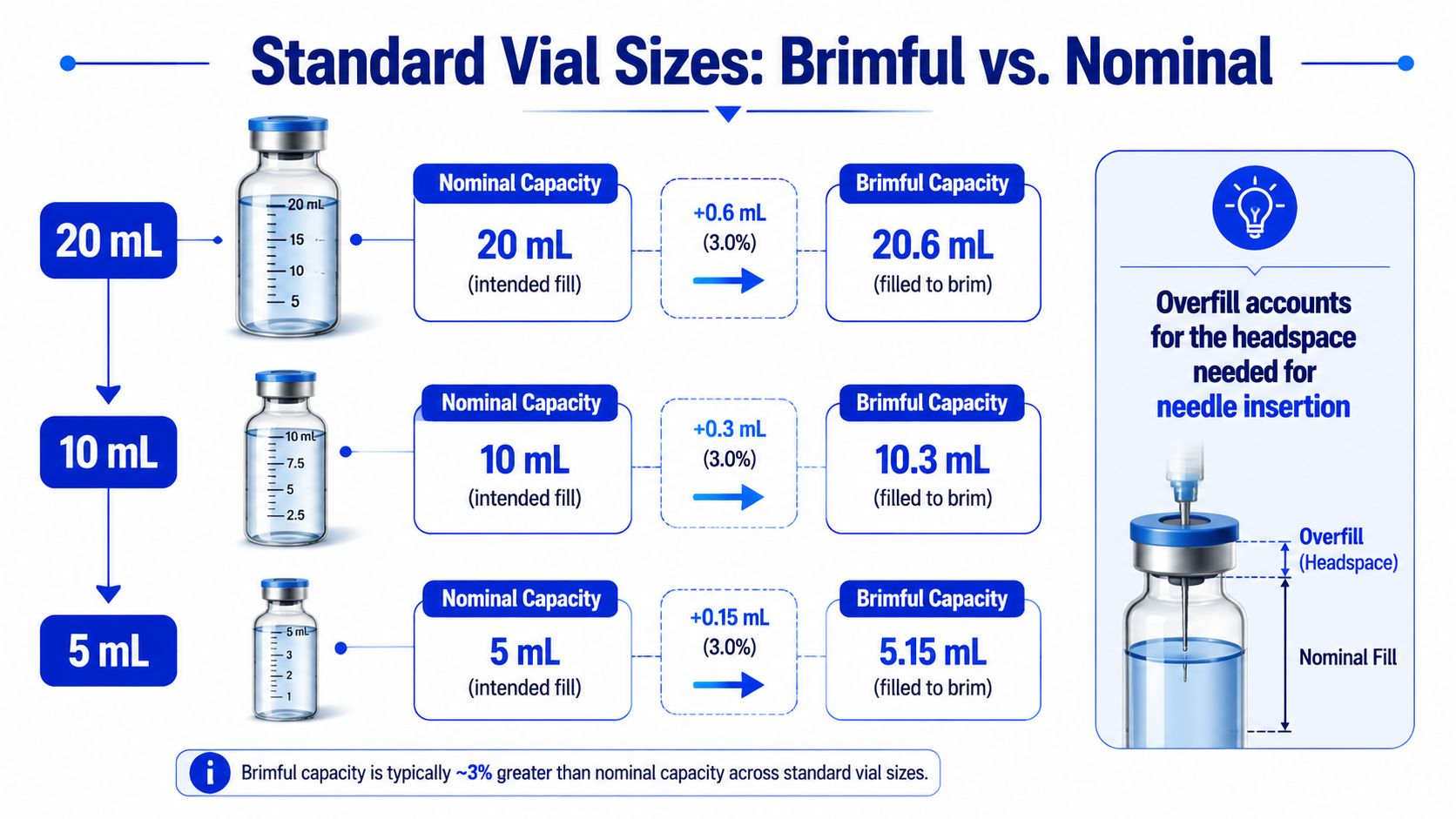
A fill line can reject a “20 mL vial” when the specification reflects only the label. Nominal capacity identifies the working format, while brimful capacity describes how much the glass can physically contain. The difference affects fill volume, headspace, foam control, needle access, lyophilization behaviour, and the space occupied by the stopper and closure.
Published ISO 8362-1 tubular vial formats provide practical benchmarks. A 10R vial measures 24 x 45 mm and has about 13.5 mL brimful capacity. A 20R vial measures 30 x 55 x 1.2 mm and has about 26 mL brimful capacity, while a 30R vial measures 30 x 75 x 1.2 mm and has about 37.5 mL brimful capacity. These figures appear in the independent tubular vial specification tables from Dedecke.
Nominal capacity is a working designation
A nominal 20 mL vial is not intended to be filled to its brimful volume. The extra space accommodates headspace, needle insertion and withdrawal, and normal process variation. Filling near the physical limit can increase foam, stopper contact, spillage, and inadequate gas volume.
Common lab formats include 3 mL, 10 mL, 20 mL, and 30 mL. Choose among them according to the actual formulation volume, overfill allowance, withdrawal method, and whether the vial will be accessed once or repeatedly. A vial that fits the product volume may still be unsuitable if the closure leaves too little working space.
Geometry affects handling
Published dimensions also show wall thickness increasing from 1.0 mm in smaller formats to 1.2 mm in the 20R and 30R sizes. The Dedecke vial tables provide those size and wall-thickness benchmarks. A thicker wall can support mechanical strength in larger containers, but impact, thermal shock, and freeze-thaw exposure still require control.
Before purchasing, procurement should request:
- Working volume: State the actual fill volume, not only the nominal vial label.
- Brimful volume: Confirm physical capacity and usable headspace.
- Dimensions: Check diameter, height, neck finish, and machine compatibility.
- Closure space: Confirm stopper, seal, and crimp dimensions before ordering.
- Process behaviour: Evaluate foaming, lyophilization, freezing, and withdrawal requirements.
A fill line specified around nominal volume alone can force late changes. Build the specification around the formulation and process, then match those requirements to the vial format.
Closures, Stoppers, and the Real Source of Container Risk
A glass body can meet its dimensional specification and still fail as a packaging system if the closure combination is poorly matched. The elastomer stopper is the product-contact barrier and the point of needle entry. The aluminum crimp or screw mechanism holds that barrier in place, while a flip-off cap protects the access surface and provides a visible indication of prior access.
The closure interface needs its own validation
Bromobutyl and chlorobutyl stoppers are common choices because they offer chemical resistance and pharmaceutical compatibility. Silicone-coated, low-silicone, and silicone-free designs can change machinability, particle generation, and interaction with proteins or other sensitive formulations. Lyophilization stoppers use specialized geometries, including designs that allow moisture escape during the drying cycle before the stopper is fully seated.
Crimped aluminum seals are appropriate when high closure integrity and tamper evidence matter, especially for sealed sterile products that aren't intended for repeated re-entry. Screw-thread closures can be more convenient for bench use because they're resealable, but convenience doesn't automatically equal equivalent sterile barrier performance.
The stopper is part of the formulation's contact surface, not a disposable accessory.
A stopper can shift during handling, deform under capping force, shed fragments during puncture, or contribute extractables during storage. Container closure integrity testing should therefore cover the complete vial, stopper, and seal assembly under intended storage and transport conditions.
Handling and identification still matter
Secondary packaging protects the primary container during transport, but it can also create confusion if labels obscure inspection areas or if operators handle unmarked containers on a shared bench. For laboratories managing fragile containers, Storage & Removal Boxes Ltd glass labels offer a practical reference for warning and handling identification.
A suitable label won't compensate for a weak closure process. Operators still need defined capping parameters, inspection criteria, compatible disinfectants, and storage instructions. Validation should examine stopper chemistry, puncture performance, reseal behaviour, particulate, extractables and leachables, and the possibility of closure movement during shipment or temperature cycling.
Sterility, Multi-Dose Access, and What Happens After the Vial Is Opened
A sealed vial can leave manufacturing sterile and still become a contamination risk once it enters routine use. Cap disinfection, needle puncture, repeated withdrawals, bench placement, transport between rooms, and contact with gloved hands all change the exposure model.
Independent literature shows why external surfaces deserve attention. A 2020 review found surface drug traces on 56% of commercial antineoplastic containers, and a 2024 pilot study found detectable contamination and cross-contamination on shrink-wrapped and secondary-packaged vials. The findings are discussed in the published review on contamination of drug vial surfaces. These observations don't prove that every vial is unsafe, but they do show that secondary packaging and apparent cleanliness aren't substitutes for controlled handling.
Single-use and multi-dose workflows differ
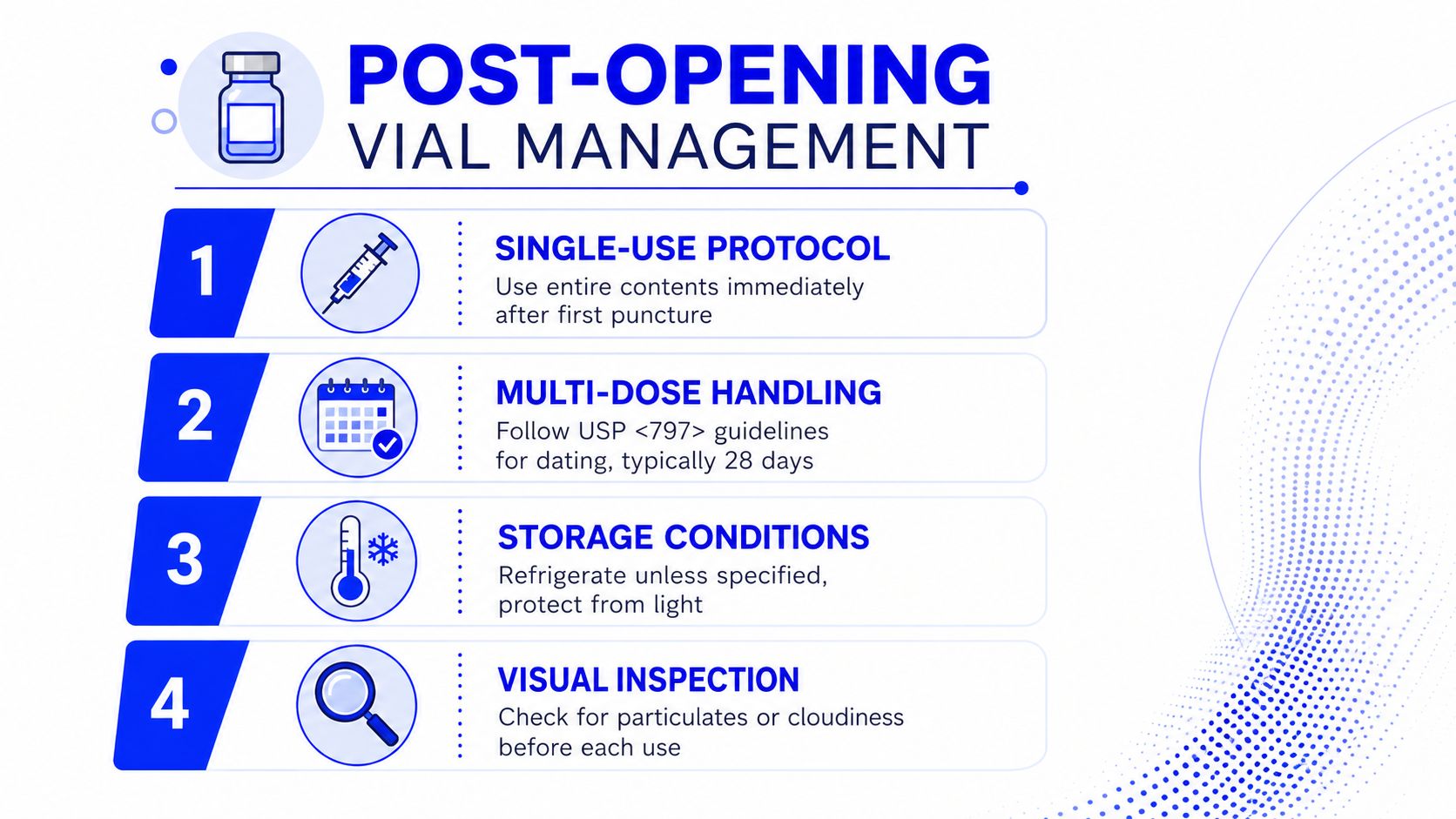
A single-use vial should be managed around immediate use after puncture, with the remaining contents discarded according to the applicable laboratory or institutional procedure. A multi-dose workflow requires a defined in-use period, repeated disinfection, controlled needle access, clear dating, and storage conditions supported by the product and SOP.
For research teams working with sterile diluents, sterile water vials for reconstitution workflows may fit a defined RUO process, but the user still has to follow the supplier's instructions and the laboratory's aseptic procedures. A bacteriostatic formulation containing 0.9% benzyl alcohol can support repeated withdrawals within the stated in-use period when handled aseptically, but it doesn't make careless access acceptable.
What operators should control
- Cap preparation: Disinfect the access surface using a validated procedure and allow the surface to dry as required.
- Needle discipline: Use appropriate sterile equipment for each access and avoid contact between the needle and nonsterile surfaces.
- Bench segregation: Keep opened vials away from contaminated materials, crowded work areas, and unnecessary transport.
- Visual inspection: Check for particulates, cloudiness, colour change, cracks, and closure damage before use.
- Dating and records: Mark opening information and follow the approved in-use window for the specific product.
The vial controls the sealed state. Aseptic technique controls what happens after opening. Glass doesn't remove the need for workflow design, staff training, or a clear multi-dose policy.
Selecting the Right Vial for Your Workflow
A practical specification starts with the job the vial must perform.
For peptide, protein, or antibody reconstitution, Type I clear glass is a sensible starting point when compatibility and visibility matter. Select the nominal format around the required working volume, then verify brimful capacity, stopper chemistry, and the number of expected punctures.
For sterile fill-finish, the complete container closure system must match the filling line, sterilization approach, crimping equipment, inspection process, and required documentation. A standard-compliant vial still needs qualification with the selected stopper and seal.
For lyophilized products, confirm that the stopper geometry supports the drying cycle and that the vial's dimensions, shoulder profile, and closure fit the lyophilizer and loading configuration. For multi-user bench dispensing, resealability, clear identification, secondary packaging, opening dates, and contamination controls may matter more than maximum throughput.
A procurement checklist should include:
- Material grade and colour
- ISO 8362-1 format and neck finish
- Nominal and brimful capacity
- Dimensions and wall thickness
- Stopper material and coating
- Crimp, flip-off, or screw closure
- Sterilization and processing compatibility
- Expected storage and in-use conditions
- Lot-specific Certificate of Analysis and quality records
- Secondary packaging and transport protection
The common mistakes are predictable: choosing Type III without compatibility evidence, treating nominal volume as usable fill volume, and ignoring stopper chemistry. These labware selection tips for lab professionals reinforce the value of matching the container to the actual workflow rather than buying by size alone.
For RUO reconstitution workflows, Herbilabs supplies sterile, non-pyrogenic reconstitution solutions containing 0.9% benzyl alcohol in premium glass multi-dose vial formats, with lot-specific Certificates of Analysis and formats including 3 mL, 10 mL, 20 mL, and 30 mL. The appropriate product and vial size still depend on the material being reconstituted, access frequency, storage requirements, and the laboratory's approved procedure.
Herbilabs provides RUO sterile diluents and reconstitution solutions in practical glass vial formats, with quality documentation and fulfillment options for laboratories, resellers, and private-label partners. Visit Herbilabs to review the available vial formats and select a documented solution that matches the intended glass injection vial workflow.