Private Label, White Label, Wholesale partnerships available - EU, USA and UK - Free shipping from €75

Bac Water 10ml: Complete Lab Guide for Multi-Dose Use
You've got a bench full of lyophilized vials, a reconstitution step scheduled between two assay runs, and a 10 mL bacteriostatic water vial on the cart because it seems like the safest middle ground. That choice only works if the vial size, preservative system, handling method, and actual usage pattern line up. Otherwise, a convenient multi-dose bottle turns into a quiet source of waste, contamination risk, or avoidable documentation headaches.
Table of Contents
- Understanding bac water 10ml for Research Workflows
- Technical Specifications That Define Quality
- Aseptic Technique and the 28-Day In-Use Window
- Comparing Vial Sizes for Different Research Needs
- The Hidden Economics of 10 mL Multi-Dose Vials
- Verifying Supplier Quality and Documentation
- Making the Right Choice for Your Lab
Understanding bac water 10ml for Research Workflows
A researcher opens a cold box, reaches for a bac water 10ml vial, and checks the label before touching the stopper. That routine looks simple, but the label has to mean something concrete if the vial is going to support peptide, protein, or antibody work without adding avoidable variability.
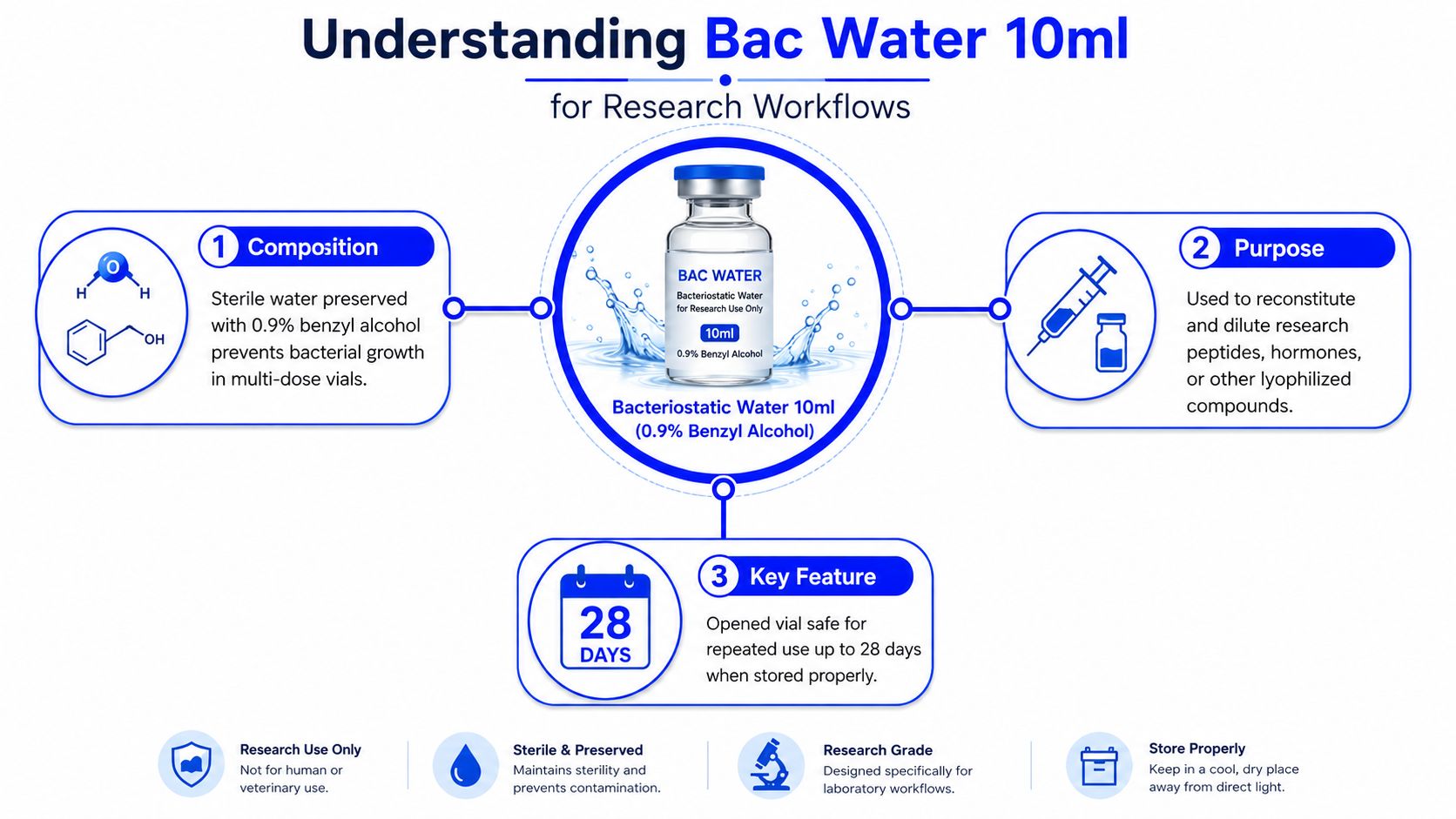
Bacteriostatic water in a 10 mL vial is typically sterile water with 0.9% benzyl alcohol, also described as 9 mg/mL, and DailyMed identifies it as a sterile, nonpyrogenic preparation of Water for Injection DailyMed product reference. That preservative level is what separates bacteriostatic water from plain sterile water, because it supports multi-dose access after the vial is punctured. In practical lab use, that matters when a single container has to support repeated withdrawals across a short project window.
Why the 10 mL format keeps showing up
The 10 mL size sits in a practical middle zone. It is large enough to support repeated reconstitution work, but small enough that a lab does not have to commit to a bottle that sits around long after opening. That balance explains why the format shows up across research and pharmaceutical-adjacent workflows, especially where the same vial has to serve multiple preparations.
The 28-day in-use window associated with bacteriostatic formulations gives that format its workflow value. Once the vial is opened, the clock starts at first puncture, not when the bottle arrives. That timing matters in real scheduling, because a lab that opens a 10 mL vial for one project can end up discarding usable volume if the work pace slows or sample demand drops before the window closes.
A 10 mL vial can reduce bottle count and save time at the bench. It can also create waste if the team opens it for a small run and never uses the remaining volume before the in-use period ends. The right choice depends on how often the vial will be accessed, how tightly the work is scheduled, and whether the lab can keep each puncture controlled enough to avoid contamination during repeated withdrawals.
Practical rule: A 10 mL vial is only “multi-dose” if the lab treats it like a controlled container, not a convenience bottle.
Technical Specifications That Define Quality
A label that says bacteriostatic water isn't enough. The practical question is whether the vial's release specs support the kind of reconstitution work being done, especially with sensitive peptides or proteins that can misbehave when the water quality drifts.
The parameters that matter at the bench
The relevant release profile commonly includes pH 4.5–7.0, sterility to USP <71>, and endotoxin limits below 0.5 EU/mL technical datasheet. Some technical sheets also describe 0.22 µm sterile filtration, which reduces particulate and microbial load before aseptic filling. That matters because the filter step is part of how the product gets to a state suitable for repeated access, not just a detail buried in manufacturing notes.
A lab manager looks at these specs differently depending on the downstream assay. pH drift can change how a compound dissolves. Endotoxin contamination can complicate cell-based workflows. Bioburden can turn a clean reconstitution into a problem that only shows up later, after time and reagent have already been spent. Type I borosilicate glass and compatible elastomer closures also matter because container integrity has to hold through storage and repeated puncture.
| Key Quality Parameters for 10 mL Bacteriostatic Water | ||
|---|---|---|
| Parameter | Typical Range | Why It Matters |
| pH | 4.5–7.0 | Supports predictable solubility behavior during reconstitution |
| Sterility standard | USP <71> | Confirms sterile manufacturing controls |
| Endotoxin limit | Below 0.5 EU/mL | Reduces risk in sensitive biological workflows |
| Filtration | 0.22 µm | Lowers particulate and microbial load before filling |
| Container | Type I borosilicate glass | Helps preserve integrity during storage and access |
What good specs do in practice
Good specifications don't make a careless process safe, but they do reduce the chance that the diluent itself becomes the weak point. That distinction matters in peptide and protein workflows, where the dilution step is often blamed for downstream inconsistency even when the issue is contaminated access or poor storage discipline.
A clean datasheet also helps procurement. Instead of asking whether the vial “looks fine,” the buyer can ask whether the lot meets the documented release criteria needed for the exact workflow. That's a better question, and it's the one that keeps labs from treating a critical reagent like a commodity with no technical variance.
Aseptic Technique and the 28-Day In-Use Window
A vial can be filled correctly and still fail at the bench. The preservative buys a little margin, but only when every access keeps contamination out of the septum and the fluid path.
A 10 mL bottle makes sense only if the team can use it within the in-use window without stretching storage discipline. If the lab draws often enough to finish the vial on schedule, the larger format reduces replacement frequency and keeps procurement simple. If access is sporadic, the same bottle turns into dead volume after the window closes.
Access habits that protect the vial
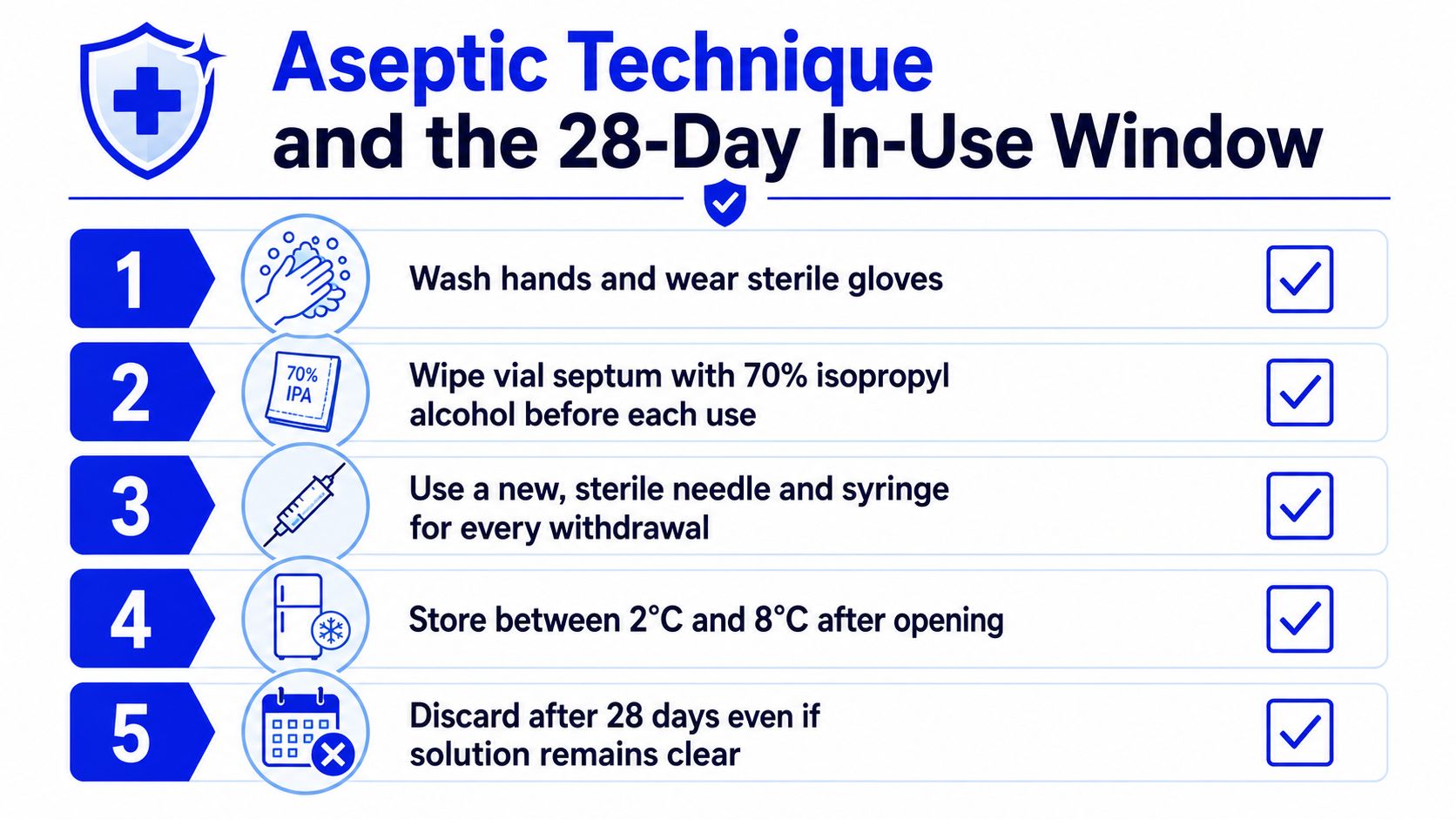
The first step is plain and unforgiving. Hands need to be clean, gloves need to stay on, and the stopper has to be swabbed before every withdrawal. A new sterile needle and syringe for each access is the other part that cannot be skipped, because reusing a sharp or touching a sterile pathway defeats the point of a multi-dose container.
Storage has to match the handling plan. References place this format at 20–25 °C, and the in-use control is tied to the 28-day window after first puncture storage and use reference. If the vial sits in a warm prep area, gets rushed through repeated access, or is recapped carelessly, the preservative cannot correct the damage. It can slow bacterial growth, but it does not reverse contamination already introduced.
The right gloves help keep the routine consistent, especially in a prep area with vials, alcohol swabs, sharps, and repeated handling. A field reference on selection is best oil resistant gloves from PSC TRADING, which is useful when cleaning agents, solvents, or nonstandard surfaces make grip control harder.
Practical rule: If the stopper is touched, the needle is reused, or the vial is left in uncontrolled storage, the 28-day assumption no longer deserves trust.
The downstream mixing step needs the same discipline. A practical guide to mixing peptides with bacteriostatic water is useful only when it sits inside a consistent aseptic routine, not as a substitute for one.
After opening, the vial should be handled like a tracked multi-dose asset, not a free-use consumable. If the lab cannot record the first puncture date, keep a clean access log, and control each stoppered entry the same way, the problem is not the bottle size. It is process control.
Comparing Vial Sizes for Different Research Needs
A vial that is too large creates its own waste pattern. A lab may open a 10 mL bottle for a workflow that only needs a few punctures, then watch the remaining volume age inside the 28-day in-use window. A smaller format avoids that dead stock. A larger format can still be the right call, but only when the team has enough repeat access to use it before the clock expires.
3 mL, 10 mL, and 30 mL serve different habits
The case for 3 mL is straightforward. If a team only needs a small number of preparations before the in-use window closes, a smaller bottle leaves less material stranded after the final withdrawal. A buyer guide notes that 1 mL to 5 mL may be used depending on the concentration target, which is why the smallest format often fits short protocols and limited access patterns better than a larger bottle.
The case for 10 mL is balance. It gives a lab room for repeated access without forcing a major inventory commitment, and it works well when several users pull from the same stock over a short cycle. Storage footprint matters here too. Fewer bottles on the shelf mean less handling, less crowding in the refrigerator, and less chance that a partly used container gets misplaced before the in-use window closes.
The case for 30 mL is different. It fits groups that know the same diluent will be used repeatedly across shared workflows, where procurement time and bottle turnover matter more than keeping the open-container burden small. A practical reference on bacteriostatic water vials is useful for comparing format options, especially when a lab wants to match bottle size to bench frequency instead of ordering by habit.
| Vial Size | Best Fit | Main Trade-Off |
|---|---|---|
| 3 mL | Low-volume or single-use work | Minimal waste, but less room for repeated access |
| 10 mL | Mid-scale research workflows | Good balance, but can still outlast usage needs |
| 30 mL | High-volume or shared workflows | Fewer purchases, but more exposure to open-vial risk |
A simple decision frame
A lab should start with access patterns, not with the most common size on the shelf. If a project only needs a few withdrawals before the month is over, a smaller vial usually keeps waste lower. If a shared bench keeps reaching for the same diluent across multiple workflows, the 10 mL format starts to make more sense because it reduces replenishment frequency without forcing a jump to a much larger container.
The question is whether the open vial can be consumed before it becomes a liability. That is where storage discipline, bench traffic, and procurement timing all intersect. A bottle that looks economical on paper can become expensive in practice if it sits half-used at expiry.
The Hidden Economics of 10 mL Multi-Dose Vials
A 10 mL vial can look cost-efficient on the purchase order and still waste money on the bench. The loss shows up when the bottle stays open longer than the workflow can justify, because every unused portion sitting past the 28-day in-use window is inventory the lab already paid for but did not consume.
Why the economics shift in practice
The buying decision is not just about unit price. It is about whether the vial will be used often enough, and soon enough, to turn its full contents into actual work before expiry. A smaller format can be cheaper in practice when a project only needs a few withdrawals, because less material is left stranded at the end of the run. A 10 mL bottle starts to make more sense when the same diluent is being reached for across several closely timed tasks and the bench can keep the turnover moving.
The trade-off is simple. More volume gives the lab more flexibility, but it also raises the chance that some of that volume will age out unused. A procurement team that buys by habit can miss that cost entirely, because the loss does not show up at the moment of purchase. It shows up later, when a partially used vial is discarded with useful volume still inside.
Waste is the hidden line item
The expensive part is not only the bottle itself. It is the combination of open-container risk, bench traffic, and expired residual volume. A vial that survives to the end of the window with half its contents untouched creates waste twice, first in the unused material and again in the time spent handling, storing, and replacing it.
Supplier controls matter here too. A supplier with clear batch control and release documentation, such as the sort of process review discussed in ISO 9001 quality systems, gives the lab a better basis for planning inventory by lot rather than by guesswork. That does not eliminate waste, but it makes purchasing decisions easier to defend and helps procurement match bottle size to real bench frequency instead of repeating the same order out of routine.
Match the bottle to the work
A 10 mL vial is the right choice when the bench can reasonably use most of it inside the in-use window and the team wants fewer replenishment events. It is a poor fit when workflows are irregular, because the open vial becomes a liability long before the bottle is empty. The same format can be efficient in one lab and wasteful in another, depending on access patterns and how tightly the project schedule is managed.
That is why the economic question is not whether a larger bottle looks cheaper on paper. It is whether the lab can consume it before the residual volume becomes dead stock. In many short runs, the smaller format wins on waste control. In shared workflows with steady turnover, 10 mL can be the practical middle ground.
Verifying Supplier Quality and Documentation
A vial can meet the right composition and still be a poor procurement choice if the paperwork is weak. For research use, documentation is part of the product, because a batch that can't be traced cleanly is hard to defend in a reproducibility review.
What serious buyers ask for
The core checks are simple to list and easy to ignore. Buyers should ask for lot-specific Certificates of Analysis, NIST traceability where applicable, seal and fill-volume checks, stability data, and transport validation buyer guide. Missing lot numbers, generic COAs, or vague quality language are all signs that the supplier may be selling a product without giving the lab enough information to verify what arrived.
A related quality-system reference on ISO 9001 quality systems is useful when a supplier can show how batch review and release control are handled. The point isn't to collect paperwork for its own sake. The point is to make sure the vial in hand matches the vial on the record.
The right question to ask
The wrong question is, “Is bacteriostatic water sterile?” The better question is, “Can the supplier prove sterile manufacturing, documentation control, and lot consistency for this specific 10 mL batch?” That shift matters because search results and procurement pages often blur bacteriostatic water with unrelated BAC products, which creates avoidable confusion for buyers trying to compare options.
Procurement rule: If the supplier can't show lot-level traceability, the product is a risk even when the label looks familiar.
For labs that need a RUO supply chain with batch review, 10 mL is only part of the decision. Documentation has to support the vial's use in the actual workflow, especially when multiple people handle the same stock. A clean label without clean records is just a better-looking risk.
Making the Right Choice for Your Lab
The best choice comes from matching specification, handling, and vial size to actual use, not from buying the largest bottle or the cheapest one. Bac water 10ml is the right fit when repeated withdrawals are expected, aseptic access is disciplined, and the bottle can be consumed inside the 28-day in-use window. If the workflow is shorter or lighter, a smaller format can reduce waste and simplify inventory control.
For a lab buyer, the checklist is straightforward. Verify composition and release specs, confirm the first-puncture tracking process, match vial size to the number of real reconstitutions, and demand lot-level documentation before release. Those four checks prevent the most common mistakes.
Herbilabs supplies bacteriostatic water and reconstitution solutions in multiple vial formats, including RUO 10 mL options, with documentation and manufacturing controls built for research workflows. If your lab needs to compare vial sizes, verify lot-level records, or tighten reconstitution handling, visit Herbilabs and review the available formats before your next procurement cycle.