Private Label, White Label, Wholesale partnerships available - EU, USA and UK - Free shipping from €75

Vial of Liquid: A Complete 2026 Lab Safety Guide
A researcher can spend weeks preparing a peptide study, then compromise the entire workflow during a routine withdrawal. The vial looks clear, the stopper appears intact, and the liquid remains within its expected volume. Yet a contaminated needle, an inadequately disinfected septum, or an unnoticed crack can turn a controlled experiment into an uncertain result.
A vial of liquid is therefore more than packaging. It's a coordinated system of container material, closure, seal, formulation, storage, labeling, and handling practices. Each part protects the liquid from contamination, chemical interaction, particulate matter, and loss of traceability. Treating the vial as part of the experimental method, rather than as passive storage, gives laboratory teams a more reliable basis for reconstitution, sampling, and repeat testing.
Table of Contents
- Understanding the Vial of Liquid in the Lab
- Vial Formats, Materials, and Construction
- Single-Dose vs. Multi-Dose, Weighing the Risks
- Aseptic Technique and In-Use Safety Protocols
- Storage, Stability, and Shelf-Life Management
- Quality Assurance and RUO Product Standards
- Conclusion, Prioritizing Integrity in Every Withdrawal
Understanding the Vial of Liquid in the Lab
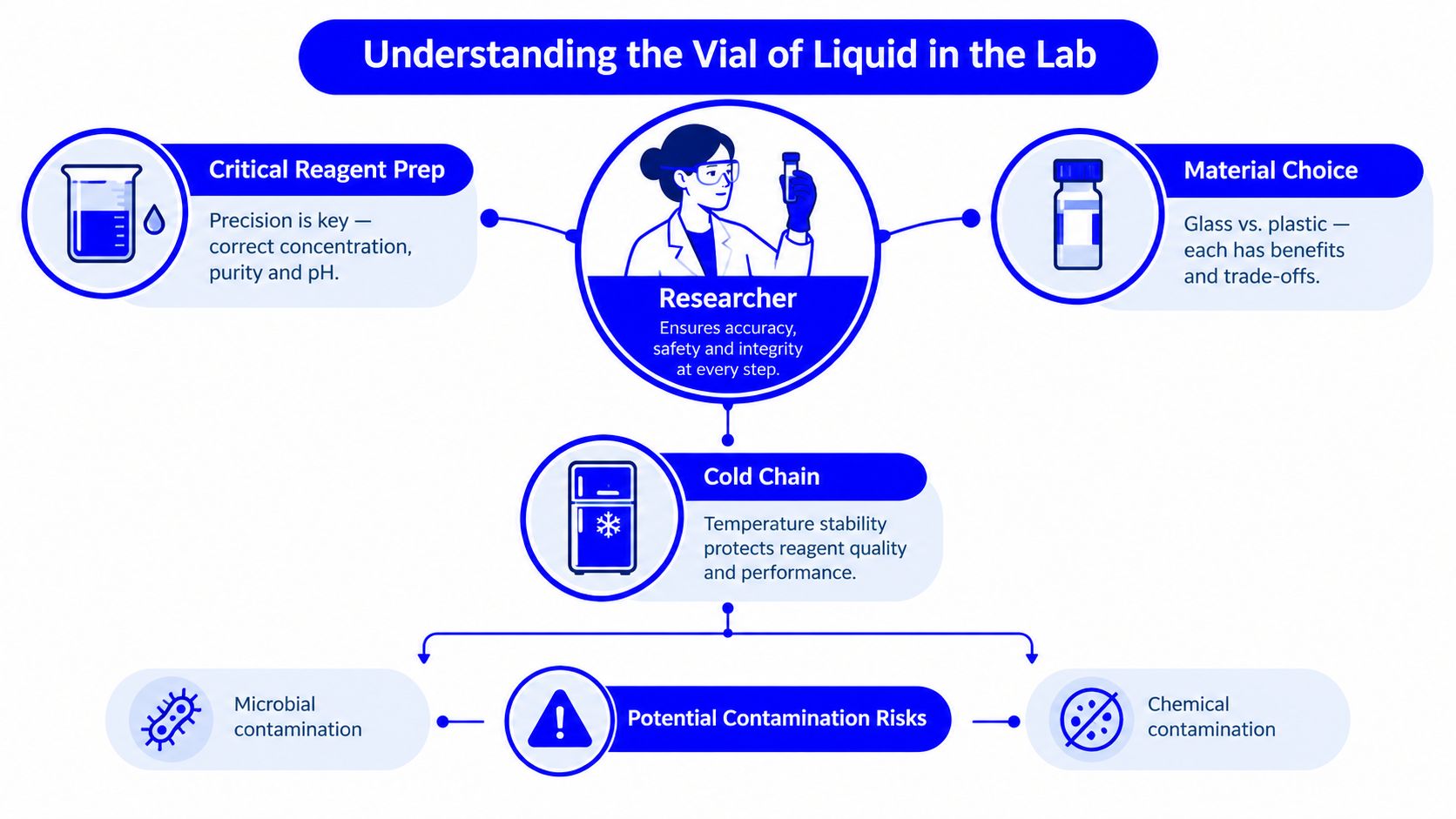
A vial can leave a carefully prepared experiment exposed at the access point. The liquid may have the correct concentration and the seal may look intact, yet repeated needle entry, an inadequately disinfected stopper, or poor storage history can compromise its suitability for research use.
The practical definition is straightforward: a vial of liquid is a small container for a reagent, diluent, sample, or pharmaceutical-style preparation. In operation, it must do more than hold liquid. Its closure must limit contamination and preserve the contents before opening, then maintain appropriate in-use integrity after access begins.
The vial as part of the method
Neck finish, stopper, crimp, container material, and storage history all affect whether a liquid remains suitable for its intended workflow. These details matter during critical reagent preparation because accurate preparation and sterile equipment cannot correct contamination introduced during withdrawal.
Modern laboratory and pharmaceutical-style vials use standardized dimensions and closure systems. Distributor catalogues list formats from approximately 0.044 mL micro-vials to about 50 mL, including 0.1 mL, 1 mL, 1.5 mL, 7.5 mL, 10 mL, 20 mL, and 25 mL options (Fisher Scientific vial listings). These formats support chromatography, sample storage, research handling, and pharmaceutical-style workflows.
Nominal volume also differs from the space available when a vial is completely filled. A 10 mL nominal vial with a 20 mm crimp finish may hold approximately 13.5 mL at brimful capacity. That distinction affects headspace, mixing, withdrawal control, and equipment fit.
Choose the container and closure with the same care as the formulation. A compatible liquid in a poorly matched vial remains a weakly controlled experiment.
Vial Formats, Materials, and Construction
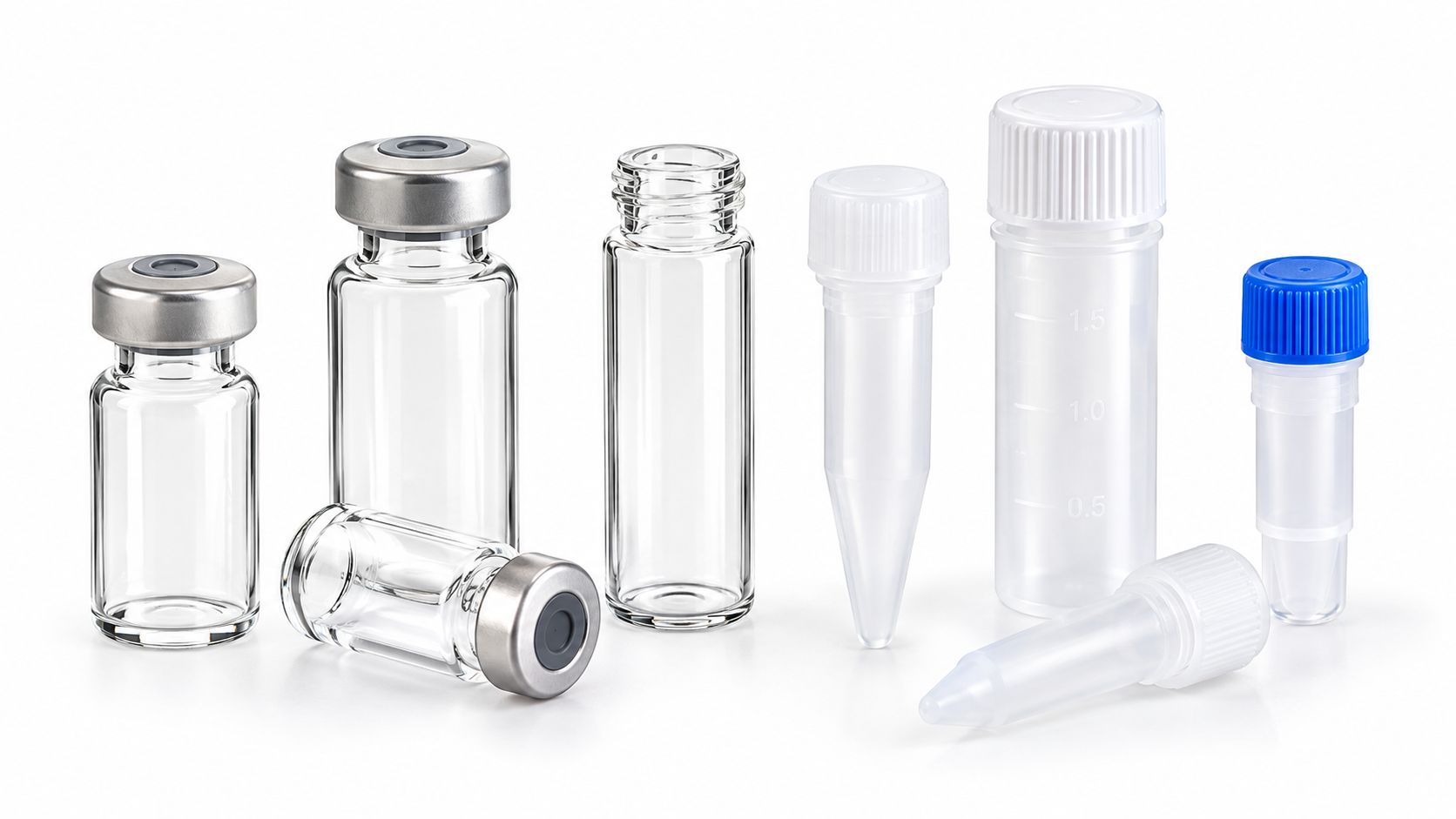
Vial construction determines how the liquid is stored, accessed, and monitored. Glass is widely used where chemical compatibility, visual inspection, and dimensional stability matter. Plastic can be useful when lower weight, impact resistance, or a particular dispensing format takes priority, but the material must be evaluated for interaction with the formulation and the intended storage conditions.
A vial typically combines the body, neck finish, elastomeric stopper, and an aluminum crimp seal. The stopper forms the puncturable barrier, while the crimp secures it against the vial finish. A flip-off or similar cap can protect the access point before use and provide a visible indication that the closure has been disturbed.
Matching format to workflow
The appropriate size depends on withdrawal volume, expected access frequency, available storage, and the need to minimize unused liquid. A small vial can reduce waste for low-volume work, while a larger format may suit repeated preparation or shared laboratory workflows. The decision shouldn't be based on capacity alone, because every additional access creates another opportunity for handling error.
Standardized catalog formats help laboratories source compatible containers across markets. Teams can compare sterile vial formats before selecting a package for a particular reagent, needle, storage system, or filling process. For work involving clinical-adjacent workflows, general background on IV therapy for cancer patients can also help distinguish professional administration practices from research-only handling.
What the stopper changes
Elastomeric stoppers are designed to reseal after needle withdrawal, but resealing isn't permission to puncture carelessly. Testing has found strong self-sealing beyond the USP standard of 10 punctures with a 21-gauge needle, while larger-bore needles and repeated puncture in the same region increased the likelihood of coring particles (DailyMed stopper information).
Coring occurs when the needle removes a small fragment of rubber during entry. Smooth insertion, an appropriate needle bore, and varied puncture locations reduce mechanical stress on the stopper. If particulate matter appears in the liquid, the vial shouldn't be rescued by filtration or visual reassurance. It should be isolated and assessed under the laboratory's discard and deviation procedures.
Single-Dose vs. Multi-Dose, Weighing the Risks
Single-dose and multi-dose vials solve different operational problems. A single-dose vial limits the workflow to one withdrawal, reducing the number of opportunities for contamination after opening. A multi-dose vial supports repeated access, which can be practical when a reagent is used across a defined experiment or when discarding the remaining liquid would create avoidable waste.
The trade-off is straightforward. Single-dose packaging offers a simpler contamination-control decision, while multi-dose packaging demands disciplined access, dating, storage, and disposal. Neither format removes the need for aseptic handling at the point of use.
What the contamination data shows
A clinical study of opened vials found bacterial contamination in 11 of 205 vials, or 5.36%. The reported contamination rate was 4.85% for single-dose vials and 7.50% for multiple-dose vials (clinical study of vial contamination). The figures don't mean that every multi-dose vial becomes unsafe, but they demonstrate that repeated access creates a measurable risk that must be actively controlled.
The likely failure points are familiar in laboratory practice:
- Shared access: A vial used by multiple people has more opportunities for inconsistent technique.
- Delayed use: Storing an opened vial for later work extends the period during which handling and environmental exposure can matter.
- Poor septum preparation: Skipping disinfection transfers risk directly to the closure.
- Repeated puncture: Concentrating needle entries in one area can damage the stopper and increase particulate risk.
Bacteriostatic Water for Injection illustrates why some multi-dose formats exist. The solution contains 0.9%, or 9 mg/mL, benzyl alcohol as a bacteriostatic preservative, which suppresses microbial growth between withdrawals but doesn't eliminate contamination risk (DailyMed Bacteriostatic Water for Injection).
A preservative supports a controlled multi-dose workflow. It doesn't compensate for a contaminated needle, an unclean stopper, or questionable container integrity.
The choice should follow the workflow. Use a single-dose presentation when the application and volume support one-time access. Use a multi-dose presentation only when the laboratory can enforce dedicated handling, documented first entry, controlled storage, and clear discard criteria.
Aseptic Technique and In-Use Safety Protocols
Aseptic access should be treated as a repeatable procedure, not a matter of personal preference. Every withdrawal is a new exposure event, even when the vial has already been used successfully. The operator should work with clean hands, a clean work area, sterile equipment, and a vial that has passed visual and integrity checks.
The access sequence
-
Inspect before preparation. Check the label, lot information, expiry or use-by details, cap condition, glass body, stopper, and liquid appearance. A cracked, leaking, cloudy, or particulate-containing vial should be removed from active use.
-
Expose the septum without contaminating it. Remove the protective cap according to the container design. Don't touch the rubber access surface after preparation.
-
Disinfect before every entry. Wipe the stopper with an appropriate disinfectant, such as 70% ethanol, and allow the surface to dry. Disinfecting only before the first withdrawal isn't sufficient for repeated access.
-
Use sterile equipment for each withdrawal. A new sterile needle and syringe prevent material from a previous draw from being carried into the vial. A needle shouldn't be reused, left inserted in the stopper, or used as a permanent access device.
-
Enter smoothly and vary the puncture location. Smaller-bore needles can reduce coring when compatible with the application, while smooth entry reduces unnecessary stopper damage (DailyMed stopper information).
-
Record first entry immediately. Label the vial with the opening date, operator or batch record reference, storage requirement, and applicable discard date. If the date can't be established, the vial's in-use status is uncertain.
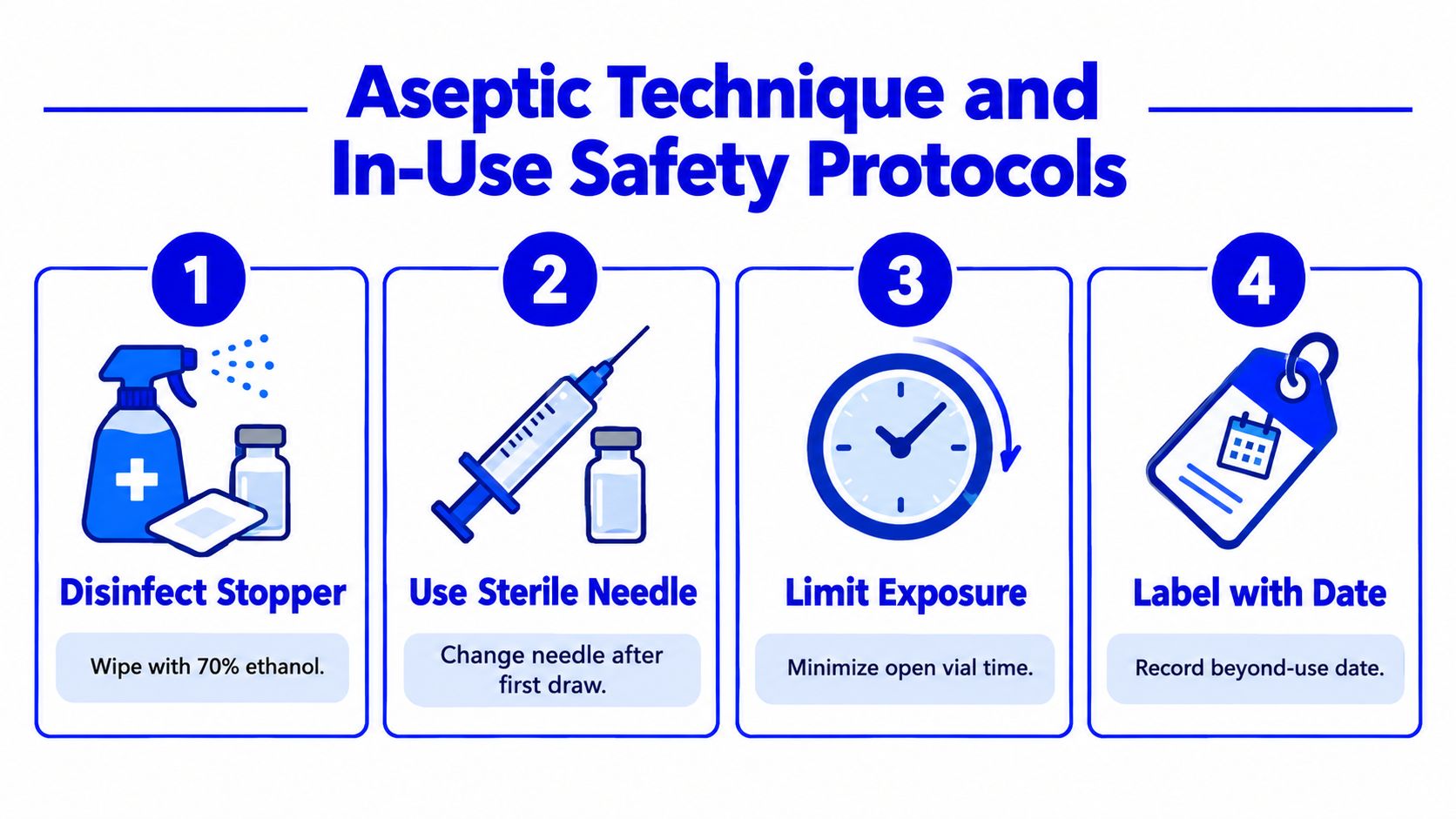
The commonly cited 28-day in-use limit for bacteriostatic multi-dose containers is a control boundary, not proof that a vial remains safe beyond it (DailyMed Bacteriostatic Water for Injection). The product-specific instructions and laboratory quality system still govern. A vial should be discarded earlier if sterility is compromised or questionable, if the container is damaged, or if the liquid changes appearance.
For teams developing or auditing procedures, microbiology aseptic practices from Herbilabs provide useful context for controlling contamination during routine handling. When sourcing from a compounding or dispensing provider, documentation on how to verify a compliant pharmacy can help separate a documented quality process from a purely cosmetic product claim.
The following visual can support staff training, but it doesn't replace a validated local SOP.
Storage, Stability, and Shelf-Life Management
Storage status changes after the first puncture. Before access, follow the manufacturer's expiry date and conditions for the intact container. After access, apply the product-specific in-use limit, record the first-entry date, and verify that the vial remained within the required conditions. Sealed-vial stability data does not automatically establish safety during use.
Temperature control matters for proteins, peptides, and other labile materials. Refrigeration cannot correct a damaged container or restore sterility after poor handling. Protecting a vial preserves an acceptable starting condition, but it cannot reverse a closure breach.
What to control during storage
- Temperature: Follow the specified range and limit repeated temperature cycling. Record every excursion before returning the vial to storage.
- Light: Keep light-sensitive materials in the packaging or storage configuration specified by the manufacturer.
- Position: Secure vials against rolling and tipping, and prevent contact with surfaces that could damage the cap or stopper.
- Segregation: Separate opened and unopened containers, and show opened status in the inventory record.
- Inspection: Check for cracks, leaks, particles, color changes, or other evidence of compromised closure before use.
Headspace also affects long-term storage for volatile formulations. Greater gas volume can permit more evaporation or gas exchange, especially when temperature changes repeatedly. Use the manufacturer's container and storage guidance, and avoid unnecessary opening or transfers that alter the vial's internal environment.
A normal appearance does not establish a documented history. If staff cannot confirm first-entry timing, storage conditions, or handling responsibility, the liquid should not be treated as fully documented. Record sealed and in-use status in the inventory system, not only on a handwritten label.
Record each temperature excursion with the date, duration, measured temperature, and the operator who returned the vial to storage. The deviation can then be assessed against the product's stability data rather than assumed acceptable.
Quality Assurance and RUO Product Standards
For Research Use Only materials, a reliable purchasing decision begins with documentation. A clear product label is useful, but it doesn't show how a batch was released, how materials were traced, or whether the supplier can connect the container to a lot-specific record.
Quality systems should be evaluated as a set of controls rather than as isolated badges. ISO and GMP credentials can indicate a structured manufacturing environment, while a Certificate of Analysis can connect a specific lot to defined test results. The laboratory still needs to confirm that the documentation matches the product, intended use, and internal acceptance criteria.
What a serious review should include
- Identity and lot traceability: The vial, outer packaging, and COA should point to the same batch.
- Sterility information: The supplier should explain the applicable sterility assurance and release process.
- Endotoxin testing: Where relevant to the workflow, the documentation should identify the test basis and acceptance criteria.
- Physical and chemical checks: pH, appearance, particulate assessment, and container closure observations should be addressed where applicable.
- Change control: A credible supplier should be able to explain how formulation, packaging, or manufacturing changes are recorded.
Herbilabs states that its RUO bacteriostatic water and reconstitution solutions are supplied in glass multi-dose formats, with lot-specific COAs and QA review before release. Those records are most useful when retained with the experiment's batch notes, storage log, and access history.
A laboratory evaluating suppliers can also review ISO 9001 quality systems for labware to understand how documented procedures, traceability, audits, and corrective actions support repeatable procurement. Certification isn't a substitute for product-specific evidence, but missing documentation makes deviation investigation and result replication harder.
The strongest standard is practical: can the lab identify what was used, which lot supplied it, how it was stored, when it was opened, and why it was accepted or discarded?
Conclusion, Prioritizing Integrity in Every Withdrawal
A vial of liquid earns its place in a research workflow through more than its contents. The material, volume, stopper, crimp, storage conditions, label, and access history all contribute to the confidence that a withdrawal represents the intended reagent rather than an uncontrolled mixture of formulation and handling error.
The most important distinction is between sealed-vial integrity and in-use integrity. An intact container benefits from the manufacturer's closure and shelf-life controls. Once punctured, the laboratory assumes additional responsibility for septum disinfection, sterile equipment, controlled storage, access records, and timely disposal. A bacteriostatic preservative can support repeated withdrawals, but it doesn't eliminate the need for aseptic technique.
The practical consequences of weak handling are not limited to visible contamination. Particles from stopper coring can affect an analytical result, an undocumented storage excursion can undermine interpretation, and an unknown first-entry date can make an otherwise clear vial unsuitable for a defensible experiment. CDC injection-safety guidance emphasizes discarding containers when sterility is compromised or questionable, dedicating multi-dose vials whenever possible, disinfecting the stopper before every access, avoiding pooled doses, and never reusing syringes (CDC injection safety guidance).
A disciplined laboratory turns these requirements into routine behavior:
- Choose deliberately: Match material, capacity, closure, and access frequency to the workflow.
- Document immediately: Record lot, first entry, storage conditions, and discard status.
- Handle consistently: Disinfect every time, use sterile equipment, and minimize repeated puncture in one area.
- Reject uncertainty: Discard damaged, questionable, contaminated, or out-of-window containers.
- Preserve traceability: Keep the COA and vial history with the relevant experimental record.
Reliable results depend on the withdrawals that appear too routine to document.
The small act of accessing a vial is therefore a core laboratory skill. Researchers who control that act protect sample integrity, improve reproducibility, and make later troubleshooting possible. The vial isn't separate from the experiment. It is one of the experiment's containment and quality controls.
Herbilabs supplies sterile RUO bacteriostatic water and reconstitution solutions in multiple glass multi-dose vial formats, with lot-specific documentation for research workflows. Visit Herbilabs to review available formats and select a documented solution that fits the laboratory's access, storage, and traceability requirements.