Private Label, White Label, Wholesale partnerships available - EU, USA and UK - Free shipping from €75

10 mL Sterile Vial: Lab Specs and Storage
A researcher has just opened a fresh 10 mL sterile vial to reconstitute a valuable peptide or protein. The seal was intact, the glass looked clean, and the first withdrawal went smoothly. The hidden risk begins after that first needle entry, when a container that was sterile at release becomes a repeatedly accessed system whose safety depends on technique, storage, documentation, and timely discard.
That distinction matters in any laboratory handling multi-dose diluents. A vial isn't indefinitely protected because it left the manufacturer sterile. Every puncture creates another opportunity for contamination, while poor labeling can make the in-use period impossible to verify. The vial should therefore be managed as part of a validated workflow, not as disposable glassware.
Table of Contents
- The Reality of Multi-Dose Vial Handling
- Physical Specifications and Closure Mechanics
- Aseptic Technique and the 28-Day Rule
- Quality Documentation and Traceability
- Procurement and Supply Chain Logistics
- Redefining Vial Shelf Life and Usability
The Reality of Multi-Dose Vial Handling
A common failure starts with a reasonable assumption. A researcher opens a sterile vial, dates nothing, withdraws solution several times, and returns it to a shared refrigerator between uses. Days later, a cloudy preparation or unexpected assay result appears. The investigation often focuses on the peptide, protein, or analytical method first, even though the more immediate problem may be repeated vial access without a controlled record.
The sterile seal only describes the product's condition before use. It doesn't guarantee sterility after the closure has been punctured, and it doesn't replace aseptic technique. The difference between sterility at release and sterility assurance during use is the central handling issue for every multi-dose format.
Practical rule: Treat the first puncture as the start of a controlled in-use period, not as a minor event.
The 10 mL format is popular because it fits common research workflows without forcing a lab to manage a large container. Market data place the up-to-10 mL segment among the larger parts of the global vials market, while small-capacity vials from 1 to 10 mL represented 44.2% of pharmaceutical glass vial consumption in the cited analysis (Fortune Business Insights). That size can support repeated withdrawals or several preparation steps while limiting unused liquid compared with a larger format.
Why the format fits laboratory work
The pharmaceutical glass packaging market was estimated at USD 23.40 billion in 2025 and is projected to reach USD 51.56 billion by 2033, with a projected 10.5% CAGR from 2026 to 2033, according to Grand View Research. Pharmaceutical glass vials accounted for more than 33.9% of global revenue in 2025, which shows that vial-based containment sits inside a large, established packaging system rather than a narrow laboratory niche.
That installed base supports injectable biologics, generics, and other parenteral products that require chemical resistance and sterile containment. In research settings, the same practical logic applies to diluents and working solutions. A 10 mL vial is often large enough for repeated preparation work, but compact enough to keep waste and storage demands manageable.
Labs also need to consider the broader production environment behind specialized containers. For teams developing unusual devices, adapters, or fill-finish prototypes, resources on serial production for medical prototypes can help clarify how component design and repeatable manufacturing affect downstream handling. The vial itself is only one part of a controlled system.
The operating question isn't whether 10 mL is enough. It is whether the lab can control every access event, record the relevant dates and lot information, protect the closure, and discard the remaining solution when the approved in-use period ends.
Physical Specifications and Closure Mechanics
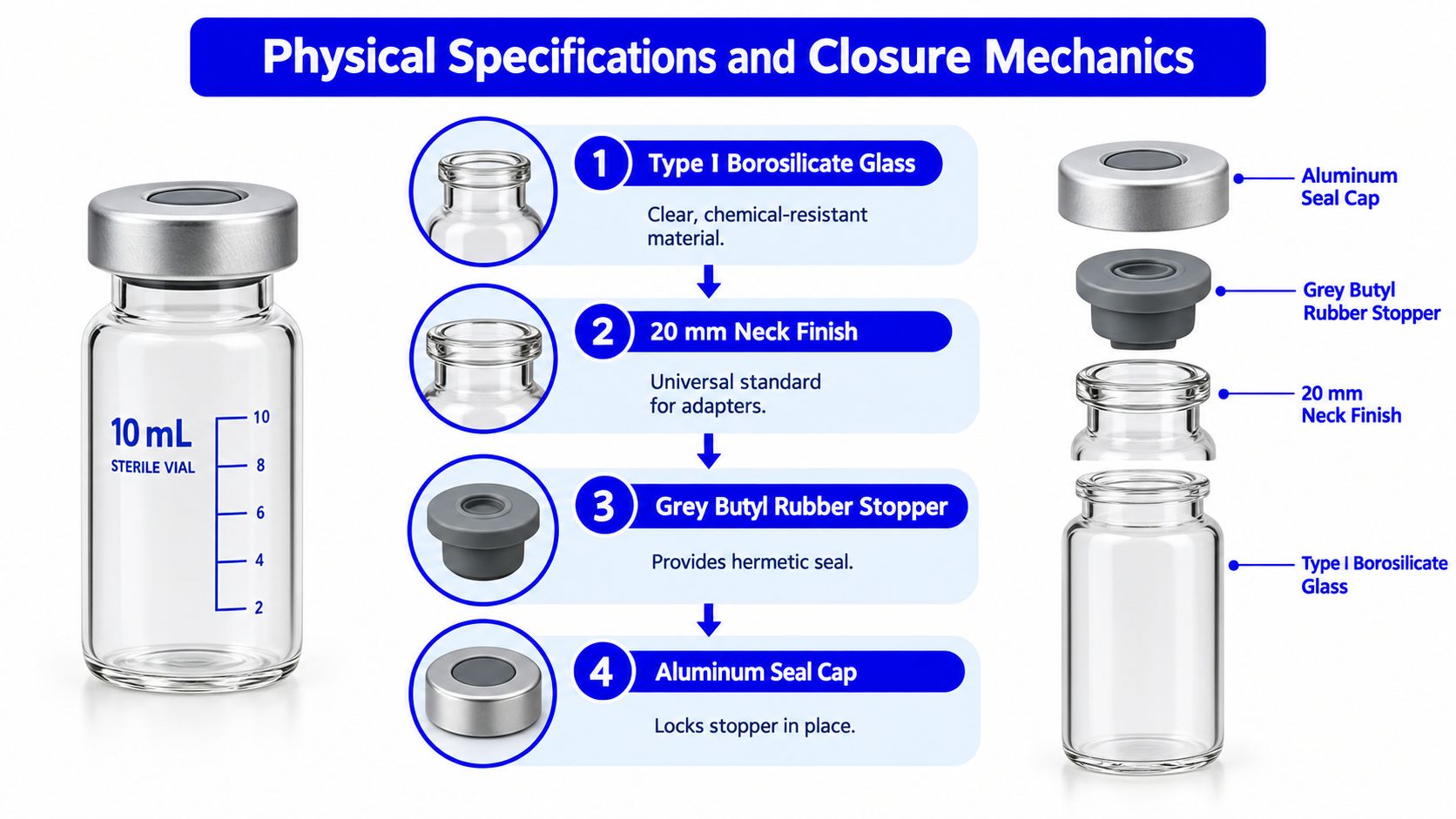
A 10 mL sterile vial is a validated container-and-closure system, not just a small glass bottle. A common configuration uses Type I borosilicate glass, a 20 mm neck finish, approximately 45 mm of height, and about 22 mm of outer diameter. Confirm the exact profile, including permitted tolerances, against the supplier drawing before ordering racks, trays, cartons, or filling equipment.
Type I borosilicate glass provides chemical resistance for pharmaceutical containment, but compatibility still depends on the application. Review the formulation, elastomer, sterilization method, storage conditions, and supplier documentation together. A glass grade alone does not confirm suitability for every liquid or process.
Nominal volume isn't brimful volume
Many 10 mL containers have a brimful capacity of roughly 13.5 mL, as shown by Fisher Scientific. The nominal volume identifies the intended working fill. Brimful capacity describes the approximate volume at the physical top of the container.
The difference provides headspace for stopper insertion, crimping, liquid movement, and expansion during handling or sterilization. Filling to the brim can wet the stopper, obstruct proper closure placement, and reduce room for pressure or volume changes.
A specification review should record four separate values:
- Nominal fill volume: The labeled working capacity, 10 mL in this format.
- Brimful capacity: The approximate physical maximum, which may be around 13.5 mL.
- Headspace: The room reserved for closure insertion, sealing, and controlled handling.
- Dimensional tolerance: The allowed variation in height, diameter, and neck geometry.
The closure is a system
The neck finish, elastomeric stopper, and aluminum seal cap must function together. The stopper forms the primary barrier. The crimped aluminum cap holds it in position and protects the assembly from displacement. Select an elastomer that tolerates the specified needle puncture pattern without excessive coring, fragments, leakage, or loss of reseal performance.
Every puncture can affect future usability. Blunt or angled needles, off-center entry, and unnecessary movement can damage the stopper and introduce particles or leakage paths. Use the specified access method, keep the disinfected surface protected, and inspect the closure if puncture resistance or seal behavior changes.
Teams can compare sterile vial formats by checking nominal volume, neck finish, closure materials, and intended access pattern. Listings for 10 mL glass vials for research can support initial format comparisons. Before use, verify the selected configuration against lot-specific quality documents and the formulation compatibility review.
Aseptic Technique and the 28-Day Rule
The first puncture should trigger a short, repeatable procedure. Before access, the operator verifies the vial identity, checks the solution, disinfects the stopper according to the laboratory SOP, and allows the disinfectant to dry. A needle should enter only after the stopper is ready, and the needle shouldn't be reused between containers or preparations.
The vial needs a clear first-access date and operator identification. The date belongs on the vial or its controlled record, not only in a notebook that may be separated from the container. If the label is damaged or the first-puncture date can't be confirmed, the safest response is to quarantine the vial and follow the laboratory's discard or investigation procedure.
A controlled access sequence
A practical sequence looks like this:
- Verify before opening the workspace. Confirm the product identity, lot, expiry information, storage condition, and intended use. Inspect for particles, discoloration, damage, leakage, or a compromised seal.
- Prepare a clean work area. Keep the vial away from unnecessary materials, open containers, and traffic. Use sterile equipment appropriate to the preparation and follow the facility's aseptic SOP.
- Disinfect the stopper. Use the approved disinfectant and contact time. Let the surface dry fully, because puncturing a wet stopper can carry disinfectant into the preparation.
- Access once with controlled equipment. Use a sterile needle and syringe, enter the stopper cleanly, and avoid touching the needle or stopper with nonsterile surfaces.
- Record the event. Mark the first-puncture date, document the operator or batch record, and record any unusual observation.
- Return the vial correctly. Keep the closure protected, store the container under the product's specified conditions, and don't leave it exposed on the bench.
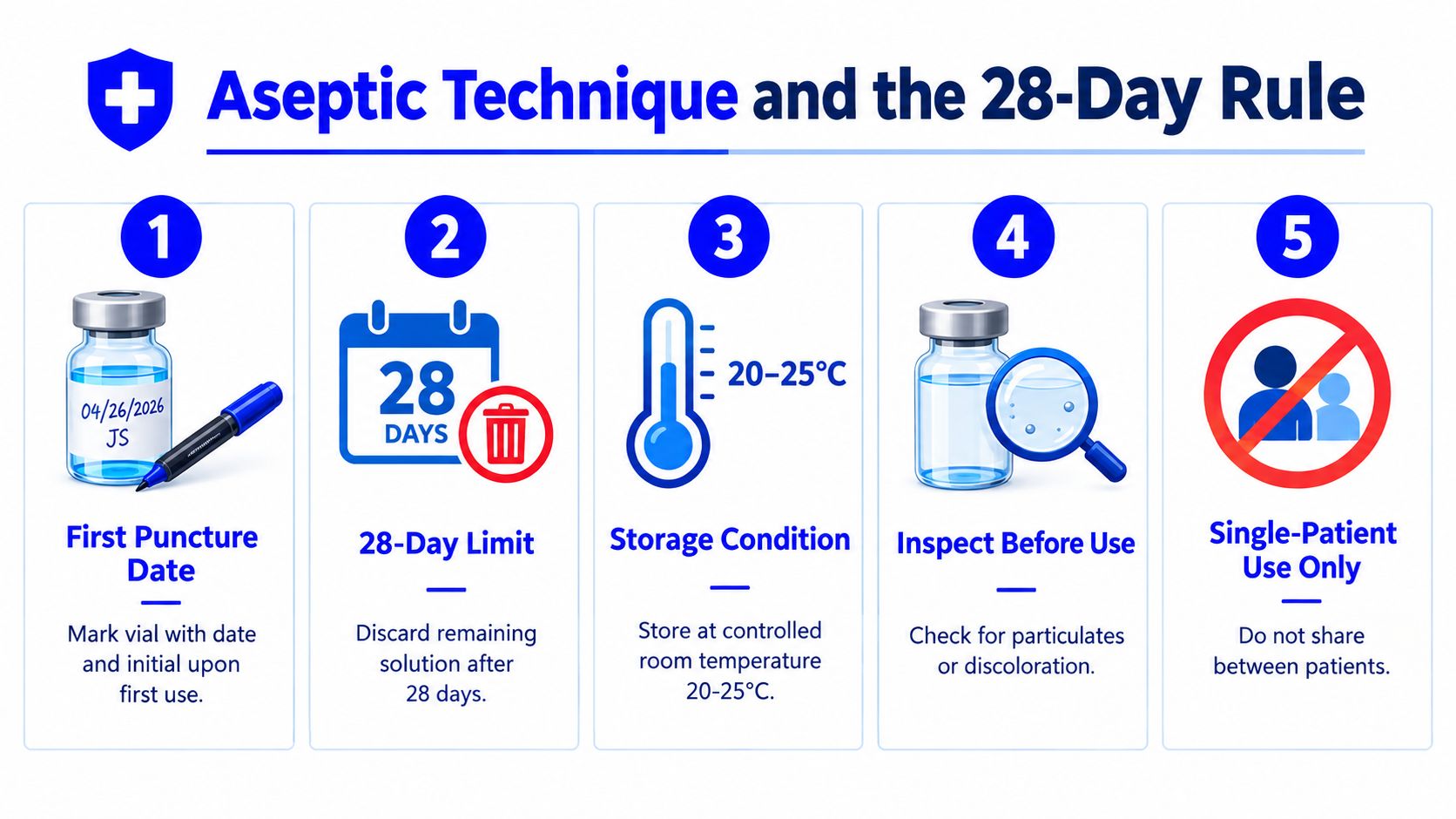
For multidose containers, infection-control guidance says the vial should be dated at first access and discarded within 28 days, unless the manufacturer specifies a shorter period (Public Health Ontario). This is a contamination-control limit, not a declaration that the liquid suddenly becomes chemically unstable on a particular day.
Why preservative performance doesn't remove the risk
Preservatives can support multidose use, but they don't make repeated access harmless. Each entry creates another opportunity for microbial introduction, especially if the stopper isn't disinfected correctly, the needle contacts a nonsterile surface, or the container is shared between users.
A 10 mL vial containing bacteriostatic water or another preservative-containing solution still requires controlled storage and aseptic handling. Guidance discussing bacteriostatic water should be read alongside the product label and the laboratory's own SOP, particularly where the solution is used to prepare sensitive research materials.
Contamination control: The 28-day window is a maximum handling framework under the stated conditions. It isn't permission to keep a vial longer when access technique, storage, labeling, or product instructions are uncertain.
The same distinction should guide any reconstituted peptide expiration timeline. The usable life of the resulting preparation depends on the formulation, storage, container closure, and validated instructions. The vial's in-use period and the reconstituted compound's stability period aren't interchangeable records.
Quality Documentation and Traceability
A sterile vial without useful documentation is difficult to defend during an investigation. The glass may look intact and the liquid may appear clear, but appearance doesn't verify sterility, non-pyrogenic status, pH, identity, or batch consistency. Those properties belong in the quality system and should be traceable to the specific lot in use.
A lot-specific Certificate of Analysis, or COA, gives the laboratory a documented reference for the supplied material. Depending on the product and release specification, the record may address pH, sterility, non-pyrogenic status, composition, testing, and release approval. The exact tests and acceptance criteria should be reviewed rather than assumed.
What a useful record connects
A practical traceability file should connect four elements:
- Container identity: Product name, format, lot number, and expiry information.
- Material status: COA, release decision, storage requirements, and any applicable handling restrictions.
- Workflow event: First puncture date, operator, preparation record, and associated sample or experiment.
- Exception history: Damage, temperature excursion, failed inspection, suspected contamination, or deviation review.
This connection protects more than compliance. If an assay produces an unexpected result, the lab can determine whether the diluent lot, preparation method, storage history, or access record contributed to the outcome. Without that chain, researchers may discard an entire experiment without knowing whether the root cause was chemical, procedural, or microbiological.
Certifications need context
ISO and GMP credentials can support confidence in the manufacturing environment, but they don't replace product-specific review. A facility operating under ISO 13485:2016, GMP, and ISO 9001:2016 procedures may have structured controls for batch review, material traceability, employee training, facility audits, and documented procedures. The buyer still needs to confirm that the supplied product matches the intended use and that the current lot has the required release documents.
A quality review before use should ask whether the COA is lot-specific, whether the product description matches the vial label, whether the document identifies the relevant tests, and whether storage and transport conditions were maintained. This is especially important for independent labs that may not have a separate quality department to perform the review.
Documentation also supports reproducibility. Researchers can record the vial lot alongside the compound lot, reconstitution date, operator, equipment, and assay run. That turns a small container into a traceable component of the experimental record.
Procurement and Supply Chain Logistics
A purchasing decision changes with the buyer's operating scale. An independent researcher may need a small quantity with clear documentation and prompt dispatch. A biotech group may prioritize consistent replenishment, lot continuity, and controlled storage. A reseller or private-label partner may need packaging specifications, labeling support, predictable production, and cross-border fulfillment.
The wrong format can create two problems at once. A small buyer may purchase more than can be used within the approved period, while a larger group may create avoidable delays by ordering individual units instead of maintaining a planned supply. Multi-pack configurations, including 10 × 10 mL kits, can support continuity when the lab has a defined consumption pattern and adequate storage control.
| Buyer Type | Primary Priority | Ideal Format |
|---|---|---|
| Independent researcher | Clear documentation, manageable quantity, prompt dispatch | Individual 10 mL vial or small multi-pack |
| Small private lab | Replenishment and consistent lot records | 10 mL multi-pack with lot tracking |
| Biotech or pharmaceutical R&D group | Supply continuity, QA review, and repeatable specifications | Planned bulk purchasing with documented release |
| Wholesale partner | Unit economics, packaging consistency, and reliable availability | Case quantities or recurring supply |
| Private-label or white-label partner | Custom commercial workflow, labeling, and distribution support | Coordinated production and fulfillment program |
Storage and dispatch affect usability
Temperature-controlled warehousing helps protect product integrity before shipment, but the buyer should still confirm the supplier's storage instructions and transport controls. A shipment that arrives with damaged packaging, unclear exposure history, or an unexplained temperature excursion shouldn't be placed directly into active use.
Distribution capability also matters when experiments follow a fixed schedule. Same-day dispatch, EU, UK, and USA coverage, and clear shipping thresholds may reduce procurement friction, but those services don't replace batch documentation or receiving inspection. A fast shipment is useful only when the product arrives identifiable, intact, and suitable for the laboratory's workflow.
For teams comparing a ready-to-use reconstitution solution, the review should include the vial construction, intended research use, lot-specific COA, storage conditions, pack size, and fulfillment terms. Herbilabs offers sterile diluents in several vial formats, including 10 mL options, alongside multi-pack, wholesale, private-label, and white-label arrangements for research-use workflows.
A receiving checklist can stay simple:
- Inspect the shipment: Check cartons, seals, labels, and visible damage.
- Record the lot: Match the physical label to the purchase order and COA.
- Confirm storage: Place the material under the stated conditions without unnecessary delay.
- Quarantine exceptions: Separate damaged, mislabeled, or questionable units pending review.
- Plan replenishment: Base order timing on actual usage, approved shelf life, and supplier lead time.
Redefining Vial Shelf Life and Usability
A vial doesn't have one universal shelf-life number that applies unchanged from the warehouse to the last withdrawal. Before opening, the product is governed by its labeled expiry, release status, packaging integrity, and storage history. After the first puncture, the relevant question changes to whether the closure, liquid, records, storage, and access technique still support the approved in-use period.
That is why the phrase 10 mL sterile vial describes a format, not a complete handling specification. Two vials with the same nominal volume can differ in glass composition, closure design, preservative system, sterility documentation, storage requirements, and permitted use after opening.
The operational definition of usable
A vial is suitable for continued use only when the key conditions remain satisfied:
- The identity is confirmed. The product and lot match the preparation record.
- The container remains intact. There is no visible damage, leakage, compromised closure, or unexplained change.
- The solution passes inspection. Particles, discoloration, or other abnormal appearance requires investigation.
- The access date is known. The first puncture is recorded clearly.
- The in-use limit is respected. A multidose vial is discarded within the applicable period, including the 28-day rule where it applies, or sooner if the manufacturer requires it.
- The preparation record is complete. The operator can connect the diluent to the material, date, and experiment.
A sterile container protects the starting condition. Controlled handling protects the period after opening.
The most reliable labs make these actions routine rather than relying on memory. Labels are completed at first access, records travel with the batch documentation, and questionable containers are removed from service instead of being rationalized back into the workflow. That discipline protects costly research materials and makes failed results easier to investigate.
The final decision should always follow the product label, supplier documentation, and the laboratory's approved SOP. If a vial's opening date is missing, storage is uncertain, the closure looks compromised, or the solution appears abnormal, replacement is safer than extending use based on volume remaining.
Herbilabs supplies sterile, non-pyrogenic reconstitution solutions in multi-dose vial formats for research-use-only workflows, with lot-specific documentation and distribution across the EU, UK, and USA. Review the available options and handling information at Herbilabs, then select a format that matches the lab's access frequency, documentation requirements, and storage controls.