Private Label, White Label, Wholesale partnerships available - EU, USA and UK - Free shipping from €75

Preservative Free Sterile Saline Solution: A Practical Guide
A researcher reaches into a cold room, takes out a 10 mL ampule of preservative-free saline, and places it beside a lyophilized peptide vial. Then the hesitation starts. The ampule was opened two days ago, the reconstitution is scheduled now, and the experiment depends on whether that liquid is still trustworthy.
That decision is less simple than reading “sterile” on a label. The formulation, container, opening method, storage temperature, withdrawal pattern, reagent compatibility, and supplier documentation all affect whether a saline product fits the workflow. A preservative-free sterile saline solution can be an excellent diluent, but it doesn't protect itself from contamination after access.
Table of Contents
- What This Guide Will Help You Decide
- Defining Preservative Free Sterile Saline Solution
- Preservative Free vs Bacteriostatic Saline
- Common RUO Use Cases and Why It Fits
- Handling and Storage After Opening
- Availability and Procurement Realities
- Common Misconceptions Worth Correcting
- Choosing the Right Format for Your Workflow
What This Guide Will Help You Decide
The central bench question is practical: which saline format gives the protocol the lowest avoidable risk? Preservative-free saline and bacteriostatic saline can both support research workflows, yet they solve different operational problems. One prioritizes a simple isotonic formulation without antimicrobial additives. The other supports repeated access when its preservative is compatible with the intended reagent and assay.
Three decisions usually matter most.
Formulation choice. The researcher needs to determine whether the target peptide, protein, antibody, cell suspension, or assay component can tolerate an antimicrobial additive such as benzyl alcohol. If compatibility is uncertain, a preservative-free product is generally the more conservative starting point, subject to the product documentation and protocol requirements.
In-use handling. A sealed container can meet sterility specifications at release, but opening changes the contamination-control problem. A single-dose label, container closure, aseptic technique, storage condition, and number of entries all matter more than the word “sterile” by itself.
Workflow fit. A single reconstitution performed under controlled conditions calls for a different format than a working stock accessed repeatedly over several days. Container size and closure design also influence waste, exposure, and the number of opportunities for accidental contamination.
A defensible choice comes from comparing those variables rather than selecting the product with the most familiar name. Teams that need a repeatable way to weigh formulation, handling, and procurement factors can use this guide alongside resources on evidence-based decision making on Documind.
Bench principle: The right saline is the one whose chemistry and handling instructions match the complete protocol, not just the first reconstitution step.
Defining Preservative Free Sterile Saline Solution
Preservative-free sterile saline solution is generally a sterile preparation of 0.9% sodium chloride in water for injection. The formulation is designed to be isotonic, with a calculated osmolarity of around 308 mOsmol/L and sodium and chloride concentrations of about 154 mEq/L each, as described in the DailyMed product information.
The 0.9% concentration matters because it produces a salt environment broadly compatible with physiological fluids. That compatibility helps reduce osmotic stress when the solution is used for dilution, irrigation, or reconstitution. It doesn't guarantee that every peptide, protein, cell line, or assay will perform well in saline. It only establishes why the formulation is widely considered a physiologically compatible starting point.
What “preservative-free” changes
The solution contains no antimicrobial agent, bacteriostat, or added preservative. It therefore has no in-container mechanism for suppressing microbial growth after the closure is breached. Benzyl alcohol and parabens aren't interchangeable with sodium chloride. They can affect sensitive biological materials, cell-based assays, or downstream measurements, so removing them may be important for reagent compatibility.
Sterility also has a time and handling boundary. Before opening, the container is protected by its sealed package and validated manufacturing process. After access, the user becomes responsible for controlling exposure, entry, storage, and disposal according to the label and laboratory procedure.
Container formats create different risks
Common formats include:
- Ampules, which can provide a single-use quantity but require careful opening and transfer.
- Single-dose vials, which use a septum and needle or spike, but aren't automatically suitable for repeated withdrawal.
- Prefilled syringes, which reduce some transfer steps while imposing their own compatibility and handling requirements.
The term shouldn't be confused with sterile water, bacteriostatic saline, or buffered salt solutions. Sterile water lacks sodium chloride and can create a very different osmotic environment. Bacteriostatic saline includes an antimicrobial additive. Buffered solutions contain additional components that alter pH or buffering capacity. The product label and certificate of analysis should settle those distinctions before the material reaches the bench.
Preservative Free vs Bacteriostatic Saline
The comparison begins with composition. Preservative-free saline contains sodium chloride and water without an antimicrobial additive, while bacteriostatic saline contains a preservative, commonly 0.9% benzyl alcohol in RUO reconstitution products. That difference affects repeated access, reagent compatibility, and the consequences of a multi-day workflow.
| Attribute | Preservative Free | Bacteriostatic |
|---|---|---|
| Core formulation | 0.9% sodium chloride in water for injection, without antimicrobial additives | Saline or water-based diluent containing an antimicrobial agent |
| Typical container approach | Ampules, single-dose vials, or other single-use formats | Multi-dose vial designed for repeated withdrawals |
| Intended workflow | One-time use or tightly controlled single-use preparation | Repeated access when the target material is compatible |
| In-use behavior | No preservative protection after opening | Preservative suppresses microbial growth, but doesn't replace aseptic technique |
| Compatibility question | Usually avoids preservative-related interference | Requires confirmation that benzyl alcohol is acceptable |
| Main contamination concern | Repeated access to a container labeled for single use | False confidence that the preservative makes poor technique safe |
| Reconstitution suitability | Strong option for preservative-sensitive materials and cell-based work | Practical for compatible peptides, proteins, or antibodies used across a working period |
The table describes risk profiles, not universal guarantees. A bacteriostatic vial still needs a clean work area, sterile components, controlled punctures, and appropriate storage. Handling recommendations for bacteriostatic water should be treated as part of the workflow design, not as a substitute for the product's own instructions.
When preservative-free earns the preference
Preservative-free saline is usually the more defensible choice when a reagent may be sensitive to benzyl alcohol, when a cell-based assay could be affected by an antimicrobial additive, or when the protocol already specifies single-use preparation. It also suits a one-time reconstitution where the remaining solution has no planned role.
When bacteriostatic can be practical
Bacteriostatic saline may fit a workflow that draws small volumes repeatedly from one vial across a defined period, provided the target material and assay have been shown to tolerate the preservative. The convenience comes from reducing the need to open a new single-dose container for every withdrawal, not from eliminating contamination control.
The decision isn't about which product is always superior. It is about matching the formulation to the protocol, the target reagent, and the number of times the container will be accessed.
Common RUO Use Cases and Why It Fits
Researchers often choose preservative-free saline when the diluent itself should introduce as few additional variables as possible. The isotonic 0.9% sodium chloride environment can support dilution and reconstitution tasks involving biological materials, but the final choice still depends on the reagent's instructions, stability data, and assay design.
Reconstituting lyophilized peptides and proteins
A peptide or protein supplied as a lyophilized powder may require a defined diluent and mixing sequence. If the protocol excludes benzyl alcohol or another antimicrobial additive, preservative-free saline avoids adding that variable. For example, a researcher may reconstitute a 1 mg peptide vial in 1 to 2 mL aliquots, but the correct volume, concentration, mixing method, and storage condition must come from the material-specific documentation rather than from saline alone.
The solution should be introduced slowly when the target material is prone to foaming or aggregation. Vigorous shaking can damage some proteins, so gentle swirling or controlled inversion may be preferable when the protocol permits it.
Supporting antibody and cell workflows
Antibody dilution for a cell-based assay requires attention to both reagent compatibility and cell exposure. A preservative-free diluent may be appropriate when the protocol calls for a simple isotonic medium without antimicrobial additives. Cell suspension work also demands attention to pH, osmolarity, protein adsorption, and the time cells remain outside their normal culture conditions.
Preservative-free saline isn't a universal cell-culture buffer. It may lack nutrients, buffering components, or proteins required for cell viability. A formulation that is acceptable for a short transfer or dilution step may be unsuitable as a prolonged incubation medium.
Resuspending standards and preparing dilutions
Lyophilized ELISA standards and similar reference materials may be reconstituted with a specified diluent before serial dilution. The researcher should verify whether the kit requires water, saline, a supplied buffer, or a protein-containing diluent. Substituting saline without that check can change recovery, binding behavior, or assay background.
| RUO Application | Why Preservative-Free Fits | Typical Volume Range |
|---|---|---|
| Lyophilized peptide reconstitution | Avoids adding benzyl alcohol when compatibility is uncertain | Protocol-defined, often a small vial volume |
| Protein preparation | Provides an isotonic diluent without antimicrobial additives | Defined by the product's concentration target |
| Antibody dilution | May reduce preservative-related interference in sensitive assays | Determined by assay design |
| Cell suspension handling | Offers isotonic salt without a preservative, when the protocol supports saline | Determined by cell density and transfer step |
| ELISA standard resuspension | Can fit protocols requiring a simple saline diluent | Specified by the kit or standard documentation |
The important distinction is between a suitable diluent and a complete biological medium. Preservative-free saline solves the diluent question in some workflows, but it doesn't replace a validated assay buffer or culture medium.
Handling and Storage After Opening
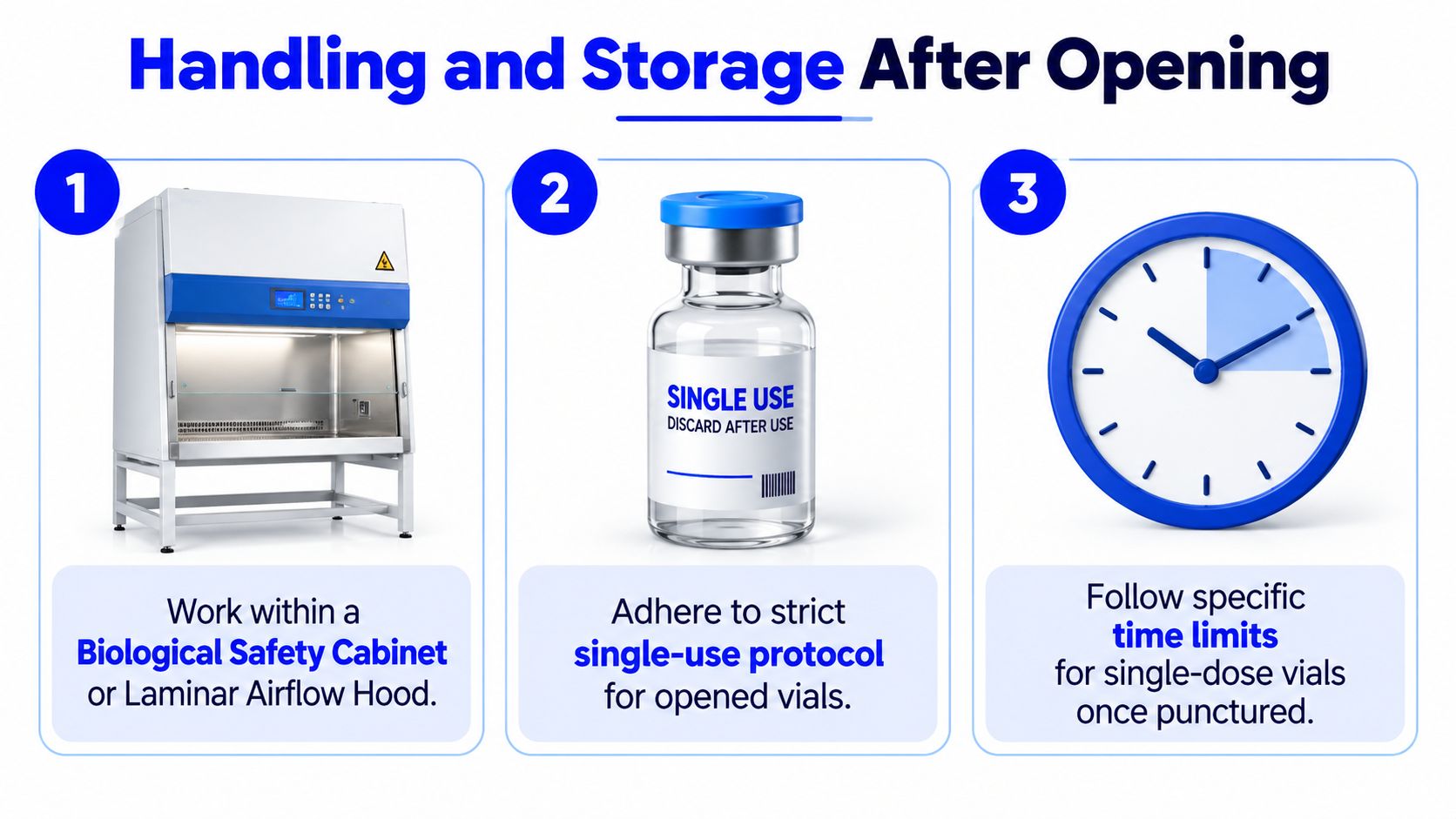
The most difficult question often arrives after the container has been opened: how long can the remaining saline be used? Manufacturer instructions for preservative-free sterile saline commonly default to single-dose use or immediate discard after access because the solution contains no antimicrobial protection. Repeated withdrawals increase the number of contamination opportunities, even when the liquid still looks clear.
An independent study involving multidose preservative-free saline for scleral lens care reported no bacterial or fungal growth for at least 30 days under minimal handling in that specific study design, as reported in the published investigation. That finding shouldn't be converted into a general laboratory expiry rule. The container, closure, environment, withdrawal frequency, storage condition, and user technique can all differ substantially.
Aseptic practice is the control
A controlled procedure should define who can access the container, how the septum is disinfected, which syringe and needle are used, and where the vial is stored. A biological safety cabinet or laminar airflow hood may be appropriate for the workflow, but the cabinet doesn't correct poor component handling or an exposed closure.
Useful controls include:
- Single-use needle and syringe discipline: Never reuse a needle, syringe, or transfer device.
- Minimal vial entry: Avoid repeated punctures when the protocol can be divided into single-use portions.
- Clear labeling: Record the opening date, opening time, operator, storage condition, and discard decision.
- Visual inspection: Discard material showing turbidity, unexpected particles, container damage, or another sign of change.
- Protocol authority: Follow the manufacturer's labeled use and the laboratory's approved SOP before applying a research convenience window.
Research teams sometimes establish internal windows, such as use within a working day or refrigerated use for a longer defined period, but those windows require documented validation or an approved risk assessment. A study-specific observation doesn't override a single-dose label.
For comparison, guidance on how long bacteriostatic water remains usable also depends on aseptic technique, container integrity, storage, and the product's stated instructions. The presence of a preservative changes the risk profile, not the need for disciplined handling.
Availability and Procurement Realities
Preservative-free saline is a procurement issue as well as a formulation issue. The FDA announced in 2025 that the nationwide shortage of 0.9% sodium chloride injection products had ended, while other sterile saline and sterile-water products remained under supply pressure. Distribution constraints and protective allocation can still affect research buyers even when a headline shortage has been resolved.
That distinction matters because a laboratory may need continuity rather than a one-time purchase. A substitute might have the same sodium chloride concentration but a different container, sterility claim, intended use, preservative profile, or documentation package. Procurement should therefore record the exact product identity instead of treating all saline products as interchangeable.
Packaging affects the operating model
Small ampules reduce the temptation to retain an opened container, but they can create more transfers and more packaging waste. Single-dose vials offer a different closure and access method. Larger bottles may suit a controlled high-volume process, yet they can create a greater exposed volume once opened and may not fit a protocol that requires individually sealed portions.
The practical decision includes:
- Container size: Match the fill volume to the amount used in one defined operation.
- Closure type: Confirm whether the vial, ampule, or syringe supports the intended transfer method.
- Documentation: Request a lot-specific certificate of analysis when the workflow requires traceability.
- Storage instructions: Follow the labeled temperature and transport requirements rather than assuming that a research product follows clinical storage conditions.
- Continuity planning: Keep an approved alternative format or supplier under review before existing stock becomes critical.
Laboratories evaluating sterile water and related diluents can also consult this research purchasing guide for sterile water. The same procurement discipline applies to saline: define acceptable specifications first, then compare supply, packaging, documentation, and handling burden.
Common Misconceptions Worth Correcting
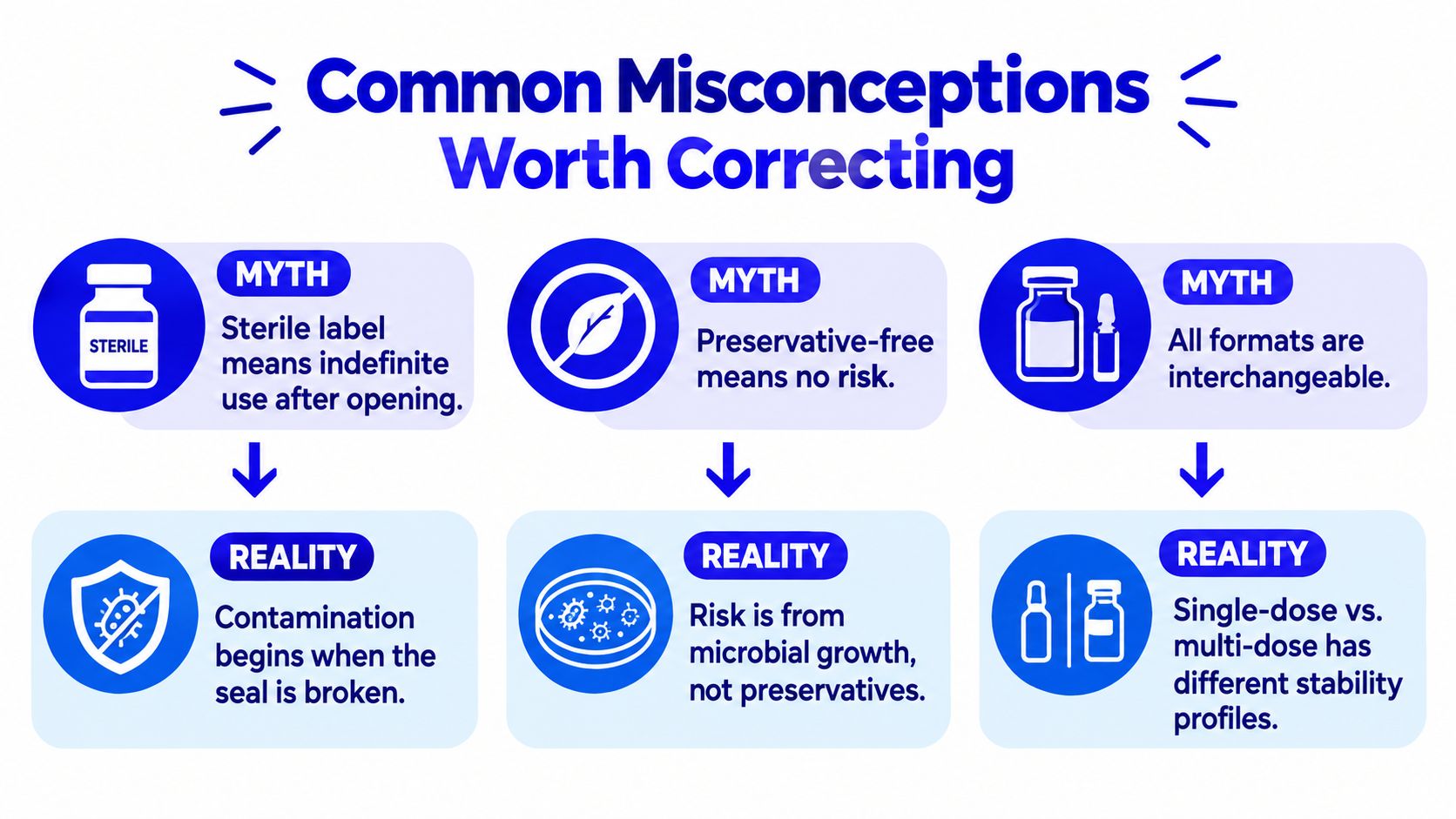
A sterile label describes the product at a defined point in its lifecycle. It doesn't mean the container remains sterile indefinitely after the closure is broken. Once a user accesses the vial, contamination risk depends on every subsequent contact, puncture, transfer, and storage decision.
Myth one, sterile means indefinite use
Reality: Sterility is not a permanent property after access. Preservative-free saline has no antimicrobial agent to suppress growth inside the container, which is why manufacturers commonly specify single-dose handling and discard after use. Clear appearance doesn't prove the absence of microorganisms.
Myth two, all single-dose formats behave the same
Reality: An ampule, a septum-sealed vial, and a small bottle expose the operator to different opening and transfer steps. Residual volume, closure design, access frequency, and the likelihood of accidental contact all influence practical risk. A laboratory SOP should address the actual container on the shelf, not an abstract category called “single dose.”
Myth three, preservative-free is automatically safest
Reality: Preservative-free is often the appropriate choice for a one-time preparation or a preservative-sensitive target. It may be a poor operational fit for a multi-day working stock that requires repeated withdrawals, especially when the protocol lacks a validated in-use plan.
The better question is not whether preservatives are good or bad in isolation. It is whether the additive is compatible with the reagent and whether the chosen container supports the way the laboratory will use it.
Practical correction: Choose the formulation first, then design the access and discard procedure around the container.
Choosing the Right Format for Your Workflow
A useful decision starts with the intended in-use window, not the product name. The researcher should identify how long the prepared material must remain available, how often the container will be entered, whether the target is preservative-sensitive, and whether the supplier can provide consistent documentation and replenishment.
Four bench scenarios
Single reconstitution. A researcher dissolves a lyophilized peptide, transfers the preparation into planned aliquots, and closes the operation. Preservative-free saline is usually the cleaner default when the protocol permits it, particularly when the target material or downstream assay has no established benzyl alcohol tolerance.
Repeated withdrawals across several days. A working stock is accessed many times, with small volumes removed during successive runs. A bacteriostatic format may be more practical if the target reagent is compatible, the product is labeled for multidose use, and the laboratory follows a documented aseptic procedure.
High-throughput serial dilution. A plate-based process may consume many small volumes in a short session. Preservative-free unit doses can reduce retention of opened material, while a compatible bacteriostatic vial may reduce repeated container changes. The better option depends on throughput, transfer design, and contamination controls.
Sensitive cell-based application. If benzyl alcohol or another additive could affect the cells or the readout, preservative-free saline should receive priority, assuming the protocol supports saline as the diluent. The saline still may not replace a complete cell-compatible buffer or medium.
A portable checklist
Before ordering, the laboratory should document:
- Target compatibility: Has the reagent supplier addressed preservatives, ionic strength, pH, and osmolarity?
- Access pattern: Will the container be entered once, occasionally, or repeatedly?
- Container choice: Does the format minimize transfers and match the planned volume?
- Discard rule: What event or time point requires disposal?
- Supply continuity: Can the supplier provide the required lot records and an acceptable alternative if availability changes?
- Quality records: Are the certificate of analysis, lot number, sterility information, and storage instructions available for the project file?
Herbilabs offers RUO sterile diluents, including preservative-free 0.9% sodium chloride options and bacteriostatic reconstitution solutions in multiple vial formats, with lot-specific documentation described for its products. That makes it one supplier option for laboratories comparing single-use saline with multi-dose reconstitution formats.
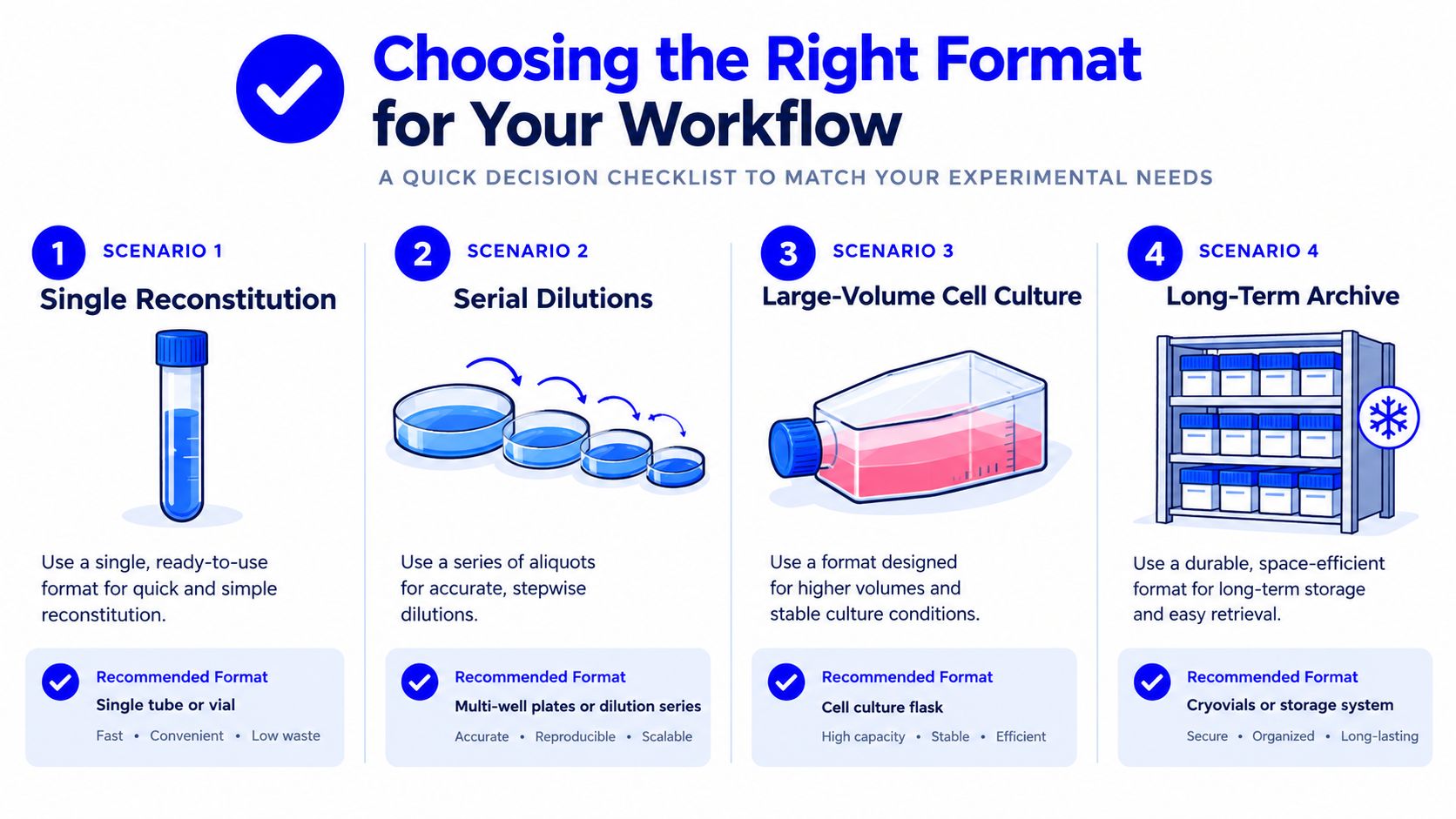
The short rule is simple: use preservative-free saline for single-use precision work and preservative-sensitive targets; consider bacteriostatic saline for repeated, multi-day workflows when compatibility and handling controls are established.
Herbilabs supplies RUO sterile diluents and reconstitution solutions in preservative-free and bacteriostatic formats, with multiple vial options and lot-specific documentation for laboratory records. Review the available formats and contact Herbilabs to match saline packaging and handling requirements to the next research workflow.