Private Label, White Label, Wholesale partnerships available - EU, USA and UK - Free shipping from €75

Testosterone Needles and Syringes Size Guide
The most popular advice about testosterone needles and syringes is also the least reliable: choose a standard needle size and use it for every injection. There isn't one universal testosterone needle. The labeled formulation, dose volume, container, oil viscosity, and depth of the intended tissue determine the equipment, not a forum favorite.
A narrow needle isn't automatically the better choice, and a prefilled autoinjector isn't interchangeable with medication drawn from a vial. Nor is bacteriostatic water a shortcut for making thick testosterone oil easier to inject. Safe procurement starts with the exact product label and ends with a device configuration confirmed by a trained clinician.
Author: Herbilabs
Table of Contents
- Testosterone Needle and Syringe Specifications
- Gauge and Length by Injection Site
- Draw Needles Injection Needles and Luer Fittings
- Bacteriostatic Water Is Not the Diluent
- Single-Use Handling and Sharps Disposal
- What to Record Before You Procure
Testosterone Needle and Syringe Specifications
A testosterone product's format can matter as much as its name. The label determines whether the supply list needs a vial and separate syringe, a compatible needle, or a complete delivery device.
The FDA prescribing information describes AZMIRO as a 1 mL, 200 mg/mL single-dose prefilled syringe supplied without a needle.
Labeled testosterone formats and the device they imply
| Format | Container and dose | Route or device | Needle or syringe note |
|---|---|---|---|
| Testosterone cypionate 200 mg/mL | 1 mL single-dose glass vial | Intramuscular only; not intravenous | A syringe sized for the prescribed volume; inspect the solution for particulate matter or discoloration |
| XYOSTED testosterone enanthate | 0.5 mL prefilled autoinjector at 50 mg, 75 mg, or 100 mg | Prefilled device, not a loose syringe | Needle is part of the autoinjector |
| AVEED testosterone undecanoate | 750 mg in 3 mL | Intramuscular; repeat after 4 weeks, then every 10 weeks | Follow the product instructions for withdrawing the dose and the specified equipment |
| AZMIRO | 1 mL of 200 mg/mL in a single-dose prefilled syringe | As directed on that product label | Package does not include a needle; obtain a suitable needle separately |
The table compares formats, not treatment schedules. A vial requires medication to be withdrawn into a syringe. A prefilled syringe avoids that transfer, while an autoinjector includes its own delivery mechanism. These formats are not interchangeable just because they contain testosterone.
Read volume separately from concentration
Concentration is the amount of medication in a given liquid volume. Syringe capacity is the amount of liquid the barrel can hold. Check both against the prescription and product label before procurement.
For a small prescribed volume, fine graduations make the measured amount easier to read. For a larger volume, the barrel needs enough capacity. The Herbilabs guide to 1cc markings explains how to read syringe markings without confusing them with needle specifications.
Some injectable testosterone products are intended for administration by a healthcare professional. Follow the product's delivery instructions and discuss the equipment and administration arrangements during what to expect at HRT consultations.
Establish the order specification
Record the product, prescribed dose volume, container type, and intended route. Then confirm:
- Syringe capacity: account for whether the medication is already in a prefilled device.
- Needle connection: match the needle to the intended syringe.
- Gauge and length: specify them separately.
- Device type: distinguish a loose syringe from a prefilled syringe or autoinjector.
A clear order specification reduces the risk of receiving a syringe that cannot accurately hold or measure the prescribed volume.
Gauge and Length by Injection Site
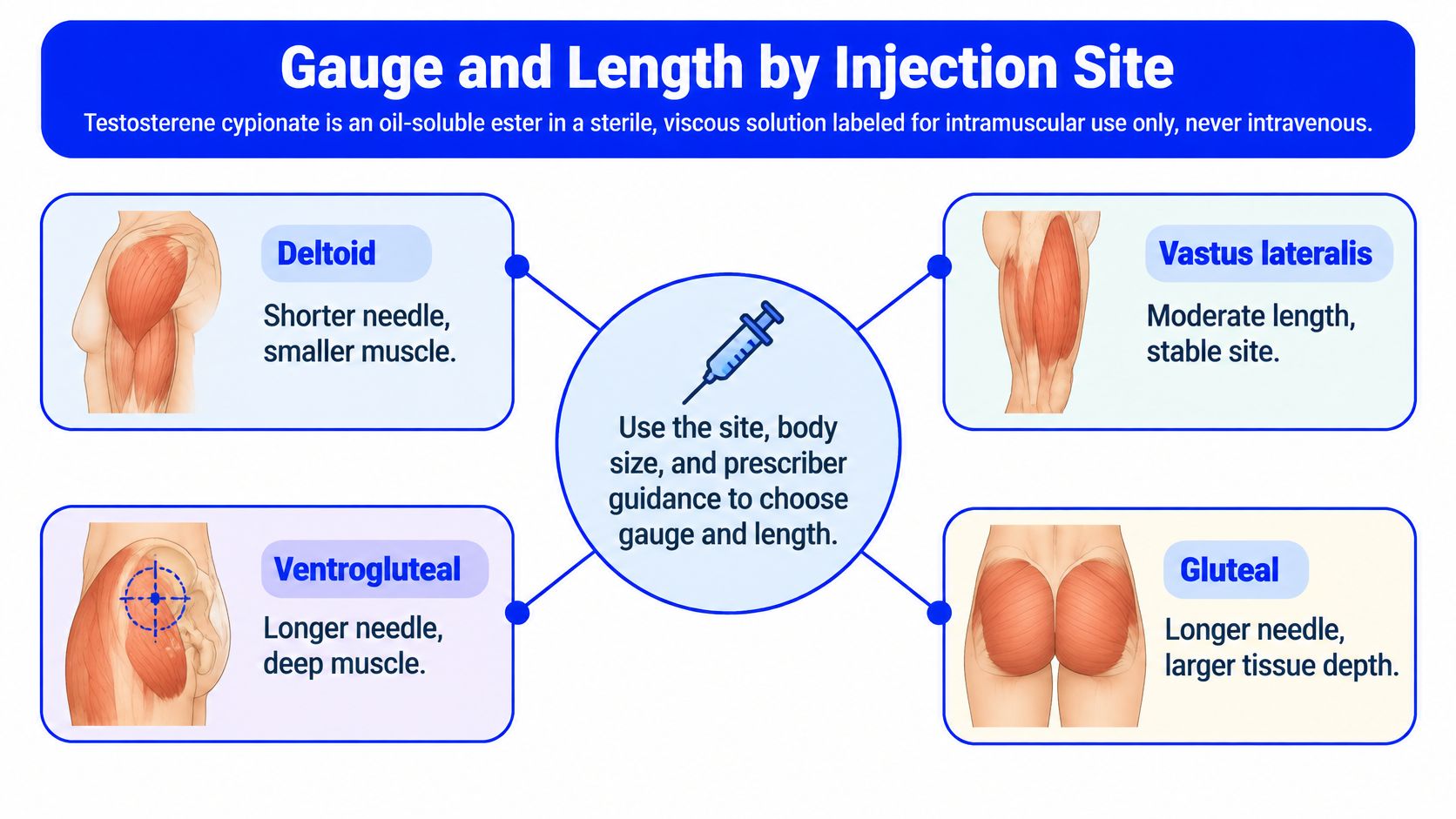
Testosterone cypionate is an oil-soluble ester supplied as a sterile, viscous injectable solution. Its FDA prescribing information specifies intramuscular administration only, not intravenous use, and requires inspection for particulate matter or discoloration before administration.
Oil changes the handling experience. Pulling a viscous liquid through a narrow bore resembles drawing honey through a coffee stirrer: it takes longer, and pushing it back through requires more effort. That resistance matters, but it doesn't answer the separate question of how far the needle must reach.
Separate gauge from tissue depth
Gauge describes needle thickness; length determines reach. A higher gauge number denotes a thinner needle. Selecting a thinner needle doesn't establish whether its tip will reach muscle, and choosing a longer needle doesn't solve excessive resistance through a narrow bore.
The syringe presents another independent decision. Its graduations must allow the prescribed volume to be read accurately, and the operator must be able to control its plunger. A technically compatible combination can still be unsuitable for someone with limited hand strength or difficulty reading the markings.
The usual intramuscular discussion range is 22–25 gauge, but the following site comparison is a clinician discussion aid, not a testosterone-specific prescription. These general dimensions cannot establish suitability without assessment of the person, formulation, and intended volume.
Intramuscular needle length by injection site
| Site | Typical gauge | Typical length | What changes it |
|---|---|---|---|
| Intramuscular deltoid | 22–25 gauge | About 5/8–1 in | Shorter end only when subcutaneous fat is thin and the tip still reaches muscle |
| Intramuscular vastus lateralis | 22–25 gauge | About 1–1.5 in | Thicker adipose tissue requires sufficient length so the dose isn't left in fat |
| Intramuscular ventrogluteal | 22–25 gauge | About 1–1.5 in | Length follows muscle size and fat thickness, not a single adult default |
The deltoid is a smaller muscle, so accessibility alone doesn't make it suitable for every oil volume. The vastus lateralis may offer a more manageable position for some patients, while ventrogluteal selection requires correct anatomical identification. A trained clinician must establish the site rather than leaving the patient to interpret an illustration.
Recognize both length failures
A needle that's too short can leave an intended intramuscular dose in subcutaneous fat. A needle that's too long can increase the chance of contacting bone or deeper structures. The goal isn't maximum penetration; it's appropriate penetration into the intended tissue while avoiding major vessels and nerves.
Practical rule: A short subcutaneous needle isn't a substitute for an intramuscular needle merely because it looks less intimidating.
Body composition needs a site-specific assessment. Overall body size doesn't reveal the exact thickness of fat over the selected muscle, and the same person may need different considerations at different anatomical sites. Muscle size, tissue depth, and solution volume must be considered together.
Route-specific advice also shouldn't migrate between medicines. Trim's step-by-step Mounjaro injection advice is useful for understanding that product's administration process, but it isn't a template for intramuscular testosterone oil. Similar-looking injection supplies don't make the medicines or tissue targets interchangeable.
Account for the person operating the device
A smaller injection needle may improve comfort but demand more pressure and patience. For someone with low hand strength, forcing a resistant plunger can make stable handling difficult. A clinician or pharmacist should assess the whole assembly rather than selecting the finest needle in isolation.
Visual limitations matter too. Clear barrel markings, readable packaging, adequate lighting, and a stable preparation surface are procurement considerations, not optional conveniences. Disposal access must also be realistic before treatment begins.
The CDC's clinical injection-safety guidance reinforces that sterile equipment and safe vial access remain essential regardless of device preference. Convenience doesn't justify a setup that compromises aseptic handling.
Finally, visibly compromised medication isn't an equipment problem. Particles or discoloration require the product to be withheld and referred to the dispensing professional, not filtered, diluted, or pushed through a wider needle. Final gauge, length, and site selection belong to the product instructions and a trained healthcare professional.
Draw Needles Injection Needles and Luer Fittings
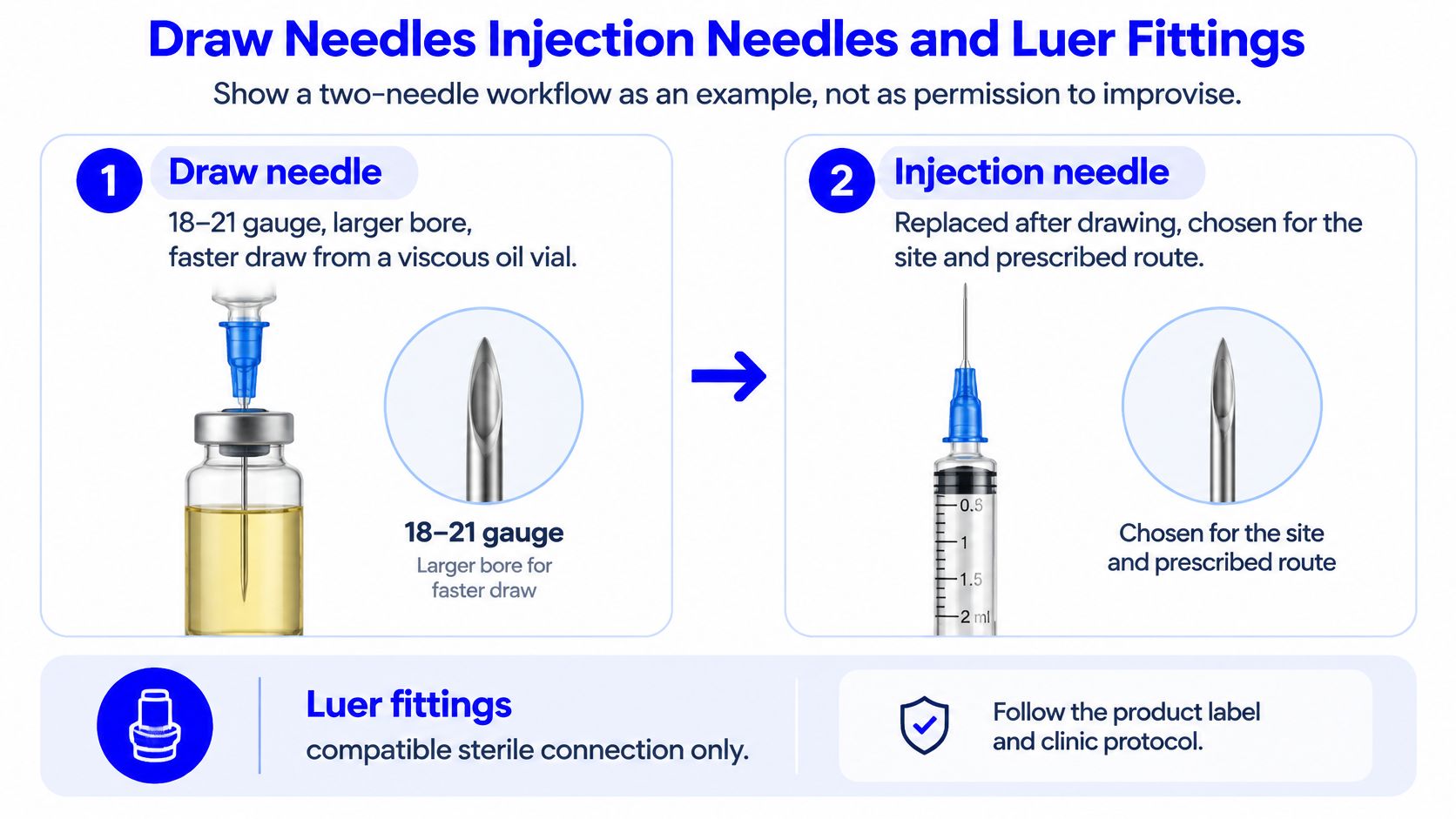
A two-needle workflow separates withdrawal from administration, but it's an example of an authorized process, not permission to improvise. For viscous oil drawn from a vial, a larger-bore draw needle can reduce withdrawal resistance; a fresh injection needle can then be fitted if the product instructions and local policy allow that sequence.
The testosterone cypionate labeling supports treating route verification and trained administration as safety controls. It also identifies injection-site inflammation and pain as relevant adverse effects.
Compare role and connection separately
How needle role and hub type differ
| Device | Best used for | Main limitation |
|---|---|---|
| 18–21 gauge draw needle | Withdrawing viscous oil from a vial when authorized | Too large to treat as the default injection needle |
| 22–25 gauge injection needle | Intramuscular administration at a professionally selected length | Slower oil flow; must still reach muscle |
| Luer-Lok syringe | Secure threaded hub under higher plunger pressure | Requires a compatible separate sterile needle unless supplied otherwise |
| Luer-slip syringe | Quick friction-fit attachment | Can disconnect when resistance is high or attachment is inadequate |
| Fixed-needle insulin syringe | Small aqueous volumes appropriate to its intended use | Cannot swap drawing and injection needles; poor default for thick intramuscular oil |
A Luer-Lok threaded connection offers better retention when the operator meets oil resistance. A Luer-slip connection relies on friction, so attachment and handling deserve particular attention. Neither connection compensates for incompatible components or excessive force.
The reference on secure syringe connections for lab workflows helps distinguish attachment design from barrel size. Fixed-needle insulin syringes don't offer the same component-swapping capability.
Apply the comparison without rebuilding the product
In a hypothetical clinician-approved setup, a 1 mL labeled cypionate withdrawal might use a matching-capacity Luer-Lok syringe, an 18-gauge draw needle, and a 22–25 gauge administration needle whose length has been selected for the site. That combination is appropriate only if it matches the exact product instructions and clinician's direction.
A 3 mL undecanoate withdrawal instead requires sufficient barrel capacity and the product's specified draw equipment. An autoinjector isn't rebuilt from loose needles and syringes.
Both needles and the syringe must start sterile. The CDC injection-and-sharps safety material emphasizes protecting sterile components from contaminated surfaces; replacing a needle doesn't restore sterility to a contaminated syringe.
Bacteriostatic Water Is Not the Diluent
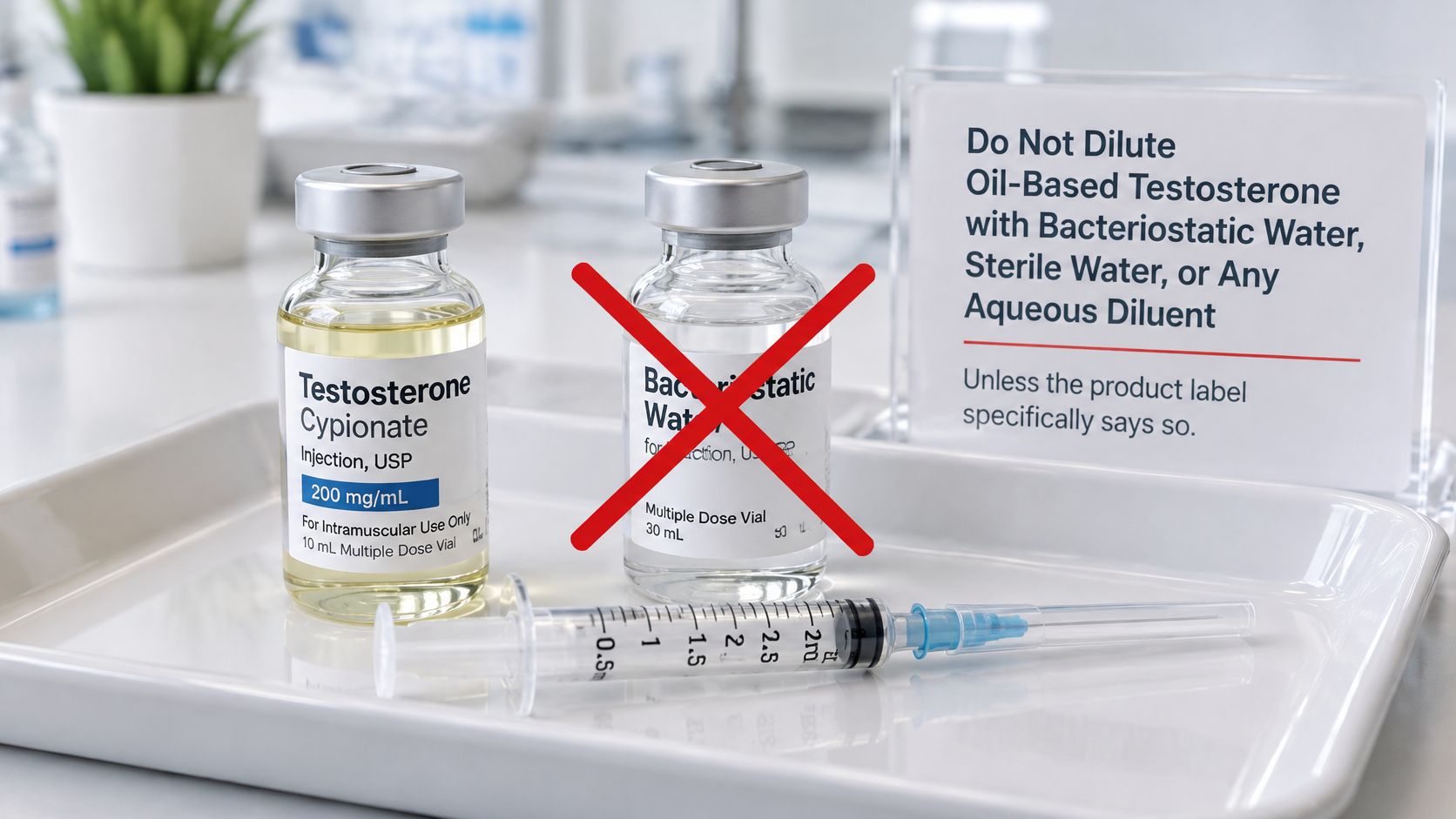
Oil testosterone esters must not be reconstituted, thinned, or diluted with bacteriostatic water, sterile water, or another aqueous liquid unless the exact product label explicitly directs it. The finished injectable formulation isn't an unfinished powder awaiting a diluent.
Adding water doesn't provide a controlled way to improve oil flow. Oil and water don't become a uniform, validated injectable formulation merely because they share a syringe. Altering the supplied formulation can undermine dose accuracy and introduces an unnecessary transfer and contamination opportunity.
Keep aqueous reconstitution separate
Bacteriostatic water has a different role: an aqueous diluent for compatible materials under their applicable instructions. In research, that can include lyophilized peptides and other reagents. That use doesn't establish compatibility with an oil-based drug.
The handling guidance for bacteriostatic water belongs to that separate aqueous workflow. Preservative content doesn't make unauthorized mixing acceptable, and a preservative never replaces aseptic technique.
A diluent's presence on the same shelf isn't evidence that it belongs in the same syringe.
The hardware must also suit the liquid. Stopper, barrel, plunger, and connection compatibility should be checked against the fluid and device manufacturers' specifications. An oil withdrawal and an aqueous reagent transfer shouldn't be treated as equivalent merely because both involve a vial.
Separate supplies at the bench
A laboratory holding both testosterone material and peptide diluent should maintain distinct preparation arrangements:
- Identify the fluid. Labels and records should distinguish the finished oil formulation from the aqueous research diluent.
- Separate transfer supplies. Needles and syringes must not pass between the workflows.
- Control vial access. Each stopper needs appropriate disinfection and aseptic access with sterile equipment.
- Record first access. Multi-dose containers need traceable opening information and a product-specific discard policy.
A preservative-containing diluent doesn't sterilize a contaminated stopper, needle, or syringe. Nor does it authorize extending an in-use period beyond the applicable instructions.
For a resistant testosterone withdrawal, the appropriate response is professional review of the equipment and handling method, not a home-made formulation change. Bacteriostatic water is a diluent only for compatible, authorized aqueous applications, never a routine additive to testosterone oil.
Single-Use Handling and Sharps Disposal
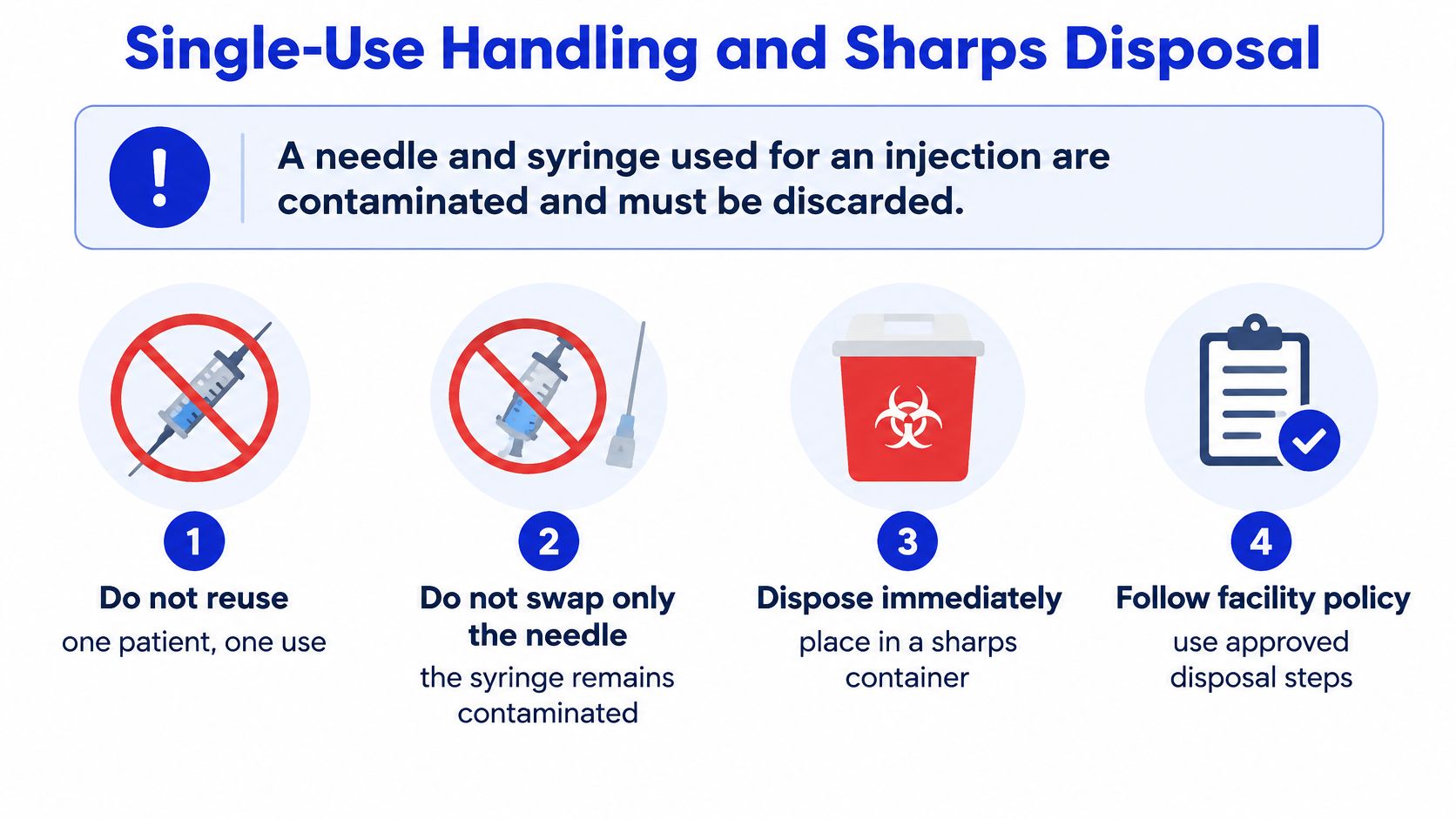
A needle and syringe used for an injection are contaminated and must be discarded. Changing only the needle doesn't make the syringe safe for another patient or another entry into a medication vial, according to the CDC's injection-safety guidance.
Medication can become contaminated through backflow or contact with a contaminated needle. A used syringe can therefore carry contamination into the next medication container, including a multi-dose vial. The risk applies wherever supplies might be shared or mistaken for unused equipment.
Understand the narrow exception
The CDC describes limited reuse during an uninterrupted procedure only when incremental doses are integral to that procedure, the syringe remains under continuous control, strict aseptic technique is maintained, and disposal follows immediately afterward. This exception does not permit storing a testosterone syringe for the next scheduled injection.
A multi-dose medication container doesn't change the status of used injection equipment. Its contents may be intended for repeated authorized withdrawals, but each access still requires appropriate sterile supplies and handling.
Dispose at the point of use
The CDC and NIOSH sharps-container guidance supports immediate disposal and warns against exceeding the marked fill line, or three-quarters full where that alternative-container limit applies.
- Position the container. Keep an appropriate puncture-resistant sharps container within immediate reach before preparation begins.
- Avoid extra handling. Don't recap, bend, break, or detach the contaminated needle.
- Discard the connected assembly. Place the still-attached needle and syringe directly into the container after use.
- Respect the capacity mark. Replace the container before it becomes overfilled, following its marked limit and applicable facility guidance.
- Use the approved waste route. Close and manage the container according to state or local requirements. Loose contaminated sharps must never enter household or ordinary workplace trash.
The operator shouldn't have to carry an exposed used needle across a room to find disposal. A container hidden in a cupboard or blocked by supplies isn't an effective point-of-use arrangement.
Sharps collection is part of the equipment setup, not an afterthought. Site choice, needle preference, and container size don't remove the obligation to discard the used assembly promptly and safely.
What to Record Before You Procure
A defensible order starts with authorization and a complete device specification. For prescription testosterone, the purchaser must confirm eligibility to obtain the drug and ensure that the actual product label, not a general internet chart, establishes the intended route and dose.
A pharmacist or clinician should approve syringe capacity, gauge, length, and connection before an order is released. Sterile single-use needles and syringes should be purchased in appropriate intact packaging. A bulk purchase changes stock availability, not reuse rules.
Make the record useful
An order line that says only “testosterone syringes” leaves too much unresolved. The administration or research-withdrawal record should capture:
- Product identity and lot, sufficient to trace the material used.
- Vial first-access date, when the container is multi-dose.
- Syringe capacity and graduation suitability, including whether the device is prefilled.
- Connection type, recorded as the actual compatible fitting.
- Needle gauge and length, with draw and administration roles distinguished.
- Operator identity, tied to the authorized procedure.
- Disposal event, documented under the facility's sharps policy.
These records should describe the equipment used, not merely copy the intended purchase description. If a substitution arrives, its compatibility needs review before release to the work area.
Keep the legal and practical categories distinct
Injectable testosterone is a drug with its own prescription and labeling requirements. Empty needles and syringes are medical devices, and local supply rules may also apply. An aqueous research diluent is a separate product category, not permission to turn a finished testosterone vial into a home-mix kit.
Research-use-only materials must remain within their stated scope. A laboratory designation doesn't authorize patient administration, override a medicine's instructions, or establish compatibility between unrelated products.
Order decision: The right purchase is a documented compatible assembly, not the cheapest box carrying a familiar gauge.
Procurement should therefore select a barrel that accommodates the labeled volume, a compatible secure connection suited to oil resistance, and a needle length professionally matched to the intended tissue. Stock planning should include fresh sterile components and a working disposal route for every authorized procedure.
The practical endpoint is straightforward: approved equipment, readable specifications, traceable material, and immediate disposal after use. A substitution that changes any of those conditions requires review rather than improvisation.
Herbilabs offers research-use-only bacteriostatic water and reconstitution solutions, multiple vial formats, and lot-specific certificates of analysis for separate aqueous laboratory workflows. Laboratories sourcing peptide diluent can visit Herbilabs to compare formats and documentation while keeping those supplies separate from testosterone oil preparation.