Private Label, White Label, Wholesale partnerships available - EU, USA and UK - Free shipping from €75

What Does 1cc Look Like on a Syringe: A Visual Guide
A researcher holds a clear syringe over a vial, sees several lines on the barrel, and pauses. The question seems simple: what does 1cc look like on a syringe? On a standard volume syringe, the answer is straightforward, but the visual position changes with syringe size and the markings may use either milliliters or insulin units. Reading the wrong scale can turn a clear measurement into a dosing error.
The practical starting point is this: 1cc equals 1mL. On a typical 1mL syringe, 1cc reaches the full 1.0mL mark. The main complication is that an insulin syringe may display units rather than milliliters, so its markings shouldn't be interpreted as a universal volume scale.
Table of Contents
- Understanding What 1cc Actually Represents
- Reading Syringe Graduations for Precise Measurement
- Comparing Syringe Types and Their 1cc Markings
- Avoiding the Insulin Syringe Confusion
- Mastering Accurate Dosing Technique
- Best Practices for Consistent Results
Understanding What 1cc Actually Represents
A cubic centimeter, written as cc or cm³, and a milliliter, written as mL, describe the same volume. Therefore, 1cc = 1mL, and a syringe marketed as a 1cc syringe has a capacity of 1mL. This equivalence is explained in the reference guide to cc measurements on syringes.
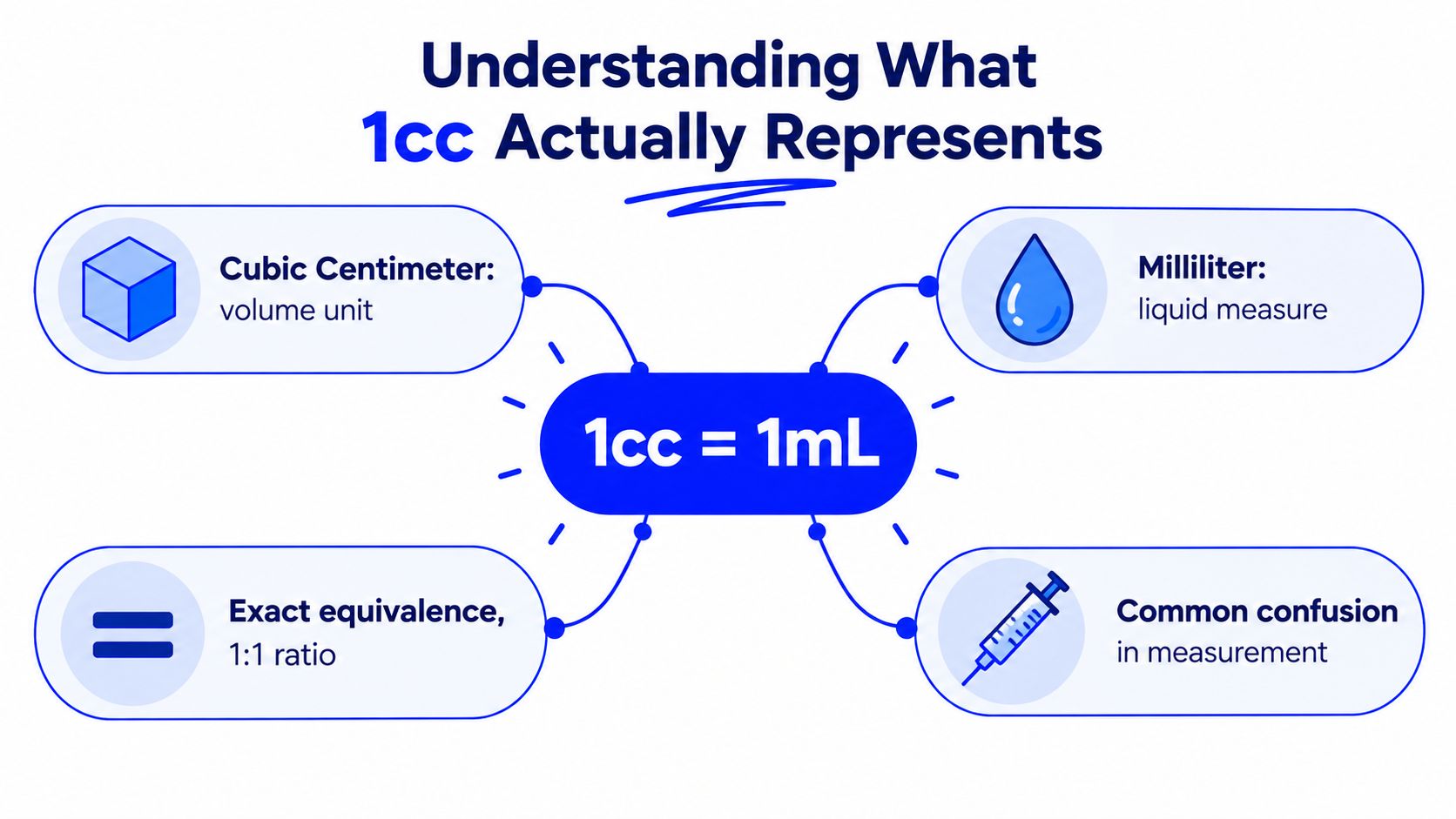
That means 1cc isn't a special intermediate line on a standard 1mL syringe. It is the endpoint of the barrel's volume scale. If the syringe is empty, the plunger sits near the zero position. When the barrel contains 1cc, the plunger's leading edge aligns with the 1.0mL graduation at the top of the scale.
The visual confusion usually comes from the syringe label, not from the volume itself. Some syringes use mL or cc markings, while insulin syringes use concentration-based units. A volume syringe answers, “How much liquid is present?” A unit-marked syringe answers, “How many medication units are being delivered at a specified concentration?”
Practical rule: Identify the scale before drawing liquid. A clear barrel doesn't make an unfamiliar scale safe to interpret.
For research work involving reconstitution solutions, the distinction matters because the volume of diluent changes the resulting concentration. A researcher should record the syringe capacity, the visible scale, and the intended volume before transferring liquid. The goal is to match the written protocol to the markings printed on the barrel.
Reading Syringe Graduations for Precise Measurement
A researcher preparing a small-volume transfer should first identify the scale, then confirm which graduation matches the target. On a 1mL barrel, numbered marks commonly appear at 0.1mL intervals, while shorter ticks may indicate 0.01mL increments. The exact pattern varies by model, so the printed scale on the syringe takes priority over assumptions based on appearance.
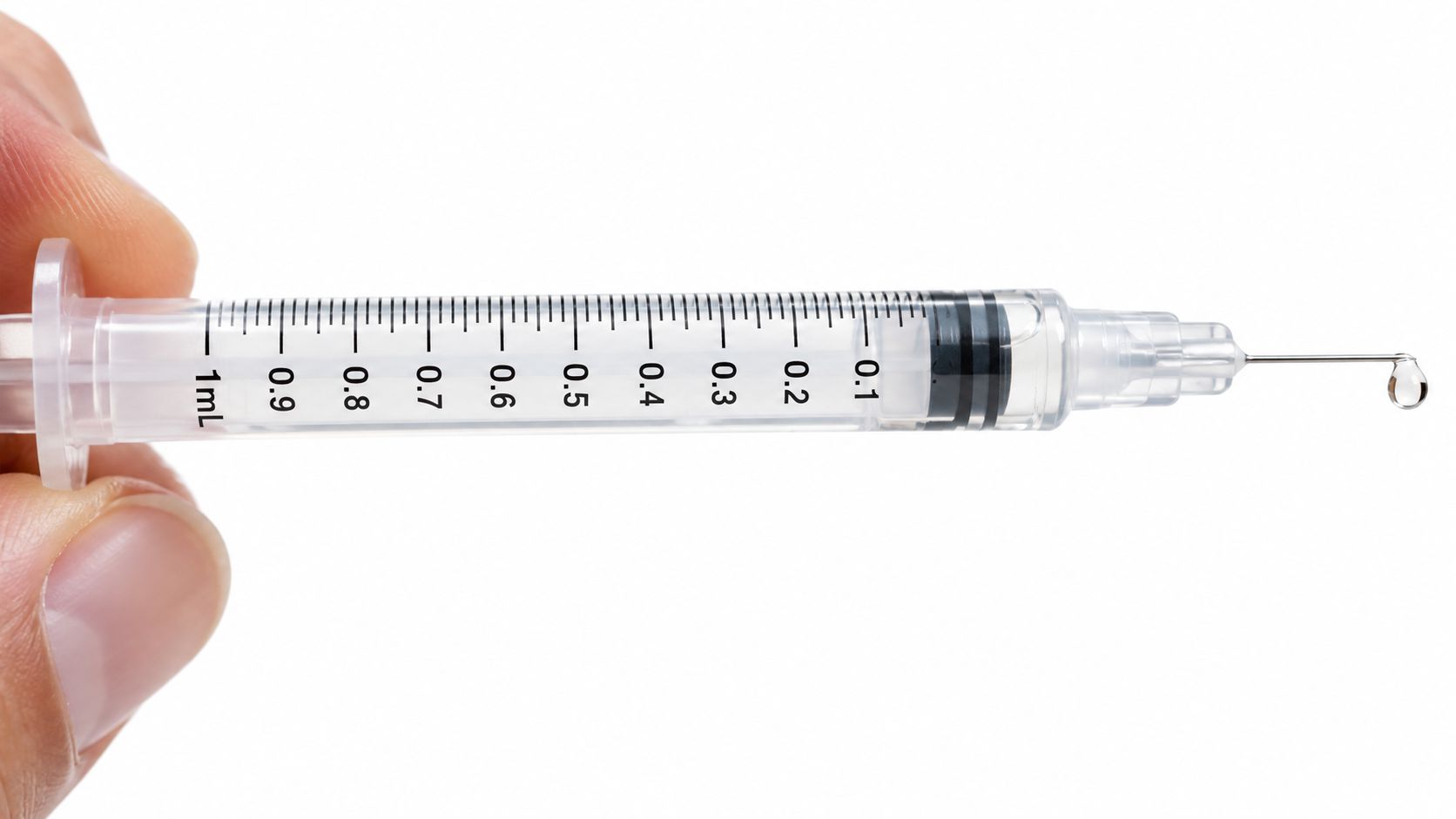
Use this visual sequence:
- Find the mL scale printed on the barrel.
- Identify the final numbered graduation, marked 1.0mL or 1mL.
- Draw liquid until the plunger's leading edge aligns with the selected mark.
- Hold the syringe at eye level and inspect the liquid without tilting the barrel.
The plunger has several visible edges, which can cause a false reading. Use the rubber stopper edge nearest the needle as the reference point. Do not align the graduation with the stopper's rear edge or with the end of the plastic plunger rod.
Reading the liquid level consistently
A liquid surface curves inside a narrow barrel, forming a meniscus. For repeatable measurements, keep the syringe at eye level and use the same part of that curve each time, following the instructions for the specific syringe and procedure.
A tilted barrel changes the apparent level. Viewing from above can make the liquid seem lower, while viewing from below can make it seem higher. That difference matters more for small transfers and for solutions used to prepare a defined concentration.
Record the syringe capacity, scale type, selected graduation, and intended volume before transferring liquid. A volume-marked syringe reports liquid amount. A unit-marked syringe reports medication units at a specified concentration, so treating the two scales as interchangeable can produce a dangerous dose.
For a related example of milliliter volume, see 2ml of water explained. Aesthetic terminology may use partial-syringe language differently, so half syringe filler price is not a substitute for reading the equipment's actual graduations.
Comparing Syringe Types and Their 1cc Markings
A 1cc target can look like a full syringe or a short section of the barrel, depending on the syringe's capacity. In a 1mL tuberculin syringe, 1cc reaches the endpoint. In a larger syringe, it occupies only part of the barrel and appears near the lower end of the scale.
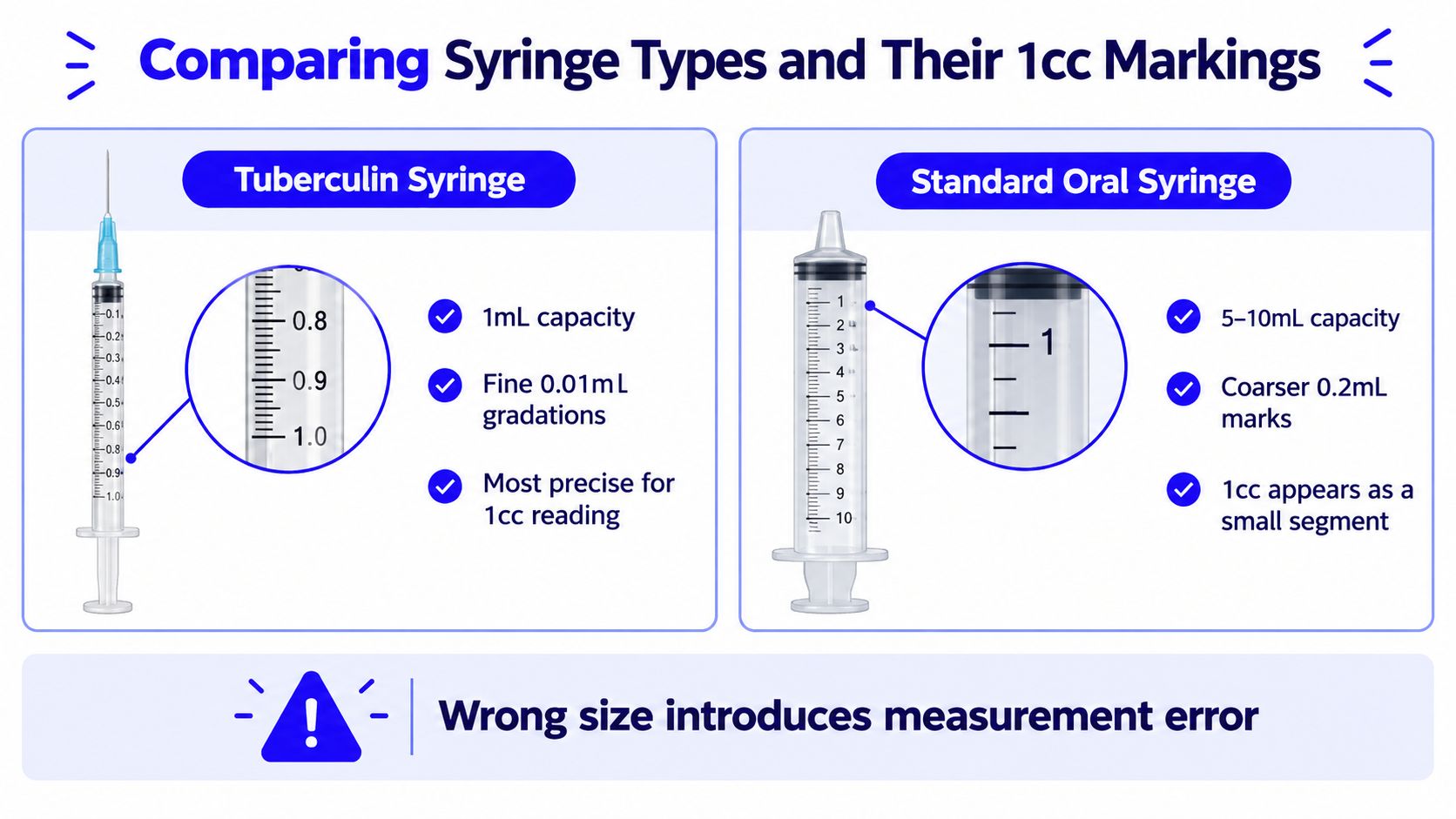
A 1mL tuberculin syringe usually gives the clearest visual reference for 1cc because the liquid reaches the end of its scale. Its narrow barrel and fine graduations make small volume changes easier to distinguish. Some models use 0.01mL intervals, while others use different minor divisions, so read the printed markings on that specific syringe.
A 3mL syringe shows 1cc at roughly one-third of its capacity. A 5mL or 10mL syringe shows 1cc as a smaller section near the barrel's lower scale. Wider spacing between graduations makes the target harder to judge precisely.
| Syringe type | How 1cc appears | Practical consideration |
|---|---|---|
| 1mL tuberculin syringe | Full 1mL endpoint | Fine visual control for small volumes |
| 3mL syringe | Partial fill near the lower part of the scale | Fewer visible subdivisions |
| 5mL or 10mL syringe | Small portion of the barrel | More estimation between marks |
For a 1cc target, choose the smallest syringe that can contain the volume. A 1mL tuberculin syringe may show finer increments than a 5mL barrel, reducing the need to estimate between lines. Capacity alone does not determine accuracy. The graduations and the way the barrel presents the liquid do.
Match the syringe to the target volume, then read the printed scale rather than judging the liquid by its apparent height.
A separate explanation of UK filler price ranges may use cc to describe a product or treatment quantity. That terminology does not show where 1cc sits on a physical syringe. The barrel capacity and its printed graduations determine the visual position. Always confirm that the syringe is volume-marked before treating its scale as a direct cc or mL measurement.
Avoiding the Insulin Syringe Confusion
An insulin syringe isn't interchangeable with a standard mL syringe just because both have a narrow barrel. Insulin syringes are labeled in units, and the relationship between units and volume depends on the insulin concentration. A standard volume syringe measures cc or mL directly. The concentration-specific distinction is highlighted in this guide to using syringes.
That means 1cc doesn't universally equal a fixed number of insulin units. Unit counts belong to the formulation and its labeled concentration, not to cc itself. A researcher who sees a “100” on a unit-marked syringe and assumes it represents 1mL without checking the label can select the wrong scale.
Before measuring, check:
- Barrel label: Confirm whether the syringe is marked in mL, cc, or units.
- Product concentration: Read the formulation label and protocol rather than guessing the conversion.
- Syringe type: Don't use a unit-based insulin syringe as though it were a standard volume syringe.
- Written record: Document the actual volume scale and concentration used.
This distinction also matters during cleanup. Used sharps shouldn't be left loose in a laboratory or household area. Guidance on how to dispose of dog syringes properly offers handling context for insulin syringes, although local disposal requirements still control the final process.
For equipment comparisons, the Herbilabs syringe specifications should be read alongside the product label and the intended protocol. A syringe's printed scale is useful only when the user knows what its units represent.
Mastering Accurate Dosing Technique
Accurate measurement begins before the plunger moves. The researcher should confirm the target volume, inspect the syringe scale, and use equipment compatible with the liquid and the approved procedure. For bacteriostatic water or another reconstitution solution, aseptic handling and the governing laboratory protocol take priority over speed.
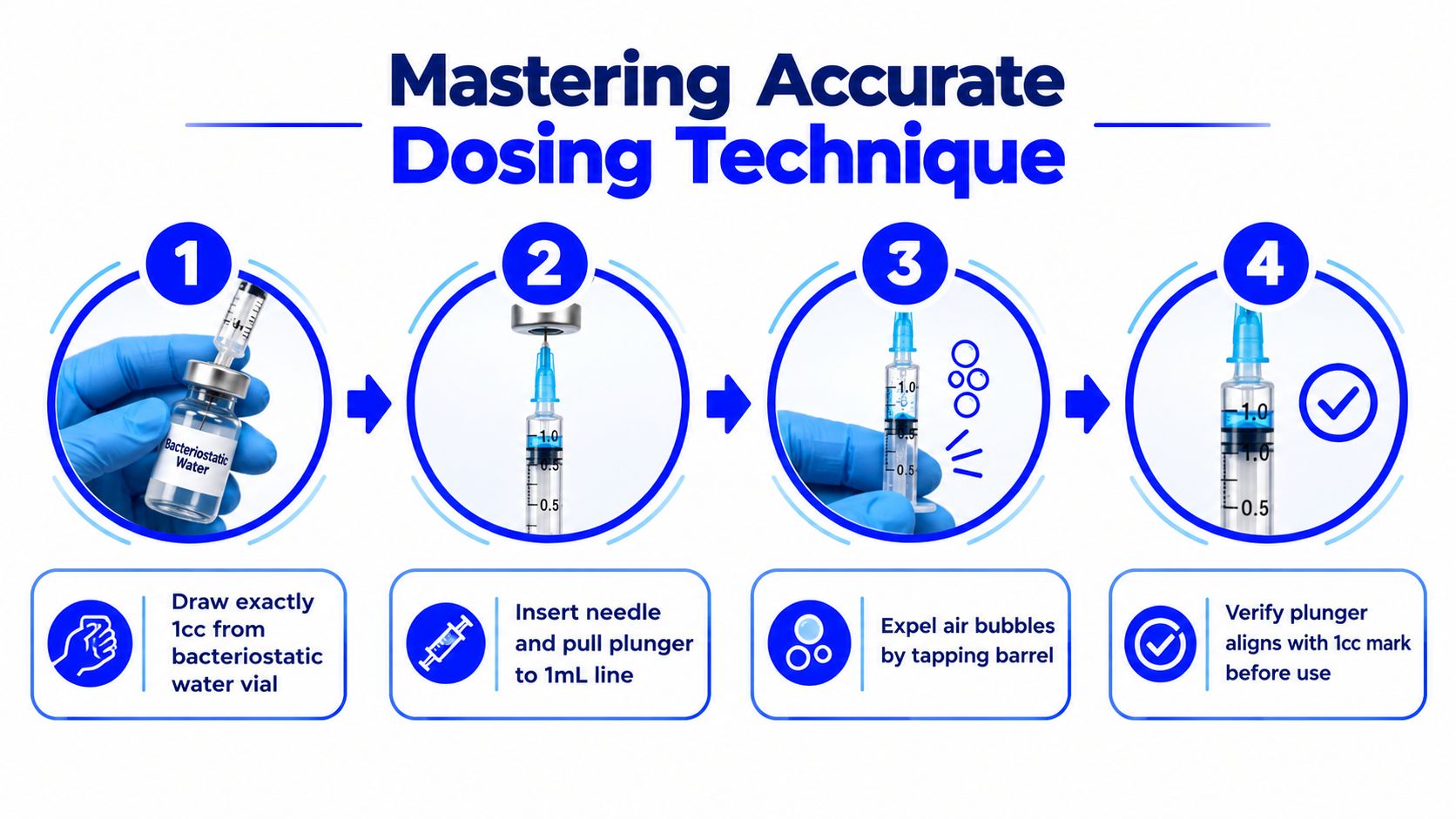
A controlled drawing sequence
- Inspect the scale. Confirm that the barrel measures mL or cc and identify the 1.0mL endpoint. If the syringe uses units, stop and verify the concentration-specific conversion before drawing.
- Prepare the vial and syringe. Use the needle, connection, and handling method specified by the protocol. Avoid touching sterile contact surfaces.
- Draw slowly. Pull the plunger back in a controlled motion until the liquid passes the target slightly, if the procedure allows adjustment for bubble removal. Fast movement can create bubbles and makes overshooting easier.
- Remove visible air. Hold the syringe upright, tap the barrel gently so bubbles move upward, and advance the plunger carefully until the air is expelled. Excessive tapping can splash liquid or make the plunger jump past the intended mark.
- Set the final reading. Return the syringe to eye level and align the plunger's leading edge with 1.0mL. Check the meniscus and confirm that the barrel hasn't been tilted.
- Transfer according to the protocol. Keep the needle and connection controlled throughout the transfer, then handle the used syringe as a sharp.
A common mistake is to treat the first apparent alignment as final. The plunger may shift after bubbles rise, and the liquid level can change when the barrel is rotated. A second eye-level check takes little time and catches errors that aren't obvious from above.
Measurement habit: Remove bubbles first, then perform the final alignment. Don't use a bubble-filled syringe as the reference for 1cc.
Precision has limits even when technique is consistent. Educational pharmaceutical guidance reports approximately ±5% volumetric accuracy for common syringe sizes, while one cited evaluation found a 0.07mL accuracy limit for a 1mL syringe below 0.2mL. These figures are discussed in Kendall Hunt's syringe accuracy guidance. They describe equipment limitations, not permission to guess, and specialty syringes may have different manufacturer specifications.
Best Practices for Consistent Results
Reliable 1cc measurement comes from repeating the same controlled choices. The syringe should suit the target volume, the scale should be identified before use, and the plunger should be read at eye level after bubbles have been removed. Larger barrels can work for larger transfers, but a small target volume is easier to judge in a small-volume syringe with suitable graduations.
A concise laboratory checklist can prevent most avoidable mistakes:
- Select the barrel first: Use a 1mL format when the procedure requires clear visual control of a 1mL target, unless the protocol specifies another device.
- Read the printed scale: Don't assume that a “1cc” description means the barrel uses mL markings. Confirm whether it uses volume or concentration-based units.
- Align the correct edge: Use the leading edge of the rubber plunger, not the back edge.
- Control the meniscus: Hold the syringe at eye level and use the same reading method for every measurement.
- Manage bubbles: Draw steadily, tap gently, and make the final adjustment only after the air has been expelled.
- Respect equipment limits: A syringe can provide a precise visual guide without delivering laboratory-grade accuracy at every volume.
- Replace compromised equipment: Discard syringes with damaged barrels, unclear graduations, sticking plungers, compromised packaging, or contaminated connections.
For workflows involving bacteriostatic water, the written reconstitution procedure should define the diluent, target volume, handling conditions, and documentation. Herbilabs offers sterile diluents and related labware for research-use-only workflows, while syringe selection remains the responsibility of the researcher and the applicable protocol.
The clearest visual answer remains simple: on a 1mL volume syringe, 1cc is the full 1.0mL mark. The difficult part is making sure the syringe uses a volume scale and that the plunger, meniscus, and barrel are read consistently.
Researchers who need sterile diluents and compatible labware can review Herbilabs' research-use-only products and choose a format that fits their reconstitution workflow. Visit Herbilabs to review bacteriostatic water options, vial formats, and related laboratory supplies before the next measurement task.