Private Label, White Label, Wholesale partnerships available - EU, USA and UK - Free shipping from €75

Temperature Controlled LTL Transportation How to Ship Right
A small RUO shipment can leave a controlled warehouse in perfect condition and still arrive with an unresolved temperature question. A pallet of bacteriostatic water vials may spend hours waiting at a transfer terminal, move through another dock without a recorded product reading, or arrive with a delivery scan but no usable temperature history. The trailer may have been set correctly, yet the cargo itself may not have stayed within its required range.
That is the operational reality behind temperature controlled LTL transportation. Shared refrigerated networks make sense for smaller shipments, including one to several pallets, but every consolidation point adds handling, dwell, and communication risk. Reliable delivery therefore means more than booking a reefer. The shipment needs suitable packaging, a documented setpoint, disciplined handoffs, continuous monitoring, and a receipt process that preserves lot and condition records.
For RUO labware moving between the EU, UK, and US, the practical standard is straightforward: the product remains within its approved range, the chain of custody is clear, and the shipper can prove what happened between pickup and delivery. Facility security also belongs in the wider risk picture. Teams reviewing controls around pharmaceutical production and storage may find this resource on fire and life-safety for drug manufacturing useful when connecting transport procedures with site protection.
The Herbilabs guide to dependable lab shipments provides related context on why dependable fulfillment matters to research schedules. The following workflow focuses on the points that usually decide whether a small refrigerated shipment arrives as planned or becomes a quality investigation.
Table of Contents
- Introduction to Temperature Controlled LTL for RUO Labware
- How to Choose the Right Carrier and Service Level
- Packaging and Palletization for Temperature Stability
- Transit Planning Labeling and Paperwork That Prevents Delays
- Temperature Monitoring and Handling Excursions in Transit
- Costs Operational Trade Offs and Final Checklist for Reliable Delivery
Introduction to Temperature Controlled LTL for RUO Labware
A research team may release a few cartons of sterile diluent and RUO labware for a cross-border order, then select refrigerated LTL because a dedicated reefer would leave much of its capacity unused. Pickup can be on time, the vehicle can hold the requested setpoint, and the delivery appointment can be confirmed. Risk often rises later, when the pallet reaches a shared terminal and waits for consolidation.
The questions are operational. Was the pallet held in a refrigerated zone or left on a dock? Did the next operator see the required handling range? Was the outer shipper still cold at transfer? Did anyone record product temperature, rather than relying on the trailer display?
Refrigerated LTL combines compatible temperature-sensitive shipments in a shared network. That can suit smaller consignments, but unloading, sorting, staging, and reloading create exposure at every transfer point. Shippers should minimize handoffs, pre-stage freight at the correct setpoint, and monitor conditions at pickup, transfer, and delivery. The temperature-controlled LTL transportation guide describes this operating approach.
Why small laboratory shipments need a different risk lens
RUO labware is often compact and easy to stack, which can hide its handling risk. A small pallet may be more vulnerable to crushing, misplaced paperwork, and terminal dwell than a larger, clearly identified consignment. Glass vials need restraint and separation, while the shipper must limit ambient exposure and absorb rough handling.
The freight also carries information that must stay aligned: product identity, lot reference, destination, temperature requirement, and supporting quality documents. A delivery can look intact yet lack the condition evidence needed for release. That gap can delay laboratory work and trigger a quality review.
Facility controls belong in the same risk assessment. Teams connecting transport procedures with site protection may find this resource on fire and life-safety for drug manufacturing useful.
Practical rule: LTL suits a shipment when its packaging can tolerate shared-network handling, the carrier can account for each handoff, and the receiving team has a defined response if the logger records an excursion.
What successful delivery looks like
A reliable outcome has four parts:
- Correct service selection: The carrier accepts the actual temperature range and commodity, not merely the word “refrigerated.”
- Stable preparation: Freight enters the network conditioned and packed for the expected transit and dwell profile.
- Controlled handling: Warehouse and terminal staff can identify the pallet, orientation, setpoint, and handling restrictions.
- Proof at receipt: The consignee checks the packaging and logger status, then files delivery and quality records together.
The Herbilabs guide to dependable lab shipments offers related context on how dependable fulfillment supports research schedules.
The key distinction is technical eligibility versus operational suitability. A shipment may meet LTL size and weight rules yet remain a poor candidate if transfer dwell could expose sensitive material to unacceptable risk. For RUO labware, that decision belongs in booking, before the pallet enters the shared network.
How to Choose the Right Carrier and Service Level
Carrier selection should begin with the network, not the quote. A low freight price has little value if the provider can't explain where refrigerated freight transfers, how long it may remain staged, or who owns the response when a reefer fails. For RUO shipments, the carrier must also understand that a clean delivery scan isn't the same as proof of condition.
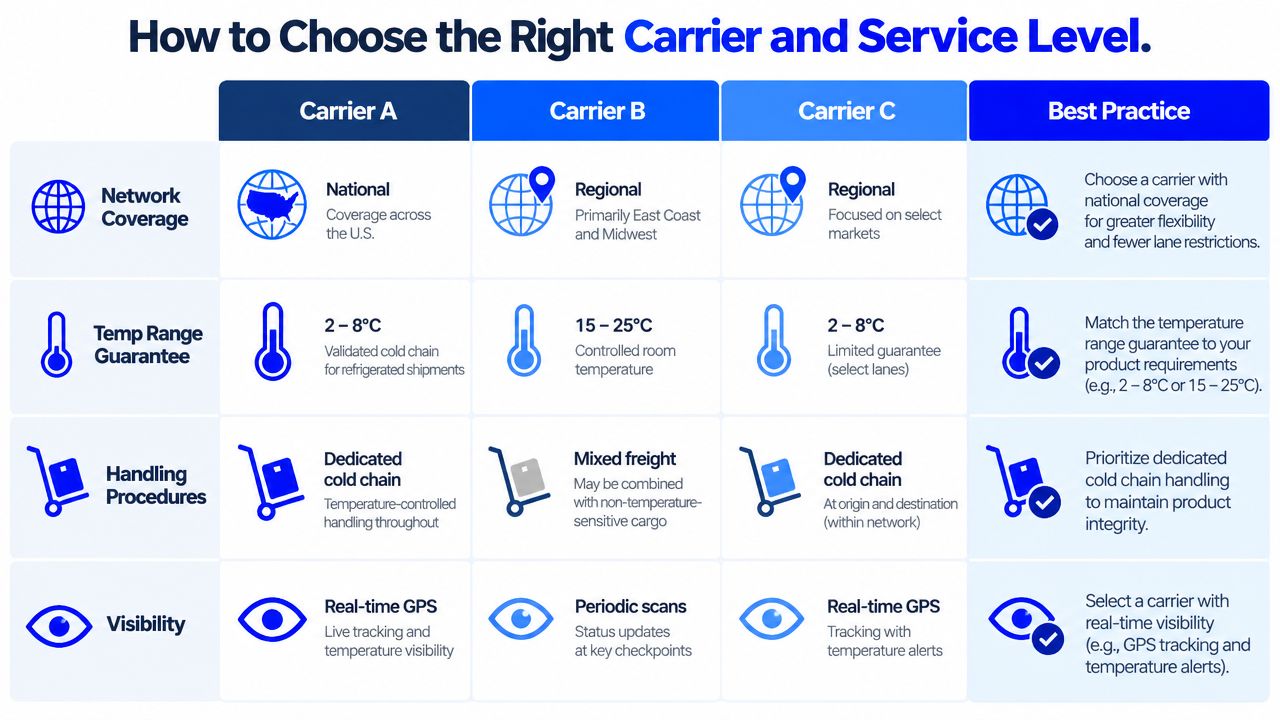
Shared reefer LTL and dedicated reefer compared
Shared LTL spreads vehicle use across compatible shipments. It can work well for securely packaged freight with a reasonable delivery window, especially when the provider offers direct control over the refrigerated network and reliable exception communication. The trade-off is exposure to terminal dwell, multiple loading events, and route changes.
Exclusive-use reefer removes much of that shared-network complexity. It generally costs more, but the shipper gains control over loading sequence, stops, route planning, and custody. The right comparison is therefore landed risk, not line-haul price alone.
| Decision factor | Shared-temperature LTL | Dedicated reefer |
|---|---|---|
| Freight cost | Uses shared capacity and may suit smaller consignments | Pays for exclusive vehicle use |
| Handoffs | More likely to include terminal transfers | Fewer planned custody changes |
| Dwell exposure | Depends heavily on the carrier's terminal process | Easier to control through direct routing |
| Monitoring | Must cover the product through every transfer | Still required, but the movement is simpler |
| Best fit | Stable, well-packaged freight with manageable service risk | Sensitive cargo, tight windows, or high loss exposure |
Capacity stress can change that decision. Market reporting describes refrigerated rates remaining high in several US regions and notes that truckload freight cascading into LTL can increase shipment weight and strain refrigerated networks. The market reporting on refrigerated transportation conditions is useful context when reviewing peak-season assumptions.
Questions that expose weak service
A carrier should answer these questions in writing:
- Network design: Which terminals handle the shipment, and are those locations refrigerated during staging?
- Temperature promise: Is the stated range a trailer setting, an ambient service commitment, or a product-condition guarantee?
- Transfer control: Who checks the shipment at each handoff, and how is that check recorded?
- Visibility: Can the shipper access continuous temperature data, location events, alerts, and custody records?
- Peak planning: What changes when capacity tightens, appointments slip, or a transfer is missed?
- Exception ownership: Which team contacts the shipper, consignee, and quality contact when readings leave range?
A carrier that only offers pickup and delivery scans isn't providing enough evidence for sensitive cargo. Guidance on how to vet box-truck partners can support a broader partner-review process, but refrigerated LTL still requires specific answers about temperature control and transfer handling.
The cold chain container breakdown can also help teams compare the physical protection expected from different container designs before approving a carrier or packaging combination.
Packaging and Palletization for Temperature Stability
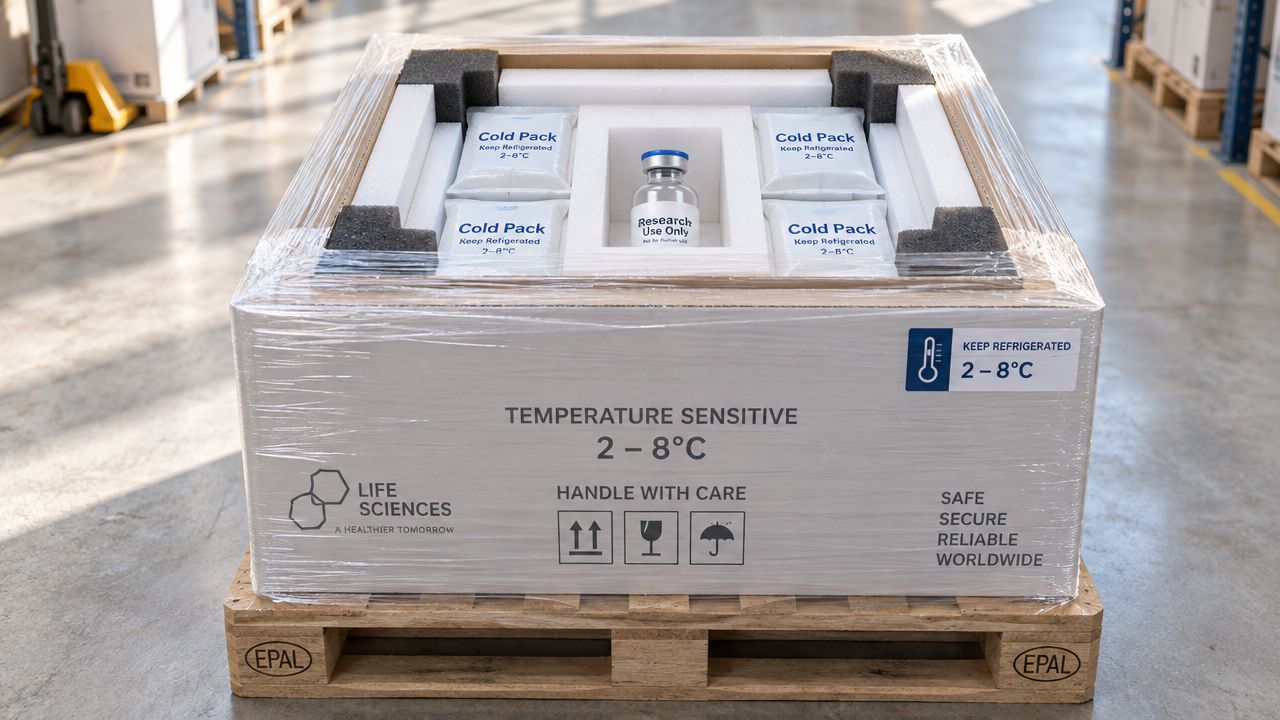
Packaging should be designed as a system, not selected by choosing an insulated box and adding cold packs at the last minute. A RUO vial shipment needs protection against temperature change, vibration, compression, moisture, and repeated handling. The shipper must also remain functional if the pallet waits at a transfer terminal longer than planned.
Build from the vial outward
The primary container comes first. Glass vials should sit in a fitted insert or divider that prevents contact between units. Secondary containment should capture leakage without allowing liquid to move freely across the shipper. Void fill needs to immobilize the contents, but it shouldn't compress caps, labels, or closures.
The insulated shipper then manages heat flow. Gel packs, phase-change materials, and other refrigerants should match the required range and expected duration. Packs need conditioning under a controlled procedure, because placing material into a shipper at an inconsistent state can create either inadequate cooling or local cold spots.
A practical packing sequence looks like this:
- Stabilize the product: Stage the vials at the required temperature before packing, following the approved internal procedure.
- Secure the primary units: Use dividers or a molded insert so glass doesn't strike glass.
- Separate refrigerant from product: Add a barrier or designed placement layer where direct contact could overcool or damage labels.
- Fill thermal gaps: Close empty space without blocking the intended air path around the payload.
- Close and identify: Seal the shipper, place the logger in the defined monitoring position, and apply handling marks to the outer packaging.
The thermal design must reflect the full journey, including collection, terminal transfers, customs processing where relevant, and final-mile delivery. A refrigerated trailer can't compensate for a shipper that starts warm or has inadequate thermal mass.
Pallet construction controls handling risk
Palletization should keep the load square, stable, and visible to warehouse staff. Cartons need enough compression strength for stacking and enough restraint to prevent lateral movement. Stretch wrap should secure the load without covering critical labels, logger indicators, or ventilation features.
Packaging rule: A compact pallet isn't automatically a safe pallet. Stability, label visibility, refrigerant placement, and access to the logger all need to survive every transfer.
Place heavier cartons below lighter ones, avoid overhang, and use corner protection where the carton geometry permits. The pallet label should remain readable from the aisle, with the temperature range and orientation instructions repeated where necessary. If a carrier uses mixed refrigerated freight, compatibility matters too. Odor transfer, leakage, and incompatible handling requirements can create problems even when the air temperature is correct.
Temperature controlled LTL transportation works best when the packaging specification, carrier SOP, and monitoring plan were tested together. The following video can provide a visual supplement for teams training warehouse staff on refrigerated shipment preparation.
Transit Planning Labeling and Paperwork That Prevents Delays
Most avoidable excursions begin before the truck arrives. A booking that omits the temperature requirement, a pickup window that conflicts with the route, or freight that waits unconditioned for collection can undermine an otherwise capable carrier.
The booking record should state the required range, commodity description, pallet count, dimensions, weight, collection window, delivery appointment, and consignee contact. If the lane crosses borders, the shipper should confirm who owns customs documentation and how the carrier handles a hold. Unclear responsibility can turn a paperwork question into terminal dwell.
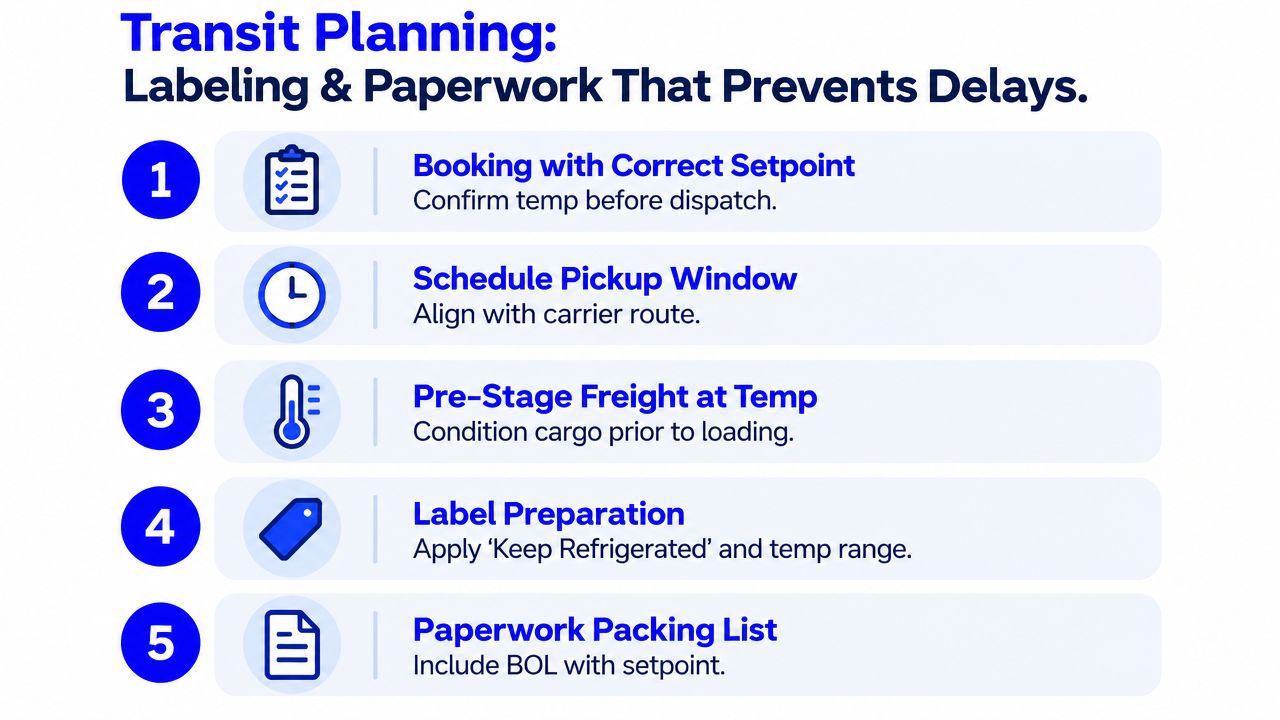
The pre-dispatch checklist
Warehouse staff should use a controlled checklist rather than relying on memory:
- Confirm the setpoint: Record the required range on the booking and bill of lading. Don't assume “reefer” communicates the correct condition.
- Fix the pickup window: Match the collection appointment to the carrier route and the time the freight can be released.
- Pre-stage at temperature: Move product into the conditioned staging area before loading and record the handover.
- Apply clear labels: Use “Keep Refrigerated,” the approved temperature range, orientation marks, shipment identifier, and consignee details.
- Assemble the paperwork: Include the bill of lading, packing list, commercial invoice where applicable, lot references, and any required RUO wording.
The paperwork should describe the material accurately without turning a research-use product into a clinical or therapeutic claim. Lot-specific Certificates of Analysis and QA release records should be matched to the shipped units, while commercial documents should support the actual destination and transaction.
EU, UK, and US lane discipline
Cross-border shipments need document consistency. Product names, quantities, consignee details, country of origin information where required, and lot references should agree across the commercial invoice, packing list, labels, and quality file. A mismatch can delay clearance or force staff to open and inspect a shipper that should have remained closed.
The carrier should receive a document pack before pickup, with a duplicate accessible to the consignee and logistics contact. Digital copies help, but the physical shipment still needs an external document pouch that can be found without opening the insulated payload.
A useful internal handoff record includes:
- Dispatch timestamp and releasing employee
- Product condition at pack-out
- Logger identifier and activation status
- Seal or closure reference
- Pallet count and visible damage check
- Carrier name, vehicle reference, and driver handover
- Expected transfer and delivery milestones
The more clearly each party understands the next action, the less likely the pallet is to wait while someone searches for a missing instruction.
Temperature Monitoring and Handling Excursions in Transit
A trailer setpoint describes the equipment's intended operating condition. It doesn't prove that the product stayed within range. Established pharmaceutical guidance treats 2 to 8°C shipments as acceptable only under tightly defined excursion rules, including limited-duration excursions and, in some cases, one-time-only exceptions. The ASHP cold-chain management resource provides that regulatory and operational context.
Many freight operations check temperature at origin and destination but lack useful evidence from the middle of the journey. That gap matters most at transfer points, where a pallet can leave the controlled trailer environment and wait during sorting or reloading.
What a credible monitoring stack includes
A suitable system combines the logger, alert process, and records workflow. The logger should measure the relevant payload environment, not report a nearby trailer sensor. Placement should follow the packaging qualification or internal shipping procedure, with the device protected from direct refrigerant contact unless that location is specifically required.
Continuous logging is more useful than isolated readings because it shows when a change began, how long it lasted, and whether the temperature recovered. Alerts should reach a named logistics or quality contact who can act while the shipment is still in transit.
A carrier review should ask whether the platform provides:
- Live or near-live readings: Data should be available before delivery, not only after receipt.
- Exception alerts: The system should identify a developing excursion and show who received the alert.
- Location context: Temperature events need to be associated with pickup, transfer, dwell, and delivery points.
- Chain-of-custody records: Each handoff should identify the responsible party and time.
- Exportable evidence: The final temperature file should be easy to attach to the lot and delivery record.
Technology has become a baseline expectation in refrigerated LTL commentary, but “baseline” should mean more than a tracking page. For sensitive or regulated cargo, proof of condition requires continuous temperature visibility, proactive alerts, digital custody records, and a retrievable final report.
Responding to an excursion
An excursion should trigger a controlled decision, not an automatic release or disposal. The receiving team should quarantine the affected shipment or clearly segregate it from accepted stock, preserve the packaging, download the logger file, and record the condition on arrival.
The quality review should compare the event with the product's approved stability information and excursion procedure. The record should include the highest or lowest observed reading, duration, shipment location, packaging condition, and any carrier explanation. The customer or internal study owner then receives a clear status update, even if the final disposition remains pending.
Excursion rule: Preserve evidence first. Product disposition follows the approved quality process, not an assumption based on the trailer setpoint or the appearance of the vials.
A carrier that can't provide transfer history, alert ownership, or a complete logger export should be treated as a higher-risk option for sensitive RUO cargo. Temperature monitoring isn't a decorative compliance feature. It is the evidence that allows a laboratory to make a defensible receipt decision.
Costs Operational Trade Offs and Final Checklist for Reliable Delivery
A temperature-controlled LTL quote can look attractive until a pallet waits at a terminal or changes trailers at a transfer point. Refrigerated service carries higher operating costs than dry or full-truckload transport because it requires tighter time control, specialized equipment, and added handling. Budget for the full exposure, not only the line-haul charge.
Include insulated packaging, conditioned refrigerants, temperature loggers, appointment requirements, customs-related dwell, accessorial charges, and peak-capacity constraints. Replacement difficulty, study interruption, quarantine, or customer impact can outweigh the saving from a shared network. Dedicated reefer is easier to justify when one missed handoff could compromise the shipment.
Use this approval check before release:
- Carrier: Confirm refrigerated network coverage, transfer procedures, service range, escalation contacts, and access to custody data.
- Service level: Use shared LTL only when the product can tolerate realistic terminal dwell, the packaging has adequate hold time, and the lead time allows recovery from a delay.
- Packaging: Verify conditioned product, validated refrigerant placement, vial separation, pallet stability, and visible handling labels. RUO labware needs protection against both temperature drift and carton movement.
- Documents: Match the bill of lading, packing list, commercial paperwork, lot references, and RUO description. Put handling instructions where each handoff team can see them.
- Monitoring: Activate the logger, record its identifier, assign alert ownership, and require a final export.
- Receipt: Inspect seals and cartons, check the logger before release, document damage, and attach the evidence to the lot file.
For smaller laboratory orders, Herbilabs publishes information about free shipping on bacteriostatic water alongside its fulfillment offering. Confirm that the selected service still provides the packaging protection and records required by the receiving workflow.
Reliable temperature controlled LTL transportation depends on decisions made before pickup. Shared LTL fits when the carrier can control transfer risk, the package can absorb expected dwell, and the shipper has condition evidence. Dedicated reefer fits when an excursion or missed transfer would cost more than the transport premium.
Herbilabs offers RUO bacteriostatic water and related labware with lot-specific quality documentation, controlled storage, and distribution support across the EU, UK, and USA. Teams reviewing packaging, monitoring, and delivery requirements for sensitive laboratory shipments can visit Herbilabs to discuss available formats and fulfillment options.