Private Label, White Label, Wholesale partnerships available - EU, USA and UK - Free shipping from €75
Bacteriostatic Water Free Shipping: A Complete 2026 Guide
A buyer usually starts this search after the cart is already open, the vial size is already chosen, and the shipping fee appears at checkout. That is the moment when bacteriostatic water free shipping stops being a nice extra and starts looking like a procurement decision, because the wrong shipping policy can change both the total spend and the way the order arrives.
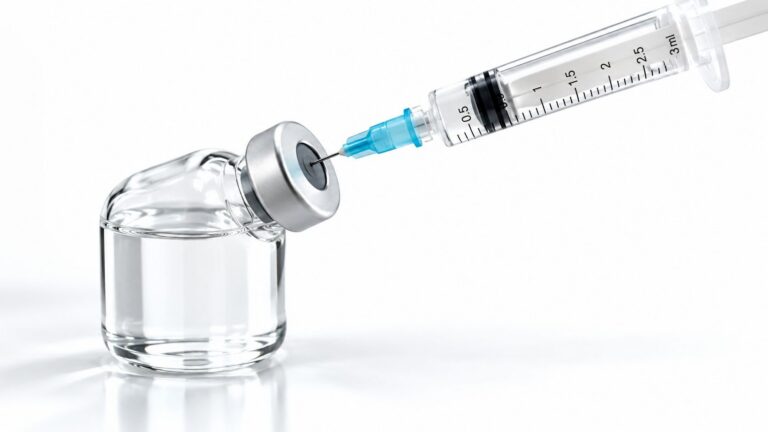
For sterile diluents, shipping is not just a checkout line. The product is sterile, non-pyrogenic water containing 0.9% benzyl alcohol (9 mg/mL) as a preservative, and once a vial is opened it may remain usable for up to 28 days when handled aseptically, according to Hospira guidance cited by supplier sources on BacteriostaticWater.com. That means a buyer is often purchasing something that gets consumed on a rolling basis, not a one-time accessory. In that context, shipping policy affects replenishment timing, budget control, and the confidence that the vial will still be handled correctly when it reaches the lab.
Table of Contents
- Why Free Shipping Matters for Bacteriostatic Water
- What Bacteriostatic Water Actually Is
- How Free Shipping Thresholds Usually Work
- Regional Coverage Across the EU, UK, and USA
- Temperature Control and Same-Day Dispatch
- Reaching the Threshold Without Overbuying
- Pre-Order Checklist Before You Check Out
Why Free Shipping Matters for Bacteriostatic Water
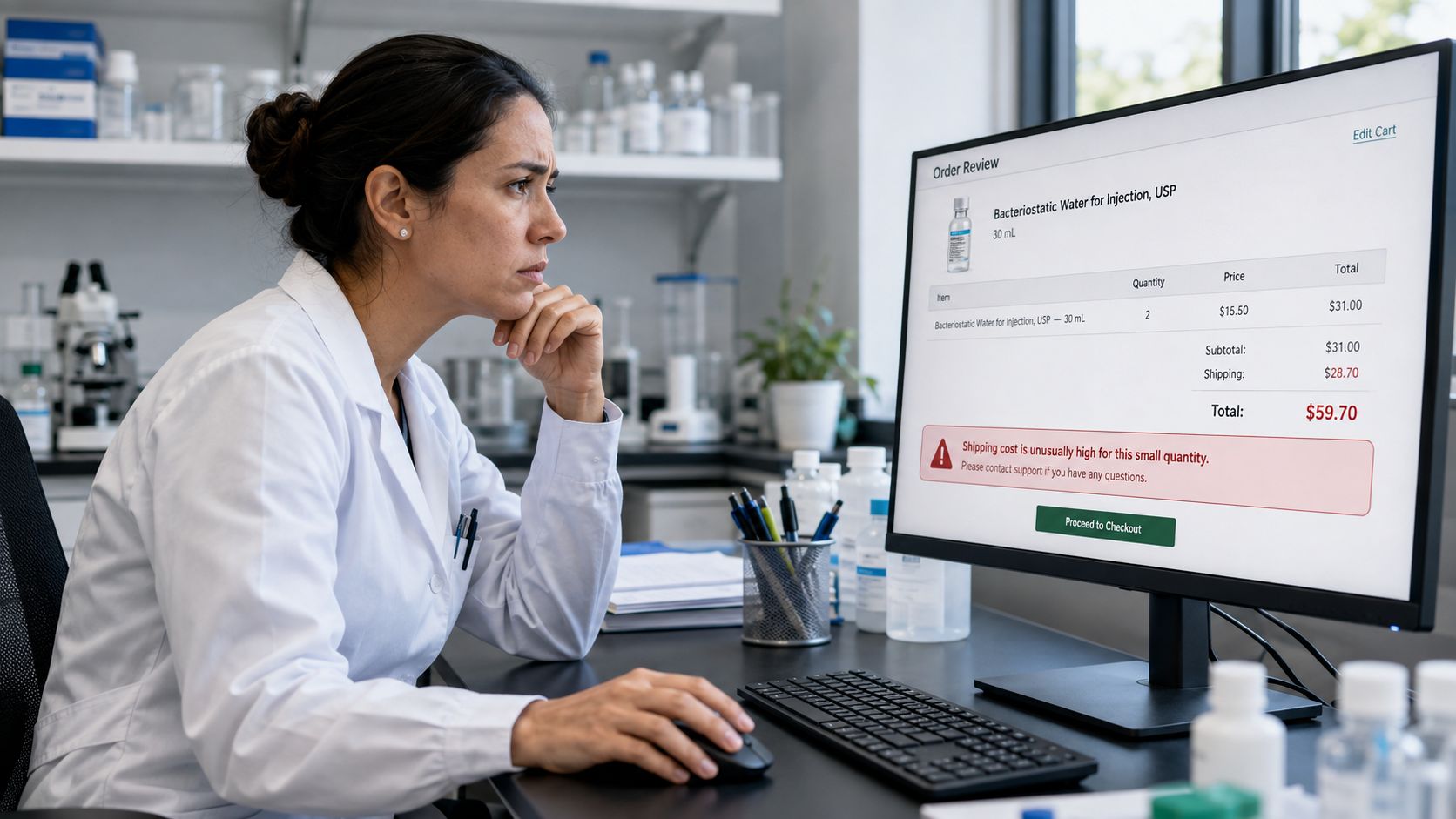
A lab manager restocking sterile diluent can be surprised by how quickly the shipping line outweighs the item itself. That happens often with consumables. The product is needed on a recurring basis, but the delivery charge arrives every time unless the supplier offers a clear threshold or free shipping that the team can plan around.
Shipping is part of the real product cost
Free shipping can look like a small perk on labware, but for sterile diluents it often belongs in the procurement calculation. A buyer who reorders vials on a regular cycle may pay the same delivery charge again and again, even when each order is modest and the item is routine. That turns shipping into a cumulative budget issue, not a one-time inconvenience.
A single order can illustrate the point. One small vial may seem inexpensive until the carrier charge pushes the total well above the planned spend, while a slightly larger cart may cross the free-shipping line and lower the effective cost per vial. In practice, that difference shapes whether a lab buys in a way that fits its schedule or keeps paying extra for each restock.
Sterile items also behave differently from non-critical lab accessories. A box of disposable labware can arrive late without affecting the bench in the same way, but a diluent supports immediate prep work and reagent handling. A supplier's shipping policy gives the buyer a clue about whether the operation is set up for repeat sterile fulfillment or only for casual retail orders.
Practical rule: if a supplier treats shipping as an afterthought, sterile fulfillment can be an afterthought too.
For procurement buyers, that matters more than the headline price. A lower product price can disappear once repeat shipping charges are added across several restocks. That is why many teams compare shipping policy with the same attention they give packaging, documentation, or lot traceability.
Readers who want a clearer picture of buyer behavior can also review how shipping fees affect checkout. The point is straightforward, shipping friction changes purchasing decisions fast, and that matters when the item is something a lab needs on schedule.
Free shipping also signals fulfillment discipline
A clear shipping policy usually tells the buyer something about the supplier's warehouse logic. If a company can offer a threshold, track dispatch, and define what counts as eligible, it is likely managing sterile inventory with more structure than a generic marketplace seller. That does not guarantee perfection, but it does suggest the buyer is dealing with a business that has thought through the handoff from shelf to carrier.
For lab procurement, that handoff matters because the order does not just need to be low cost. It needs to be usable, traceable, and delivered in a condition that fits sterile handling expectations. Reliable delivery practices are part of the same decision, because a usable vial that arrives late or in poor condition still disrupts the bench.
What Bacteriostatic Water Actually Is
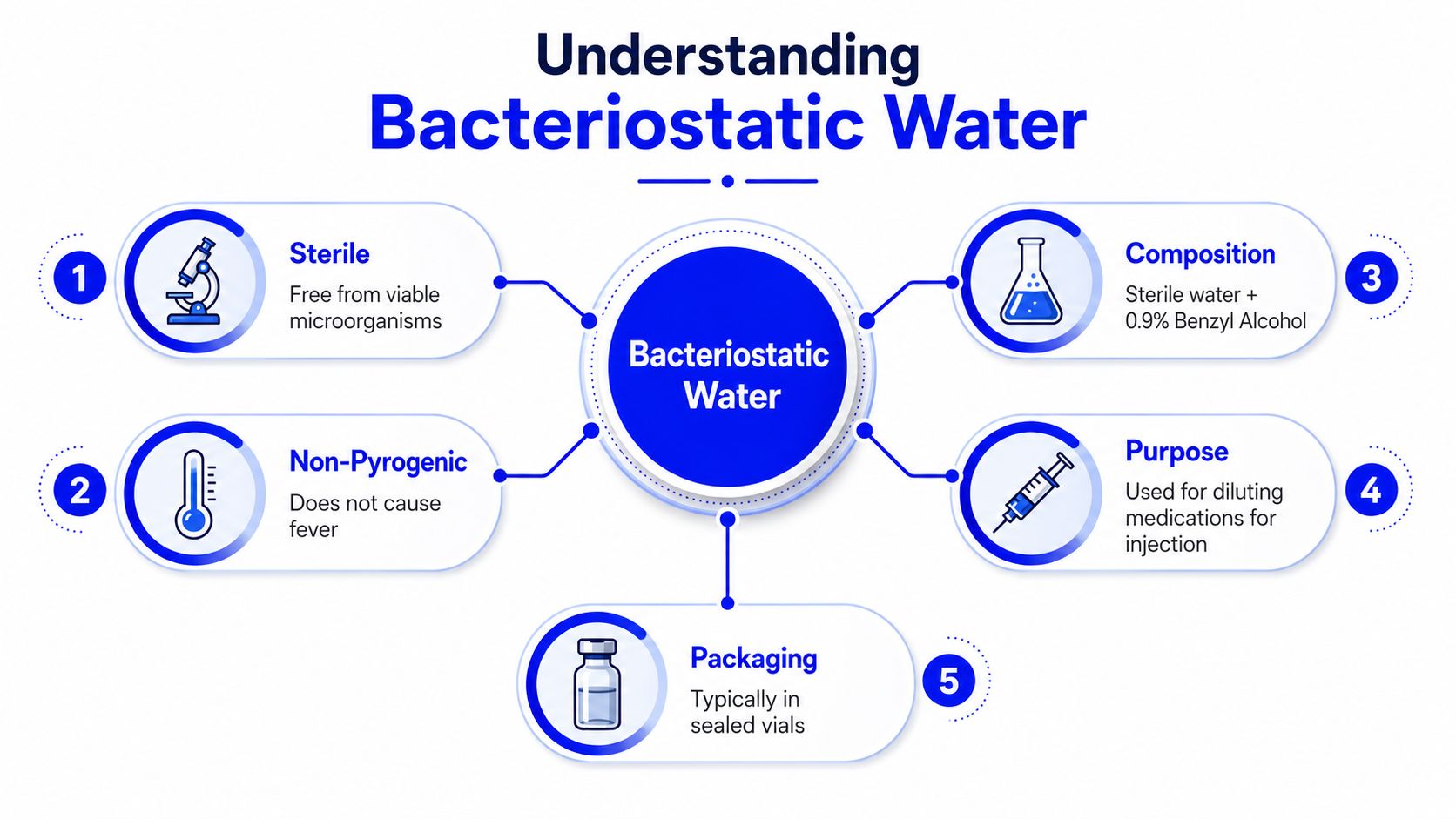
A buyer can read a shipping policy only after knowing what is being shipped. Bacteriostatic water is sterile, non-pyrogenic water containing 0.9% benzyl alcohol (9 mg/mL) as a preservative, and that preservative allows repeated withdrawals from a multi-dose vial for up to 28 days when handled aseptically, according to BacteriostaticWater.com. That preservative is the key difference from plain sterile water.
The formulation drives the buying pattern
Shipping becomes part of the buying decision because buyers do not treat the vial as a one-time item. A researcher may open one vial, use part of it, then return to it over a short operating window. That pattern creates replenishment orders, which means delivery charges keep appearing in the total cost of ownership.
Typical retail and lab-facing offerings are often sold in 3 mL, 10 mL, 20 mL, and 30 mL vial formats, with multi-pack kits such as 10×3 mL and 10×10 mL available from some suppliers. Those formats matter because a free-shipping threshold may be easy to reach with a multi-pack, but not with a single small vial. The cart value can change the shipping outcome before the buyer has finished comparing brands.
Why the 28-day window changes reorder habits
Once a vial is in use, buyers often plan the next order before the current vial is fully gone. That makes shipping policy more relevant than it would be for a shelf-stable accessory that is reordered less often. The practical question is whether the supplier makes it easy to replenish without paying a separate delivery fee every time.
That is why order cadence matters as much as package price. A small vial that gets replaced often can create more shipping events than a larger pack covering the same work period. In practice, the cheapest checkout is not always the cheapest supply plan.
Readers who want a buyer-side view of how product details are discussed in the field can also use how to become a pharma sales rep as a reference point for how product features, documentation, and customer questions are often handled. The packaging, not just the content, is part of what the buyer is evaluating.
How Free Shipping Thresholds Usually Work
Most lab-supply shipping policies use a straightforward formula. The buyer gets free shipping only after the cart reaches a minimum order value, only in certain regions, and sometimes only with a specific carrier or service level. That structure is common because sterile items need more than a plain envelope, they need protected packaging, predictable handling, and tracked movement.
The threshold is usually about the subtotal
When a supplier says an order qualifies for free shipping, the number usually means the subtotal before tax and often before any discount code is applied. Buyers should read that line carefully, because a discounted total may fall below the threshold even if the original cart looked high enough. If split shipments are involved, shipping from a previous partial dispatch usually doesn't count toward the next order unless the policy says it does.
Herbilabs publishes a clear example of this model with free EU shipping from €75 on its site, which makes the logic easy to understand. The point isn't that every supplier uses the same number, it's that a threshold only works when the buyer can see exactly what qualifies and what doesn't.
Typical policy pieces the buyer should look for
- Minimum order value: the cart has to reach a defined subtotal before shipping is waived.
- Geographic restriction: the offer may apply only to the EU, or only to domestic shipping in the UK or USA.
- Carrier or weight limit: free delivery may apply only to standard ground service, or only below a certain parcel weight.
A policy written this way is usually there because sterile diluents are not cheap to move safely. Packaging can be padded, tracked, and sometimes temperature-aware, which raises the actual shipping cost behind the scenes. That's why a threshold isn't a gimmick, it's a cost-recovery rule.
For buyers comparing delivery speed against shipping savings, balancing shipping cost and delivery time is a useful lens. A lower-cost method can be acceptable for some orders, but sterile products often justify a more controlled service if the policy and timing are clear.
A good threshold is one the lab can plan around, not one the buyer only discovers after checkout.
Regional Coverage Across the EU, UK, and USA
Regional policy is where free shipping gets practical. A buyer in Berlin, a buyer in London, and a buyer in Boston may all see the same product page, but their shipping experience can differ because the warehouse, customs path, and delivery network are not the same. That's why the country selector at checkout matters as much as the product price.
EU orders often move through one distribution path
For the EU, shipping is often handled through a single distribution entity, and that can make threshold-based free shipping relatively simple. When the buyer's cart crosses the required value, the order is eligible under the stated regional terms, and the parcel moves from the regional warehouse to the delivery network without extra cross-border complexity. In a setup like Herbilabs' EU distribution model, the key variable is whether the cart qualifies under the published rule and whether the shipping address is inside the covered region.
UK and USA orders need different checks
The UK can be more nuanced after Brexit because the order may ship domestically or from a separate warehouse path depending on where inventory sits. A buyer should always confirm the warehouse origin before relying on a free-shipping promise, because domestic handling and cross-border handling are not the same thing. The USA is often simpler, with a flat threshold tied to a tracked ground or expedited service, but the buyer still needs to verify whether the service level is the one included in the offer.
| Region | What the buyer should verify | What can differ in practice |
|---|---|---|
| EU | Threshold, covered countries, warehouse origin | Delivery route and regional eligibility |
| UK | Domestic or EU dispatch, address matching | Customs path and shipping service |
| USA | Threshold and carrier class | Ground versus expedited fulfillment |
A Berlin researcher and a Boston researcher may both hit a free-shipping minimum, but one may get the item through a regional EU warehouse while the other receives it through a domestic U.S. carrier network. The checkout screen has to match the destination country, or the order can be priced and routed incorrectly.
Temperature Control and Same-Day Dispatch
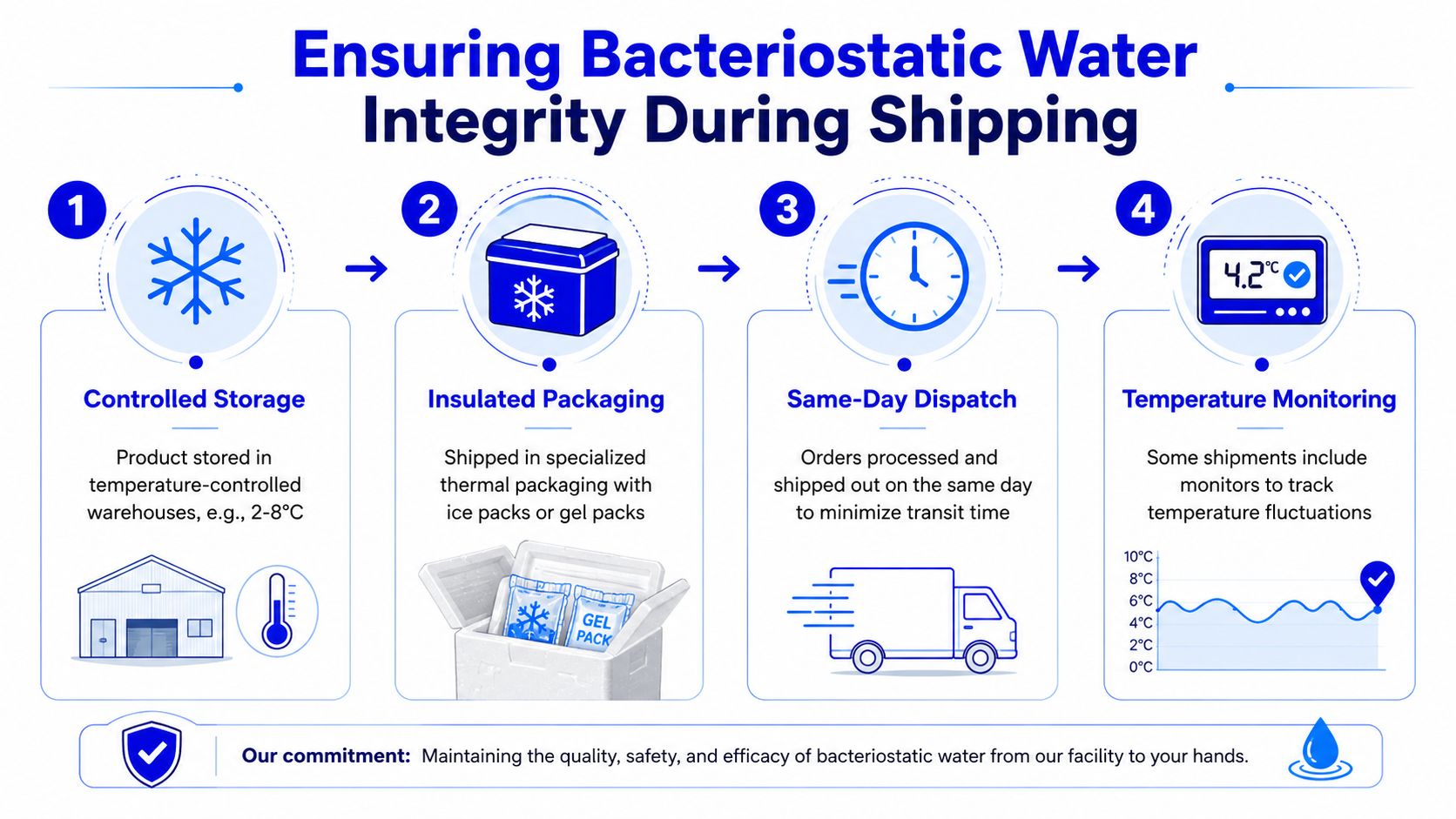
Shipping cost only matters if the vial arrives in a condition that still fits sterile use. Bacteriostatic water is commonly stored in temperature-controlled environments, and reputable suppliers ship it in insulated packaging to protect the product in transit, even though it is not always treated like a strict cold-chain item. That distinction matters because the goal is product integrity, not just fast delivery.
Same-day dispatch is about warehouse timing
“Same-day dispatch” usually means the order is picked and handed to the carrier on the same business day, assuming it lands before the cutoff time. That can be a major difference for sterile supplies, because an order that leaves on Friday and sits in a depot over the weekend is still free shipping, but not necessarily good logistics. The buyer should read dispatch language as a quality cue, not just a convenience feature.
What the shipping journey should protect
Herbilabs' storage and handling model includes temperature-controlled warehousing, and its stability guidance fits the same logic, because shelf-life and shipment handling are linked. Once a vial leaves controlled storage, the packing method and dispatch timing become the buyer's main protection against unnecessary transit exposure.
Useful check: free shipping is only useful if the order doesn't spend extra time sitting in the wrong place.
A supplier that publishes clear dispatch windows, packaging notes, and delivery estimates is giving the buyer more than a convenience estimate. It's showing that the warehouse process has been set up to move a sterile item quickly enough to stay practical for the lab. For buyers, that is every bit as important as the final shipping price.
Reaching the Threshold Without Overbuying
Hitting a free-shipping minimum doesn't have to mean buying more than the lab can use. The better approach is to combine vial sizes, coordinate with a colleague, or move a routine replenishment order forward a little so the cart crosses the line naturally. That keeps the budget aligned with actual usage instead of forcing stockpiling just to avoid delivery charges.
A simple threshold example
If the free-shipping rule is €75, a buyer can often reach it by combining a small vial pack with a larger pack or by adding a separate consumable that the lab would have ordered soon anyway. The same logic applies in dollars if a supplier sets a U.S. threshold in a similar structure. The point is to plan the cart around real demand, not around a shipping workaround.
| Region | Example Order | Typical Threshold | Result |
|---|---|---|---|
| EU | One 10 mL vial plus a 10×3 mL pack | €75 | Qualifies if subtotal clears the rule |
| USA | Two small vial packs in one cart | Supplier-defined U.S. minimum | Qualifies if subtotal clears the rule |
| UK | One replenishment order placed with a colleague's cart | Supplier-defined UK minimum | Qualifies if same shipment address is used |
Compare shipping fees against the order's real use
A smaller order that misses free shipping can still make sense if the lab needs the vial immediately. A larger order that clears the threshold is better if the extra product will be used within the normal replenishment cycle. The wrong move is buying far beyond expected use just to chase a shipping benefit.
For teams looking at supplier options, documentation can matter as much as the parcel fee. Herbilabs' vial range gives buyers a practical example of how format choice can help align the cart with actual demand. A small order from a supplier with weak quality paperwork can end up more expensive overall than a slightly larger order from a facility with stronger release controls, because the hidden cost shows up later in the workflow.
A pre-check list before placing the order
- Subtotal first: confirm the cart total that counts toward free shipping.
- Address second: make sure the country selector matches the delivery address.
- Service level third: check whether standard or tracked delivery is included.
- Documentation fourth: verify that lot-specific records are available if the lab needs them.
- Usage fifth: compare the quantity to real consumption so the order doesn't become excess inventory.
Pre-Order Checklist Before You Check Out
A good restock order doesn't take long to verify, but it should always be checked the same way. The buyer should confirm the country selector matches the shipping address, check the subtotal rather than the discounted total, and review the estimated dispatch date before placing the order. Those three items catch most avoidable checkout mistakes.
The next two checks are just as important. Look for temperature-aware packaging notes, and verify that a lot-specific Certificate of Analysis is available for the lot if the lab's records require it. That habit keeps the purchase aligned with sterile workflow, documentation needs, and the actual delivery path.
A repeatable checklist beats a rushed checkout every time.
For teams that order regularly, this shouldn't be a special review. It should be the same minute-long routine every time the cart contains bacteriostatic water or any other sterile diluent. That's how free shipping becomes a procurement tool instead of a surprise at checkout.
Herbilabs supplies bacteriostatic water and related labware for research use with controlled production, documented quality review, and regional fulfillment across the EU, UK, and USA. For buyers who want a straightforward way to compare vial formats, shipping rules, and documentation in one place, visit Herbilabs and review the current ordering options before the next restock.