Private Label, White Label, Wholesale partnerships available - EU, USA and UK - Free shipping from €75

Climate Controlled Shipping Container Guide
A refrigerated truck sits at a loading dock while pallets of clinical-trial materials, vaccines, or fresh produce wait for inspection. The shipping label specifies 2°C to 8°C, yet the reefer door has already opened twice, the gasket looks worn, and the last data logger shows a temperature spike that nobody has explained. The container may have met its nameplate specification, but the shipment still faces a real risk.
That gap between equipment specifications and dock-floor performance is the central issue in cold-chain logistics. A climate controlled shipping container isn't just a refrigerated box. It's a system that must be selected for the cargo, qualified for the route, monitored during use, and supported by records that explain every excursion. The principles also matter in broader operations that are transforming lab supply chains, where reliable movement depends on evidence rather than assumptions.
Table of Contents
- The Loading Dock Problem This Guide Solves
- What a Climate Controlled Shipping Container Actually Is
- Temperature Humidity and Insulation Specs That Matter
- Where Climate Controlled Containers Earn Their Keep
- Choosing the Right Unit Without Overpaying
- Monitoring Validation and Regulatory Records
- Pitfalls That Quietly Undo Good Hardware
- A Monday Morning Pre-Shipment Checklist
The Loading Dock Problem This Guide Solves
Cold-chain failures rarely come from one dramatic event. More often, a shipment accumulates small weaknesses: a unit starts warm, pallets block the return-air path, a door remains open during paperwork, or a sensor sits in a location that doesn't represent the payload. Each issue can leave a misleadingly reassuring display on the reefer controller while conditions inside the load vary.
A new logistics coordinator should separate three questions:
- Can the equipment create the required condition? This is the specification question.
- Can the packed load hold that condition across the planned lane? This is the qualification question.
- Can the team prove what happened? This is the monitoring and documentation question.
The distinction matters for pharmaceutical materials, research reagents, biologics, food, and any product whose value depends on controlled storage. WHO guidance calls for monitoring temperature and humidity exposure, documented calibration, and defined handling of deviations, rather than relying only on a set point shown on a controller WHO storage and transport guidance.
Why the dock changes the answer
A container that performs well in an empty test can behave differently after loading. Dense cartons absorb and release heat slowly, while air near doors and ceilings can react quickly to outside conditions. Door openings, inspections, power changes, and transshipment dwell periods create the conditions that a brochure often leaves out.
The practical approach is to begin with the cargo profile, route, dwell time, power availability, and acceptable excursion response. The equipment choice follows those facts. This guide therefore treats climate-controlled shipping as a measurement-and-qualification discipline first, and an equipment purchase second.
What a Climate Controlled Shipping Container Actually Is
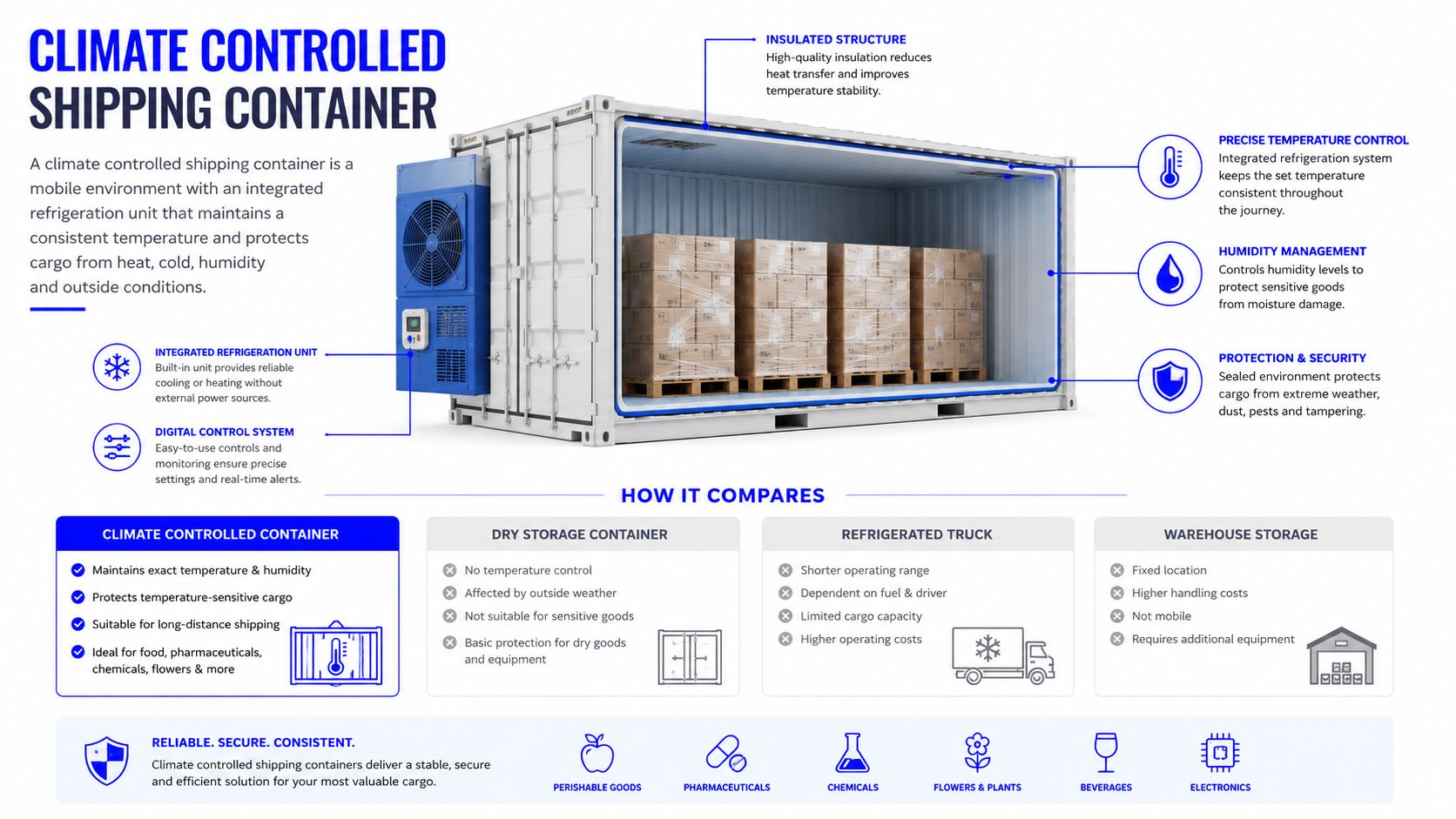
A research shipment waits on a hot loading dock while the receiving laboratory expects a stable condition. A standard intermodal container cannot actively manage that risk. Its steel enclosure and floor shield cargo from rain, wind, and handling damage, but the interior follows the surrounding temperature. A climate controlled shipping container adds insulation to slow heat transfer and equipment that actively conditions the air, or materials that passively buffer temperature around the payload.
An active unit combines refrigeration, heating, and forced-air circulation. Some configurations also include power backup. Technical references describe polyurethane insulation around R-6 to R-7 per inch and container thermal conductivity of approximately 0.019 to 0.022 W/(m·K) technical overview of portable climate-controlled containers. Depending on its design and battery configuration, a unit may maintain approximately 2°C to 8°C for up to 120 hours, or provide broader control such as -35°C to 49°C. These figures define equipment capability under stated conditions. They do not certify a particular packed load, route, or door-opening pattern.
A passive system uses phase change materials, gel packs, dry ice, or other thermal buffers. Rather than continuously adding or removing heat with a compressor, the packaging absorbs incoming heat or releases stored thermal energy as the surroundings cool. Passive protection can suit defined short lanes where power is unreliable. Its protection window depends on conditioning, packing density, ambient exposure, and door discipline.
Temperature is not the only controlled variable
Temperature control alone may leave a shipment exposed. A complete climate-control assessment also examines air circulation, humidity, condensation, and sensor location. Cooling can lower air temperature without removing enough moisture. If a surface falls below the surrounding dew point, water can condense there. Poor sensor placement can also make the display look acceptable while another area drifts.
The same principles apply to residential storage solutions Boston. Define the required condition, then qualify the loaded container against power interruptions, door openings, and actual dwell conditions. The purchase is only one part of the control system. Measurement and evidence determine whether the container protects the shipment in practice.
Temperature Humidity and Insulation Specs That Matter
A specification sheet starts the conversation. It does not make a release decision. The stated temperature range describes what the unit may achieve under defined test conditions, not whether a loaded shipment will develop warm zones, condensation, or slow recovery after a door opening.
Insulation reduces heat flow, giving the control system more time to respond as outdoor conditions change. Forced-air circulation then distributes conditioned air through the cargo space. These features work together, yet neither corrects blocked airflow, tight pallet spacing, or a return-air path obstructed by packaging.
Read recovery performance alongside the setpoint. Ask how long the container takes to return to its approved band after a planned door opening, and whether that result was measured with a representative payload. A short recovery time on an empty unit says little about a dense pallet load. Record the door-open duration, ambient exposure, payload arrangement, and the warmest sensor location during qualification.
Read the sheet by asking what happens next
Humidity needs its own acceptance criteria. Cooling air can reach the target temperature while leaving too much moisture behind. If a wall, ceiling, or product surface falls below the surrounding dew point, condensation may form. The display can remain acceptable while cartons soften, labels deteriorate, or moisture reaches sensitive materials.
A MSP Packaging's container desiccant guide offers practical context for moisture protection. Desiccant can reduce available moisture inside suitable packaging, but it cannot replace humidity mapping, airflow review, or a qualified container design.
Airflow requires a physical check at the dock. T-bar floors, open return-air routes, and correct pallet spacing help limit stagnant pockets. Place sensors to represent the load, including likely warm and cold locations, rather than choosing the easiest mounting point.
| Spec | Active reefer | Passive / PCM | Standard dry container |
|---|---|---|---|
| Temperature control | Active cooling and heating, depending on configuration | Thermal buffering around a defined payload | No active control |
| Insulation role | Slows heat gain and supports system recovery | Extends the useful buffer period | Mainly structural protection |
| Humidity management | Depends on controls, ventilation, and configuration | Depends on packaging and moisture management | Not controlled |
| Power requirement | Usually continuous power or planned backup | No compressor power, but conditioning is required | No climate-control power |
| Main qualification concern | Hotspots, recovery, power continuity, and sensor placement | Phase conditioning, duration, ambient profile, and packing density | Cargo suitability in uncontrolled conditions |
For laboratory materials, the lab reagent storage guide for 2026 reinforces the same operating principle: connect the stated storage condition to the material's sensitivity and actual handling. The purchase is only one input. Qualification evidence should show what happens during loading, door openings, dwell time, and routine dock variation. That evidence also exposes the operating-economics gap, because a unit that needs constant intervention, backup power, or slow loading may cost more to run than its comparison table suggests.
Where Climate Controlled Containers Earn Their Keep
The right container depends on the job, not the industry label. “Pharma,” “biotech,” and “perishables” each contain different temperature, humidity, documentation, and response requirements. Treating them as one category leads buyers toward either inadequate control or unnecessary operating complexity.
| Use case | Typical temperature range | Humidity target | Tolerance for excursion | Documentation burden |
|---|---|---|---|---|
| Pharmaceutical distribution | Often a defined refrigerated band, such as 2°C to 8°C | Product and packaging dependent | Low, with formal assessment of deviations | High |
| Biotech and RUO materials | Product-specific, potentially refrigerated or frozen | Product and packaging dependent | Often low for high-value or irreplaceable material | Moderate to high |
| Perishables | Commodity and route dependent, often cold with controlled ventilation | Frequently important for quality and appearance | Variable, with quality loss accumulating over time | Operational and customer dependent |
Three jobs, three operating profiles
Pharmaceutical shipments require a defensible chain of custody. Vaccines, insulin, and clinical-trial materials need documented handoffs, calibrated monitoring, and a defined decision process when data leaves the approved range. A controller display alone won't answer whether the product experienced a localized excursion.
Biotech shipments can involve RUO reagents, cell banks, proteins, or gene-therapy intermediates with materially different requirements. Some materials need passive protection with dry ice or another specialized thermal strategy. High-value research material may have little tolerance for an unexplained event even when the shipment isn't being released as a commercial medicine. A product-specific lyophilized peptides storage protocol helps establish the storage logic before the logistics team chooses the container.
Perishable cargo includes produce, seafood, dairy, and flowers. The goal may include moisture retention, ventilation, ripening control, and appearance, not just a single temperature band. Frequent loading and unloading can make the actual mean condition differ from the displayed set point.
Shipping records also need operational clarity. A practical guide for logistics leaders can help teams organize bill-of-lading information and handoff responsibilities. Before comparing sizes or rates, the coordinator should identify which of these three jobs the shipment most resembles.
Choosing the Right Unit Without Overpaying
Selection should begin with qualification questions, not a catalog search. A large container can create unnecessary power, space, and repositioning requirements, while a smaller unit can fail if pallets restrict airflow or loading takes too long.
Start with the internal usable volume and the actual pallet pattern. Confirm the number of pallets, carton height, clearance above the load, access for inspection, and the door opening needed for the handling equipment. Standard pallet footprints, such as 40 by 48 inches, should be checked against the container's internal dimensions and door clearance rather than assumed from the external length.
Match the power plan to the lane
A shipyard connection may use three-phase 460V power, while a genset or local facility may provide single-phase 230V operation. Those values come from the planned electrical setup and must be verified with the carrier or equipment provider. A unit that fits physically can still fail operationally if the available plug, voltage, phase, or backup arrangement doesn't match.
The cost comparison should include more than the rental or purchase quote. Reefer boxes can rent for two to three times the price of dry units, and ocean reefer freight may carry a 50% to 100% premium over standard freight, according to market coverage from GoFreight's temperature-controlled freight analysis. Pre-trip inspections, monitoring, higher insurance, power consumption, and possible deadhead repositioning can also affect the landed cost.
Practical rule: A lower equipment price isn't a lower shipment cost if the unit lacks the right power connection, monitoring evidence, or route qualification.
A simple decision path
- Choose active control for multi-day lanes, continuous power, and shipments where documented temperature control is central to release.
- Choose passive protection for a defined short-duration lane where the payload, ambient profile, and phase change materials have been qualified together.
- Choose a standard reefer only when its known operating behavior matches the cargo's validated tolerance and documentation requirements.
The purchase decision should follow a qualification package that includes mapping, monitoring, power verification, and a written response to excursions.
Monitoring Validation and Regulatory Records
Monitoring turns a container from a promising machine into a defensible shipping system. RUO operations may not face every pharmaceutical requirement, but the same discipline supports release decisions and exposes the gap between a controller display and actual payload conditions. Humidity deserves equal attention. A shipment can remain within its temperature range while condensation or moisture-sensitive materials create a separate risk.
Place sensors where the load can fail
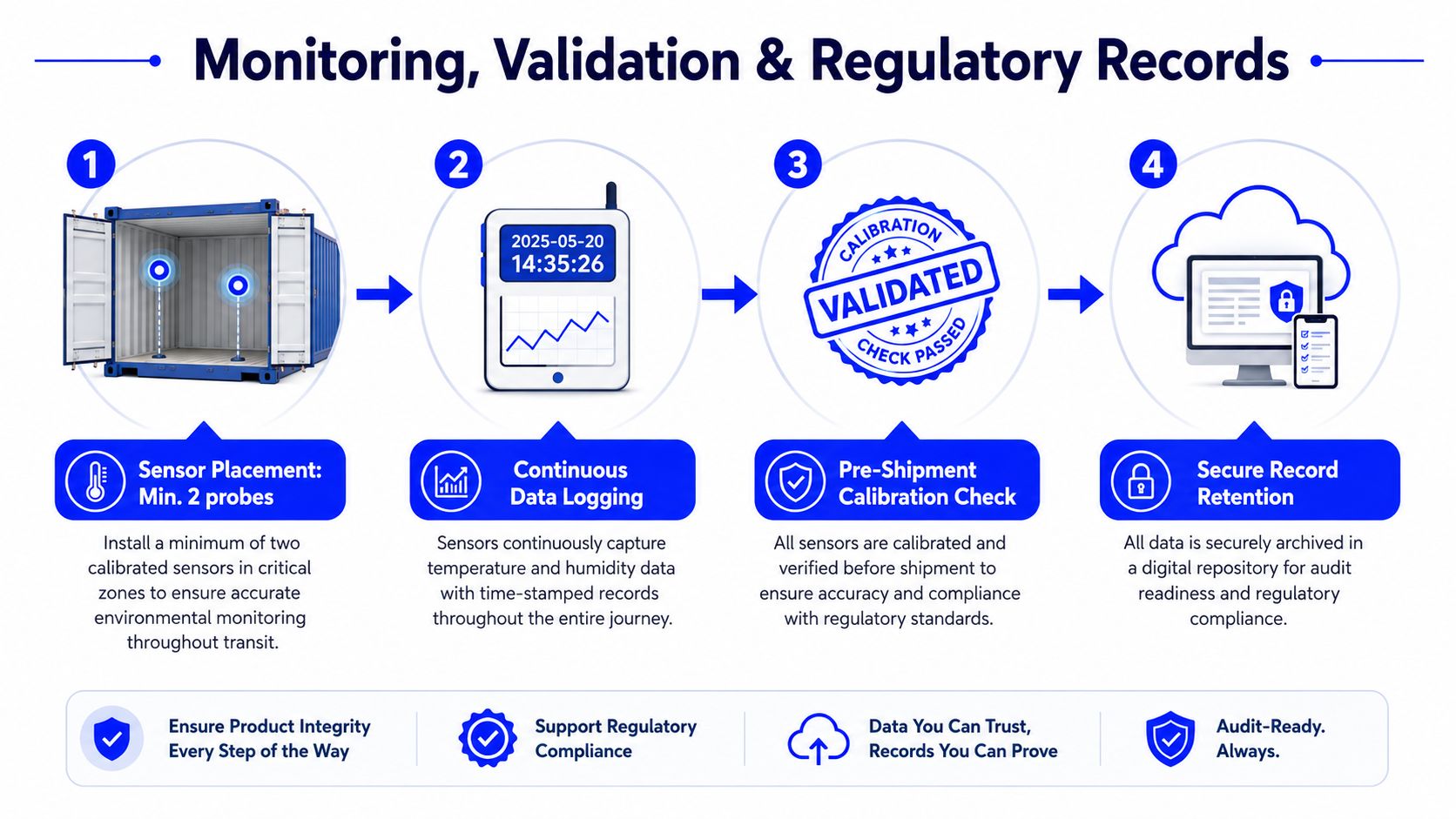
At minimum, the shipment plan should define two probe locations:
- Load probe: positioned within the thermal mass of the payload, where it reflects product conditions rather than free air.
- Return-air probe: positioned in the conditioned-air path to show what the unit is receiving and recirculating.
Neither probe should sit casually beside the door. Record each location on a packing diagram, identify the instrument, confirm calibration status, and start the logger before departure. A door opening can create a short air-temperature spike that says little about the payload, or a longer excursion that reaches the product. The sensor position determines which event the record can support.
Map the load, not just the empty box
A mapping study should include empty and loaded conditions when both are relevant. Place sensors at likely hot, cold, upper, middle, lower, front, and door-adjacent locations. A summer profile does not establish winter performance, because external temperature, solar load, heating demand, and condensation behavior can change.
When a logger produces an excursion, preserve the original file and define the affected time window. Compare it with door, power, and handoff records, then determine whether the sensor represented the payload. A useful deviation record reads like a small incident file: shipment identifier, sensor location, start and end times, recorded conditions, suspected cause, affected material, reviewer, disposition decision, and corrective and preventive action.
The disposition should connect evidence to the decision. A brief door opening may require no product action if the load probe stayed within limits. A power interruption during a warm handoff may require quarantine and further assessment.
A defensible record explains the event. It doesn't merely show a green or red graph.
Records should include the mapping report, calibration certificates, packing configuration, handoff temperatures, logger files, deviation assessment, and CAPA documentation. Secure retention helps an audit or internal investigation because the team can reconstruct the shipment rather than rely on memory. The equipment purchase is only the starting point. Qualification and readable evidence determine whether the container performed as intended.
Pitfalls That Quietly Undo Good Hardware
The hardware is often easier to specify than the operating behavior. A strong climate controlled shipping container can still produce weak evidence when condensation, calibration, packaging, or door handling receives little attention.
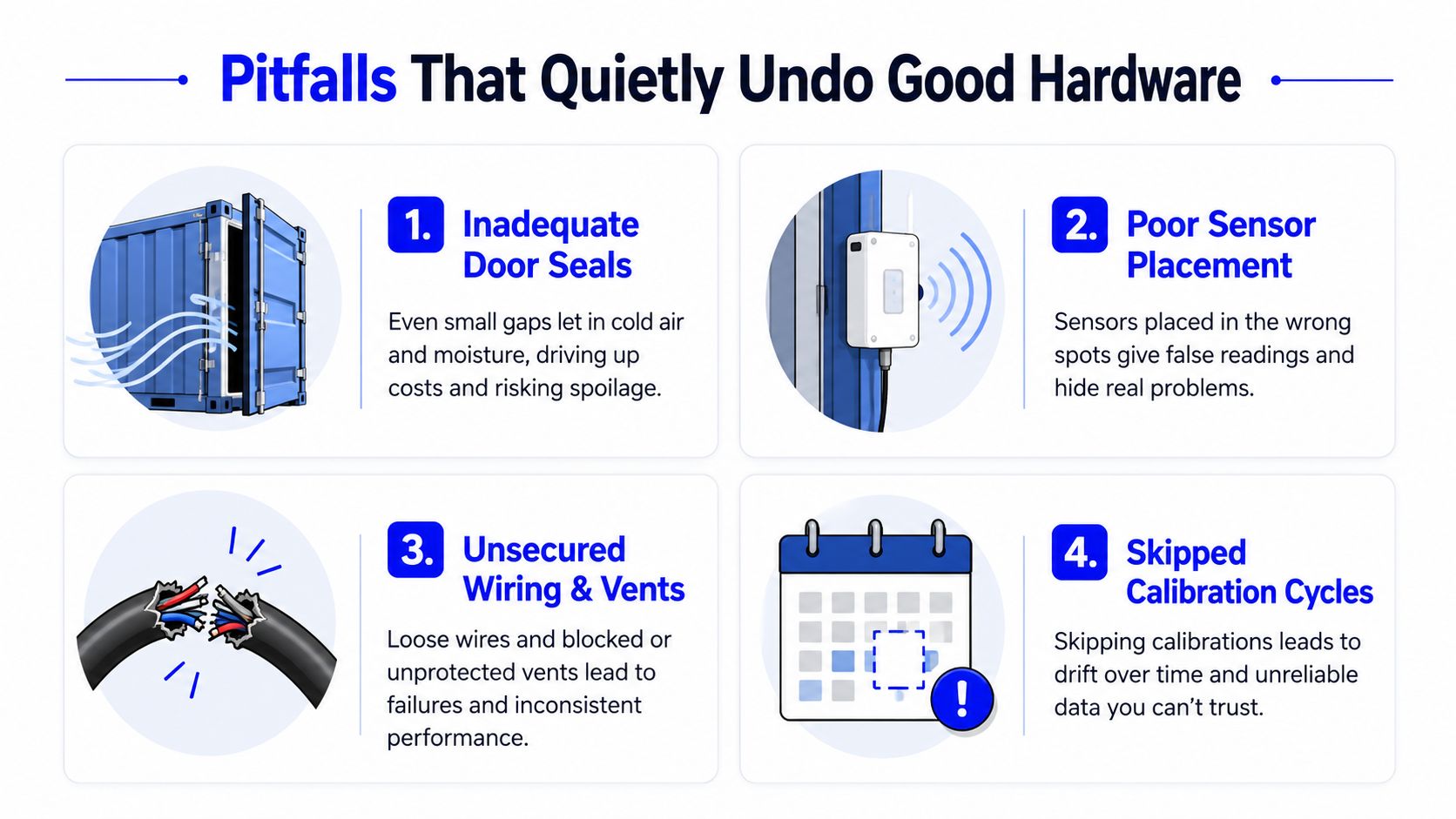
Four quiet failure modes
Condensation appears when cold surfaces meet humid air and the surface temperature falls below the surrounding dew point. Ceiling panels, carton surfaces, and product packaging can become wet even when the temperature display remains within range. Humidity monitoring, controlled loading, ventilation, and an appropriate packaging design help identify and reduce this risk.
Set-point drift develops when a controller or sensor loses calibration, a component ages, or the system operates under a different load than the original test. The displayed value may slowly diverge from the condition at the payload. A calibration check and review of actual logger data should therefore sit alongside the controller reading.
Incorrect PCM conditioning undermines passive shipments before they depart. Phase change materials must be conditioned according to the validated procedure and then packed in the approved arrangement. If the panels begin at the wrong state, the container may lose its protective buffer well before the planned handoff.
Poor door discipline exposes the system to rapid changes in air temperature. The size of the excursion depends on outside conditions, door duration, load arrangement, and recovery performance. Repeated openings can also disturb the temperature gradient that the mapping study established.
Packaging remains part of the system
Insulated blankets, dunnage, gel packs, dry ice, cartons, and pallets all change airflow and thermal behavior. A qualified container can't rescue cargo that was loaded warm, packed against the return-air path, or surrounded by unvalidated materials.
The dock team should treat every packaging change as a potential change to the qualified configuration. A new carton size, altered pallet pattern, different PCM supplier, or longer inspection stop may require review before routine use.
A Monday Morning Pre-Shipment Checklist
A reliable pre-shipment check should be short enough to use and detailed enough to catch preventable failures. The following workflow gives a laboratory logistics coordinator a practical starting point for the first shipment of the week.
Container qualification
- Mapping status: Confirm the latest approved mapping study covers the planned load arrangement and relevant seasonal conditions.
- Controller calibration: Verify current calibration for the controller and monitoring instruments.
- Physical condition: Inspect cleanliness, insulation surfaces, T-bar floors, door gaskets, vents, cables, and return-air paths.
- Power readiness: Match the unit's voltage, phase, plug, generator, and backup plan to the route.
Cargo preparation
- Pre-conditioning: Confirm that the cargo, packaging, and container have reached the approved starting condition.
- PCM status: Check that every PCM panel or gel pack follows the qualified conditioning procedure.
- Load pattern: Keep airflow paths open, stabilize pallets, protect cartons from contact with cold surfaces, and record the final arrangement.
- Door plan: Assign responsibility for loading, inspection, sealing, and any required opening so the team doesn't improvise at the dock.
Documentation
- Calibration records: Attach or reference certificates for every logger and probe.
- Procedure control: Confirm the current SOP version and the approved packing instruction.
- Handoff record: Capture the starting temperature, seal information, carrier handoff, and container identification.
- Excursion response: Provide the contact responsible for reviewing data and opening a deviation if limits are exceeded.
In-transit controls
- Sensor map: Record exactly where each probe sits and which instrument ID applies.
- Data access: Confirm that live or downloaded data will be available to the responsible reviewer.
- Contingency contact: List the carrier, site, quality, and receiving contacts before departure.
- Return logistics: Plan equipment recovery, logger retrieval, and record archiving before the unit leaves the origin.
The final check should verify the complete measurement chain, from the payload and packaging to the data record and release decision.
The checklist should be repeated after any deviation, packaging change, route change, or equipment repair. Climate-controlled shipping works when people manage the conditions deliberately, measure the payload accurately, and preserve the evidence needed to explain the result.
Herbilabs supports RUO workflows with sterile reconstitution solutions, lot-specific Certificates of Analysis, temperature-controlled storage, and fulfillment for laboratories and research organizations. Visit Herbilabs to review the available labware and supply options, then align the product, packaging, monitoring, and receiving procedures before the next temperature-sensitive shipment.