Private Label, White Label, Wholesale partnerships available - EU, USA and UK - Free shipping from €75

Sterile Water or Bacteriostatic Water for Peptides
Most advice on sterile water or bacteriostatic water for peptides starts with a shortcut, then stops thinking. The usual rule, bacteriostatic water for repeat draws and sterile water for one-time use, is useful, but it's not enough for real lab work because the right choice depends on assay compatibility, exposure window, and downstream biology. In practice, the wrong diluent can be just as problematic as the wrong concentration, especially when a protocol is preservative-sensitive or when aseptic handling is inconsistent.
| Decision point | Sterile water | Bacteriostatic water |
|---|---|---|
| Additives | Zero additives | 0.9% benzyl alcohol |
| Use pattern | Single-use or immediate discard after opening | Multi-dose access after first puncture |
| Best fit | Preservative-free workflows, one-session use, sensitive assays | Repeated withdrawals, multi-session planning |
| Operational risk | Shorter in-use window | 28-day benchmark only holds with disciplined handling |
The practical question is not “which water is better?” It's “which water matches this protocol without creating avoidable variables?”
Table of Contents
- Why the Default Choice Is Not Always Right
- Chemical Composition and Functional Differences
- Side-by-Side Evaluation of Stability and Risk
- Matching Water Type to Your Research Workflow
- The Hidden Risks Behind the 28-Day Benchmark
- Aseptic Technique and Storage Protocols
- Quality Documentation and Supply Chain Reliability
- Making Your Final Decision
Why the Default Choice Is Not Always Right
A lot of peptide guidance treats bacteriostatic water as the automatic answer because it supports repeated access from the same vial. That default makes sense for many workflows, but it breaks down fast when the downstream biology cares about preservatives, or when the protocol itself asks for a preservative-free diluent. In those cases, sterile water is not a compromise, it's the correct input.
Protocol compatibility beats habit
The most defensible choice is the one that fits the assay, not the one that's most common in community discussions. Neutral peptide guidance notes that sterile water is appropriate for single-session reconstitution, for manufacturer-mandated preservative-free workflows, and for preservative-sensitive or in-vitro/cell-culture contexts where benzyl alcohol may interfere, while bacteriostatic water is better suited to repeated withdrawals in a multi-dose vial. That distinction matters because the same base water can look similar on paper, yet behave differently once the vial is punctured and the sample enters an actual workflow. DL Peptides' reconstitution guidance is useful here because it frames the choice around compatibility, not convenience.
The bigger error is using a convenience rule to justify a protocol decision that should have been biology-driven. If a lab is documenting reagent selection for a sensitive assay, “bacteriostatic water is what people usually use” is not a sufficient rationale.
Practical rule: if the protocol has a preservative constraint, that constraint outranks the usual multi-dose preference.
Exposure window and biology belong in the same decision
The right diluent also depends on how long the reconstituted material will be in circulation within the lab. A one-time use workflow, a fresh-prep assay, or a manufacturer instruction that calls for a preservative-free vehicle all point toward sterile water. A workflow with repeated access and a longer in-use window points toward bacteriostatic water.
That sounds simple until the project crosses into cell work, assay development, or documentation-heavy R&D. Then the decision needs to be recorded in terms of why the diluent was selected, not just which one was available. For independent researchers and lab managers, that documentation is often the difference between a clean internal review and a preventable ambiguity later.
Chemical Composition and Functional Differences
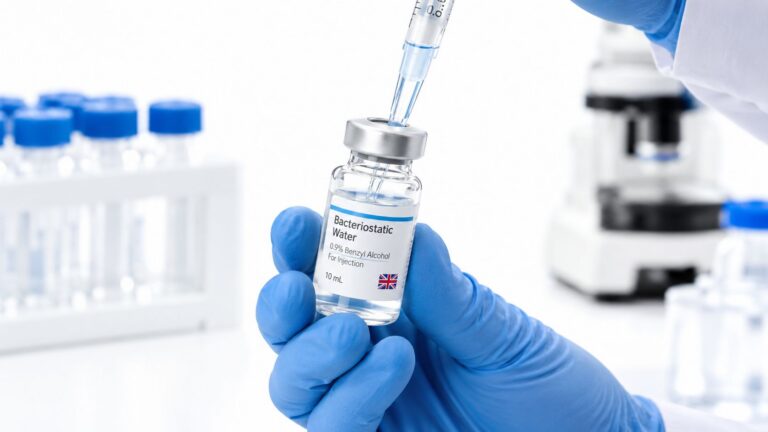
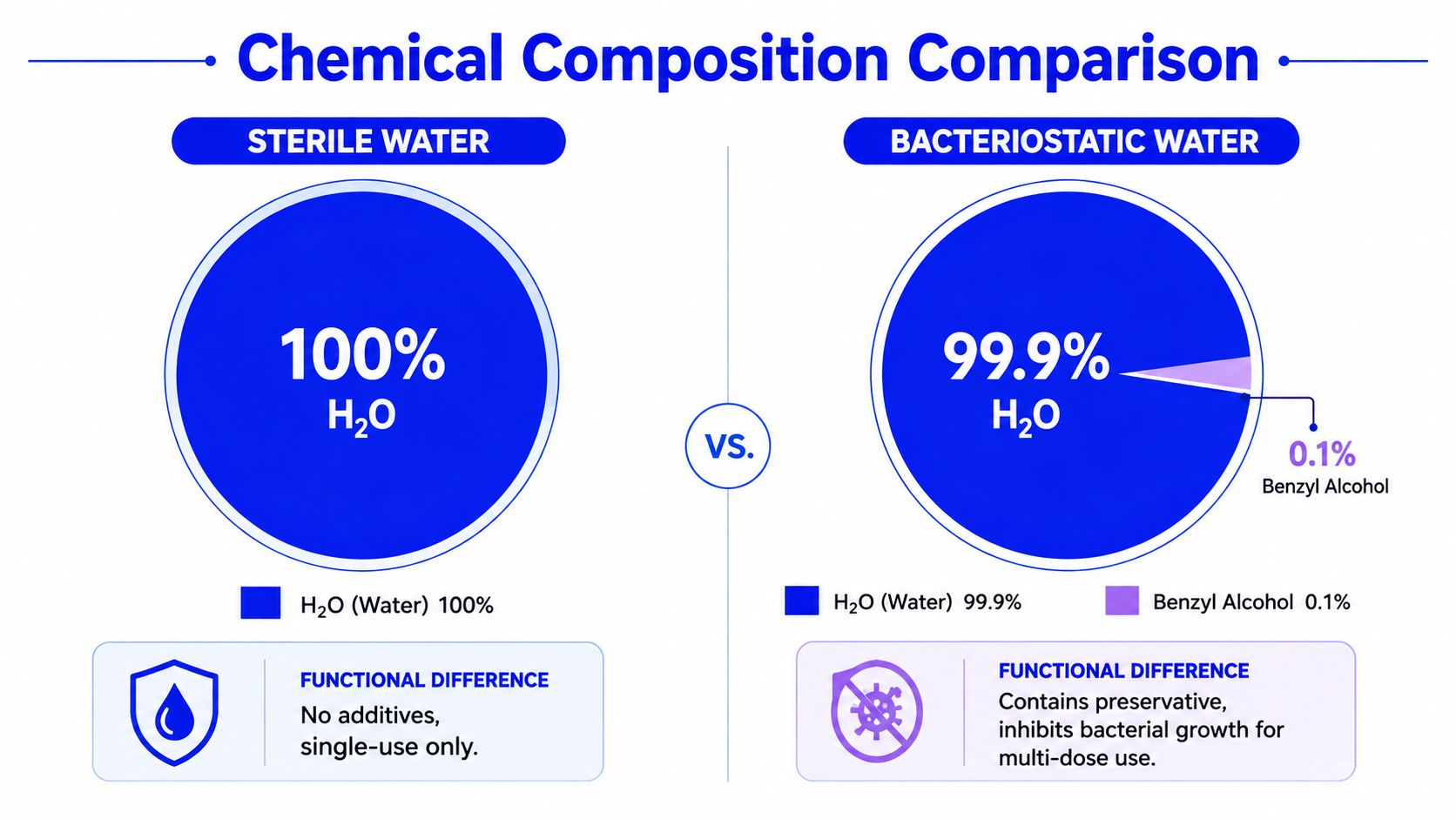
The core distinction is chemical, but the operational consequences show up in day-to-day handling. Bacteriostatic water is sterile, non-pyrogenic water with 0.9% benzyl alcohol, 9 mg/mL, and that preservative is what makes repeated access possible after the vial is punctured. Sterile water contains no preservative, so once it's opened it's generally treated as a single-use diluent.
Same base water, different workflow behavior
That difference sounds small until a vial enters a real lab routine. The presence of benzyl alcohol suppresses bacterial growth after puncture, which is why bacteriostatic water is treated as a multi-dose diluent. Without a preservative, sterile water has no built-in protection once opened, so the handling model shifts to immediate use and discard.
The practical implication is not just shelf-life language. It affects how a researcher plans aliquots, how many times a container can be accessed, how waste is managed, and whether the vial format even matches the project timeline. A multi-session peptide workflow is structurally different from a one-and-done reconstitution, even if the base water looks similar to the eye.
Why the additive changes the lab decision
Procurement and protocol meet here. The same liquid category can support very different operational choices because the preservative status determines whether a vial can be treated as multi-dose or should be treated as immediate-use only. For peptide research teams, that's the point where the label matters more than the name.
A useful internal reference for teams comparing the two options is HerbiLabs' bacteriostatic water versus sterile water overview, because the distinction is not just theoretical. It's the difference between a vial that supports repeated withdrawals and one that should be opened with a single-use mindset.
Lab manager takeaway: the deciding factor isn't “water plus a little preservative” in the abstract, it's whether that preservative aligns with the assay and the access pattern.
Side-by-Side Evaluation of Stability and Risk
Once the composition is clear, the decision becomes a matter of risk management. Sterile water minimizes preservative exposure but leaves no protection for repeated access. Bacteriostatic water gives more flexibility for repeated withdrawals, but only as long as handling stays disciplined.
| Criteria | Sterile Water | Bacteriostatic Water |
|---|---|---|
| Stability after opening | Intended for immediate use, then discard | Commonly referenced 28-day in-use window after first puncture |
| Contamination risk with repeated access | Higher if reused after opening | Lower than preservative-free water, but still dependent on aseptic technique |
| Cost efficiency by usage pattern | Better for single-session work, less useful if only part of the vial is needed | Better for repeated withdrawals and multi-session workflows |
| Compatibility with sensitive biology | Better when preservatives may interfere | Less suitable when the assay calls for preservative-free conditions |
Stability is not the same as immunity to handling error
The stability advantage of bacteriostatic water is operational, not magical. It is designed to reduce bacterial growth risk after puncture, not to erase contamination risk altogether. The moment a vial is handled poorly, the benefit drops quickly.
That's why the comparison has to include actual lab behavior. A clean single-session assay can do well with sterile water because the vial never needs repeated access. A multi-day project that uses only partial volumes becomes a different problem entirely, because waste, contamination risk, and vial format all start to matter more.
Scenario fit matters more than brand preference
A researcher working through daily aliquots over a short project may value the repeated-access model. Another team running a quick, preservative-sensitive reconstitution may prefer the cleaner one-time workflow. Neither choice is universal. The best fit depends on how the vial will be handled, how often it will be entered, and whether the downstream biology can tolerate a preservative.
One practical angle that's easy to overlook is inventory planning. Multi-dose vials can reduce waste in repeated-access workflows, while single-use sterile water keeps the protocol simpler when the entire volume is consumed at once. That difference is especially relevant for lab managers trying to match vial format to actual use, not just to habit.
Matching Water Type to Your Research Workflow
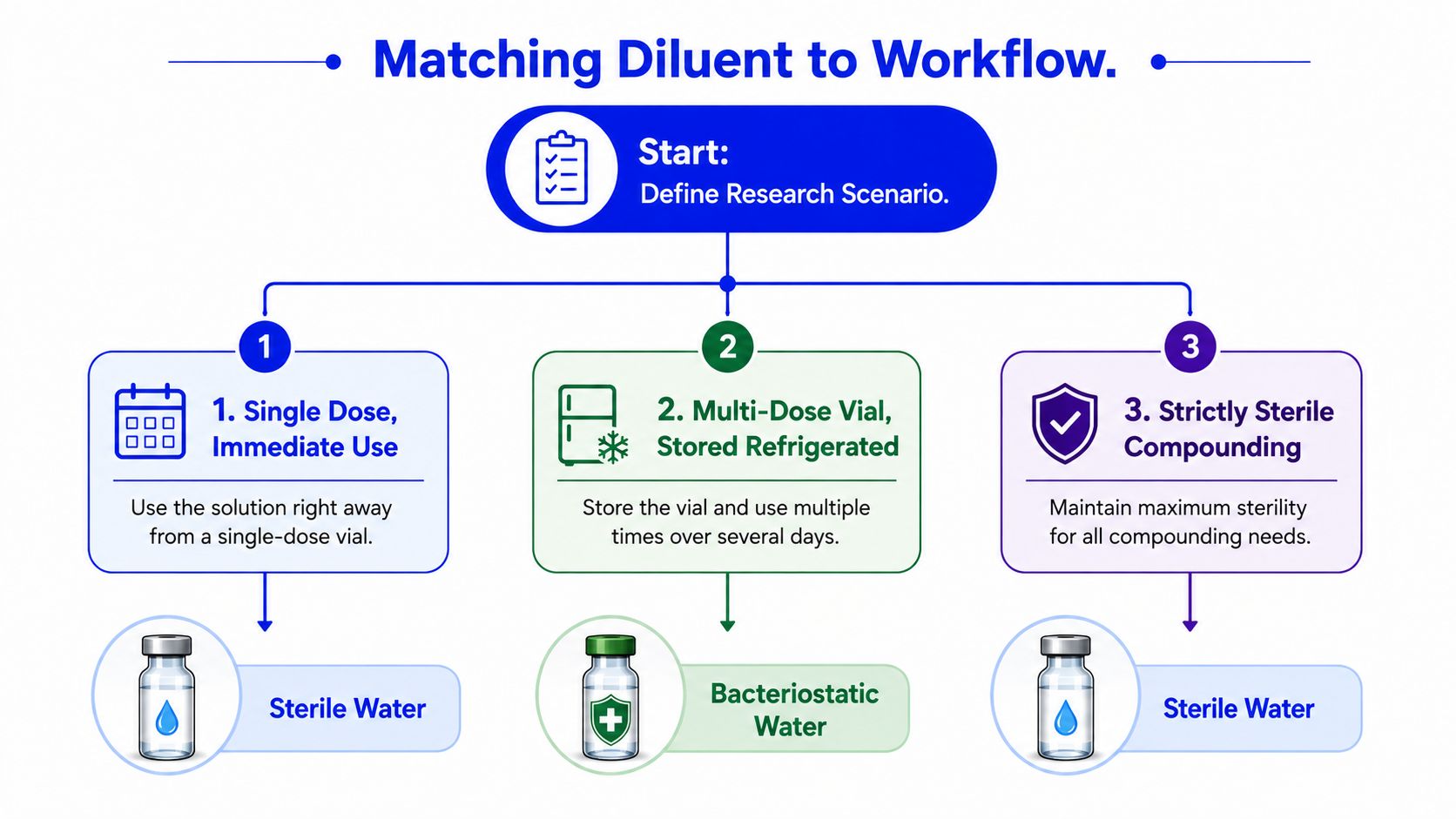
The right choice becomes much easier when the protocol is broken into actual workflow types. A diluent that works well for one project can be the wrong call for another, even if both involve peptides and reconstitution.
Single-session and preservative-sensitive work lean sterile
If the full volume will be used immediately, sterile water is the cleaner choice. That includes one-time reconstitution, preservative-free protocols, and assay environments where benzyl alcohol could interfere with biology or analysis. In those settings, adding a preservative creates a new variable that does not help the data.
This is also the right posture when a manufacturer's instructions call for a preservative-free diluent. Lab teams shouldn't override that with a generic community rule, because the protocol's own constraints matter more than convenience. When the exposure window is short, sterile water usually gives the simplest path with the fewest downstream questions.
Repeated withdrawals point toward bacteriostatic water
When a project requires multiple withdrawals from the same vial, bacteriostatic water is the more logical fit. The preservative supports the multi-dose model and aligns with the handling pattern most peptide users describe as practical for longer workflows. That's why it's often chosen for reconstitution scenarios that span more than one session.
For teams planning repeated access, a multi-dose product with documented handling support becomes useful. HerbiLabs' reconstitution solution is positioned for that type of RUO workflow, with a 0.9% benzyl alcohol formulation intended for reconstituting peptides and other lyophilized materials, which makes it relevant when the workflow needs a bacteriostatic-style diluent rather than a preservative-free one. Internal teams comparing sourcing options can also review the product-specific guidance at HerbiLabs' peptide reconstitution page.
If the same vial will be punctured more than once, the diluent decision should be made as a handling strategy, not as a preference question.
Edge cases need protocol notes, not shortcuts
Some workflows span both single-use and multi-use phases. Others sit in a gray zone where the peptide, assay, or downstream test may be sensitive to additives but the team still wants some access flexibility. In those cases, the safer move is to document the rationale in the protocol and choose the diluent that protects the most fragile step, not the most convenient one.
A simple internal checklist helps:
- Single use, immediate consumption: sterile water.
- Repeated access from one vial: bacteriostatic water.
- Preservative-sensitive biology: sterile water.
- Undocumented workflow ambiguity: confirm the assay's tolerance before selecting the diluent.
The Hidden Risks Behind the 28-Day Benchmark
The 28-day in-use window for bacteriostatic water gets repeated so often that it can sound like a guarantee. It isn't. That benchmark assumes the vial is handled correctly, and the world often falls short of that assumption.
The label assumes disciplined handling
Bacteriostatic water is commonly described as suitable for repeated withdrawals for up to 28 days after first puncture, but that only works when vial integrity and storage are controlled. If the stopper is repeatedly abused, if aseptic steps are sloppy, or if the vial sits in poor conditions, the label-style benchmark stops being useful.
A 2026 handling guide makes the same point in plain language, the period is viable only when vial integrity and controlled storage are maintained. That's the part many independent labs miss, because the conversation often stops at the number and never reaches the conditions behind it. Biogenix Peptides' handling guide is valuable because it frames the benchmark as conditional, not absolute.
Real-world puncture habits change the risk profile
The biggest failure point is usually not the chemistry, it's the workflow. Repeat septum punctures, inconsistent needle changes, poor disposal habits, and casual handling all increase the chance that the vial's protection margin gets eroded. The preservative helps, but it doesn't rescue bad technique.
That matters because many small labs and independent users don't operate under the same environmental controls as larger institutions. A benchmark that looks tidy on paper can become less reliable when storage discipline slips or when the vial is handled by more than one person. The practical takeaway is blunt, if the aseptic process is weak, the 28-day figure should be treated as aspirational rather than automatic.
Lab reality: the clock matters, but the puncture history matters more.
Aseptic Technique and Storage Protocols
Good handling protects both water types, but it matters most once the vial is opened. The differences are simple, sterile water needs stricter single-access discipline, while bacteriostatic water needs repeated-access discipline that doesn't drift into casual use.
Before the vial is punctured
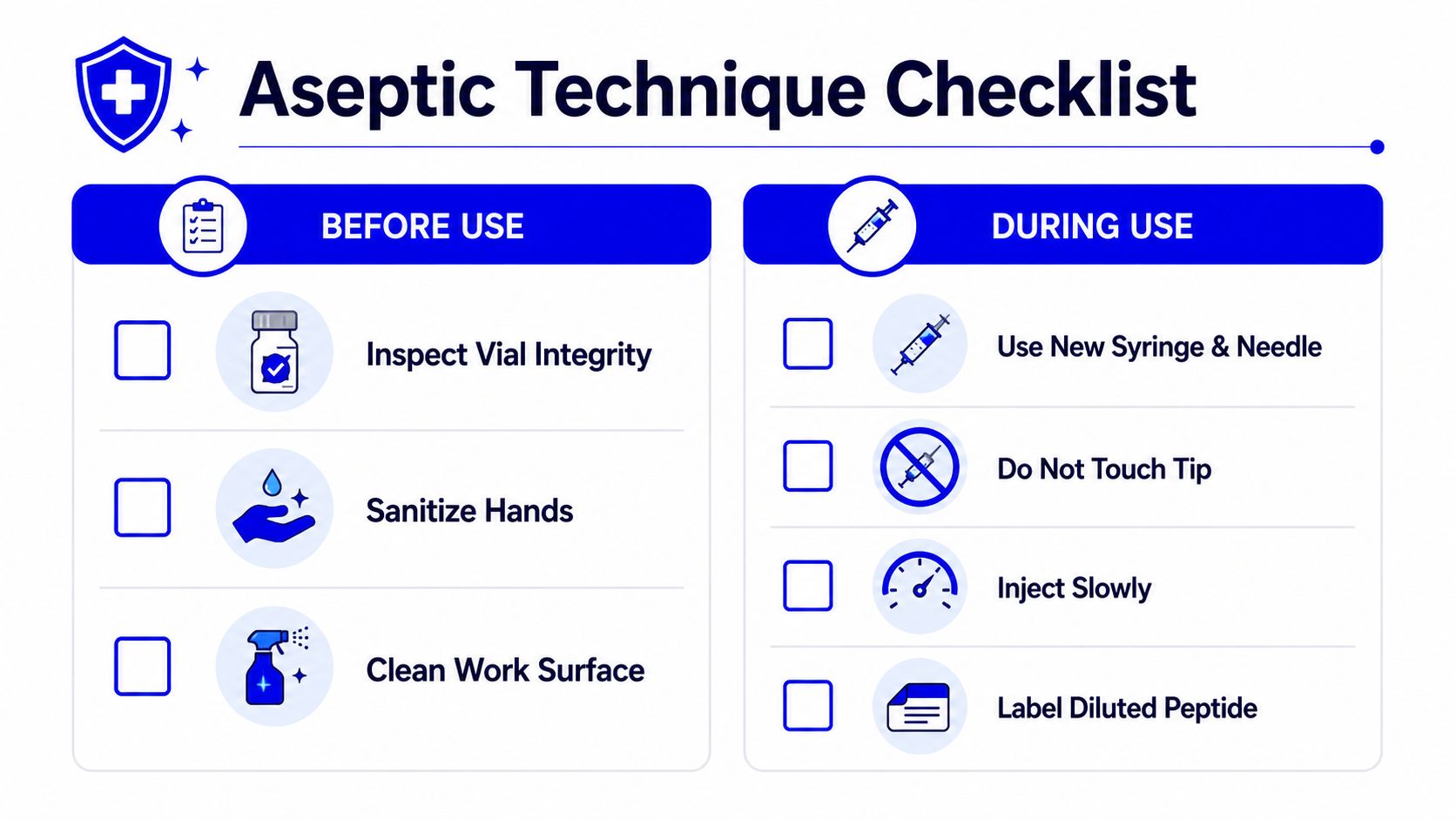
The work starts before the needle touches the stopper. Inspect the vial for cloudiness, particles, cracks, leaks, discoloration, or a damaged stopper. Clean the work surface, sanitize hands, and make sure the vial top is ready before access begins.
A practical contamination-control resource like AUSFF's protection vector designs can be useful for teams building SOP visuals or internal safety materials, especially when the goal is to communicate barrier discipline, not to overcomplicate the procedure. The actual aseptic logic stays the same, keep the vial clean, keep the bench controlled, and avoid unnecessary handling.
During access, control the touchpoints
Use a new syringe and needle for each withdrawal. Don't touch the tip or let it contact non-sterile surfaces. Inject and withdraw slowly, then label the diluted peptide clearly so the handling timeline doesn't get lost in the rack.
The handling difference between single-use and multi-dose workflows is mostly about restraint. Sterile water should be treated as immediate-use only after opening. Bacteriostatic water can support repeated access, but each puncture should be intentional, documented, and limited to what the protocol requires.
Storage has to match the in-use model
Storage discipline matters even when the water itself is intact. Keep the vial in a clean, controlled environment away from direct sunlight and avoid unnecessary temperature swings. Freezing is not a casual default, and once sterility is in doubt, the vial should be discarded rather than argued with.
A useful internal SOP reference for teams working through the reconstitution step is HerbiLabs' bacteriostatic water for peptide reconstitution page, especially when the issue is not just what to buy, but how to handle it once it arrives.
Quality Documentation and Supply Chain Reliability
Choosing the correct water type matters, but sourcing it from a supplier with usable documentation matters just as much. If the product arrives without clear records, the lab is left guessing about batch consistency, and that weakens the value of every downstream result.
Ask for documentation that supports the protocol
For RUO teams, quality paperwork should not be an afterthought. Lot-specific Certificates of Analysis, documented quality review, and manufacturing controls help show that the diluent is consistent from batch to batch. In regulated or semi-regulated environments, that documentation is part of the experimental record, not a bonus file.
Facility claims also matter. HerbiLabs states that its operations use ISO 13485:2016, GMP, and ISO 9001:2016 procedures, alongside batch reviews, material traceability, and training controls. Those kinds of systems help reduce procurement uncertainty because they make the supply chain more legible to the lab manager who has to defend the choice later. A useful framework for document discipline in this context is HerbiLabs' ISO 9001 quality systems page.
Fulfillment stability affects experimental continuity
Supply reliability isn't glamorous, but it's operationally important. If a project depends on repeated reconstitution work, a delayed shipment can disrupt the timeline just as easily as a bad formulation choice. That's why temperature-controlled warehousing, consistent fulfillment, and vial-format availability should be part of the selection criteria.
For teams that manage records across multiple projects, life sciences document automation is a helpful adjacent concept because it shows how documentation workflows can be structured around repeatable review and traceability. The same principle applies to diluent procurement, if the supplier can't support clean records, the lab absorbs the cost in review time.
Supplier choice is part of experimental design
For independent researchers and small R&D teams, the supplier is part of the method. A multi-dose product with a clear COA and controlled storage is different from an unverified bottle that happens to be cheaper. The label only helps if the supply chain behind it is coherent.
Making Your Final Decision
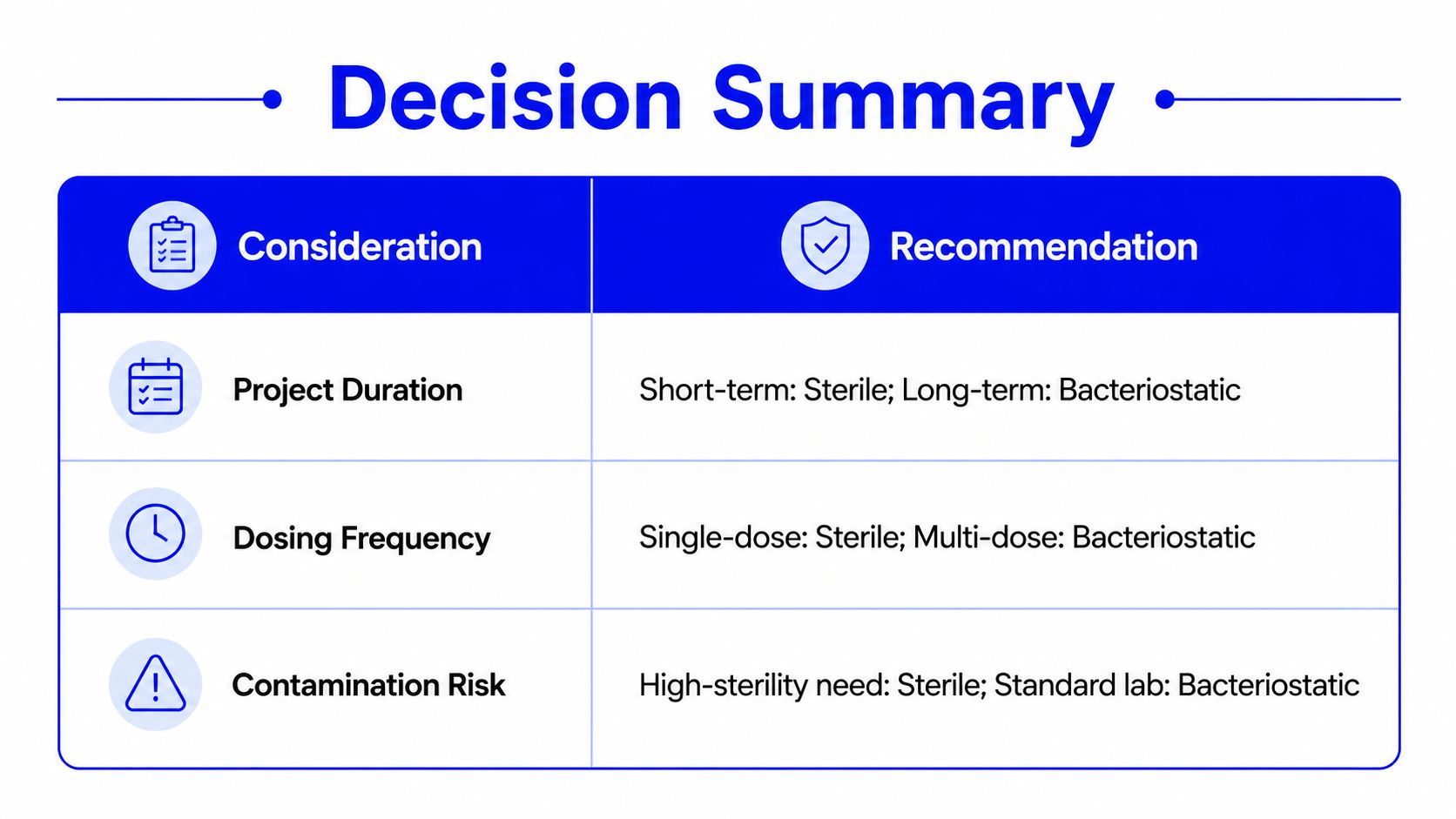
The cleanest decision framework is simple. Use sterile water when the protocol is single-use, preservative-sensitive, or explicitly preservative-free. Use bacteriostatic water when the vial will be punctured more than once and the workflow can support disciplined aseptic handling.
The fastest way to decide
If the project duration is short and the full volume will be used at once, sterile water is usually the cleaner answer. If the workflow spans multiple withdrawals, bacteriostatic water fits better. If contamination risk is unusually high or the assay needs the strictest preservative-free environment, sterile water should take priority.
Red flags are easy to spot. A protocol that doesn't specify a preservative requirement needs a compatibility check before the diluent is chosen. A project that mixes single-use and repeated-use assumptions without resetting notes or labeling correctly invites avoidable mistakes. A vial that's been handled casually should not be treated as though the 28-day benchmark still applies by default.
Document the reason, not just the choice
The strongest teams don't just pick a diluent, they record why that diluent fit the protocol. That matters for internal compliance, peer review, and continuity when more than one person touches the project. A clean note about assay compatibility, exposure window, and storage assumptions is often enough to make the choice defensible.
The answer to sterile water or bacteriostatic water for peptides is not a slogan. It's a workflow decision, and the best one is the one that matches the biology, the handling discipline, and the documentation your lab can maintain.
If your team needs a documented diluent for peptide reconstitution, HerbiLabs supplies RUO bacteriostatic water and related labware in multiple vial formats, with quality documentation and controlled production workflows. Visit HerbiLabs to review the available options and match the product to your protocol before the next reconstitution step.