Private Label, White Label, Wholesale partnerships available - EU, USA and UK - Free shipping from €75
Bacteriostatic Water for Injection UK: Complete Guide
A UK-registered bacteriostatic water for injection product contains 0.9% benzyl alcohol, equal to 9 mg/mL, and is sterile and non-pyrogenic. Although an official medicine register lists an authorized product, most bacteriostatic water sold to researchers is labelled Research Use Only, not for clinical use.
A purchasing manager can easily mistake two similar-looking vials for interchangeable products. One may carry formal UK medicinal product information, while another may be a laboratory diluent sold for reconstituting research materials. Both may contain preserved sterile water, but their regulatory status, intended use, documentation, and handling expectations aren't the same.
That distinction matters at the bench. A vial that arrived quickly and looks clean still needs a traceable lot, a clear label, controlled storage, and a discard decision based on how it was accessed. The preservative gives a multi-dose workflow more practical flexibility, but it doesn't turn poor technique into acceptable technique.
Table of Contents
- What Bacteriostatic Water Actually Is
- Regulatory Status and Sourcing in the UK
- Safe Handling and Storage Protocols
- Understanding Quality Documentation and COAs
- Choosing the Right Vial Format and Pack Size
- Common Myths and Safety Misconceptions
- Key Takeaways for UK Researchers
What Bacteriostatic Water Actually Is
At the bench, two clear vials can look interchangeable while serving different purposes. A technician may select plain sterile water because the labels appear similar, or treat “bacteriostatic” as permission to pierce the stopper repeatedly without further controls. Both choices can compromise a reconstitution workflow.
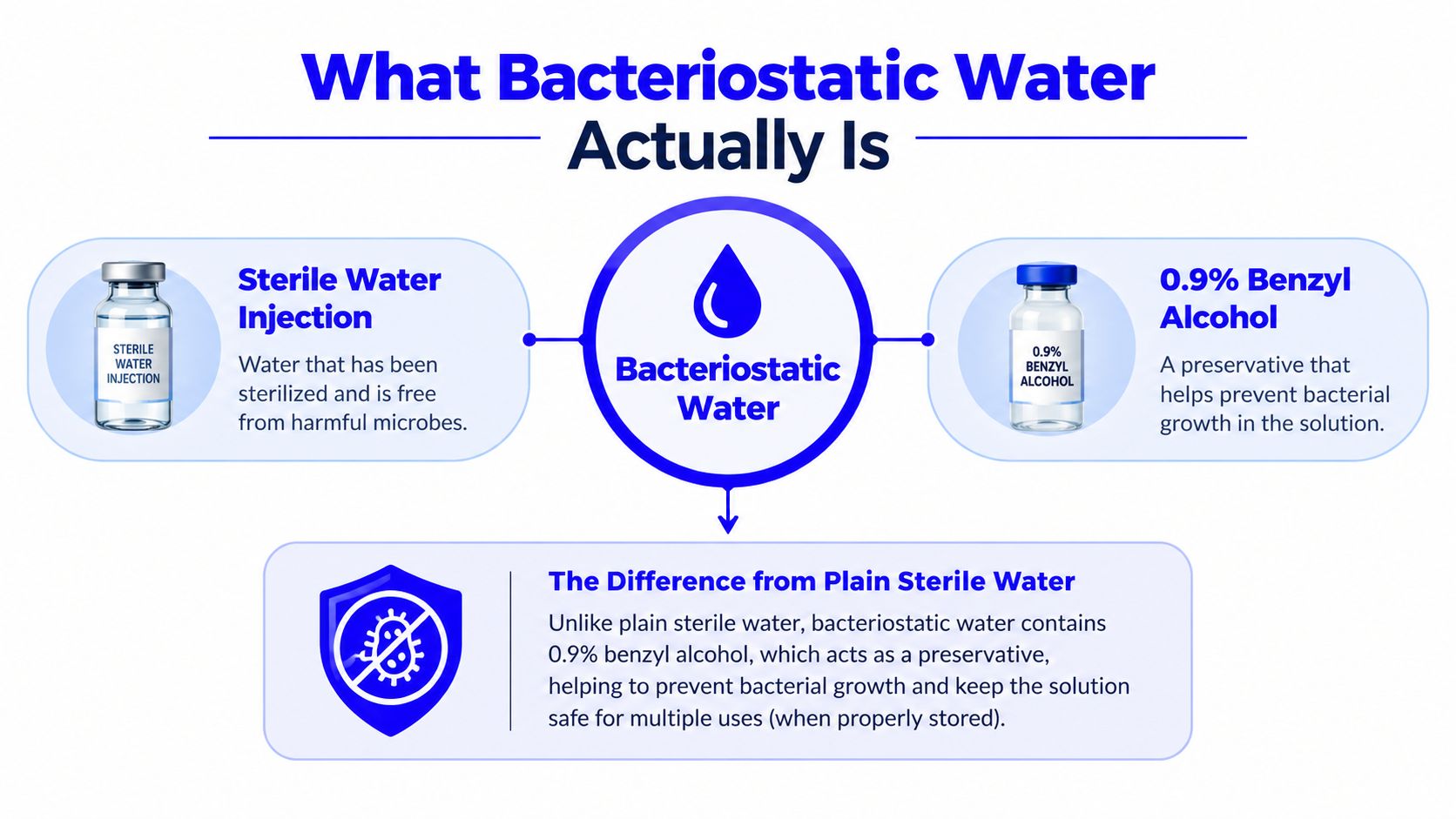
Bacteriostatic Water for Injection is a preserved diluent. It consists of sterile, non-pyrogenic Water for Injection with 0.9% benzyl alcohol, or 9 mg/mL, as the bacteriostatic preservative, according to the DailyMed product labeling.
The preservative changes the workflow
Plain sterile water contains no antimicrobial preservative. Benzyl alcohol can suppress the growth of small numbers of microorganisms introduced during access, so a compatible formulation may support repeated withdrawals under the product label and local protocol.
The preservative does not sterilize a contaminated vial, remove endotoxin risk, or provide complete protection against bacterial or viral contamination. A multi-dose vial still requires aseptic access, and CDC injection safety guidance supports treating each entry as a contamination-control event.
The 28-day discard rule has a microbiological purpose. Each puncture creates another opportunity for organisms to enter, while preservative activity is not an unlimited substitute for controlled handling. Unless the manufacturer or governing protocol specifies a different period, discard the opened vial after 28 days, even if liquid remains and no visible contamination is present.
Use plain sterile water when the protocol requires an unpreserved, single-use diluent. Choose bacteriostatic water only when the target material tolerates benzyl alcohol and repeated access is appropriate. Some peptide formulations, proteins, and antibodies can lose stability or compatibility in the presence of preservatives, so check the formulation record or technical specification before reconstitution.
The UK regulatory distinction between a listed medicine and an RUO diluent is detailed in the next section. A formal medicine record does not make an unrelated laboratory diluent equivalent.
Regulatory Status and Sourcing in the UK
A vial arrives for a UK research project with a familiar label and a lot-specific COA. That documentation may support purchasing, but it does not answer the regulatory question. Confirm whether the material is a listed medicinal product or an RUO laboratory diluent before approving it for use.
The Medicines.org.uk electronic Medicines Compendium lists Bacteriostatic Water for Injection under product code PL 00057/0934, with a documented update on 2024-09-25 and a page refresh on 2026-10-02. The UK electronic Medicines Compendium record identifies the formal medicinal product and its approved information. It does not validate every vial marketed online as “bacteriostatic water.”
An RUO vial may have a manufacturer, lot number, COA, and technical specification while remaining outside the status of a clinically authorised medicine. Research Use Only describes intended use. It does not remove the laboratory's responsibility to verify identity, composition, traceability, and compatibility with the planned experiment.
What the label actually tells the lab
Before ordering, review:
- Intended-use wording: Confirm that the label clearly identifies RUO material or a medicinal product.
- Traceability: Match the vial and outer packaging to a lot or batch.
- Composition: Check that the diluent and preservative concentration are stated clearly.
- Documentation: Request a lot-specific COA, not only a general marketing specification.
- Supply-chain identity: Record the seller, manufacturer, and fulfilment details.
The distinction also affects in-use decisions. A regulated medicinal product record demonstrates that a specific product has formal regulatory documentation. It does not make an unrelated RUO diluent equivalent. Conversely, an RUO label does not prove poor quality, but the lab must judge the available evidence rather than infer suitability from packaging, appearance, or search ranking.
The preservative explains why a bacteriostatic product may support repeated withdrawals, not why it can be kept indefinitely. Every puncture creates another opportunity for microbial entry. Preservative activity can limit growth under appropriate conditions, but it cannot sterilise a contaminated vial. Apply the manufacturer's or local protocol's discard period, commonly 28 days where no different instruction applies, and document the first puncture date.
Compliance work may also cover purchasing controls and online pharmaceutical workflows. Teams can review strategies for digital health compliance alongside their own approval records.
For a small lab, the rule is practical: buy for the intended workflow, document the exact product received, and keep medicinal authorisation separate from RUO suitability.
Safe Handling and Storage Protocols
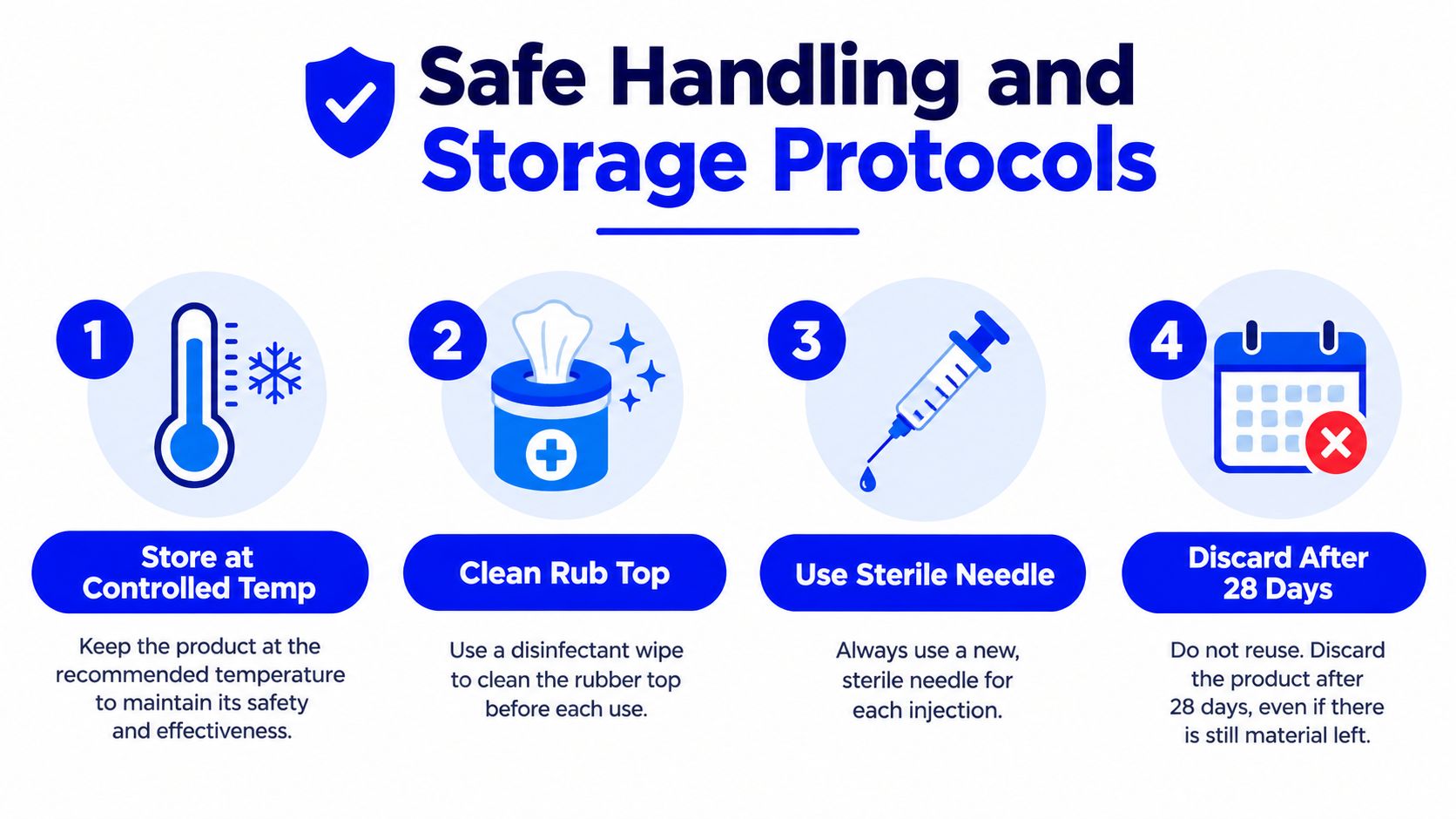
A weekly audit finds an opened vial in the refrigerator with no puncture date. The solution looks clear, and the label identifies the product, but its in-use history is unknown. Quarantine it. Appearance cannot restore traceability or establish that the vial remains suitable.
The CDC guidance on multi-dose vial safety explains the operating principle: antimicrobial preservatives can limit microbial growth, but they do not replace aseptic technique or make a contaminated vial safe. A regulated UK medicinal product record may document a formally authorised product. That record does not make an unrelated RUO laboratory diluent equivalent. An RUO product may still have useful quality evidence, but suitability must be judged from its documentation and intended workflow.
The in-use routine
Build the following checks into the SOP and records:
| Step | Why it matters |
|---|---|
| Record the first puncture date on the vial or controlled-use label. | An unknown opening date removes a key part of the vial's traceability. |
| Inspect the container, stopper, solution, and label before access. | Damage, particles, cloudiness, or unclear identity requires quarantine rather than guesswork. |
| Disinfect the stopper with the laboratory-approved disinfectant and let it dry. | Dry contact time supports the intended surface-disinfection process. |
| Use a new sterile needle and syringe for every withdrawal. | Reuse and leaving a needle in the stopper create avoidable contamination routes. |
| Minimise exposure and return the vial to its designated storage location promptly. | Protected closures and controlled storage reduce handling, heat, and light exposure. |
| Apply the discard rule recorded in the product label or local procedure. | Where no different validated instruction applies, use 28 days after first puncture as the maximum in-use period for this workflow. |
The bac water handling guidance can support staff training, while the laboratory SOP remains the controlling document.
Why the 28-day boundary matters
The 28-day rule is a discard boundary, not a sterilisation period. Each puncture can introduce organisms. Benzyl alcohol may inhibit multiplication of a small initial burden, but it does not reliably destroy an established population or reverse contamination. The period therefore manages risk under defined handling conditions rather than guaranteeing safety until the final day.
Follow the product label for storage conditions. A controlled environment helps limit avoidable heat, light, and closure damage, but it cannot compensate for a compromised stopper or missing access history. Sellers and distributors also need automated compliance for online pharmacies so restrictions and fulfilment instructions remain consistent.
Understanding Quality Documentation and COAs
A COA earns its value from traceability. If the PDF cannot be tied to the vial in the laboratory, it may describe a manufacturer's general process without providing strong evidence about the specific shipment.
Start with the physical label. Match the lot or batch identifier to the COA, then compare the product name with the purchasing record. Small differences matter when a regulated UK medicinal product is being compared with a research-use-only laboratory diluent. The former should have a product record appropriate to its authorised status. An RUO diluent may instead be supported by a supplier specification and lot-release document, without carrying the same medicinal-product documentation or intended-use assurance.
What the reviewer should verify
Check the following before releasing the material into active work:
- Identity and composition: Confirm the named diluent, water description, and preservative information where stated.
- Sterility information: Identify the sterility assessment and its result. Confirm that the document applies to the stated lot.
- Endotoxin information: Look for an endotoxin result or specification when the product documentation provides one.
- pH specification: Check that the reported range is defined and linked to the lot or release specification.
- Release status: Look for an authorised QA disposition, review date, or equivalent release statement.
- Traceability: Match the lot, manufacturing details, expiry information, and packaging records to the physical vial.
The document type should fit the material. A medicinal-product record supports a different purchasing and release decision from an RUO COA. Neither document replaces the laboratory SOP, a compatibility assessment, or review of the aseptic process. The operator still has to confirm that the diluent suits the experiment and that the workflow controls contamination.
The 28-day discard rule also needs microbiological context. Benzyl alcohol can inhibit multiplication after a small contamination event, but it does not sterilise the vial or reliably eliminate an established population. Every puncture creates another opportunity for organisms to enter. The boundary therefore controls risk under defined handling conditions. It is not evidence that the contents remain sterile until the final day.
Purchasing teams can turn these bacteriostatic water procurement tips into a repeatable vendor questionnaire covering product identity, lot documentation, intended use, storage requirements, and restrictions.
A missing COA warrants a pause before release. Clear liquid alone is weak evidence. Another trained person should be able to identify the same material, inspect the same records, and understand how it was controlled.
Choosing the Right Vial Format and Pack Size
A vial that suits a busy shared facility can be wasteful for a small team preparing material only occasionally. Select the format from the withdrawal pattern, storage space, and discard controls, rather than from unit price alone. Confirm the manufacturer's fill volume, storage instructions, and permitted use before placing the order.
Bacteriostatic Water Vial Format Comparison
| Vial Size | Best For | Pros | Cons |
|---|---|---|---|
| 3 mL | Low-volume experiments and occasional preparation | Leaves less residual material after a short workflow and needs little storage space | May require replacement more often during several scheduled preparations |
| 10 mL | Small laboratories with regular, moderate use | Provides a practical working volume without excessive residual material | Can be inefficient when withdrawals are infrequent |
| 20 mL | Teams with recurring preparation work | Reduces the need to open another container during an active project | Creates more waste when access is occasional |
| 30 mL | Higher-throughput research workflows | Supports repeated preparation and simplifies stock planning | Requires strict opening-date and storage control |
Match packs to actual consumption
Pack size should follow recorded consumption. A multi-pack supports continuity when demand is predictable, while advance purchasing can leave several vials approaching expiry before the project uses them.
- Occasional use: Choose smaller formats and keep reserve vials unopened.
- Steady use: Select a mid-sized vial that matches documented withdrawal patterns.
- Shared facility use: Assign each opened vial to a defined project or bench area.
- Contract or batch work: Match the pack to the project schedule and available storage.
The purchasing decision also depends on the material's status. A regulated UK medicinal product record identifies a specific authorised product and supports a different release decision from an RUO laboratory diluent with a supplier-issued COA. Similar composition or packaging does not make the records interchangeable. Confirm the actual product identity, intended use, lot documentation, and laboratory acceptance requirements before treating a vial as suitable.
The 28-day discard rule should shape pack selection. Benzyl alcohol may inhibit multiplication after limited contamination, but it does not sterilise the vial or reliably remove an established microbial population. Each stopper puncture creates another entry opportunity. The discard boundary controls risk under defined handling conditions, so a large vial can be poor value if the team cannot use it within the permitted period.
Cost includes wasted contents, disposal, delayed work, emergency shipping, and undocumented substitutions. A low invoice price may therefore produce a higher operational cost.
Record format, lot documentation, opening date, storage location, and planned discard date. That record lets another trained operator verify why the pack size was chosen and whether the vial remains eligible for use.
Common Myths and Safety Misconceptions
The most dangerous errors usually sound reasonable. A technician sees “bacteriostatic” on the label and assumes the vial is protected indefinitely, or sees an RUO product listed beside clinical supplies and assumes the regulatory status is equivalent.
Myth one, the preservative makes contamination harmless
It doesn't. Benzyl alcohol suppresses the growth of some microorganisms, but it doesn't eliminate contamination or protect against every type of microbial threat. The CDC specifically warns that preservatives in multi-dose vials don't provide complete protection against bacterial contamination and don't protect against viral contamination.
Better practice: Treat every puncture as a contamination-control event. Use a sterile needle and syringe, disinfect the stopper, keep the vial protected, and record the access date.
Myth two, an official UK listing covers every online vial
It doesn't. The UK record applies to the identified medicinal product and its formal product information. An RUO diluent is a different purchasing category, even if it has a similar composition.
Better practice: Verify the actual manufacturer's identity, label, intended use, lot number, and COA. Don't use a registry entry for one product as evidence for another.
Myth three, bacteriostatic water can replace sterile water in every protocol
It can't. The preservative changes the formulation, and compatibility depends on the material being reconstituted and the protocol's requirements. Plain sterile water may be the appropriate choice when a preservative-free diluent is required or when the procedure is designed for single-use handling.
Better practice: Follow the specific reconstitution instructions rather than choosing by habit.
Myth four, the vial lasts as long as the liquid looks clear
Appearance is not a microbiological release test. A clear solution can still have an unacceptable handling history, an unknown opening date, or contamination that isn't visible to the operator.
For a practical discussion of bacteriostatic water, the useful question is not merely how long the liquid looks usable. The useful question is whether the product's label, access history, storage record, and validated local procedure support continued use.
Key Takeaways for UK Researchers
The central mistake is reducing bacteriostatic water to a bottle of preserved sterile liquid. A responsible UK workflow also asks what product is this, who authorized or supplied it, what use is permitted, and what evidence connects the vial to its quality record.
A medicinal product record and an RUO laboratory diluent serve different purposes. The UK electronic Medicines Compendium entry demonstrates how a specific product can be identified through formal medicine information, while an RUO product must be assessed through its own labeling, supplier controls, technical documentation, and lot traceability.
A working approval checklist
Before a vial enters active research use, the responsible person should confirm:
- Product category: The label clearly states whether the material is medicinal or RUO.
- Formulation: The preservative and diluent description match the protocol's needs.
- Documentation: The lot-specific COA is available and matches the physical vial.
- Compatibility: The target research material is suitable for the selected diluent.
- Handling: The team has a written access, stopper-disinfection, and storage procedure.
- Date control: The opening date and discard date are recorded before repeated use begins.
- Procurement record: The supplier, product identity, lot, and receiving details are retained.
The 28-day boundary should be treated as a controlled discard point, not a promise that the vial remains sterile without disciplined handling. The preservative gives the laboratory a useful margin against microbial multiplication, but it doesn't replace aseptic technique, visual inspection, documentation, or sound judgment.
Small teams often improve reliability by assigning ownership. One person can approve suppliers, another can receive and record lots, and every operator can follow the same bench procedure. That separation makes deviations easier to identify before they affect a study.
Researchers sourcing bacteriostatic water in the UK should review the product label and COA before ordering, then build the vial into the laboratory's existing quality system. For RUO work, the right choice is the product that fits the protocol and can be traced, stored, handled, and discarded consistently.
Herbilabs supplies RUO bacteriostatic water and reconstitution solutions in multiple vial formats, with lot-specific documentation for research workflows. Visit Herbilabs to review the available options and match the format and records to the lab's handling procedure.