Private Label, White Label, Wholesale partnerships available - EU, USA and UK - Free shipping from €75
Bacteriostatic Water vs Sterile Water: RUO Lab Guide
You're standing at the bench with a lyophilized peptide, a clean rack of vials, and two labels that seem close enough to swap. One says bacteriostatic water, the other says sterile water, and the protocol only says “reconstitute with sterile water.” That wording looks simple until the choice starts shaping contamination risk, assay compatibility, storage discipline, and whether the vial can be revisited later or has to be discarded right away.
| Criterion | Bacteriostatic Water | Sterile Water |
|---|---|---|
| Preservative | 0.9% benzyl alcohol | No preservative |
| Antimicrobial agent | Included to inhibit bacterial growth after access | None |
| Typical access pattern | Designed for multiple withdrawals | Typically single-use |
| In-use window | Commonly treated as a 28-day post-puncture vial when handled aseptically and refrigerated | Often discarded after opening in many guides |
| pH range | About 4.5 to 7.0 | About 5.0 to 7.0 |
| Practical fit | Reconstitution where repeated vial access is expected | One-time preparation or preservative-sensitive workflows |
Table of Contents
- Why This Choice Matters in Research Workflows
- Bacteriostatic Water and Sterile Water at a Glance
- How Benzyl Alcohol Changes the In-Use Equation
- Reconstitution Scenarios Across Common Research Workflows
- Compatibility Tradeoffs Most Comparisons Skip
- Regulatory Context and Documentation for RUO Labs
- Decision Framework for Choosing the Right Diluent
- Practical Checklist for Storage, Access, and Reuse
Why This Choice Matters in Research Workflows
A researcher at the bench often isn't choosing between two equally interchangeable waters. The core decision is whether the vial will be opened once for a single assay run, or accessed repeatedly across a workflow that stretches over days or weeks. That difference determines whether a preservative is helpful protection or an unwanted contaminant.
The distinction starts with formulation. Bacteriostatic water contains 0.9% benzyl alcohol, while sterile water contains no preservatives or antimicrobial agents. That single difference changes how the container behaves after first puncture, because one product is built to tolerate repeated access and the other is not (Mountainside Medical).
The decision is really about risk control
In RUO settings, the consequences show up fast. A vial that should have supported repeated preparation may fail early if the wrong diluent was chosen. A preservative that helped protect the vial can also carry into a sensitive assay and distort the readout, so the “easy” option can become the wrong one.
Practical rule: if the protocol expects one withdrawal, preservative-free water usually keeps the workflow cleaner. If the protocol expects repeated access, the preservative becomes part of the contamination-control strategy.
The other hidden factor is documentation. Many labs can state what water was used, but fewer can show why it fit the access pattern, storage method, and biomolecule sensitivity. That's where the decision starts affecting reproducibility rather than just convenience.
Three questions usually settle the issue before the first puncture. How often will the vial be entered. Is the biomolecule sensitive to benzyl alcohol. Does the workflow need a reusable in-use window, or a single clean preparation. Those are the decision drivers, and they matter more than the familiar label on the bottle.
Bacteriostatic Water and Sterile Water at a Glance
A protocol can look correct on paper and still fail at the bench if the diluent does not match how the vial will be used. Bacteriostatic water for injection is a sterile, nonpyrogenic diluent with 0.9% benzyl alcohol and a pH range commonly described around 4.5 to 7.0. Sterile water for injection has no preservative, is commonly described around pH 5.0 to 7.0, and is generally supplied as a single-use container (BAC Water Catalog, Mountainside Medical).
What the label tells procurement teams
Read the label as a workflow instruction, not a packaging cue. If the container says bacteriostatic, the formulation already carries a preservative that supports repeated access. If it says sterile water, the absence of a preservative means the vial is not built for the same reuse pattern.
The packaging format reinforces that difference. Bacteriostatic water is generally positioned for multiple withdrawals, while sterile water is generally positioned for single use. That matters when protocol language says “sterile water” without clarifying whether the team needs preservative-free water for a one-time preparation or a sterile diluent that will be opened only once (DailyMed).
Quick comparison for protocol review
- Bacteriostatic water: contains benzyl alcohol, supports repeated access, and is used when a vial will be revisited.
- Sterile water: contains no preservative, fits single-use workflows, and stays cleaner for sensitive applications.
- pH range: both sit in a broadly compatible range for many routine reconstitution tasks, but the preservative difference is still the deciding factor.
That preservative difference is also the part that matters most for assay sensitivity. As explained in this overview of benzyl alcohol in lab solutions, a formulation that helps control contamination after first puncture can still be a poor fit if carryover into the final preparation would interfere with downstream readouts. The practical choice is less about the bottle label and more about whether the workflow needs repeated access or a preservative-free one-time dilution.
The usable distinction is straightforward. If the question is whether the container can support repeated handling without immediate discard, bacteriostatic water is built for that use pattern. If the question is whether the preparation must remain preservative-free for a sensitive application, sterile water is the safer match.
How Benzyl Alcohol Changes the In-Use Equation
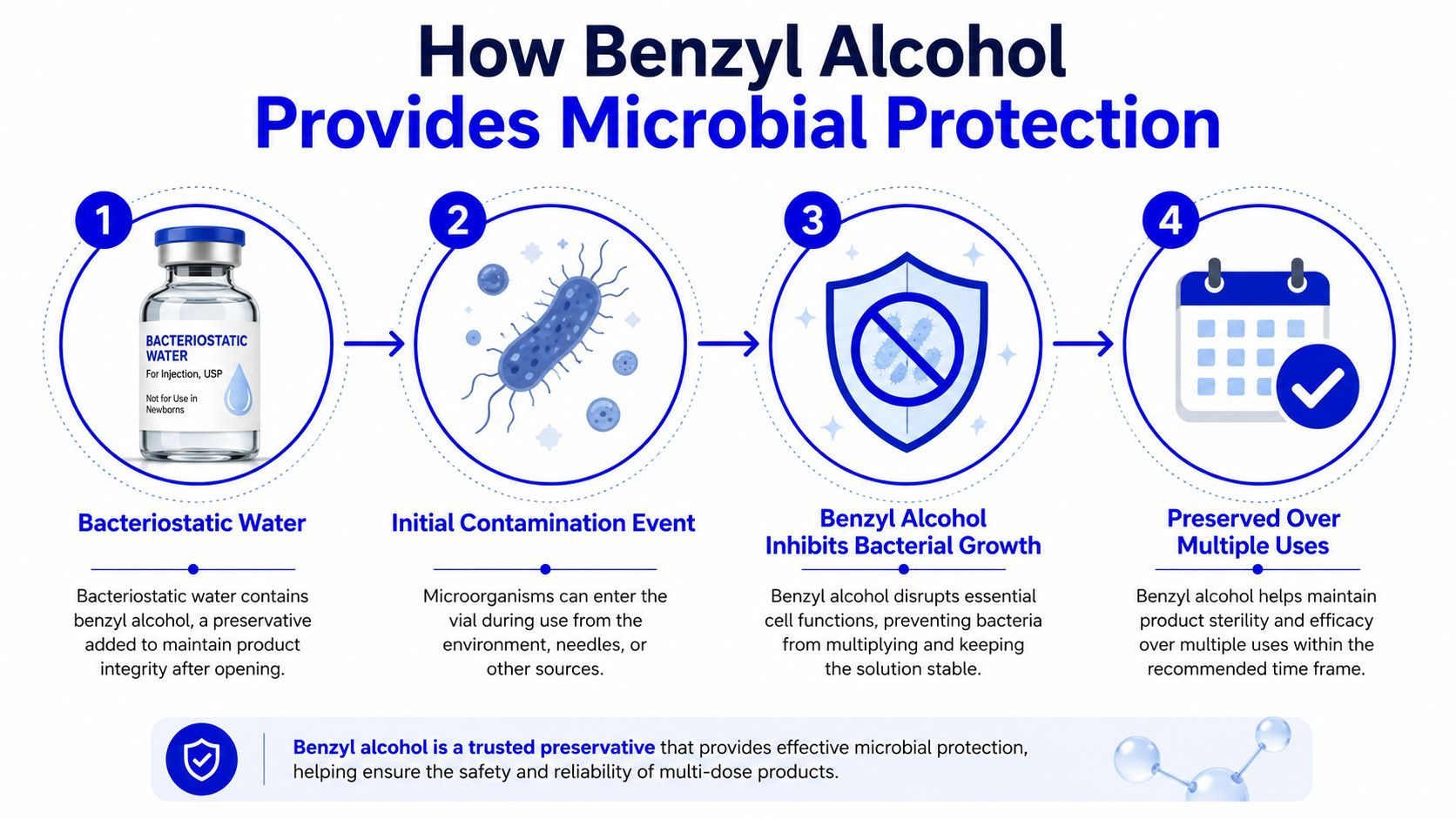
Benzyl alcohol is the reason bacteriostatic water behaves differently after the stopper is pierced. The preservative is present at 0.9%, and its job is to inhibit bacterial growth after vial access, which is what makes multiple withdrawals workable instead of immediately risky (Mountainside Medical, DailyMed).
Why the 28-day window matters
The widely cited operational rule is a 28-day in-use period after first puncture when the vial is handled aseptically and refrigerated (Harvard feed). That window is what turns bacteriostatic water from a simple diluent into a practical multi-dose workflow tool. It reduces waste, supports repeated preparation, and gives the lab a predictable time frame for reuse.
The same rule also makes the assumptions visible. The vial has to be accessed cleanly, stored correctly, and protected from sloppy bench habits. If those conditions fall apart, the preservative is no longer a substitute for poor technique.
Operational reality: preservative protection lowers risk, but it doesn't cancel contamination introduced by bad aseptic handling.
The clearest way to think about the preservative is as a backstop. Sterile water offers no such backstop after opening, so contamination risk rises immediately with each puncture. Bacteriostatic water gives the workflow a margin of safety, but only inside the use pattern it was designed for.
For labs that want a technical explanation of why benzyl alcohol matters in formulation design, this laboratory overview of benzyl alcohol's role is a useful companion read. It helps connect ingredient choice to the practical question of how long a vial can stay in rotation.
Reconstitution Scenarios Across Common Research Workflows
Different workflows ask the diluent to do different jobs. The right choice usually becomes clear once the vial's full use pattern is defined, not guessed at on the bench. A peptide prepared for repeated withdrawals over several days sits in a different category from an antibody aliquot mixed once for a single assay.
Peptides, proteins, and antibodies are not all the same case
For peptide reconstitution, bacteriostatic water often fits when the same vial will be accessed more than once and the formulation tolerates benzyl alcohol. That is the workflow Herbilabs describes on its bacteriostatic water for peptide reconstitution page, and it matches a repeated-withdrawal pattern without changing the underlying compatibility question. The key check is whether the peptide stays stable in a preservative-containing medium, not whether the vial can be opened more than once.
For proteins and antibodies, the decision is narrower. Some preparations tolerate a preservative-containing diluent, while others are sensitive enough that any extra ingredient becomes a liability. The more delicate the biomolecule, the less helpful multi-dose convenience is if it increases the chance of altered binding, drift in recovery, or assay noise.
Cell-based antibody workflows make that trade-off obvious. A diluent that is acceptable for short-term handling can still be a poor choice once the material enters a biological readout, especially if the preservative can affect cell response or background signal. In ELISA and similar plate-based assays, the issue is often different. The question is whether the reconstituted reagent will sit in a preservative-free assay environment where carryover could interfere with signal interpretation.
Lyophilized reagents need the access pattern defined first
Lyophilized materials create the same decision point. If the reconstituted material will be divided into multiple uses, bacteriostatic water can match that access pattern. If the material is prepared once for a single downstream step, sterile water keeps the formulation simpler and avoids introducing preservative into a workflow that does not need it.
- Repeated-access peptide prep: bacteriostatic water fits the access pattern if the material tolerates benzyl alcohol.
- ELISA reagent prep: sterile water is usually the cleaner choice when the assay background should stay preservative-free.
- Cell culture transfer: sterile water is the safer default when the reconstituted material will contact cells or feed a biological readout.
- Preservative-sensitive protein work: sterile water stays safer unless the protocol clearly allows bacteriostatic use.
The practical point is not abstract convenience. It is whether the reconstituted vial will move into a sensitive readout, a cell system, or a simple storage-and-withdrawal routine. Those use patterns do not carry the same risk profile, so they should not share the same diluent by default.
A lab technician does not need a more complicated rule than that. The expected reuse pattern should come first, then the molecule's sensitivity should settle any remaining doubt. Once a lab assigns the wrong water type to a recurring workflow, the mistake repeats in every future batch, and that is how a small sourcing choice turns into a reproducibility problem.
Compatibility Tradeoffs Most Comparisons Skip
The simple “multi-dose versus single-use” framing leaves out the cases where bacteriostatic water is technically acceptable but practically a bad fit. The main issue is benzyl alcohol carryover, because a preservative that protects the vial can still interfere with assays, cell-based workflows, or molecules that do not tolerate preservative exposure.
When preservative carryover becomes the problem
Sensitive biomolecules are the first place the trade-off shows up. If the active material changes behavior in the presence of benzyl alcohol, the preservative can become part of the experimental noise. That matters in RUO work where readouts are already tight and any extra variable can muddy the result.
Cell-based workflows can be even less forgiving. A diluent that is fine for simple reconstitution may be unsuitable once the reconstituted material enters a biological system where preservative artifacts can alter the response. The same caution applies when assay design depends on a preservative-free background.
Sterile water becomes mandatory when the workflow cannot tolerate those artifacts. That includes preservative-sensitive assay prep, some cell culture workflows, and any situation where the preservative itself could distort the readout. In those cases, bacteriostatic water is not a neutral substitute.
A vial can be multi-dose on the shelf and still be wrong for the assay.
The nuance matters because not every lab cares about the same endpoint. A reconstitution step that only has to support further handling can tolerate a lot more than a sample destined for a sensitive analytical method. Once the preservative enters the readout, the “convenience” label stops being useful.
This is also where the decision can't be made on packaging alone. The correct diluent is the one that fits both the chemistry and the downstream use, not just the one that keeps the vial open longer.
Regulatory Context and Documentation for RUO Labs
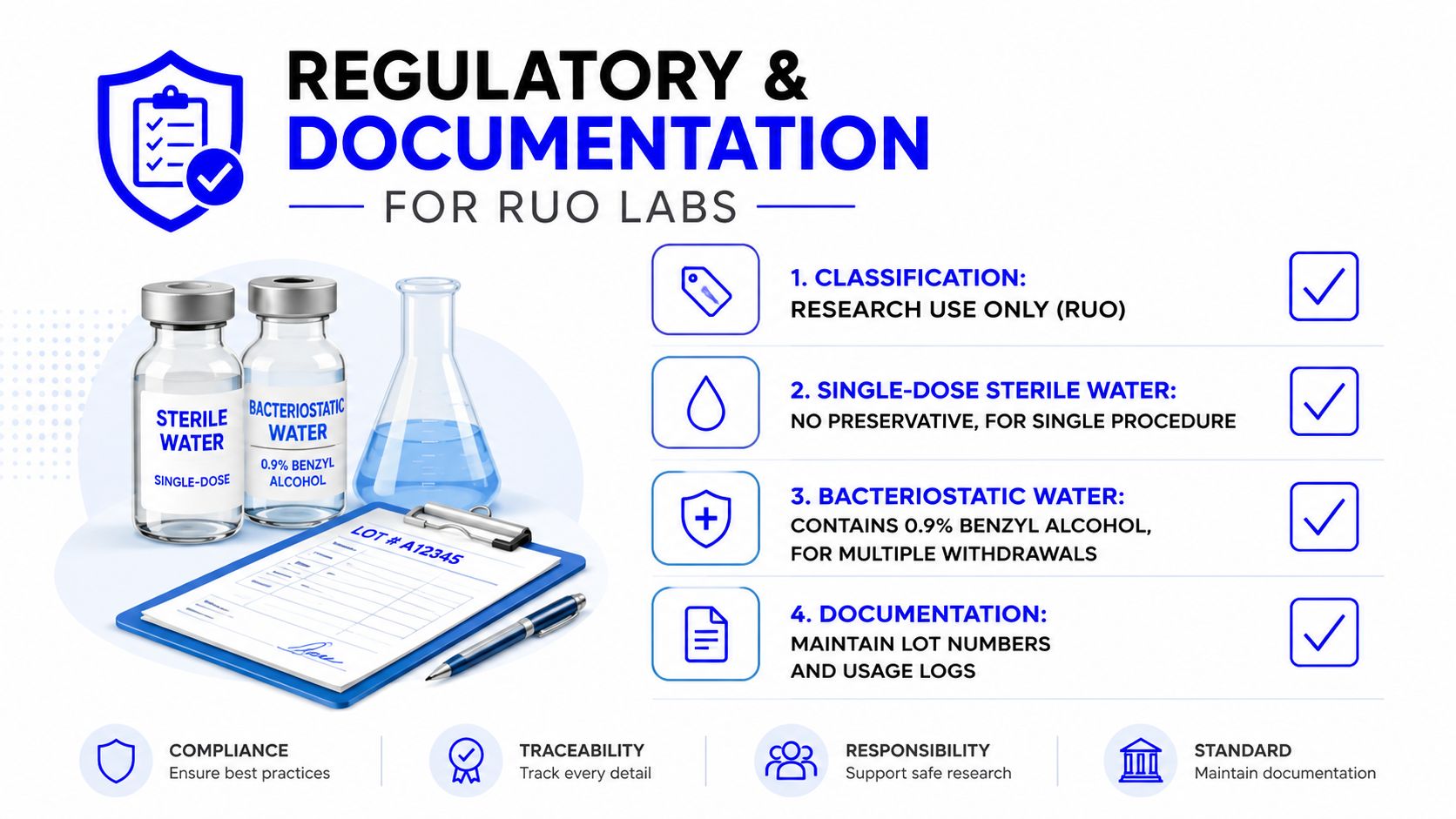
RUO labs usually care about more than whether the water is sterile. They need to know how the product is classified, whether the documentation matches the intended workflow, and whether the supplier can support lot traceability. That's where a seemingly small diluent choice becomes part of the quality system.
Documentation has to travel with the vial
For research use, the key records are the ones that make the batch defensible later. Certificates of Analysis, lot numbers, storage logs, and usage records all help show that the lab handled the material consistently. If the vial is reused, the first puncture date and in-use handling matter just as much as the product label.
This is also where supply-chain control matters. Labs working across regions often need clearer traceability than a basic product page can provide, especially when the material crosses borders or gets repackaged inside the facility. A practical reference on chain of custody in UK supply chains is useful here because the underlying principle is the same, track what moved, when it moved, and who handled it.
RUO sourcing is not the same as casual procurement
Herbilabs positions its bacteriostatic water for research use only, with documented lot review and quality controls around release. That kind of sourcing fits labs that need both the product and the paperwork, especially when repeatability matters as much as convenience. The same logic applies to sterile water, because preservative-free workflow choices still need traceable sourcing if the lab wants consistent records.
Documentation rule: if the vial can be accessed more than once, the paper trail should show the date, the storage conditions, and the rationale for reuse.
The bottom line is that the diluent choice affects audit readiness too. A lab that can explain why a preservative was used, or why it was avoided, is in a stronger position than one that just grabbed the nearest sterile-looking bottle.
Decision Framework for Choosing the Right Diluent
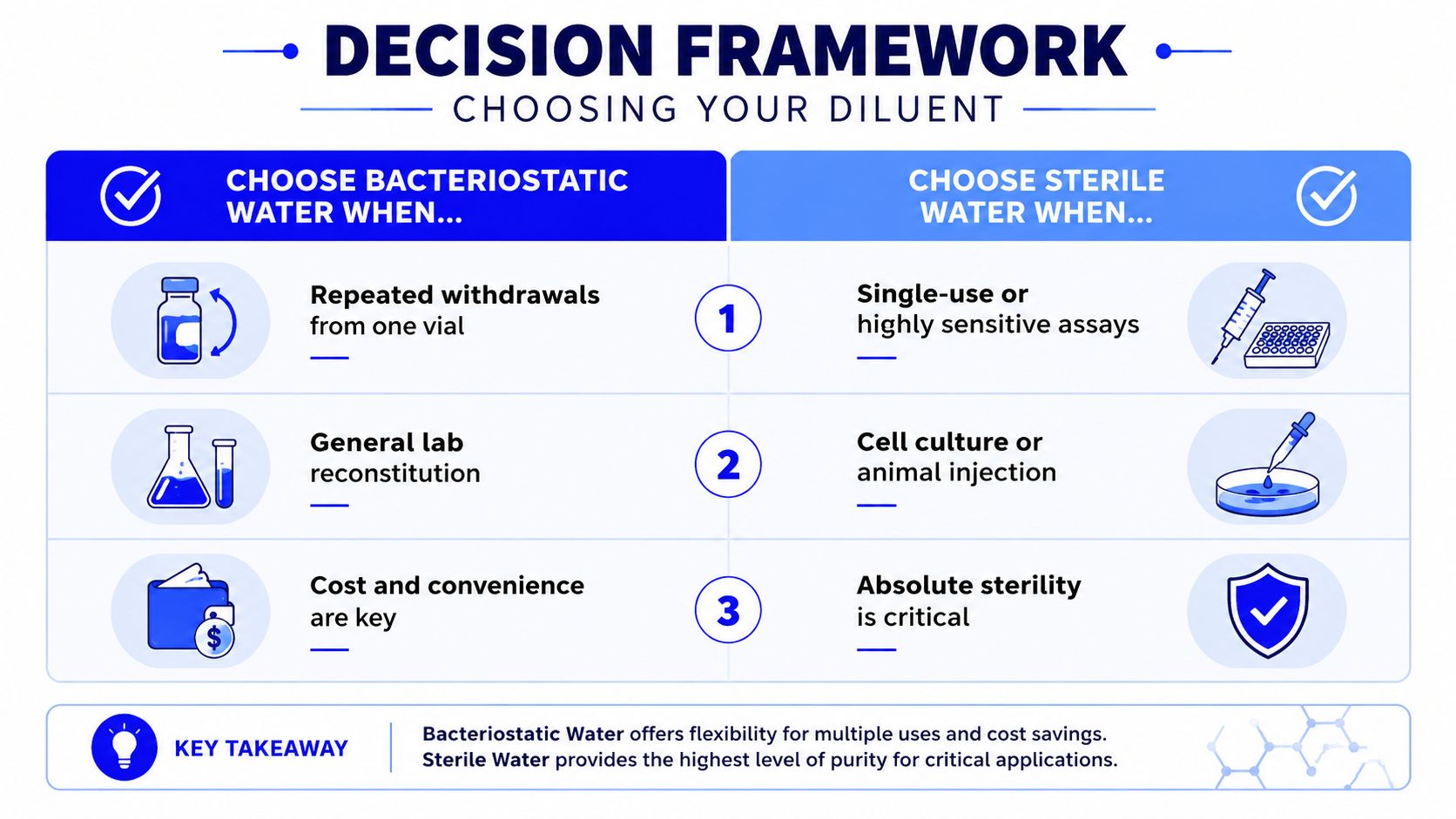
Start with the access pattern, then check assay sensitivity, then confirm the documentation trail. In practical bench terms, bacteriostatic water fits workflows that expect repeated withdrawals from the same vial, where benzyl alcohol is compatible with the molecule, the vial is handled aseptically, and the team needs an in-use window that supports refrigerated reuse up to 28 days. The Harvard feed is useful here because it reinforces the part that gets missed in casual comparisons, the preservative only helps when the vial is managed like a multi-dose container.
Sterile water becomes the better choice when the vial is opened once, the assay is sensitive to preservative carryover, or the downstream readout needs a preservative-free diluent. If the protocol is strict about residue, or the molecule has a narrow compatibility profile, sterile water removes one variable instead of adding another.
A practical decision matrix is easier to use than a loose rule of thumb:
- Choose bacteriostatic water when repeated access is part of the workflow, the vial will be refrigerated after puncture, and the compound tolerates benzyl alcohol.
- Choose sterile water when the material is reconstituted for immediate use, the sample should remain preservative-free, or the assay is sensitive enough that even small carryover matters.
- Choose sterile water when the protocol does not clearly authorize reuse. Ambiguity should default to the simpler diluent.
- Choose bacteriostatic water only when the access pattern, storage plan, and recordkeeping all support multi-use handling.
- Use the preservative-free option for steps that feed validation, analysis, or any readout where the diluent itself should not become part of the variable set.
That matrix works because it separates the questions that matter in RUO labs. First, will the vial be reopened? Second, can benzyl alcohol remain in the workflow without affecting the result? Third, can the bench team maintain the handling discipline the label assumes? If the answer to any of those questions is no, the safer choice is usually the preservative-free route.
The gray area is not between “multi-dose” and “single-use” as labels. It is between what the protocol says and how the vial will be handled on the bench. A vial can be labeled in a way that suggests flexibility, but if the workflow never requires a second puncture, preservative carryover just adds unnecessary exposure. If the vial will be accessed multiple times, then the preservative, the storage conditions, and the first-puncture record all become part of the method.
Herbilabs also offers bacteriostatic water vials for RUO workflows that are built around repeated access. That option fits after the decision is made, not before it. For teams formalizing the storage and reuse side of the SOP, the risk assessment and training guide is a useful reference for turning bench behavior into something repeatable.
Practical Checklist for Storage, Access, and Reuse
A bacteriostatic vial only performs as intended when the bench follows a clear SOP. Define where the vial lives after opening, set the storage range in the procedure, and require the team to record the first puncture before the vial goes back into rotation. If your lab keeps the vial in general bench traffic, leaves it out after use, or treats leftovers as a shared pool, the preservative no longer offsets the handling risk.
For labs formalizing that process, the risk assessment and training guide is a practical reference for turning access rules into something the team follows the same way every time.
A usable storage section should read like an operations checklist, not a reminder memo. State the refrigeration range in the SOP, name the storage location, and require a clean return path after each access so the vial is not exposed to repeated temperature swings or unnecessary handling. For teams that need a ready reference, Herbilabs also provides bacteriostatic water vials for RUO workflows where repeat access is part of the plan.
- Record the first puncture at once: the in-use record starts when the stopper is entered, not when the order arrives.
- Use one designated storage point: keep the vial in the same approved location after each access, with the temperature range written into the SOP.
- Limit casual sharing: each extra handoff increases the chance of a labeling error, a missed return, or a break in aseptic handling.
- Reject any vial with suspected contamination or visible handling issues: the in-use window does not justify keeping a compromised container in service.
- Write the reuse trigger into the method file: if the protocol expects repeated access, document who can puncture, how the vial is re-capped, and when it leaves circulation.
That level of detail matters because access patterns, not the product label alone, determine whether reuse stays controlled. A vial that is opened repeatedly for peptide or protein reconstitution needs tighter bench discipline than a one-time dilution step, especially when the assay is sensitive to preservative carryover or when sterile water is the required choice instead of a flexible substitute. A clear SOP keeps those differences visible before the vial becomes part of the method.