Private Label, White Label, Wholesale partnerships available - EU, USA and UK - Free shipping from €75
Waterglass for Sale: A Lab Buyer’s Sourcing Guide
Waterglass is the trade name for sodium silicate, usually supplied as a thick alkaline liquid with a pH around 11–12. A common commercial solution contains 37% sodium silicate by weight in water, although the exact formulation must be confirmed with the supplier.
Why do so many “waterglass for sale” listings describe the product without stating the modulus, solids content, or test method? Because most listings are written like commodity advertisements, while laboratories need procurement evidence. A low price means little if the batch arrives at the wrong composition, lacks a lot-specific certificate of analysis, or behaves differently from the material used in validation work.
The right purchase starts with the application, not the marketplace search result. Buyers need to identify the required modulus, choose liquid or solid form, match packaging to storage capacity, and verify supplier claims before committing to bulk stock. This guide treats waterglass as a laboratory and industrial procurement item, with emphasis on specifications, documentation, samples, logistics, and safe handling.
Table of Contents
- What Waterglass Actually Is
- Where Waterglass Is Used Across Industries
- Grades and Specifications That Matter
- Liquid vs Solid Forms and Packaging Options
- How to Evaluate Suppliers and Verify Their Claims
- Safe Handling and Storage Practices
- Alternatives Worth Knowing Before You Buy
- Your Waterglass Buying Checklist
What Waterglass Actually Is
Waterglass is sodium silicate, a family of compounds made from silica and sodium oxide and supplied in forms that dissolve or disperse in water. The name causes avoidable confusion. Some buyers expect a transparent glass product, while others expect a high-purity analytical reagent in a small bottle. Commercial waterglass is more often a thick, alkaline solution intended for detergents, binders, coatings, adhesives, and process chemistry.
The synonym matters because suppliers may list the same material under several terms, including sodium silicate, soluble silicate, liquid silicate, sodium metasilicate, or water glass. A search limited to one phrase can miss relevant manufacturers, technical data sheets, and regional distributors. Procurement teams should search by both the trade name and the chemical name, then compare the technical documents rather than the product titles.
Recognizing the material in a listing
A credible listing should identify more than “industrial grade.” It should state whether the product is liquid or solid, provide the silica-to-soda modulus, disclose solids content, and describe viscosity or density under a defined test condition. Packaging, batch traceability, shelf-life guidance, and a certificate of analysis should also be available before purchase.
The liquid normally looks clear to slightly hazy and pours more slowly than ordinary water. Its appearance alone doesn't establish suitability. Two solutions can look similar while having different alkali levels, silica levels, viscosity, and performance in a formulation.
The material's commercial history is also important. Sodium silicate isn't a niche laboratory curiosity. It belongs to a mature industrial supply chain that supports large-volume manufacturing, regional distribution, and application-specific grades. Buyers should therefore expect industrial documentation and delivery terms, not just a generic bottle label.
The practical question is simple: does the supplier provide enough information for a laboratory to reproduce the result? If the answer is no, the listing is incomplete regardless of how attractive the headline price looks.
Where Waterglass Is Used Across Industries
Waterglass appears in more industries than its plain appearance suggests. It can stabilize ingredients in detergent systems, bind mineral particles, seal surfaces, support casting processes, and participate in chemical processing. That broad use explains why many suppliers sell it through industrial channels rather than ordinary consumer retail.
The product has a long commercial history. An ACS-linked account of sodium silicate market development describes U.S. soluble-silicate manufacture beginning in the 1850s, followed by substantial expansion as downstream industries adopted the material. The same historical record reports sodium metasilicate output rising from an estimated 0.3 million pounds in 1928 to 386 million pounds in 1960, with 580 million pounds of capacity by 1980. Those figures are historical production milestones, not a forecast for a particular supplier.
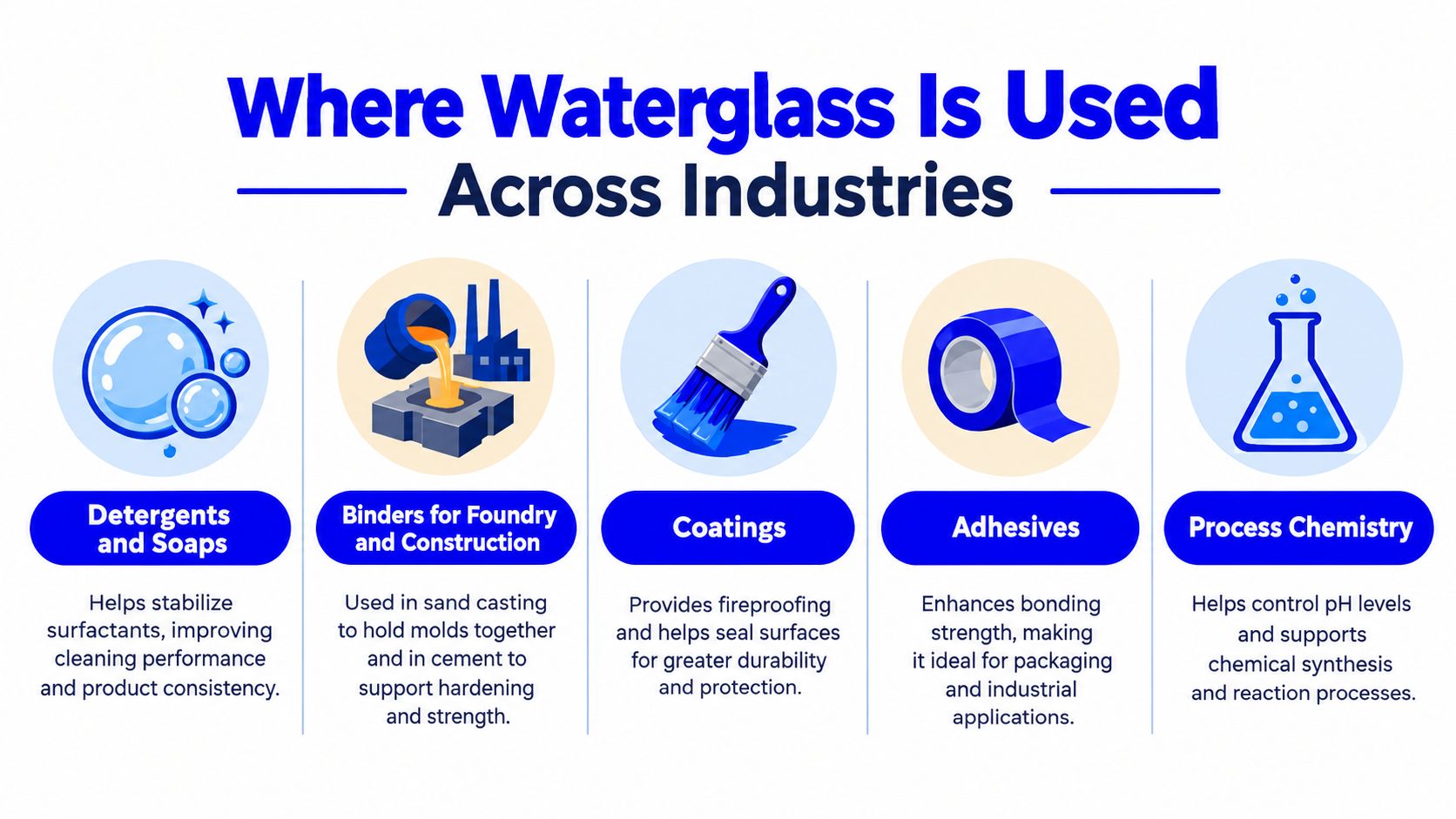
The application determines the buying profile
Detergents and soaps: Waterglass can support alkalinity and formulation stability in cleaning products. A detergent manufacturer usually cares about modulus, solids, viscosity, and compatibility with the rest of the formulation.
Foundry and construction binders: Sodium silicate can bind mineral materials, including sand in casting workflows, and can contribute to mineral-setting systems. These buyers often need consistent reactivity and predictable handling rather than reagent-style packaging.
Coatings: Silicate formulations can help create mineral-based surface treatments, sealing systems, and fire-resistant coatings. The chosen modulus affects how the solution behaves during application and drying.
Adhesives and packaging: The material's inorganic character makes it relevant where bonding, surface treatment, or mineral compatibility matters. Packaging manufacturers evaluating food and pharmaceutical packaging films may also encounter silicate-related materials in adjacent process and coating discussions.
Process chemistry: Laboratories and plants use sodium silicate in pH control, precipitation, synthesis, and other chemical operations. Here, traceability and repeatability usually matter more than marketing language such as “premium quality.”
A market report places the global sodium silicate market at USD 7.10 billion in 2025 and projects USD 9.76 billion by 2034, with a stated 3.60% CAGR. The same source reports that Asia Pacific held 41.90% of the market in 2025. These figures from Grand View Research's sodium silicate market analysis illustrate why buyers encounter bulk-oriented suppliers, regional warehouses, and industrial minimum order quantities.
The market structure creates a predictable challenge for laboratories. A small research group may need a controlled sample, while the supplier's standard process is designed around drums, bulk liquid, or industrial contracts. The buyer's task is to make the supplier document the exact material being offered, not to assume that a large industrial product automatically matches a laboratory requirement.
A short visual overview can help teams explain these use cases internally:
Grades and Specifications That Matter
The silica-to-soda modulus is the master specification for sodium silicate. It describes the relationship between silica and sodium oxide, and it gives buyers a practical way to anticipate alkalinity, viscosity, solubility, and end-use behavior. Treat modulus like a grit rating for sandpaper. A label that only says “sodium silicate” tells the buyer what material family is present, but not how the product will perform.
A modulus around 2.0–2.2 corresponds to a higher-alkali composition, with Na2O at 30.5–33.0% and SiO2 at 66.5–68.0%. A modulus around 3.0–3.5 shifts the formulation toward higher silica, with SiO2 at 75.5–77.7% and Na2O at 22.2–24.5%. These composition ranges are documented in the PubChem water glass reference.
Modulus and composition at a glance
| Modulus range | Na2O content | SiO2 content | Typical end-use behavior |
|---|---|---|---|
| 2.0–2.2 | 30.5–33.0% | 66.5–68.0% | Higher alkalinity, often relevant to detergent and strongly alkaline process systems |
| 3.0–3.5 | 22.2–24.5% | 75.5–77.7% | Higher silica character, often relevant to binders, coatings, and silica-focused applications |
The table is a purchasing aid, not a substitute for application testing. A formulation may require a narrow target inside a broader modulus range, and the supplier's nominal value may not describe the same test basis used by the laboratory.
Solids content is the next essential figure. It indicates how much of the delivered liquid is sodium silicate material rather than water. Without solids content, a buyer can't compare two liquid products fairly, calculate the amount of active material being purchased, or predict dilution and drying behavior.
Viscosity also needs context. A number without a measurement temperature, spindle, or method is weak evidence. Density or specific gravity can help identify a batch, but it doesn't replace modulus and solids testing.
Procurement rule: A waterglass listing that omits modulus and solids content should be treated as an incomplete specification, not as a bargain.
Before an order, the supplier should provide the target modulus, Na2O and SiO2 basis, solids content, viscosity, density or specific gravity, appearance, impurities, packaging material, storage conditions, and lot-specific acceptance criteria. If the supplier can't provide those details, the laboratory should keep searching.
Liquid vs Solid Forms and Packaging Options
Liquid waterglass is usually the practical choice when a laboratory needs immediate use and has suitable chemical storage. It arrives ready for dilution or formulation, but it also carries water weight, can be viscous to dispense, and may be more expensive to transport over long distances. Solid silicate reduces the water burden and can improve storage efficiency, yet it requires controlled dissolution and a preparation step before use.
The correct form depends on workflow rather than supplier preference.
| Buyer situation | More suitable form | Main trade-off |
|---|---|---|
| Small laboratory with limited preparation equipment | Liquid | Easier to use, but shipping and storage of liquid add cost and handling demands |
| Formulation group making solutions on site | Solid or liquid | Solid can support local preparation, while liquid reduces preparation time |
| Repeated production with established tanks and transfer equipment | Liquid | Efficient dispensing, but storage compatibility and temperature control matter |
| Infrequent use with a need to minimize delivered water | Solid | More preparation work and greater sensitivity to moisture during storage |
Commercial listings may distinguish products by purity claims reaching 99.9%, minimum order quantities beginning around 25 kg, and delivery windows ranging from immediate stock to two weeks. These marketplace indicators appear in supplier pricing and sourcing guidance for sodium silicate, but they shouldn't be accepted as proof of a particular batch's quality. A purity claim needs a method, a lot number, and a certificate to become useful procurement evidence.
Packaging should match the receiving site
Small containers suit bench work and method development. Drums fit laboratories with regular consumption and appropriate decanting controls. Intermediate bulk containers make sense for facilities with dedicated handling equipment and enough throughput to prevent prolonged storage. Tanker or bulk deliveries belong to established industrial operations with engineered unloading and containment.
A buyer evaluating a sterile diluent workflow may need a different product altogether, such as a ready-to-use reconstitution solution, rather than sodium silicate. That distinction matters because waterglass is an alkaline industrial chemical, not a universal laboratory diluent.
The supplier should confirm container compatibility, closure design, palletization, labeling, and transport conditions. Packaging isn't a cosmetic choice. It affects contamination risk, dispensing accuracy, storage life, and the amount of material lost during transfer.
How to Evaluate Suppliers and Verify Their Claims
Supplier evaluation should begin with a document request, not a price comparison. The most useful supplier is the one that can show how the stated modulus, solids content, viscosity, and purity were measured for the actual lot. A polished product page can't replace a defensible certificate of analysis.
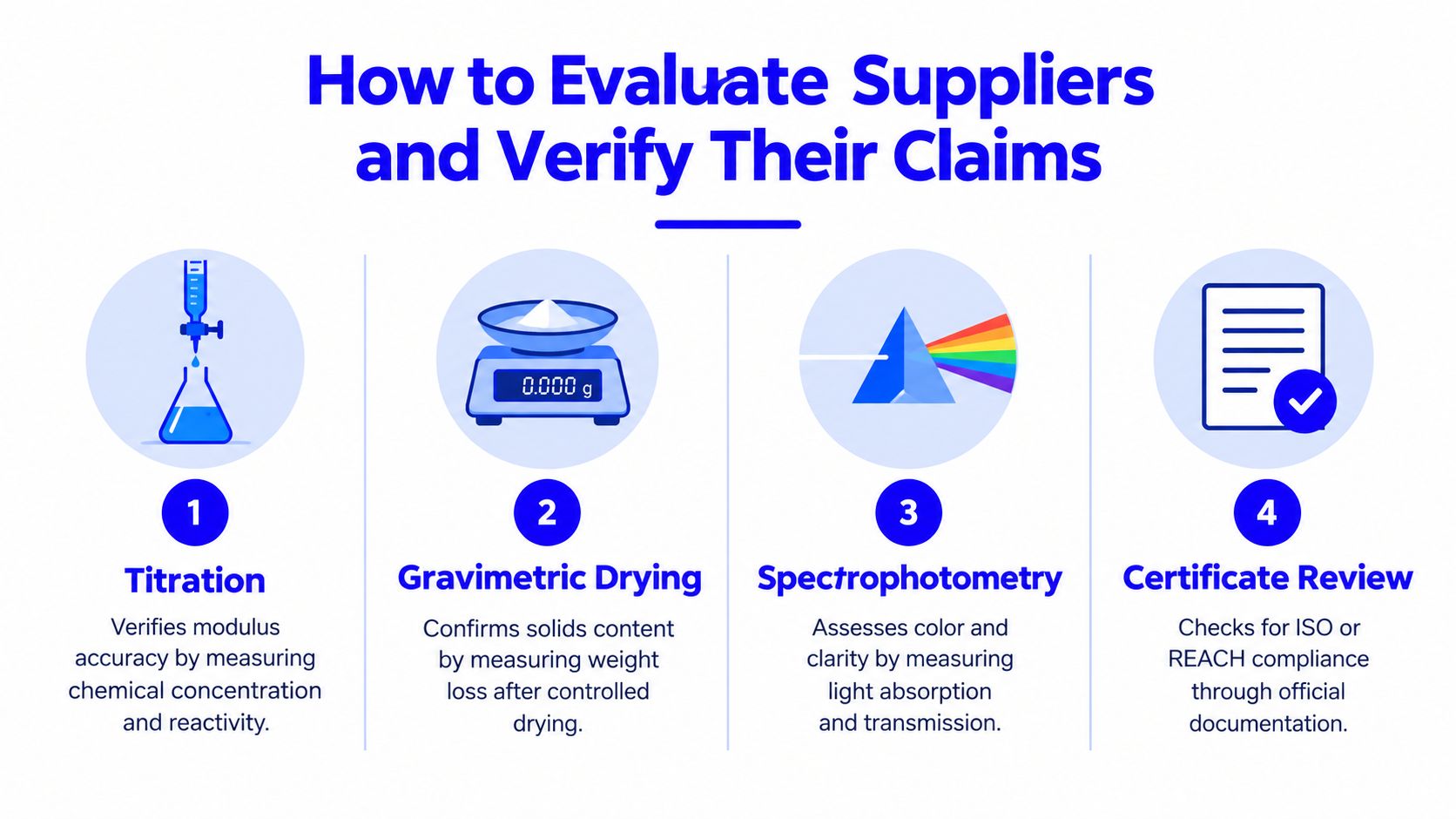
Four checks that expose weak listings
Verify modulus by titration. Buyer guides commonly identify titration as the relevant approach for checking the silica-to-soda relationship. The supplier should state the method, result, test basis, and lot number rather than provide only a rounded marketing value.
Verify solids by gravimetric drying. The laboratory should know how the supplier separates water from the dissolved silicate for the stated solids result. A gravimetric method gives the buyer a clearer basis for comparing liquid products than a vague “concentrated” description.
Review viscosity at a stated temperature. Viscosity changes with temperature, so a result measured without a temperature reference isn't sufficiently precise for process comparison. A buyer should request viscosity at 25°C, along with the instrument and method where available.
Read the certificate, not just the label. A lot-specific COA should connect the product name, batch, production date, test results, specification limits, and release approval. The buyer should also request safety documentation and any relevant compliance statements.
Samples protect the full order
A sample should be tested against the intended method before a laboratory commits to bulk stock. The test should include the properties that affect the workflow, such as appearance, viscosity, dilution behavior, modulus, solids, and compatibility with the formulation. A sample that passes visual inspection but fails a process test is still a failed purchase.
Supplier comparisons should include more than unit price:
- Documentation quality: Can the supplier provide a lot-specific COA before dispatch?
- Traceability: Can the supplier connect the container to a batch record and production site?
- Minimum order quantity: Does the required volume create unnecessary aging or disposal risk?
- Delivery reliability: Is the quoted lead time based on actual stock or a production estimate?
- Response quality: Does the technical contact answer specification questions precisely?
The lowest price per kilogram is often the most expensive option when a batch can't be released for use.
This evidence-heavy approach is especially important for laboratories that need reproducible results. A supplier that willingly provides test methods, samples, and traceability has made a stronger case than one that uses “high purity” as the entire specification.
Safe Handling and Storage Practices
Commercial sodium silicate solution is a highly alkaline liquid. Technical data for a common commercial solution report a pH around 11–12, specific gravity of about 1.39–1.41 g/cm3 at 20°C, and 37% sodium silicate by weight in water. The same technical sodium silicate listing reports water solubility of 22.2 g/100 mL at 25°C, rising to 160.6 g/100 mL at 80°C, along with hygroscopic behavior.
That temperature sensitivity has practical consequences. Heating can markedly increase dissolution, while moisture uptake can alter solid materials and compromise storage conditions. Containers should remain sealed, clearly labeled, and stored according to the supplier's safety data sheet and site chemical-management procedures.
Receiving and dispensing controls
Use suitable personal protection: Gloves, eye protection, and protective clothing should be selected according to the SDS and the site's risk assessment. Splashes deserve immediate attention because alkaline solutions can irritate or damage tissue.
Choose compatible containers: Aluminum should be avoided where the material or the supplier's SDS identifies an incompatibility. Storage managers evaluating chemical handling tank options should assess the tank material, fittings, secondary containment, transfer method, and cleaning plan together.
Control temperature: Don't heat a container casually to make dispensing easier. Any controlled warming should follow the supplier's instructions and the facility's chemical-handling procedure.
Limit moisture exposure: Solid waterglass should stay sealed when not in use. Liquid containers should be closed promptly after dispensing to reduce contamination and environmental exposure.
Inspect on arrival: Check for leaks, damaged closures, crystallization, unusual haze, and label or batch discrepancies. A damaged package is a supplier-quality issue that should be documented before the material enters inventory.
A laboratory's broader liquid-handling procedures should remain distinct from sodium silicate handling. For example, guidance covering bacteriostatic water applies to a sterile research diluent workflow, not automatically to an alkaline industrial chemical.
Storage conditions directly affect procurement value. A batch that becomes contaminated, absorbs moisture, or changes consistency because the receiving site lacked suitable controls may no longer match the COA. Buyers should therefore confirm storage requirements before ordering, not after the delivery arrives.
Alternatives Worth Knowing Before You Buy
Waterglass remains the default choice for many detergent, binder, coating, and process applications because its supply chain is mature and its industrial uses are well established. Switching makes sense only when the application has a specific incompatibility.
Potassium silicate deserves consideration where sodium content interferes with formulation performance, downstream analysis, or the finished product. It belongs to the same broad silicate family, but the potassium chemistry can change compatibility and processing behavior. A substitution still requires application testing and a new specification review.
Other binder or adhesive chemistries may be preferable when high alkalinity damages a substrate, disrupts a biological or chemical system, or creates an unacceptable downstream residue. The trigger is functional interference, not a general belief that another material sounds more advanced.
Buyers comparing desiccant-related materials should keep the chemistry separate from silicate procurement. Resources covering sustainable silica gel options UK may help with moisture-control decisions, but silica gel isn't a direct substitute for sodium silicate in detergent, binder, coating, or process applications.
The right alternative is the one that solves a documented compatibility problem. Without that problem, changing materials can add qualification work without improving the result.
Your Waterglass Buying Checklist
A procurement team can reduce most waterglass purchasing mistakes by requiring the following before approval:
- Define the application: Record the process, formulation, substrate, and performance target.
- Specify the modulus: Confirm the required silica-to-soda range instead of accepting “sodium silicate” as a complete grade.
- Confirm composition: Request Na2O, SiO2, and solids content on a stated test basis.
- Demand verification methods: Ask how modulus, solids, and viscosity were measured, including viscosity temperature.
- Request a lot-specific COA: Match the certificate to the batch, container label, and shipment documents.
- Test a sample: Validate process behavior before approving a drum, IBC, or bulk delivery.
- Match packaging to the site: Check container compatibility, transfer equipment, secondary containment, and storage capacity.
- Review logistics: Compare MOQ, actual stock position, lead time, packaging condition, and delivery reliability.
- Prepare handling controls: Establish alkaline chemical procedures, PPE requirements, spill response, and inspection at receipt.
The central buying decision isn't “which listing has the lowest price?” It is “which supplier can prove that the delivered batch matches the process requirement?” Documentation, traceability, and testable specifications protect the laboratory from paying for material that can't be released.
A supplier shortlist should be challenged with the checklist immediately. Any vendor that can't provide the modulus, solids basis, test methods, sample terms, and lot documentation should be removed before price becomes the deciding factor.
Herbilabs offers sterile bacteriostatic water and reconstitution solutions in laboratory-focused vial formats, with lot-specific COAs and wholesale or private-label options for research-use workflows. Review the available Herbilabs products when the laboratory needs a documented sterile diluent rather than sodium silicate.