Private Label, White Label, Wholesale partnerships available - EU, USA and UK - Free shipping from €75

How Long Do Peptides Last: Shelf-Life Guide
Lyophilized peptides stored correctly usually last 1 to 3 years, while reconstituted peptides typically remain usable for days to weeks, depending on the preservative, temperature, formulation, and peptide sequence. Properly packaged GMP-manufactured peptide drugs are commonly assigned shelf lives of 18 to 36 months at 2 to 8°C, but those dates apply to validated products, not every research vial.
A researcher may discover the difference after preparing a working solution, returning the vial to the refrigerator, and seeing inconsistent assay results several weeks later. The vial hasn't necessarily reached a simple calendar expiration date. Its handling history may have changed the chemistry long before the label became obviously outdated.
The more useful question isn't only “how long do peptides last?” It's which storage state, temperature, diluent, and handling routine keep the peptide reliable? That shift matters because a dry peptide can remain stable for years, while the same material in solution may become unsuitable much sooner.
Table of Contents
- The Moment Your Peptide Stops Working
- Powder vs Solution Understanding the Core Difference
- Temperature Tiers and What They Mean for Your Work
- The Chemistry Behind Degradation Pathways
- Best Practices to Extend Usable Life
- Why the 28-Day Rule Is Not Universal
- Documentation and Quality Control for Research Labs
- Making the Right Storage Decision for Your Peptide
The Moment Your Peptide Stops Working
The first warning often arrives as a result that doesn't fit the rest of the experiment. A researcher prepares a solution from a lyophilized vial, draws working portions over several weeks, and follows the same assay method each time. Then one batch produces weaker activity, unusual variability, or a result that can't be reconciled with the earlier measurements.
The immediate suspicion usually falls on pipetting, cell condition, assay timing, or reagent quality. Those checks are sensible, but the storage timeline deserves equal attention. The peptide may have spent too long at room temperature, experienced repeated warming during withdrawals, or remained in a formulation that was chemically unsuitable for extended holding.

The overlooked timeline
Most shelf-life answers divide peptides into two categories, powder and reconstituted solution, then attach a broad duration to each. That approach is useful as a starting point, but it leaves out the variable that often decides the outcome, sequence-specific chemical stability.
Two peptides stored in the same refrigerator can behave differently because their amino-acid composition, concentration, pH, buffer, and exposure history aren't identical. A preservative can reduce microbial risk without preventing oxidation, hydrolysis, deamidation, or aggregation.
Practical rule: A vial's discard decision should account for its storage and access history, not just the date printed on its label.
The reliable workflow begins by recording when the vial was received, when it was reconstituted, which diluent was used, and how often it was accessed. If those details are missing, a calendar rule may be the only available control, but it won't explain why one solution remains dependable while another loses performance early.
Powder vs Solution Understanding the Core Difference
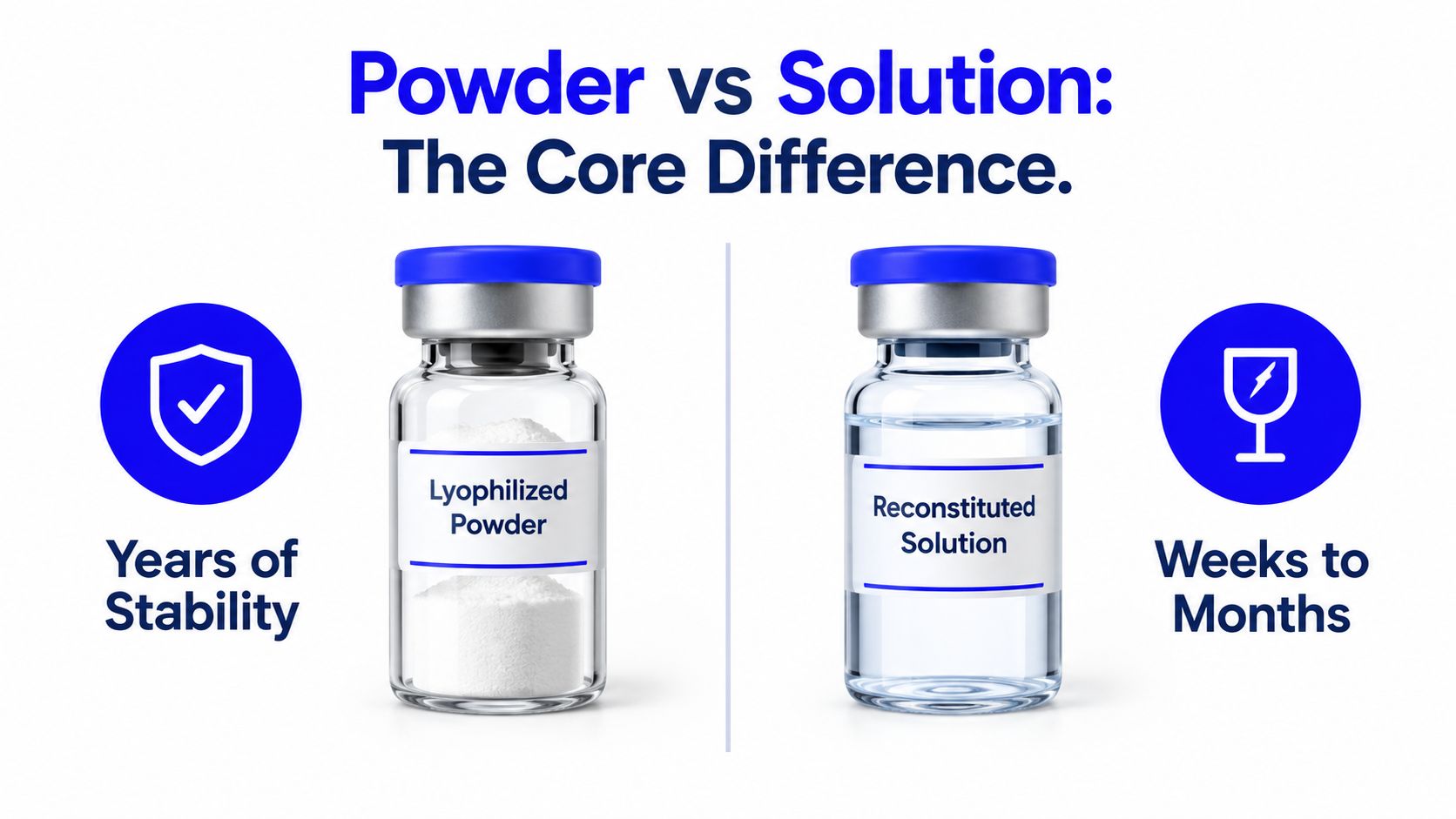
Lyophilization gives a peptide a more stable physical state by removing water. That matters because water enables hydrolysis, one of the main chemical routes through which peptide bonds and vulnerable side chains can degrade. A sealed, dry vial therefore provides a practical long-term storage format, provided the material remains protected from heat, light, and moisture.
Industry guidance commonly places properly stored lyophilized research peptides in a stability range of 1 to 3 years, while validated GMP-manufactured lyophilized peptide drugs are often assigned 18 to 36 months at 2 to 8°C in suitable packaging. These are useful reference ranges, not universal guarantees. The manufacturer's stability data, packaging, sequence, and storage conditions still control the final decision. Peptide storage guidance explains the difference between dry and reconstituted stability.
Dry storage is the holding state
The powder state suits material that won't be used immediately. A lab can keep the vial sealed, limit exposure to humidity, and remove only the quantity needed for a defined working period. This approach avoids turning the entire supply into a solution before the experiment requires it.
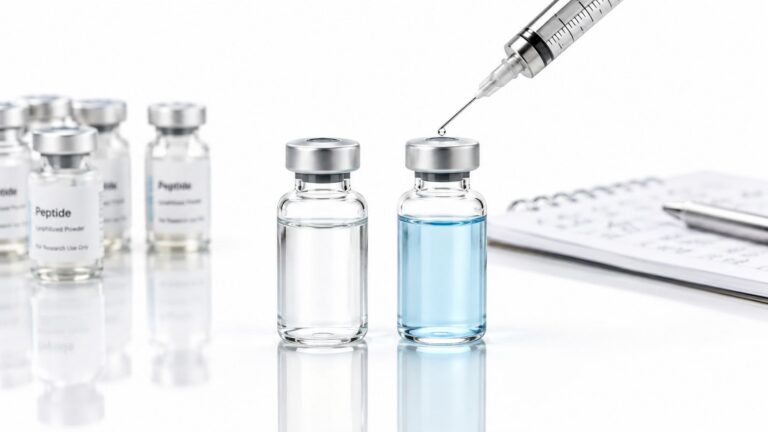
Reconstitution changes the risk profile. Water restores mobility to molecules and creates an environment where hydrolysis, oxidation, deamidation, and aggregation can proceed. The usable period then falls to days or weeks in many workflows, with freezing sometimes extending storage when the peptide and formulation tolerate it.
A practical mental model is straightforward:
- Lyophilized powder: the preferred state for long-term holding.
- Reconstituted solution: the working state, with a shorter and more sequence-dependent life.
- Aliquoted frozen solution: a risk-control option when a solution must be retained, provided freeze-thaw exposure is controlled.
The Herbilabs lyophilized peptide guide provides additional handling context for keeping dry material protected before preparation. A useful visual companion is included below.
The central trade-off is convenience versus retention. Reconstituting a full vial may simplify daily access, but it exposes the whole amount to solution-phase degradation. Keeping material dry for as long as possible usually gives the lab more control.
Temperature Tiers and What They Mean for Your Work
Temperature doesn't create a simple pass-or-fail boundary. It creates a degradation gradient. The warmer the peptide becomes, the faster many chemical reactions proceed, and the shorter the practical working window can become.
Room-temperature exposure is the least forgiving option for a reconstituted peptide. Technical guidance describes measurable degradation for many peptides within 24 to 72 hours at room temperature, and some solutions can begin changing within hours. A vial left on a bench during setup, transport, or repeated handling may therefore accumulate meaningful exposure even when it still looks clear. Temperature and expiration guidance describes the effect of room-temperature exposure.
How the tiers compare
Refrigeration at 2 to 8°C is the normal baseline for short-term use of a reconstituted peptide. It slows chemical reactions and supports routine access, but it doesn't stop degradation. A refrigerated solution still needs a defined in-use period based on the peptide, diluent, concentration, and handling record.
Freezing at −20°C is more appropriate when a prepared solution won't be used promptly. One commonly cited storage approach places short-term peptide storage at −20°C for roughly 1 to 2 weeks, with −80°C reserved for longer storage. These values are practical guidance rather than a substitute for peptide-specific validation. Technical information on peptide stability compares refrigerated and frozen storage.
Matching temperature to workflow
A researcher planning daily access may choose a refrigerated working vial and keep the remaining dry material frozen. A lab preparing a solution for occasional assays may divide it into single-use aliquots and freeze those portions instead of repeatedly thawing one container.
The mistake is treating freezing as automatically protective. Repeated freeze-thaw cycles can stress a solution, promote aggregation, and create inconsistent exposure. A freezer also doesn't correct contamination, unsuitable pH, or a vulnerable sequence.
Cold storage preserves opportunity. It doesn't replace formulation control, sterile handling, or a peptide-specific discard rule.
A temperature log is valuable because memory is unreliable. If a vial warms during a power interruption, shipment, or refrigerator failure, the event belongs in the record. The correct response depends on the material's sensitivity and the duration of exposure, not on whether the solution returned to the refrigerator afterward.
The Chemistry Behind Degradation Pathways
Peptide degradation in solution usually involves more than one pathway. The most important route depends on the sequence and formulation, which is why a universal expiration rule can mislead even when it sounds practical.
Hydrolysis involves reaction with water and is a central reason dry storage is more stable. Oxidation can affect susceptible amino-acid residues when oxygen, light, metals, or other reactive conditions are present. Deamidation can alter vulnerable residues and change the molecular species in the vial. Aggregation causes peptide molecules to associate into larger structures, potentially changing solubility and biological behavior.
These processes don't all respond to the same control. Lowering temperature can slow reaction rates, but it doesn't remove the underlying chemical vulnerability. Light protection can reduce photo-oxidative stress, but it won't solve a poor buffer choice. A preservative can manage microbial growth, but it doesn't stop chemical breakdown.
Why the sequence matters
A peptide's amino-acid composition shapes its stability profile. The surrounding pH, buffer, concentration, and solvent environment then modify how that sequence behaves. A solution that appears stable for one peptide may be unsuitable for another, even when both are stored in the same vial format and refrigerator.
This is why technical storage guidance recommends keeping peptides lyophilized at −20°C or −80°C whenever possible, and using chilled, single-use aliquots when solution storage is necessary. Handling and storage guidance discusses sequence-dependent stability and formulation effects.
Separate the two risks
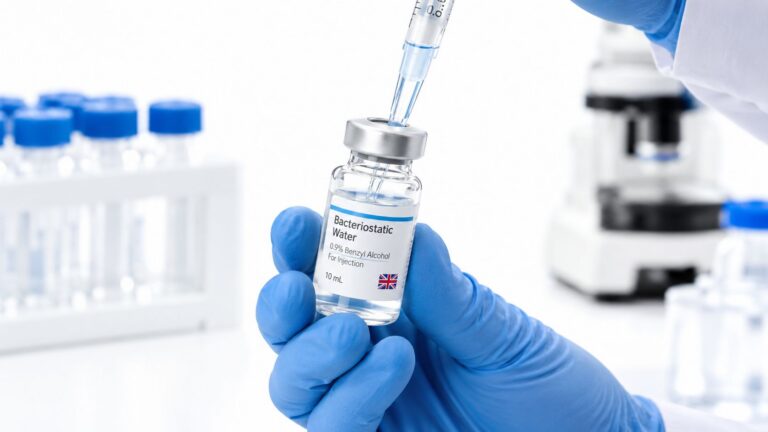
A researcher should distinguish microbiological risk from chemical risk. Bacteriostatic water contains benzyl alcohol, which suppresses microbial growth and can support multi-dose handling under appropriate conditions. It doesn't make the peptide chemically immune to heat, oxidation, deamidation, or aggregation.
The practical shelf life is governed by whichever limit arrives first. A solution may remain microbiologically controlled while its active peptide content declines. Conversely, careless access can introduce contamination before the peptide has experienced substantial chemical decay.
That distinction changes the handling decision. Preservative choice is one layer of control, while temperature, aliquoting, light protection, and sequence-specific knowledge provide the others. No single intervention reliably addresses every degradation pathway.
Best Practices to Extend Usable Life
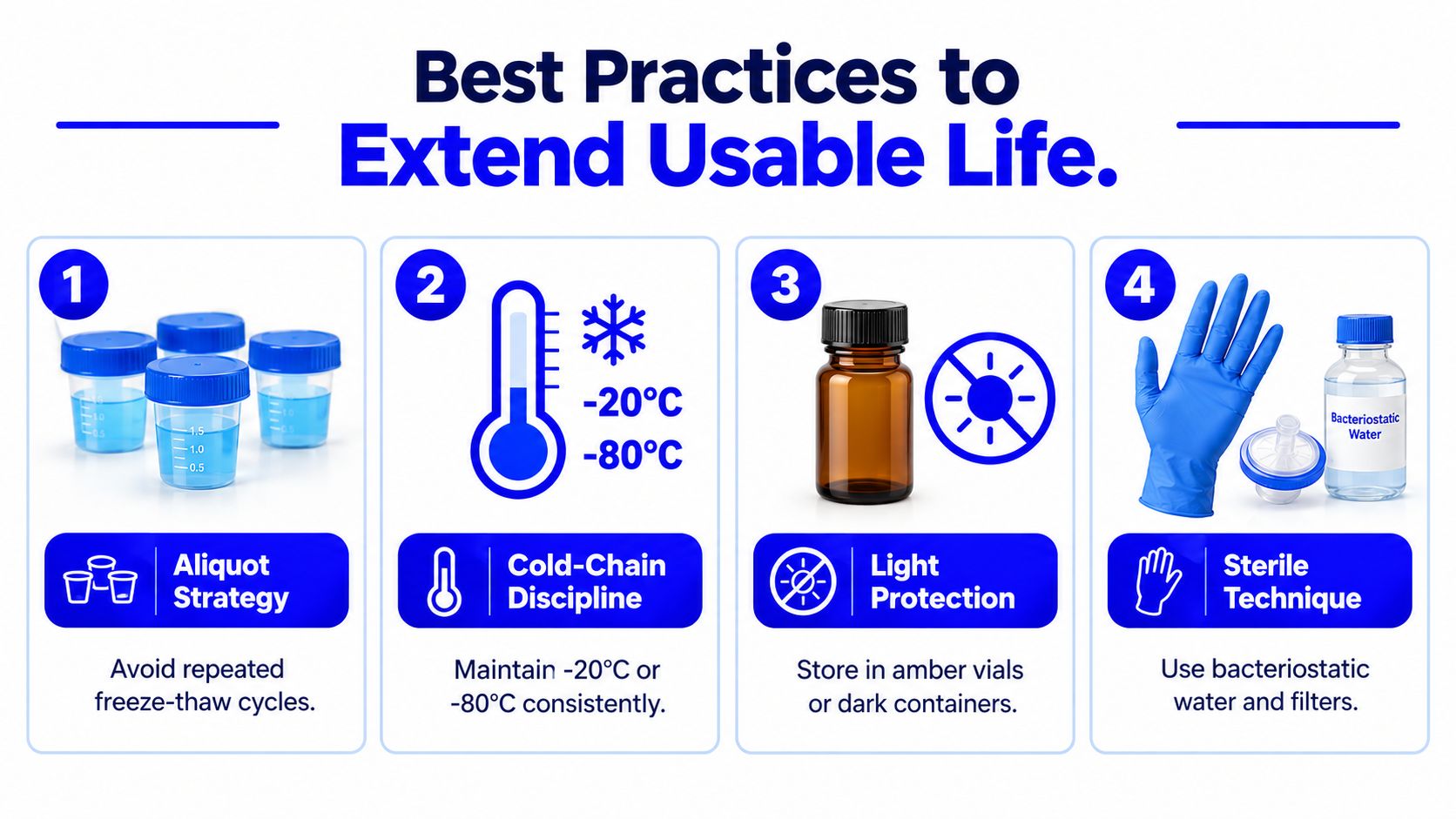
Longer usable life comes from reducing avoidable exposure. A small lab doesn't need an elaborate inventory platform to do that. It needs a consistent routine that keeps the peptide dry until required, limits access to prepared material, and makes every temperature excursion visible.
The first decision is whether the full vial needs to be reconstituted. If the experiment uses only a portion, preparing the entire amount creates unnecessary solution-phase exposure. A better workflow keeps reserve material in its original dry state and prepares a working quantity that matches the near-term experimental schedule.
A low-friction handling routine
- Use aliquots: Divide prepared solution into portions that can be used without repeatedly thawing the same vial. Single-use aliquots reduce warming cycles and limit repeated punctures.
- Protect the cold chain: Refrigerate short-term working solutions at 2 to 8°C. Use −20°C or −80°C when the planned holding period requires frozen storage, following peptide-specific guidance.
- Limit light exposure: Keep light-sensitive material in amber vials or a dark secondary container. Light protection is especially useful when the sequence or formulation has oxidation concerns.
- Record first access: Label the reconstitution date, diluent, concentration, storage condition, and first-puncture date. A vial without a clear history should receive a conservative decision.
- Use aseptic technique: Clean the work area, use sterile equipment, and avoid leaving the vial open or uncapped. Bacteriostatic water supports multi-dose workflows, but it doesn't compensate for poor technique.
The peptide reconstitution protocol can serve as a reference when a lab is standardizing preparation steps. The key is consistency, not complexity.
Bench reminder: The best storage protocol is the one that researchers can follow every time without creating extra transfers or unnecessary warming.
A printed label and a simple temperature log often prevent more confusion than an informal verbal rule. When a vial is opened, the lab should be able to answer what happened to it, where it was stored, and how often it was accessed.
Why the 28-Day Rule Is Not Universal
A vial can remain refrigerated and appear unchanged while its peptide chemistry is already shifting. The 28-day rule is a useful conservative operating standard for many multi-dose workflows using bacteriostatic water, but it is not a universal chemical expiration point. Technical guidance describes typical refrigerated in-use windows of roughly 4 to 8 weeks for peptides reconstituted in bacteriostatic water, while many laboratory procedures use about 28 days as the cautious limit. Guidance on bacteriostatic water explains the relationship between multi-dose handling and peptide stability.
Benzyl alcohol can suppress microbial growth during multi-dose handling. It does not stop sequence-specific chemical decay. One peptide may retain useful integrity beyond a conservative handling window, while another may degrade before that window closes.
Factors that shift the practical limit
Sequence composition is the hidden variable that blanket rules leave out. Reactive residues and structural features can make one peptide more vulnerable to oxidation, deamidation, or aggregation than another.
Buffer and pH also influence the outcome. The same peptide can behave differently in different formulations because its chemical environment affects reaction rates and solubility. A dating rule that ignores formulation can therefore create either unnecessary waste or unwarranted confidence.
Handling history changes the decision in either direction. Repeated warming, multiple punctures, light exposure, and poorly controlled dilution lower confidence. A carefully prepared, continuously chilled aliquot carries a different risk profile from a vial opened repeatedly and left on the bench.
Research guidance describes refrigerated reconstituted stability ranging from 24 to 72 hours in some situations to 28 to 90 days in others, depending on sequence and handling. A discussion of peptide stability and degradation highlights why condition-based decisions are more reliable than one-size-fits-all dating.
Set an internal discard rule that combines the conservative microbiological window with available formulation or stability data. Discard a solution after accidental warming, visible change, uncertain access history, or unexplained assay drift. The calendar should support that judgment, not replace it.
Documentation and Quality Control for Research Labs
Shelf-life controls fail when the lab can't reconstruct what happened to a vial. Documentation doesn't need to be bureaucratic, but it does need to connect the material, the preparation event, and the experiment that used it.
At receipt, the researcher should record the product identity, lot number, condition of the shipment, storage location, and available Certificate of Analysis. The intake record should also note whether the vial arrived dry, sealed, and free from visible damage. These details support traceability if later results look unusual.
The minimum useful record
A practical vial log includes:
- Material identity: Peptide name, formulation, amount, and supplier.
- Lot traceability: Lot number and Certificate of Analysis reference.
- Preparation event: Reconstitution date, diluent, concentration, and operator.
- Access history: First puncture date and notable subsequent withdrawals.
- Storage record: Refrigerator or freezer location, temperature range, and excursions.
- Disposition: Date and reason for discard, especially when the decision follows warming or unexpected assay performance.
A lot-specific Certificate of Analysis can help separate peptide variability from handling failure. It won't establish the stability of every prepared solution, but it gives the lab a documented starting point for identity, purity, and release review.
Quality control without heavy software
A shared spreadsheet, printed vial card, and calibrated temperature display may be sufficient for a small independent lab. The important feature is that the record stays with the material and can be reviewed before an experiment begins.
Researchers should compare results against the vial's handling history when an assay changes unexpectedly. If one lot was reconstituted earlier, warmed repeatedly, or stored in a different buffer, those variables belong in the investigation rather than being dismissed as random noise.
A disciplined lab also defines who can approve continued use after an excursion. Without that decision rule, researchers may keep a questionable vial just because discarding it feels wasteful.
Making the Right Storage Decision for Your Peptide
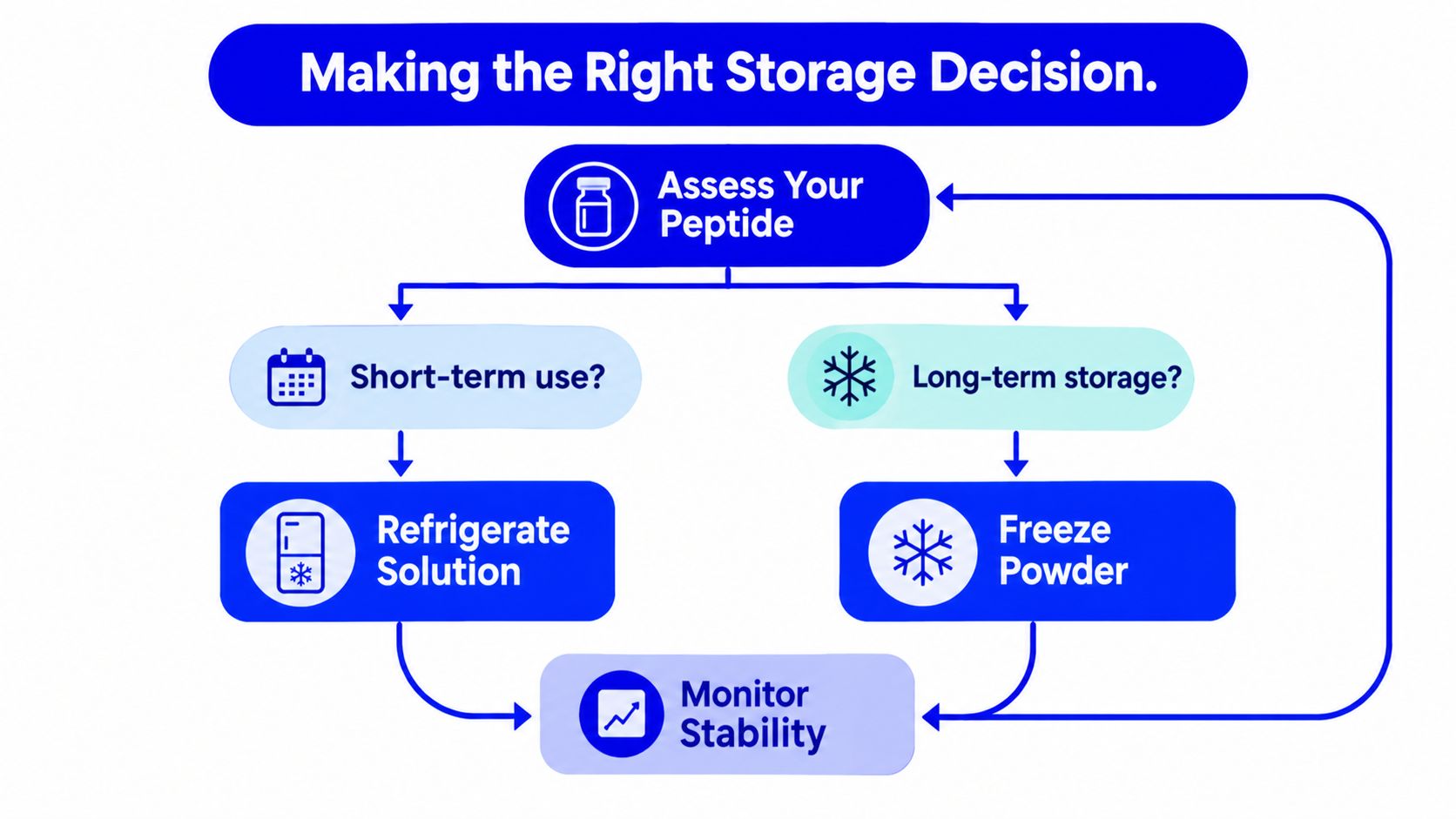
A useful storage decision begins with the peptide's intended use, not with a generic expiration number. If the material will remain unused, the dry state usually offers the strongest stability margin. If it will support immediate experiments, a refrigerated working solution may be practical. If access will be intermittent, aliquoting can prevent repeated stress on the main supply.
The sequence should then influence the level of caution. When sequence-specific data are available, they should take priority over broad internet guidance. When they aren't available, the lab should use conservative storage, minimize solution hold time, and treat unexplained changes as a reason to stop rather than continue guessing.
A practical decision flow
- Assess the starting material. Confirm whether the peptide is lyophilized or already in solution, and review the lot documentation.
- Define the work window. Choose a refrigerated working format for near-term use, or keep the peptide dry when access is not imminent.
- Choose the diluent carefully. Consider microbial control and chemical compatibility separately.
- Divide when access is intermittent. Use aliquots to reduce repeated warming, thawing, and puncturing.
- Monitor the record. Track temperature, light exposure, first access, and any visible or analytical change.
- Discard on evidence, not optimism. Uncertain history, accidental warming, contamination concerns, or unexpected assay performance should override a reassuring calendar date.
Shelf life is therefore a controllable variable rather than a fixed number. Good storage doesn't guarantee activity indefinitely, but it preserves the conditions under which the peptide can remain reliable and makes failures easier to investigate.
Herbilabs provides bacteriostatic water and reconstitution solutions for research-use workflows, along with lot-specific quality documentation that can support peptide preparation records. Researchers and lab managers can review the available formats and handling information at Herbilabs before standardizing their next reconstitution workflow.