Private Label, White Label, Wholesale partnerships available - EU, USA and UK - Free shipping from €75

Sterile Water for Injection: A 2026 Guide
You're at the bench, one vial short of starting a reconstitution, and the shelf holds a few look-alike containers that all seem to say “sterile.” That's where mistakes begin. Sterile water for injection looks simple, but in lab and pharmacy workflows it carries rules about use, storage, withdrawal pattern, and, in the wrong hands, serious patient risk.
Table of Contents
- Why the Water in That Vial Matters More Than You Think
- What Sterile Water for Injection Is
- USP Standards and What They Mean in Practice
- SWFI vs Bacteriostatic Water vs Saline vs Sterile Water
- How Sterile Water for Injection Is Actually Made
- Safety Beyond the Label and the Hemolysis Trap
- Storage, Handling, and Planning Around SWFI Shortages
- Putting It All Together Before You Open the Next Vial
Why the Water in That Vial Matters More Than You Think
A researcher reaches for a vial to reconstitute a lyophilized peptide. The label says water, the cap looks clean, and the bench is busy, so the choice feels routine. It isn't routine, because the vial is part of the experiment's input chain, and the wrong diluent can alter stability, documentation, and downstream handling in ways that are easy to miss at the moment of use.
That matters even more when the same product type appears in mixed settings, such as a research lab with pharmacy-adjacent storage or a shared prep room. A vial selected casually for a bench task can later be mistaken for a different IV-adjacent product if packaging and storage are not tightly controlled. The product is not just water, it is a regulated input with a defined use pattern.
Practical rule: if the workflow is “mix once, use once, discard the rest,” the product choice should match that one-time design, not a multi-dose habit.
The operational reality is that a “simple” diluent can shape how a team documents the prep, how long a mixed product stays acceptable to use, and how clearly staff understand what the vial is for. In other words, the water in that vial is part of the control system. That is why sterile water for injection deserves the same attention as the compound it helps prepare.
What Sterile Water for Injection Is
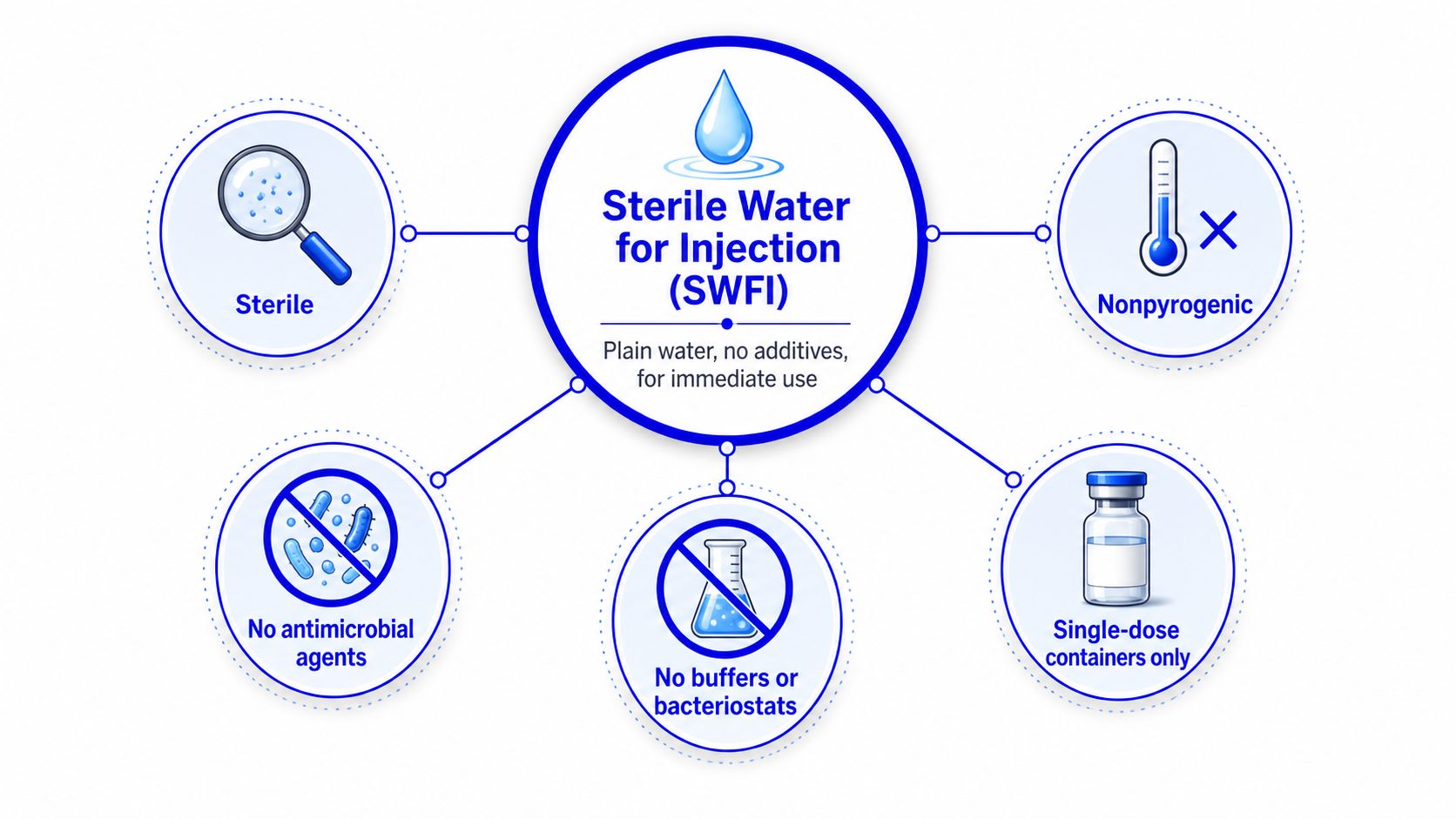
A new researcher sees a vial labeled water and may assume it is interchangeable with other sterile liquids on the shelf. That assumption can create problems fast. Sterile Water for Injection, SWFI, is sterile, nonpyrogenic water with no bacteriostat, no antimicrobial agent, and no added buffer. Its value comes from what is left out, because those missing additives keep the product from changing how an injectable preparation behaves after opening. Major pharmacopeial and drug-labeling sources describe it as a single-dose product for diluting or dissolving injectable drugs, not a vial meant for repeated access. See the visual summary below.
The easiest way to understand SWFI is to separate its job from its packaging. It is water, but it has been made sterile and nonpyrogenic so it can support parenteral preparation under controlled conditions. It is also packaged with a use pattern that assumes immediate, single-use handling. That packaging choice is not cosmetic, it tells staff how the vial is supposed to move through a workflow.
A common U.S. presentation is a 10 mL single-dose vial, and cartons often contain 10 vials or 25 vials (FDA label reference). For lab and pharmacy staff, that detail matters because it signals a controlled-use format, not a storage container. If a process requires repeated withdrawals, SWFI is the wrong starting point unless a separate aseptic single-use process is being followed and the remaining volume is discarded right away.
A vial marked for single-dose use should be handled like a one-time tool, not like a pantry item.
That distinction becomes easier to miss when people move between bench work and clinical-facing environments. A lab user may focus only on reconstitution, while a pharmacy user also has to account for labeling, in-use handling, and what happens to the vial after the first puncture. The product itself does not change, but the risk of misuse rises as the workflow becomes more regulated. For teams that need a wider compliance framework, testing water for Melbourne homes shows how water quality thinking changes when the use case changes, even though the material may seem simple.
USP Standards and What They Mean in Practice
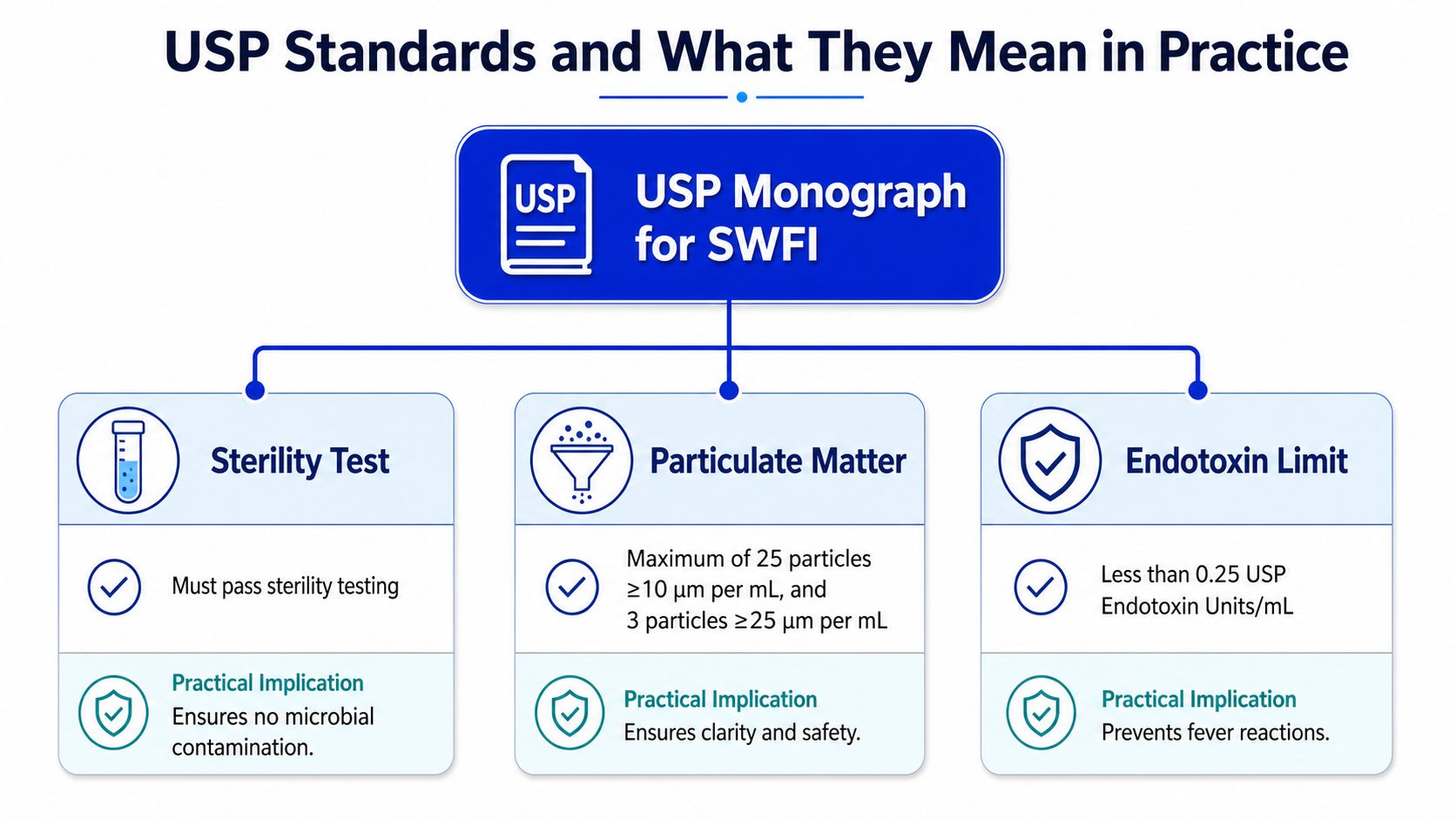
A vial of SWFI only becomes a usable compliance item once it is measured against the USP monograph. The standard requires sterility, particulate matter control, and an endotoxin limit of less than 0.25 USP Endotoxin Unit per mL (USP monograph). It also limits the product to single-dose glass or plastic containers no larger than 1 L, with Type I or Type II glass preferred, as reflected in the monograph and the related standards summary in this USP standards guide for labs compliance and quality. Those details are not background noise. They define what the product can safely be used for, and how the vial should move through a pharmacy or lab workflow.
Sterility, particulates, and endotoxin
Sterility means the finished unit should pass sterility testing, so viable microbes are not expected in the vial. Particulate matter limits are there to reduce visible and subvisible contamination, which matters any time a fluid will be used with injectable drugs. Endotoxin is the pyrogen concern. A clear vial can still carry a problem that causes fever reactions after administration, so clarity alone never proves suitability.
A practical way to read the monograph is to treat it like a release checklist. Bench staff, pharmacy staff, and procurement teams all need the same habit, verify the product against the standard before it enters use, rather than assuming that a clean-looking container is enough.
What the container format tells the user
The container format is part of the specification, not an afterthought. A single-dose vial is built for one access event, then discard. Once punctured, it is not meant to behave like a stock bottle, so “save the rest for later” is the wrong mental model.
That detail matters in real workflows. A researcher may only be thinking about reconstitution, while a pharmacy technician has to think about labeling, in-use handling, and what happens after the first puncture. The same vial can look harmless in a bench drawer and high risk at the point of administration, especially if someone treats it like a reusable supply. For a broader compliance lens that compares water quality expectations against intended use, testing water for Melbourne homes shows how the testing standard changes with the job the water is expected to do.
SWFI vs Bacteriostatic Water vs Saline vs Sterile Water
A shelf full of water-based vials can look interchangeable until the use pattern is written out. The core question is not “which one is clean,” it is “which one matches the withdrawal pattern, preservative needs, and target compound.” That's where teams avoid a lot of silent mistakes.
The four common options side by side
| Product | Preservative | Dose Format | Typical Use | In-Use Window |
|---|---|---|---|---|
| Sterile Water for Injection | No | Single-dose | Diluting or dissolving injectable drugs | Use once, then discard |
| Bacteriostatic water | Yes, benzyl alcohol | Often multi-dose | Repeated withdrawals where preservative is needed | Supported for repeated access when used aseptically |
| Sterile water | No | Varies by product | Fresh-prep or short-handle workflows | Short handling window, product-specific |
| Saline | No preservative in standard forms | Single or multi-dose, depending on product | Isotonic dilution or flushing workflows | Depends on container and label |
The simplest decision point is whether the workflow needs repeated withdrawals. If it does, a preserved product such as bacteriostatic water is the more defensible default because it is built for that handling pattern. If the workflow is a one-time reconstitution and the label calls for a fresh, preservative-free diluent, SWFI fits better.
SWFI differs from plain sterile water in its clinical framing. The SWFI label language and packaging are tied to injectable preparation, while “sterile water” on its own can appear in more than one context and should be checked carefully for exact use instructions. That distinction matters because a vial name alone doesn't tell the whole story.
Saline solves a different problem. It provides sodium chloride in a form suited to certain dilution or flushing needs, so it is not a drop-in replacement for every reconstitution task. A compound that is sensitive to electrolytes, tonicity, or formulation additives may need SWFI instead.
For a more focused side-by-side discussion of preserved and preservative-free options, a useful companion reference is Herbi Labs' bacteriostatic water comparison guide. The operational habit to build is not brand loyalty, it's label fidelity.
Procurement rule: buy the vial that matches the withdrawal pattern first, then confirm the chemistry second. Teams that reverse those two steps usually buy the wrong format.
How Sterile Water for Injection Is Actually Made
SWFI is not made by “filling clean water into a vial.” The production train is built in layers because each step removes a different class of risk. That redundancy is deliberate, since injectable preparation cannot rely on a single barrier.
The production barriers
Source water is first pretreated, then purified through processes such as distillation or reverse osmosis. After that, manufacturers commonly apply 0.22 µm filtration before filling into single-dose containers. Where the process and packaging are compatible, terminal sterilization can add another layer of control. Each step is there because no single step solves everything.
Distillation and reverse osmosis address dissolved and microbiological load at different points in the train. The final filtration step is especially important for particulate control before filling. In a compliant setup, the vial is then sealed in a way that preserves the single-dose design assumption.
What procurement teams should ask for
A good supplier file should give buyers enough confidence to trace the lot, not just the product name. Look for:
- Lot-specific Certificate of Analysis, COA with release data.
- Documented manufacturing controls that show how sterility and particulate risk are managed.
- Facility quality credentials such as GMP or ISO-based systems.
- Container format clarity, especially single-dose status and container material.
The point is transparency, not box-checking. A supplier that can show how the water was made gives the lab a better foundation for acceptance testing, inventory planning, and internal audit trails. For a regulated team, that documentation is part of the product.
Safety Beyond the Label and the Hemolysis Trap
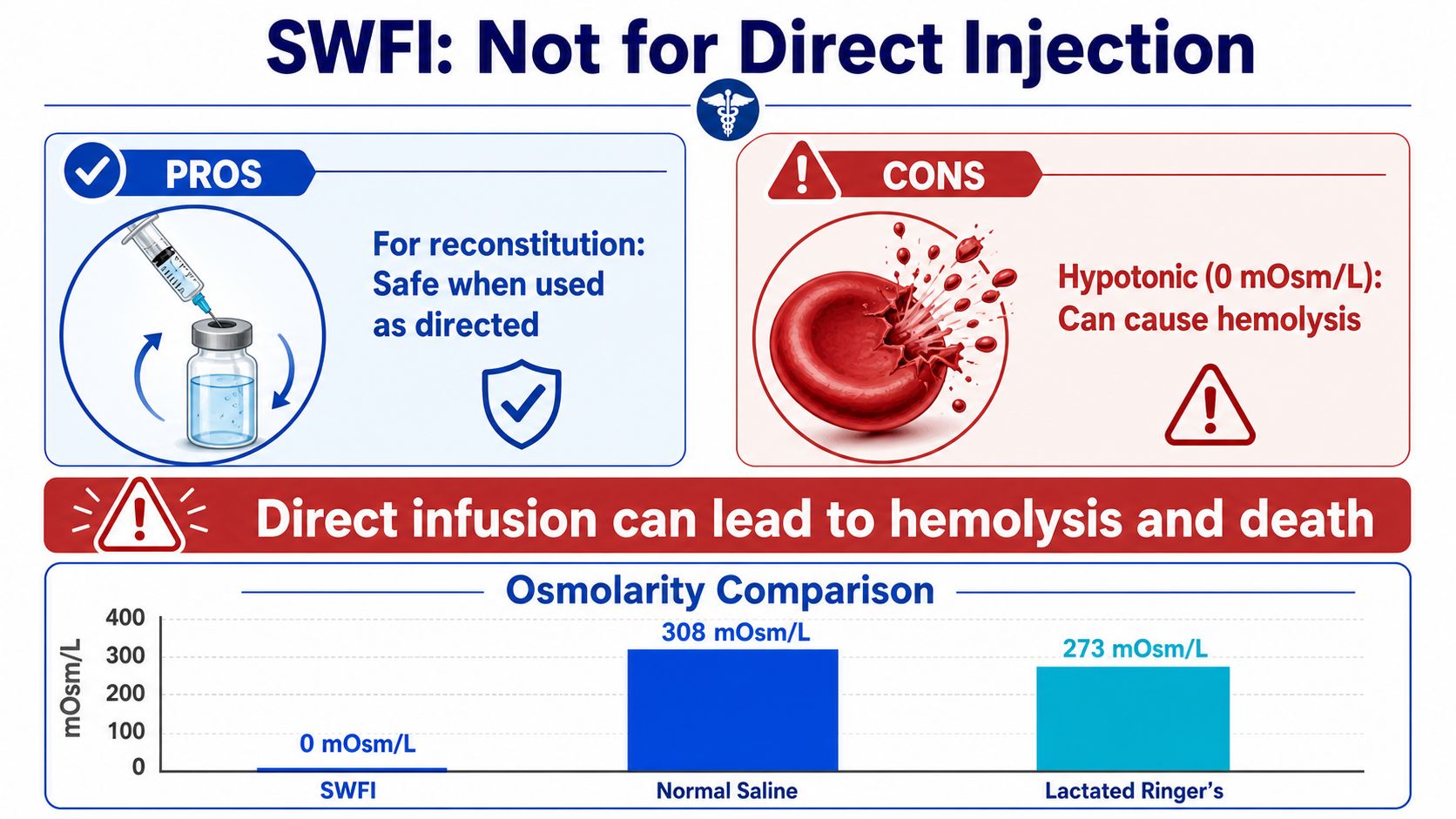
The most dangerous mistake with SWFI is not subtle. It is the assumption that “sterile” means “safe to inject by itself.” Patient-safety guidance says SWFI is hypotonic at 0 mOsm/L, and direct IV administration can cause hemolysis and can be fatal; reported error cases have included deaths, and recurring contributors include knowledge gaps about hypernatremia treatment and look-alike packaging with other IV solutions (patient safety advisory).
Permitted use and prohibited use
SWFI is appropriate as a solvent or diluent for injectable drugs when the target product calls for it. It is not appropriate as a standalone IV fluid. That distinction sounds obvious in a policy document, but it gets blurred in shared storage areas where vials are grouped by shape rather than by function.
The label confusion is the operational risk. If a prep area stores SWFI near IV solutions, or if staff are trained loosely on “water for injection,” the wrong vial can be selected in a hurry. Mixed-audience environments need separation by function, not just by manufacturer category.
How to reduce the error pattern
The safest workflows use three habits together:
- Store by use category, not by shelf convenience.
- Mark single-dose products clearly at receiving and during stocking.
- Document every puncture and discard event so a vial cannot drift into reuse.
A useful external reminder for teams working around infusion workflows is the list of cancer infusion side effect signs to watch, because infusion-side-effect monitoring and medication-error prevention often sit in the same operational space. The point isn't that SWFI causes those side effects, it's that any IV workflow demands strict product identification before a solution ever reaches a patient.
Storage, Handling, and Planning Around SWFI Shortages
SWFI is a supply item, not a permanent fixture. If the right vial is missing when the work is ready to begin, the best label in the world doesn't help. That's why storage discipline and shortage planning belong in the same conversation.
Day-to-day handling
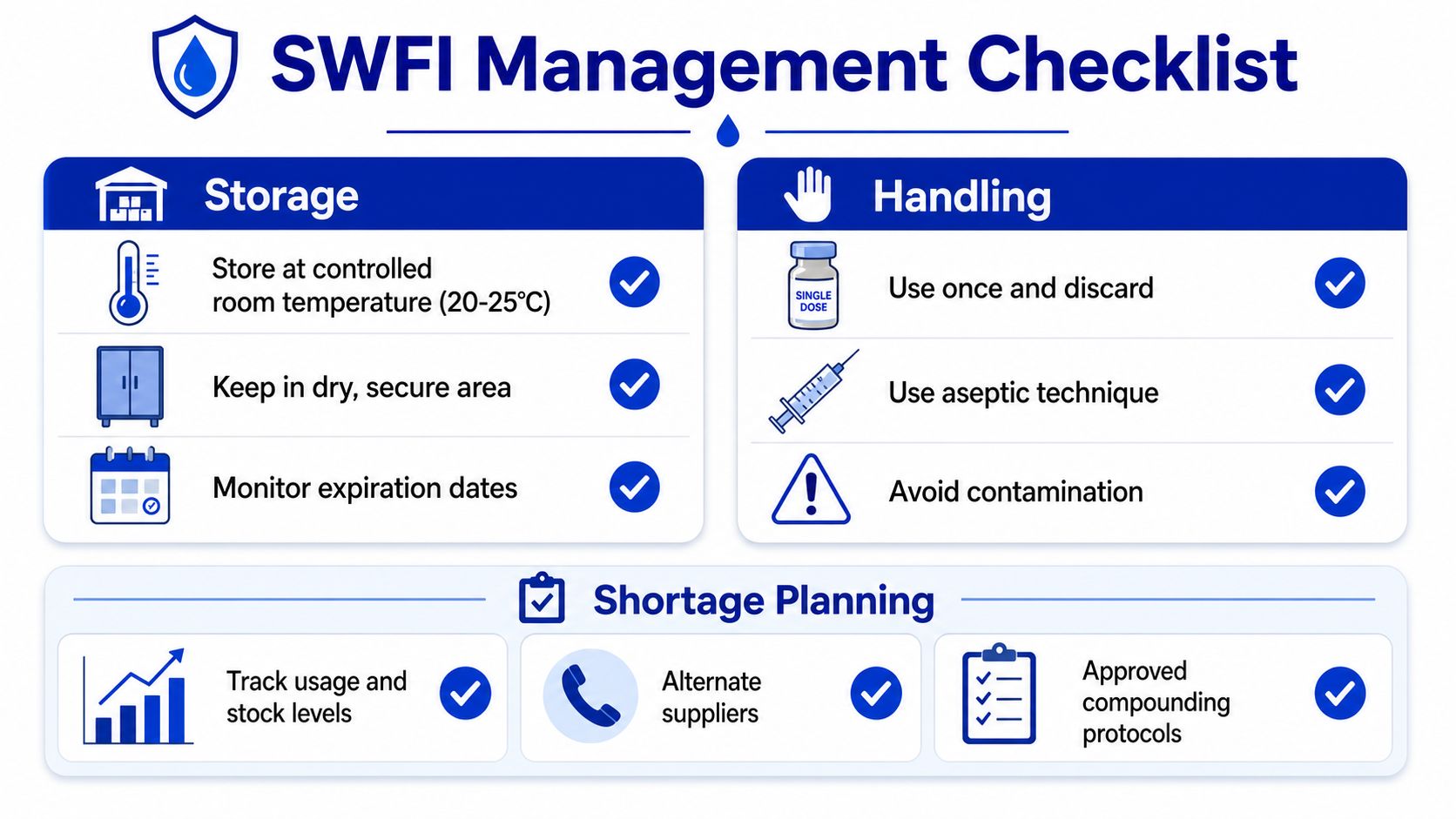
Single-dose vials should stay in a controlled, dry, secure location with expiration dates watched closely. Once opened, the vial should be used once and discarded. Aseptic technique still matters, because contamination risk rises the moment the closure is breached.
For teams that manage research inventory alongside other liquids, the mistake to avoid is casual reclassification. A vial that looks “unused enough” is still an opened single-dose container once it has been punctured. That is the point where traceability matters more than shelf appearance.
What to do when supply gets tight
Shortage guidance treats SWFI as an active operational issue, not a historical footnote. ASHP maintains a dedicated SWFI shortage FAQ, and shortage alerts have described nationwide strain across multiple manufacturers (ASHP shortage resource). That means labs and pharmacies need a plan before stock runs low.
Useful planning moves include:
- Track usage and stock levels so reorder timing isn't guesswork.
- Resize vial formats when possible to reduce wastage.
- Pre-approve alternate diluents for workflows where a substitute is valid.
- Coordinate procurement across lab, pharmacy, and reseller channels so one group doesn't assume another has already ordered.
- Keep approved compounding protocols current so a shortage doesn't stall work unnecessarily.
For teams thinking about inventory resilience in related water products, Herbi Labs' shelf-life and stability guide is a useful operational companion. The broader lesson is that supply continuity is part of quality, because the correct product is only useful when it's available on time.
Putting It All Together Before You Open the Next Vial
Before a vial is opened, three checks matter most. Confirm the documentation matches monograph-grade SWFI, match the container to the withdrawal pattern, and keep the vial separated from IV-adjacent products so a hypotonic error can't happen by accident. Procurement should be planned, not rushed.
If the workflow is single-use, single-dose SWFI fits. If repeated access is needed, the product choice should change. If the shelf is empty, the order should have been placed sooner.
Herbilabs supports research-use workflows that depend on clear diluent choices, documented quality, and reliable fulfillment. If your lab or reseller team needs sterile or bacteriostatic water products with controlled production and lot-level documentation, visit Herbilabs to review the available formats and get the right vial into your workflow on time.