Private Label, White Label, Wholesale partnerships available - EU, USA and UK - Free shipping from €75

Sodium Chloride Water: A Practical Lab Guide for 2026
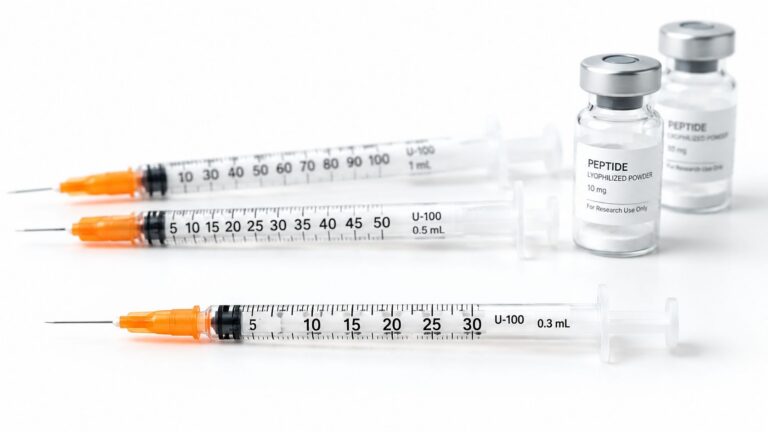
A researcher has a freezer-cold vial of lyophilized peptide on the bench, a sterile syringe ready, and two plausible diluents within reach: 0.9% sodium chloride water or bacteriostatic water. The choice can look routine, but it affects reconstitution behavior, ionic conditions, cell compatibility, and the risk created by every later vial entry.
Sodium chloride water isn't clean water with salt added. Its concentration, ion content, sterility class, packaging, and access history all matter. A suitable diluent can support a reproducible preparation. An unsuitable one can change solubility, disturb osmotic balance, introduce a preservative that a sensitive assay doesn't tolerate, or leave a shared vial vulnerable to contamination.
The reasoning becomes clearer through three questions. What does the familiar 0.9% mean? When does preservative-free saline make more sense than bacteriostatic water in a research-use-only workflow? And how should a laboratory control contamination, lot variation, and documentation after a vial is opened?
Table of Contents
- Why a Sodium Chloride Solution Matters in the Lab
- What Sodium Chloride Water Actually Is
- Why 0.9 Percent Became the Standard Concentration
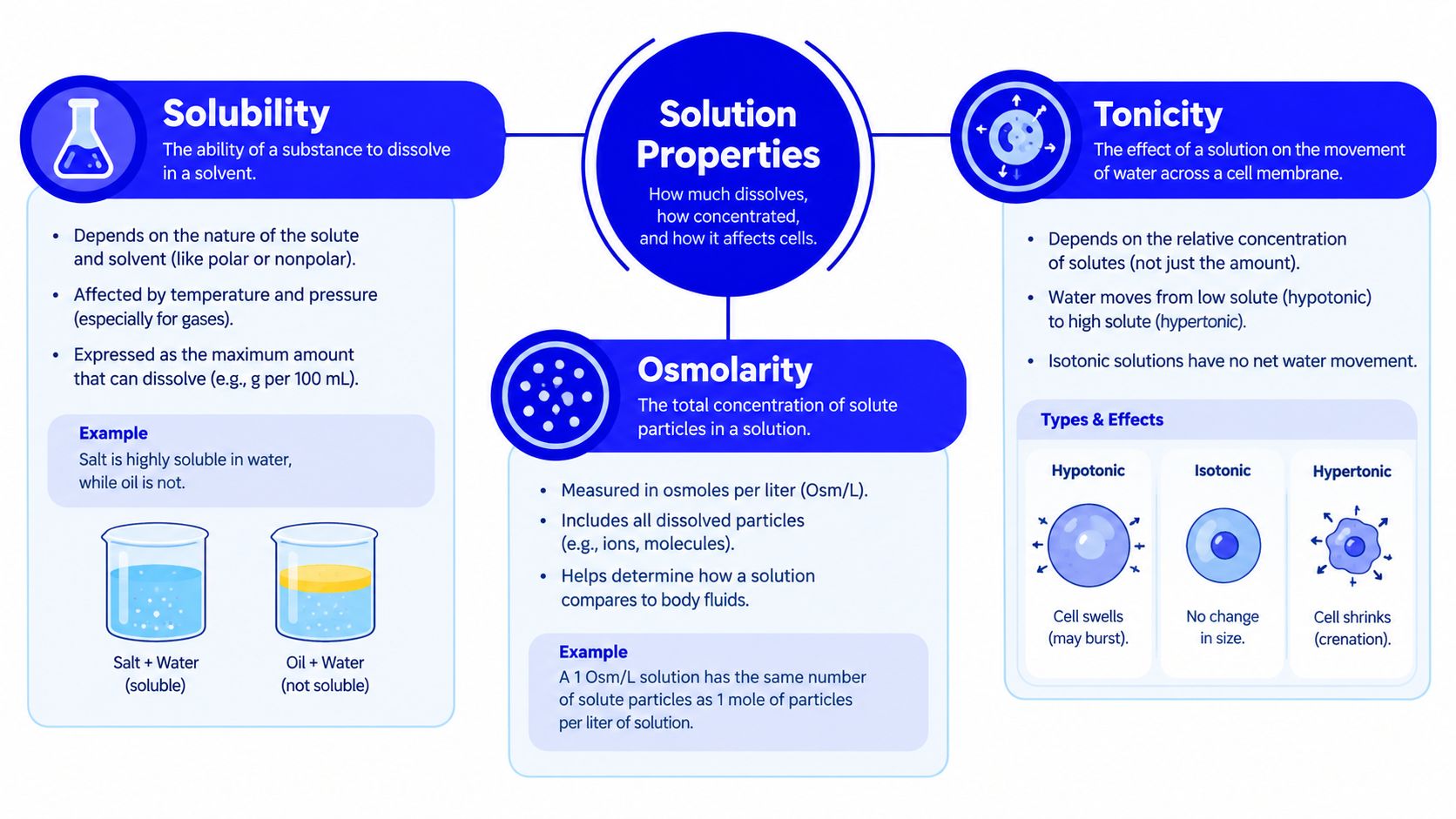
- Solubility, Osmolarity, and Tonicity Explained
- Sodium Chloride Water Versus Bacteriostatic Water
- Handling, Stability, and Sterility in Practice
- Common Assumptions Worth Questioning
Why a Sodium Chloride Solution Matters in the Lab
A lyophilized peptide doesn't reconstitute in a chemical vacuum. As the diluent enters the vial, its water content, dissolved ions, pH, and osmotic properties interact with the dried material. A researcher may see a clear solution and assume the job is complete, yet clarity alone doesn't prove that the preparation is compatible with the next assay.
Sodium chloride water supplies sodium and chloride ions, so it changes ionic strength and the surrounding osmotic environment. Those conditions can influence how proteins or peptides dissolve and how they behave afterward. In cell-based work, the same choice can affect whether cells encounter a broadly isotonic environment or a solution that pulls water into or out of them.
The choice starts with the downstream use
For a single-use reconstitution followed immediately by a compatible assay, preservative-free saline may offer a straightforward composition. For a preparation that requires repeated withdrawals, a bacteriostatic formulation may reduce some microbial-growth risk, but its preservative can create a separate compatibility question.
The correct decision therefore comes from the entire workflow, not from the diluent label alone. The material being reconstituted, the target concentration, the assay matrix, the number of vial entries, and the required sterility controls all belong in the decision.
Practical rule: A diluent is part of the experimental system. It should be selected and documented with the same care as the peptide, protein, antibody, or buffer receiving it.
Research-use-only status doesn't remove the need for disciplined handling. It makes the laboratory responsible for defining suitability, recording the lot and expiry, and checking whether the product's formulation matches the intended experiment. A saline vial used once in a controlled workflow presents a different risk profile from a vial accessed repeatedly across several days.
What Sodium Chloride Water Actually Is
At the simplest level, sodium chloride water is sodium chloride dissolved in water. Sodium chloride is the familiar salt used in food, but once it dissolves, the solid crystal separates into sodium ions and chloride ions. Water molecules surround those charged particles, keeping them dispersed throughout the solution rather than leaving them as visible grains.
That distinction matters because the ions do more than add mass. They contribute electrical charge, ionic strength, and osmotic particles. Tap water, deionized water, distilled water, sterile water, and saline can all look clear while carrying very different chemical and microbiological characteristics.
Normal saline generally refers to the standard 0.9% sodium chloride preparation. In the commonly reported formulation, that means 9 grams of sodium chloride per liter of water, producing about 154 mEq/L of sodium and 154 mEq/L of chloride. These formulation details are summarized in the historical and clinical review of normal saline and the discussion of the standard concentration in Emergencias.
Concentration notation affects the calculation
A laboratory also needs to distinguish weight per volume from weight per weight. A 0.9% w/v preparation expresses the mass of sodium chloride relative to the final solution volume. A w/w preparation expresses the mass of salt relative to the total mass of the solution. Those notations aren't interchangeable when a researcher is calculating a stock or checking a reconstitution record.
A lab may prepare saline from suitable reagent-grade material, or it may purchase a pre-sterilized container intended for a defined use. The first option requires controlled weighing, dissolution, container selection, and sterilization validation. The second shifts attention toward supplier documentation, package integrity, storage, and expiry.
The label “normal” can also mislead new researchers. It doesn't mean that every biological system has the same ideal salt concentration. It identifies a widely adopted reference preparation whose composition is defined and reproducible.
Why 0.9 Percent Became the Standard Concentration
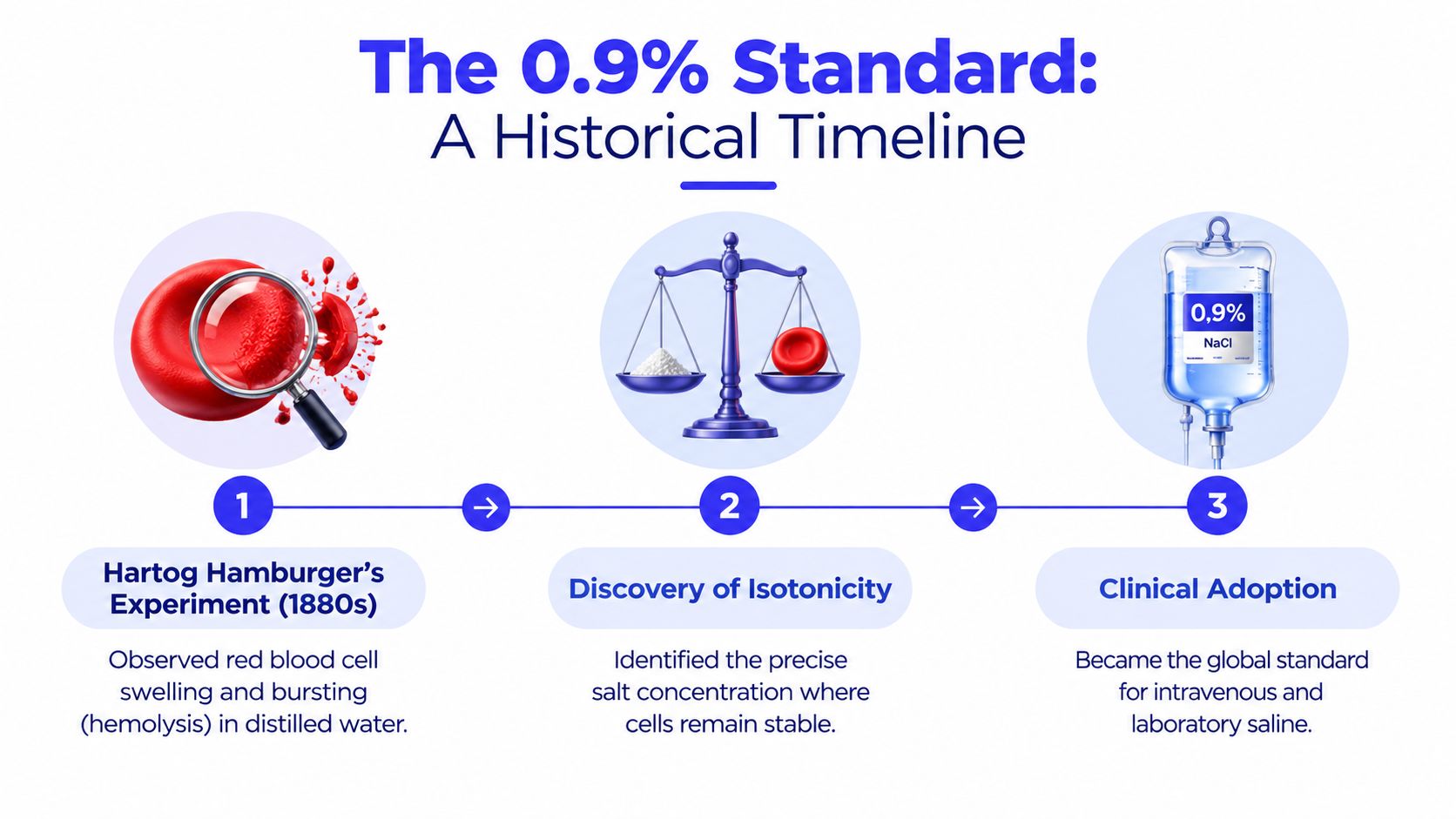
The everyday saline number has a historical origin. During the cholera era in Europe in 1831–1832, Scottish physician Thomas Latta described injecting a salt-and-water solution after earlier attempts to infuse plain water had proved ineffective and potentially harmful, as detailed in the historical review of saline.
The exact 0.9% formulation came later through nineteenth-century standardization. Hartog Jacob Hamburger used red-cell and freezing-point experiments to argue that a solution near 0.9% was sufficiently isotonic in vitro to avoid visible hemolysis. The value then gained practical authority because it offered a repeatable approximation of the osmotic conditions surrounding blood cells, rather than because nature had declared one exact concentration universally correct.
A benchmark, not a biological law
A red blood cell provides a useful teaching model. In a solution that is too dilute relative to the cell, water can enter and the cell can swell. In a solution that is too concentrated, water can leave and the cell can shrink. A solution near the isotonic range reduces that net movement under the test conditions.
That principle helped support the later use of physiological saline for infusion and irrigation. It also explains why laboratories often reach for 0.9% saline when they need a familiar isotonic benchmark. The concentration is convenient, reproducible, and close enough to physiological serum for many general applications, but it isn't automatically optimal for every cell type, protein, tissue, or co-solute system.
Historical reviews also caution that the routinely used 0.9% formulation has little convincing original physiological basis. Its persistence reflects a mixture of experimental convention, clinical adoption, and practical standardization. The Emergencias review describes how Hamburger's work helped establish the concentration as a standard while placing that history in context.
For a laboratory, the useful conclusion is modest. 0.9% is a reference point, not permission to skip compatibility testing. Temperature, cell type, membrane behavior, protein composition, and other dissolved substances can change the final effective environment. Researchers selecting a commercial sterile diluent can browse Herbilabs sterile diluents while still checking the product documentation against the intended RUO workflow.
Solubility, Osmolarity, and Tonicity Explained
Three terms often appear together, but they answer different questions.
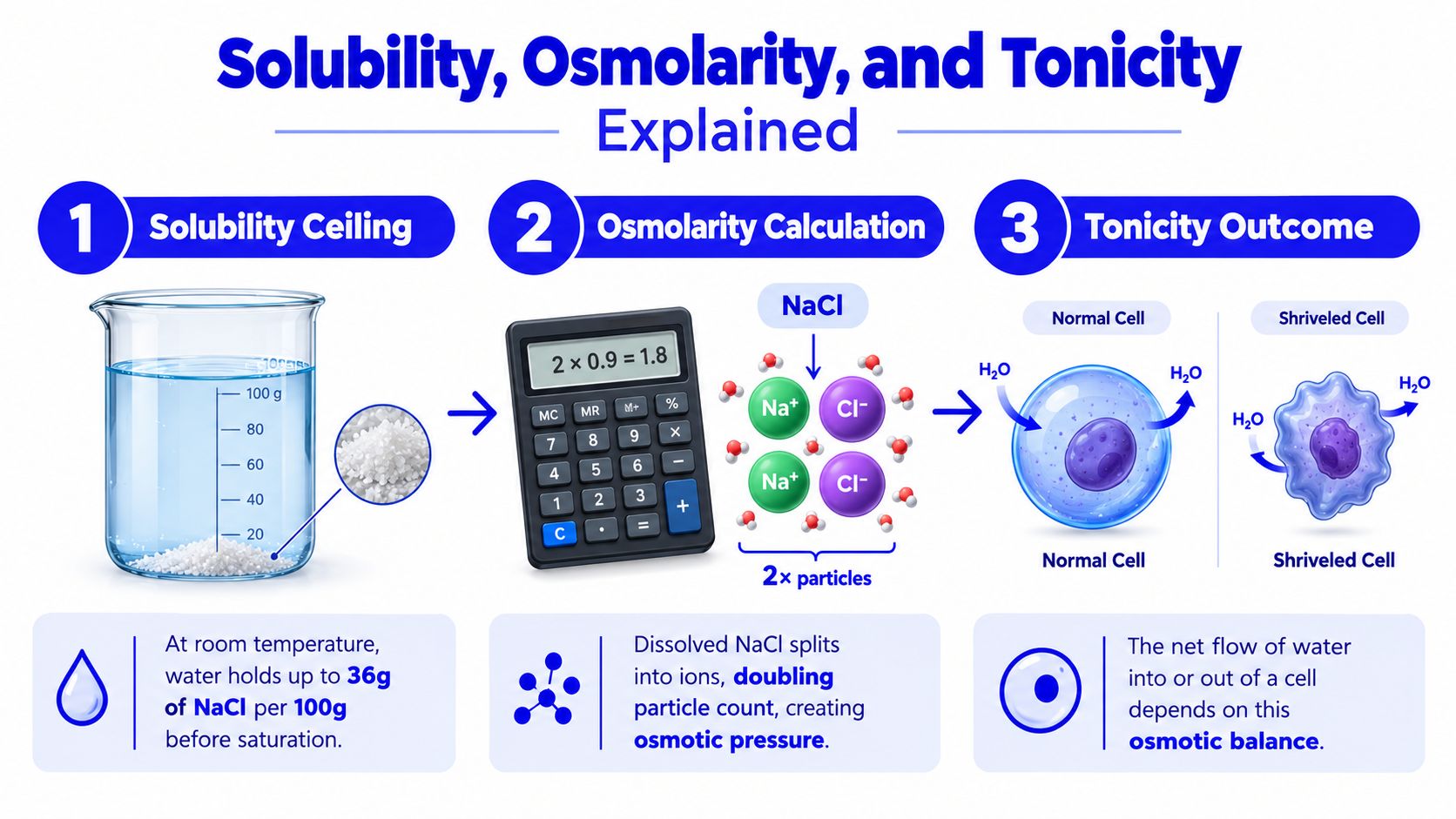
Solubility asks how much sodium chloride water can hold before undissolved salt remains. At 25 °C, sodium chloride dissolves at about 36.0 grams per 100 grams of water, approximately 357–360 grams per liter. At 100 °C, the value reaches about 38.99 grams per 100 grams of water, according to PubChem's sodium chloride data. Heating therefore increases capacity only modestly. The relatively flat curve makes ordinary preparations predictable, but temperature control still matters near saturation.
Osmolarity concerns the number of dissolved particles. Sodium chloride separates into sodium and chloride ions, so the dissolved salt contributes more particles than an intact, non-dissociating solute with the same molar amount. Reference data show osmotic concentration rising broadly with sodium chloride concentration, from 100 mOsmol/kg at 3.087 g/kg water to 700 mOsmol/kg at 22.380 g/kg water, as reported in the USP osmolarity reference.
Tonicity is the biological consequence
Tonicity asks what those particles do across a cell membrane. Osmolarity counts particles in a solution, while tonicity focuses on the effective water movement produced by substances that cannot freely cross the membrane. A solution can therefore have a measured osmolarity without producing exactly the same biological effect in every cell system.
For general saline, the practical lesson is control. A weighing error, dilution mistake, evaporation event, or incorrect final-volume assumption changes the osmotic environment. The USP reference describes the approximate proportional relationship between concentration and osmolality, which is why even small preparation errors can create meaningful shifts when cells, proteins, or tissues are sensitive to tonicity.
A researcher should record the preparation basis, solvent quality, final volume, lot, and verification method. The target isn't “salt water.” It is a defined solution whose composition remains compatible with the material and assay.
Sodium Chloride Water Versus Bacteriostatic Water
Saline and bacteriostatic water solve different workflow problems. 0.9% sodium chloride water is a sterile isotonic solution without a microbial-growth-suppressing preservative. Bacteriostatic water contains 0.9% benzyl alcohol, a preservative intended to inhibit microbial growth in a multi-dose format.
That doesn't make one universally better. The relevant question is whether the experiment benefits more from a preservative-free composition and single-use handling, or from repeated withdrawals under the product's labeled conditions.
| Attribute | 0.9% Sodium Chloride Water | 0.9% Benzyl-Alcohol Bacteriostatic Water |
|---|---|---|
| Primary composition | Sodium chloride in sterile water | Sterile water with benzyl alcohol |
| Osmotic role | Provides an isotonic saline environment | Provides a water-based diluent with preservative |
| Repeated access | Usually treated as single-use unless labeling states otherwise | Designed for multi-dose access within the labeled in-use window |
| Main compatibility question | Does added sodium chloride suit the reagent or assay? | Does benzyl alcohol suit the reagent, cells, or assay? |
| Typical workflow strength | Preservative-free reconstitution and controlled single use | Repeated withdrawals where the formulation is compatible |
| Main risk | Contamination after opening or repeated access | Preservative incompatibility and contamination if technique is poor |
Three decisions belong on the worksheet
Access pattern. A vial entered once can be managed as a controlled single-use component. A vial entered repeatedly creates more opportunities for septum damage, particles, and microbial introduction. The bacteriostatic water guidance can help a lab document the handling assumptions for a multi-dose format.
Assay compatibility. Benzyl alcohol isn't a neutral substitute for saline. Sensitive proteins, cell assays, and some reconstitution workflows may require preservative-free conditions or a validation check before use. Bacteriostatic formats are also not intended for neonatal use or every cell-culture application.
Traceability. RUO teams should capture the diluent name, formulation, lot, expiry, preparation date, operator, and any compatibility result. That record helps separate a reagent effect from a diluent effect when an experiment behaves unexpectedly.
A laboratory may also need a broader cleaning-control reference, particularly when vial handling sits inside a shared facility. The safe hospital disinfectant guide offers context on disinfectant selection, but surface disinfection doesn't replace sterile technique at the vial septum.
Handling, Stability, and Sterility in Practice
The vial's label establishes the formal storage and in-use requirements, but good bench practice follows a consistent sequence. A clean hood or controlled work area reduces environmental exposure. The operator should inspect the container, confirm identity and expiry, disinfect the septum with an appropriate alcohol swab, and allow the surface to dry before access.
Every entry requires a new sterile needle and syringe. A used needle must never be returned to the vial, even if it appears clean. The safe injection practice guidance states that multi-dose vials should be accessed with a new sterile needle and syringe each time, kept outside treatment areas, and discarded when sterility is uncertain.
Match the vial type to the access plan
A preservative-free saline container generally fits a single-use workflow. Once opened, retaining the remainder for convenience can create a sterility decision that the original format wasn't designed to support. A bacteriostatic format supports repeated withdrawals only when the formulation is compatible, the product labeling allows it, and the laboratory maintains aseptic handling within the stated in-use period.
Storage should follow the product instructions. In general, the container should remain at the specified room-temperature range, protected from light when required, and never frozen unless the manufacturer explicitly permits that condition. Temperature excursions can affect packaging and solution integrity even when the liquid still looks normal.
Make every access auditable
A small vial label or electronic record should capture:
- Identity and lot: Record the exact formulation and supplier lot.
- Expiry and opening date: Separate the manufacturer's expiry from the laboratory's in-use period.
- Operator and purpose: Link each access to the experiment or preparation.
- Inspection result: Note any cloudiness, particles, damaged closure, or unusual appearance.
Contamination warning: Cloudiness, particulate matter, a damaged septum, or uncertain sterility is a reason to stop and discard the container according to laboratory procedure.
For facilities handling many lots and operators, semi-automated GMP solutions can provide useful context for controlled records and repeatable manufacturing processes. For smaller teams, a validated checklist and access log can achieve the same basic discipline without adding unnecessary complexity. Guidance on bac water handling is most useful when it is adapted to the specific product label and the laboratory's risk assessment.
Common Assumptions Worth Questioning
The first assumption is that 0.9% saline is always the best biological choice. It is a familiar benchmark, but the intended application decides whether its ionic composition is appropriate. Cleveland Clinic guidance distinguishes among uses and emphasizes sterile or otherwise appropriately treated water for nasal irrigation while warning against tap water and against using saline in the eyes, as described in its saline solution guidance.
Wound care also deserves a careful reading rather than a blanket rule. A recent wound-healing paper reported that distilled water outperformed 0.9% sodium chloride in several rat-model endpoints. That result doesn't automatically settle human wound-care practice, but it does show why researchers should separate a model-specific finding from a universal recommendation.
“Clean water” isn't a defined reagent
Tap water, distilled water, deionized water, sterile-filtered water, and sterile water for injection differ in ion content, particulate burden, microbial status, and endotoxin control. A clear appearance says very little about those properties. Protein and cell workflows can be especially sensitive to contaminants that aren't visible at the bench.
The correct question isn't whether the water looks clean. It is whether the water's quality specification matches the material, assay, and sterility requirement. A researcher should check the certificate, intended use, container integrity, and preparation history before treating any water-based diluent as interchangeable with saline.
The final assumption is that repeated access to a saline vial is harmless. Infection-control guidance warns that multi-dose access can create a patient-safety risk even for inexpensive 0.9% sodium chloride solutions, especially when a vial is shared or sterility becomes uncertain. Benzyl alcohol can suppress microbial growth in a suitable bacteriostatic format, but it doesn't repair poor technique, remove introduced particles, or guarantee compatibility with every experiment.
The defensible rule is simple: choose the formulation for the assay, choose the vial format for the access pattern, and document every decision. A reusable vial is convenient only when its chemical compatibility and sterility controls are both sound.
Herbilabs offers sterile diluents and reconstitution solutions for RUO workflows, including sodium chloride and benzyl-alcohol bacteriostatic formats in multiple vial sizes with lot-specific documentation. Researchers comparing saline with bacteriostatic water can visit Herbilabs to review the available options and match the formulation to the intended reconstitution and access plan.