Private Label, White Label, Wholesale partnerships available - EU, USA and UK - Free shipping from €75
3 10 Ml Insulin Syringe: Specs, Sizing, and Lab Use
Could a syringe designed for insulin become a useful low-volume precision tool in a peptide workflow, or does the label create more confusion than clarity? The phrase “3 10 ml insulin syringe” exposes that problem. It can look like a request for a three-milliliter or ten-milliliter device, yet the intended product is usually a 3/10 mL syringe, also written as 0.3 mL or 30-unit U-100 insulin syringe.
That distinction matters before a buyer compares needles, markings, or reconstitution technique. A small barrel can improve visual control for low-volume draws, but it doesn't automatically turn insulin-unit markings into laboratory volume markings. The operator still needs to confirm the concentration, calculate the required volume, and select a syringe that holds the complete draw without forcing repeated fills.
Table of Contents
- What People Mean by a 3 10 mL Insulin Syringe
- How U-100 Insulin Concentration Defines the Barrel
- Comparing 0.3 mL, 0.5 mL, and 1 mL Insulin Syringes
- Needle Gauge and Length Options for Small-Barrel Syringes
- ISO 8537 and the Limits of Single-Use Insulin Syringes
- Using a 3 10 mL Syringe for Peptide Reconstitution
- When the 0.3 mL Barrel Loses Its Accuracy Advantage
- Insulin Syringes Versus Dedicated Lab Low-Volume Tools
- Aseptic Handling and the 28-Day In-Use Window
- Quick Reference for Choosing and Using a 3 10 mL Syringe
What People Mean by a 3 10 mL Insulin Syringe
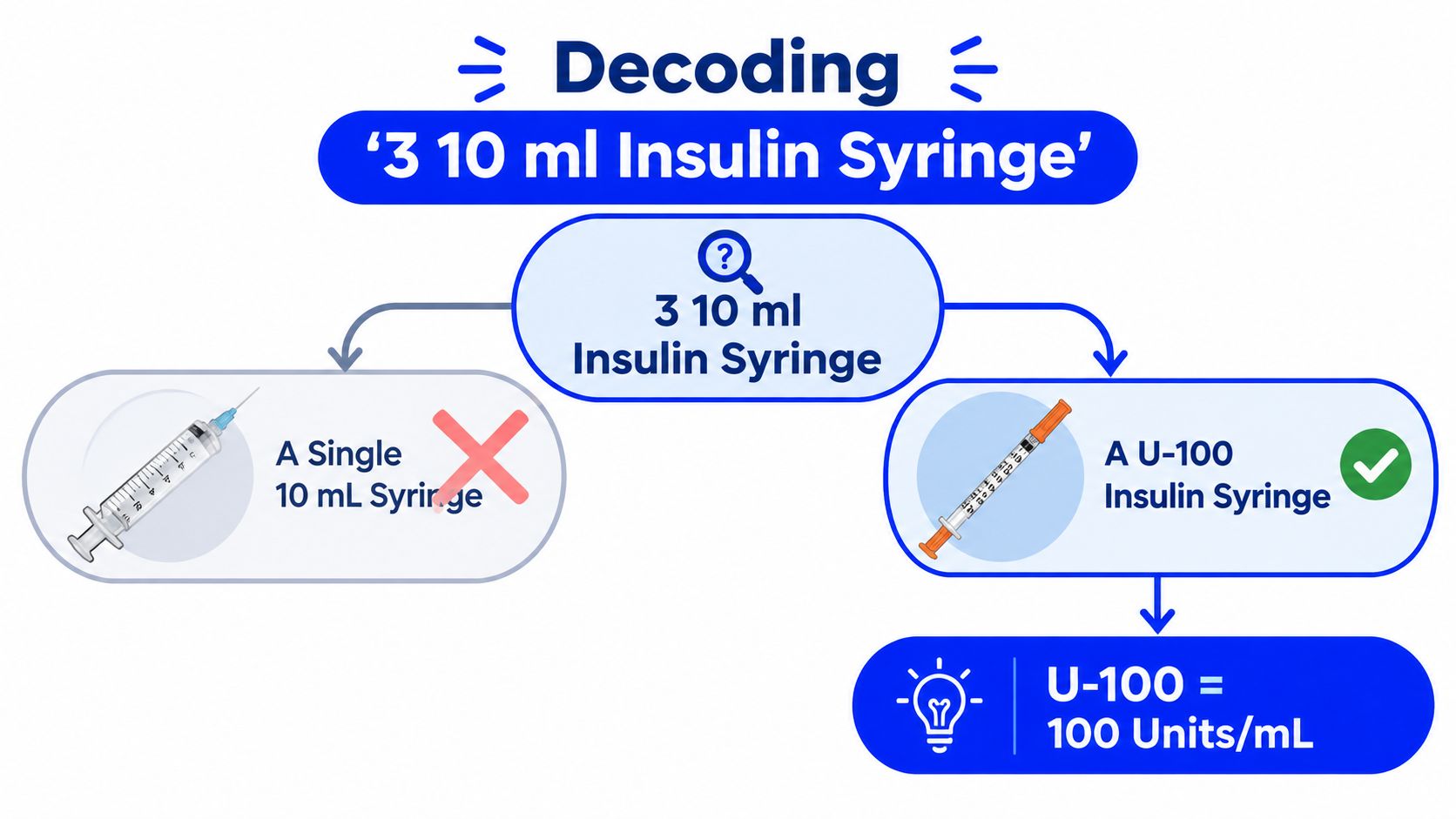
What does 3 10 mL insulin syringe describe? The phrase is ambiguous, but it usually represents a missing slash in 3/10 mL, meaning a 0.3 mL barrel. In the U-100 format, that barrel holds 30 insulin units. Common comparison sizes are 0.5 mL, holding 50 units, and 1 mL, holding 100 units (Nationwide Children's Hospital explains the three standard sizes and their capacities).
The same wording can also mean three 10 mL syringes, where “3” is a quantity and “10 mL” is the capacity. It may even reflect a misread 30-unit marking on a different syringe. Product titles and packaging can blur these meanings, so verify both the printed barrel capacity and the U-100 designation before assessing the syringe for a low-volume task.
The terminology test
A standard insulin syringe is not a full 10 mL device. ISO 8537:2016 addresses sterile, single-use insulin syringes for U-40 and U-100 insulin, with recognized insulin-syringe formats extending to a 1 mL nominal capacity, rather than a 10 mL barrel. The scope is summarized by the ISO 8537:2016 standard description.
This guide uses the phrase for a 3/10 mL, or 0.3 mL, U-100 insulin syringe. Its short barrel can make small volume intervals easier to see, which is why it may suit low-volume peptide reconstitution work. The markings still represent insulin units, however, so the required liquid volume must be converted into milliliters before drawing.
Practical rule: Read “3/10 mL” as a barrel capacity, not as a request for a 10 mL syringe.
How U-100 Insulin Concentration Defines the Barrel
Why does a U-100 insulin syringe show units instead of milliliters? The answer is its calibration system. U-100 means 100 units per milliliter, so 1 unit equals 0.01 mL. A 0.3 mL barrel therefore holds 30 units at the full line. Manufacturer instructions for a 0.3 mL U-100 syringe describe its unit-based graduations and capacity.
The conversion is:
30 units × 0.01 mL per unit = 0.3 mL
That calculation explains the marking. The plunger scale is labeled 30 units, rather than “0.30 mL,” because the syringe was designed to measure a liquid with the U-100 concentration. Some 0.3 mL products use single-unit graduations and print numbers at every five units, although the exact pattern depends on the manufacturer. Check the barrel itself before using it for a reconstitution task.
The conversion table
| Units Marked | Volume (mL) | Notes |
|---|---|---|
| 1 unit | 0.01 mL | One U-100 unit corresponds to 0.01 mL |
| 5 units | 0.05 mL | A common printed reference point |
| 10 units | 0.10 mL | One-tenth of a milliliter |
| 15 units | 0.15 mL | Half of a 0.3 mL barrel |
| 20 units | 0.20 mL | Two-tenths of a milliliter |
| 30 units | 0.30 mL | Full 3/10 mL barrel capacity |
The main laboratory risk appears when a non-insulin solution is drawn into the syringe and the unit marks are read as milliliters. A 30-unit reading represents 0.3 mL only under the U-100 conversion convention. It does not mean 30 mL, and it is not a universal volume label for every liquid.
For peptide work, calculate the target volume in milliliters first, then convert that volume into the syringe's U-100 units before drawing.
Comparing 0.3 mL, 0.5 mL, and 1 mL Insulin Syringes
Which barrel gives a low-volume draw the clearest reading without forcing unnecessary refills? The three common U-100 formats serve different working ranges. A 0.3 mL syringe, also called a 3/10 mL syringe, holds 30 units. A 0.5 mL syringe holds 50 units, while a 1 mL syringe holds 100 units. These capacities are standard reference points for comparing the formats.
The smaller barrel gives each graduation more visual space. That can make it easier to align the meniscus with the intended mark during a small draw. A short, fixed-needle, low-dead-space design may also leave less liquid behind, though barrel size alone does not establish the device's residual volume or accuracy.
| Feature | 0.3 mL (3/10 mL) | 0.5 mL (1/2 mL) | 1 mL |
|---|---|---|---|
| U-100 capacity | 30 units | 50 units | 100 units |
| Typical role | Low-volume dosing | Mid-range dosing | Larger single draws |
| Reading advantage | Strongest for small doses | Balanced | More capacity, less visual detail per unit |
| Repeated fills | Required above 30 units | Required above 50 units | Least likely for larger draws |
| Needle choices | Available with fine gauges and short lengths | Broadly available | Broadly available |
| Selection principle | Use when the complete draw fits comfortably | Use when the dose approaches or exceeds 30 units | Use when the draw needs the larger capacity |
For a single draw, the 30-unit decision rule is useful. A required volume at or below 30 U-100 units can fit within the 3/10 mL format. Above that capacity, the operator must refill the syringe or choose a larger barrel. Each refill adds another plunger movement, transfer step, and opportunity to misread the scale. A 0.5 mL or 1 mL barrel may therefore be easier to control for a larger draw, even if its graduations appear less spread out.
As with any bench planning, estimate the complete liquid volume before selecting the vessel. The same planning principle applies when learning how to calculate grow bags for mushrooms: match capacity to the full requirement rather than choosing a container from one step alone.
The 0.3 mL format is a low-volume precision tool, not a guarantee of accuracy. Choose the smallest barrel that holds the full intended draw in one controlled fill, then confirm its graduation interval, dead space, and compatibility with the solution.
Needle Gauge and Length Options for Small-Barrel Syringes
Could the needle be limiting the transfer even when the barrel fits? Barrel size and needle selection address different variables. The barrel sets capacity and reading resolution. Gauge describes needle thickness, while length determines how far the needle can reach. Technical procurement information for 0.3 mL U-100 syringes lists 31G needles around 6 mm to 8 mm long, with 0.3 mL graduations and, in some products, half-unit markings (MSF's product specification lists a 0.3 mL U-100 configuration).
Gauge numbers run opposite to thickness: a smaller number means a thicker needle. A thicker needle can move a viscous diluent more readily. A finer needle may reduce the size of the access point, but it can also increase resistance and slow transfer. Choosing a small barrel does not remove this trade-off.
Matching the needle to the task
- 28G: A relatively thick option for liquids that resist movement.
- 29G: A middle-ground choice for routine low-volume handling.
- 30G and 31G: Fine options when a smaller needle matters, though thicker solutions may move more slowly.
Short needles, including 6 mm and 8 mm options, suit shallow access or injection tasks where limited depth is required. Longer needles, including 12.7 mm variants, reach farther, but may leave more residual liquid in the needle and be less convenient for small-volume transfers.
Fixed-needle designs can reduce residual volume because they remove a detachable junction where liquid may remain. The procurement specification should identify the required dead-space performance rather than assume that every syringe delivers the same usable volume.
Match gauge to liquid resistance and length to access depth. Habit is not a specification.
ISO 8537 and the Limits of Single-Use Insulin Syringes
What does ISO 8537:2016 tell you about a 3/10 mL insulin syringe? It defines requirements for sterile, single-use insulin syringes, with or without needles. Its scope covers syringes marked for U-40 and U-100 insulin and identifies them for human use only (the ISO standard page identifies the covered syringe types and intended use).
That boundary matters when the syringe moves from clinical supply to research procurement. A 3/10 mL syringe may serve as a convenient low-volume transfer tool, but its barrel markings do not function as a general laboratory calibration certificate. The format helps you read a small volume, much like a short ruler helps measure a narrow distance. It does not establish the accuracy required for every analytical procedure.
The standard also limits how the device should be treated after filling. These syringes are intended for use soon after they are filled, rather than for extended insulin storage. A filled syringe left waiting can introduce practical concerns such as evaporation, handling exposure, and changes in how residual liquid sits in the barrel or needle.
What that means at the bench
Use the device within its intended role:
- Draw the specified liquid.
- Read the meniscus against the correct graduation.
- Transfer it soon after filling.
- Dispose of the syringe after single use.
This does not rule out every research application. For a small reconstitution transfer, the syringe can provide a sterile, convenient aid. It should not become a storage vessel or return repeatedly to stock for later work.
Using a 3 10 mL Syringe for Peptide Reconstitution
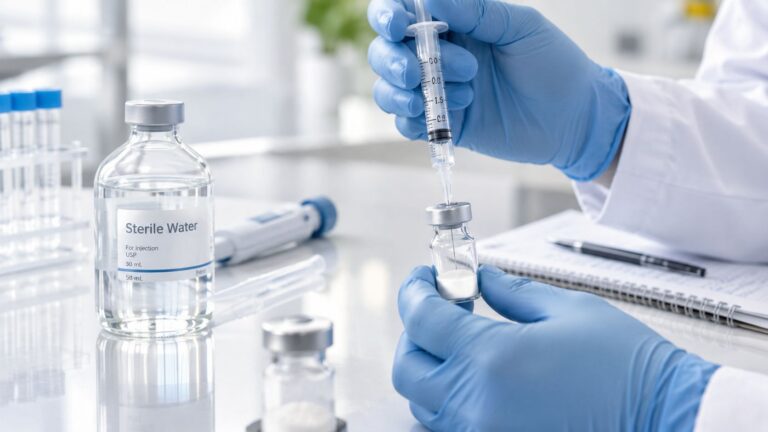
A 0.3 mL syringe can work for a small peptide reconstitution when the planned diluent volume fits within its 30-unit capacity. A tightly controlled example uses a lyophilized peptide vial and bacteriostatic water, but the material's manufacturer instructions and laboratory safety procedures remain the controlling references.
The workflow begins with preparation, not with the needle.
- Bring the diluent to room temperature. A room-temperature liquid can be easier to draw and handle than a cold, more viscous solution.
- Draw 0.30 mL, or 30 U-100 units. Keep the barrel vertical during the final reading and remove visible air before confirming the plunger position.
- Access the stopper carefully. The needle bevel should face upward, and the liquid should enter slowly along the vial wall rather than striking the lyophilized material directly.
- Agitate gently. Rolling is preferable to vigorous shaking when the material's solubility guidance calls for gentle handling.
- Wait for a clear solution. If particles, cloudiness, or unexpected discoloration remains, the material shouldn't be used without appropriate technical review.
- Read the dose at eye level. Align the meniscus with the intended unit mark and avoid estimating from an angled view.
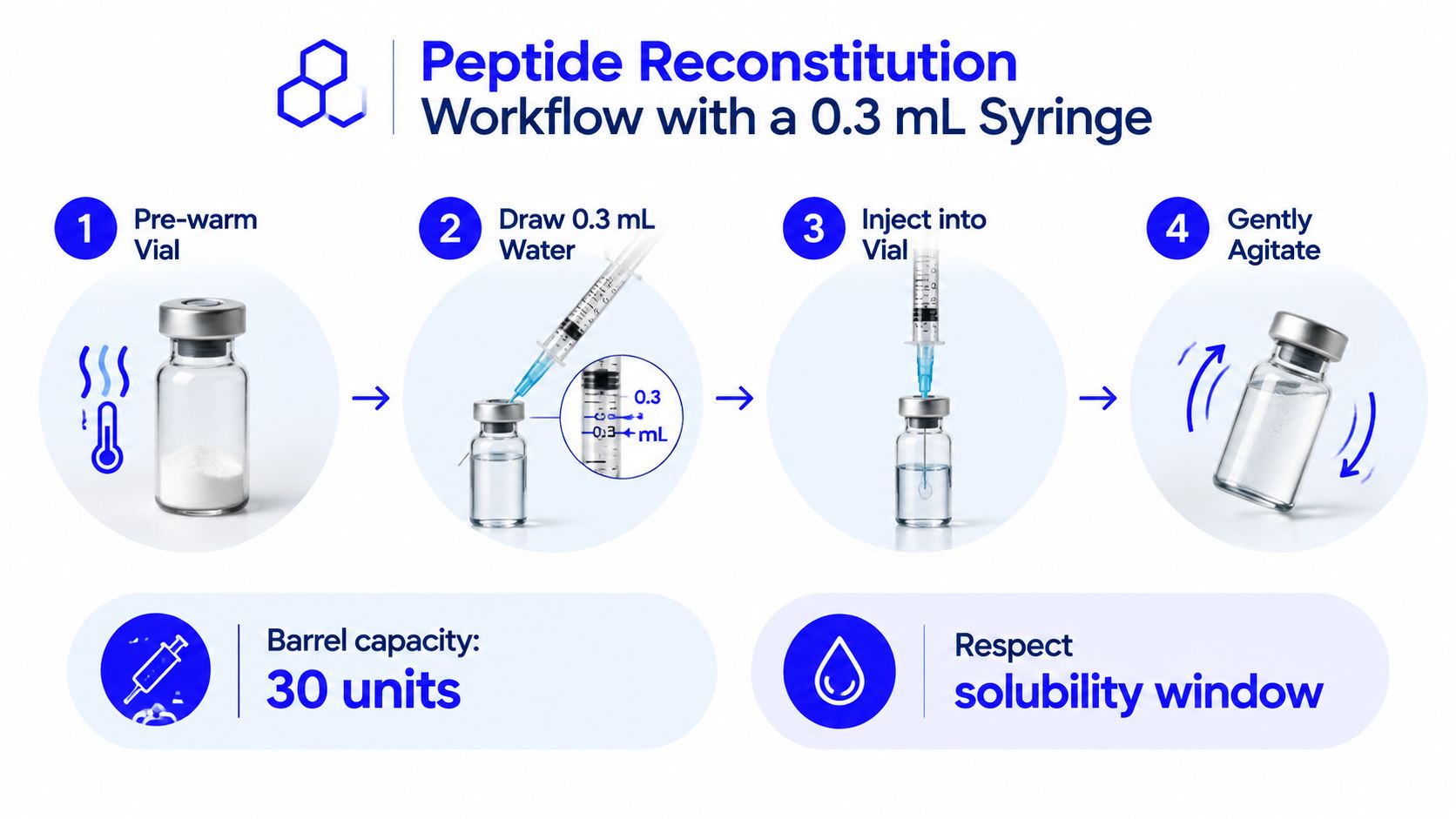
A vial requiring more than 0.3 mL of diluent needs either a second fill or a larger barrel. That isn't a minor inconvenience. Every additional fill creates another opportunity to introduce air, misread the meniscus, or compromise aseptic handling.
For laboratories comparing suppliers, sterile medication syringes can be reviewed alongside other handling supplies through this resource to find sterile syringes for home care. A suitable reconstitution solution should also be selected according to the material's documented requirements, not by vial size.
The following video provides a visual supplement for syringe handling and reconstitution technique:
When the 0.3 mL Barrel Loses Its Accuracy Advantage
The smallest barrel isn't always the most accurate choice. Its main advantage appears when the target volume is small enough that the graduations provide useful visual discrimination, while the operator still has enough plunger travel to position the meniscus confidently.
Half-unit markings can help users who need finer low-dose measurement, and neutral guidance identifies the 0.3 mL format for doses up to 30 units, with half-unit versions available for more detailed readings (Time of Care discusses 0.3 mL selection and half-unit options). Near the top of the barrel, however, alignment, plunger movement, and air removal become more consequential.
| Barrel Size | Nominal Graduations | Error per 0.5 Unit Misread | Recommended Volume Range |
|---|---|---|---|
| 0.3 mL | Often single-unit, with half-unit options in some products | Larger fraction of the full barrel | Small draws that remain comfortably below capacity |
| 0.5 mL | Product-dependent U-100 graduations | Smaller fraction of the full barrel than in a 0.3 mL syringe | Mid-range draws approaching the 0.3 mL limit |
| 1 mL | Product-dependent U-100 graduations | Smallest fraction of full scale among these formats | Larger single draws |
A useful practical boundary is 0.15 mL, or 15 U-100 units, when the operator wants the 0.3 mL syringe's strongest low-volume reading advantage. That isn't a universal accuracy guarantee. It is a conservative selection principle that leaves room for meniscus reading and handling variability.
For example, a reconstitution plan requiring 1 mL of diluent cannot fit in one 0.3 mL barrel. Multiple fills may be possible, but a 0.5 mL or 1 mL syringe can reduce cumulative handling and transfer steps. The safer selection is the barrel that holds the complete planned draw without crowding the upper graduation.
Insulin Syringes Versus Dedicated Lab Low-Volume Tools
A 3/10 mL U-100 insulin syringe is attractive because it is compact, readily understood by many users, and available with fine needle configurations. Its weakness is the unit-based scale. Every reading requires the operator to remember that the printed number represents U-100 units, then convert that number into milliliters when the liquid isn't U-100 insulin.
A fixed-volume tuberculin syringe can remove that conversion burden by using direct volume markings. A 0.3 mL tuberculin syringe may be easier for an operator who needs to document milliliters directly, although its fixed needle can restrict access angles. A repeater pipette is better suited to repeated aliquoting, but it brings a different procurement, validation, and tip-management burden.
| Dimension | U-100 Insulin Syringe | 0.3 mL Tuberculin Syringe | Repeater Pipette |
|---|---|---|---|
| Graduation type | Insulin-unit markings | Direct volume markings | Adjustable or digital setting |
| Needle or tip | Commonly fixed needle | Commonly fixed needle | Disposable pipette tip |
| Capacity approach | 0.3 mL U-100 format | Small-volume direct measurement | Repeated dispensing |
| Practical strength | Compact, accessible, low-volume draws | Avoids U-100 conversion | Efficient for multi-aliquot workflows |
| Main limitation | Requires unit-to-volume conversion | Less flexible vial access | Higher equipment and validation demands |
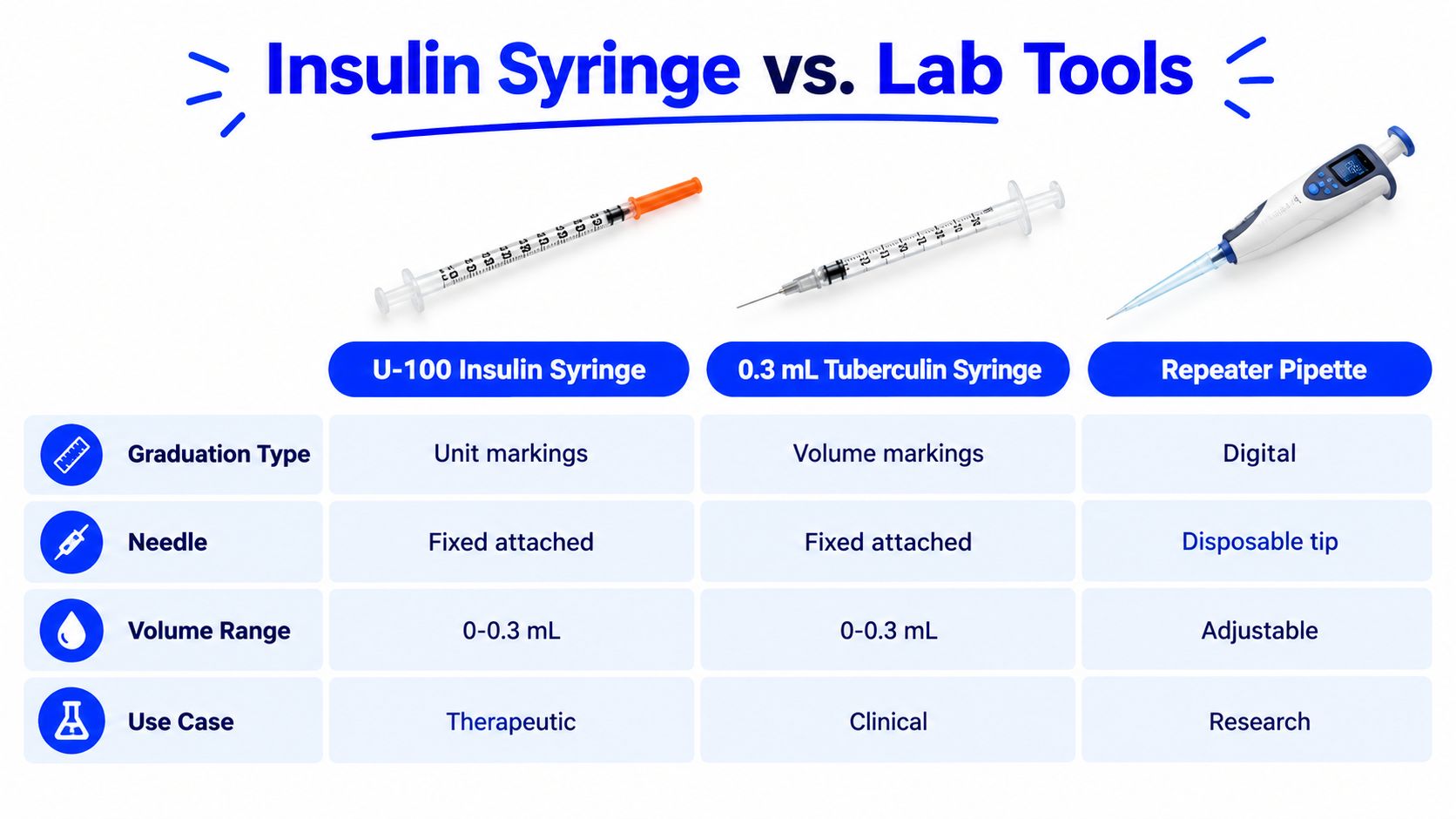
For a single-vial preparation below 0.5 mL, the insulin syringe can be a pragmatic choice when the operator is comfortable with U-100 conversion. For a quantitative method, multi-aliquot library, or documented analytical workflow, a direct-volume lab syringe or validated repeater pipette may offer better process control. Herbilabs also provides a syringe selection for reconstitution resource for teams comparing syringe formats and connection types.
No device should be chosen solely because its barrel is small. The correct comparison includes markings, dead volume, sterility, access geometry, documentation, and the number of transfers expected in the workflow.
Aseptic Handling and the 28-Day In-Use Window
A syringe's single-use status and a diluent's in-use period are separate controls. Bacteriostatic water containing 0.9% benzyl alcohol can support an in-use period of up to 28 days when the vial is accessed and stored correctly, but that period belongs to the prepared vial and its diluent system, not to a reusable syringe (Herbilabs provides guidance on how long bacteriostatic water lasts after opening).
A disciplined workflow should include the following:
- Clean the septum: Wipe the vial stopper with 70% isopropyl alcohol and let it dry before every access.
- Use a new sterile syringe: Select a fresh 0.3 mL insulin syringe for each draw. Never return a used needle to the vial.
- Control storage: Keep the prepared vial refrigerated at 2 to 8 °C between sessions, according to the applicable material and product instructions.
- Label the preparation: Record the reconstitution date, diluent identity, and final concentration.
- Respect the discard date: Discard the vial at day 28, even if liquid remains, when that is the applicable bacteriostatic-water window.
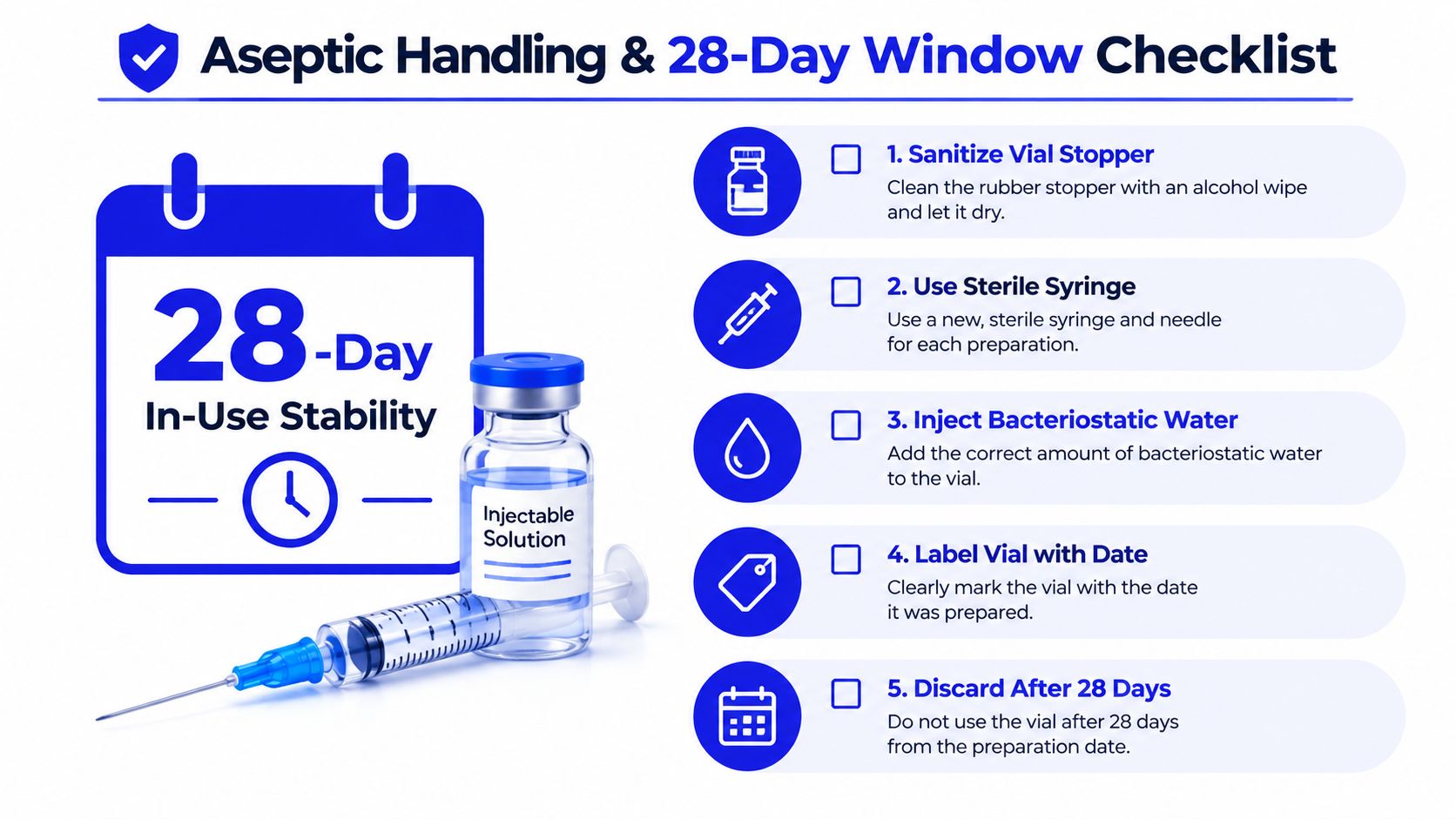
Multi-dose access without preservative creates a different contamination concern and should be handled under the relevant laboratory or clinical protocol. A new syringe for each withdrawal reduces carryover risk, but it can't correct a contaminated stopper, poor storage, or an unsuitable diluent.
Readers reviewing injection-specific technique can consult this Mounjaro UK patient guide, while research teams should follow their own approved SOPs and the manufacturer's instructions for the material being prepared.
Quick Reference for Choosing and Using a 3 10 mL Syringe
What does “3 10 mL syringe” identify? In most searches, it means a 0.3 mL, 30-unit U-100 insulin syringe, not a 10 mL insulin syringe. The phrase may also refer to a pack quantity, so confirm the barrel capacity before ordering. Used correctly, this small barrel is a low-volume precision tool, not a universal reconstitution device.
Use this checklist at the bench:
- Confirm the draw volume: Choose 0.3 mL when one draw fits within 30 U-100 units and stays comfortably below the top graduation.
- Choose a larger barrel when needed: Use 0.5 mL or 1 mL if the planned draw exceeds 0.3 mL or would require repeated fills.
- Read the graduations: Check for single-unit or half-unit markings, then confirm the operator can convert U-100 units to milliliters.
- Match the needle: A 0.3 mL U-100 configuration may use a fine, short needle, while other products offer different gauge and length combinations. Select the combination that suits the vial access and approved procedure.
- Compare dead space: Fixed-needle and detachable designs retain different residual volumes. That difference can affect a low-volume preparation.
- Check the package: Review sterility information, lot details, expiry, intact packaging, and manufacturer documentation before use.
- Keep the device's role limited: An insulin syringe is intended for single-use measurement and transfer, not extended storage. It should not remain attached to a vial between sessions.
- Document the calculation: Record the planned diluent volume and final concentration so the selected barrel can be checked before the draw.
The 3/10 mL format fits a workflow built around low volume, fine visual reading, and a single controlled draw. It loses that advantage when the diluent approaches or exceeds the barrel limit, when direct milliliter markings are required, or when a validated laboratory pipetting system is available. A syringe graduation is a reading aid, not proof of analytical accuracy.
Herbilabs supplies sterile reconstitution solutions and related labware for research-use-only workflows, with vial formats, lot-specific documentation, and distribution across the EU, UK, and USA. Review Herbilabs options alongside syringe specifications, aseptic procedures, and volume calculations before ordering supplies for a low-volume reconstitution workflow.