Private Label, White Label, Wholesale partnerships available - EU, USA and UK - Free shipping from €75

Sodium Chloride Soap: What It Is, Uses, and Safety
A sodium chloride soap formula usually uses common table salt as a processing aid or texture modifier, not as the cleansing agent. Salt can separate soap from glycerol during manufacture, firm some bars, and alter liquid-soap viscosity, but the right amount depends on the product format and the condition of the skin.
Why, then, do so many explanations treat “salt soap” as though sodium chloride itself washes the skin? The phrase hides several different jobs. Sodium chloride soap may describe an ordinary saponified soap containing salt, a bar deliberately made with brine, or a liquid cleanser adjusted with salt for texture. Those products can behave very differently.
Table of Contents
- What Sodium Chloride Soap Actually Means
- The Chemistry of Salt in Soap Formulation
- How Sodium Chloride Shaped Industrial Soapmaking
- Practical Dosage and Formulation Effects of Salt
- Sodium Chloride Soap vs Saline and Other Cleansers
- Skin Effects and Safety Nuance Most Articles Miss
- Consumer, Industrial, and Lab Applications Compared
- Key Takeaways and Quick Reference
What Sodium Chloride Soap Actually Means
The phrase sodium chloride soap sounds as if the bar is made primarily from salt. Usually, that isn't what it means. Sodium chloride, or NaCl, is common table salt, and in soapmaking it often works behind the scenes while the actual cleansing molecules come from saponified oils or fats.
Saponification converts fats and oils into fatty-acid salts, such as sodium cocoate or sodium olivate. Those molecules interact with oily soil and water, allowing dirt and grease to rinse away. Sodium chloride doesn't perform that same cleansing role. It's more like a backstage stagehand than the lead actor, important to the production but not the star.
Three uses are easy to confuse:
- Bar-soap hardener: Salt can reduce the solubility of soap and help a bar feel firmer.
- Liquid-soap viscosity modifier: In some liquid systems, NaCl changes micelle organization and can thicken or thin the product depending on concentration. The ingredient explanation for sodium chloride in soap bases describes salt as a formulation modifier rather than an active detergent.
- Saltwater or brine cleanser: A product may intentionally contain saline water or visible salt crystals. That's a different design from adding a small amount of dissolved salt to a conventional soap batch.
A label containing sodium chloride therefore doesn't automatically identify a “salt-based soap.” The surrounding ingredients matter. A bar built around sodium cocoate, sodium palmate, or another fatty-acid salt is still a conventional soap, even if sodium chloride appears later in the ingredient list.
Readers should also separate dissolved salt from coarse salt crystals. Dissolved NaCl influences the water phase and the structure of the soap. Large crystals create a physical exfoliating surface, which can feel much harsher even when the underlying cleansing chemistry is similar.
The Chemistry of Salt in Soap Formulation
Salt behaves a little like salt added to a cooking pot. It changes the environment around the ingredients, rather than becoming the food itself. In soapmaking, that environmental change has two main consequences: it can help separate soap during manufacture, and it can adjust the flow of a finished liquid cleanser.
Salting out during soap manufacture
After fats react with an alkali, the mixture contains soap, water, glycerol, and possibly excess alkali. Adding sodium chloride makes the soap less soluble in the water phase. The soap gathers into a curd that can be filtered and washed, while glycerol and much of the unwanted aqueous material remain behind. This process is called salting out.
The chemistry of fats and oils in soapmaking describes sodium chloride as a processing aid that separates soap curds from glycerol and excess alkali. Saturated salt solutions are also used to drive fatty-acid salts out of solution, as explained in this educational description of soap precipitation.
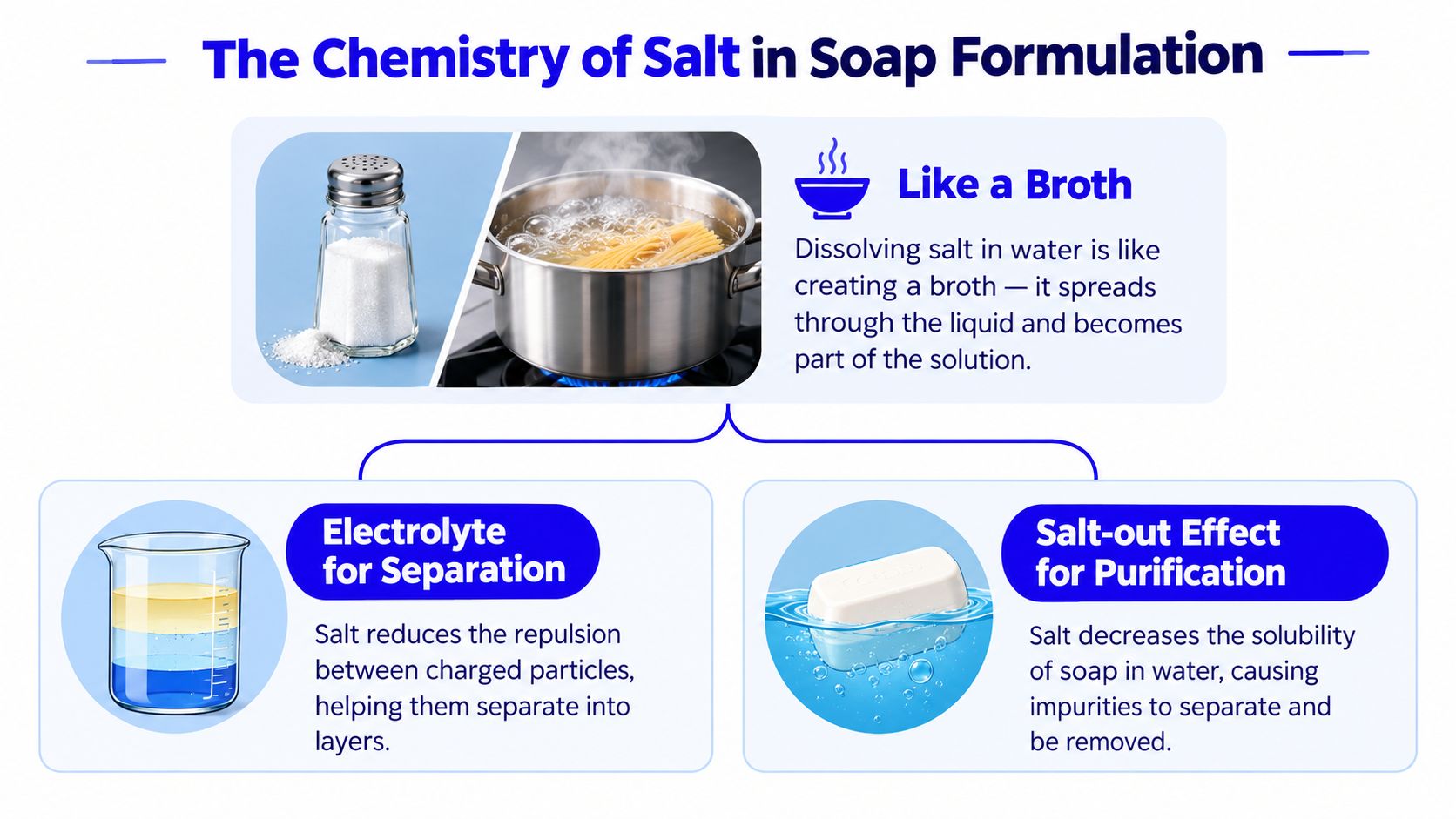
That separation improves recovery and purity. It also helps manufacturers handle soap as a distinct solid phase instead of leaving every component in one watery mixture. Readers interested in the related chemistry can also review this explanation of powerful cleaner sodium carbonate, an alkaline compound connected to historical and modern cleaning chemistry.
Salt and liquid-soap texture
In a liquid soap or surfactant base, there may be no curd to filter. Instead, sodium chloride changes the electrical environment around surfactant molecules. Their micelles can reorganize, altering viscosity, clarity, and phase behavior.
That effect isn't linear. A little salt may make a formula thicker, while more salt can push the system past its useful range and make it thinner or unstable. The formulation therefore needs controlled addition, mixing, and observation rather than a simple rule that “more salt equals thicker soap.”
Practical rule: Salt changes the system around the cleansing molecules. It doesn't replace those cleansing molecules.
How Sodium Chloride Shaped Industrial Soapmaking
Modern industrial soap owes part of its history to a problem that began with alkali. Soapmakers needed alkaline materials to react with fats, but small workshops often relied on wood ash. That approach supported local production, yet it was less suited to consistent, large-scale manufacture.
In 1790, French chemist Nicolas Leblanc developed a process for producing caustic soda, or sodium hydroxide, from common salt, sodium chloride. A related 1791 milestone converted sodium chloride into soda ash, or sodium carbonate. Because alkali is essential for saponification, this salt-based chemistry helped move soapmaking toward larger commercial production, as documented in this history of soap and industrial alkali.
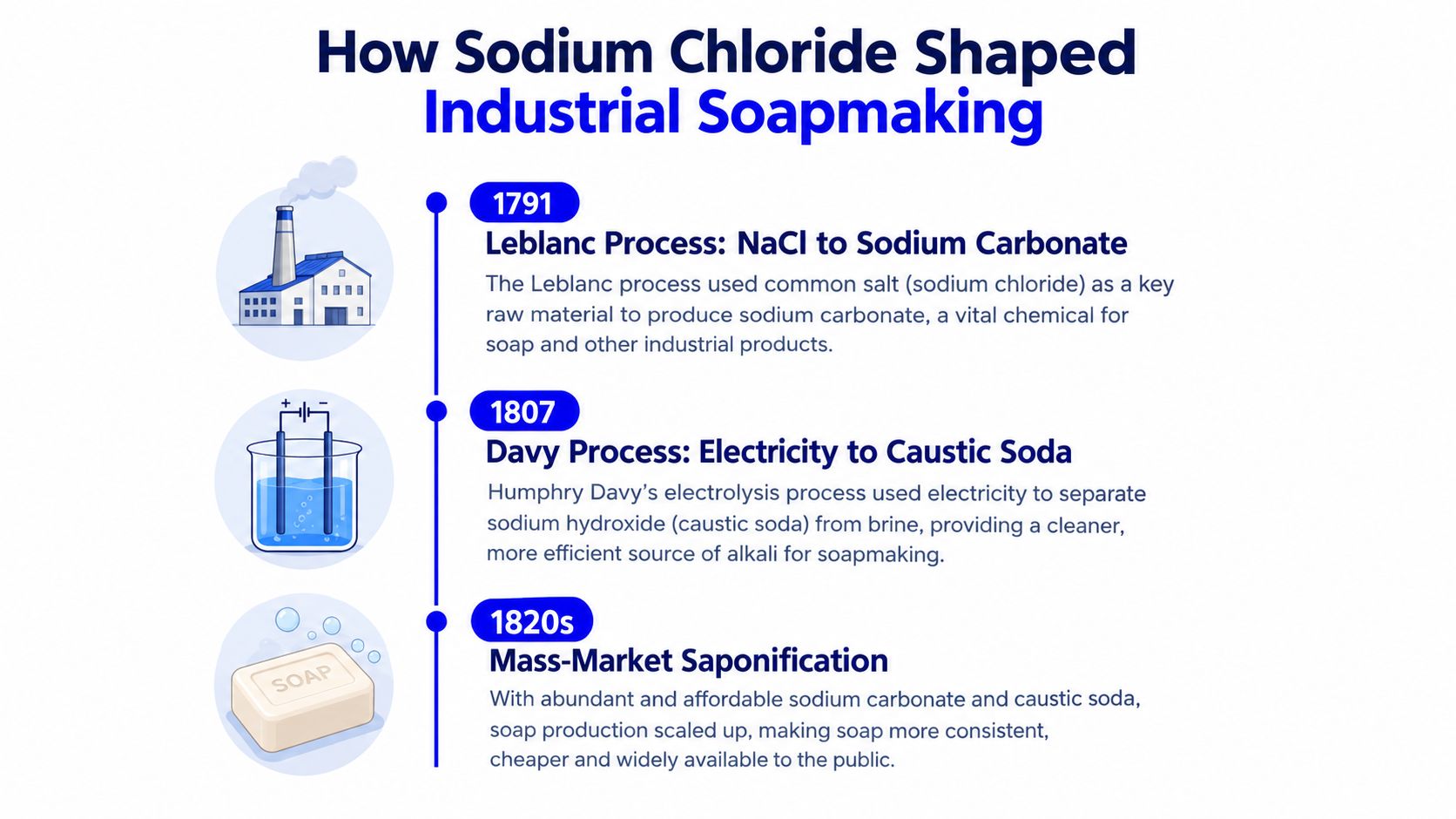
The Leblanc process remained influential for nearly a century before the Solvay process displaced it in the 1860s, according to the same historical account. That long operating period shows how central salt-fed chemical production became to nineteenth-century soap and detergent economics.
From raw salt to commercial soap
The historical chain is straightforward:
- Sodium chloride supplied the starting material.
- Industrial processing produced alkaline compounds.
- Alkali enabled more consistent fat saponification.
- Manufacturers could separate, wash, and recover soap at larger scale.
The modern connection is practical rather than symbolic. Today's formulators still use salt to influence separation during manufacture and to adjust texture in finished cleansing systems. The equipment and process controls have changed, but the underlying idea remains familiar: ionic ingredients can determine whether soap stays dispersed, separates cleanly, or pours with the desired body.
For readers who need a narrower chemistry reference, the Herbilabs guide to lab-grade saline provides context for saline materials outside ordinary cosmetic soap formulation.
Practical Dosage and Formulation Effects of Salt
The most useful formulation question isn't whether sodium chloride works. It's how much is too much for a particular format. Unfortunately, the answer can't be transferred directly from a bar recipe to a liquid cleanser, because salt changes hardness in one system and micellar viscosity in another.
The available ingredient guidance identifies a real gap in consumer and maker education. Sodium chloride can improve hardness in bar soap and viscosity in liquid soap, yet excess salt may make bars brittle or destabilize liquids. The discussion of sodium chloride in soap and personal-care formulas highlights this need for product-specific dosage guidance.
Bar soap
For a bar, salt can reduce mushiness and help the finished product feel firmer. It may also support a more stable physical structure during handling, but excessive inclusion can move the bar from firm to brittle. Cracking during unmolding, a dry snap, or rapid disintegration in use are signs that the formula needs reassessment.
Liquid soap
Liquid systems are more sensitive to the shape of the viscosity response curve. Salt may thicken a potassium-based soap or surfactant cleanser at first, then thin the formula after the system passes its useful range. Clarity can also change, so viscosity should never be judged alone.
The following table uses only the qualitative guidance available in the supplied evidence. It deliberately avoids invented concentration ranges because the brief provides no verified dosage percentages for these formats.
| Format | Typical NaCl Range | Purpose | Caution Threshold |
|---|---|---|---|
| Solid bar soap | Product-specific, measured experimentally | Increase firmness and reduce solubility | A brittle, cracked, or overly drying bar |
| Liquid soap | Product-specific, added gradually | Adjust viscosity and micelle organization | Thinning, clouding, separation, or poor skin feel |
| Brine cleanser | Defined by the product design | Create a saline water phase | Stinging or excessive dryness |
| Salt scrub or crystal bar | Defined by crystal size and formula | Physical exfoliation and texture | Abrasion, redness, or discomfort |
A sensible development method is incremental testing. A formulator can prepare small batches, add salt in controlled steps, and record appearance, firmness, lather, rinse behavior, viscosity, and skin feel. The exact response depends on the oil profile, alkali, water content, surfactant blend, temperature, and other electrolytes.
Formulation checkpoint: The first sign of “too much salt” may be a physical failure, such as cracking or thinning, before it becomes a skin complaint.
Sodium Chloride Soap vs Saline and Other Cleansers
A product called a salt soap can sit close to several unrelated categories. The safest way to interpret it is to ask what removes soil, whether the salt is dissolved or crystalline, and whether the product is intended for routine cleansing or a specialized use.
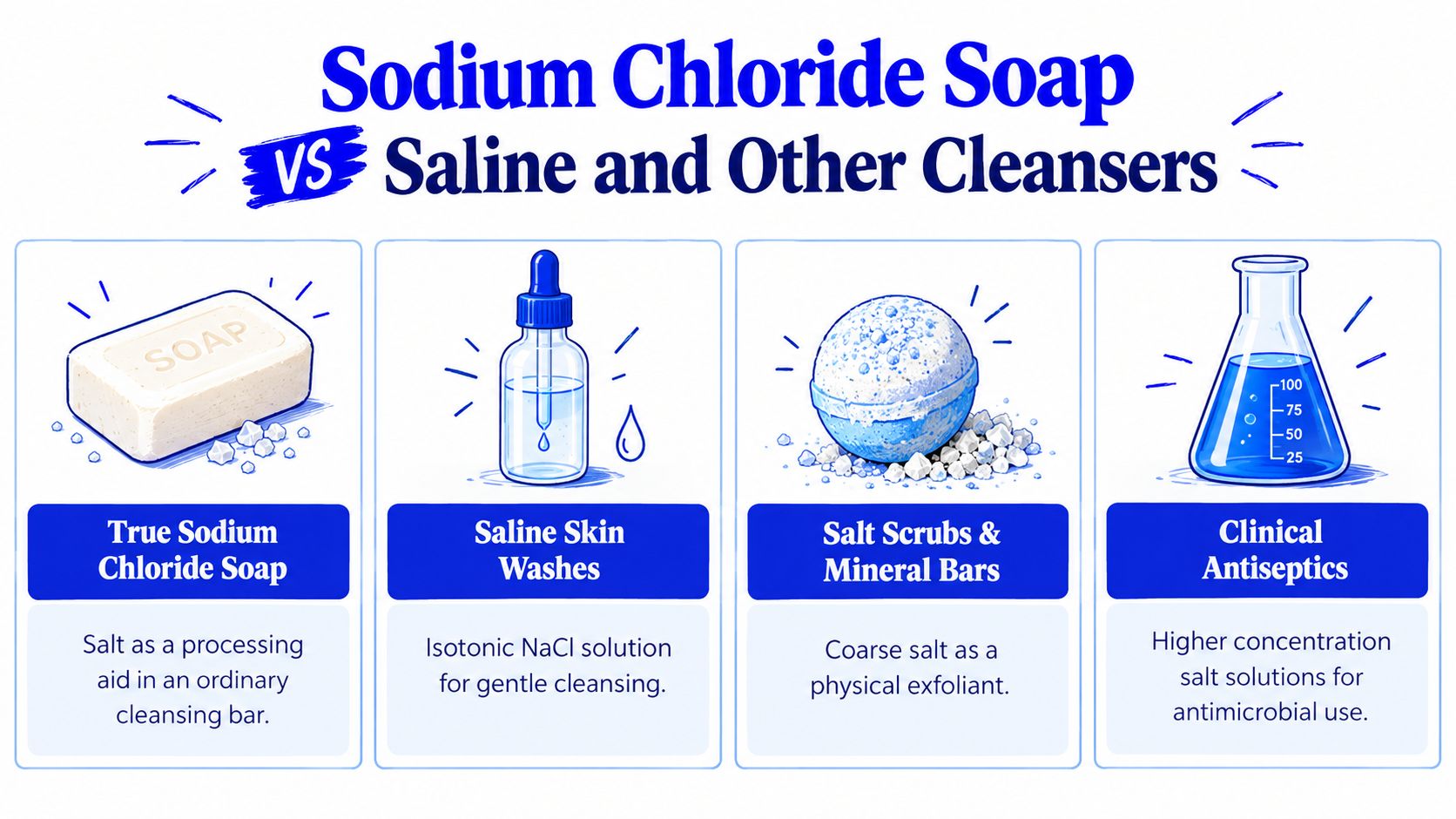
Four categories that sound similar
True sodium chloride soap is an ordinary saponified cleanser in which salt supports processing, hardness, or texture. Its cleansing action comes from fatty-acid salts. The presence of sodium chloride doesn't turn it into a saline wash.
Saline skin washes are solutions of sodium chloride in water. They may be selected for gentle rinsing or specialized skin-care situations, but saline alone isn't equivalent to soap because it lacks the amphiphilic fatty-acid salts that lift oily soil. It also shouldn't be assumed to provide antiseptic action merely because it contains salt.
Traditional castile soap is generally associated with olive-oil soap. Its feel and hardness arise from its oil composition and processing, not from a required salt addition. Some castile formulas may include other ingredients, so the label remains more informative than the product name.
Syndet bars use synthetic detergent molecules instead of relying on saponified oils as the primary cleansing system. They can be engineered around a different pH and sensory profile from traditional soap, which may make them a better match for some users with dry or reactive skin.
| Product type | Main cleansing chemistry | Role of salt | Typical use |
|---|---|---|---|
| Sodium chloride soap | Saponified fatty-acid salts | Processing or texture modifier | Routine hand or body cleansing |
| Saline wash | Dissolved sodium chloride in water | Main dissolved solute | Rinsing or specialized washing |
| Castile soap | Predominantly saponified olive oil | Optional formulation aid | Traditional soap cleansing |
| Syndet bar | Synthetic surfactants | Optional viscosity or texture aid | Cleansing with a non-soap detergent base |
Terminology becomes especially important in laboratory and healthcare discussions. A focused explanation of bacteriostatic water vs sodium chloride helps distinguish different sterile or saline-related materials from cosmetic soap ingredients.
Skin Effects and Safety Nuance Most Articles Miss
“Generally safe” is a population-level description, not a personal guarantee. Sodium chloride in a rinse-off product may cause little trouble on intact skin, while the same salty formula can sting sharply when the barrier is compromised.
Freshly shaved skin has recently experienced mechanical stress. Eczema or dermatitis can involve an already weakened barrier, and cracked heels or other fissures expose more sensitive tissue. The supplied safety discussion emphasizes that the relevant question isn't whether salt is toxic. It's whether the product's concentration, contact, friction, fragrance, and cleansing strength suit the condition of the skin.

Why compromised skin reacts differently
Salt can create an osmotic environment that feels uncomfortable when the outer barrier is disrupted. A smooth bar with dissolved sodium chloride may sting, while a salt scrub or crystal bar adds friction and can intensify the sensation through abrasion.
The product's “natural,” “mineral,” or “pure” positioning doesn't change that physical reality. Fragrance, essential oils, high-cleansing soap bases, rough crystals, and frequent washing may all matter more than the marketing language on the package.
A practical skin-status check can guide product choice:
- Intact skin: A modestly salted rinse-off soap may be well tolerated, provided it doesn't leave persistent tightness or irritation.
- Freshly shaved skin: Test cautiously or choose a smoother, fragrance-free cleanser if stinging occurs.
- Eczema or dermatitis: Avoid experimenting during an active flare with harsh or heavily salted bars. A healthcare professional can help select a suitable cleanser.
- Cracked or open skin: Keep salt-rich and abrasive products away from damaged areas, particularly if they cause pain.
Skin-safety rule: “Safe for most people” doesn't mean “appropriate for irritated skin.”
Rinsing thoroughly can remove residual cleanser and salt from the surface. If burning, redness, itching, or worsening dryness continues after use, stopping the product is more sensible than trying to adapt the skin to it.
Consumer, Industrial, and Lab Applications Compared
The same chemical can serve different purposes depending on who is using it. A home soapmaker may care about a bar's firmness, a factory may care about pour behavior, and a laboratory may care about purity and controlled ionic conditions. Treating those as one application leads to poor recommendations.
Consumer formulation
In a solid bar, sodium chloride is selected for its effect on solubility and physical firmness. The maker evaluates unmolding, cure behavior, lather, rinsing, and how quickly the bar softens in a wet dish. A salt adjustment that helps one oil blend may produce a brittle result in another.
Industrial formulation
Liquid soaps, body washes, shampoos, and related surfactant systems may use NaCl to tune viscosity. The useful range is system-specific, and over-salting can cause thinning, cloudiness, or precipitation rather than a richer pour. Manufacturing teams therefore test the complete formula, not salt in isolation.
Digital formulation platforms can help teams document raw materials, manage formula versions, and review manufacturing data. For readers exploring that workflow, this overview of AI for beauty manufacturing offers context on beauty product lifecycle management.
Laboratory use
Laboratories may use reagent-grade sodium chloride for controlled salting-out steps, brine washes, saline preparation, or ionic-strength adjustment. Cosmetic-grade table salt and laboratory-grade material aren't interchangeable when purity, traceability, or experimental reproducibility matters. A product described as sodium chloride injection USP for research belongs to a different supply and documentation context from salt added to a handmade soap batch.
| Context | Typical NaCl Dose | Primary Function | Watch-Out |
|---|---|---|---|
| Consumer bar | Formula-specific | Firmness and processing behavior | Brittleness or uncomfortable skin feel |
| Industrial liquid cleanser | Formula-specific | Viscosity and flow control | Thinning, clouding, or precipitation |
| Soapmaking process | Process-specific | Salting out and purification | Incomplete separation or excess residual alkali |
| Laboratory workflow | Method-specific | Controlled ionic conditions or separation | Impurity, incorrect grade, or poor traceability |
The decision aid is simple. Hobbyists should test bar quality, manufacturers should map viscosity response, and researchers should prioritize grade, stoichiometry, and documentation.
Key Takeaways and Quick Reference
Sodium chloride is the chemical name for common table salt. In sodium chloride soap, it usually acts as a processing aid or formulation modifier, while saponified fatty acids provide the actual cleansing action.
The central points are easier to remember as a checklist:
- Identify the role: Salt may help separate soap from glycerol and excess alkali during manufacture.
- Match the format: In bars, it can support firmness. In liquids, it can change viscosity and micelle organization.
- Don't confuse products: A salted soap, a saline wash, a salt scrub, and a syndet bar use different cleansing or textural systems.
- Watch the skin barrier: Intact skin may tolerate a modestly salted rinse-off formula, but damaged, inflamed, freshly shaved, or cracked skin may sting or become more irritated.
- Treat crystals differently: Coarse salt adds friction and exfoliation, so it isn't equivalent to dissolved NaCl.
- Test before scaling: Salt response varies with the oil blend, alkali, surfactants, water phase, and other ingredients.
- Record what changes: A useful formulation notebook tracks salt addition, pH, viscosity, appearance, firmness, rinse behavior, and skin feel.
Salt also shouldn't be marketed as the cleansing ingredient or as an automatic antimicrobial solution at ordinary cosmetic use. Its practical value lies in controlling the structure and behavior of the formula. A buyer can start by reading the ingredient list, while a formulator can add salt cautiously and judge the complete product rather than relying on a universal rule.
Herbilabs supplies sterile diluents and related laboratory materials for research-use workflows, with product documentation and vial formats suited to controlled preparation tasks. Visit Herbilabs to review its laboratory supply range and find the material that matches the intended research application.