Private Label, White Label, Wholesale partnerships available - EU, USA and UK - Free shipping from €75

Peptide Mass Calculator: How to Find Molecular Weight
A researcher removes a peptide vial from the freezer, checks the label, and prepares to add bacteriostatic water. The dilution arithmetic looks straightforward, but the certificate describes a salt-form material while the worksheet assumes free peptide. The solution can look perfectly clear and still have a different peptide concentration than intended.
A peptide mass calculator helps prevent that mismatch, provided the operator enters the actual molecular structure and understands what the vial's reported mass represents. Reliable preparation starts with the sequence, terminal chemistry, and certificate, not with the volume of diluent.
Table of Contents
- Why a Peptide Mass Calculator Matters at the Bench
- Monoisotopic Mass Versus Average Mass and When Each Applies
- Step by Step Calculation From a Raw Sequence
- Common Modifications, Counter-Ions, and Salt Forms
- Pitfalls That Skew Peptide Mass Calculations
- Comparing Calculator Output With Measured Mass Spectra
- Using the Calculator Before Reconstitution
- Quick Reference and Verification Workflow
Why a Peptide Mass Calculator Matters at the Bench
The freezer-to-bench problem involves two separate questions: what does the peptide molecule weigh, and how much of that molecule is in the vial? A sequence calculator addresses the first. The certificate of analysis and the supplier's reporting conventions help address the second.
Confusing those questions produces a stock solution that's mathematically consistent with its worksheet but inconsistent with its contents. A correct molecular weight cannot rescue an incorrect assumption about the weighed material.
A calculation is a quality checkpoint
Peptide synthesis teams use theoretical mass to define the expected product. QC analysts compare that prediction with analytical results, while independent laboratories and resellers use it to check whether a certificate describes the ordered structure. The useful output isn't just a number; it's a number attached to explicit assumptions.
The tool's scientific foundation is mass spectrometry, not dilution arithmetic. In 1981, Donald Hunt and coworkers reported peptide sequencing by tandem mass spectrometry using a triple-quadrupole instrument, a milestone in connecting peptide structures with interpretable mass measurements, as described in Nature's account of peptide sequencing by mass spectrometry.
Modern calculations apply those theoretical relationships to a specified sequence, terminal groups, modifications, and ionization state. They don't demonstrate that synthesis produced the intended material or that storage preserved it.
Bench principle: A calculator predicts the intended molecule. Analytical testing checks the material that arrived.
What belongs beside the calculator
A usable calculation record needs more than a pasted sequence:
- Structure specification: The sequence, terminal chemistry, and any nonstandard residues or attached groups.
- Calculation settings: The mass convention and whether the output represents a neutral molecule or an ion.
- Lot documentation: The certificate, reported mass basis, and any available peptide-content information.
- Preparation objective: Whether the stock is specified by material mass, peptide-equivalent mass, or molar concentration.
These details make the calculation auditable when another analyst prepares the same lot. They also keep a molecular-weight tool from being mistaken for a concentration tool.
Before any diluent is added, the operator should be able to explain what the calculator includes and what remains outside it. That distinction matters more than the apparent precision of the displayed result.
Monoisotopic Mass Versus Average Mass and When Each Applies
A peptide batch can produce two legitimate mass values, and choosing the wrong one can make a correct result look like a mismatch. Monoisotopic mass uses a specified isotope for each element; average mass weights elemental masses by their natural isotope abundance. They describe the same chemical formula using different conventions.
For an isotope-resolved mass spectrum, compare the observed result with a monoisotopic prediction. When converting bulk peptide material into amount of substance, average molecular weight is generally the appropriate basis, unless the material's isotope composition requires another convention. The measurement and calculation must use matching mass types.
No universal peptide-size cutoff can replace checking how the measurement was made. A larger molecule may still need a monoisotopic theoretical value, while an unresolved spectrum should not be compared blindly with an isotope-specific prediction.
Peptide mass fingerprinting put this distinction to practical use: measured peptide masses were matched to theoretical masses from known sequences following proteolytic digestion, as described in Nature's history of protein identification through peptide mass matching.
Residue values depend on the mass convention
These example residue masses follow IUPAC monoisotopic and average conventions. The difference matters when a calculator sums residue masses, so record which convention its library uses.
| Residue | Monoisotopic (Da) | Average (Da) | Δ |
|---|---|---|---|
| Glycine | 57.02146 | 57.0519 | 0.0304 |
| Alanine | 71.03711 | 71.0779 | 0.0408 |
| Leucine | 113.08406 | 113.1594 | 0.0753 |
Residue mass refers to the amino-acid unit incorporated into a peptide, not the isolated free amino acid. A table labeled only “amino-acid molecular weight” may therefore use values that cannot be summed directly as peptide residues.
Before using a calculator result, check its mass-type setting and confirm whether it reports a neutral molecule or an ion. Retain the selected convention with the calculation, especially when preparing a peptide for reconstitution: the calculator's molecular-weight basis affects conversion from weighed material to molar concentration, while counter-ions and other components may require separate consideration.
For a spectrum, match the convention to the selected peak or reported neutral mass. For bulk molarity, use the basis appropriate to the material and its isotope composition. When reviewing a certificate, compare values on the certificate's stated basis before treating a difference as a product problem.
Match like with like. Mixing monoisotopic and average values creates an apparent discrepancy before the peptide's chemistry has been evaluated.
Step by Step Calculation From a Raw Sequence
A sequence calculation should be reproducible without relying on a website's hidden defaults. The arithmetic can be expressed symbolically when a validated mass library isn't available; exact decimal outputs should only be recorded after the residue values and modification definitions have been verified.
The calculation pathway is illustrated below. Any numerical callouts in a diagram should be checked against the laboratory's selected mass library before use.
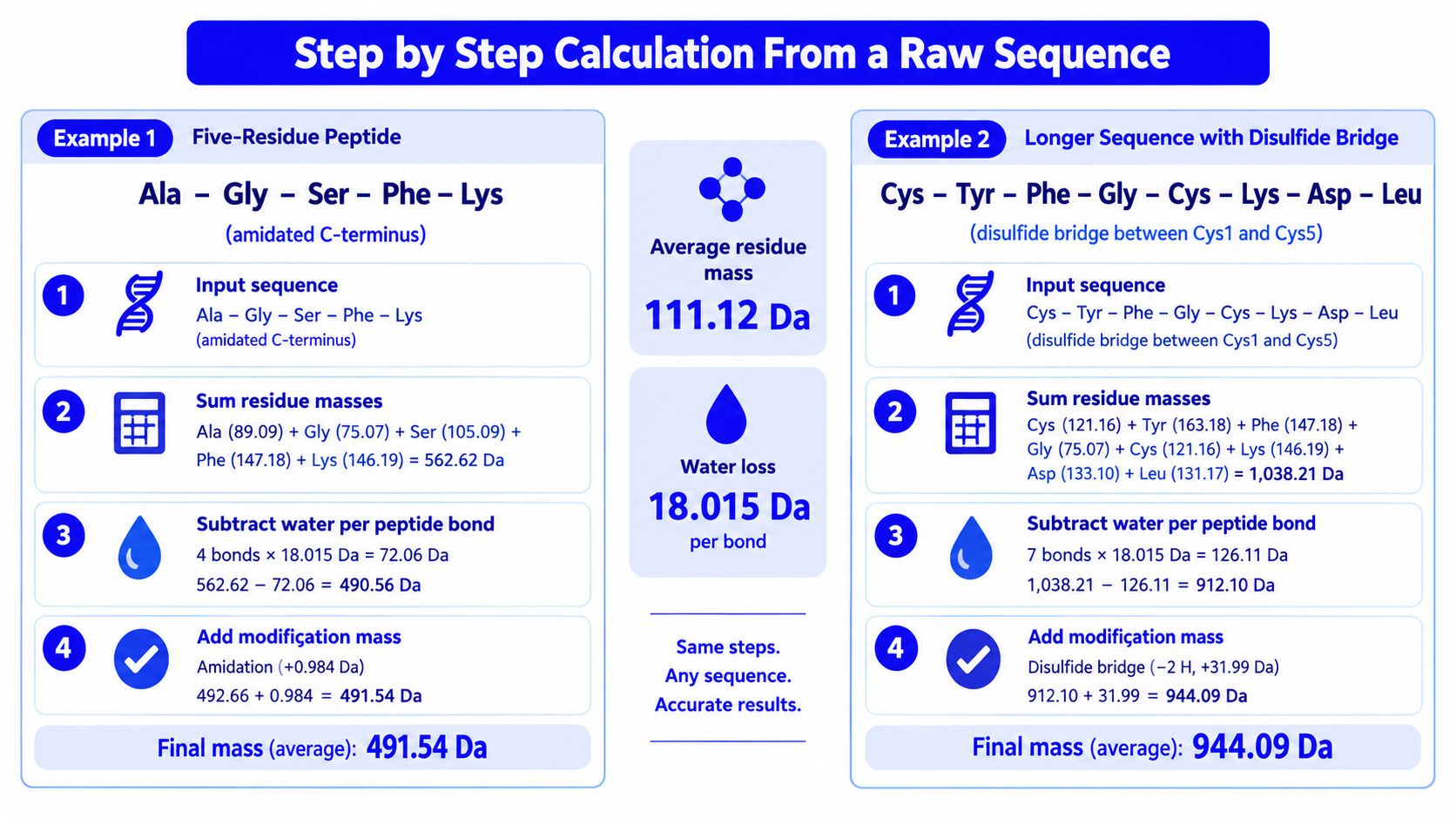
Start with the correct building blocks
For a linear peptide with unmodified termini, the residue-based calculation is:
Neutral peptide mass = sum of residue masses + terminal water
An alternative starts with free amino-acid masses and subtracts water for each peptide bond formed. These are different bookkeeping routes to the same structure. Subtracting bond water after summing residue masses counts the condensation adjustment again.
The peptide bond examples from Herbilabs provide structural context for that distinction. The worksheet should explicitly identify which type of mass table it uses.
Worked sequence with an amidated terminus
Consider the sequence Ala-Gly-Ser-Phe-Lys, specified with a free amino terminus and an amidated carboxyl terminus. Let r denote a residue mass from the selected library and W the mass of terminal water.
The auditable calculation is:
M = r(Ala) + r(Gly) + r(Ser) + r(Phe) + r(Lys) + W + Δ(amidation)
The amidation term is the difference between the specified amidated terminus and the free-acid terminus used by the baseline formula. It isn't the mass of an entire amide group added without accounting for the atoms it replaces.
The operator should verify that the calculator hasn't already included amidation through its terminal setting. Entering it again as a custom modification would double-count the change.
Worked sequence with an acetylated terminus
For Ac-Ala-Gly-Ser-Phe-Lys-Leu-Val-Asp-Glu-Thr-Cys-Pro-Asn-Gln-Arg-His-Met-Tyr-Trp-Ile-OH, the expression becomes:
M = sum of the listed residue masses + W + Δ(N-terminal acetylation)
The acetyl notation belongs in a supported terminal-modification field. Pasting it into a sequence-only field can cause rejection, omission, or misinterpretation, depending on the parser.
A useful worksheet records:
- Input sequence: The sequence as accepted by the calculator, checked against the order specification.
- Terminal settings: Free or modified amino and carboxyl termini.
- Library values: The residue and modification definitions used for the chosen mass convention.
- Final expression: Residue sum, terminal contribution, and each explicit structural adjustment.
The final decimal result should come from those documented inputs. A number without that audit trail is difficult to troubleshoot and easy to reproduce incorrectly.
Common Modifications, Counter-Ions, and Salt Forms
Before using a calculated mass to plan a reconstitution, confirm what the number represents. A peptide's covalent structure determines its molecular mass; counter-ions and other components in the vial affect the material's total mass and peptide content. A sequence-only calculator may account for the first and omit the second.
The table of common peptide modifications, counter-ions, and salt forms with their corresponding mass changes is a reference, not a substitute for checking the modification definitions or the lot-specific certificate.
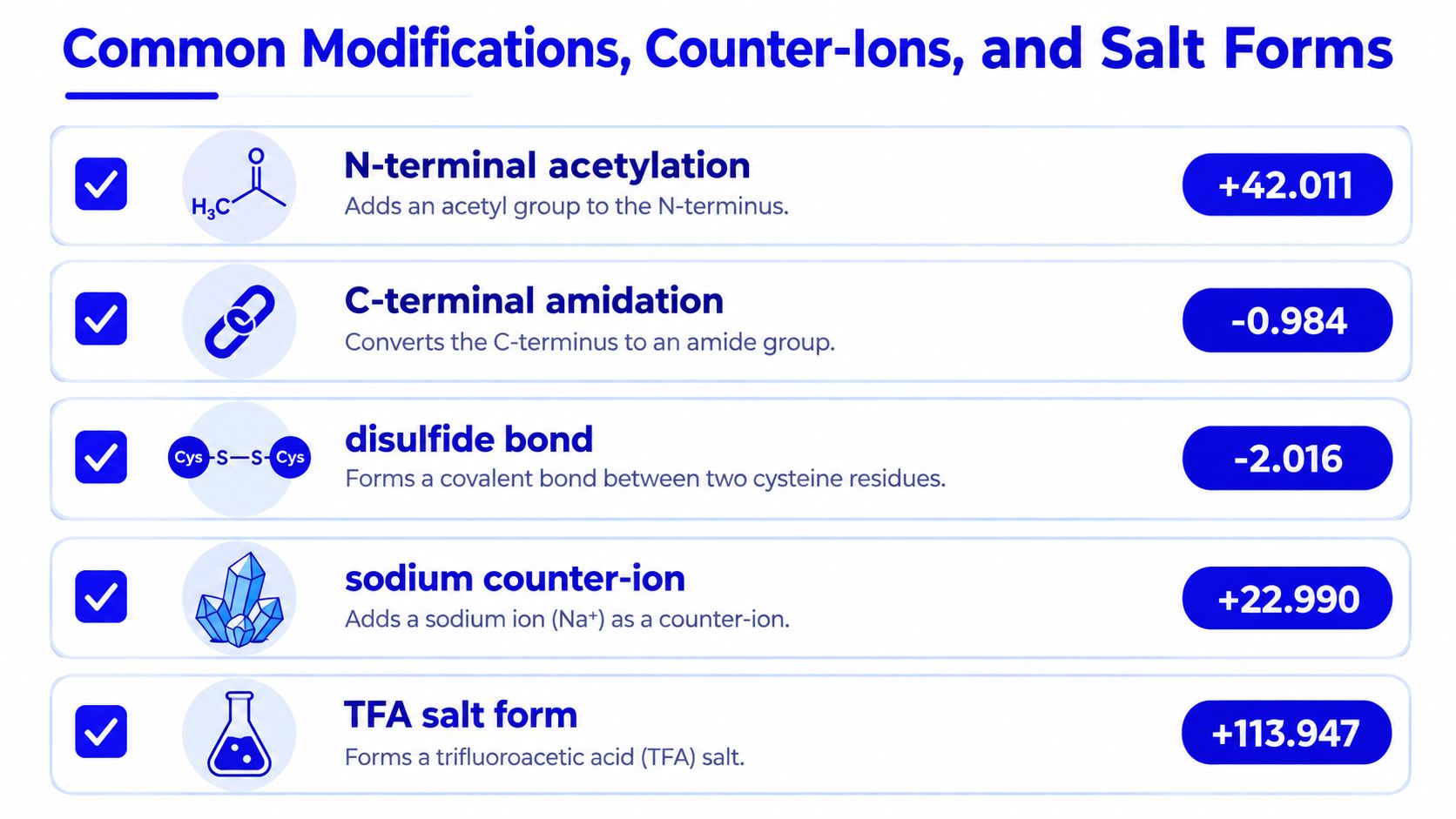
Acetylation at the N-terminus, amidation at the C-terminus, phosphorylation, and disulfide formation each need a structural definition in the calculator. Biotin and fluorescent tags require the attachment chemistry, including any linker. A preset named “FAM” or “biotin” is useful only if its definition matches the product.
| Feature | Confirm | Calculator entry |
|---|---|---|
| Terminal modification | Which terminus changed and how | Terminal setting or defined modification |
| Disulfide bridge | Connectivity and specified oxidation state | Bond or structural adjustment |
| Phosphorylation | Modified residue and site | Site-specific modification |
| Biotin or fluorescent tag | Attached group and linker chemistry | Defined conjugate modification |
Presets save time when they match the supplied structure. A custom formula better represents a different conjugate, but it must be checked against the complete chemical definition. Convenience is useful only when the underlying chemistry is clear.
Salt-form labels need a separate check. Trifluoroacetate, acetate, or hydrochloride identifies a counter-ion, but the name alone does not establish how much is present in the vial. Review the certificate before applying a correction.
The nominal weight of a lyophilized material and its peptide-equivalent content are different quantities unless supporting documentation shows otherwise.
A calculator that accepts a salt name may assume a particular stoichiometry. Confirm that assumption against the material before using the output in reconstitution calculations. Record the covalent modifications, stated counter-ion, whether its quantity was measured or assumed, and whether the vial weight represents total material or peptide-equivalent content. Check whether the certificate reports a usable peptide-content result.
If the certificate leaves these details unclear, ask the supplier to clarify them. An estimated counter-ion correction can make a worksheet look precise without making the reconstitution calculation more reliable.
Pitfalls That Skew Peptide Mass Calculations
A clean calculator output only confirms that the software accepted an input. It doesn't confirm that the input describes the vial.
The laboratory setting below reflects the practical need to review the structure alongside the calculation.
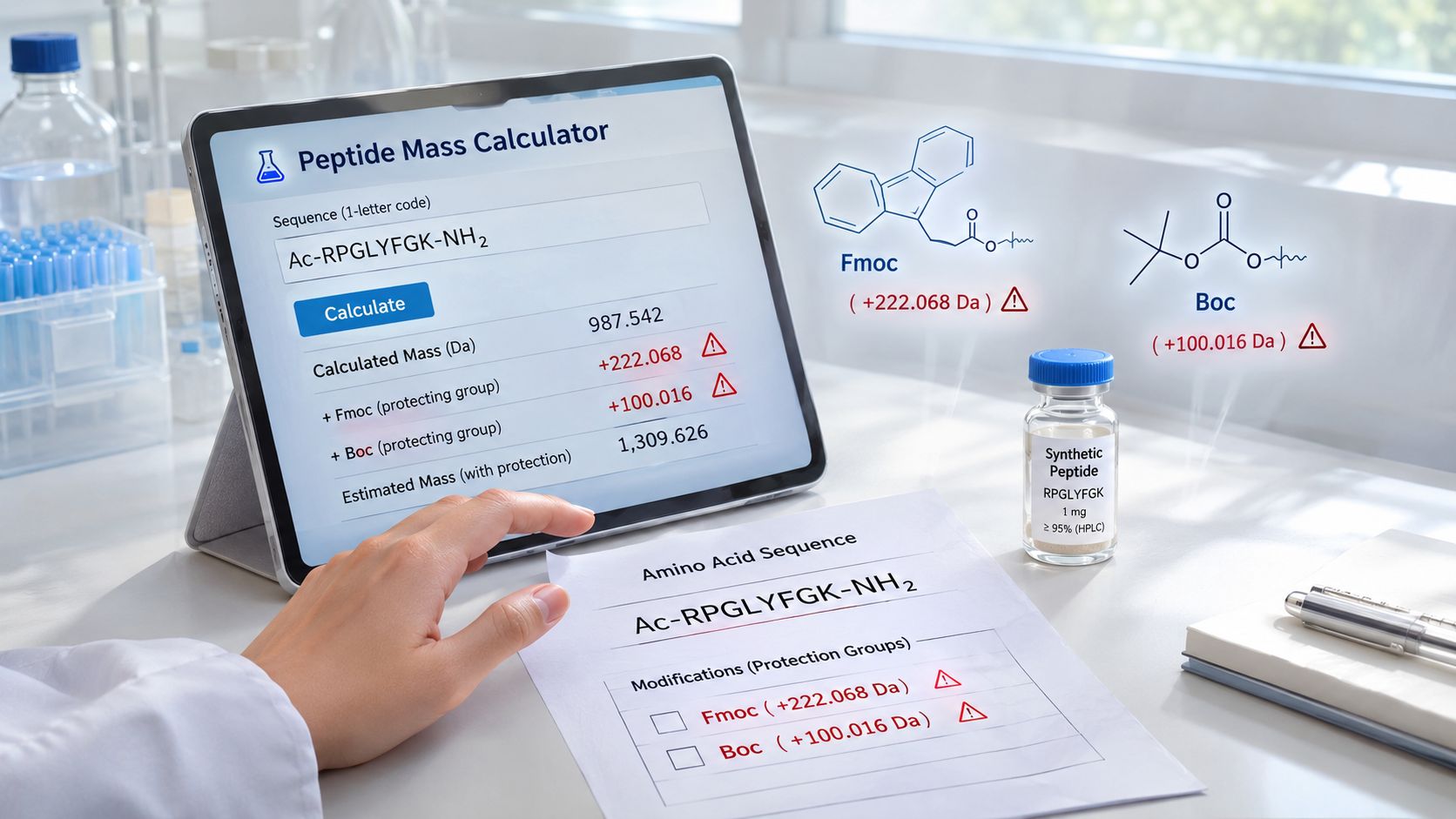
The wrong structure can produce a precise answer
A synthesis intermediate may intentionally retain protecting groups such as Fmoc, Boc, or side-chain protection. The finished product specification should distinguish that intermediate from a deprotected peptide.
Unexpected retained protection and sequence truncation are different possibilities. Incomplete deprotection doesn't itself establish that residues are missing, and an unexpected mass shouldn't be assigned to either explanation without supporting analytical evidence.
Nonstandard residues introduce another problem. A parser may accept only conventional sequence letters, while the purchase specification includes a modified amino acid or a custom building block.
- Parser behavior: Unsupported notation should cause an explicit warning rather than silent omission.
- Product state: The order should identify whether the material is a final peptide or a protected intermediate.
- Calculation scope: The output should disclose excluded features instead of presenting an unexplained total.
Labels need their own specification
Isotopically labeled peptides require the label positions and isotope composition to be represented in the calculation. A natural-abundance prediction is the wrong reference for a deliberately labeled product.
Descriptions such as SILAC-labeled material or isotope-enriched peptide aren't complete calculation instructions. The molecular specification must identify what was labeled and where.
The embedded video is supplementary; the calculation record still needs independently verified inputs.
Screen the record before troubleshooting chemistry
A small molecular-weight discrepancy doesn't translate into a universal concentration error. The consequence depends on the molecular weight, the concentration basis, and whether the error concerns the molecule or the weighed material.
The fastest useful review is therefore documentary: compare the parsed sequence with the order, inspect the calculation settings, and check the certificate's terminology. Investigating an instrument before checking an omitted modification wastes effort.
Comparing Calculator Output With Measured Mass Spectra
A calculator's neutral molecular mass and a mass spectrometer's mass-to-charge ratio, or m/z, are not directly interchangeable. An apparent disagreement may disappear once the analyst identifies the ion, charge state, and isotope assignment.
The diagram illustrates that conversion pathway. Its example values should be treated as illustrative rather than as reference values for an unknown peptide.
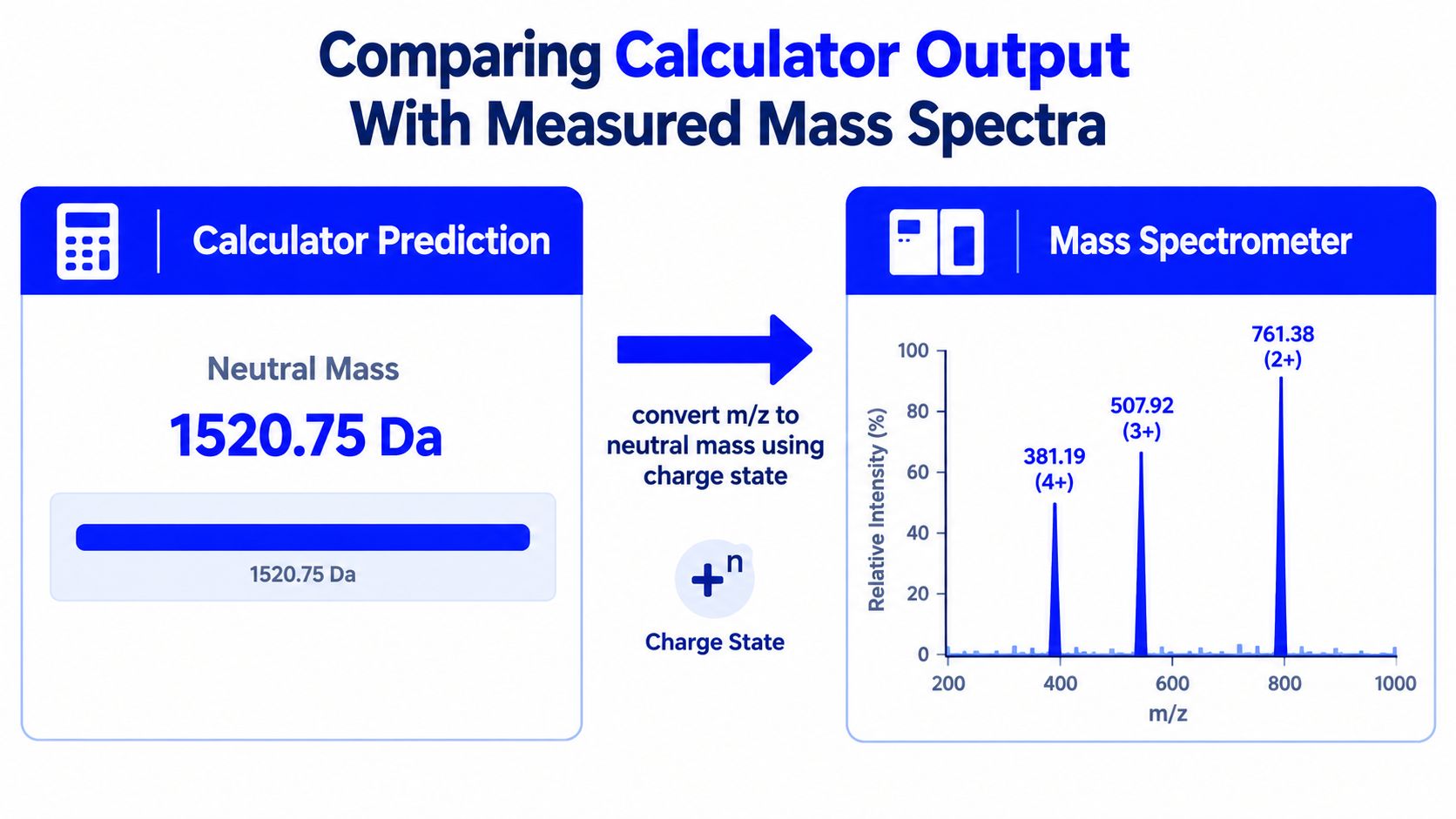
Compare the same chemical species
For a protonated ion, the relationship can be written symbolically as:
m/z = (M + z × proton mass) / z
Rearranging gives:
M = z × (m/z) − z × proton mass
Here, M is neutral mass and z is charge. The calculation must use proton mass rather than neutral hydrogen-atom mass.
That expression also assumes protonation explains the ion. An adduct-containing species needs a different adjustment, so charge assignment alone isn't sufficient.
| Experimental feature | Required interpretation |
|---|---|
| Charge-state peak | Identify charge and ion composition |
| Isotope envelope | Establish the selected isotope assignment |
| Deconvoluted neutral mass | Check the software's mass convention |
| Additional signal | Evaluate an adduct, modified species, or separate component |
An isotope envelope isn't an average-mass label
An isotope envelope contains information about the distribution of isotopic species. It shouldn't be described as an average-mass measurement alone, and its strongest peak needn't be the monoisotopic peak.
The analyst should check how the instrument software selects peaks and reports deconvoluted masses. Otherwise, a correct theoretical calculation can be compared with the wrong experimental feature.
Interpretation checkpoint: A mass difference deserves a chemical explanation only after charge, isotope assignment, and adduct assumptions agree.
Use method-specific acceptance criteria
There's no universal acceptable mass error for every peptide QC workflow. Resolution, calibration, signal quality, acquisition method, and the intended decision all affect the defensible tolerance.
The laboratory should apply its validated method criteria rather than importing a tolerance from an unrelated instrument. Agreement across interpretable charge states supports an assignment, but a mass match alone doesn't establish sequence identity or overall purity.
If the discrepancy survives those checks, the analyst can investigate candidate structural changes. The proposed explanation should account for the observed data, not merely resemble a familiar modification.
Using the Calculator Before Reconstitution
A vial is ready for concentration calculations only after the amount of peptide it contains is clear. A peptide mass calculator supplies molecular weight, but the weighed material may also include counter-ions, water, or other components. Treating the full vial mass as peptide can therefore produce a misleading concentration.
Check the certificate before choosing a mass basis. A purity result does not automatically state the peptide-equivalent fraction of the material. Confirm what the assay measures and whether the reported result supports a correction. If the peptide-equivalent fraction is not documented, record the concentration on a nominal material-mass basis rather than presenting it as an established peptide concentration.
For a material mass m and documented peptide-equivalent mass fraction f:
Peptide-equivalent mass = m × f
For a target mass concentration C:
Final solution volume = peptide-equivalent mass / C
For a molar target, use the documented molecular weight to convert peptide-equivalent mass to amount of substance. Keep units consistent from the input through the final volume.
Preparation conditions require a separate decision. Bacteriostatic water is not automatically compatible with every peptide, product label, or downstream assay. Follow the product specification and laboratory method, and consult this lab guide for peptide preparation for additional preparation context. Sterile technique alone does not establish stability, solubility, or formulation compatibility.
Record the material identity, sequence specification, lot, and certificate reference. Include whether the amount is nominal material mass or documented peptide-equivalent mass, along with the target concentration, units, and molecular-weight convention. Note the diluent, handling procedure, and approved storage conditions. Add any appearance check, labeling detail, or analytical confirmation required by the method.
One operational detail often causes a preventable error: the calculated quantity is the final solution volume, not necessarily the volume of diluent to add. The preparation procedure should state how that final volume is reached.
Quick Reference and Verification Workflow
A defensible workflow moves from prediction, to document review, to experimental confirmation. Reconstitution arithmetic comes after the relevant assumptions have been resolved.
Keep an auditable reference beside the freezer
- Mass library: Retain the documented residue values, mass convention, and modification definitions.
- Calculation expression: Record the residue sum, terminal contribution, and structural adjustments.
- Sanity checks: Confirm termini, modifications, and the certificate's material-mass basis.
- Escalation criteria: Seek analytical review for unexplained mass differences, unexpected chromatographic components, or suspected product changes.
For concentration arithmetic, the peptide mixing calculator tool from Bulk Aussie Peptides is an option to consider after the material inputs are established. Its calculation assumptions should be checked before the result enters a laboratory worksheet.
The Herbilabs labware dilution guide provides a separate dilution resource. Neither resource should be assumed to verify molecular identity, quantify residual counter-ions, or establish peptide content.
A saved calculation is useful when another analyst can reproduce it from the same documented inputs.
The complete record should connect the predicted structure, lot-specific certificate, analytical decision, and prepared stock. That chain makes later troubleshooting possible and helps prevent a nominal concentration from becoming an unsupported experimental assumption.
Herbilabs offers sterile research-use-only reconstitution solutions and related labware, alongside peptide preparation and dilution resources. Researchers can visit Herbilabs to review those options and align diluent selection with a documented peptide calculation and preparation workflow.