Private Label, White Label, Wholesale partnerships available - EU, USA and UK - Free shipping from €75

How to Reconstitute Peptides Safely in Research Labs
The vial is on the bench, the lyophilized peptide is still dry, and the syringe is ready. At that moment, the important question isn't which liquid dissolves the powder. The correct choice depends on the target concentration, expected number of vial entries, storage plan, and contamination risk.
A reliable research workflow treats reconstitution as a controlled preparation, not a quick mixing task. The solvent, injection angle, dissolution method, storage record, and first withdrawal all affect whether the final solution remains suitable for the intended RUO procedure. The following approach is designed for laboratories that need repeatable handling rather than a result that works only by chance.
Table of Contents
- Planning Your Reconstitution Before You Open Any Vial
- Choosing Between Sterile Water and Bacteriostatic Water
- Calculating the Right Volume and Concentration
- Performing the Reconstitution With Clean Technique
- Storing and Using Reconstituted Peptides Within 28 Days
- Troubleshooting Cloudiness, Particulates, and pH Shifts
- Documentation and QA for Repeatable RUO Workflows
Planning Your Reconstitution Before You Open Any Vial
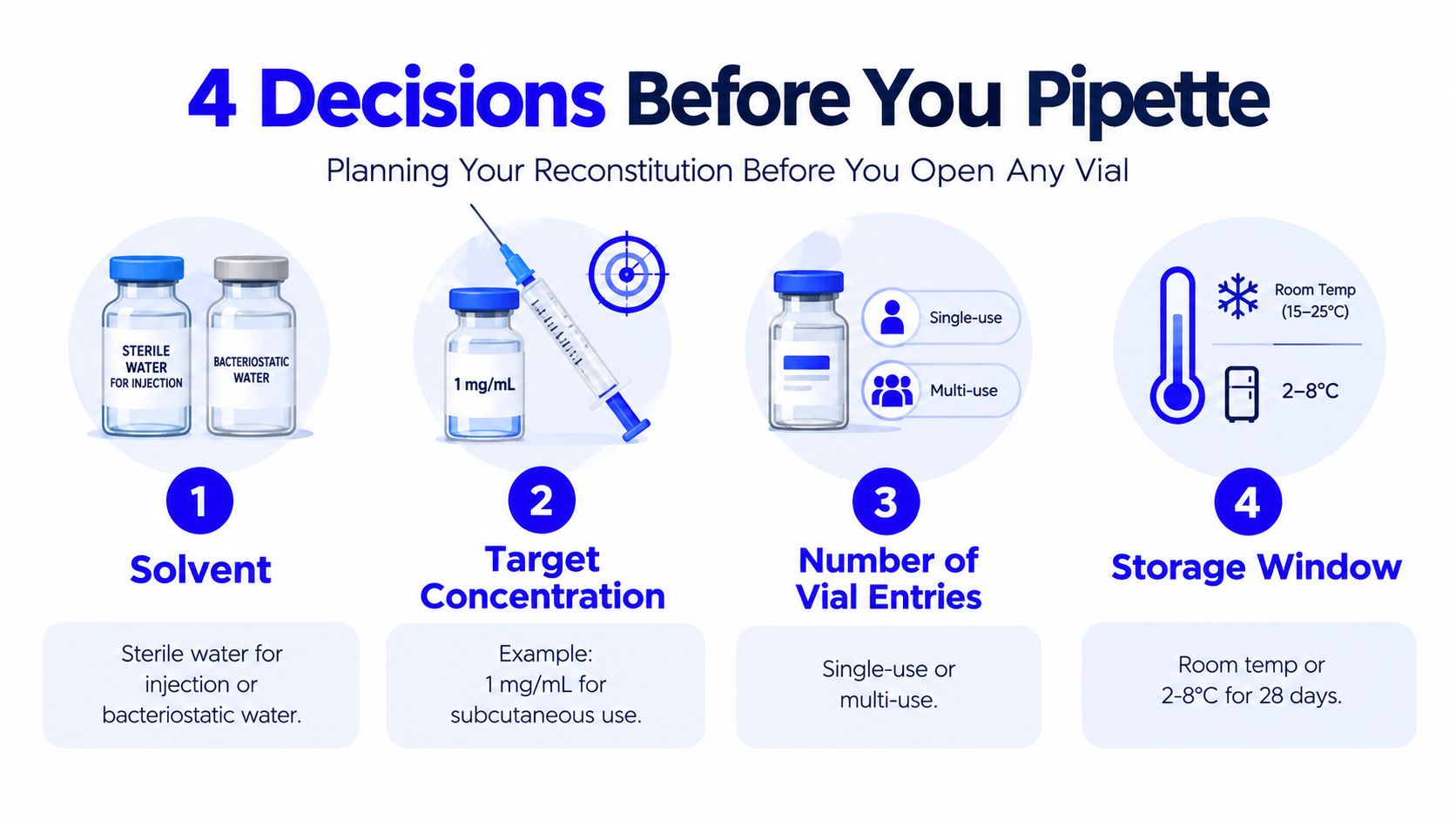
Before the diluent syringe is loaded, four decisions should already be written down: which solvent is compatible, what concentration is required, how often the vial will be entered, and how long the solution must remain in use. A vial that will be aliquoted once has different needs from a vial that will be punctured repeatedly during a research sequence.
Start by matching the solvent to the work pattern. Sterile water for injection can suit a single-use preparation, while bacteriostatic water may fit a controlled multi-dose workflow because its preservative supports repeated access. That choice still requires confirmation against the peptide, downstream assay, and supplier documentation. A preservative isn't automatically compatible with every application.
Next, verify the peptide identity, stated mass, lot number, and relevant quality documentation against the Certificate of Analysis. Calculate the intended final concentration and withdrawal volume before anything is opened. The calculation should account for the amount of material available, the desired concentration, and practical syringe handling.
Stage the bench before staging the vial
Place the vial, compatible diluent, sterile syringes, fresh needles, alcohol swabs, labels, waste container, and documentation sheet within the clean working area. Arrange them so the operator doesn't need to reach across open sterile components or leave the laminar flow path during the preparation.
Practical rule: Every avoidable movement after opening a vial is another opportunity to disrupt the clean workflow.
Record the planned solvent lot, intended volume, final concentration, and storage location. Decide in advance how vial entries will be logged. A label with the date, operator initials, and entry count turns an otherwise invisible contamination risk into a traceable event.
The planning stage also prevents unnecessary overhandling. If the peptide will be used once, prepare the required amount and avoid building a multi-use process that adds exposure. If repeated withdrawals are unavoidable, select a compatible preservative-containing diluent and establish a clear storage and entry routine before the first puncture.
Choosing Between Sterile Water and Bacteriostatic Water
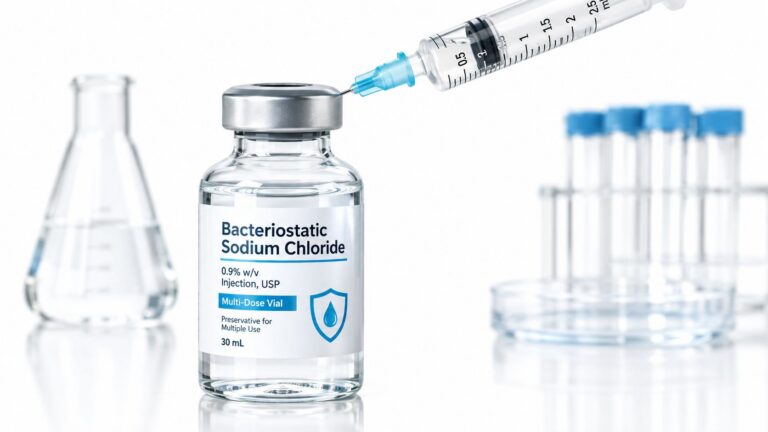
A vial needed for one immediate preparation should be handled differently from one that will be entered repeatedly. The deciding factor is vial-entry frequency, alongside peptide compatibility. Sterile water contains no preservative, so it fits immediate use or prompt single-use aliquoting. Bacteriostatic water contains 0.9% benzyl alcohol, or 9 mg/mL, as stated in DailyMed's bacteriostatic water labeling.
The preservative does not compensate for poor aseptic technique. Each entry still requires a disinfected septum, sterile syringe and needle, and controlled handling. The labeling describes sterile, nonpyrogenic water for injection and multi-dose vial presentations, including 30 mL formats. Those details provide a reference for repeated laboratory access, not permission to treat the vial casually.
| Attribute | Sterile Water for Injection | Bacteriostatic Water (0.9% Benzyl Alcohol) |
|---|---|---|
| Preservative | None | 0.9% benzyl alcohol, or 9 mg/mL |
| Best operational fit | Single-use or immediate preparation | Controlled multi-dose workflow |
| Repeated vial entries | No preservative protection | Appropriate only with maintained aseptic technique |
| Main caution | Use promptly after preparation | Confirm benzyl alcohol compatibility |
| Workflow priority | Minimize time between preparation and use | Control every entry and storage event |
A practical guide to bacteriostatic water for multi-dose peptide vials also frames the choice around access frequency. For a single planned withdrawal, sterile water avoids introducing a preservative that the workflow does not need. For scheduled repeated withdrawals, bacteriostatic water can support the format, provided the peptide and assay tolerate benzyl alcohol.
Acetic acid or another co-solvent requires a separate compatibility decision. Hydrophobic or difficult sequences may need a product-specific solvent system, while an acidic co-solvent without documented compatibility can change solubility, pH, or assay behavior. Match the liquid to both the peptide chemistry and the planned entry schedule. That decision prevents a convenient multi-dose setup from becoming a compatibility or contamination problem.
Calculating the Right Volume and Concentration
The basic calculation is straightforward:
Reconstitution volume = peptide mass ÷ target concentration
The result should be determined before the vial is opened. A clear target prevents improvised additions that change the concentration and make later withdrawals difficult to interpret.
Two examples that transfer to other vial sizes
For a 10 mg vial with a target concentration of 5 mg/mL, the required volume is:
10 mg ÷ 5 mg/mL = 2 mL
After reconstitution, a 0.1 mL withdrawal contains:
5 mg/mL × 0.1 mL = 0.5 mg, or 500 micrograms
For a 5 mg vial with a target concentration of 1 mg/mL, the required volume is:
5 mg ÷ 1 mg/mL = 5 mL
A 0.05 mL withdrawal then contains:
1 mg/mL × 0.05 mL = 0.05 mg, or 50 micrograms
The inverse calculation is equally useful:
Dose volume = desired peptide mass ÷ final concentration
That equation lets an analyst check every planned draw before transferring the solution. The calculation should be independently verified when the withdrawal volume is small or the preparation will support multiple samples.
Account for the material that won't reach the target syringe
The nominal vial mass isn't always the same as the recoverable mass. The CoA may provide purity information that affects the usable amount, so the calculation should follow the laboratory's approved purity-adjustment procedure rather than assuming the label value is fully active material.
Syringe dead volume also matters. A portion of solution can remain in the needle hub or barrel, especially with small-volume insulin syringes. The operator should use a syringe appropriate for the planned draw and document any approved allowance for dead-volume loss.
Calculation check: Don't add solvent until the target concentration, expected withdrawal volume, purity treatment, and practical recovery assumptions have been recorded.
Over-filling a vial can make withdrawal easier, but it also changes the calculated concentration. Any extra volume must be intentional and included in the worksheet. The final record should state the actual diluent volume added, not an estimate based on syringe markings after the fact.
Performing the Reconstitution With Clean Technique
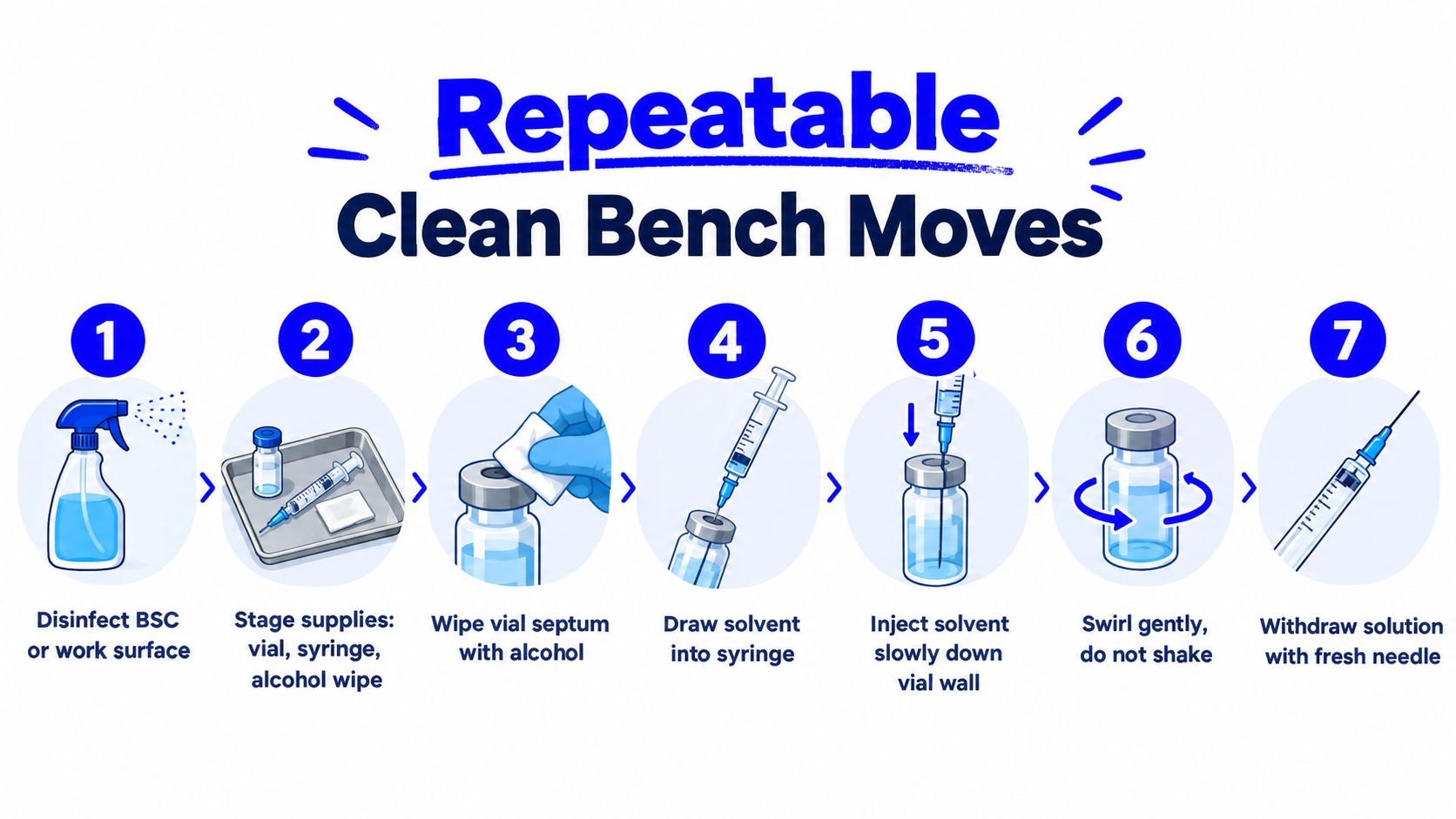
A clean reconstitution session starts with the work area, not the powder. Disinfect the biological safety cabinet or approved clean surface, allow the area to dry, and stage sterile pads, the peptide vial, diluent, alcohol swabs, syringes, needles, labels, and waste container in a controlled order.
Bring the relevant vial and diluent to a suitable working temperature according to the laboratory SOP. Avoid applying heat, and don't begin while condensation or temperature differences could complicate handling. Before puncture, swab the diluent stopper and peptide stopper with fresh 70% isopropyl alcohol, then let the alcohol dry for about 10 to 15 seconds, as described in laboratory peptide reconstitution guidance.
Use the vial wall to protect the cake
Draw the calculated solvent volume with a sterile syringe. Insert the needle through the septum and direct the liquid slowly down the inner glass wall, never straight onto the lyophilized cake. Wall injection reduces foaming and physical disruption during the transition from dry powder to solution.
Remove the syringe without touching the septum or needle. Allow the material to dissolve with gentle swirling for roughly 15 to 60 seconds, rather than shaking or vortexing. The exact dissolution behavior is product-specific, so the operator should follow the supplier's instructions if they differ from a general handling guide.
The following step by step peptide reconstitution resource can help new team members visualize the order of operations. A separate handling reference for bacteriostatic water is useful when the workflow involves repeated vial entries.
The first withdrawal deserves the same discipline as the initial injection. Use a fresh sterile syringe and needle dedicated to that vial, disinfect the septum again, and confirm the planned volume with a second person when the local SOP requires two-person verification. Recap or secure the vial immediately, inspect the solution, record the entry, and return it to its designated storage location.
Storing and Using Reconstituted Peptides Within 28 Days
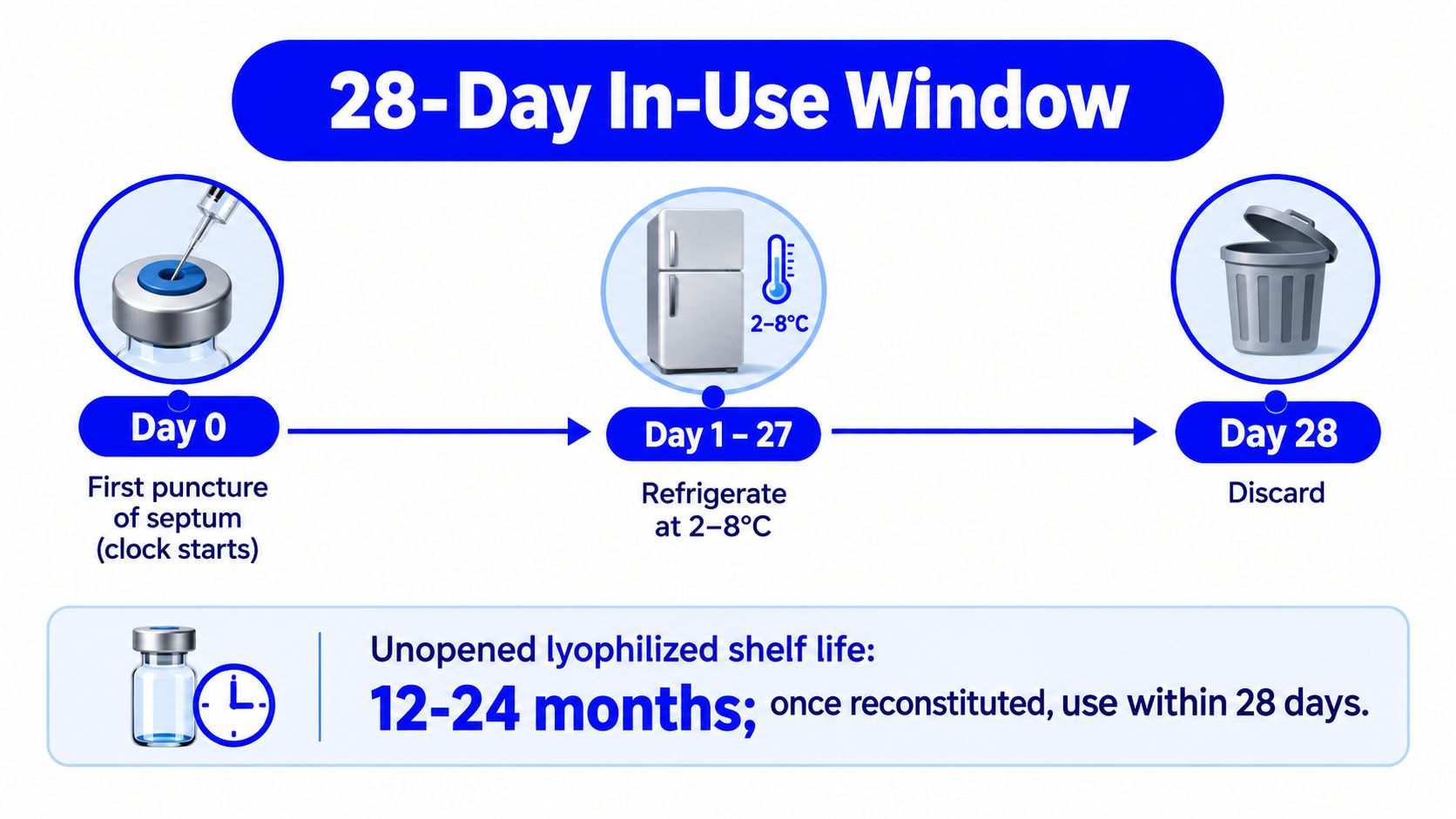
The 28-day in-use window begins when the peptide vial's septum is first punctured after reconstitution with bacteriostatic water. It does not begin when the product arrives or when the unopened lyophilized vial enters storage. This limit applies to a multi-dose workflow supported by 0.9% benzyl alcohol. It does not extend the unopened shelf life of the dry material. For practical handling details, review guidance on bacteriostatic water.
Store the reconstituted vial at 2 to 8°C when that range matches the peptide's approved laboratory procedure. The storage plan should follow the dosing schedule and expected vial-entry frequency. A preparation used repeatedly across several days requires tighter control than one withdrawn once and discarded. Before each entry, disinfect the septum with 70% isopropyl alcohol and let it dry fully. Use a new sterile syringe and needle for every withdrawal, unless the SOP permits a sterile repeat-use system dedicated to that vial.
Protect the window from silent failures
Several routine habits can compromise the in-use period without producing an immediate visual warning:
- Prolonged bench exposure: Return the vial to refrigeration promptly after handling.
- Shared needles: Never transfer a needle or syringe between vials.
- Wet septum puncture: Wait until the alcohol has dried before piercing.
- Splash or immersion: Keep the septum and cap away from contaminated surfaces and liquids.
- Topping off: Do not add fresh diluent to an older reconstituted vial to restore volume.
A sterile-water preparation has no preservative support and should be used immediately or within about 24 hours, according to current peptide storage and reconstitution guidance. That makes sterile water a poor match for repeated withdrawals over several days.
Label each vial with the first puncture date, solvent identity and lot, concentration, storage requirement, and operator initials. Record the same details in the batch log so the discard decision remains clear when multiple preparations are handled in parallel.
Troubleshooting Cloudiness, Particulates, and pH Shifts
A solution that looks abnormal shouldn't be explained away, but an immediate discard isn't the only possible first response. Triage the observation while the vial remains isolated from other materials. Gentle effervescence during initial solvation can differ from persistent haze that remains after slow swirling and a short settling period.
Particulates also provide clues, though visual inspection can't confirm a cause. Translucent fibers may come from septum or glove contact, while crystalline flakes can indicate incomplete dissolution or a response to cold diluent. A micro dip strip can provide a more useful pH check than guessing from appearance or handling, with an expected range determined by the sequence and approved formulation.
| Observation | Likely Cause | Recommended Action |
|---|---|---|
| Brief bubbles or gentle effervescence that clears | Initial solvation or air movement | Allow the solution to settle, then inspect again |
| Persistent haze after gentle swirling | Aggregation, incomplete dissolution, or contamination | Stop routine use and document the condition |
| Translucent fibers | Septum, glove, or environmental contact | Quarantine and record the lot and handling event |
| Crystalline flakes | Incomplete dissolution or cold-solvent effect | Allow controlled equilibration and reassess without forceful mixing |
| Unexpected pH | Incompatible buffer or acidic solvent choice | Hold the vial and compare with the approved formulation |
| Clear solution with no visible particles or unusual odor | No visible abnormality | Proceed only within the approved RUO procedure |
Use a decision path, not a visual guess
If the solution becomes clear and remains free of visible particulates, the analyst can proceed under the approved protocol. If fine particles persist after controlled warming and gentle agitation, filtration may be appropriate only when the peptide, filter material, and assay are known to be compatible. Otherwise, discard through the laboratory's approved process.
Visible fibers, sustained turbidity, discoloration, an abnormal odor, or a compromised septum should trigger a stop, documentation, and quarantine. Record the lot, solvent lot, operator, entry count, time, appearance, pH result, and any deviation from the SOP.
Contamination isn't always caused at the bench. Supplier quality, lot traceability, COAs, sterility information, endotoxin testing, and batch review can all affect the investigation, as emphasized by recent guidance on identifying contaminated peptide solutions. A good troubleshooting record gives the supplier's QA team something actionable instead of a vague report that the vial “looked wrong.”
Documentation and QA for Repeatable RUO Workflows
A usable reconstitution record should let another analyst rebuild the preparation without relying on memory. Tie the peptide lot, solvent lot, calculated concentration, handling events, visual observations, and storage decisions to the same entry.
A practical one-page record
Keep the form beside the clean area and capture:
- Identity: Peptide name or ID, stated mass, lot number, and CoA verification.
- Solvent: Diluent identity, lot number, source, and compatibility check.
- Calculation: Planned volume, actual volume added, target concentration, and any approved purity adjustment.
- Aseptic record: Septum disinfection, drying interval, injection method, dissolution observation, and operator initials.
- Quality check: Dissolution time, visual appearance, pH result, and any particles or discoloration.
- Use history: First puncture date, entry count, withdrawal records, remaining volume, and storage location.
- Deviation status: Any spill, wet septum puncture, compromised closure, unusual appearance, or quarantine decision.
Supplier QA documents establish what arrived at the laboratory. Review the lot-specific CoA, mass confirmation, purity trace, MS data where supplied, and available sterility or endotoxin information. The bench record then shows how that material was diluted, stored, and accessed.
This distinction helps when a preparation looks abnormal. A clean solvent lot, correct volume, controlled injection, normal pH, and uneventful entry history point the investigation toward the peptide lot or supplier documentation. A missed alcohol-drying step or unlogged syringe change points to a handling event instead.
A complete record is part of contamination control. It helps the next analyst decide whether a problem came from the material, the solvent, or the handling event.
The log must fit the actual dosing schedule. A vial entered repeatedly needs immediate entry-count updates and a clear withdrawal history. A preparation used once still needs the same identity, calculation, appearance, and storage fields. Attach the CoA or lot record before routine use, and record each decision at the bench rather than reconstructing it later.
A printable peptide reconstitution log can provide a consistent format for these entries. Herbilabs supplies sterile, nonpyrogenic reconstitution solutions in multi-dose vial formats for RUO preparation of peptides, proteins, and antibodies, with lot-specific documentation available for laboratory records. Review the available diluents and labware options, then match the selected format to vial-entry frequency and QA requirements.