Private Label, White Label, Wholesale partnerships available - EU, USA and UK - Free shipping from €75
Peptide Dilution Calculator: Formulas, Examples, and Use
Can a peptide dilution calculator tell whether a mathematically correct concentration is valid for the experiment? Not by itself. The calculation can show how mass and volume relate, but a trustworthy preparation also depends on what the vial contains, whether the peptide dissolves in the chosen solvent, and whether the resulting solution is suitable for the assay.
The practical goal isn't just to get a number. It's to document a preparation whose inputs, handling, and limitations are clear enough for another researcher to understand and assess.
Table of Contents
- What a Peptide Dilution Calculator Actually Does
- Core Formulas and Unit Conversions You Need First
- Choosing Between mg/mL, µg/mL, and Molar Units
- Three Worked Examples From Vial to Working Stock
- Adjusting for Peptide Purity, Salts, and Net Content
- Serial Dilutions From a Stock Using C1V1 Equals C2V2
- When the Calculator Says One Thing and the Chemistry Says Another
- Multi-Dose Handling and the 28-Day In-Use Window
- Step-by-Step Use of a Peptide Dilution Calculator
- Quick-Reference Summary and Verification Table
What a Peptide Dilution Calculator Actually Does
A peptide dilution calculator is the arithmetic layer between a peptide's stated mass or stock concentration and a target concentration. It can calculate a mass-per-volume concentration, convert between units, or estimate the transfer volume needed to make a working solution. Those operations are useful, but they describe the calculation, not the quality of the prepared material.
Before entering values, a researcher needs to resolve five questions:
- What is the net peptide content? The stated vial fill may not equal the amount of peptide available for the calculation.
- What concentration basis is intended? A result based on total vial mass isn't necessarily the same as one based on verified peptide content.
- What final volume is required? The volume of solvent added and the final solution volume may differ.
- Which solvent is compatible? Solvent choice can depend on the peptide and the assay.
- How much vehicle can the downstream assay tolerate? A stock may be usable on its own but unsuitable at the volume needed for the assay.
The calculator can't confirm sequence identity, purity, recovery, stability, or biological activity. Nor can it establish that a peptide has fully dissolved. Those require separate documentation or analytical checks, chosen to fit the research question and preparation.
Readers looking for general context on how peptide-related treatments are discussed outside a research workflow can explore peptide therapy treatments. That context doesn't replace laboratory guidance or validate a research preparation.
Practical rule: Treat the calculated concentration as a preparation record entry, not as proof that the solution is fit for an assay.
Core Formulas and Unit Conversions You Need First
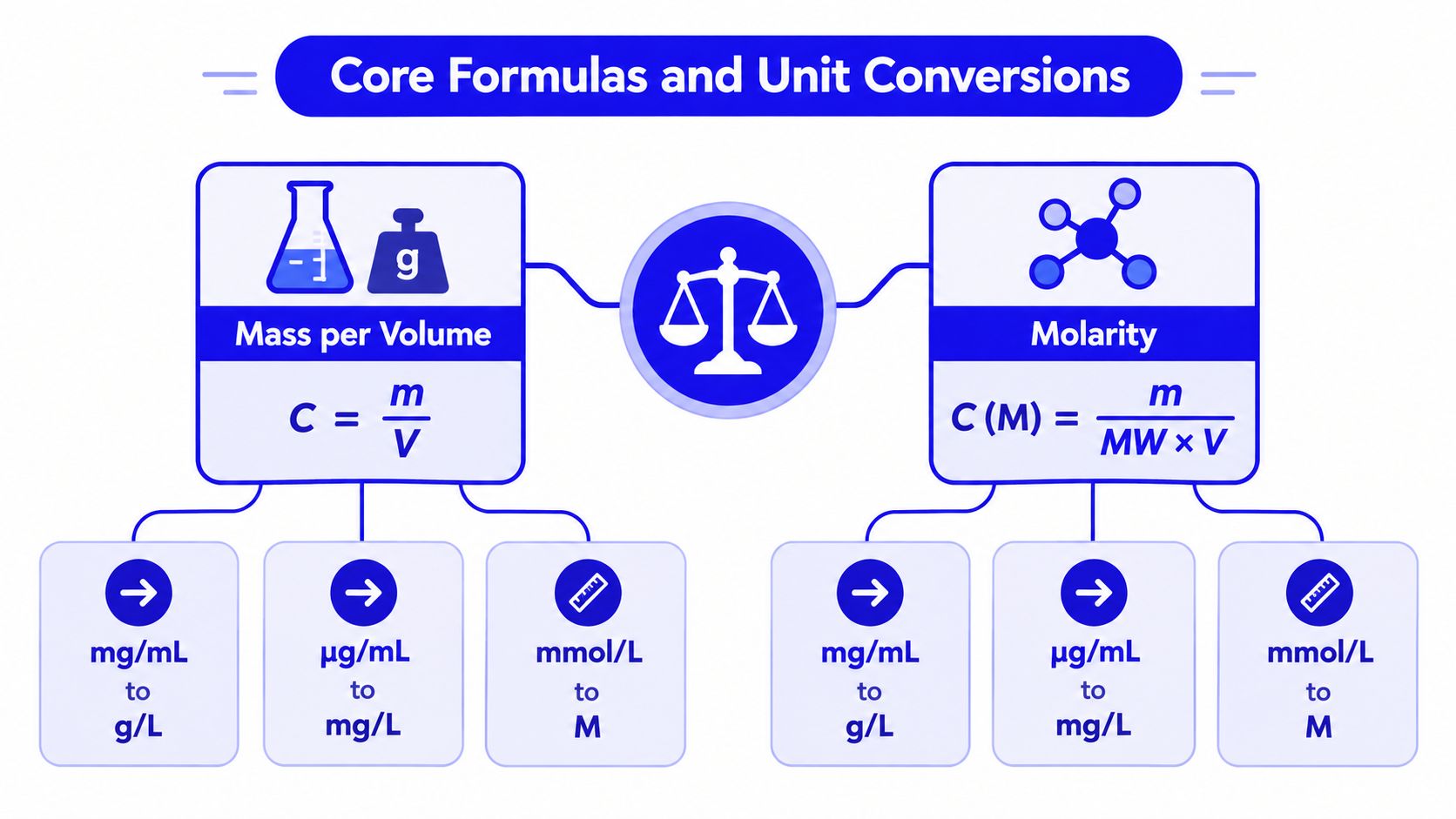
The basic mass-per-volume calculation is:
C = m / V
Here, C is concentration, m is the peptide mass, and V is the solution volume. If a preparation contains 10 mg of material in a final volume of 2 mL, its nominal concentration is 5 mg/mL. The arithmetic is simple; the important detail is that the mass and volume units must match the units expected in the result.
For molarity, the molecular weight must also be included:
C (M) = m / (MW × V)
In this form, mass is in grams, molecular weight is in grams per mole, and volume is in liters. Molar concentration describes the number of moles per volume, so it's useful when an assay depends on the number of peptide molecules rather than their total mass.
Keep units consistent
Common conversions include:
- mg to µg: multiply by 1,000.
- mL to µL: multiply by 1,000.
- g/mol to mg/mmol: divide by 1,000.
A frequent error is applying a factor of 1,000 twice, or not at all, when moving between milligrams and micrograms or milliliters and microliters. Write each unit beside its number before calculating, then cancel units through the equation.
For example, a nominal concentration of 5 mg/mL equals 5 g/L, because both the mass and volume have been converted by the same factor. To convert that result to micromolar concentration, the peptide's molecular weight is required. If the molecular weight is 2,500 g/mol, then 5 g/L divided by 2,500 g/mol gives 0.002 mol/L, or 2,000 µM. That result is only as meaningful as the molecular weight and mass basis entered.
Choosing Between mg/mL, µg/mL, and Molar Units
The right unit depends on what the assay needs to compare. mg/mL and µg/mL express mass per volume, so they suit weighing and reconstitution records or workflows that specify a mass-based concentration. µM and nM express molecular amount per volume, which helps when the assay requires a defined molar concentration.
A mass concentration cannot be converted to a molar concentration without a molecular weight. For the same mass-per-volume concentration, a heavier molecule represents fewer moles than a lighter molecule. That's why two peptides at the same µg/mL may not be at the same nM.
For a molecular weight expressed in g/mol, these paired equations convert between micrograms per milliliter and nanomolar:
C (nM) = C (µg/mL) × 10⁶ / MW
C (µg/mL) = C (nM) × MW / 10⁶
| Stock statement | Equivalent unit | Formula | When to use |
|---|---|---|---|
| mg/mL | g/L | Same numeric value | Mass-based stock records |
| µg/mL | mg/L | Same numeric value | Lower mass concentrations |
| µg/mL | nM | µg/mL × 10⁶ / MW | Convert to a molar assay target |
| nM | µg/mL | nM × MW / 10⁶ | Convert a molar target to mass concentration |
| µM | nM | µM × 1,000 | Move between molar prefixes |
The unit conversion still leaves a chemistry question: a numerical concentration doesn't establish that the peptide is dissolved or compatible with the assay. Solvent selection can depend on sequence, salt or counterion, pH, hydrophobicity, and assay compatibility, so water isn't universally suitable (technical guidance on peptide reconstitution).
Three Worked Examples From Vial to Working Stock
The examples below show the arithmetic, but each result still needs to be interpreted using the material's documented content and the intended solvent. A calculation can't confirm purity, identify a counterion, or establish how a preparation will behave after repeated withdrawals.
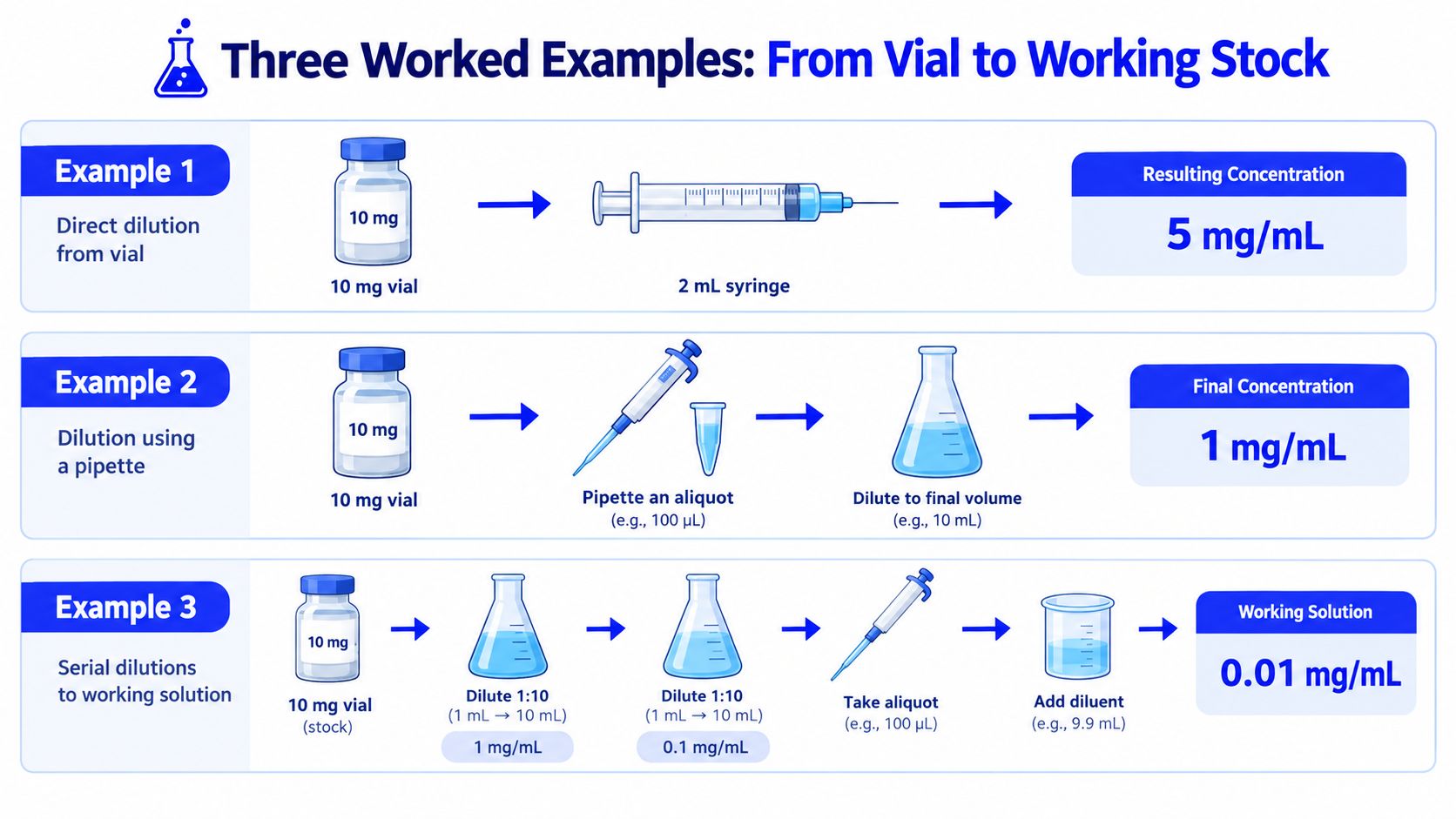
Example 1: Prepare a mass-based stock
A vial labeled 10 mg is brought to a final solution volume of 2 mL. Using C = m / V, the nominal stock concentration is:
10 mg / 2 mL = 5 mg/mL
The unit check is straightforward: milligrams divided by milliliters gives milligrams per milliliter. Before treating that figure as the concentration for an experiment, the researcher still needs to check whether the labeled mass is net peptide content and whether the peptide's purity and counterion affect the basis.
Example 2: Make a 100 µg/mL working solution
The 5 mg/mL stock equals 5,000 µg/mL. To make 1 mL at 100 µg/mL, use C₁V₁ = C₂V₂:
V₁ = (100 µg/mL × 1 mL) / 5,000 µg/mL = 0.02 mL
That transfer is 20 µL of stock. Add compatible diluent to reach the intended final volume, then record both the transfer and the final volume. If the stock contains a salt counterion or the assay has a vehicle limit, the calculated transfer alone won't answer whether the working solution is appropriate.
For a preparation workflow that begins with lyophilized material, use a documented diluent volume calculation for reconstitution, then check the concentration basis before diluting.
Example 3: Convert to molar units and dilute
Suppose a peptide has a molecular weight of 2,500 g/mol, and the stock is 5 mg/mL. That stock is 5 g/L, so its molarity is 5 ÷ 2,500 = 0.002 M, or 2,000 µM. To make 1 mL at 500 nM, the dilution factor is 2,000,000 nM ÷ 500 nM = 4,000.
A single transfer from the concentrated stock could be too small to measure reliably, so a researcher may use an intermediate dilution and document each step. The final working solution is 500 nM, equivalent to 1.25 µg/mL at the stated molecular weight. Confirm whether the molecular weight and starting stock basis reflect the actual peptide form, including its counterion and purity.
Adjusting for Peptide Purity, Salts, and Net Content
The mass printed on a vial isn't always the mass of peptide that should go into the concentration calculation. A vial may state total fill, while its certificate of analysis may report net peptide content or other relevant material characteristics. The calculation should use the basis supported by the documentation, rather than assuming the entire stated fill is active peptide.
If the documented peptide purity is expressed as a fraction and the preparation method calls for a purity correction, the mass term becomes:
C = (m × purity fraction) / V
For example, a purity value written as a percentage must first be converted to a fraction before multiplying. That adjustment only addresses the purity basis represented by the documentation. It doesn't automatically account for a counterion, residual moisture, or uncertainty in the stated fill.
Salt or counterion forms, such as TFA, acetate, or hydrochloride, can contribute mass that isn't peptide sequence mass. The researcher should check the product documentation to see whether the stated content or molecular weight is for the peptide alone or the supplied form. A concentration based on the wrong molecular weight can produce an incorrect molar result even when the mass-per-volume arithmetic is correct.
Another distinction is solvent added versus final solution volume. Adding a measured solvent volume to a lyophilized cake doesn't necessarily establish that the final solution volume equals the volume added. Use the preparation method's specified basis and document it clearly.
Before calculating, check:
- Vial basis: Is the stated amount total fill or verified net peptide content?
- Purity basis: Does the certificate support a correction, and is the value recorded as a fraction in the equation?
- Molecular-weight basis: Does it describe the supplied peptide form?
- Volume basis: Is the target based on diluent added or final solution volume?
Serial Dilutions From a Stock Using C1V1 Equals C2V2
For a dilution, C₁V₁ = C₂V₂ connects the starting concentration and transfer volume to the desired concentration and final volume. Rearranged, V₁ = C₂V₂ / C₁. The units for both concentrations must match, and the final volume must be expressed in the same units as the transfer volume.
Consider a 1 mg/mL stock and a series of 1 mL working solutions. Convert the starting concentration to 1,000 µg/mL before calculating the first transfer. For each step, the transfer is calculated from the concentration immediately above it in the series, not repeatedly from the original stock.
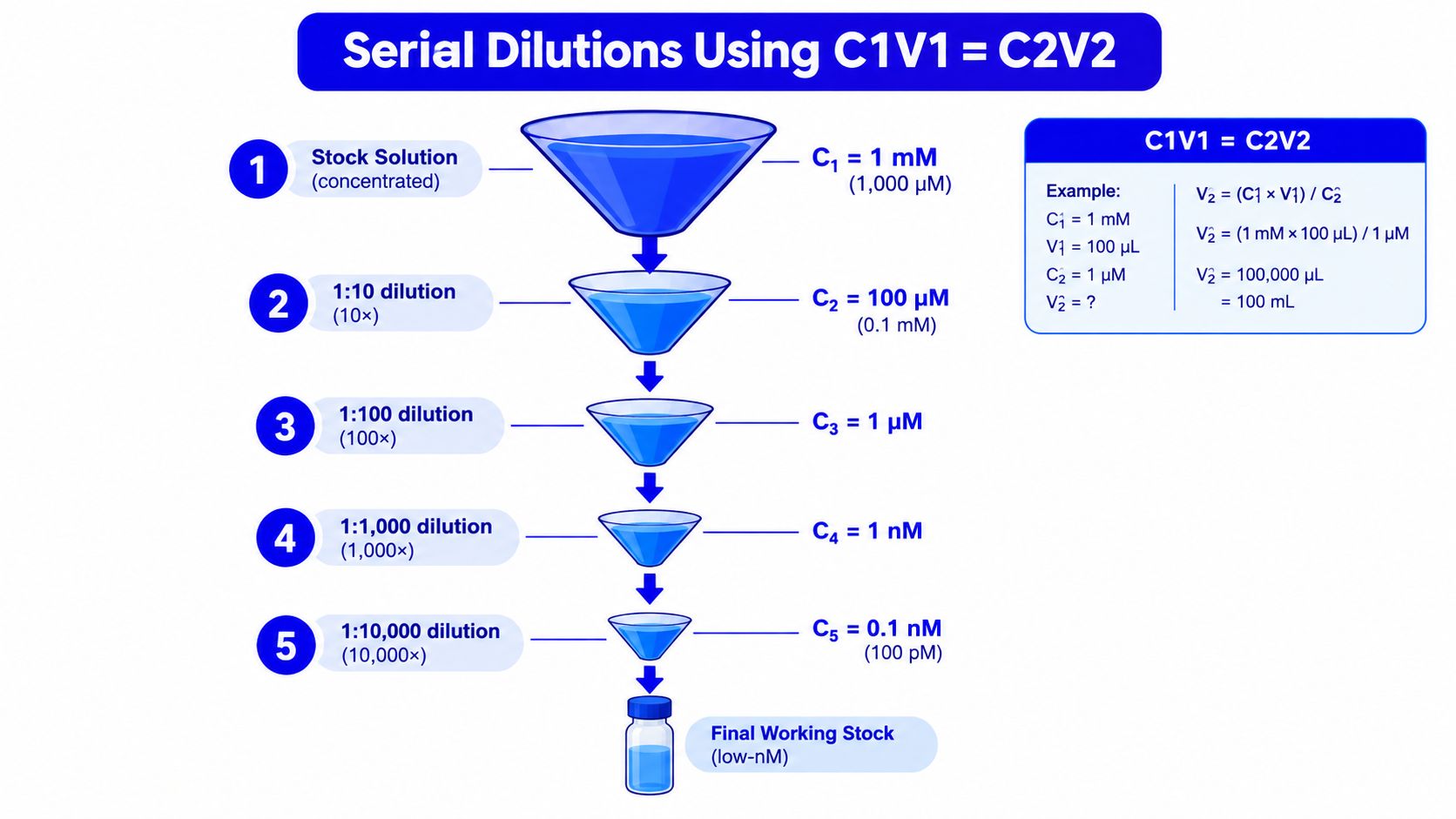
| Target concentration | Starting solution | Transfer into a 1 mL final volume |
|---|---|---|
| 10 µg/mL | 1,000 µg/mL | 10 µL |
| 1 µg/mL | 10 µg/mL | 100 µL |
| 100 ng/mL | 1 µg/mL | 100 µL |
| 10 ng/mL | 100 ng/mL | 100 µL |
| 1 ng/mL | 10 ng/mL | 100 µL |
For instance, the first step is 10 µg/mL × 1 mL ÷ 1,000 µg/mL = 0.01 mL, which is 10 µL. The next step uses the 10 µg/mL solution as its starting material. This makes the series easy to follow, but it also means an error in an earlier transfer carries forward.
Use a matched, compatible solvent for each dilution, and avoid a jump so large that the required transfer becomes difficult to measure accurately. Where the assay permits, check the final concentration using an appropriate analytical method. The video below provides a visual reference for serial dilution calculations.
When the Calculator Says One Thing and the Chemistry Says Another
What should you record when a vial calculates to 5 mg/mL, yet visible material remains undissolved? Treat 5 mg/mL as the nominal concentration, based on the amount added and the final volume. It does not establish how much peptide is in solution. Record the calculated value, the observed appearance, and any preparation details needed to identify the batch. Don't report the nominal value as a confirmed dissolved concentration.
A clear vial is not proof of identity or concentration either. Visual inspection can flag particles, cloudiness, or other changes, but it cannot determine what caused them. If the material does not dissolve as expected, follow the applicable preparation method and assay requirements before deciding whether the stock is suitable. Depending on the experiment, an analytical check may be needed.
The solvent-choice factors covered earlier still apply here. A solvent that aids dissolution may affect the downstream assay, so check method compatibility rather than relying on the calculator's output. For preparation planning, consult this technical resource on master solvents for lab workflows. Record the solvent used and any relevant assay constraints.
Before using the stock, ask whether it is in solution, in the right solvent, and stable for the duration of the assay. The calculator supplies a starting value; the preparation record and appropriate checks determine whether that stock is fit for the intended experiment.
Multi-Dose Handling and the 28-Day In-Use Window
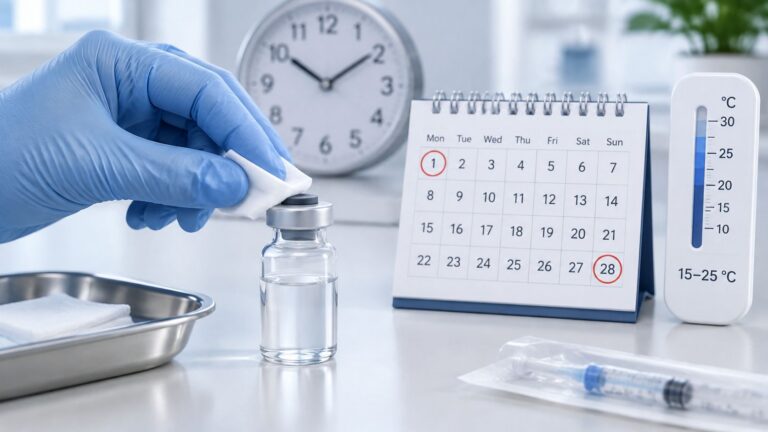
A multi-dose vial adds a handling record to the concentration record. When bacteriostatic water containing 0.9% benzyl alcohol is used, the stated in-use period can be up to 28 days with proper aseptic technique, subject to the product's labeling and applicable laboratory procedures (Herbilabs information on bacteriostatic water). That window doesn't replace the manufacturer's instructions or local requirements.
Record the first-puncture date when the vial is first accessed. A label should make it possible to identify the contents and trace the preparation, including the peptide name, lot, concentration, preparation date, initials, and the diluent lot. Clear labels also help distinguish a newly prepared vial from one that has already been accessed.
Storage instructions can differ between an unopened vial and one that has been punctured. Follow the specific diluent and peptide documentation for both states, and make sure the storage record reflects whether the vial is in use. Don't infer a storage temperature from another product or from the calculator output.
Discard a vial if visible particulate appears, aseptic technique has been breached, or the applicable in-use window has passed. Those observations don't prove a particular failure mechanism, but they're practical triggers to stop using the preparation rather than extending its use by assumption.
The concentration remains the same arithmetic result only if the material and volume basis remain appropriate. Handling records help show what happened to the solution after that calculation was made.
Step-by-Step Use of a Peptide Dilution Calculator
Use the calculator as part of a documented workflow. Collect the inputs first, so the result can be reproduced rather than reconstructed from memory.
- Establish the peptide mass basis. Record the stated mass and check whether the documentation provides net peptide content or a purity basis.
- Choose the concentration target and volume. Specify whether the target is mass per volume or molar, and define whether volume means solvent added or final solution volume.
- Identify the diluent. Record its identity and lot, then check compatibility with both the peptide and the assay.
- Enter molecular weight if needed. A calculator can't convert mass concentration to molarity without it. Verify that the molecular weight matches the relevant peptide form.
- Check the assay's vehicle tolerance. Make sure the planned stock transfer won't introduce an incompatible amount of solvent into the experiment.
Read the output as a calculation, not a verification. If the tool gives a stock concentration, compare the stated mass and volume basis with the preparation record. If it provides a transfer volume for a serial dilution, record the starting concentration and the intended final volume alongside the transfer. This preserves the information another researcher needs to understand what was prepared.
Before the vial leaves the bench, put the preparation details on its label and retain the supporting documentation. A concise record should include:
- Net-content basis: Note the source used for peptide content and any applicable correction.
- Preparation date: Log the first-puncture date when a multi-dose vial is accessed.
- Diluent lot: Record the diluent identity and lot information.
- COA and calculation: Keep the certificate of analysis with the preparation record and preserve the calculation inputs and outputs.
A calculator can standardize the arithmetic. The record makes the preparation traceable.
Our free reconstitution concentration calculator helps check volumes and concentrations for lab preparations.
Quick-Reference Summary and Verification Table
A trustworthy concentration result depends on more than the final displayed value. Collect the mass basis, purity information, molecular weight when molarity is needed, target volume, solvent identity, and assay vehicle requirements. Keep the units visible throughout each calculation so conversion errors are easier to spot.
| Preparation step | What the calculation establishes | What still needs checking |
|---|---|---|
| Mass divided by volume | Nominal mass-per-volume concentration | Vial mass basis and final-volume definition |
| Purity adjustment | Concentration based on the documented purity basis | Whether the certificate supports that correction |
| Conversion to molarity | Molar concentration using molecular weight | Whether the molecular weight matches the supplied peptide form |
| Working-stock dilution | Transfer volume for a specified target and final volume | Transfer accuracy and compatible vehicle |
| Dissolution and handling | Nothing about solution quality by arithmetic alone | Visual inspection, preparation records, and suitable analytical checks |
Bench-side checks
- Before calculation: Confirm net content, purity basis, counterion information, molecular weight if needed, and target volume.
- During calculation: Convert units explicitly, preserve the dilution steps, and document the solvent basis.
- After preparation: Check for visible material, record the diluent lot and first-puncture date where relevant, and retain the preparation record with its supporting COA.
- When greater confidence is required: Select an analytical check suited to the material and assay. Depending on the question, methods may include HPLC, LC-MS, UV, amino-acid analysis, particle checks, pH measurement, or a time-course assessment. A visual check alone doesn't establish identity, purity, or concentration.
A peptide dilution calculator is the right starting point. Documentation, handling, and analytical confirmation are what make the preparation interpretable and trustworthy.
Herbilabs supplies sterile bacteriostatic water and reconstitution solutions for research-use workflows, along with lot-specific documentation. Visit Herbilabs to review its labware and diluent options for peptide preparation.