Private Label, White Label, Wholesale partnerships available - EU, USA and UK - Free shipping from €75

Peptide BPC 157 and TB500: An RUO Comparison
The popular advice to swap or stack BPC-157 and TB-500 as general repair agents skips the decisions that matter at the bench. A reproducible research program starts with molecular identity, evidence quality, and preparation controls, not recovery stories. Neither a familiar product name nor a sterile diluent establishes that a peptide is suitable for a particular experiment.
Table of Contents
- Why Peptide BPC 157 and TB500 Are Compared
- What the Evidence Actually Supports
- Mechanisms That Separate the Two Peptides
- Research Applications by Study Setting
- Stability Reconstitution and Aseptic Handling
- Identity Testing Before Any Protocol Decision
- Choosing a Sterile Diluent and Vial Format
Why Peptide BPC 157 and TB500 Are Compared
The comparison usually begins with similar marketing language, not equivalent materials. Both names appear in discussions of tissue repair, which can encourage researchers to treat them as alternatives before checking what each vial contains. That's the wrong starting point for research use only, or RUO, work.
Consider a hypothetical private laboratory receiving lyophilized vials labeled BPC-157 and TB-500. Both arrive with repair-oriented descriptions, but the laboratory still needs to establish the sequence designation, analytical documentation, intended model, and preparation requirements. The descriptions alone don't answer any of those questions.
| Decision point | BPC-157 | TB-500 |
|---|---|---|
| Identity question | Does the material match the specified BPC-157 sequence? | Is the material a defined fragment, analogue, or full-length thymosin beta-4? |
| Evidence boundary | Preclinical findings must remain separate from limited human observations | Parent-protein research must remain separate from fragment-specific evidence |
| Protocol requirement | Match the characterized lot to the experimental endpoint | Establish the exact molecular designation before selecting endpoints |
| Preparation requirement | Document compatibility and stability after mixing | Document compatibility without assuming equivalence to the parent protein |
The practical problem isn't choosing between molecules. It's deciding whether either incoming material is sufficiently characterized to support an interpretable experiment. A reseller faces the same documentation problem when preparing product specifications: a broad biological description can't substitute for an exact material designation.
Separate the purchasing decision from the research question
A useful purchasing specification states what the laboratory needs to receive and verify. A study protocol states what the laboratory intends to measure. Combining those decisions too early makes it easier to accept a familiar label instead of a suitable reagent.
Practical rule: Similar marketing language isn't a basis for substitution, co-formulation, or a shared preparation protocol.
A defensible comparison of peptide BPC 157 and TB500 therefore considers identity, evidence, stability, and sterile preparation independently. Human dosing schedules and therapeutic recommendations don't belong in that comparison. The useful outcome is a documented basis for accepting a material, selecting a non-clinical question, and interpreting results without relying on informal performance stories.
What the Evidence Actually Supports
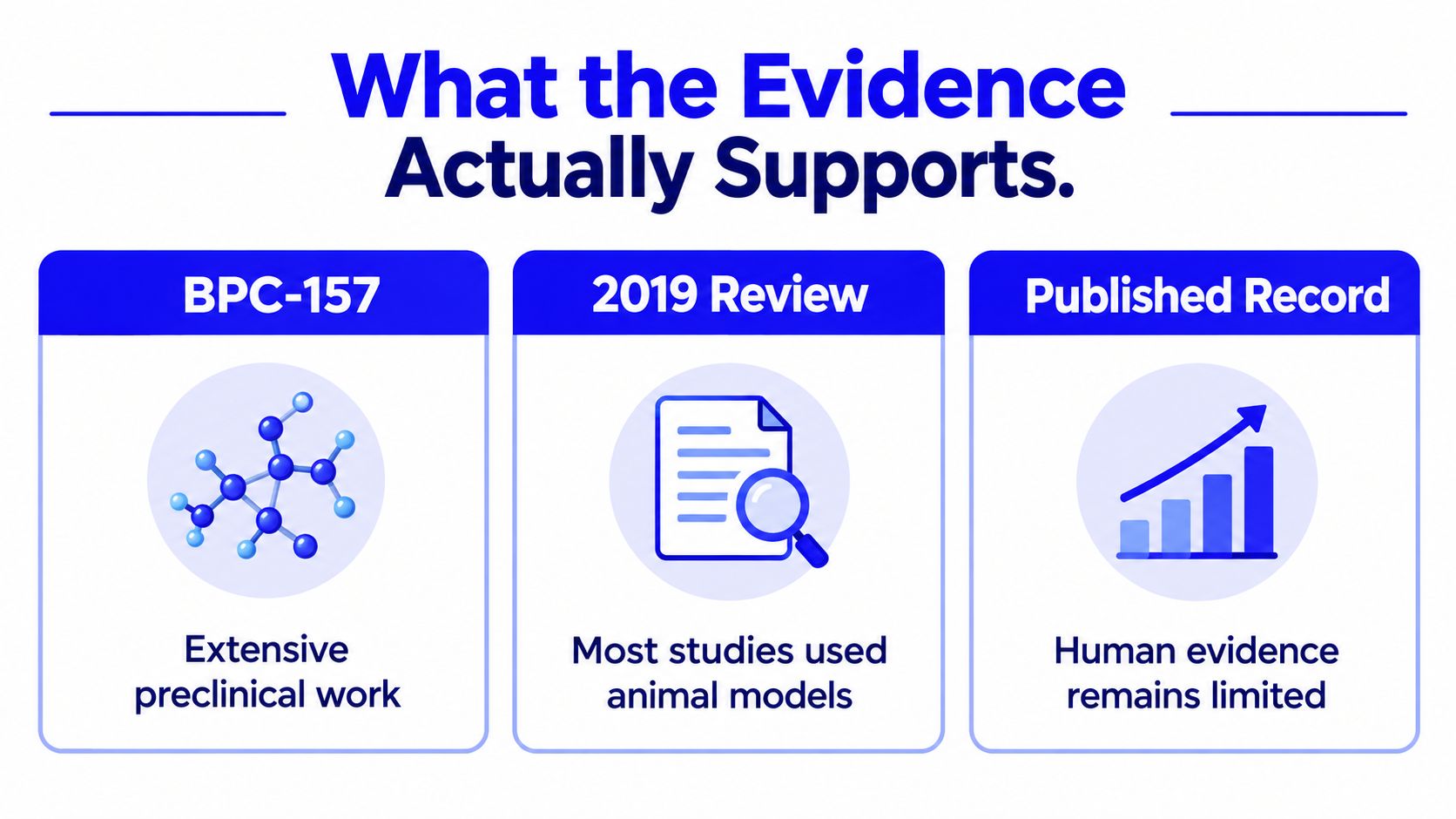
BPC-157 has a substantial preclinical literature, but the amount of animal research shouldn't be mistaken for established human efficacy. The human record needs to be read study by study, with the design limitations attached to every result.
The historical findings summarized in the review of BPC-157 human evidence include the following:
- Early clinical record: A 2019 review reported predominantly small-rodent studies and unconfirmed human efficacy, while identifying a 2015 randomized phase-I oral trial involving 42 healthy participants at 0.25, 0.5, 1, or 2 micrograms per kilogram whose detailed results remained unpublished.
- Retrospective knee-pain observations: Among 12 patients receiving intra-articular BPC-157 alone, 11 reported significant improvement, or 91.6%, and 1 did not, or 8.3%; among 16 patients reached for follow-up across the BPC-157-only and combination groups, 14 reported relief, or 87.5%.
- Intravenous pilot: Only 2 healthy adults received doses up to 20 mg, with no reported side effects or measurable changes in cardiac, liver, kidney, thyroid, or blood-glucose biomarkers.
These findings don't carry equal evidentiary weight. An unpublished detailed trial record can't be evaluated like a complete report, and the knee-pain series lacked a randomized control group and relied on patient-reported outcomes. The intravenous pilot was too small to establish safety or exclude uncommon adverse effects.
Keep clinical context separate from proof
For TB-500, the essential distinction is between evidence concerning a marketed fragment and research involving thymosin beta-4. The parent protein's clinical history doesn't establish that a product sold as TB-500 is an approved medicine or a clinically interchangeable substance.
The ProMD Health Ashburn Med Spa guide offers broader context for readers encountering the term peptide therapy. That broader context should remain separate from the compound-specific evidence needed to evaluate these experimental materials.
The correct laboratory interpretation is conservative: human observations can motivate questions, but they don't validate therapeutic claims. A report of improvement doesn't establish a treatment effect without an adequate comparison, and a report of no observed side effects doesn't establish general safety. Neither should be converted into a procurement claim promising injury recovery.
Mechanisms That Separate the Two Peptides
Mechanistic comparisons are useful only when researchers distinguish a proposed pathway from a demonstrated response in the intended model. Shared references to angiogenesis or inflammation don't establish equivalent biological activity.
The preclinical review of BPC-157 biology and pharmacokinetics describes a synthetic 15-amino-acid peptide, proposed VEGFR2-linked angiogenesis, Akt–eNOS and nitric-oxide modulation, ERK1/2 signaling, fibroblast activity, collagen-associated repair, and inflammatory-cytokine reduction, alongside an estimated half-life below 30 minutes and hepatic and renal handling. These are research findings and proposals, not validated human treatment mechanisms.
The exposure caveat matters. Reported animal effects can persist longer than measurable peptide exposure, so an observed tissue response shouldn't be treated as a direct measurement of how long intact material remains present. A laboratory needs an exposure question and a biological-response question, rather than assuming they're interchangeable.
Proposed biology is not a dosing benchmark
The same preclinical review describes rodent safety studies without an identified lethal or minimum toxic dose across the tested routes and without major genotoxic, teratogenic, anaphylactic, or organ-level toxicity signals. Those findings don't establish human safety or an effective human dose.
For thymosin beta-4, the associated biology concerns actin regulation, cell migration, angiogenesis, and inflammatory modulation. A TB-500 fragment requires its own characterization; parent-protein biology doesn't supply missing fragment-specific exposure–response, tissue-distribution, or pharmacokinetic measurements.
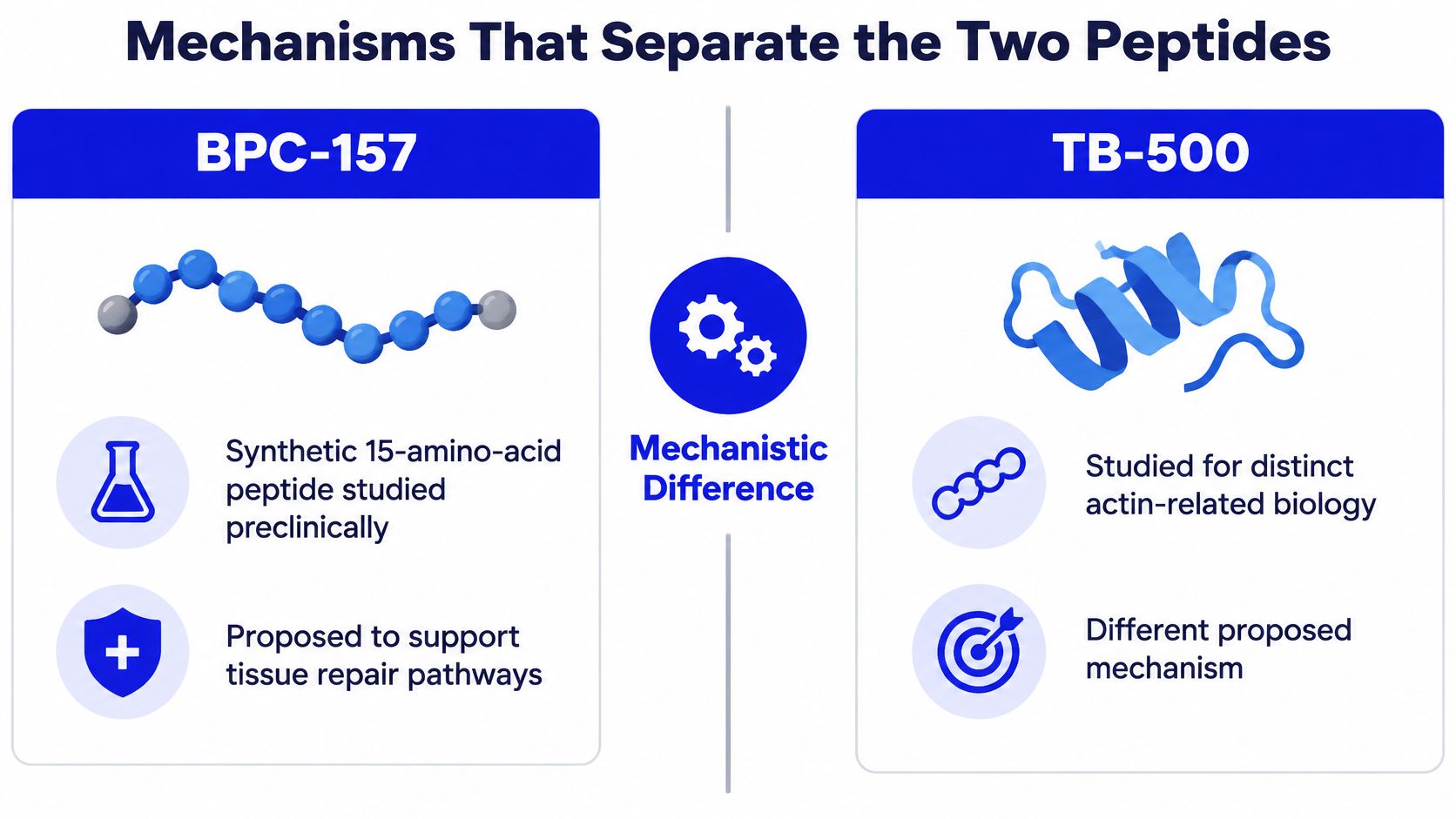
A shared repair label hides different molecules and unresolved human pharmacokinetics. Pathway overlap doesn't establish equivalent exposure, performance, or combination benefit.
For an exploratory cell-migration experiment, a laboratory could define migration as the primary endpoint while separately tracking viability and material integrity. That design would test a bounded question. It wouldn't justify concluding that the material repairs an injury or behaves like a different peptide.
Useful mechanistic work therefore needs clearly separated measurements:
- Material measurements: Confirm what was introduced into the assay and whether its composition changed during preparation.
- Biological endpoints: Specify the tissue-relevant response being measured rather than using repair as an undefined outcome.
- Interpretation limits: Distinguish an association with a pathway from evidence that the pathway explains the observed result.
The strongest benchmark is an endpoint the laboratory can measure reproducibly under defined conditions. A pathway name alone isn't a protocol.
Research Applications by Study Setting
A tissue-specific research question provides a better selection criterion than a general preference for either peptide. The material should fit the documented model, and the interpretation should stay inside that model's limits.
For BPC-157, the preclinical literature discussed earlier spans gastrointestinal, tendon, ligament, muscle, bone, and vascular-injury settings. These are model domains, not approved indications. A laboratory investigating a gastrointestinal endpoint shouldn't assume that a result from a tendon model establishes the same response in its system.
Match the material to the setting
A hypothetical connective-tissue laboratory might select a defined tendon-related endpoint and evaluate whether its assay can distinguish a response from background variation. Another group might study a gastrointestinal model with a different primary measurement. Even if both groups use BPC-157, their conclusions need not be interchangeable.
Thymosin beta-4 has a different research history. The review distinguishing thymosin beta-4 programs from TB-500 evidence describes ophthalmic, dermal, and limited cardiac research programs; it also reports that WADA detected intact TB-500 and metabolites in horse urine and plasma in 2023, without human detectability data at that time, and summarizes a small uncontrolled BPC-157 plus TB4 subgroup with 75% reporting improvement and 25% reporting no relief.
Those findings answer different questions. The sports-analytical work concerns detecting material and metabolites, not therapeutic benefit or human safety. The combination subgroup can't isolate either compound's contribution or establish that combining materials produces an additive effect.
| Research setting | Defensible question | Unsupported extension |
|---|---|---|
| Tissue-model experiment | Does a characterized material affect the predefined endpoint? | The material treats the corresponding human condition |
| Analytical detection | Can the method identify the target in the tested matrix? | Detection establishes safety or useful exposure |
| Combination experiment | How does the defined mixture compare with appropriate controls? | A reported combination outcome proves synergy |
A laboratory proposing a mixture should treat that mixture as a distinct experimental condition, not as a shortcut around single-material characterization. Otherwise, an unexpected result becomes difficult to assign to either ingredient, the preparation process, or their interaction.
The useful closing questions are specific: Does the cited model match the intended tissue context? Is the reagent a fragment or the parent sequence? Can the assay distinguish a mixture effect from each component's response? None requires declaring a universal winner.
Stability Reconstitution and Aseptic Handling
An unopened container and a reconstituted working vial need different records. The unopened container follows its labeled storage instructions; the working vial also needs a preparation history, first-puncture date, and documented in-use limit. Refrigeration shouldn't be used to extend a window that has already expired.
Sterility and peptide stability also require separate decisions. A preparation may remain visually clear without demonstrating unchanged peptide identity, concentration, or activity. Conversely, an analytically suitable formulation still needs an aseptic workflow when contamination would compromise the experiment.
Establish the preparation record before mixing
The preparation record should identify the peptide lot, diluent lot, operator, preparation date, intended concentration, storage conditions, and applicable discard criteria. Where the supplier hasn't established compatibility or post-reconstitution stability for the intended conditions, the laboratory should record that uncertainty rather than assigning a shelf life by habit.
A practical review of bac water can support preparation planning, but it doesn't replace the peptide's own instructions or the laboratory's validated procedures. A preserved sterile diluent may suit repeated withdrawals, while an additive-free alternative may be necessary when the assay can't tolerate a preservative.
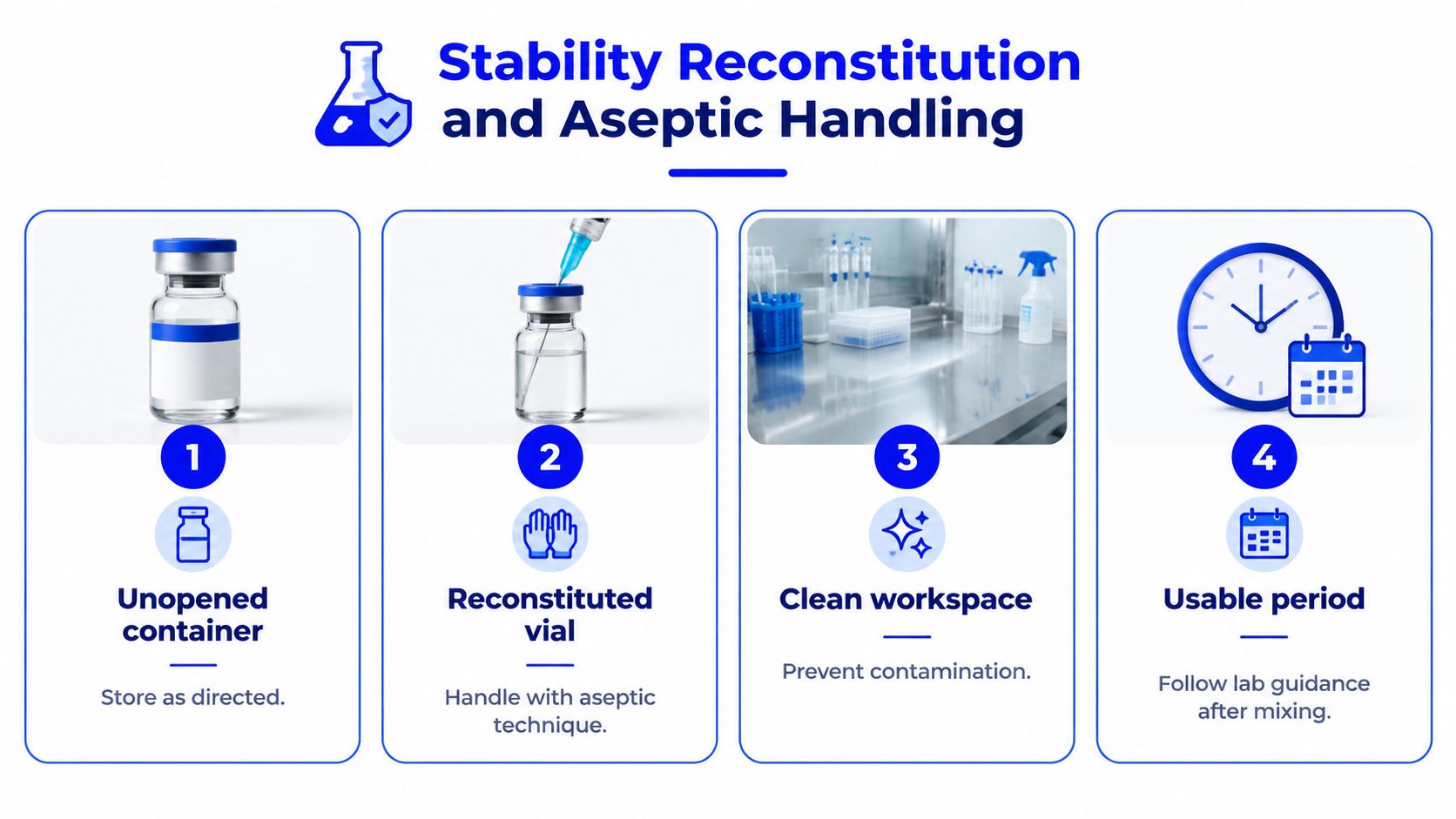
The bench checklist should address both preparation and release for use:
- Confirm the instructions: Check the lyophilized material's specified diluent, handling restrictions, and storage requirements.
- Qualify the diluent: Use documented sterile, non-pyrogenic material compatible with the experimental system.
- Control vial access: Plan withdrawals, limit unnecessary needle entries, and follow the laboratory's aseptic-access procedure.
- Label the working material: Record first puncture, reconstitution, and the applicable discard point so another operator can interpret the vial's status.
- Apply rejection criteria: Discard material after suspected contamination, unexplained cloudiness, or an exceeded permitted window.
- Retain traceability: Keep lot paperwork and any deviations with the preparation record.
Handling boundary: A diluent's permitted in-use period isn't evidence that a dissolved peptide remains stable for that entire period.
Manufacturing filtration and a specified solution pH are useful purchasing attributes, but neither establishes peptide compatibility on its own. A laboratory still needs to assess degradation, aggregation, and concentration under its actual preparation conditions. That separation prevents a common error: treating the diluent's documentation as if it were stability data for every material mixed into it.
Identity Testing Before Any Protocol Decision
Nominal peptide content on a label can't establish molecular identity. For a TB-500 product, the receiving laboratory needs to know whether the specification describes the intended fragment, an analogue, or full-length thymosin beta-4. For BPC-157, the analytical record needs to support the designated sequence rather than merely repeat the product name.
The FDA review addressing TB-500 evidence gaps reports that its literature review identified no human clinical studies for TB-500. The evidence framework also lacks a controlled human injury-recovery benchmark and a measured human half-life, so claims of validated weekly dosing, superior performance, or proven additive benefit aren't defensible protocol inputs.
Build an incoming-material release decision
A certificate of analysis is a starting document, not a substitute for reviewing what was tested. The receiving team should check whether the methods and results answer the questions relevant to the planned experiment.
- Identity and sequence: Require an explicit molecular or fragment designation and analytical support for that designation.
- Purity and aggregation: Review the impurity profile and whether the selected methods address aggregation relevant to the preparation.
- Endotoxin and sterility: Treat these as distinct specifications when the intended system requires them.
- Concentration accuracy: Establish the basis for calculating the amount introduced into the assay.
- Post-reconstitution stability: Evaluate whether supporting data match the intended solvent, storage, and handling conditions.
The Herbilabs guide to batch testing provides a procurement-oriented reference for organizing lot review. Laboratories and resellers should file the certificate of analysis, sequence or fragment designation, supplier lot, receipt status, and preparation record together.
Release criterion: Proceed only when the documentation supports the intended research use. Hold or reject material when an unresolved identity or quality gap could make the result uninterpretable.
This gate should be established before experimental results create pressure to accept a questionable lot. A positive response doesn't retrospectively prove identity, and a negative response doesn't establish that a peptide lacks biological activity if the material was inadequately characterized.
Acceptance criteria should also remain tied to the assay. Exploratory screening and a tightly controlled comparative study may need different levels of qualification, but neither benefits from undocumented assumptions. The responsible trade-off is explicit: a less-characterized lot may cost less to obtain, while leaving more uncertainty in every result generated from it.
Choosing a Sterile Diluent and Vial Format
The sensible vial format is the one that matches the planned preparation and withdrawal pattern. Buying a larger container isn't automatically economical if the laboratory can't use its contents within the applicable limits or maintain an adequately controlled access workflow.
Diluent selection comes before format selection. The protocol needs to tolerate the preservative, ionic composition, and other relevant formulation attributes. The discussion of sterile water versus saline osmolarity is useful when evaluating whether different aqueous diluents can be substituted in a particular experimental system.
Bacteriostatic Vial Formats for RUO Reconstitution
| Format | Best-fit RUO use | Handling note |
|---|---|---|
| Small-volume vial | A short pilot or limited preparation | Avoid opening more material than the planned work requires |
| Intermediate multi-dose vial | A series of scheduled withdrawals | Match access frequency to the documented in-use conditions |
| Larger multi-dose vial | A workflow with sufficient planned consumption | Require a clear access plan and responsible operator |
| Multi-pack of smaller vials | Separate experiments, teams, or preparation dates | Preserve unopened stock until each unit is needed |
Herbilabs is one option for RUO bacteriostatic reconstitution solution and related labware, alongside other suppliers whose documentation meets the laboratory's requirements. The relevant purchasing questions concern lot-specific certificates, formulation compatibility, container suitability, and traceability, rather than a general claim that a diluent works with peptides.
Verify documentation before ordering volume
A buyer should request current product specifications and the relevant lot documentation before committing to a study supply. Facility credentials, quality procedures, and release controls should be checked for their scope and applicability, not treated as proof that a particular peptide formulation has been validated.
Operational details matter too. Storage arrangements, dispatch availability, destination coverage, and wholesale or private-label documentation can affect whether a small laboratory or reseller maintains continuity without overstocking. Those details should be verified against current terms rather than assumed from a previous purchase.
For BPC-157 or TB-500 work, the final purchasing decision should connect the selected diluent to a written preparation plan. That plan should establish preservative compatibility, suitable container access, the required analytical checks, and responsibility for recording first puncture. A well-documented smaller format is more useful than a larger vial with uncertain handling history.
Herbilabs offers sterile RUO diluents, reconstitution solutions, and vial formats for documented laboratory preparation workflows. Laboratories comparing BPC-157 and TB-500 can visit Herbilabs to review product documentation and request lot-specific COA details, then confirm benzyl-alcohol compatibility and record the first-puncture date before placing a vial into use.