Private Label, White Label, Wholesale partnerships available - EU, USA and UK - Free shipping from €75

Temperature Controlled Shipping Explained for Labs
A lab receives a small shipment of vials on Monday morning. The outer carton is intact, the delivery took less time than expected, and the package still feels cool. Yet the temperature record is missing, the carrier handoff isn't documented, and nobody can tell whether the vials spent an hour in a warm vehicle or on a cold loading dock. The box looks acceptable, but the evidence needed to release the shipment isn't there.
That situation explains why temperature controlled shipping is more than a choice between gel packs and foam. For research-use-only materials, reconstitution solutions, peptides, proteins, antibodies, and other sensitive lab supplies, product integrity depends on a chain of controlled conditions and a record showing that the chain held. Packaging matters, but so do the selected temperature band, route assumptions, monitoring device, handoffs, and the decision made when a trace shows an excursion.
The cold chain has become a large logistics infrastructure layer. One market outlook places global cold chain logistics at USD 361.37 billion in 2025, with a projection of USD 383.46 billion in 2026 and USD 515.79 billion by 2031, implying a 6.12% CAGR over 2026–2031. A separate outlook estimates USD 429.1 billion in 2026 and USD 1.37 trillion by 2035, with a projected 13.8% CAGR. The differing estimates use different market definitions, but both point to the same conclusion: controlled-temperature distribution supports major food, biopharma, and specialty chemical networks rather than a narrow niche. (Mordor Intelligence cold chain logistics market outlook)
Table of Contents
- Why Temperature Control Matters Before the Box Leaves
- How the Cold Chain Keeps Products Stable in Transit
- Temperature Ranges and What They Mean for Lab Materials
- Packaging and Insulation Options That Actually Hold Temperature
- Monitoring Validation and Proving Control With Data
- Cost Lead Time and Compliance Tradeoffs to Plan For
- Best Practice Checklist for Suppliers and Buyers
Why Temperature Control Matters Before the Box Leaves
A lab orders a sterile reconstitution solution for a scheduled experiment. The receiving team checks the seal, lot label, and quantity. The parcel looks normal, yet no usable temperature trace arrives with it. If the product specification requires a controlled range, visual inspection cannot establish whether the contents remained within that range.
Temperature drift can affect sensitive materials in different ways. A reconstitution solution may fail the buyer's release criteria, while a peptide, protein, or antibody may raise stability concerns after uncontrolled exposure. The risk is not limited to a visibly frozen vial or hot parcel. A brief excursion can matter when the material has a narrow sensitivity band, or when several smaller events occur during handoffs.
The delivery is a chain of decisions
The first decision occurs before dispatch. The supplier must confirm the permitted range, expected route, transit duration, seasonal conditions, packaging configuration, and monitoring requirement. The buyer needs a receiving procedure that names who reviews the shipment record and who can place the material into quarantine.
The next decision is how an excursion will be handled. A calibrated logger, a continuous trace, documented handoffs, and predefined acceptance criteria give the receiving team a basis for review. GDP-style guidance treats an excursion as a controlled quality event. The shipment remains quarantined until a documented disposition decision is made. (GDP temperature-controlled freight guidance)
Practical rule: A shipment is controlled only when the receiving team can assess the product condition and identify the decisions made along the route.
Why short shipments still deserve attention
Small RUO parcels can pass through more handling points than a dedicated pallet. A courier may collect the parcel, a hub may sort it, a vehicle may wait during a route change, and the final driver may arrive after the laboratory has closed. Each handoff can change the thermal conditions, even when the journey appears routine.
The planning question is therefore specific: what route, duration, temperature window, monitoring method, and receiving response apply to this shipment? Herbilabs describes temperature-controlled storage, lot-specific Certificates of Analysis, quality review, and same-day dispatch as parts of its laboratory supply operations. Those practices support preparation, but the supplier and buyer still need lane-specific decisions for the actual parcel.
A cold pack choice cannot answer every operational question. Before the box leaves, confirm the permitted range, the expected handoffs, who reviews the record, and what happens if conditions fall outside the approved window.
How the Cold Chain Keeps Products Stable in Transit
A temperature-controlled shipment can leave the supplier in perfect condition and still arrive with an incomplete quality record. The cold chain works like a relay race: manufacturing sets the starting condition, warehousing preserves and prepares it, the carrier manages the route, and the final handoff completes the transfer. If one exchange loses control or evidence, the laboratory may be unable to confirm what happened, even when the outer box looks intact.
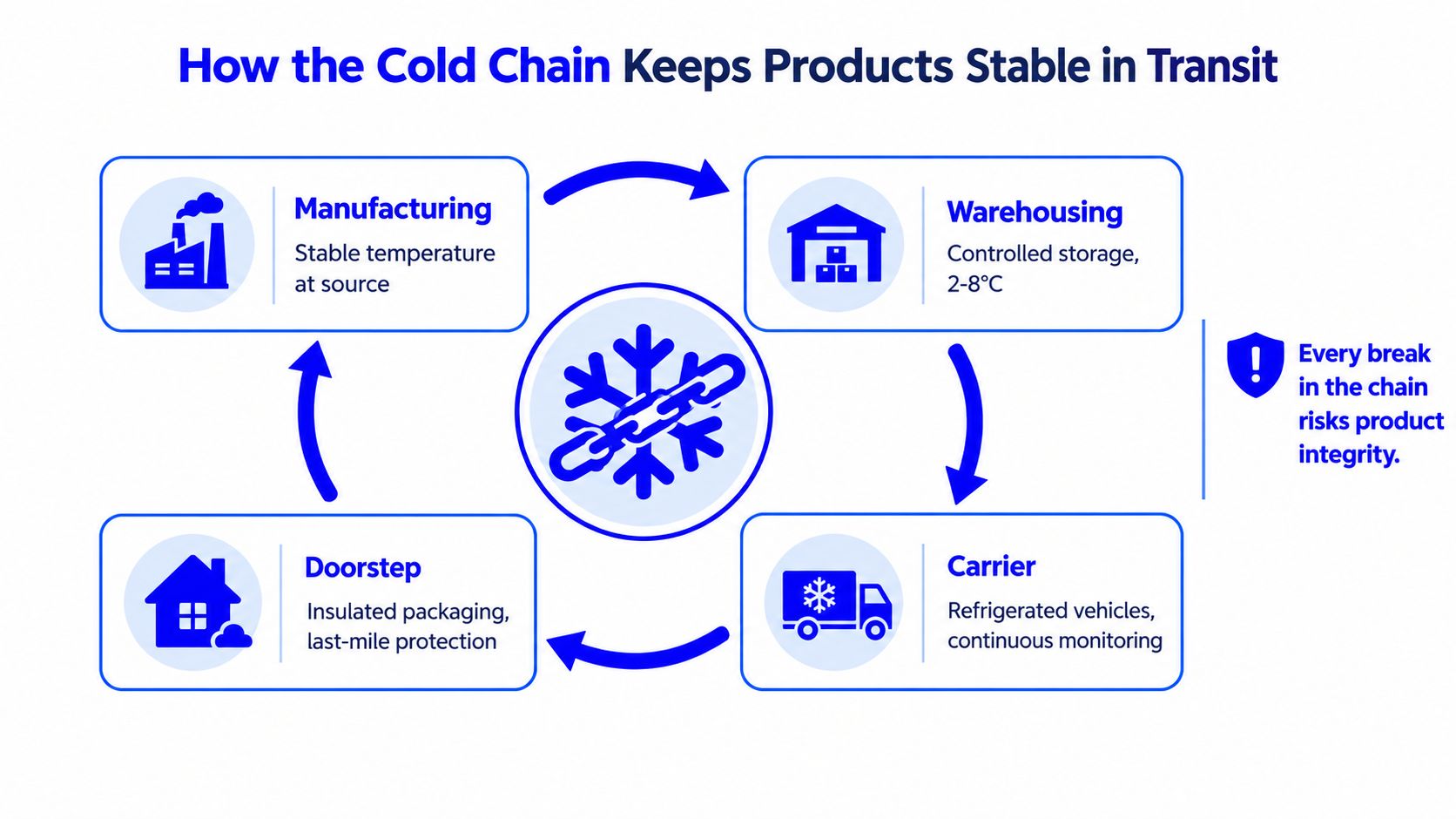
Four linked environments
Manufacturing establishes the product's starting condition. Release information should identify the lot, storage requirement, distribution limits, and supporting quality documents. Packaging cannot restore material that already began outside its approved condition.
Warehousing protects that condition before dispatch and prepares the shipment for its lane. Staff can stage the product, condition refrigerants, select the packout, attach a logger, and verify that the configuration matches the expected journey. Herbilabs describes temperature-controlled storage, lot-specific Certificates of Analysis, quality review, and same-day dispatch as parts of its laboratory supply operations. These measures support continuity, while lane validation still determines whether the shipment is suitable for transport.
Carrier transport adds variables that the supplier may not control directly. Loading delays, changing ambient conditions, vehicle transfers, and uneven handling can affect the parcel. A passive shipper relies on insulation and refrigerants. An active solution uses powered temperature control. Both require a route-specific assessment, because the same equipment may perform differently on another lane.
For larger or international movements, buyers may assess preserved air cargo solutions when air freight forms part of the route. Service speed alone does not prove that the product condition will remain controlled.
Doorstep delivery is the last evidence point. A parcel may complete its main journey and then wait during a missed delivery or an unplanned handoff. The receiving laboratory should know who will accept it, where the logger will be retrieved, how the package will be inspected, and who reviews an exception.
Storage specifications are not distribution validation
A storage statement describes the environment a product should occupy while held. Distribution validation examines the full packout under expected transport stresses. The distinction matters because an average temperature can hide a localized hot or cold spot.
Use three connected records:
- Product record: lot, release status, storage requirement, and permitted excursion window.
- Shipment record: packout, refrigerant conditioning, logger identity, carrier, route, and dispatch time.
- Receipt record: arrival condition, temperature trace, handoff evidence, and release or quarantine decision.
For practical guidance on aligning labware handling with a selected lane and service, buyers can review how to ship labware right. The box is only one part of control. The route decisions, handoffs, and records show whether the product remained suitable.
Temperature Ranges and What They Mean for Lab Materials
A parcel marked “cold” can still be wrong for its contents. A chilled shipment may protect a refrigerated reagent yet damage a frozen material, while an ultra-low product can lose suitability long before the package looks warm. Buyers and suppliers therefore need a defined temperature band tied to the material's actual sensitivity.
For laboratory shipments, four practical reference bands are ambient 15–25°C, chilled 2–8°C, frozen -20°C, and ultra-low ranges below -70°C. These ranges support packout qualification, but the product documentation remains the controlling authority. The shipping record should preserve that connection, so a range label does not become the only evidence of suitability. (Cold-chain package testing guidance)
| Temperature Band | Typical Lab Use Case | Key Risk If Breached |
|---|---|---|
| Ambient, 15–25°C | Materials that tolerate controlled room-temperature distribution | Heat or cold exposure can move the product outside its stability profile |
| Chilled, 2–8°C | Refrigerated solutions, selected reagents, and materials requiring a narrow cool range | Warm spots, freezing contact, or prolonged time outside the band may affect suitability |
| Frozen, -20°C | Materials whose stability profile calls for frozen storage | Partial thawing, refreezing, or insufficient cold reserve can change the product condition |
| Ultra-low, below -70°C | Highly temperature-sensitive materials requiring deep or ultra-low protection | Ordinary chilled or frozen packouts won't provide the required protection |
Range, duration, and excursion tolerance
A temperature band is only one part of the release decision. Reviewers also need to know how far the shipment moved outside the band and for how long. A brief, minor deviation may receive a different assessment from a sustained or repeated excursion, but only the product's approved criteria can determine release or quarantine.
A logger average can hide the event that matters. For example, a trace may show an acceptable average while recording a short peak above the upper limit. At the cold end, a refrigerant touching a vial can create a local freezing risk even when the parcel-wide average remains within range.
The temperature trace is evidence, not the decision itself. The receiver must compare it with the material's approved excursion window and record the resulting disposition.
Match the band to the material
The shipper specification should state the target range, rather than only saying “keep refrigerated.” It should also identify the expected duration, permitted excursion window, freeze sensitivity, and evidence the receiver must review.
A chilled material may require a different arrangement from a frozen product, even if both use an insulated container. Refrigerant selection, thermal mass, sensor position, and loading pattern affect the internal conditions. Qualification should therefore use the exact sensitivity band and intended packout. Generic cold-chain labels cannot replace lane-specific evidence that the material stayed suitable.
Packaging and Insulation Options That Actually Hold Temperature
A small RUO shipment can leave the lab within specification and still arrive without a defensible temperature record. The package is therefore part of an evidence chain. Its insulation, refrigerant, product load, logger placement, carrier handoffs, and route conditions must support the same conclusion: the material remained suitable for its intended use.
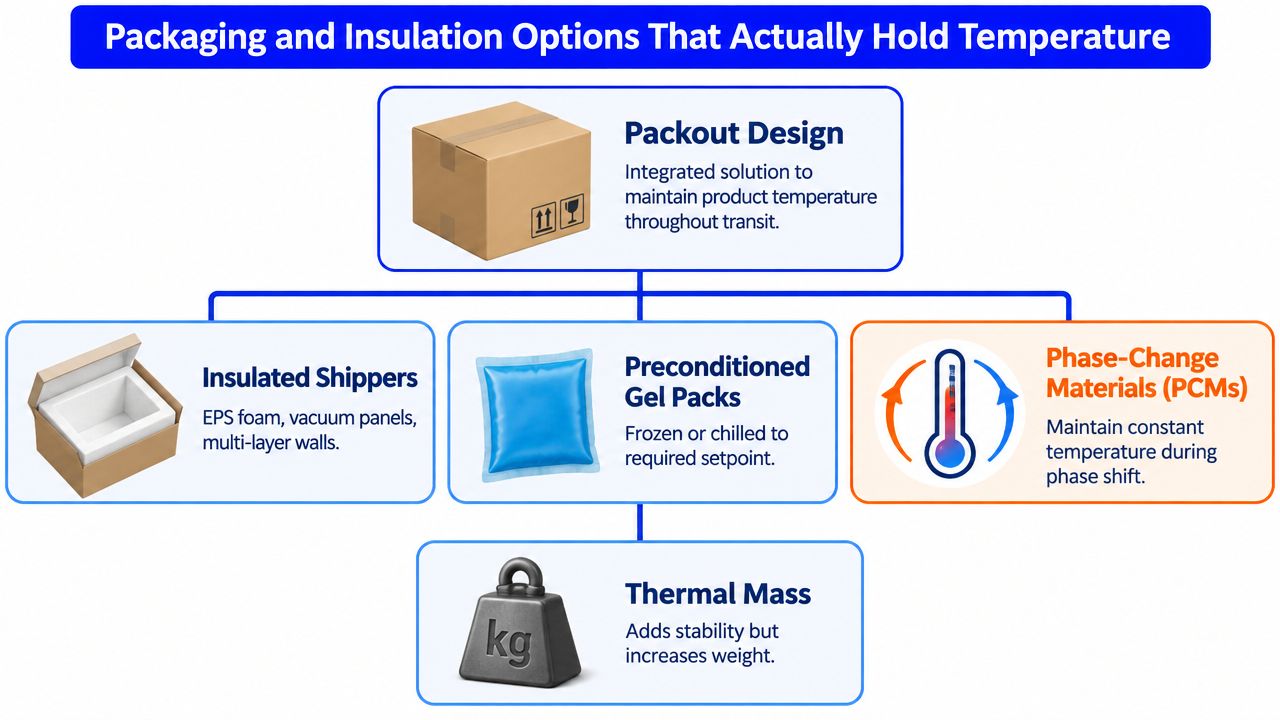
The main components
Insulated shippers made with EPS foam, vacuum panels, or multilayer walls slow heat transfer from the surrounding environment. Thickness helps, but the complete construction matters more. Lid fit, seams, air gaps, refrigerant position, and exposure while loading can create weak points that insulation alone will not correct.
Preconditioned gel packs suit many short-duration passive shipments. They must be prepared for the intended setpoint through a controlled process, rather than taken directly from a freezer or refrigerator. Poor conditioning can produce excessive cold beside the product or leave insufficient cooling capacity for the route.
Phase-change materials, or PCMs, change phase near a selected target temperature. This can support a narrower operating range than a generic frozen pack when the PCM is conditioned correctly and the packout has been qualified.
Thermal mass slows internal temperature change, much like a larger reservoir takes longer to warm or cool. It also adds weight, uses space, and may complicate transport. The amount should match the product load and route, not a general assumption that more mass always improves protection.
Packaging principle: Insulation slows heat transfer. Refrigerants absorb or release heat. Thermal mass reduces rapid swings. A route-relevant test is what shows whether the combined system works.
Why duration changes the answer
A packout that protects a parcel during a short journey may fail during a longer service window. Qualification commonly examines 24-, 48-, or 72-hour conditions in environmental chambers with the intended packout, product load, refrigerant condition, and route stress profile. The test should represent the actual service plan, including likely delays and handling exposure.
A compact insulated shipper, conditioned gel packs, and a logger may suit a small RUO shipment. A larger load may require a palletized thermal system or active equipment. Product sensitivity, duration, route, and handoffs determine the choice. Parcel size alone does not establish suitability. Buyers can compare temperature specs for biotech shipping with the material requirement and intended lane.
Test the weak points
Environmental chamber work should cover expected winter and summer stress. Sensors belong near likely hot and cold spots, not only at the box center. A vial touching frozen refrigerant may experience a different condition from one surrounded by other products, even inside the same shipper.
The embedded explanation below shows how packaging components contribute to temperature retention.
Recheck the design after changing the packaging, product thermal mass, carrier service, transit duration, or shipping lane. The aim is to demonstrate control for the complete configuration, then preserve that evidence through each handoff. A thickest-available shipper cannot replace lane-specific validation, clear receiving records, and a logger trace that supports the final disposition.
Monitoring Validation and Proving Control With Data
A small RUO shipment can arrive looking perfectly cold and still leave a weak quality record. The box protects the material, but the evidence must connect dispatch, transit, handoffs, and receipt. Usable data shows what the product experienced, for how long, and whether that history meets the approved acceptance criteria.
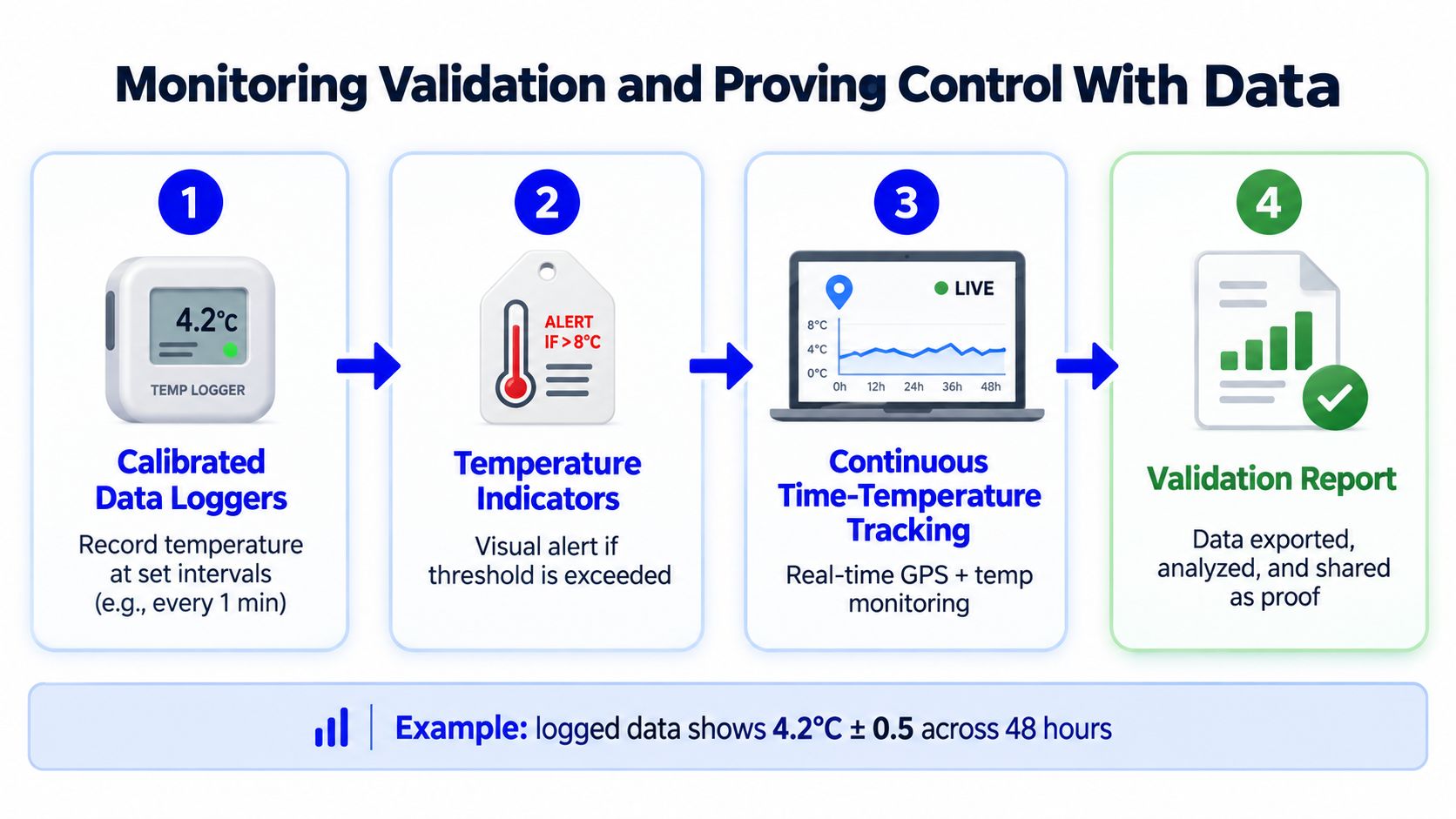
Build the evidence before dispatch
Select a calibrated data logger for the product's required temperature band. Place it inside the packout where its reading can represent the product condition, rather than automatically putting it at the box center. A temperature indicator can provide a quick visual warning, but it cannot show the magnitude and duration of an excursion when the receiving decision depends on both.
Validation examines the complete shipping configuration. Precondition the shipper and refrigerants, position thermocouples or calibrated loggers near likely hot and cold spots, and use environmental chambers to reproduce route stress. ISTA 7D and 7E are commonly used transport-packaging test profiles, with simulations that may cover 24, 48, or 72 hours. (Cold-chain package testing guidance)
The test should answer practical questions:
- Does the product remain within its target band for the planned duration?
- Where do hot and cold spots occur?
- Can the refrigerant freeze material near its surface?
- How does the packout perform under seasonal stress?
- Which recorded event requires quarantine or investigation?
A vial against frozen refrigerant may experience a different condition from a vial surrounded by other products. Sensor placement should reflect that risk.
Read the trace at receipt
The receiving team should verify the logger identity, download or review its trace, compare the recorded profile with the product's acceptance criteria, and document the disposition. Touching the carton cannot establish the temperature history.
If the trace shows an excursion, quarantine the shipment until an authorized person completes the review. The review should link the recorded event to the product's defined limits and the available handling records.
Release decision: The question is whether the record supports release under the product's defined criteria.
Preserve continuity across handoffs
The evidence package may include packout identification, logger calibration status, dispatch and receipt times, carrier details, handoff records, and any deviation report. Each item closes a different gap. A missing handoff record can weaken the conclusion even when the final temperature trace appears acceptable.
This matters especially for small R&D shipments, where several parties may handle one parcel. A 2026 compliance discussion identifies incomplete or non-continuous temperature records, missing shipper-carrier agreements, and absent pre-trip inspection records as common weaknesses. It also notes that regulators can treat a gap in the record as a gap in compliance. (Temperature-controlled freight compliance in 2026)
Requalification should follow meaningful changes, including a new lane, longer service window, different packaging, or altered product load. The earlier validation report documents the old configuration. It does not automatically prove that the revised route or packout remains controlled.
Cost Lead Time and Compliance Tradeoffs to Plan For
Temperature control adds more than a special carton to the purchase order. The shipment may require conditioned materials, qualified packaging, monitoring devices, trained handling, priority coordination, additional warehouse controls, and a review process at receipt. For a small, high-value laboratory order, those supporting activities can represent a meaningful part of the total operating burden.
Cold-chain growth also creates a less comfortable buying reality. A 2026 industry update reports that U.S. refrigerated warehouse expenses rose 2.77% year over year in Q3 2025, electricity costs rose 5.18%, and labor costs rose 3.91%. (GCCA Cold Facts industry update)
Three costs that buyers should separate
Protection cost covers the physical solution, such as an insulated shipper, gel packs, PCM, thermal mass, or active equipment. A cheaper packout may be unsuitable if it has never been tested for the actual route.
Visibility cost covers loggers, alerts, data retrieval, record retention, and review. That expense supports a release decision and helps identify where a lane fails.
Quality cost covers qualification, requalification, deviation review, quarantine, replacement planning, and supplier or carrier documentation. Omitting this category can make a quote look attractive while leaving the buyer exposed to an unsupported acceptance decision.
The same industry update indicates that growth is being driven more by frozen and ultra-low segments than by generic refrigerated shipping. That distinction matters because a small lab order requiring tight control may need a more specialized design than a commodity chilled shipment, even when both are described casually as “cold.”
Lead time is part of the control strategy
A faster service can reduce exposure, but speed alone doesn't compensate for poor handoffs or missing evidence. A slower route may work when the packout is qualified for its duration and the receiving team can manage the delivery window. Conversely, an urgent route can still fail if the parcel waits at an uncontrolled transfer point.
Supplier agreements should define who prepares the shipment, who checks the refrigerant, who owns the logger data, who receives alerts, and who authorizes a deviation decision. Buyers sourcing bacteriostatic water wholesale should also ask how lot documentation, dispatch timing, storage, and shipment records fit together.
Budgeting rule: The shipping quote should include the cost of proving control, not only the cost of moving the parcel.
Documentation gaps deserve special attention. Missing continuous records, shipper-carrier agreements, or pre-trip evidence can leave a compliant-looking shipment without a defensible chain of custody. A buyer should evaluate the supplier's record process before selecting the lowest transport price.
Best Practice Checklist for Suppliers and Buyers
A small RUO shipment can arrive with intact insulation and still lack defensible temperature evidence. The supplier and buyer should assign each control and each decision before dispatch. The package is only one part of the system. Records and handoffs show whether control continued from packout to receipt.
Before dispatch
- Confirm the product band: Record whether the shipment requires ambient 15–25°C, chilled 2–8°C, frozen -20°C, or an ultra-low range below -70°C. Document any permitted excursion window.
- Match the lane: Select the validated packout, refrigerant, thermal mass, logger position, and service duration for the actual route, including expected handoffs.
- Condition the refrigerants: Prepare gel packs or PCMs according to the qualified procedure. Prevent direct contact that could create localized cold spots.
- Build the evidence file: Include lot identity, quality documents, logger details, carrier information, dispatch time, and handoff instructions. Confirm where the complete record will be stored.
- Assign decisions: Name the person who receives alerts, reviews the trace, and can quarantine or release the shipment.
A written ownership map works like a lab chain-of-custody form. It prevents a missing alert or incomplete logger file from becoming nobody's responsibility.
At receipt
- Inspect before opening: Record damage, tampering, leakage, label condition, and delivery timing.
- Review the trace: Compare the full time-temperature record with the product's approved criteria. Touch cannot show whether an excursion occurred during an earlier handoff.
- Quarantine uncertainty: Hold the shipment if the record is incomplete or an excursion exceeds the documented acceptance window.
- Document the decision: Retain the trace, investigation, disposition, and corrective action with the shipment record.
- Requalify after change: Reassess the configuration when packaging, route, duration, carrier process, or product load changes.
Herbilabs offers RUO bacteriostatic water and reconstitution solutions in multiple vial formats, with temperature-controlled storage, lot-specific Certificates of Analysis, quality review, and same-day dispatch described among its fulfillment practices. Buyers should still request shipment-specific evidence and define an inbound SOP. Information about Herbilabs products and fulfillment is available at Herbilabs.