Private Label, White Label, Wholesale partnerships available - EU, USA and UK - Free shipping from €75

Lot Tracking for Clear Laboratory Traceability
A carton of lyophilised material arrives on a Tuesday. Someone signs for it, sets the vials on the shelf, and drops the packing slip into a folder named after the supplier. Nothing from the box gets written into a log, because the boxes always look the same and the shelf always has room.
Three months later a run gives a reading that doesn't match the four before it, and the first question is a plain one. Which container went into that run? The answer takes either thirty seconds or an afternoon, and the difference is whether anyone wrote down the lot number at the moment the carton was opened.
Lot tracking is the paper and spreadsheet work that makes the thirty-second answer possible. It isn't a software category, a scanner, or a compliance badge on a website. It's a short set of fields kept on the same key, applied every time material crosses the bench.
Table of Contents
- What Lot Tracking Means on the Bench
- The Minimum Lot Record a Small Lab Can Keep
- How a Lot Number Opens the Right COA
- Storage Checks and the In-Use Handling Note
- When a New Lot Meets a Result That Will Not Repeat
- Lot Tracking or a Serial Number on Every Vial
- File One Packet Under the Printed Lot
What Lot Tracking Means on the Bench
Say a team has used the same method for months with material from one supplier. A new carton lands, the vials look identical to the ones already in the box, and the only thing written on the shipping note is a date. Two weeks later the numbers drift, and nobody can say whether the vial in the drift run came from the old carton, the new one, or the one behind it. That's the moment lot tracking is for.
Lot tracking ties each container to one production group through the identifier printed on it, so identical-looking vials stop being interchangeable. The U.S. Food and Drug Administration defines a lot number as a set of alphanumeric characters assigned by a manufacturer or repackager to identify a batch, or a specifically identified portion of a batch, having uniform character and quality within specified limits, in its guidance on standardizing product-tracing data.
The label already carries the whole chain, if anyone reads it carefully.

Four rules follow from that definition. The lot identifies a group, not a single unit, so one record covers every vial that shares it. The number is assigned by the maker, so the laboratory copies it and never invents one. Members of a lot are assumed uniform within stated limits, which is exactly the assumption under test when something goes wrong. And the string is alphanumeric, so a zero and a capital O, or a one and a capital I, are not interchangeable. Transcribe it character by character and check it against the label twice.
A lot number isn't a nickname, a catalogue code, or a date someone typed into a spreadsheet. FDA guidance also says the manufacturer-assigned number should travel in the transaction information passed to later purchasers, and each trading partner carries forward the number it received rather than issuing a fresh one. That's why the printed string on a vial still points back to the manufacturing batch after two or three handoffs.
For an independent researcher the value is narrow rather than grand. One abnormal observation should point at one group, not the whole cupboard. Everything here builds on the same key: a minimum record at receipt, the Certificate of Analysis that belongs to that lot, storage and handling events hung on the same string, and a way to use the file when a result won't repeat. Consistent fields come before any software choice, and a spreadsheet with the right columns beats a platform with the wrong ones. Teams that outgrow the notebook and start building a data lineage programme are asking a familiar question at a larger scale, where a value came from and what happened to it afterwards.
The Minimum Lot Record a Small Lab Can Keep
The question that rarely gets a straight answer is what a small laboratory has to write down. Vendors answer with a platform. A workable answer is ten fields, filled at three moments, kept where a colleague can find them without asking.
| Record field | Capture point | What it protects |
|---|---|---|
| Product name | Receipt | Stops the lot number being separated from the material that arrived |
| Lot number as printed | Receipt, then again at first use | Keeps the exact alphanumeric key instead of a shortened or retyped code |
| Quantity received | Receipt | Shows how many containers share that one lot |
| Receipt date | Receipt | Starts the custody timeline |
| Order or supplier reference | Receipt | Points back to the shipment without replacing the printed lot |
| Storage location | Put-away | Says where those containers actually sit |
| Stated storage condition | Put-away | Records the required range rather than a vague room-temperature note |
| Linked Certificate of Analysis | Receipt | Files the lot document, not a generic specification sheet |
| Date first opened and operator | First puncture | Separates opened containers from unopened ones in the same lot |
| Disposition | Hold, finish or discard | Stops a closed lot being treated as still available |
Nothing in that table requires a purchase. A notebook page works, and so does one tab in a spreadsheet with one row per lot, plus the COA saved as a file named after the same string.
Two points where the lot gets checked
- At receipt. Read the printed label on the vial or kit against the shipping note or invoice. Write the lot only when the two match, and write it exactly as printed. A mismatch is a stop sign, not a rounding error.
- At first use. Read the label again and confirm the string is already on the log before any material is withdrawn. This catches a mis-keyed digit from weeks earlier, while the container is still in hand and the paperwork is still findable.
The contrarian point deserves saying plainly: a barcode or QR code isn't automatically better than handwriting. A scan preserves an incorrect lot number faithfully and fast, if nobody compared the label to the paperwork at receipt.
A scan is only as good as the check behind it. Automation moves a wrong string from one system to another without ever looking at the vial.
Edge cases that quietly break the file
- Don't reuse an identifier. Once material is finished or discarded, the code retires with it. A recycled number fuses two histories into one.
- Don't overwrite the printed lot with an internal stock code. Give the internal code its own column and leave the printed string intact, so a later lookup still resolves to the manufacturer's record.
- Don't invent a code for each vial inside a kit. Record how many containers share the one printed lot, because the group is the unit of traceability.
Published sampling guidance supports the same shape of record from the other direction. It connects the identity and size of the lot with the material sampled, the sampling date and location, the protocol used, container details, any abnormalities, the identity of the sampler and the chain of custody, as laid out in the AQCG guide to sampling. FDA guidance makes a related point about sample integrity from collection through laboratory receipt, and about documenting each party's role in custody.
The same instinct keeps equipment findable on a large industrial site, where asset tagging best practices begin with a label that someone else can read. Build the columns before the next delivery is unpacked. Ten minutes at a desk now separates a lookup from a guessing game later.
How a Lot Number Opens the Right COA
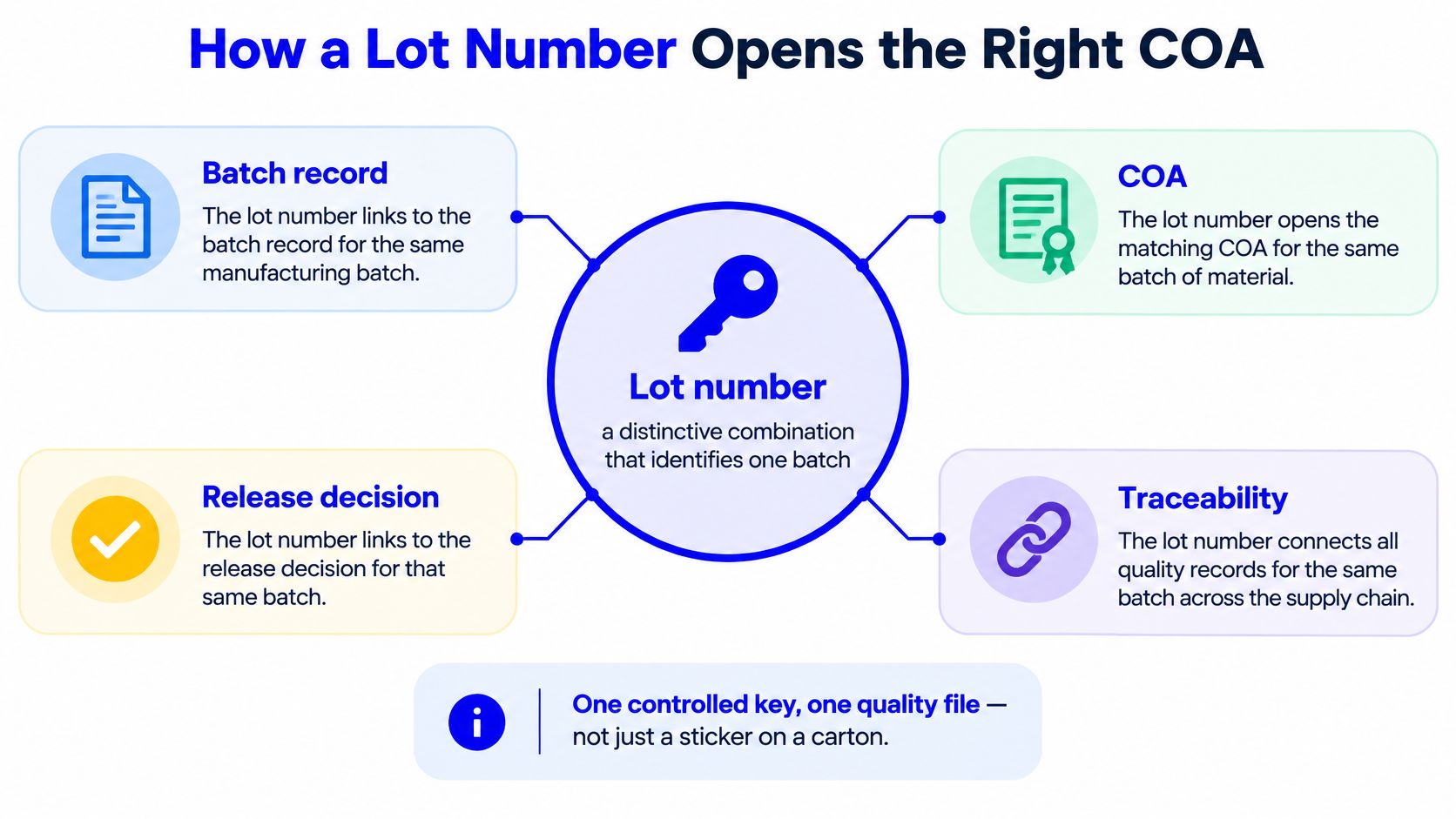
The lot number earns its keep when it opens one file and only one. Stuck on a carton as decoration, it says nothing. Used as a key, it connects the container in front of you to the paperwork that describes how it was made and released.
The World Health Organization's GMP guidance defines a batch or lot number as a distinctive alphanumeric combination that identifies the batch on labels, batch records, and the corresponding Certificate of Analysis, in its GMP guidance for pharmaceutical products. The definition is deliberately repetitive: the same string appears in three places so that the physical object and the papers stay the same object.
What a lookup should actually return
For a research laboratory, three things need to resolve from the printed string, and a fourth is a bonus when the supplier provides it.
- The lot record, meaning the printed number, the material, quantity, receipt date and storage location.
- The lot's Certificate of Analysis, not the product's general specification sheet.
- The laboratory's own receipt note, filed beside it, because supplier paperwork and internal custody together explain what happened.
That set turns a scare into a narrow question. If a supplier reports a defect, or the bench sees an abnormal result, staff can pull one lot, see which containers share it, and leave other lots in service while the question is answered. Treating every vial of the same product as suspect is what happens when the lot was never recorded in the first place.
Herbilabs practice on the file
Every lot has its own Certificate of Analysis, published on Herbilabs certificates of analysis, and each vial in a pack carries the same lot number and the same document. The buyer's job is to copy that printed string at receipt and store the COA with the lot, not in a general downloads folder filed under a product name, where the next lot's document will eventually sit on top of it.
A generic specification sheet isn't a substitute. It describes a product category. The lot document describes the batch that is physically on the shelf, and only one of those two can answer a question about a specific container.
The WHO model expects records to be completed when the work happens rather than reconstructed afterwards, and retained beyond the finished product's expiry under applicable requirements. The laboratory mirror is modest: file the COA the week the goods arrive, not the week a question appears.
The test is one lookup. Hand a colleague a vial and see whether they reach the correct COA without asking anyone, using a descriptive name for the document rather than a product nickname. If they can, the key works.
Storage Checks and the In-Use Handling Note
A lot record that says what arrived but not where it sat is half a record. The missing half is environmental, and it's where small labs lose the thread: the shelf gets checked generally, the lot gets recorded specifically, and the two never meet on paper.
The World Health Organization's good storage and distribution guidance sets controlled room temperature at 15 to 25 °C, and states that storage conditions should be maintained as stated on product labels or as described by the manufacturer, in the WHO storage and distribution annex.pdf). The same guidance prefers actual limits over vague wording such as "ambient conditions", which is a useful rebuke to any record that says the stockroom is normally fine.
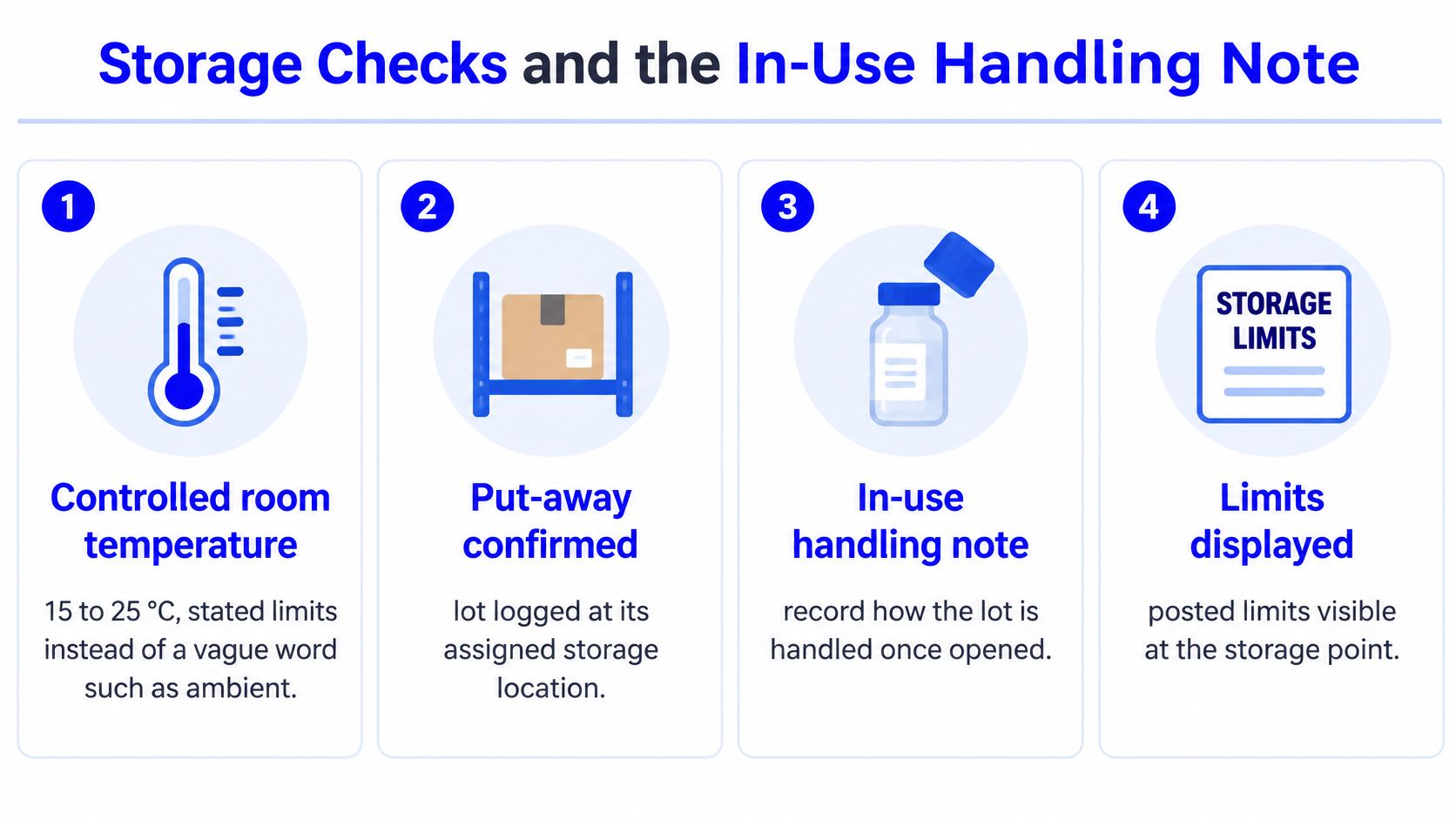
Herbilabs specifies storage at 15-25 °C for its laboratory material, so that range is the acceptance criterion written on the record rather than paraphrased. Name the monitoring method beside it, whether that's a min/max thermometer read at a set time each morning or a data logger with a downloaded trace, and say where the readings live. Then connect the two: an excursion that isn't attached to a lot number is a story, not a record.
Excursions belong to a lot
An excursion note needs six things: the lot number, the location, the date and time, the highest or lowest temperature observed, the duration if it's known, and the disposition decision that followed.
Filed against the lot, never against the room. "The stockroom is usually fine" answers nothing six months later. The note either names the lot or it doesn't exist.
Sealed storage and in-use handling are two states
When a vial is first punctured, write that date on the same record that already carries the lot number. Review it against the 28-day in-use period, described here as a common laboratory convention after first puncture with aseptic handling. It's a convention, not a product guarantee, and it isn't evidence that any particular later experiment remains suitable.
The mechanics are worth getting right. A USP General Chapter <797> FAQ notes that a multiple-dose vial may carry a beyond-use date of 60 days yet still must be discarded no later than 28 days after first puncture, with the shorter limit governing, as recorded in the USP compounding FAQ document. For research documentation the useful part is the habit rather than the number: the first-puncture date is an event on the vial's record, and the review date is calculated from it.
Unopened containers in the same lot keep their own status. An open vial's window never gets copied onto a sealed one, and a sealed vial's shelf life never gets assumed for an open one. Handling notes for laboratory best practices for handling bacteriostatic water belong in the same packet, on the same key.
The query test is simple. Given only a lot number, staff should be able to say where the material is, whether any container from that lot is open, and whether a temperature note exists.
When a New Lot Meets a Result That Will Not Repeat
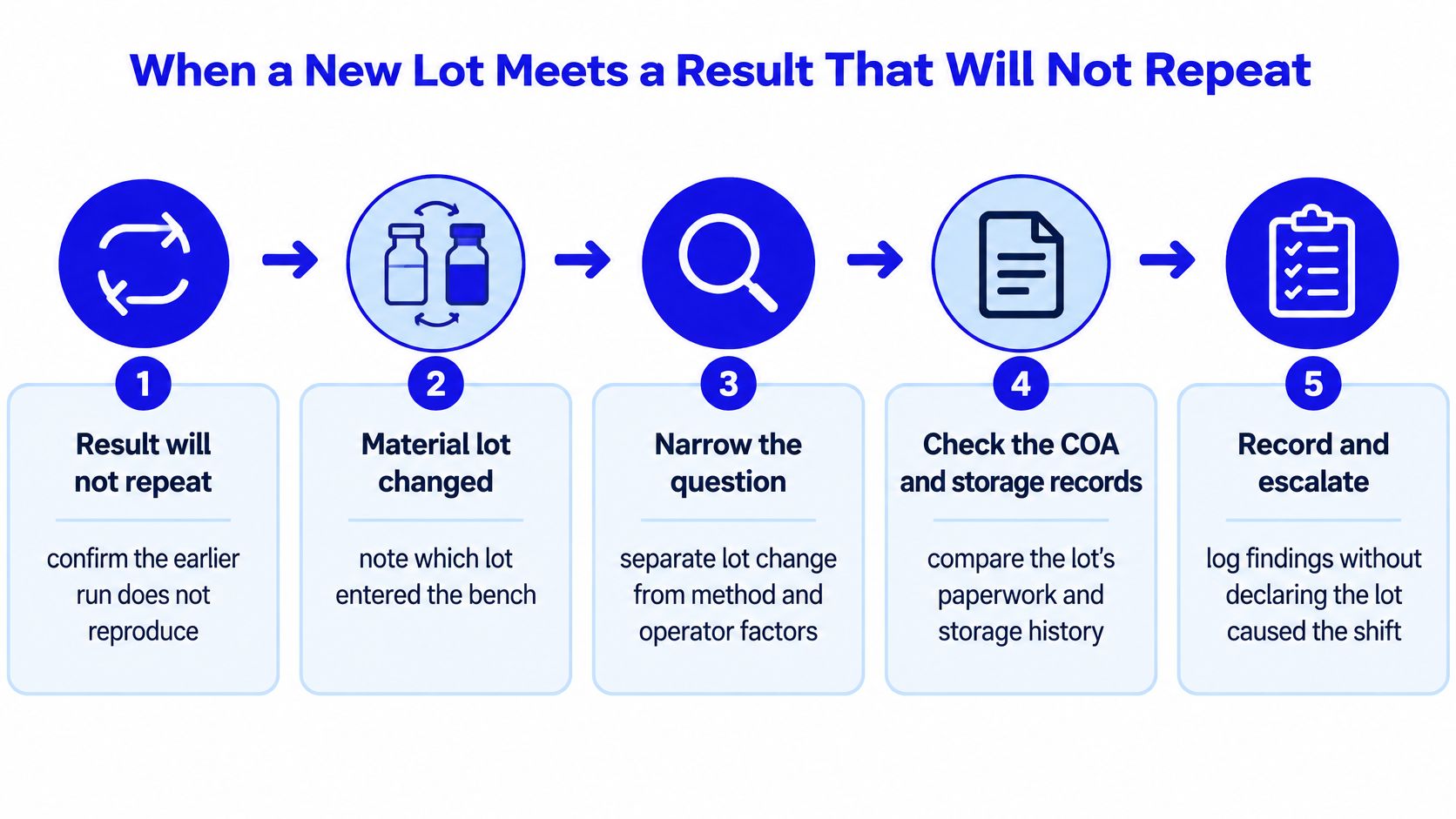
This is the scenario the compliance literature handles worst. A run won't reproduce, and somewhere between the two runs a new lot came onto the bench. The instinct is to blame the material and reorder. The cheaper, faster move is to narrow the question with records that already exist.
An investigation like this isn't proof that the lot caused the shift. Lot-level records show when a new lot entered use, retrieve its COA, display the storage history, and put results from before and after the change side by side, which narrows the field rather than settling it, in the way this discussion of COA and lot traceability describes.
Five checks in order
- Mark the entry date. Write the day the new lot first came into use, and which runs followed it.
- Open both COAs. Put the previous lot's document beside the new one and read the release information for each.
- Read the environmental notes. Storage entries and any excursion record for both lots, including who signed them.
- List what else moved. Method version, instrument, operator, calibration dates, and which runs used which lot.
- Write the unexplained remainder. Compare results before and after, then state plainly what the file cannot settle.
A COA proves release, not custody
A filed Certificate of Analysis documents the supplier's release information for one batch. It doesn't prove the laboratory stored the container in range, labelled it correctly, or handled it aseptically. That gap is why a lot-change event note carries date received, date opened, storage observations, method version, instrument, operator and the runs affected, not just a PDF in a folder.
One illustration is enough. Take two lots of bacteriostatic water used with the same written method to prepare lyophilised material. They arrived in different weeks, and the newer lot has a single temperature note on file. The record shows where the two histories diverge. It doesn't replace repeating the work under controlled conditions.
The post-puncture window belongs here as a handling checkpoint to record, not as automatic evidence that a lot was unsuitable for an experiment. Archive the investigation with both lot numbers, both COAs, the event note and the disposition decision, so a second attempt starts from evidence. Readers who want the analytical side can go deeper on why batch testing matters in labs.
Lot Tracking or a Serial Number on Every Vial
Two identifier styles get confused because both are printed codes that look similar on a label. They answer different questions. GS1 describes batch and lot identification as combining a trade-item identifier such as a Global Trade Item Number with a batch or lot number, which narrows a large population of identical products into a specific manufacturing group, in its global traceability standard.
Lot identification has always been the middle ground between no traceability and unit-by-unit serialization. It gives targeted control without requiring every item to carry its own number, and it suits quality events that happen at batch level: a production run, a raw material, a shared set of conditions. Serialization answers the other question, following one individual object wherever it goes.
| Question | Lot tracking | Serial tracking |
|---|---|---|
| What the code represents | One production group with shared history | One individual container or object |
| How widely the code is shared | Many vials or kits from that group | One unit only |
| What a hold looks like | The affected group can be separated without stopping unrelated lots | One unit is separated |
| How a COA attaches | One Certificate of Analysis covers the lot | A unit record still points back to the parent lot if a COA exists |
| Record burden for a small lab | One parent record plus events | A separate record for every unit |
| Typical lab fit | Multi-vial research material released by batch | A unique instrument or other one-off object |
The record doesn't stop at the shelf. One lot should point to many receipts, warehouse locations and later movements, with every transaction keeping the original printed lot rather than overwriting it with an internal SKU, which is the distribution discipline set out in WHO guidance for excipients. Read in the other direction, that one-to-many structure is what lets a small lab pull every event for a lot in a single query instead of walking the shelves.
Where containment has to move quickly across a larger footprint, software starts ranking which records to pull first, and AI-driven recall containment is one direction that work is heading. The data model underneath it is still a lot record pointing at its events.
If the question is which production group this was, use the lot. If the question is which single object this was, use a serial.
For most small laboratories, that settles it. Multi-vial material released by batch sits on the lot side, and the one-of-a-kind item sits on the serial side.
File One Packet Under the Printed Lot
A finished lot file is one folder, notebook section or spreadsheet tab named with the printed lot number and nothing else. Not the product name. Not the month it arrived. The string on the label.
Four objects sit inside, all of them captured earlier: the receiving line, the Certificate of Analysis for that exact lot, the storage and excursion notes, and any lot-change investigation with its disposition. Nothing gets rebuilt, and nothing gets summarised into a second document that can drift from the original.
The retrieval test is the whole point. Hand a colleague a vial and the packet should show the same alphanumeric string on the label, on the COA and on the receiving line, in under a minute, without anyone's memory involved.
Herbilabs places a Certificate of Analysis for every lot on its COA page, and each container in a pack carries that lot number and that document. Each lot is checked through lot-specific Certificates of Analysis and quality assurance review before the product is released. The material is bacteriostatic water: sterile water with 0.9% benzyl alcohol in multi-use glass vials, sold for research use only, with the 10 mL vial and the 10 x 10 mL kit in stock. Storage on the record stays 15-25 °C, and the 28-day in-use period after first puncture remains a common laboratory convention rather than a product guarantee. Herbilabs manufactures the product and ships all orders from the EU, across the US, the UK and the EU.
One key, checked at receipt and again at first use, opening one packet. That's the system, and the lot number is the only folder name a later question needs.
Herbilabs team
Herbilabs supplies bacteriostatic water for laboratory research with a Certificate of Analysis for every lot, so the packet described here can be opened the week a carton arrives rather than the week a result stops repeating. The 10 mL vial and the 10 x 10 mL kit are in stock and ship from the EU across the US, the UK and the EU. Visit Herbilabs to see the current formats and pull the lot document for the material already on the shelf.