Private Label, White Label, Wholesale partnerships available - EU, USA and UK - Free shipping from €75

Lyophilized Peptides Storage: Best Practices for Lab
“Keep lyophilized peptides cold, dark, and dry” is useful advice, but it's not a storage protocol. It treats every sequence, vial, freezer, and research timeline as if they present the same risk. In practice, humidity exposure, sequence chemistry, temperature cycling, and the difference between a sealed vial and an opened working stock determine whether a peptide remains suitable for reproducible research.
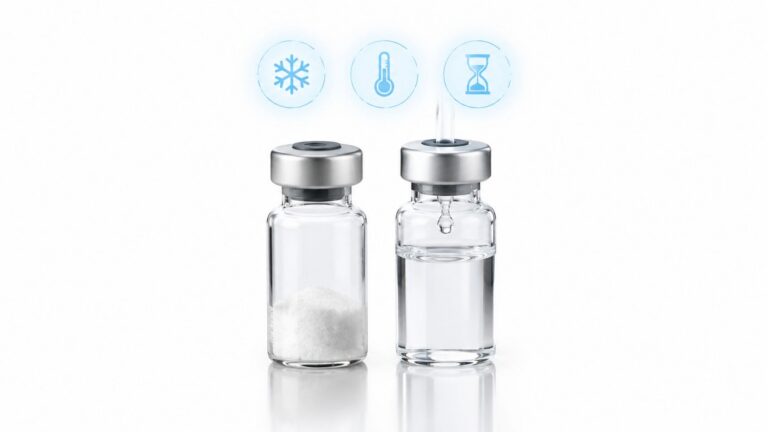
Lyophilization removes water and sharply slows hydrolysis and other degradation pathways, which is why manufacturers commonly ship research-grade peptides in dry form. Yet the powder's relative resilience can create false confidence. A vial may tolerate brief transit handling while still requiring disciplined equilibration, opening, resealing, and documentation once it reaches the laboratory.
Table of Contents
- Why Generic Storage Rules Fail Modern Peptide Research
- Understanding Peptide Degradation Mechanisms
- Choosing the Right Storage Temperature for Your Peptides
- Proper Vial Handling and Moisture Control Protocols
- Sealed Storage Versus Post-Opening and Reconstituted Peptides
- Documentation and Traceability for Research Compliance
Why Generic Storage Rules Fail Modern Peptide Research
The standard rule, keep the vial cold, dark, and dry, is a starting point rather than a decision. A sealed, well-protected peptide with a short working timeline doesn't present the same storage problem as a moisture-sensitive sequence intended for long-term retention across facilities. Treating both identically can waste freezer capacity in one case and provide inadequate protection in the other.
Sequence chemistry matters. Independent peptide-handling guidance identifies methionine, tryptophan, cysteine, asparagine, and Asp-Gly motifs as residues or sequence features that may require colder or more protective conditions than a routine −20°C default (peptide handling guidance). Methionine and tryptophan can be vulnerable to oxidative damage, while susceptible bonds and residues can make hydrolysis or rearrangement more consequential. The appropriate question isn't “Which freezer is available?” It's “What can this sequence tolerate over the intended hold time?”
The chemistry is only half the problem
Facility practice introduces another layer of variability. A vial can move through a manufacturer, courier, receiving area, central freezer, satellite laboratory, and working bench before a study begins. Each transfer creates opportunities for temperature cycling, condensation, light exposure, and delayed re-cooling. Global R&D and reseller workflows make this especially important because the sample may be unpacked and transferred by people who weren't involved in the original storage decision.
A useful internal standard should therefore record the peptide sequence, lot documentation, intended use window, packaging, and sensitivity flags. The 2026 guide to industry standards for research solutions can help teams frame storage as part of broader research-solution quality practices rather than as an isolated freezer task.
Practical rule: A temperature label without an opening and handling rule is incomplete.
Where the common rule breaks down
The generic approach fails most often in three situations:
- Labile sequences: Peptides containing oxidation- or hydrolysis-sensitive features may need stronger light, oxygen, moisture, and temperature controls.
- Long retention periods: A short transit window and long-term inventory storage shouldn't share the same risk assessment.
- Repeated access: Opening a vial in humid laboratory air can matter more than the freezer set point after the sample has been exposed.
Major peptide-storage guidance commonly places long-term dry storage at −20°C or colder, away from light and moisture, with reported stability windows ranging from one to three years at −20°C, three to five years for many peptides under optimal dry frozen storage, and beyond a decade at −80°C for especially well-protected samples (peptide storage stability guide). Those are practical ranges, not universal guarantees. Sequence, packaging, residual moisture, and handling history still control the decision.
Understanding Peptide Degradation Mechanisms
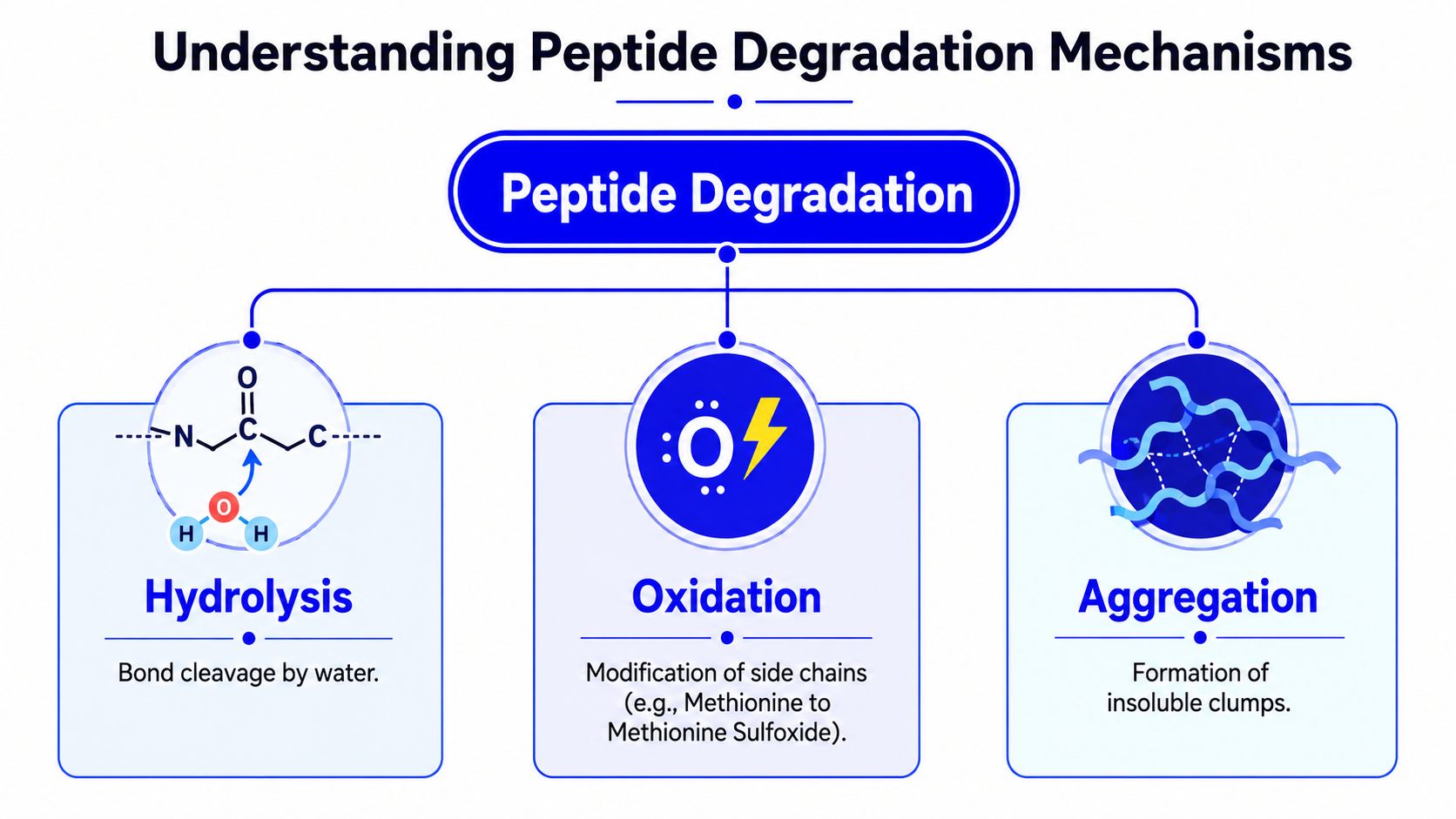
Cold, dry storage reduces risk, but it does not stop peptide degradation. Lyophilization removes much of the water that enables reactions, while temperature, light, oxygen, and handling determine how well the remaining stability is preserved. The right protocol therefore depends on the sequence and on how often the vial will be opened.
Hydrolysis follows moisture exposure
Hydrolysis is the water-driven cleavage or modification of chemical bonds. Lyophilization slows this pathway, which is why dry peptide cakes generally tolerate storage better than dissolved preparations. Moisture can still enter through a compromised stopper, repeated opening, humid laboratory air, or condensation that forms as a cold vial equilibrates.
That last risk is easy to miss. A vial taken directly from cold storage can collect surface moisture before it is opened, and humid air can enter as soon as the seal is broken. A cake that appears compacted, damp, or adhered to the vial wall warrants review rather than automatic use. The guide to what lyophilized peptides are explains why freeze-drying supports a dry storage state, but the seal and handling sequence determine whether that state survives routine RUO use.
Oxidation depends on sequence and exposure
Oxidation affects susceptible side chains, particularly methionine, tryptophan, and cysteine. Oxygen, light, heat, and reactive impurities can alter peptide identity or assay behavior even when the vial looks normal.
Protect the vial from light with amber packaging or an opaque secondary container, and keep bench exposure short. Opening also changes the headspace. Air replaces the protected internal environment, while repeated access creates more opportunities for oxygen and moisture entry. Sequence-specific sensitivity should guide how strictly these controls are applied.
Aggregation can begin after reconstitution
Aggregation occurs when peptide molecules associate into larger clusters or insoluble material. Reconstitution, unsuitable pH, repeated freeze-thaw events, and interactions between degradation products and intact molecules can all contribute. Cloudiness or visible particles may indicate aggregation or contamination, although a clear solution does not confirm full integrity.
Temperature influences all three pathways. Lower temperatures generally slow reactions, while repeated movement between cold storage and room conditions increases moisture and physical stress. Dry, sealed material and reconstituted material require separate handling decisions. Reconstituted peptides may remain stable only days to weeks at 2–8°C, whereas longer holds generally require freezing, as outlined in the freezer versus refrigerator storage protocols.
Choosing the Right Storage Temperature for Your Peptides
Temperature should be chosen by sequence sensitivity, planned hold time, and freezer reliability. A set point alone does not protect a sample if the unit cycles frequently, the door remains open, or inventory is packed in a way that exposes stock to repeated warming.
For many sealed lyophilized peptides, −20°C or colder is a practical long-term benchmark. Keep vials sealed, shielded from light and moisture, and stored under temperature monitoring. Bachem describes common benchmark ranges of approximately one to two years at 2–8°C and two to five years at −20°C, with deep-freeze conditions extending stability further (Bachem peptide handling and storage guidance). These ranges support planning, not a guarantee for every sequence or formulation.
A working decision matrix
| Peptide Type | Storage Duration | Recommended Temperature | Key Considerations |
|---|---|---|---|
| Relatively robust, sealed lyophilized material | Short-term transit or temporary holding | Room temperature only briefly | Keep sealed, shaded, and return to controlled storage promptly |
| General sealed lyophilized peptide | Long-term inventory | −20°C or colder | Limit moisture, light, and temperature cycling |
| Sequence with oxidation- or hydrolysis-sensitive features | Extended retention | Colder storage, potentially −80°C | Review sequence chemistry, packaging, and supplier guidance |
| Opened but dry peptide | Short working period | −20°C or colder | Minimize headspace exposure and reseal immediately |
| Reconstituted peptide | Short-term use | 2–8°C | Validate the in-use window and protect aseptic integrity |
| Reconstituted peptide for longer holding | Extended working stock | Frozen aliquots | Avoid repeated thawing and refreezing |
Room-temperature storage fits transit and brief handling, not routine long-term inventory. Depending on sequence and packaging, dry material may remain acceptable for weeks to months at room temperature, while more sensitive material requires tighter control, as described in this peptide storage stability guidance. Supplier instructions for the specific lot should take priority when they impose stricter conditions.
Freezer reliability matters as much as the set point
A dependable −20°C freezer can protect inventory better than an intermittently maintained −80°C unit. Place frequently accessed working vials near the front, and keep long-term stock away from routine door opening. Duplicate high-value samples across validated storage units when the study justifies the added control.
Sequence chemistry should also shape the backup plan. For oxidation-sensitive peptides, identify an alternate cold location before equipment failure occurs. Document excursion limits, quarantine samples after significant exposure, and do not treat unchanged powder appearance as evidence that the peptide remains intact. In RUO workflows, sealed long-term storage and opened-vial handling require separate decisions, because equilibration and headspace exposure can become the actual source of risk.
Proper Vial Handling and Moisture Control Protocols
For dry peptides, the most dangerous moment often occurs outside the freezer. A cold vial brought into humid laboratory air can collect condensation before the stopper is removed. That moisture can enter when the vial is opened, wet the cake, and accelerate degradation.
Equilibrate before opening
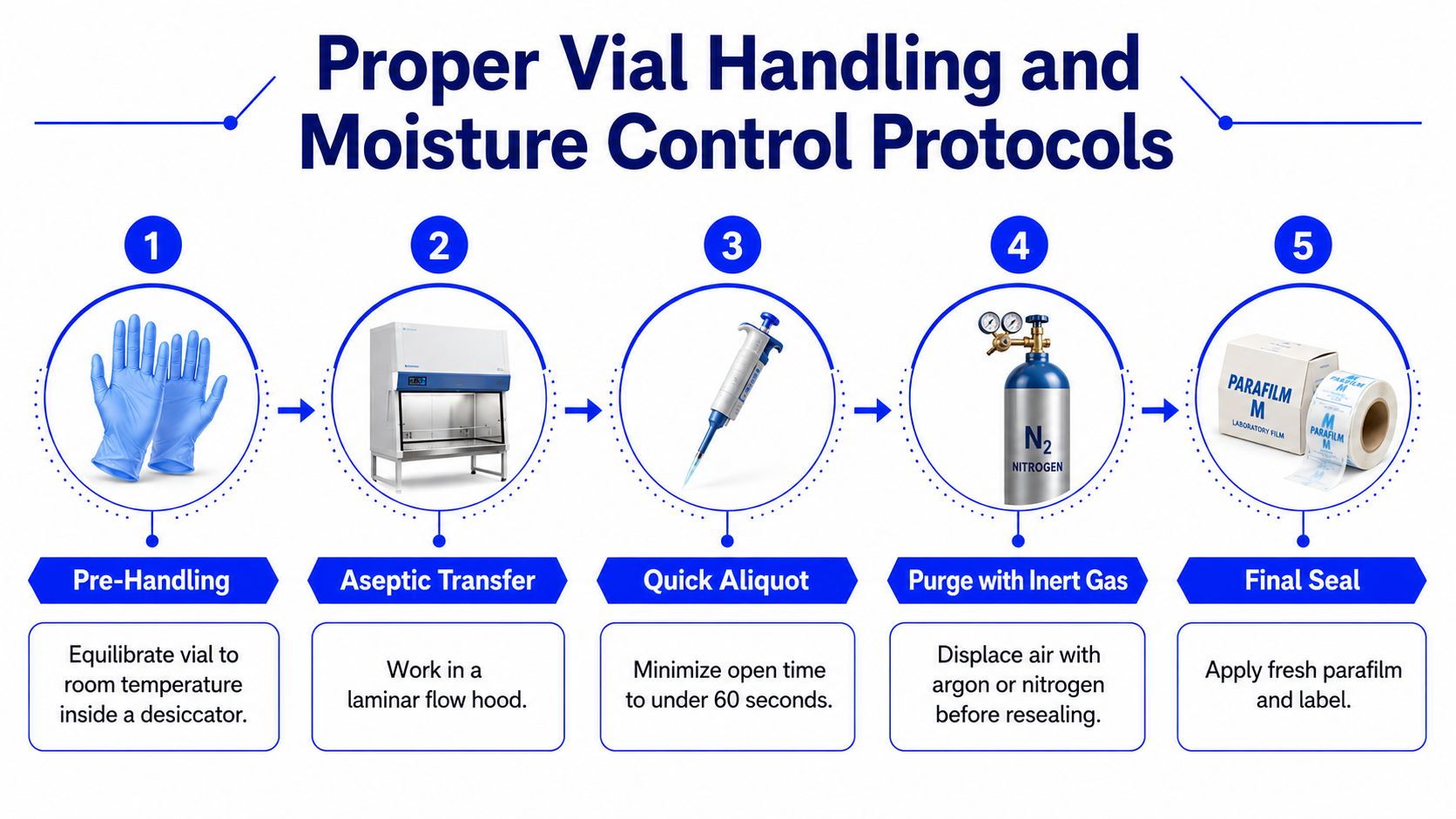
The vial should warm to room temperature inside a desiccator before opening. This allows the exterior and contents to equilibrate in a low-moisture environment, reducing condensation risk. Opening a frozen vial immediately on the bench is one of the simplest ways to defeat an otherwise sound storage protocol.
The exact equilibration time depends on vial size, packaging, and thermal conditions, so it shouldn't be guessed or copied across facilities without validation. The operating procedure should define the visual and handling endpoint, such as no visible condensation and a stable room-temperature surface, rather than relying on an unsupported universal time.
Use a controlled opening sequence
A practical sequence looks like this:
- Prepare the workspace: Stage labels, sterile tools, secondary containment, and the receiving container before removing the vial.
- Equilibrate in a desiccator: Keep the sealed vial protected until condensation risk has passed.
- Transfer aseptically: Perform opening and aliquoting in the qualified clean workspace used for the research material.
- Limit exposure: Remove only the amount needed and keep the vial open for the shortest practical interval.
- Reseal immediately: Replace the stopper, apply the approved seal, update the access record, and return the vial to controlled storage.
A desiccator with an appropriate desiccant protects the immediate handling environment, while a humidity monitor helps identify whether the workspace itself is undermining the procedure. For teams reviewing broader freezer, cabinet, and environmental-control options, a practical lab storage solutions guide can support equipment planning without replacing peptide-specific instructions.
Reduce headspace and repeated exposure
Aliquoting can reduce repeated vial access, but it adds transfer steps and therefore requires strong aseptic technique. The correct choice depends on the peptide's sensitivity, the expected number of withdrawals, and the risk of contamination during transfer. Inert-gas purging may be appropriate for selected oxygen-sensitive workflows when validated by the laboratory, but it shouldn't be treated as a substitute for dry handling and prompt resealing.
Condensation is not harmless frost. It is a moisture-transfer event that can change the storage state of the material.
The vial should be inspected after opening. A wet or compacted cake, unusual discoloration, damaged seal, or compromised stopper should trigger quarantine and supplier review. Research teams should retain the vial and associated records when a quality dispute or stability investigation may follow.
Sealed Storage Versus Post-Opening and Reconstituted Peptides
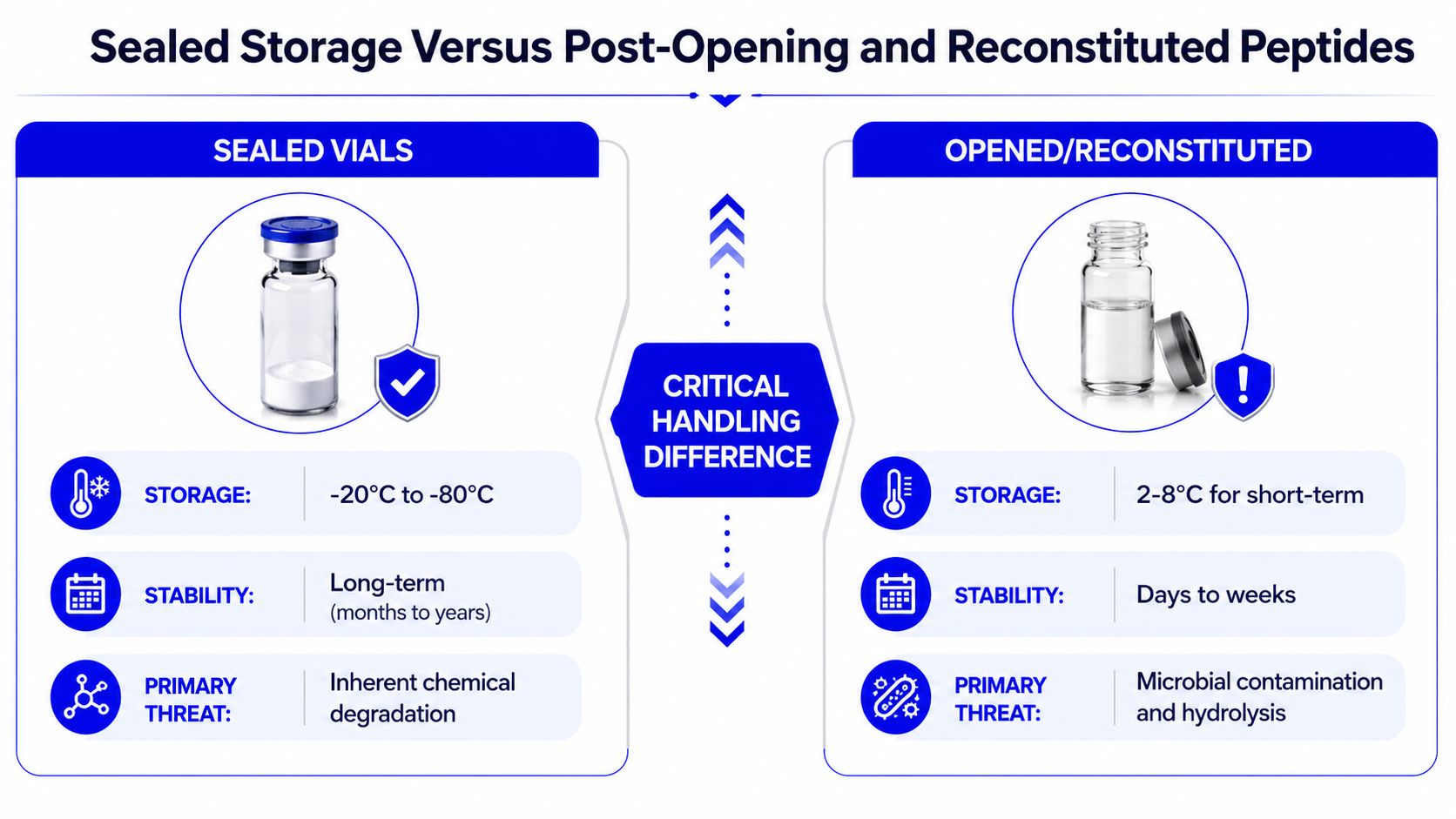
A sealed lyophilized vial and a reconstituted working solution require different storage decisions. The dry cake has low water activity and may remain usable for years under suitable frozen conditions. Once dissolved, the peptide enters a solvent environment that can promote hydrolysis, oxidation, aggregation, and microbial contamination. The sequence, formulation, container, and planned use should determine the storage state, rather than a blanket “keep it cold” rule.
Three storage states need separate rules
Sealed lyophilized material belongs in the long-term inventory system. Keep it tightly sealed, protected from light and moisture, and stored at the temperature selected for the peptide sequence and expected retention period. Before moving a cold vial into a warmer workspace, allow it to equilibrate while sealed. Opening it while the vial is still cold can draw humid air inside and create condensation on the stopper or cake.
Opened but still-dry material has a different risk profile. Each access event introduces humid air and increases headspace exposure. If the remaining material cannot be returned promptly to controlled storage, the laboratory needs a validated moisture-control procedure. Record when and why the vial was opened, because post-opening handling can explain later changes that are otherwise mistaken for lot or assay variability.
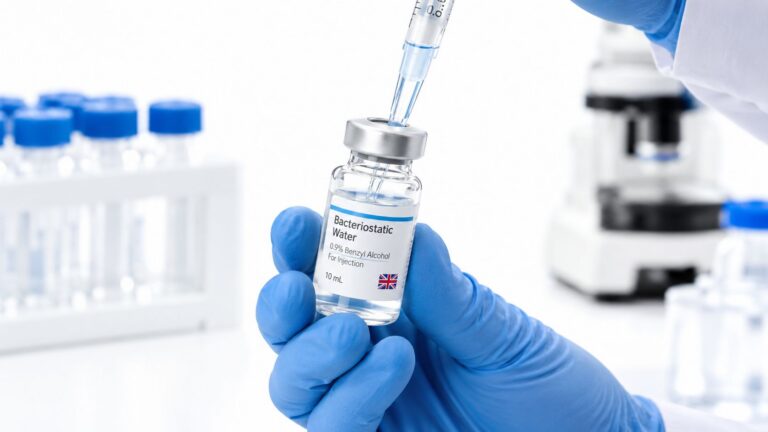
Reconstituted material belongs in a working-stock procedure. Stability commonly falls to days or weeks at 2–8°C, while freezing supports longer holds when the specific preparation permits it. A bacteriostatic diluent containing benzyl alcohol may support a longer in-use period than sterile water or saline in some workflows, but supplier and institutional procedures still govern the decision. Review practical guidance on mixing peptides with bacteriostatic water before selecting a diluent.
Aliquot before freezing
Repeated freeze-thaw cycles add avoidable stress to dissolved preparations. Divide the solution into suitable single-use or limited-use aliquots before freezing, then thaw only the amount required for the experiment. Refreezing leftovers increases uncertainty and should be avoided unless the workflow has validated it.
Label every reconstituted vial or aliquot with the peptide identity, lot, solvent, concentration, preparation date, storage condition, and discard or review date. A dry-vial stability window does not transfer to a dissolved solution.
The following video can supplement a written procedure, but it should not replace the laboratory's approved method:
Documentation and Traceability for Research Compliance
A freezer preserves a sample, but a traceability system preserves the meaning of the result. Without a reliable record, a team may not know whether a failed assay reflects biology, lot variation, reconstitution practice, temperature excursion, or repeated vial access.
The receiving record should establish identity and condition before the material enters inventory. At minimum, the record should connect the peptide name and lot to the supplier documentation, receipt condition, assigned storage location, and responsible custodian. Lot-specific Certificates of Analysis support batch review and give researchers a reference point when results differ between materials.
Build the record around access events
A practical inventory log should capture:
- Receipt details: Record the lot, arrival date, package condition, and initial storage decision.
- Storage history: Document the assigned freezer, temperature monitoring, and any excursion or relocation.
- Access history: Note each opening, date, researcher, purpose, and whether the vial remained dry.
- Reconstitution details: Record solvent, preparation date, concentration, aliquot identity, and working-storage location.
- Disposition: Mark material as consumed, discarded, quarantined, or retained for investigation.
Digital systems make searching, permissions, and audit trails easier, while controlled paper logs can work when they're signed, dated, reviewed, and protected from alteration. Either format fails if researchers record events later from memory. The access event should be documented when it occurs, especially after a freezer alarm, relocation, or unexpected delay.
Connect storage records to reproducibility
Traceability becomes more valuable when storage data links to assay results, instrument runs, and protocol versions. A research team should be able to identify which lot, vial, reconstitution event, and storage condition supported a particular result without reconstructing the history from disconnected notebooks.
Teams building a more structured evidence trail can review PlotStudio AI reproducibility tools as one option for organizing research records and making experimental context easier to inspect. The tool doesn't replace freezer monitoring or controlled laboratory procedures, but it can complement them by connecting observations with the conditions under which they were produced.
A sample without a handling history may be physically present but scientifically ambiguous.
Storage reviews should include the freezer map, temperature records, access logs, supplier COAs, and excursion decisions. That combination supports internal audits, collaboration between facilities, and defensible decisions about whether a sample remains suitable for use.
Herbilabs supplies sterile RUO reconstitution solutions in multiple vial formats, with lot-specific Certificates of Analysis and documented quality controls for laboratories preparing peptide working solutions. Visit Herbilabs to review the available labware and reconstitution options, then align the selected product with the laboratory's approved aseptic and storage procedure.