Private Label, White Label, Wholesale partnerships available - EU, USA and UK - Free shipping from €75

Level 2 Mask Guide to Standards and Fit
An ASTM Level 2 mask must achieve at least 98% bacterial and submicron particulate filtration and resist synthetic blood at 120 mmHg, yet it remains a loose surgical mask, not a fit-tested respirator. Advice to choose the highest filtration percentage misses the practical issue: air can pass around the edges instead of through the tested material.
By Herbilabs
A box label helps buyers compare medical barriers. It doesn't establish how a particular mask fits a particular face, and it doesn't settle whether the task calls for respiratory protection. Safe selection starts with the exposure, not the largest percentage printed on the package.
Table of Contents
- What a Level 2 Mask Is For
- How Level 2 Compares with Other Barriers
- The Tests That Create a Level 2 Score
- Why the Percentage Is Not Your Protection
- Choose the Level by Exposure
- What to Demand on the Label and the File
- Purchase Order and Storage
What a Level 2 Mask Is For
Level 2 is a material-performance class, not a face-seal rating. Printing it on a box doesn't mean the wearer is sealed against airborne particles. The useful question is whether the documented barrier properties match the work.
Consider a teaching laboratory preparing for specimen-handling demonstrations. The purchasing team needs a medical mask for source control and anticipated splashes, while the laboratory supervisor separately decides which tasks require containment, eye protection, or respiratory protection. Ordering a procedure mask solves only the mask-barrier part of that assessment.
The ASTM F2100 standard overview identifies the classification as a combination of filtration, fluid resistance, breathability, and other material requirements:
Level 2 working thresholds: at least 98% bacterial filtration efficiency, at least 98% submicron particulate filtration efficiency, and resistance to synthetic blood at 120 mmHg, together with flammability requirements and a breathability limit.
These aren't interchangeable measures. A filtration result describes passage through the tested material, while a fluid-resistance result describes performance against a specified splash challenge. Neither tells the supervisor how much air will travel through a gap beside the nose.
A fabric report rather than a garment fitting
The rating is like a laboratory report for fabric, not a measurement of how a garment sits on a person. A fabric can meet its specification while the finished garment fits poorly. The same distinction matters when a mask panel performs well but its shape leaves an opening at the chin.
Procedure rooms, clinics, teaching laboratories, and procurement teams use medical-mask classifications to specify a suitable fluid barrier. For moderate fluid exposure, a documented Level 2 product can be an appropriate candidate. It isn't a dust-respirator designation or a blanket approval for any laboratory task.
The distinction also prevents mask selection from replacing environmental controls. For non-laboratory housekeeping, allergy-friendly cleaning advice from Star Cleaner Australia, published by Star Cleaner Australia Pty Ltd, offers a separate resource for planning cleaning practices. Such advice belongs alongside an exposure assessment, not in place of one, and a medical-mask label shouldn't be interpreted as an allergy-protection certification.
A useful purchasing decision therefore has separate parts:
- Exposure selection: Choose a barrier category appropriate to the anticipated fluid contact.
- Individual fit: Check whether the actual product sits properly on the wearer.
- Document verification: Request evidence for the sold mask rather than accepting a slogan.
Keeping those decisions separate makes the classification useful without asking it to prove something the laboratory tests never measured.
How Level 2 Compares with Other Barriers
Level 2 describes how mask material performs in lab tests. It does not measure the gap between a mask and a wearer's face, or establish protection against inhaled aerosols.
| Barrier | BFE minimum | PFE minimum | Synthetic blood | Typical job |
|---|---|---|---|---|
| ASTM Level 1 | ≥95% | ≥80% on the KDHE comparison | 80 mmHg | Low-fluid exams and basic source control |
| ASTM Level 2 | ≥98% | ≥98% | 120 mmHg | Moderate splash and spray in procedures |
| ASTM Level 3 | ≥98% | ≥98% | Higher than Level 2 | Heavy blood or body-fluid spray |
| Surgical mask as a class | Material tests only | Material tests only | Specified by the tested level | Loose barrier, not a seal |
| N95 or FFP2 respirator | Respirator particle testing, not BFE classification | Not an ASTM medical-mask score | Not established by the respirator designation | Airborne particles with an appropriate seal |
The Kansas Department of Health and Environment comparison lists Level 1 at at least 95% BFE, at least 80% PFE, and 80 mmHg synthetic-blood resistance, compared with at least 98% BFE, at least 98% PFE, and 120 mmHg for Level 2.
A respirator is not a higher rung on the ASTM medical-mask ladder. Medical masks and respirators use different classifications, so compare each barrier within its own test framework. A loose mask material can meet its class and still leave gaps at the cheeks or chin.
Breathability needs its own specification
Differential pressure measures resistance to airflow through mask material. It is separate from filtration, and its limit depends on the standard edition and test conditions cited. Confirm the method, units, and acceptance criterion in the supplier's test report before comparing results.
A claim that a mask is comfortable does not replace a measured differential-pressure result. The lab value describes the tested material; it does not establish how comfortable the mask will feel on every face during every task.
Keep the comparison within its scope
Mask selection is one part of workplace contamination control. Shared offices, reception areas, and staff rooms need their own cleaning workflow. Arelli Cleaning's guide to preventing cross contamination in offices covers that separate planning need. An office-cleaning routine does not determine the mask class for specimen handling.
Selection verdict: Level 2 is a material class for moderate fluid exposure. Level 3 has a higher synthetic-blood resistance threshold. A respirator is a different type of barrier for airborne-particle hazards, and its seal matters.
The Tests That Create a Level 2 Score
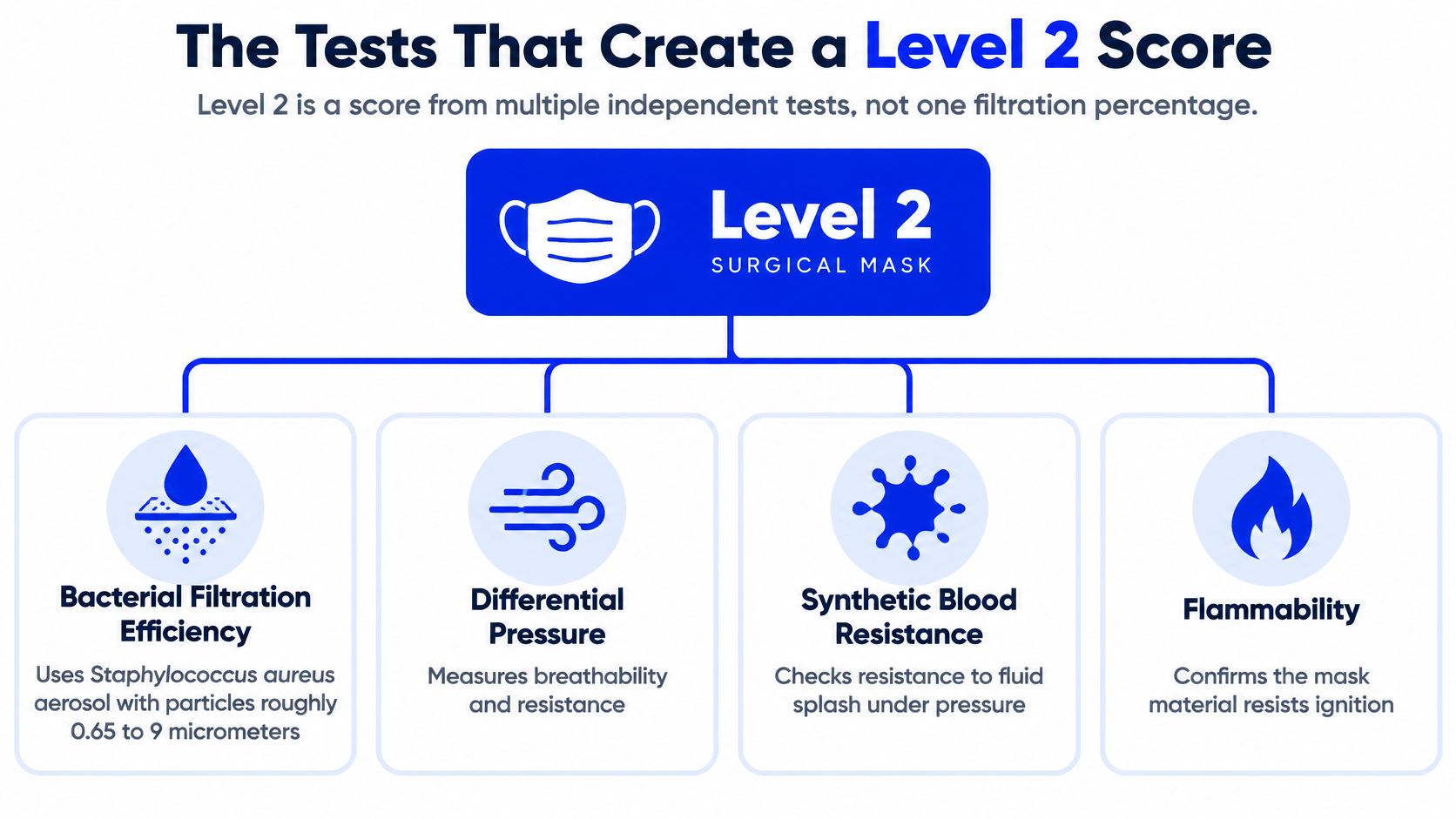
A Level 2 score describes tested mask material, not the whole experience of wearing a mask. The tests assess separate properties, so a high filtration result cannot make up for missing evidence on fluid resistance or breathability.
The ASTM F2100 medical face-mask specification identifies bacterial filtration, differential pressure, submicron particulate filtration, synthetic-blood resistance, and flammability as classification measures. It also includes biocompatibility requirements. Buyers should look for evidence across these categories, not just a certificate for the filter medium.
Filtration asks what passes through the material
Bacterial filtration efficiency, or BFE, measures how the material performs against a bacterial aerosol challenge. The laboratory compares the challenge reaching the material with the amount recovered beyond it. The result applies to that controlled test; it is not an estimate of infection risk for a wearer.
Particulate filtration efficiency, or PFE, measures the passage of small test particles through the material. Its challenge and method differ from BFE, so one result cannot stand in for the other. Check that a supplier identifies the test method behind each filtration percentage.
A large number in a brochure means little without that context. Find the named method and result, then check which material property the percentage describes. Passing one test does not prove performance in an untested category or show that the mask seals against the face.
Fluid, airflow, and ignition answer different questions
The other three tests assess distinct material properties:
- Synthetic-blood resistance: Checks whether the material resists penetration during a specified pressurized fluid challenge. It does not measure wear duration or show that a damp mask remains usable.
- Differential pressure: Measures resistance as air moves through the material under test conditions. Check the report for units and the applicable acceptance limit.
- Flammability: Evaluates burning behavior under the specified method. It does not establish suitability for unassessed heat or flame exposure.
Biocompatibility is also part of the medical-device evaluation. It concerns the suitability of materials for their intended contact; it is not a sixth filtration test.
Five tests, one label, none of them a fit test.
A useful report connects each result to a method, a tested product, and an acceptance criterion. Checkmarks without supporting results leave those details unclear. Even when the material passes the applicable tests, the score says nothing about edge leakage, face shape, or aerosol protection.
Why the Percentage Is Not Your Protection
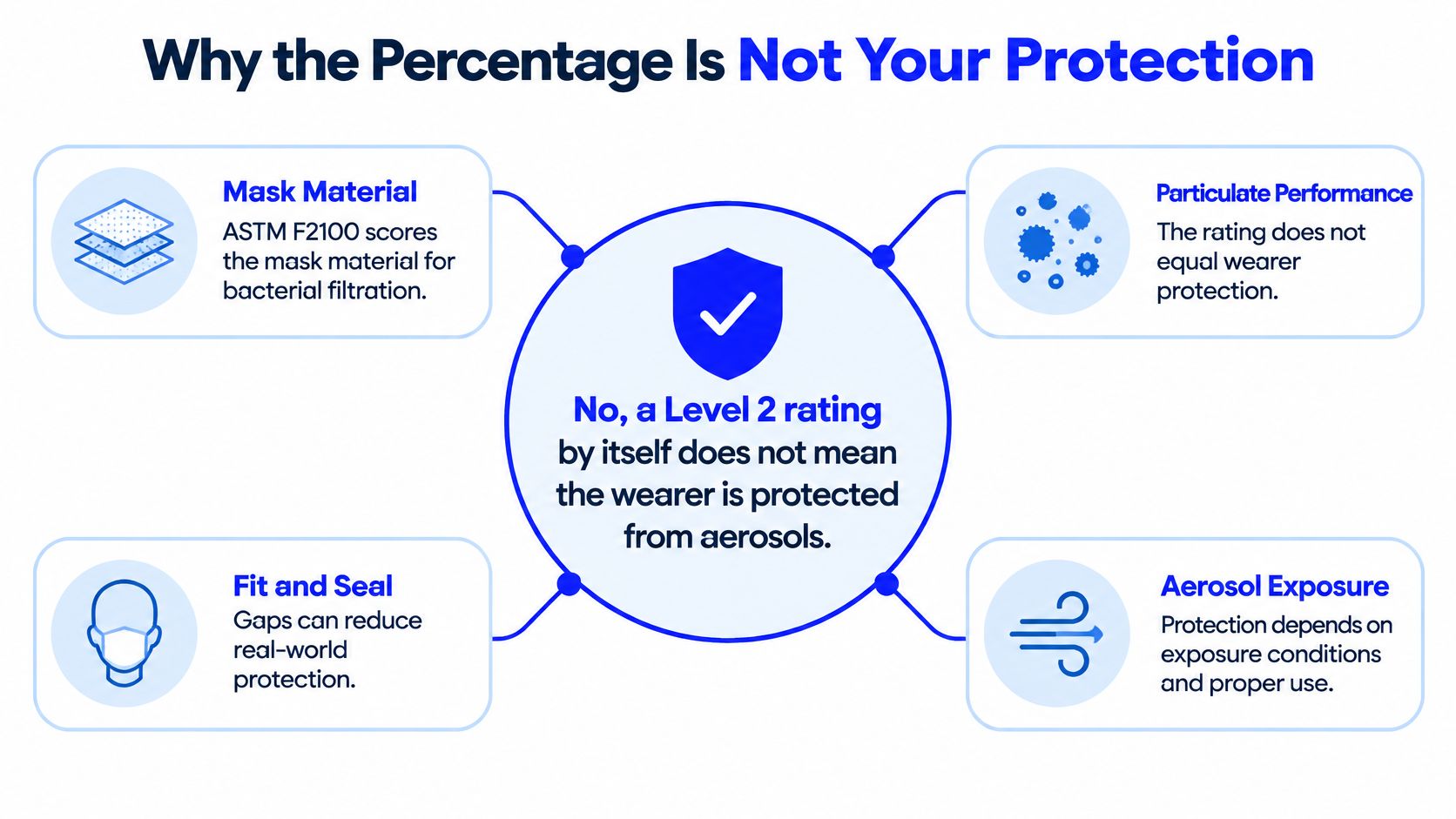
No, a Level 2 rating by itself doesn't establish protection from aerosols. A filtration result concerns air that passes through the tested panel. It doesn't account for air taking an easier route around the perimeter.
The ASTM F2100-20 specification excludes inward and outward leakage around the mask edges from its material-performance assessment. Face shape therefore remains a separate selection issue, especially when the chin or cheek contour leaves an opening despite an apparently well-positioned nose strip.
A door screen offers a useful comparison. Fine mesh can't control the air passing through an open gap beside the frame. A high-performing mask panel has the same limitation when the fit leaves a bypass route.
A practical fit check
The CDC mask-fit guidance recommends complete nose-and-mouth coverage, snug sides without gaps, an edge-leakage check, and handling by the attachments rather than the mask surface. A practical sequence is:
- Cover the nose and mouth completely. The mask shouldn't sit beneath the nose.
- Seat the panel against the cheeks. Visible side openings call for adjustment or a different size or model.
- Cup hands around the outer edges. Air escaping toward the eyes or sides indicates a fit problem.
- Handle the loops or ties. Avoid grasping the outer panel during adjustment or removal.
Talking and head movement can change the fit, so the check should reflect the movements needed for the task. Repeatedly pulling the panel back into place isn't a satisfactory substitute for a product that stays positioned.
Better fit routes more air through the material, but it doesn't turn a procedure mask into a fit-tested respirator. EN 14683 Type II and Type IIR labels aren't seal certificates either. Comparing medical-mask standards doesn't remove the need to assess leakage and respiratory hazards separately.
Choose the Level by Exposure
A Level 2 rating describes how mask material performs in specified tests. It does not account for face shape, gaps at the edges, or aerosol protection. Choose a barrier for the task's fluid exposure, then assess inhalation hazards separately.
The FDA guide to masks and respirators explains that surgical masks are Class II medical devices evaluated for fluid-barrier performance, filtration, flammability, and biocompatibility. Their loose fit does not provide reliable protection from aerosolized particles.
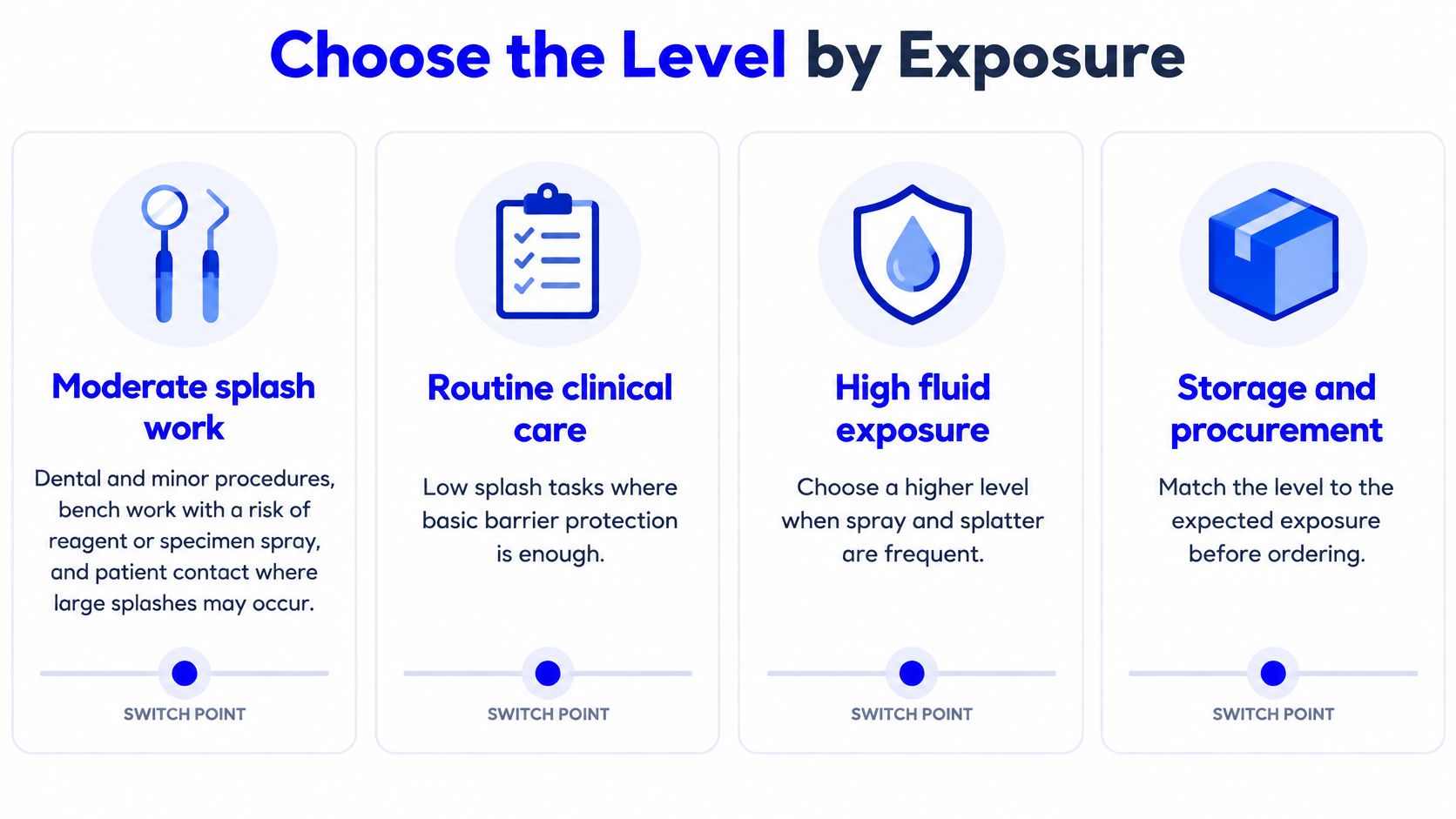
Match the choice to the switch point
- Moderate splash work: Level 2 can suit dental or minor procedures and specimen handling when the risk assessment calls for a medical fluid barrier. Reagent spray also needs a chemical-compatibility assessment. A synthetic-blood test does not establish resistance to every chemical.
- High-pressure fluid exposure: Trauma work, some surgeries, or a line capable of spurting fluid calls for assessment of a higher fluid-barrier category. Do not assume a moderate barrier suits a more demanding task.
- Low-fluid examinations: Level 1 may be suitable when the assessment calls for a lighter medical barrier and does not identify a need for higher splash resistance.
- Airborne hazards: Airborne pathogens, aerosol-generating procedures, and inhaled-particle risks require an appropriately selected, fit-tested N95, FFP2, or higher respirator under the applicable protection program.
Keep laboratory controls in place
A procedure mask does not replace a biosafety cabinet, eye protection, or respiratory protection required by the task assessment. The research laboratory safety planning guide can support that broader review.
Food-service areas may have separate PPE and storage procedures. See kitchen PPE standards and storage tips, and assess biological or chemical laboratory work on its own terms.
Practical rule: Select the barrier for the fluid and the respirator for the inhalation hazard.
Check that the mask covers the nose, mouth, and chin and stays in place during the task. A good fit reduces gaps, but does not make a procedure mask a respirator.
What to Demand on the Label and the File
A bare Level 2 claim isn't a complete purchasing specification. Procurement needs a file that identifies the standard edition, the tested mask, and the evidence supporting each advertised property.
The FDA clearance record K211295 provides a historical benchmark: its 2021 documentation specifies at least 98% BFE under ASTM F2101, at least 98% PFE under ASTM F2299, 120 mmHg synthetic-blood resistance, Class 1 flammability under 16 CFR Part 1610, and differential pressure below 6.0 mm H2O/cm² under its cited ASTM F2100-19 framework. The record reports 32 of 32 samples passing the fluid challenge; comparison documentation also records filtration of at least 99% and differential pressure below 5.0 mm H2O/cm².
Documents to request for a Level 2 mask
The following acceptance checks translate that clearance example into a working document review, rather than imposing its historical breathability limit on every edition.
| Check | Proof to request | Accept when |
|---|---|---|
| Standard edition | ASTM F2100 edition on the report | Edition is named, not just Level 2 |
| Finished mask | Test documentation for the sold configuration | Evidence isn't limited to filter media |
| Bacterial filtration | ASTM F2101 result | Meets the Level 2 minimum |
| Submicron particles | ASTM F2299 result | Meets the Level 2 minimum |
| Fluid barrier | Synthetic-blood test report at the claimed pressure | Samples meet the applicable acceptance criteria |
| Breathability | Differential pressure with units | Result is within the cited edition's limit |
| Flame | 16 CFR Part 1610 report | Required flammability class is documented |
| Device file | Applicable 510(k) or equivalent documentation | Identifier matches the purchased model |
The file should identify the sold configuration, including the attachment style and nose piece. A report for filter media alone doesn't establish that the marketed finished product is the evaluated mask.
Resolve mismatches before release
The most useful review compares documents side by side. The model on the carton, supplier quotation, laboratory report, and regulatory record should match. When a supplier offers an alternative model, procurement should repeat the comparison rather than treating the substitution as administrative.
These checks help expose incomplete claims:
- Method mismatch: A filtration percentage appears without identifying whether it came from bacterial or particulate testing.
- Edition mismatch: The supplier quotes a limit from one framework but submits a report using another without explanation.
- Product mismatch: The regulatory identifier belongs to a different model or manufacturer.
- Category mismatch: Respirator imagery appears on a procedure mask without separate evidence supporting that claim.
EU and UK buyers shouldn't translate EN 14683 Type II or Type IIR into ASTM Level 2. If a product claims both, its file should support both labels independently.
The research labware certification details provide a related reference for organizing product-documentation checks. The purchasing principle remains specific: the evidence must belong to the product being ordered, not merely to a similar material.
Purchase Order and Storage
A useful purchase order turns a marketing description into a verifiable deliverable. It should make missing evidence grounds for holding the order, not a problem discovered after the masks reach the bench.
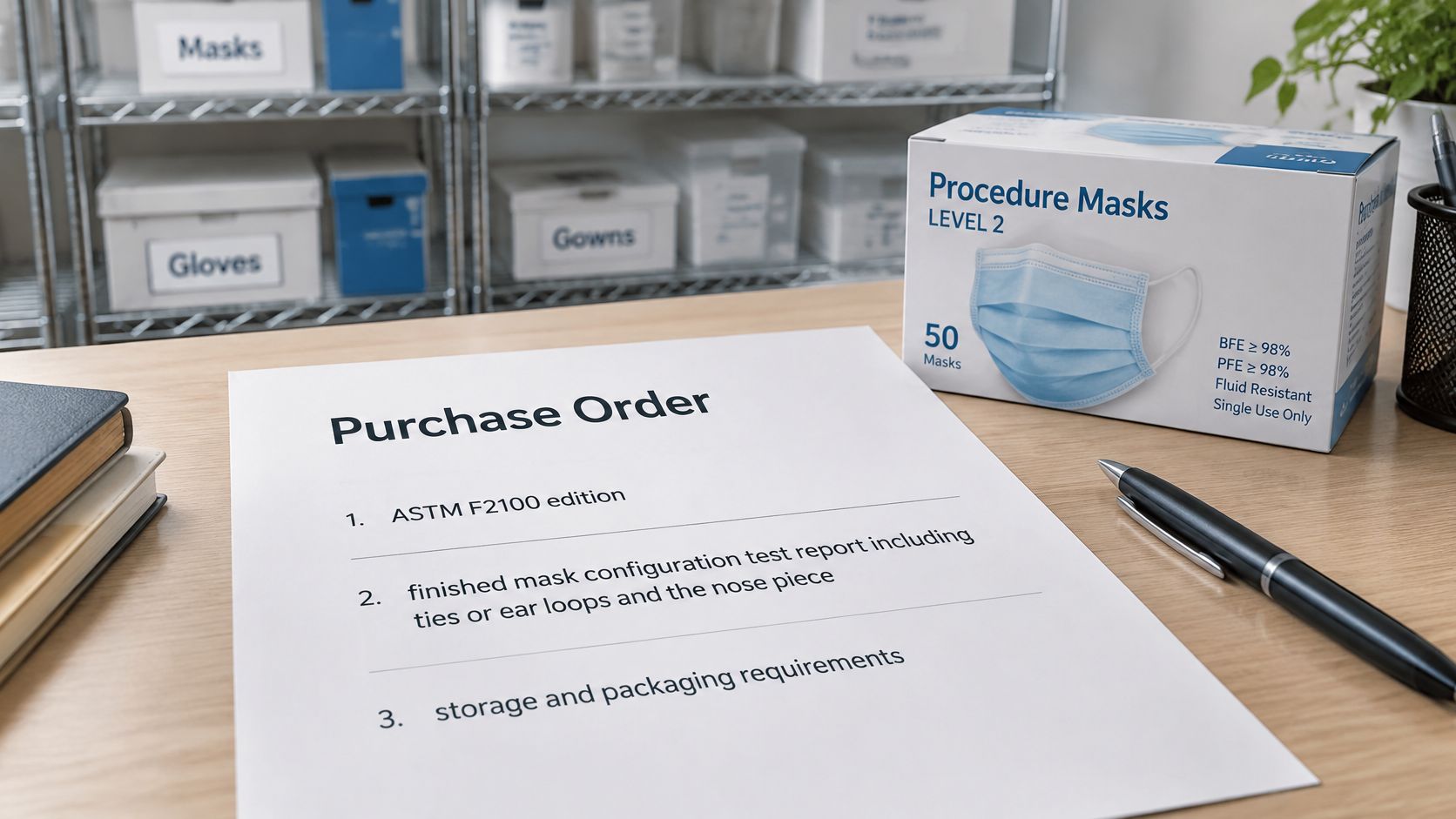
Purchase-order lines
- Standard identification: The supplier must state the ASTM F2100 edition supporting the classification.
- Finished-product evidence: The test file must identify the sold mask configuration, including ties or ear loops and the nose piece.
- Regulatory identity: The applicable device-file identifier must match the manufacturer and model purchased.
A lot without that documentation should remain on hold. A brochure-only claim or unexplained respirator symbol warrants clarification before acceptance, not an assumption that the product meets the intended specification.
Storage and release to use
Masks should stay clean, dry, and protected from crushing. Staff shouldn't judge a soiled or damaged mask solely by its original certificate, and a mask that no longer stays properly positioned should be replaced.
The research consumables checklist from Herbilabs can help purchasing teams incorporate documentation and receipt checks into routine stock management. Before the next order is released, the buyer should specify Level 2 for the required fluid barrier and specify appropriate respiratory protection whenever the hazard is inhaled air bypassing the mask edges.
Herbilabs offers research-use-only sterile diluents and related labware, supported by quality documentation and practical laboratory education. Teams reviewing mask specifications alongside broader bench supplies can visit Herbilabs to explore research products and documentation-focused procurement resources.