Private Label, White Label, Wholesale partnerships available - EU, USA and UK - Free shipping from €75
Laboratory Product Certification Explained for Lab Professionals
Discover how to explain laboratory product certification and its crucial role in ensuring quality and compliance for lab professionals. Learn more!
TL;DR:
- Laboratory product certification under ISO/IEC 17025 confirms a lab’s competence and operational consistency for regulatory acceptance.
- Maintaining accreditation requires continuous effort, including strict calibration, proficiency testing, and scope management to avoid data rejection.
Laboratory product certification is the formal process by which testing and calibration laboratories demonstrate competence, impartiality, and operational consistency under internationally recognized standards, most notably ISO/IEC 17025. To explain laboratory product certification accurately, it must be understood not as a marketing credential but as technical proof of competence that regulatory bodies, manufacturers, and supply chain partners rely on to accept test data. Laboratories that achieve accreditation under frameworks such as ISO/IEC 17025, CE marking requirements, or FDA-aligned Good Manufacturing Practices produce results that withstand regulatory scrutiny. Research confirms that accredited labs score significantly higher on diagnostic accuracy ratings (4.24 vs. 3.61, p=0.001) compared to non-accredited counterparts. That difference is not marginal. It represents the gap between data that advances a regulatory submission and data that gets rejected.
What are the main international standards for laboratory product certification?
Laboratory product certification operates within a defined hierarchy of international and regional standards, each with a distinct scope and applicability. Understanding which standard governs a given testing context is the first decision a laboratory professional or quality assurance specialist must make before initiating any certification process.

ISO/IEC 17025 is the globally recognized benchmark for testing and calibration laboratories. It specifies requirements for competence, impartiality, and consistent operation, and third-party accreditation under this standard is the mechanism by which laboratories prove they produce valid results. Accreditation bodies such as UKAS (United Kingdom Accreditation Service), A2LA (American Association for Laboratory Accreditation), and DAkkS (Deutsche Akkreditierungsstelle) assess laboratories against ISO/IEC 17025 and issue formal accreditation certificates.
Beyond ISO/IEC 17025, several other frameworks govern product certification in labs depending on the product category and target market.
| Standard / Framework | Scope | Primary Applicability |
|---|---|---|
| ISO/IEC 17025 | Testing and calibration laboratory competence | All testing labs seeking regulatory acceptance |
| CE Marking (EU) | Product conformity with EU safety, health, and environmental requirements | Products sold within the European Economic Area |
| FDA 21 CFR Part 58 (GLP) | Good Laboratory Practice for nonclinical safety studies | Pharmaceutical and chemical product testing for FDA submissions |
| UL Certification | Safety testing and product certification for North American markets | Electrical, electronic, and consumer products |
| ISO 13485 | Quality management for medical device manufacturers | Medical device testing and production labs |
CE marking, for example, requires that specific product categories be tested by a Notified Body, which itself must hold accreditation under ISO/IEC 17025 or an equivalent standard. FDA’s Good Laboratory Practice regulations under 21 CFR Part 58 impose parallel requirements for nonclinical laboratory studies submitted in support of research or marketing permits. The standards are not interchangeable; each governs a specific regulatory pathway.
Pro Tip: Before selecting a contract laboratory, verify that its accreditation scope explicitly covers the test methods and product categories relevant to your submission. A laboratory accredited under ISO/IEC 17025 for chemical analysis is not automatically qualified to conduct microbiological testing under that same certificate.
How does the ISO/IEC 17025 accreditation process work?
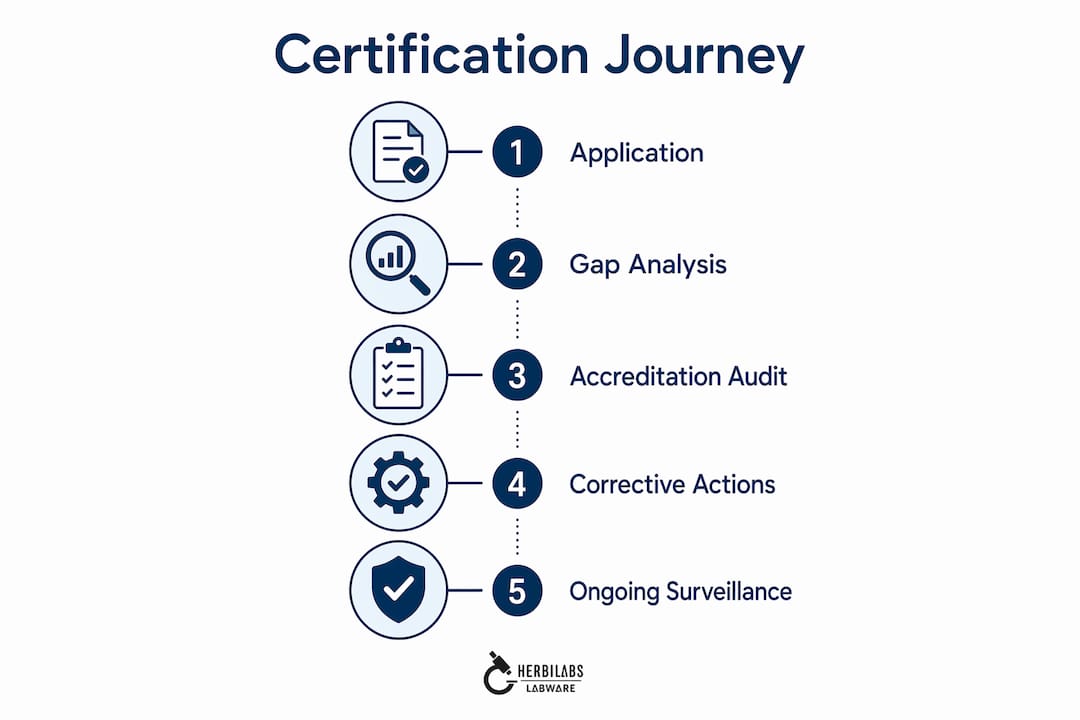
The accreditation process for ISO/IEC 17025 is structured, sequential, and more resource-intensive than most laboratories initially anticipate. For medium-sized laboratories, the typical lead time is 12 to 24 months to implement quality systems, validate methods, and train staff to the required standard. That timeline reflects the depth of organizational change required, not merely paperwork.
The process follows a defined sequence:
-
Gap analysis and readiness assessment. The laboratory conducts an internal review against ISO/IEC 17025 requirements to identify deficiencies in documentation, equipment calibration records, method validation data, and personnel competence files. This step defines the scope of work before any formal application.
-
Quality management system development. The laboratory documents its quality manual, standard operating procedures, method validation protocols, and personnel training records. Every procedure that affects test result validity must be documented and controlled.
-
Scope of accreditation definition. The laboratory defines exactly which test methods, measurement ranges, and matrices it intends to have accredited. This document, known as the Schedule of Accreditation, is legally binding. Common errors arise from assuming full coverage when the scope is actually narrow and method-specific.
-
Application submission to the accreditation body. The laboratory submits its application, quality documentation, and proposed scope to its national accreditation body. The body conducts a document review before scheduling an on-site assessment.
-
On-site assessment. Trained assessors visit the laboratory to evaluate physical facilities, equipment calibration status, staff competence through witnessed testing, and the practical implementation of the quality management system. Findings are classified as major or minor nonconformities.
-
Corrective action and resolution. The laboratory addresses all nonconformities identified during the assessment and submits objective evidence of correction to the accreditation body for review.
-
Accreditation decision and certificate issuance. Upon satisfactory resolution of all findings, the accreditation body issues the certificate and the Schedule of Accreditation. The certificate is valid for a defined period, typically four years, subject to annual surveillance.
Pro Tip: Laboratories that engage an experienced quality consultant during the gap analysis phase consistently reduce their time to accreditation. The most common documentation gap is incomplete method validation records, particularly for in-house or modified standard methods.
What ongoing requirements must certified laboratories meet?
Accreditation is not a one-time event. The ongoing costs of accreditation include calibration cycles, proficiency testing participation, and the administrative burden of audit preparation, all of which laboratories routinely underestimate when calculating the true cost of certification.
The continuous obligations fall into several categories:
- Annual surveillance assessments. Accreditation bodies conduct annual or biennial on-site surveillance visits to verify that the laboratory continues to operate within its accredited scope and that the quality management system remains effective.
- Equipment calibration. All measurement equipment must be calibrated at defined intervals by traceable calibration services. Calibration records must be current and available for review at all times.
- Proficiency testing participation. Laboratories must participate in external proficiency testing or interlaboratory comparison programs relevant to their accredited test methods. Poor performance in proficiency testing can trigger a scope suspension.
- Personnel competence records. Every analyst performing accredited testing must have documented evidence of training, qualification, and ongoing competency assessment. Staff turnover creates compliance risk if onboarding procedures are not formalized.
- Internal audits and management reviews. ISO/IEC 17025 requires scheduled internal audits and formal management reviews to identify systemic issues before they become nonconformities during external assessment.
Accreditation demands a sustained quality culture, not periodic compliance activity. Laboratories that treat surveillance audits as isolated events rather than continuous practice consistently accumulate nonconformities that erode both their accreditation status and client confidence.
Scope drift is a specific risk that quality managers must monitor. When a laboratory introduces new test methods, modifies existing procedures, or changes instrumentation without notifying the accreditation body, those activities fall outside the accredited scope. Results generated under out-of-scope conditions are not covered by the accreditation certificate, which can invalidate data submitted to regulatory agencies. Maintaining effective quality control practices within the laboratory is the operational foundation that prevents scope drift from occurring.
How does lab certification affect regulatory submissions and market access?
Laboratory product certification has direct, measurable consequences for regulatory submission outcomes and product market access timelines. Regulatory bodies including the FDA, Health Canada, and EU competent authorities frequently reject test data from non-accredited laboratories, requiring costly re-testing that delays product approvals by months or years.
The EU Cosmetics Regulation (EC) No 1223/2009 requires that safety assessments reference data from qualified testing sources, and in practice, this means accredited laboratories. The FDA’s GMP framework under 21 CFR Parts 210 and 211 requires that contract laboratories used for pharmaceutical product testing meet standards equivalent to those of the manufacturer’s own quality system, which in most cases means ISO/IEC 17025 accreditation or equivalent. For medical devices, selecting an ISO 17025 accredited laboratory is a strategic regulatory decision that directly affects submission speed and final market availability.
The supply chain implications are equally significant. Contract research organizations, pharmaceutical manufacturers, and device companies increasingly require accreditation certificates as a prerequisite for laboratory vendor qualification. A laboratory without current accreditation documentation is disqualified from consideration regardless of its technical capabilities. This makes understanding GMP compliance frameworks a parallel requirement for laboratories serving regulated industries.
Researchers and product developers who engage certified laboratories early in the development process gain a measurable advantage. Early involvement of an accredited contract laboratory allows method development and validation to occur within the accredited framework, meaning the data generated is submission-ready from the outset. Laboratories that are brought in late, after non-accredited preliminary testing has already been conducted, often require complete method re-validation under accredited conditions, which duplicates both cost and time.
Pro Tip: When evaluating a contract laboratory for regulatory work, request the current Schedule of Accreditation directly from the accreditation body’s public register, not from the laboratory itself. Public registers maintained by UKAS, A2LA, and equivalent bodies reflect the current accredited scope in real time and cannot be altered by the laboratory.
Key takeaways
Laboratory product certification under ISO/IEC 17025 is a continuous, scope-specific commitment that determines whether test data is accepted by regulatory authorities, not a credential that can be assumed or approximated.
| Point | Details |
|---|---|
| Certification is scope-specific | The Schedule of Accreditation defines exactly which methods are covered; never assume broader coverage. |
| Timeline is 12 to 24 months | Medium-sized laboratories require up to two years to implement quality systems and achieve initial accreditation. |
| Ongoing obligations are substantial | Calibration, proficiency testing, and annual surveillance are continuous requirements, not optional maintenance. |
| Regulatory rejection is the cost of non-compliance | FDA, EU, and Health Canada authorities reject data from non-accredited labs, triggering costly re-testing. |
| Early engagement reduces risk | Involving a certified laboratory at the development stage produces submission-ready data from the start. |
Why accreditation scope is the detail most professionals overlook
From my experience working closely with laboratory quality systems and the researchers who depend on them, the single most consequential mistake I observe is not the failure to pursue accreditation. It is the failure to read the Schedule of Accreditation carefully before relying on a laboratory’s results. A laboratory can hold a valid ISO/IEC 17025 certificate and still be entirely unqualified to perform the specific test method a researcher needs. That distinction is not a technicality. It is the difference between data that advances a submission and data that gets rejected at the agency level.
I have also seen organizations treat accreditation as a procurement checkbox rather than a technical evaluation. They confirm that a certificate exists and move on. The certificate number means nothing without verifying that the scope covers the analyte, the matrix, the concentration range, and the specific standard method required. Accreditation bodies publish their registers publicly for exactly this reason, and yet the public register is rarely consulted.
The other underestimated reality is the operational cost of maintaining accreditation once it is achieved. The initial certification effort is visible and budgeted. The annual calibration cycles, proficiency testing fees, internal audit hours, and staff competency documentation are less visible but cumulatively more expensive. Laboratories that do not build these costs into their operating budgets find themselves cutting corners on maintenance activities, which is precisely how nonconformities accumulate and accreditation lapses occur. A lapsed certificate does not just affect the laboratory. It invalidates the data generated during the lapse period for any client relying on that accreditation for regulatory purposes.
The strategic value of accreditation, when maintained rigorously, is substantial. Accredited laboratories command higher contract rates, qualify for regulated industry work that non-accredited competitors cannot access, and build a defensible quality record that supports long-term client relationships. That competitive position is earned through consistent operational discipline, not through the initial certificate.
— Ragnar
Support your certified lab operations with Herbilabs
Maintaining accreditation standards requires more than documented procedures and trained staff. The reagents and reconstitution solutions used in accredited testing must meet the same purity and consistency standards that the quality management system demands. Herbilabs supplies research-grade bacteriostatic water and sterile reconstitution solutions manufactured under strict purity controls, specifically designed to support demanding laboratory environments where product reliability is non-negotiable. For laboratories conducting peptide research, method validation, or reconstitution-dependent assays, the quality of the diluent directly affects result validity. Explore Herbilabs’ high-purity reconstitution solutions to source reagents that align with your accreditation requirements and quality standards.
FAQ
What does laboratory product certification mean?
Laboratory product certification is the formal accreditation process by which a testing or calibration laboratory demonstrates competence and operational consistency under internationally recognized standards such as ISO/IEC 17025. It confirms that the laboratory produces valid, reliable results accepted by regulatory authorities and industry clients.
How long does ISO/IEC 17025 accreditation take?
For medium-sized laboratories, ISO/IEC 17025 accreditation typically requires 12 to 24 months to complete, covering quality system development, method validation, staff training, and the formal on-site assessment process.
Why do regulatory agencies require accredited laboratory data?
Regulatory bodies including the FDA and EU competent authorities require accredited laboratory data because non-accredited test results lack the verified impartiality and methodological consistency needed to support product safety and efficacy claims. Submissions based on non-accredited data face rejection and mandatory re-testing.
What is the scope of accreditation and why does it matter?
The scope of accreditation is a legally binding document specifying exactly which test methods, matrices, and measurement ranges a laboratory is qualified to perform under its certificate. Assuming broader coverage than the scope defines is the most frequent cause of compliance failures and regulatory data rejection.
How often must accredited laboratories undergo reassessment?
Accredited laboratories undergo annual surveillance assessments conducted by their accreditation body, with a full reassessment typically required every four years. Participation in proficiency testing and maintenance of calibration records are continuous requirements between formal assessments.