Private Label, White Label, Wholesale partnerships available - EU, USA and UK - Free shipping from €75

Is Sodium Chloride a Mixture or a Compound Explained
Pure sodium chloride is not a mixture. It is an ionic compound with the fixed formula NaCl, which means sodium and chloride are present in a strict 1:1 ratio, with pure sodium chloride made of 39.34% sodium and 60.66% chlorine by mass. But everyday table salt and saline solutions are often mixtures, so the answer changes depending on what sample is being discussed.
That's why this question trips up so many people. A student hears “salt,” a cook thinks of the shaker on the table, and a lab beginner may think of salt dissolved in water. Those are related ideas, but they are not the same thing in chemistry.
The confusion usually comes from three lookalike cases:
- Pure NaCl crystals
- Commercial salt products with additives or minerals
- Saline, where sodium chloride is dissolved in water
Those three can all be called “salt” in casual speech. Chemistry doesn't work on casual speech. It works on what is in the sample.
A precise answer matters in class, in labeling, and in lab work. A bottle containing a single chemical substance is described differently from a vial containing a prepared solution. That distinction shows up in research settings too, especially when people compare dry sodium chloride with prepared diluents and saline products.
Table of Contents
- Introduction Why This Question Comes Up So Often
- What Makes a Mixture Different From a Compound
- Why Pure Sodium Chloride Is an Ionic Compound
- When Salt Is Actually a Mixture
- Simple Examples That Show the Difference in Practice
- Key Takeaways and How to Use This Knowledge Confidently
Introduction Why This Question Comes Up So Often
A lot of people ask is sodium chloride a mixture because the word “salt” hides more than one idea. In everyday language, “salt” can mean the white crystals used in cooking, the salt dissolved in saline, or a packaged product with added ingredients. Chemistry separates those cases.
One word, three different samples
When a chemistry teacher says sodium chloride, that usually means a pure substance with a defined chemical identity. When a grocery label says table salt, it may describe a consumer product that includes anti-caking agents or other additives. When a lab label says saline, it refers to sodium chloride mixed with water.
Practical rule: Don't answer the question from the name alone. Answer it from the sample in front of you.
That small shift solves most of the problem. It also explains why two people can sound like they disagree when both are partly right.
Why students mix up salt and saline
Many learners carry over a simple idea: if something contains more than one thing, it must be a mixture. That sounds reasonable until chemistry introduces compounds, where elements are chemically bonded into a new substance.
Salt water is a mixture because the water and dissolved sodium chloride are still present together in a physical combination. Pure sodium chloride is different. It has its own chemical identity, formula, and structure.
In research and RUO settings, that distinction matters when reading labels on solids, sterile solutions, or reconstitution materials. A chemist writing up NaCl powder, a saline preparation, and an additive-containing salt product shouldn't classify them the same way.
What Makes a Mixture Different From a Compound
The cleanest way to answer this topic is to separate mixture from compound first. Once that foundation is clear, sodium chloride becomes much easier to classify.
A simple picture that works
A mixture is like trail mix. The parts are put together physically, and the proportions can change. One handful may have more raisins, another may have more nuts.
A compound is more like a substance formed by chemical bonding. In classroom analogies, people sometimes compare this to a cake because the ingredients no longer behave as separate parts in the same simple way. Chemistry goes even further than that analogy. In a true compound, the atoms combine in a fixed relationship and create a distinct substance with its own formula.
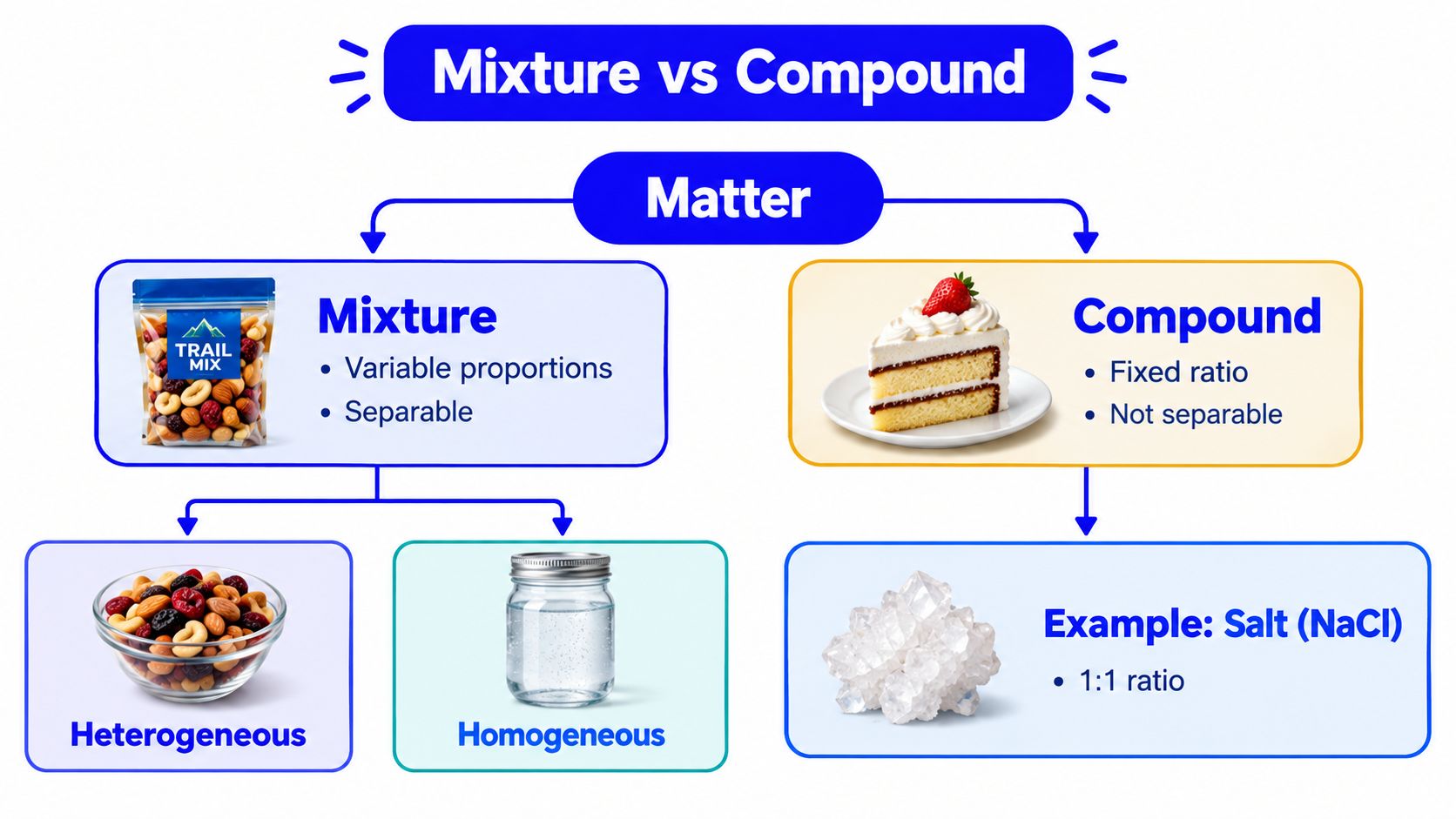
A mixture has variable composition. A compound has a fixed chemical identity.
Three fast checks
These checks help students decide what they're looking at.
- Variable composition: A mixture can be made in different proportions. A compound has a set ratio built into its formula.
- Physical separation: The parts of a mixture can often be separated by physical means. A dissolved solid may be recovered by evaporation, for example.
- No single formula: A mixture doesn't have one chemical formula that defines the whole sample. A compound does.
Those checks aren't just exam tricks. They reflect how chemists describe matter in the lab.
Homogeneous doesn't always mean compound
This is another common trap. A sample can look perfectly uniform and still be a mixture.
For example, salt dissolved in water looks the same throughout. That makes it a homogeneous mixture, not a compound. The visual uniformity can fool people into thinking there is only one substance present.
A useful contrast is:
| Type | Example | What matters |
|---|---|---|
| Heterogeneous mixture | Trail mix | Parts are visibly different |
| Homogeneous mixture | Salt water | Looks uniform, but contains more than one substance |
| Compound | Pure sodium chloride | Has one fixed chemical formula |
So the visual test isn't enough. Chemistry asks a sharper question. Are the components merely together, or are they chemically bonded into one defined substance?
Why Pure Sodium Chloride Is an Ionic Compound
Pure sodium chloride passes every test for a compound. It is not a random blend of sodium and chlorine. It is a chemically defined substance with a fixed formula and an ordered structure.
The fixed formula is the biggest clue
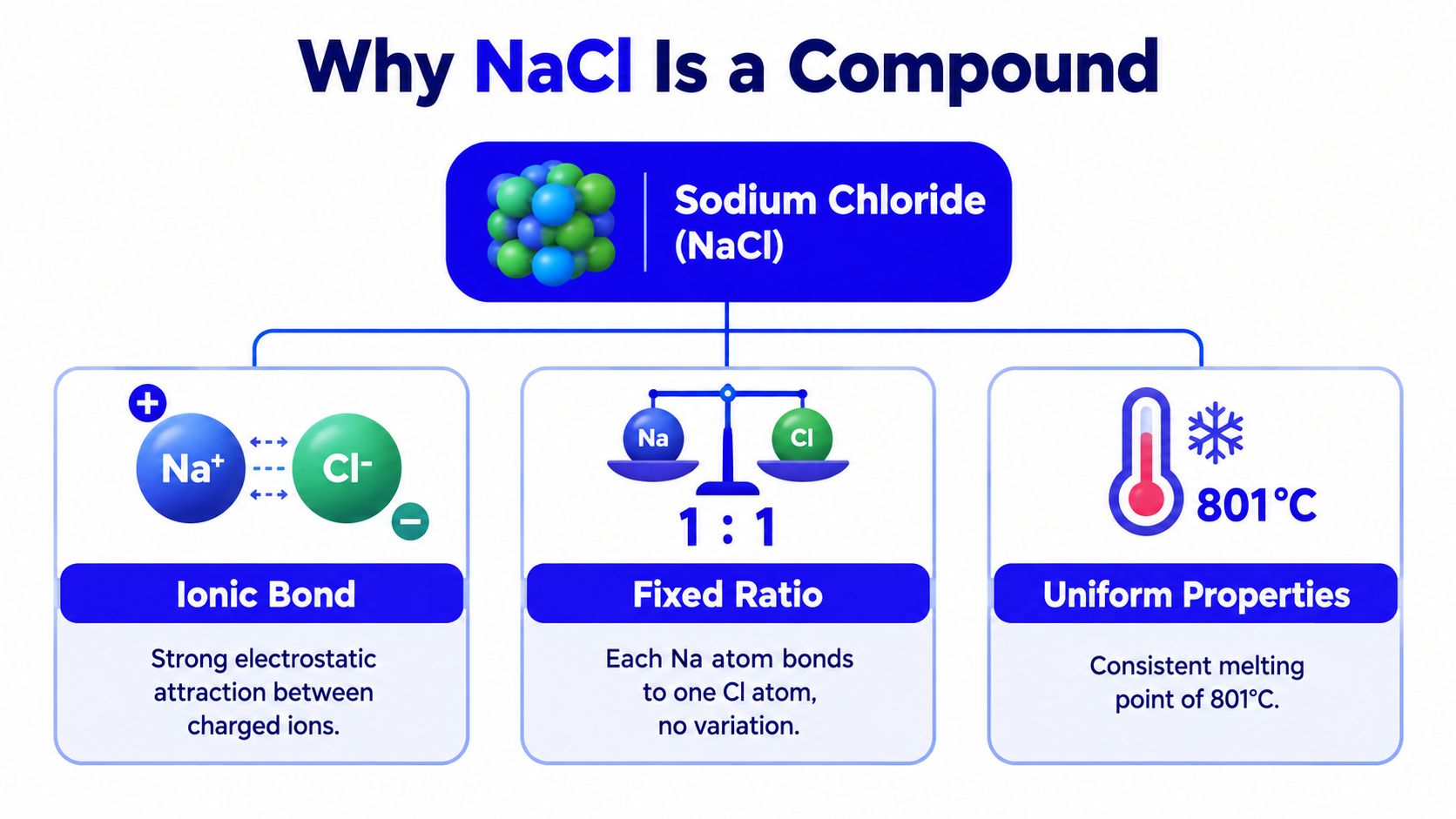
PubChem lists sodium chloride as an ionic compound with the fixed formula NaCl, meaning sodium and chloride occur in a strict 1:1 ratio, and pure sodium chloride contains 39.34% sodium and 60.66% chlorine by mass according to PubChem's sodium chloride record. A mixture wouldn't have that kind of invariant composition.
That fixed composition is the key idea. If the ratio could drift from sample to sample while still being “the same substance,” it would behave like a mixture. Pure sodium chloride doesn't do that.
Bonding matters, not just ingredients
Sodium chloride is an ionic compound. In plain language, sodium and chlorine don't just sit beside each other like cereal in a bowl. They form oppositely charged ions that are held together by electrostatic attraction in a stable ionic structure.
That's why the name of the ingredients alone doesn't settle the question. A mixture of two substances remains a physical combination. Sodium chloride becomes a new chemical substance.
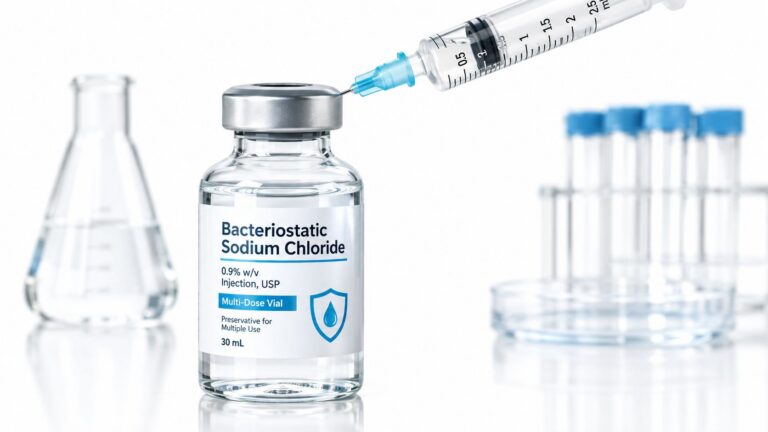
For readers comparing dry NaCl with prepared lab solutions, products such as 0.9% sodium chloride injection USP belong to a different category because they are solutions rather than pure crystalline sodium chloride.
A quick visual refresher helps here:
Structure gives more proof
NIST lists sodium chloride with molecular formula ClNa and a molecular weight of 58.443 g/mol in the NIST Chemistry WebBook entry for sodium chloride. That single formula and defined molecular weight are exactly what chemists expect from a compound, not a mixture.
At the crystal level, sodium chloride forms a highly ordered cubic lattice in space group Fm3m with a unit-cell edge of about 5.64 Å and a nearest-neighbor Na–Cl distance of about 2.3608 Å, as described in this NIST solid-state record. Randomly mixed substances don't create that kind of repeating ionic arrangement.
Pure NaCl behaves like one chemically defined material, not a physical blend of parts.
History helped settle the chemistry
A useful historical milestone came in 1807, when Sir Humphry Davy first isolated sodium by electrolysis. The same historical account notes earlier work in 1736 by Henri-Louis Duhamel de Monceau and explains how these findings helped show that common salt was built from chemically bonded elements, with sodium chloride recognized as a substance of about 58.44 g/mol in a 1:1 structure, as summarized by the University of Bristol chemistry history page on sodium chloride.
That history matters because it marks the shift from “familiar household material” to “defined chemical compound.”
When Salt Is Actually a Mixture
The answer flips. Pure sodium chloride is a compound, but many things called “salt” in ordinary life are mixtures.
The word salt is doing too much work
Wikipedia's sodium chloride overview makes an important distinction: pure NaCl has a fixed 1:1 sodium-to-chloride ratio, while table salt and sea salt are often mixtures because they can include anti-caking agents, minerals, and other additives, as noted in Wikipedia's sodium chloride article.
That means the scientific answer depends on the sample label, not the casual name.
Pure Sodium Chloride vs Common Salt Products
| Sample | Composition | Mixture or Compound | Why |
|---|---|---|---|
| Pure sodium chloride crystals | Only NaCl | Compound | One defined chemical substance |
| Table salt | Mostly NaCl plus additives | Mixture | Contains more than one substance |
| Sea salt | NaCl plus other minerals | Mixture | Natural mineral content varies |
| Himalayan salt | NaCl plus mineral impurities | Mixture | Not chemically uniform as pure NaCl |
| Saline solution | NaCl dissolved in water | Mixture | Two substances physically combined |
Saline is the biggest source of confusion
People often hear “sodium chloride solution” and mentally collapse it into “sodium chloride.” Chemistry doesn't.
A saline preparation contains sodium chloride and water together in a homogeneous mixture. It may look uniform, but it still contains more than one substance. If the water is removed, sodium chloride crystals can be recovered. That's a strong clue that the original sample was a mixture, not a pure compound.
The same logic helps when comparing saline with bacteriostatic water. Both are prepared liquid systems used in lab or handling contexts, and both need to be identified by their full composition rather than by one ingredient name.
If a label says “solution,” “with additives,” or “contains minerals,” the sample should be checked carefully before calling it a compound.
A lab note should match the actual material
In lab practice, this distinction matters because documentation should describe the material used. Writing “sodium chloride” for a bottle of pure NaCl solid is appropriate. Writing the same phrase for a saline solution without noting the water leaves out part of the composition.
That seems minor until someone tries to repeat the work. In teaching labs and RUO workflows, precise naming prevents confusion during preparation, storage, and interpretation.
Simple Examples That Show the Difference in Practice
Small examples make this easier than memorizing definitions.
Example one dissolving crystals in water
A sample of pure sodium chloride crystals starts as a compound. Once those crystals are dissolved in water, the result is a mixture because the sample now contains water and dissolved sodium chloride together.
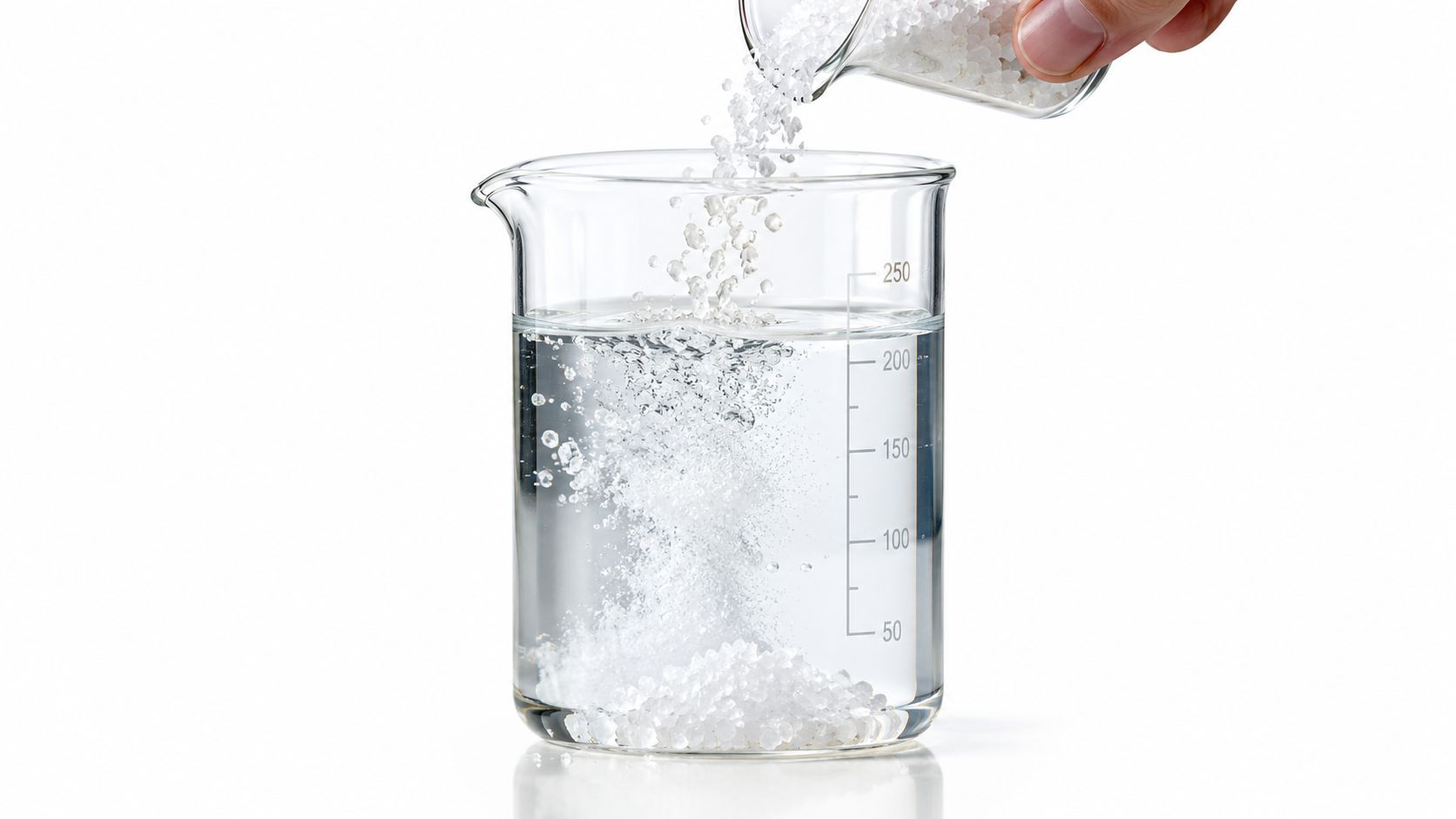
The important point is that the identity of pure NaCl as a compound doesn't vanish. What changes is the classification of the whole sample after water is added.
Takeaway: NaCl alone is a compound. NaCl plus water is a mixture.
Example two evaporating a saline sample
If a saline solution is left to evaporate, water leaves and sodium chloride crystals can remain behind. That recovery shows that the ingredients were physically combined in solution rather than turned into one brand-new compound.
This is a practical classroom clue because physical separation is one of the hallmark signs of a mixture.
A sample can contain a compound and still be a mixture overall.
Example three checking the label
A container labeled “sea salt,” “iodized salt,” or “anti-caking agent added” should raise a flag. That wording suggests the product contains more than pure sodium chloride.
A related consumer-facing example appears in sodium chloride soap explained, where sodium chloride may appear as one ingredient inside a broader formulation rather than as the whole substance.
Takeaway: Ingredient lists often reveal when “salt” means a product mixture instead of pure NaCl.
Example four RUO diluents and defined solutions
In RUO work, researchers often need to know whether a vial holds a pure substance or a prepared solution. A sterile diluent is described by its full contents because the whole preparation matters in use, storage, and records.
That's especially important when reconstituting lyophilized materials. A defined solution isn't a random blend, but it is still classified as a mixture if more than one substance is present. Good lab notes keep that difference visible.
Key Takeaways and How to Use This Knowledge Confidently
The shortest correct answer is simple. Pure sodium chloride is a compound, not a mixture. But the moment the discussion shifts to commercial salt products or saline, the answer may change.
A quick decision checklist
When someone asks is sodium chloride a mixture, the safest approach is to check these points:
- Ask what sample is meant: Pure NaCl, table salt, sea salt, or saline are not the same thing.
- Look for a formula: A single defined formula points toward a compound.
- Read the full label: Additives, minerals, or water usually mean the total sample is a mixture.
- Think about separation: If the parts can be separated by physical means, that supports a mixture classification.
Common mistakes worth avoiding
Students often make two opposite errors. Some call everything named “salt” a compound. Others call anything made from more than one element a mixture.
Both shortcuts fail. Chemistry classifies matter by how the substances are combined, not by everyday naming habits.
In exam answers and lab notes, the best wording is usually sample-specific: pure sodium chloride is a compound, while table salt products and saline are mixtures.
That phrasing is careful, accurate, and easy to defend.
A reader who keeps just one idea from this topic should keep this one: the answer depends on whether the sample is chemically defined NaCl or a product or solution containing NaCl plus something else. Once that distinction is clear, the question stops feeling tricky.
Herbilabs offers RUO-focused labware and sterile diluent information that can help researchers keep these distinctions straight when working with solutions, reconstitution, and sodium chloride-containing preparations. For readers comparing pure compounds with prepared liquid systems in research workflows, Herbilabs is a useful place to review product formats and supporting guides.