Private Label, White Label, Wholesale partnerships available - EU, USA and UK - Free shipping from €75

9 Sodium Chloride Injection Usp
A researcher has a lyophilized peptide on the bench, a reconstitution protocol in one hand, and three possible diluents in the cabinet. 0.9% sodium chloride injection USP, bacteriostatic water, and sterile water may all look interchangeable at a glance, but they create different chemical and operational conditions. The decision affects ionic strength, preservative exposure, container handling, documentation, and whether the resulting solution remains suitable for the intended RUO workflow.
The phrase 9 sodium chloride injection USP usually points to the standard 0.9% formulation, not to a special nine-strength product. Its clinical familiarity makes it a useful reference material, but clinical-grade labeling doesn't automatically answer every research question. R&D and procurement teams still need to verify composition, quality attributes, container status, labeling, and supplier records before approving it for a non-clinical process.
Table of Contents
- When to Use 0.9% Sodium Chloride Injection USP in Research
- Composition and Concentration Specifications
- USP Quality Standards and Testing Requirements
- Comparing Diluent Options for Reconstitution Work
- Storage Protocols and Handling Best Practices
- Compatibility with Peptides and Research Compounds
- Documentation and Regulatory Context for RUO Workflows
- Procurement Strategy and Supply Considerations
- Quick Reference Specifications and Decision Points
- Common Questions and Misconceptions
When to Use 0.9% Sodium Chloride Injection USP in Research
A peptide researcher preparing a small study may first reach for 0.9% sodium chloride injection USP because the protocol calls for an isotonic saline vehicle. A colleague may recommend bacteriostatic water because repeated withdrawals are expected. Another may suggest sterile water to avoid adding sodium chloride altogether. None of those choices is universally correct. The right option depends on the compound, the validated method, the required ionic environment, and the handling model.
For a compound that tolerates sodium chloride and benefits from an isotonic aqueous vehicle, 0.9% sodium chloride injection USP can provide a consistent baseline formulation. The FDA describes it as a sterile, nonpyrogenic isotonic solution for fluid and electrolyte replenishment, with a standard composition of sodium chloride in Water for Injection (FDA product labeling). In an RUO setting, that makes it relevant as a defined diluent or comparison vehicle, provided the research protocol permits its use.
The decision starts with the compound
Sterile water may be more appropriate when the method requires an aqueous vehicle without added electrolyte. Bacteriostatic water may suit a workflow designed for repeated access, but the preservative must be compatible with the research compound and downstream assay. A saline product can be a poor choice when chloride or sodium changes solubility, aggregation behavior, assay response, or analytical background.
The label also matters. A single-dose clinical product should be treated as a single-use container in the laboratory, even when the remaining volume appears clean. Reusing it can create contamination and traceability problems. The product's clinical purpose doesn't convert it into a validated RUO reagent, and the researcher remains responsible for confirming suitability through the applicable protocol and internal quality system.
Practical rule: Select the vehicle from the compound's compatibility data first, then confirm that the package, label, and quality documentation support the intended research workflow.
The most defensible use cases are controlled reconstitution, dilution, method development, and vehicle comparison where the protocol specifically permits sodium chloride at the stated concentration. Teams should record the lot, expiry information, container format, visual inspection result, dilution calculation, and operator. That record turns a familiar fluid into a controlled research input rather than an informal bench supply.
Composition and Concentration Specifications
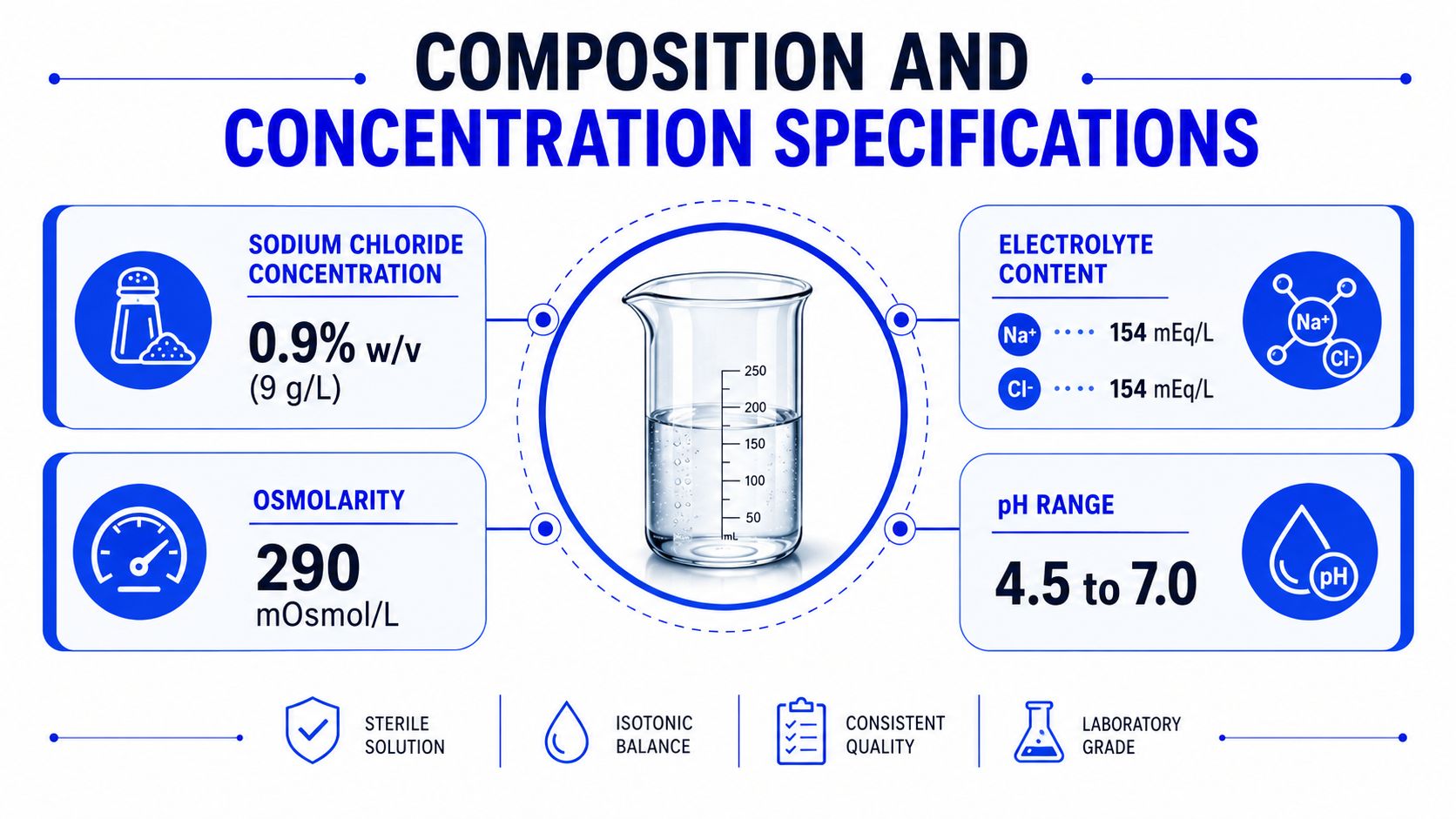
The standard formulation contains 9 g/L sodium chloride, equivalent to 9 mg/mL or 900 mg in each 100 mL, according to FDA labeling (0.9% Sodium Chloride Injection USP label). In w/v terms, 0.9% means that sodium chloride contributes nine grams for each liter of finished solution. This is the concentration behind the hospital term “normal saline,” although the historical label doesn't mean the solution is chemically identical to every physiological environment.
The solution's calculated osmolarity is 308 mOsmol/L, with approximately 154 mEq/L sodium and 154 mEq/L chloride (DailyMed formulation information). Those values matter when a peptide, protein, antibody, or assay system responds to ionic strength. Sodium chloride doesn't merely add volume. It changes the surrounding chemical environment and can influence solubility, electrostatic interactions, and analytical behavior.
What the pH tells the lab
The nominal pH is 5.0, with an acceptable labeled range of 4.5 to 7.0 (FDA product labeling). That range isn't a promise that every lot will sit at one preferred pH, nor does it establish the optimum pH for a specific research compound. It gives the lab a release and inspection parameter that should be interpreted alongside the compound's own stability and solubility requirements.
The product is described as preservative-free, with no bacteriostatic or antimicrobial agents (DailyMed formulation information). That distinction separates it from bacteriostatic water and bacteriostatic saline products. A preservative-free formulation may reduce additive-related compatibility questions, but it also places greater emphasis on single-use handling and aseptic technique.
For teams comparing vehicles, the relevant question isn't whether the label says 0.9%. The review should confirm sodium chloride amount, osmolarity, electrolyte content, pH, preservative status, container type, and intended use. Researchers who are deciding between sterile water vs bacteriostatic water should also compare whether the study needs electrolyte-free dilution, preservative-supported access, or a saline reference condition.
USP Quality Standards and Testing Requirements
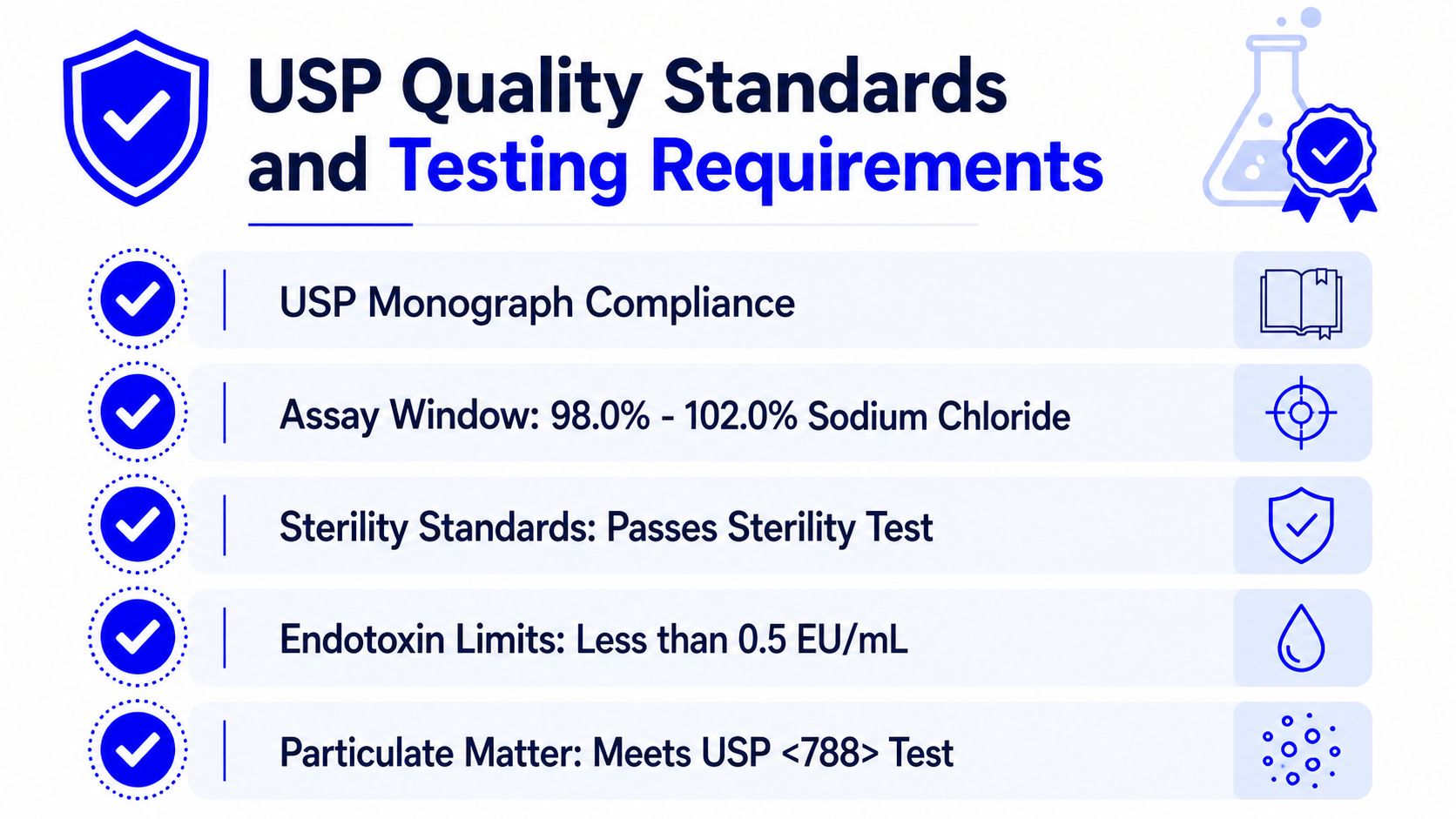
A concentration statement alone doesn't establish product quality. The USP monograph for Sodium Chloride Injection sets an assay range of not less than 95.0% and not more than 105.0% of the labeled sodium chloride amount, requires sterility, and sets an endotoxin limit of not more than 0.5 USP Endotoxin Unit per mL for injections labeled from 0.5% to 0.9% (USP monograph data). These requirements show why a procurement review should extend beyond a nominal percentage printed on a vial.
The reference also identifies microbiological quality and compendial compliance as separate control areas. A solution can have an appropriate salt concentration while still requiring review of sterility, endotoxin, particulate matter, pH, packaging integrity, and documentation. R&D teams should avoid treating a basic conductivity check or visual pass as a substitute for supplier qualification.
A practical COA review sequence
A quality reviewer can process a Certificate of Analysis in a fixed order:
- Identity and assay: Confirm the product identity, stated concentration, assay result, specification, lot, and test method. The reported result should sit within the applicable USP window, not merely near the target.
- Sterility and endotoxin: Look for explicit test status, specification, and lot association. “Sterile” in a product description isn't the same as a lot-specific release record.
- Physical attributes: Review pH and any available particulate or appearance results. These attributes help identify a product that meets concentration requirements but isn't suitable for use.
- Container and closure: Match the COA and label to the received package. A mismatch can break traceability even when the solution itself appears normal.
- Document control: Retain the issued COA, supplier identity, receipt record, inspection result, and internal approval decision.
QA perspective: A supplier's claim of USP alignment should trigger a document review, not end one.
For RUO work, the required evidence may differ from a clinical release package, but the logic remains the same. The lab needs enough information to demonstrate what entered the experiment, which lot was used, and why the material was accepted. If the supplier can't provide that evidence, the apparent convenience of the product may create a larger reproducibility problem later.
Comparing Diluent Options for Reconstitution Work
The practical distinction between saline, sterile water, and bacteriostatic water is not cosmetic. Each option creates a different balance between formulation simplicity, preservative exposure, repeated access, and research control. The comparison below is a screening tool, not a replacement for a compound-specific compatibility assessment.
| Diluent Type | Preservative | Multi-Dose Use | Typical Applications |
|---|---|---|---|
| 0.9% sodium chloride injection USP | None in the labeled preservative-free formulation | Generally treated according to the container label, with single-dose products used once | Isotonic reconstitution or dilution where sodium chloride is compatible |
| Bacteriostatic water | Contains a bacteriostatic preservative, depending on product formulation | Designed for repeated withdrawals when the label and aseptic procedure permit it | Research workflows requiring repeated access and preservative-compatible compounds |
| Sterile water | No bacteriostatic preservative in a typical sterile-water formulation | Generally handled as single-use unless the specific label states otherwise | Reconstitution where added sodium chloride or preservative isn't wanted |
Preservative status changes the risk profile
Bacteriostatic water can reduce the operational burden of repeated vial access because its preservative is intended to inhibit microbial growth. That doesn't make careless handling acceptable. Repeated punctures, poor disinfection, or uncertain storage can still compromise the workflow, and the preservative itself may interfere with sensitive assays or compounds.
Sterile water removes the sodium chloride variable, which can help when ionic strength is a known concern. It also removes the option of using saline's electrolyte background as a controlled condition. A researcher shouldn't substitute it merely because the vial is available. The final concentration, solubility, pH, and assay design all need review.
A decision model for the bench
Use 0.9% sodium chloride injection USP when the protocol calls for a saline vehicle and the compound tolerates the ionic environment. Choose sterile water when the method needs an electrolyte-free diluent. Consider bacteriostatic water when repeated access is part of the validated workflow and the compound and assay tolerate the preservative.
A documented safety tips for lab reconstitution review should include container status, access frequency, storage, operator technique, and post-reconstitution stability. The practical failure is usually not choosing the “wrong” fluid in the abstract. It is choosing a fluid without recording why it matches the method.
Storage Protocols and Handling Best Practices
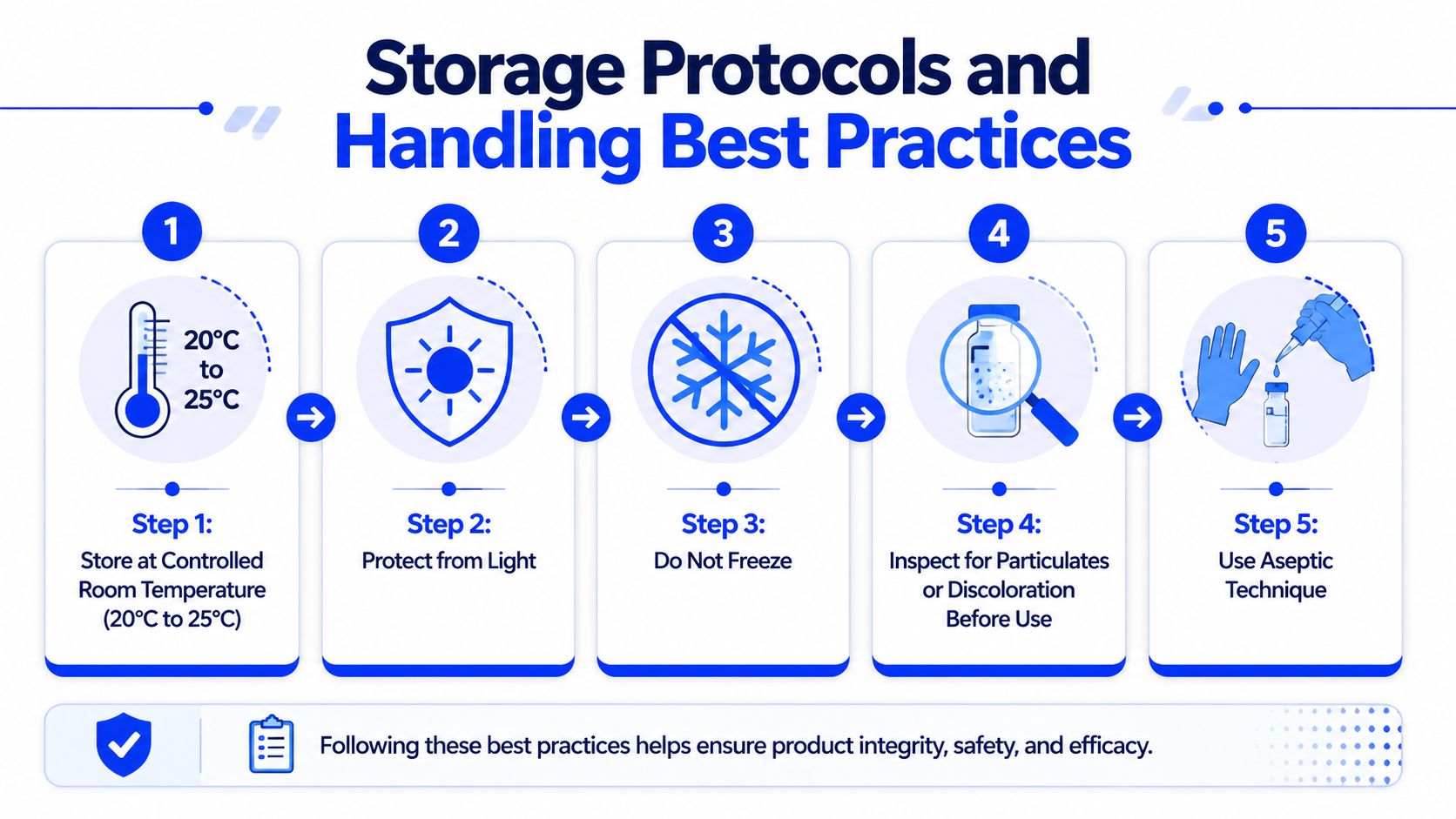
Storage controls begin at receipt. The operator should confirm the outer packaging, lot identity, expiry information, and container closure before placing the product into the lab's controlled inventory. The product label and supplier instructions take priority over a generic storage habit, particularly when the package is a single-dose injectable.
The inspection step deserves more attention than it usually receives. FDA labeling warns against using the solution when it is discolored, cloudy, hazy, or contains a precipitate, and it warns that reuse of single-use product creates a contamination risk (FDA sodium chloride labeling). A clear appearance supports acceptance, but it doesn't prove sterility or eliminate the need for aseptic handling.
Receipt, inspection, and access
A workable handling protocol can be kept simple:
- Quarantine on arrival: Hold shipments until the receiving check confirms intact packaging, correct product, and acceptable labeling.
- Inspect before opening: Check the solution against the label warning signs. Reject or escalate any vial with unexpected particles, haze, discoloration, leakage, or container damage.
- Disinfect the access point: Use the lab's approved aseptic procedure before every puncture. Don't treat a clean-looking stopper as a sterile stopper after repeated access.
- Record first use: For a single-dose product, plan the entire withdrawal as one controlled event. Don't return unused material to stock or transfer it to an unqualified container.
- Separate accepted and rejected stock: Mark questionable units clearly and prevent accidental return to the usable inventory.
A 2025 recall of two B. Braun lots of 1000 mL 0.9% Sodium Chloride Injection USP involved particulate matter inside the container, demonstrating why lot review and visual inspection remain necessary even for familiar products (FDA shortage resolution statement). The incident doesn't mean every saline container is compromised. It does mean that routine familiarity isn't a quality control.
Handling rule: A single-dose label controls reuse decisions. A preservative-free formulation doesn't become multi-dose because a researcher needs the remaining volume.
Teams using bacteriostatic water should apply the same discipline while accounting for the specific preservative and container instructions. Controlled storage, documented access, and prompt escalation of deviations protect both the experiment and the inventory record.
Compatibility with Peptides and Research Compounds
Compatibility should be treated as a formulation question, not a popularity contest between diluents. 0.9% sodium chloride injection USP adds sodium and chloride ions and presents a nominally acidic pH range of 4.5 to 7.0, as described in FDA labeling (FDA product labeling). Those characteristics may be acceptable for one peptide and unsuitable for another.
For lyophilized peptides, the first review point is the manufacturer's reconstitution instruction or the method owner's validated protocol. If the target compound is sensitive to ionic strength, sterile water may provide a cleaner starting condition. If the compound requires a saline vehicle for a defined experimental design, the lab should confirm that the sodium chloride concentration doesn't produce cloudiness, precipitation, poor recovery, or an unacceptable assay baseline.
Proteins and antibodies need a wider screen
Proteins and antibodies can respond to pH, ionic strength, concentration, agitation, surface contact, and temperature. Saline may support an isotonic formulation, but it doesn't automatically provide the buffering capacity or stabilization system required by a sensitive biologic. A solution that looks clear immediately after reconstitution may still require later checks for aggregation or activity.
The lab should define acceptance criteria before preparing the full batch. Useful observations include:
- Appearance: Record clarity, color, and visible particles immediately after preparation and at defined observation points.
- Solubility: Confirm that the material dissolves without persistent residue or unexpected precipitation.
- Assay response: Compare the diluent blank with the reconstituted sample so the vehicle's background is understood.
- Stability behavior: Use the approved storage and handling study rather than assuming that the diluent determines shelf life.
- Container interaction: Consider adsorption or recovery losses when the working concentration is low.
The preservative-free status of standard 0.9% sodium chloride injection USP can remove one compatibility variable, but it doesn't eliminate the salt burden. A small-scale feasibility test, with an appropriate blank and documented observations, is more reliable than selecting a vehicle based solely on the term “isotonic.”
Documentation and Regulatory Context for RUO Workflows
Clinical-grade presentation and RUO suitability are related but not identical. A product labeled for injection is manufactured and labeled for a clinical context, while a research team using it for reconstitution must define how that material fits its own non-clinical quality system. The label establishes the product's identity, composition, intended handling, and warnings. It doesn't validate every peptide or assay in a research portfolio.
A supplier package should normally allow the receiving team to connect the physical container to its quality record. At minimum, the file should capture the product name, lot, expiry information, concentration, container format, supplier, receipt date, and acceptance decision. A lot-specific COA is more useful than a generic specification sheet because it links testing information to the material used.
What the RUO record should contain
A controlled research record can include:
- Product qualification: Label or technical sheet showing composition, preservative status, and intended use.
- Lot evidence: COA or release document tied to the received lot.
- Receiving inspection: Packaging condition, visual appearance, and any deviation record.
- Use record: Operator, date opened, volume withdrawn, compound, and protocol reference.
- Disposition: Remaining material status, disposal record, or approved storage location.
The USP data for sodium chloride injection emphasizes assay, sterility, and endotoxin controls (USP Sodium Chloride Injection monograph). An RUO lab may not repeat every compendial test for every vial, but it should understand which attributes support its risk assessment and which gaps require supplier clarification.
Procurement and QA should also distinguish “USP” as a formulation or compendial claim from a broader statement that a supplier's entire operation meets every requirement relevant to the laboratory. Documented review, supplier communication, and internal approval are what make the material defensible in an audit or investigation.
Procurement Strategy and Supply Considerations
Procurement teams should stop treating 0.9% sodium chloride injection USP as a commodity that can be swapped without review. The product class is familiar, but presentations differ by manufacturer, volume, container, label, and distribution route. A substitute can alter single-dose handling, storage space, withdrawal practices, and the evidence available for the lot record.
Supply status also needs a more precise reading. The FDA stated that the nationwide shortage of sodium chloride 0.9% injection products officially ended on August 8, 2025, and the products were removed from the federal shortage list (FDA shortage resolution statement). Earlier in 2025, ASHP shortage pages still showed allocation or back-order conditions for specific presentations, and a recall affected some 1000 mL lots. Formal shortage resolution therefore doesn't guarantee that every size, package, manufacturer, or channel is immediately available.
A supplier screen that protects the workflow
A qualified sourcing review should ask:
- Can the vendor identify the exact presentation? Volume, container type, single-dose or multi-dose status, and preservative information should be explicit.
- Does the vendor provide lot documentation? Generic marketing language isn't enough for controlled R&D.
- Can the vendor explain availability by presentation? A broad “in stock” statement may conceal limits on the format the lab needs.
- What happens during a recall? The supplier should support lot traceability and notification.
- Can the lab approve an alternate? A prequalified second source reduces pressure to accept an undocumented replacement.
Cost should be evaluated after quality and continuity requirements are clear. A lower unit price doesn't compensate for an incompatible container, missing COA, unexpected preservative, or delayed experiment. The strongest purchasing specification names the formulation and quality attributes, then permits only controlled substitutions.
Quick Reference Specifications and Decision Points
The following lookup is designed for receiving, bench preparation, and procurement review. It separates fixed reference data from decisions that require compound-specific evidence.
Reference specifications
- Concentration: 0.9% w/v, equal to 9 g/L, 9 mg/mL, and 900 mg per 100 mL (FDA product labeling).
- Osmolarity: 308 mOsmol/L (DailyMed formulation information).
- Electrolytes: Approximately 154 mEq/L sodium and 154 mEq/L chloride (DailyMed formulation information).
- pH: Nominally 5.0, with an acceptable range of 4.5 to 7.0 (FDA product labeling).
- Preservatives: The standard labeled formulation is preservative-free (DailyMed formulation information).
- USP quality: Assay from 95.0% to 105.0% of label claim, sterility required, and endotoxin no more than 0.5 USP Endotoxin Unit per mL for the stated injection range (USP monograph data).
Decision checks
- Confirm the compound protocol permits saline.
- Compare saline with sterile water and bacteriostatic water.
- Verify the label, container status, lot, and COA.
- Inspect for haze, discoloration, precipitate, particles, leaks, or damage.
- Record the preparation and dispose of single-use remainder according to the lab procedure.
Common Questions and Misconceptions
Is 0.9% sodium chloride truly “normal” or physiological? The historical label is convenient, but historical review literature argues that the current 0.9% formulation has little scientific or historical basis for being called truly normal or physiological (FDA historical review document). In practice, it remains a widely recognized reference saline formulation, not a universal match for every biological or research environment.
Does a sterile saline label make a vial suitable for every RUO reconstitution? No. Sterility and formulation identity don't prove compatibility with a particular peptide, protein, antibody, or assay. The research protocol still needs to address ionic strength, pH, concentration, preservative status, and stability.
Can a single-dose vial be reused if it looks clear? It shouldn't be treated as reusable on appearance alone. FDA labeling warns that re-use of single-use product creates contamination risk (FDA sodium chloride labeling).
Did the end of the nationwide shortage mean every presentation was immediately normalized? No. The FDA announced resolution on August 8, 2025, while presentation-level allocation, back orders, and lot-specific recalls still illustrate why procurement teams should verify actual availability and traceability rather than rely on a headline (FDA shortage resolution statement).
Herbilabs offers sterile bacteriostatic reconstitution solutions for RUO workflows, with multiple vial formats, lot-specific COAs, and documented quality controls for research teams evaluating alternatives to preservative-free saline. Visit Herbilabs to review the available diluent and labware options, then match the product documentation and handling format to the approved research protocol.