Private Label, White Label, Wholesale partnerships available - EU, USA and UK - Free shipping from €75
How to Ensure Reagent Purity in Your Lab in 2026
Discover how to ensure reagent purity in your lab in 2026. Learn essential methods and protocols to guarantee accurate results and reliability.
TL;DR:
- Reagent purity measures the target compound’s proportion in a sample free from contaminants, with standards from bodies like ACS guiding acceptable levels. Ensuring quality involves selecting the appropriate grade, verifying with complementary analytical methods like HPLC, MS, and Karl Fischer titration, and maintaining strict storage protocols; most purity failures stem from lab handling rather than supplier issues. Consistent documentation, lot-specific COAs, and disciplined laboratory practices are critical to preventing contamination and ensuring reproducible, reliable results.
Reagent purity is defined as the measurable proportion of a target compound in a given sample, free from interfering contaminants, solvents, or degradation products. Knowing how to ensure reagent purity is the single most consequential quality control decision a laboratory scientist makes, because even trace impurities can skew bioassays, invalidate chromatographic data, and compromise reproducibility across entire experimental series. Standards bodies such as the American Chemical Society (ACS) and independent testing laboratories like Janoshik Analytical Laboratories have established graded purity classifications and verification protocols that define what “pure enough” means for each research context. This guide covers those grades, the analytical methods used to verify them, and the storage and handling protocols that preserve integrity from receipt to use.
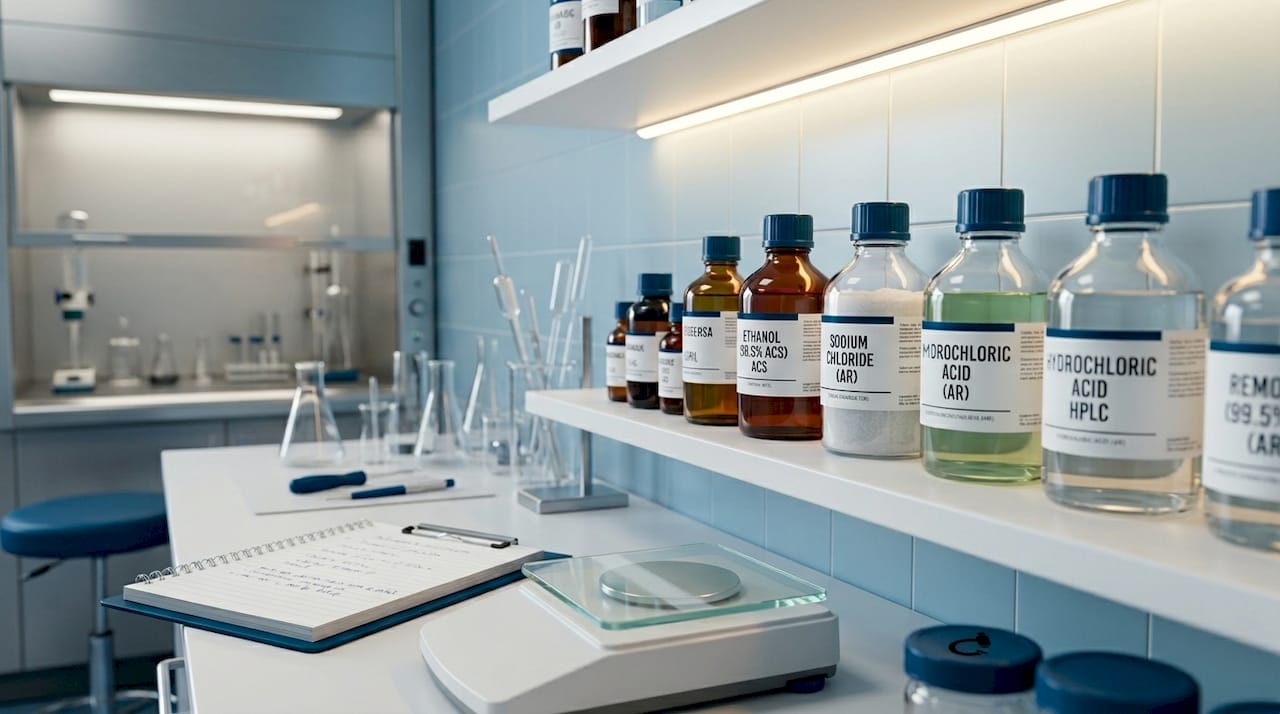
How to ensure reagent purity: grades, testing, and protocols
Reagent purity is not a single fixed value. It is a specification tied to a recognized grade, a validated test method, and a documented chain of custody. Understanding all three components is what separates a reliable experimental workflow from one that produces ambiguous or irreproducible results. The sections below address each component in sequence, from grade selection through analytical verification to day-to-day handling.
What are the standard reagent purity grades?
Reagent purity grades are standardized classifications that define the maximum allowable concentrations of specific impurities within a chemical lot. The four grades most commonly encountered in research settings are ACS grade, analytical reagent (AR) grade, guaranteed reagent (GR) grade, and technical or laboratory grade.
| Purity Grade | Typical Purity Range | Common Applications | Impurity Expectation |
|---|---|---|---|
| ACS Grade | ≥99.5% | Quantitative analysis, reference standards | Meets ACS specification limits |
| Analytical Reagent (AR) | ≥99.0% | General analytical work, HPLC mobile phases | Low, defined impurity profile |
| Guaranteed Reagent (GR) | ≥98.0% | Routine laboratory synthesis | Moderate, documented limits |
| Technical/Lab Grade | 96–98% | Preparative work, non-critical synthesis | Higher, less strictly controlled |
ACS grade reagents meet the specifications published by the American Chemical Society Committee on Analytical Reagents, making them the default choice for quantitative analytical work where impurity limits are tightly defined. Analytical reagent grade, supplied by manufacturers such as Fisher Scientific and Ricca Chemical Company, is appropriate for most HPLC mobile phase preparation and routine assay work. Technical grade reagents, with purity typically in the 96 to 98% range, are suitable for preparative synthesis but should never be used where trace impurities would interfere with detection or biological response.
Selecting the correct grade is a cost-accuracy tradeoff. ACS grade reagents carry a price premium that is justified for reference standard preparation or regulatory submission work, but unnecessary for a wash step in a preparative protocol. Mismatching grade to application in either direction, using technical grade in a quantitative assay or ACS grade in a bulk wash, wastes resources or introduces risk.
Pro Tip: Map each reagent in your protocol to its functional role before ordering. Reagents that contact the analyte directly or appear in the detection step warrant ACS or AR grade; reagents used only in upstream preparation steps often do not.
How to test reagent quality: analytical methods compared
Reagent purity testing relies on a portfolio of analytical techniques, each with distinct sensitivity, specificity, and detection scope. No single method captures all contaminant classes, which is why method selection must be deliberate.
| Method | Sensitivity | Specificity | Typical Application | Key Limitation |
|---|---|---|---|---|
| HPLC (UV detection) | High for UV-absorbing species | Moderate | Organic purity, peptide analysis | Cannot detect non-UV absorbers |
| Mass Spectrometry (MS) | Very high | Very high | Molecular identity confirmation | Requires skilled interpretation |
| Karl Fischer Titration | High | Water-specific | Residual moisture quantification | Single analyte only |
| Infrared Spectroscopy (IR) | Moderate | Structural | Functional group identification | Semi-quantitative |
| Optical Rotation | High | Chiral-specific | Enantiomeric purity | Chiral compounds only |
| Probe-based qPCR | Extremely high | DNA-specific | Host-cell DNA contamination | DNA targets only |
| NMR Spectroscopy | Moderate to high | Structural | Solvent, salt, structural impurities | Instrument access required |
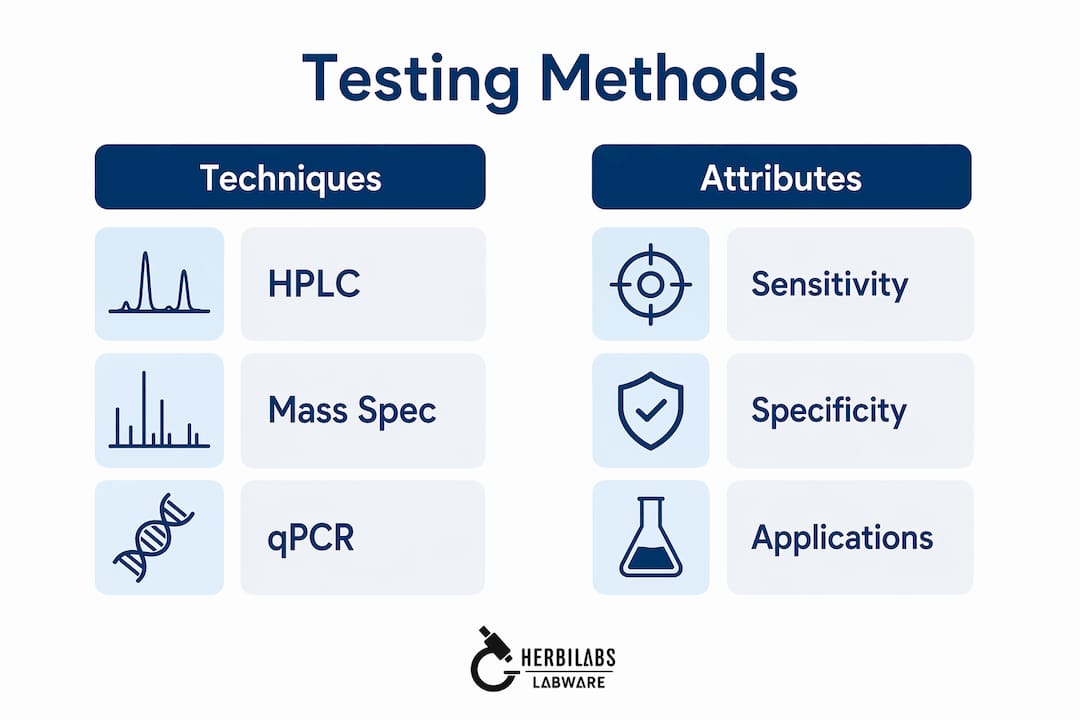
HPLC with UV detection at 220 nm is the most widely used method for organic purity assessment. However, HPLC purity measurement quantifies only UV-absorbing species, meaning water, inorganic salts, and non-chromophoric solvents are invisible to this detector. This is a critical limitation that researchers frequently underestimate. A reagent reporting 99% purity by HPLC may still contain significant residual solvent or salt that affects molarity calculations and downstream assay performance.
Mass spectrometry resolves the co-elution problem that HPLC alone cannot address. When two compounds share nearly identical retention times, HPLC reports a single peak with apparently high purity, while MS reveals distinct mass-to-charge ratios for each species. Combining HPLC and MS provides both quantitative purity data and molecular identity confirmation, which is the standard approach for peptide reagent verification in biopharmaceutical research.
Peak purity assessment using a photodiode array (PDA) detector adds another layer of confidence to chromatographic analysis. PDA-based peak purity evaluation compares UV spectra collected at the peak start, apex, and end, requiring a similarity index above 99% and a purity angle below the threshold angle to confirm that a chromatographic peak represents a single compound. This technique is now standard practice in pharmaceutical method development and is increasingly applied in research reagent QC.
For biologics and DNA-containing reagents, probe-based qPCR methods detect residual host-cell DNA down to 1 fg/µL for human HEK293 DNA and 5 fg/µL for bacterial E. coli DNA. This level of sensitivity matters because residual host DNA can trigger immune or cellular stress responses in downstream bioassays, producing false-positive signals that are difficult to trace back to the reagent source.
Pro Tip: For peptide or protein reagents, run HPLC for quantitative purity, MS for identity confirmation, and Karl Fischer titration for residual moisture. This three-method combination covers the contaminant classes that each individual method misses.
Best practices for reagent storage and handling
Proper storage is not a passive activity. Degradation and contamination accumulate incrementally through repeated openings, temperature fluctuations, and inadequate sealing, often without visible signs until an experiment fails.
Reagent storage conditions require keeping chemicals in their original labeled containers, in cool and dry locations, away from direct sunlight and heat sources. Original containers are engineered for compatibility with their contents: amber glass for light-sensitive compounds, HDPE for corrosives, and borosilicate glass for organic solvents. Transferring reagents to substitute containers, even temporarily, introduces contamination risk from residual cleaning agents, plasticizers, or incompatible materials.
Glass containers are generally preferred over plastic for organic solvents and concentrated acids because plastics can leach monomers or absorb analytes at trace concentrations. For aqueous buffers and biological reagents, low-binding polypropylene or borosilicate glass are both acceptable, provided the container is certified clean and appropriately sealed.
Inventory rotation using the first-in, first-out (FIFO) principle prevents older stock from sitting unused past its stability window. Labeling every container with the receipt date, opening date, and expiration date is a minimum documentation standard. Many laboratories also record lot numbers to enable batch-specific traceability when a purity issue is later identified.
Storage do’s and don’ts:
- Do store volatile reagents in ventilated cabinets with secondary containment.
- Do use desiccants for hygroscopic compounds and verify desiccant activity regularly.
- Do record the date a container is first opened and set a discard date based on the manufacturer’s post-opening stability data.
- Don’t return unused reagent to the original container after dispensing, as this introduces contamination from the dispensing vessel.
- Don’t store incompatible reagent classes in the same cabinet, particularly oxidizers with organics.
- Don’t rely on visual inspection alone to assess reagent condition. Colorless solutions can degrade without any visible change.
Pro Tip: Inspect reagents quarterly for signs of precipitation, color change, or unusual odor. These are early indicators of degradation that HPLC will confirm but that visual inspection can flag weeks earlier, before a compromised reagent enters a critical experiment.
Common pitfalls and how to troubleshoot reagent purity issues
Contamination sources in laboratory settings include supplier inconsistencies, improper storage, and handling errors, all of which adversely affect test results and reproducibility. Identifying which source is responsible requires a structured troubleshooting approach rather than ad hoc investigation.
The most frequently overlooked contamination source is the supplier batch itself. Certificate of analysis (COA) documents provided by manufacturers are generated from a representative sample of a production batch, not from the specific vial shipped to your laboratory. Independent third-party verification through laboratories such as Janoshik Analytical Laboratories, which provide COAs with chromatograms, MS spectra, batch identifiers, and online verification codes, offers a level of assurance that manufacturer-issued COAs alone cannot match. Certificates from third-party providers like Au Peptide Labs follow a similar model, providing independently generated analytical data that can be cross-referenced against the manufacturer’s documentation.
When a purity issue is suspected, the following numbered protocol provides a structured path to resolution:
- Quarantine the suspect lot immediately and label it clearly to prevent further use while investigation proceeds.
- Review the COA for the specific lot number and compare reported purity values against your in-house test results.
- Repeat the purity test using a second, complementary analytical method to rule out instrument error or method artifact.
- Test a reference standard of known purity alongside the suspect reagent to confirm that the analytical system is performing correctly.
- Check storage records for the suspect lot, including temperature logs and container integrity, to identify whether degradation occurred post-receipt.
- Contact the supplier with your analytical data and request a replacement lot or a refund, supported by your documented findings.
- Update your approved supplier list if the issue reflects a systemic quality control failure at the supplier level.
Co-elution is a particularly deceptive pitfall in HPLC-based purity assessment. Two structurally similar impurities can co-elute with the target compound, inflating the apparent purity percentage while masking the true contaminant load. PDA detection and MS confirmation are the most reliable tools for identifying co-elution artifacts.
Pro Tip: Request lot-specific COAs, not generic product COAs, from every supplier before accepting a shipment. A COA that does not reference your specific lot number provides no meaningful quality assurance for that batch.
Key takeaways
Ensuring reagent purity requires selecting the correct purity grade, validating that grade with complementary analytical methods, and maintaining strict storage and handling discipline throughout the reagent lifecycle.
| Point | Details |
|---|---|
| Match grade to application | Use ACS or AR grade for analytical and detection steps; lower grades suit preparative work. |
| Combine analytical methods | HPLC quantifies UV-absorbing purity; MS confirms identity; Karl Fischer measures moisture. |
| Store in original containers | Original packaging preserves chemical compatibility and prevents contamination from substitute vessels. |
| Demand lot-specific COAs | Generic product COAs do not guarantee the purity of your specific shipment batch. |
| Troubleshoot systematically | Quarantine, retest with a second method, and check storage records before contacting the supplier. |
Why reagent purity is harder to maintain than most labs assume
I have reviewed enough failed experiments traced back to reagent quality to say this plainly: the majority of purity failures in research laboratories are not supplier failures. They are protocol failures. The reagent arrived pure. It degraded, or became contaminated, inside the laboratory.
The most common misconception I encounter is that a COA issued at the time of manufacture remains valid indefinitely, provided the container looks intact. Stability data tells a different story. Hygroscopic compounds absorb atmospheric moisture within minutes of opening in a humid environment. Light-sensitive reagents degrade measurably within days of exposure to ambient laboratory lighting. Researchers who rely on a two-year-old COA for a reagent that has been opened and resealed dozens of times are not practicing quality control. They are practicing optimism.
The second misconception is that HPLC purity is equivalent to absolute purity. It is not. An HPLC purity figure of 98% means that 98% of the UV-absorbing signal at the detection wavelength belongs to the target compound. It says nothing about water content, residual solvents, or inorganic salts, all of which affect molarity, solubility, and biological activity. Upstream investment in multi-method verification reduces downstream reagent consumption and experimental failure rates, which translates directly into cost savings and faster research timelines.
The labs that maintain the highest reagent integrity are not necessarily the ones with the largest analytical budgets. They are the ones with the most disciplined documentation culture: every lot numbered, every opening dated, every purity test recorded. That discipline is replicable at any scale.
— Ragnar
Herbilabs high-purity solutions for your research workflow
Maintaining reagent purity starts with sourcing from a supplier whose manufacturing standards are built around contamination prevention, not just compliance documentation.
Herbilabs manufactures bacteriostatic water, sterile diluents, and reconstitution solutions in a dedicated facility under strict quality control protocols, with each batch produced to research-grade purity standards. Every product is packaged in sterile, sealed containers designed to preserve integrity from production through delivery. Researchers working in peptide science, biologics, or general laboratory applications can also consult the best laboratory reagents guide to identify products matched to their specific purity and compatibility requirements. Herbilabs serves research institutions, universities, and independent researchers across the UK and Europe with reliable delivery and documented quality assurance.
FAQ
What does reagent purity percentage actually measure?
Reagent purity percentage measures the proportion of the target compound relative to all detectable species using a specified analytical method, most commonly HPLC with UV detection. It does not account for non-UV-absorbing contaminants such as water, salts, or residual solvents unless additional tests like Karl Fischer titration or NMR are performed.
How often should reagents be retested after purchase?
Reagents should be retested whenever a new lot is received, after any unusual storage event such as a temperature excursion, and at intervals defined by the manufacturer’s post-opening stability data. High-value or critical reagents used in regulatory or publication-grade work warrant in-house verification at each point of use.
What is the difference between ACS grade and analytical reagent grade?
ACS grade reagents meet the specific impurity limits published by the American Chemical Society and are the highest standard for quantitative analytical work. Analytical reagent grade meets manufacturer-defined purity specifications that are comparable but not identical to ACS limits, making it suitable for most routine analytical applications.
Why is a certificate of analysis not always sufficient proof of purity?
A manufacturer-issued COA is generated from a representative sample of a production batch and may not reflect the purity of the specific vial in your laboratory. Independent third-party verification, such as that provided by Janoshik Analytical Laboratories, generates lot-specific analytical data including chromatograms and MS spectra that can be independently verified.
Can reagent contamination originate inside the laboratory rather than from the supplier?
Yes. Contamination from improper handling, inadequate sealing, incompatible storage containers, and cross-contact with other reagents is a primary source of purity loss after receipt. Maintaining original packaging, following FIFO inventory rotation, and documenting every opening event are the most effective controls against in-laboratory contamination.