Private Label, White Label, Wholesale partnerships available - EU, USA and UK - Free shipping from €75

How to Do Dilution Calculations: Step-by-Step Lab Guide
A reader stands at the bench with a stock vial in one hand, a pipette in the other, and a protocol that asks for a much weaker solution. The label says one concentration, the protocol says another, and the units don't match. Rushing at that point produces a solution that's ten times too strong or too weak, and the error often isn't visible until the results look wrong.
Learning how to do dilution calculations starts with a slower habit. The reader writes every value down, checks that each pair of units matches, and only then does the arithmetic. That unit check before calculation catches the mismatch that causes most wrong dilutions, and it takes less than a minute.
Table of Contents
- Dilution Formula Variables at a Glance
- Unit Conversions Before You Calculate
- Five-Step Dilution Procedure With Checks
- Worked Dilution Cases for Molar and Percent Solutions
- Serial Dilutions and Multi-Step Series
Dilution Formula Variables at a Glance
A dilution adds diluent to a stock without changing the amount of solute. The solute spreads through a larger volume, so the concentration falls while the total amount stays the same. That's why concentration multiplied by volume stays constant, written as C1 × V1 = C2 × V2.
Each symbol has a plain meaning. C1 is the concentration of the stock in the vial, V1 is the volume of that stock to measure out, C2 is the target concentration after dilution, and V2 is the final total volume once diluent has been added. Readers who name all four before touching a calculator avoid swapping stock and target values.
The Four Variables and Their Units
| Symbol | Meaning | Typical unit | Where readers slip |
|---|---|---|---|
| C1 | Concentration of the stock | M, mM, % w/v or mg/mL | Stock label in a different unit from the target |
| V1 | Volume of stock to measure out | µL or mL | Solving in one unit and measuring in another |
| C2 | Target concentration after dilution | Same unit as C1 | Reading the target as a percentage when the stock is molar |
| V2 | Final total volume after adding diluent | Same unit as V1 | Adding the diluent volume instead of the total volume |
Two matching rules keep the equation honest. C1 and C2 must share one concentration unit, and V1 and V2 must share one volume unit. The equation doesn't care which units the reader picks, provided each pair matches on both sides.
Practical rule: If the concentration units don't match, or the volume units don't match, the arithmetic hasn't started yet. Conversion comes first.
Most bench work rearranges the equation to find the stock volume, using V1 = (C2 × V2) / C1. When the unknown is instead the final volume that a measured amount of stock can make, the rearranged form is V2 = (C1 × V1) / C2. Writing the rearranged form before inserting numbers shows which values sit on top and which sit underneath.
Before any arithmetic, the reader should write down all four values for the planned dilution and mark the single unknown. A value without a unit counts as unfinished, and a page with two unknowns means a needed figure is still missing from the protocol or the stock label.
Unit Conversions Before You Calculate
A unit mismatch causes most wrong dilutions. The equation multiplies and divides whatever numbers it receives, so a stock labelled in micrograms per millilitre and a target written in milligrams per millilitre will produce a wrong answer with perfectly correct arithmetic.
Conversions Readers Meet Most Often
| From | To | Factor |
|---|---|---|
| µL | mL | ÷ 1000 |
| mL | L | ÷ 1000 |
| M | mM | × 1000 |
| mM | µM | × 1000 |
| % w/v | mg/mL | × 10 |
Each row carries a free error check. When the new unit is bigger than the old one, as with microlitres into millilitres or millilitres into litres, the number must shrink. When the new unit is smaller, as with molar into millimolar or millimolar into micromolar, the number must grow. A converted figure that moves in the wrong direction signals a flipped factor before the equation ever sees it.
The last row confuses many readers because it hides a factor of ten. A 1% w/v solution contains 1 g of solute in 100 mL, which works out to 10 mg/mL, so multiplying a % w/v figure by 10 gives the value in mg/mL. A 2% w/v stock, for example, becomes 20 mg/mL.
Say a protocol calls for a 250 µL measurement while the rest of the worksheet runs in millilitres. Dividing 250 by 1000 gives 0.25 mL, and that converted figure enters the equation. Converting every value before any arithmetic keeps the worksheet clean, while converting partway through invites a reader to convert one value twice or skip another entirely.
One boundary deserves attention. % w/v is a mass-per-volume unit, so no single factor carries it into molar units such as M or mM. Percent counts mass sitting in a fixed volume, while molarity counts molecules in a fixed volume, and the solute's molecular weight is the bridge between them. It works like converting a price per kilogram into a price per item: impossible until you know what one item weighs.
A conversion also presumes the solute dissolves in the chosen diluent at all. Concentrated acids get checked on this point before any unit work begins, and acetic acid mixes with water in any proportion, a solubility question covered in detail at safe acetic acid dilution with Herbilabs.
A simple habit closes out the conversion pass. Write the unit beside every number, cross out each figure whose unit does not yet match its pair, and keep converting until nothing remains crossed out. Then run one last check on the units themselves: set the planned values side by side and confirm the shared unit would cancel, leaving only the unit the answer should carry.
Five-Step Dilution Procedure With Checks
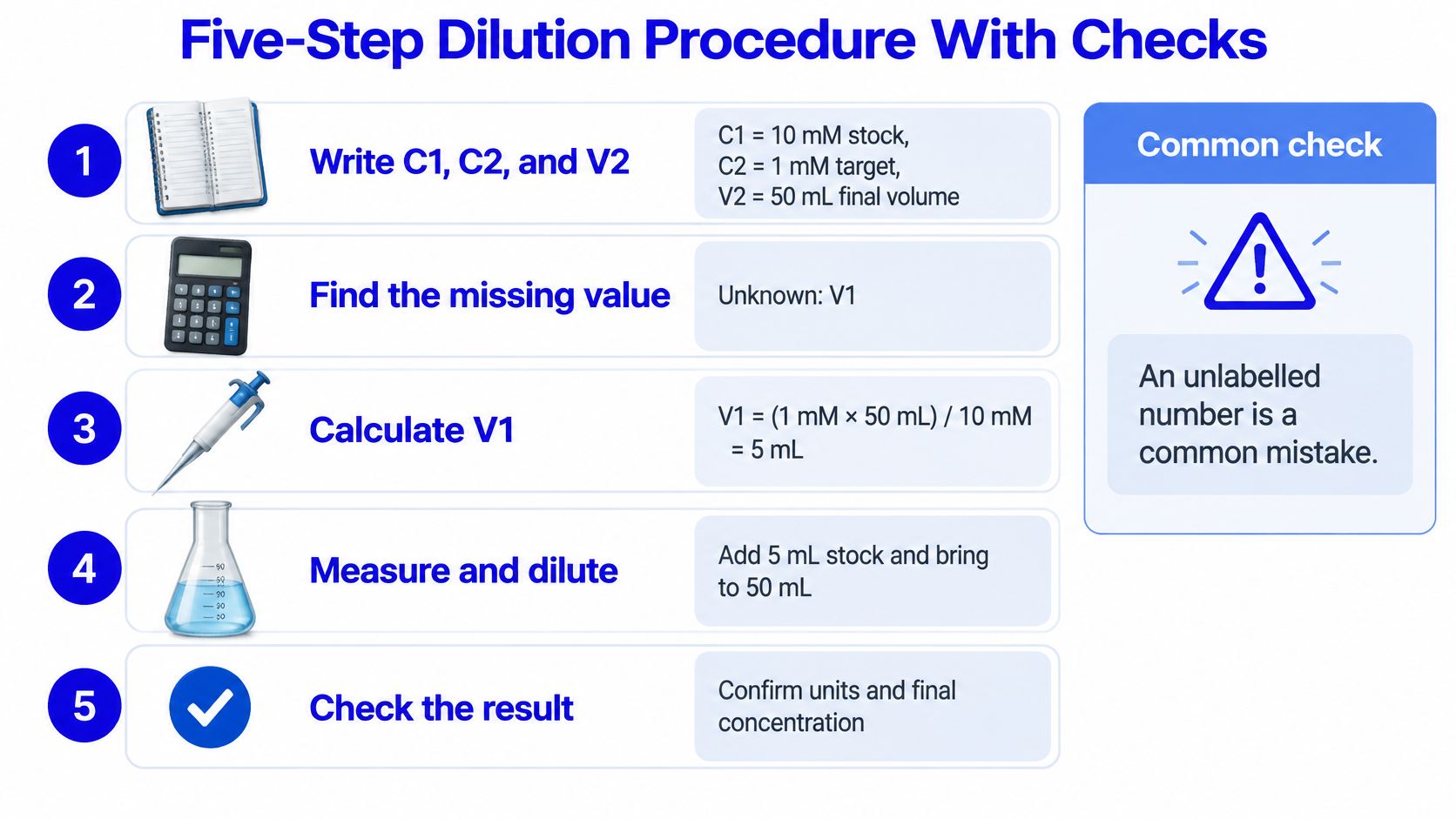
One worked example runs through all five steps: preparing 50 mL of a 1 mM solution from a 10 mM stock. The same numbers appear at every stage so each check can be tested against the step before it. Every figure keeps its unit attached the whole way through, because a mismatched unit caught on paper costs nothing, while the same mismatch caught in a finished vial costs the whole preparation.
Steps One and Two
- Write down C1, C2 and V2 with their units, and mark the unknown. Here C1 is 10 mM, C2 is 1 mM, V2 is 50 mL, and V1 is the unknown. Writing "10" alone invites trouble when the worksheet is revisited; writing "10 mM" means the unit itself can be checked against every other value on the sheet.
- Confirm C1 and C2 share one unit, and convert if they don't. Both values are already in mM, so no conversion is needed. Had the stock been labelled in µM, the worksheet would show a four-digit figure against a one-digit figure, and the mismatch would be obvious before the equation is touched. Solving with mixed units produces an answer out by a factor of 1000, which is exactly the slip this check exists to catch.
Steps Three and Four
- Solve for the unknown using the rearranged formula. Writing V1 = (C2 × V2) / C1 first, then inserting the numbers, gives V1 = (1 mM × 50 mL) / 10 mM = 5 mL. The mM in the numerator and denominator cancel, so the answer lands in mL, the same unit as V2. A leftover unit of anything else would mean the formula was set up wrong.
- Sanity-check the result before measuring anything. V1 must be smaller than V2, and 5 mL is smaller than 50 mL, so the answer passes. A stock volume that comes out larger than the final volume signals a flipped ratio, not a real instruction. The volume also needs to sit within the range the available pipette or cylinder measures accurately, and small volumes shouldn't be rounded early because the rounding error carries straight into the final concentration.
Readers recording several dilutions in a spreadsheet can use a structured summary approach to summarize spreadsheet findings with evidence so each calculated volume stays tied to its stock and target values. A tidy record makes the sanity check repeatable rather than a matter of memory.
Step Five and Verification
- Add diluent up to the final volume rather than measuring out a separate diluent volume. The reader pipettes 5 mL of stock, then adds diluent until the total reaches 50 mL. Adding 50 mL of diluent on top of the 5 mL of stock gives 55 mL and a concentration below target, which is the most frequent bench slip in this step. Guidance on choosing diluents for reconstituting lyophilised material helps readers match the diluent to the material before this step begins.
Verification reverses the calculation. Using C2 = (C1 × V1) / V2 gives (10 mM × 5 mL) / 50 mL = 1 mM, which matches the target exactly. The units get checked once more here: mM × mL ÷ mL leaves mM, so a result in any other unit means a value was entered incorrectly. Herbilabs provides a free reconstitution calculator that works out the amount of solution to add and the draw volume in U-100 units, which works as a second check on hand arithmetic.
Before preparing the solution, the reader confirms that units match on both sides, V1 is smaller than V2, the final volume is the total, and the stock concentration and expiry are recorded.
If the recalculation matches the target, the reader records the calculation on the batch sheet and labels the vial with its concentration and date. That label is what the next person at the bench trusts, so it carries the same care as the arithmetic itself.
Worked Dilution Cases for Molar and Percent Solutions
A 20% w/v stock with a 200 mL target looks like a different problem from a 10 mM stock with a 50 mL target, yet both solve on a single line once the units on each side match. That match is the first step. Before any arithmetic runs, the reader reads the units off C1, C2 and V2 and confirms they pair cleanly, because the unit mismatch that produces most wrong dilutions is far easier to catch on paper than after liquid has moved.
Cases at a Glance
Every row below uses the same rearranged equation, V1 = (C2 × V2) / C1, with the units written next to each value so the check stays visible inside the maths.
| Case | Given | Target | Stock volume (V1) |
|---|---|---|---|
| Molar, simple | 10 mM stock | 1 mM in 50 mL | 5 mL |
| Percent w/v | 20% w/v stock | 5% w/v in 200 mL | 50 mL |
| Mass per volume | 1 mg/mL stock | 0.1 mg/mL in 10 mL | 1 mL |
| Unit conversion needed | 500 µM stock | 50 µM in 2 mL | 0.2 mL (200 µL) |
| Large final volume | 0.5 M stock | 25 mM in 1 L | 50 mL |
The molar case already has matching units, so it goes straight to V1 = (1 mM × 50 mL) / 10 mM = 5 mL. The percent case behaves the same way: percent w/v is still a concentration unit, so V1 = (5% × 200 mL) / 20% = 50 mL with no extra handling. Percent solutions solve with the same equation as molar solutions provided both sides carry the same unit, and a second worked percent example appears in the Herbilabs guide to concentrated saline. The mass-per-volume row confirms the pattern once more, giving V1 = (0.1 mg/mL × 10 mL) / 1 mg/mL = 1 mL.
The conversion row shows a case where the answer, not the setup, needs restating. Both concentrations already sit in µM, so the equation runs directly: V1 = (50 µM × 2 mL) / 500 µM = 0.2 mL, which the reader then writes as 200 µL because that is the unit a micropipette displays. Converting after solving is acceptable here precisely because the inputs matched before the arithmetic began. Readers who want more repetitions of this unit handling can work through structured tips for solving chemistry problems alongside these cases.
The large-volume row is the one where conversion must happen before solving, since the stock is in molar and the target is in millimolar. Restating 25 mM as 0.025 M and 1 L as 1000 mL gives V1 = (0.025 M × 1000 mL) / 0.5 M = 50 mL. Skipping either conversion leaves the result off by a factor of 1000, which is exactly the scale of error the unit check exists to catch.
Run a personal stock and target through the same pattern and compare against the table. A result whose units cancel cleanly, and whose volume lands in the same proportionate range as the rows above, is ready for the bench.
Serial Dilutions and Multi-Step Series
A single dilution step stops being practical when the required change in concentration is very large. The calculation might ask for a stock volume so small that no pipette in the lab can measure it accurately. A serial dilution solves that problem by reaching the target through several moderate steps instead of one extreme one. The photograph below shows a typical series in progress.
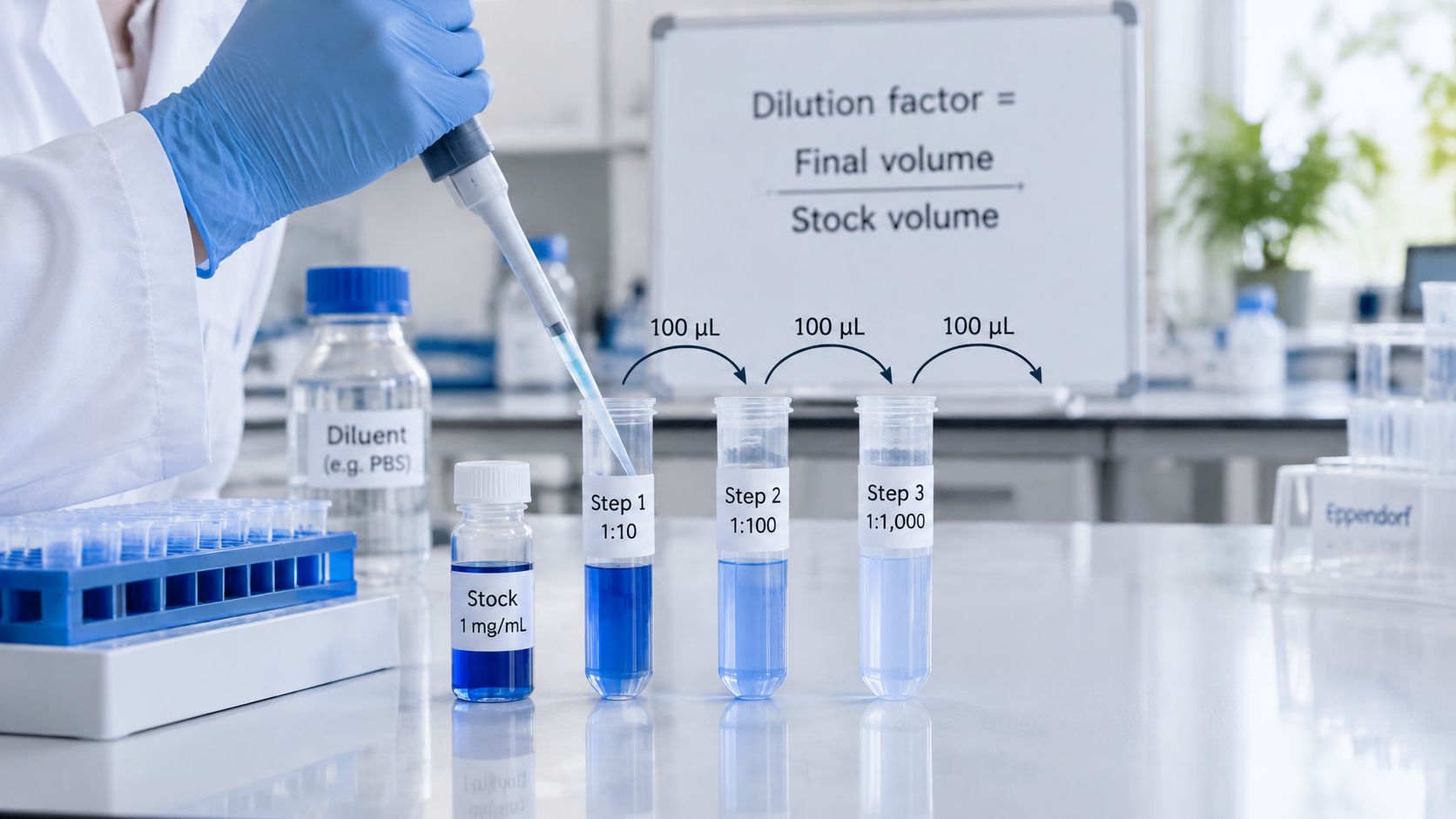
The dilution factor for one step is the final volume divided by the volume of sample taken. Transferring 1 mL of sample and bringing it to 10 mL total, which means adding 9 mL of diluent, gives a 1:10 dilution with a factor of 10. Readers who treat 1:10 as 1 mL plus 10 mL of diluent end up with 11 mL and a factor of 11, so the total volume definition matters.
Steps in a series multiply together. Three successive 1:10 steps give a total dilution of 1:1000, because 10 × 10 × 10 equals 1000. Planning a series therefore means choosing a step factor, counting how many steps reach the required total, and checking that the final concentration matches the target before starting.
What Accuracy Depends On
A 2024 study published on bioRxiv found that a 1000-fold dilution series was as accurate as 10-fold and 100-fold series for bacterial-cell enumeration when the final volume was 10 mL, provided that 1 µL pipetting was avoided. Fewer, larger steps can therefore match many small ones, and the pipetted volume matters more than the step count. That study tested one bacterial-enumeration setup, so readers should treat the result as a principle about pipetting volume rather than a universal rule for every assay.
The short video below demonstrates the transfer technique that keeps each step consistent.
A workable plan fits on one worksheet line per step. The reader writes each step's factor, multiplies the factors together, and confirms the total against the target dilution. Any step calling for a very small pipetted volume gets redesigned with a larger transfer volume before work begins.
Readers who have checked their units, solved for the stock volume, and verified the result can put the method to work with research-use reconstitution solution and the free calculator from the Herbilabs team. Visiting Herbilabs gives access to product details, lot documentation, and practical lab guides that support accurate dilution work.