Private Label, White Label, Wholesale partnerships available - EU, USA and UK - Free shipping from €75

9 Percent Sodium Chloride: Concentration, Uses and Safety
9 percent sodium chloride is 90 g/L, ten times the 9 g/L of 0.9% normal saline, and it is hypertonic, not isotonic. A missing decimal point therefore changes more than the strength on a label: it changes how the solution affects cells, how a researcher handles it, and whether it belongs in a preparation at all.
By Herbilabs
The most useful starting question isn't whether a bottle contains saline. It's whether the label describes the concentration, formulation and intended use that the protocol requires. A familiar ingredient name can't answer those questions.
Table of Contents
- Nine Percent Versus 0.9 Percent Sodium Chloride at a Glance
- Why Nine Percent Behaves as Hypertonic, Not Isotonic
- Where Labs Use Nine Percent Sodium Chloride
- Dilute, Verify and Screen Reagents Before Use
- Safety and Handling Rules for Concentrated Saline
- Choose the Right Saline Strength for Your Work
Nine Percent Versus 0.9 Percent Sodium Chloride at a Glance
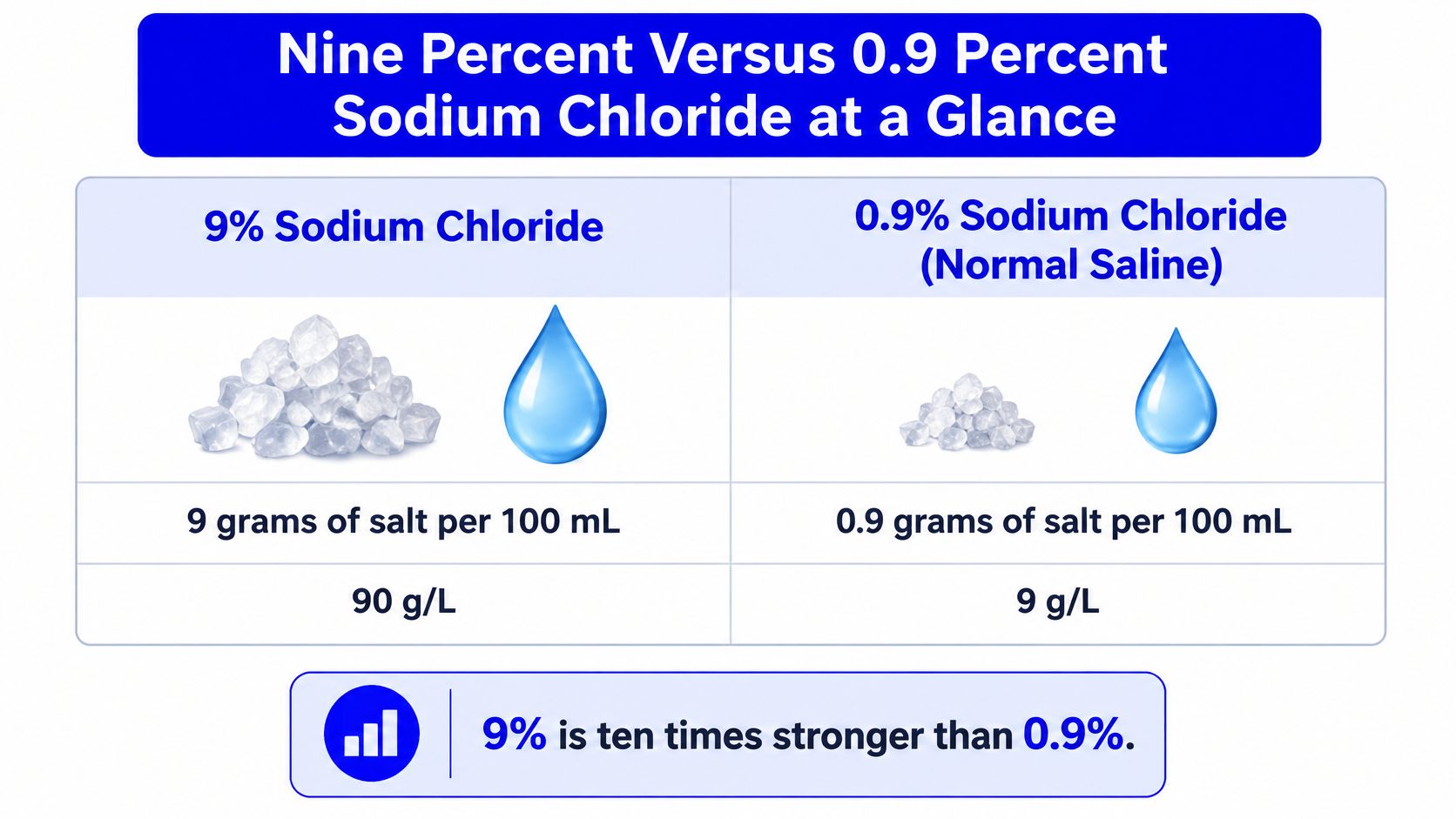
9 percent sodium chloride means a concentrate, not normal saline. On a weight-per-volume basis, the percentage describes grams of sodium chloride in the final solution volume, not grams added to that volume of water.
The NCBI normal saline reference describes 0.9% sodium chloride as 0.9 grams per 100 milliliters, equivalent to 9 grams per liter, with approximately 154 mEq/L each of sodium and chloride and a calculated osmolarity of about 308 mOsmol/L. The concentrated row below follows the tenfold increase in sodium chloride mass; its osmolarity is an ideal theoretical calculation rather than a measured specification.
0.9% and 9% sodium chloride compared
| Solution | Salt per liter | Sodium and chloride | Calculated osmolarity | Tonicity |
|---|---|---|---|---|
| 0.9% sodium chloride (normal saline) | 9 g | 154 mEq/L each | About 308 mOsmol/L | Isotonic |
| 9% sodium chloride | 90 g | About 1,540 mEq/L each | About 3,080 mOsmol/L (theoretical) | Hypertonic |
For another useful label conversion, the FDA sodium chloride label gives the normal-saline formulation equivalent to 9 mg/mL; scaling that mass concentration tenfold gives 90 mg/mL for the concentrate. These units describe salt mass, not sodium mass alone.
The comparison makes the decimal-point difference visible.
Why the labels get confused
Both products may be described informally as saline. Decimal marks can disappear in handwritten notes, abbreviated stock lists or translated catalogues. A researcher who recognizes the word but doesn't read the concentration can select the wrong bottle before any calculation begins.
Container size creates another distraction. A large bottle isn't necessarily dilute, and a small vial isn't necessarily concentrated. The total volume and the concentration describe different properties.
The saline distinctions explained by Herbilabs provide additional context for separating the familiar name from the actual formulation.
A label check before opening
A practical check follows a fixed order:
- Percentage basis: Confirm whether the concentration is weight per volume. A bare percentage without its basis needs clarification.
- Volume: Distinguish the container's total contents from the final volume required by the preparation.
- Intended use: Identify whether the product is a stock reagent, an assay diluent, an irrigation product or a specifically labeled injectable preparation.
An independent read-back helps when transferring catalogue information into a worksheet. The researcher should compare the original label with the protocol, rather than comparing a newly written label with another transcription of the same information.
Practical rule: A label that says concentrated saline should be treated as a concentrated reagent until its composition and intended use are confirmed. The word saline isn't evidence that it is normal saline.
Why Nine Percent Behaves as Hypertonic, Not Isotonic
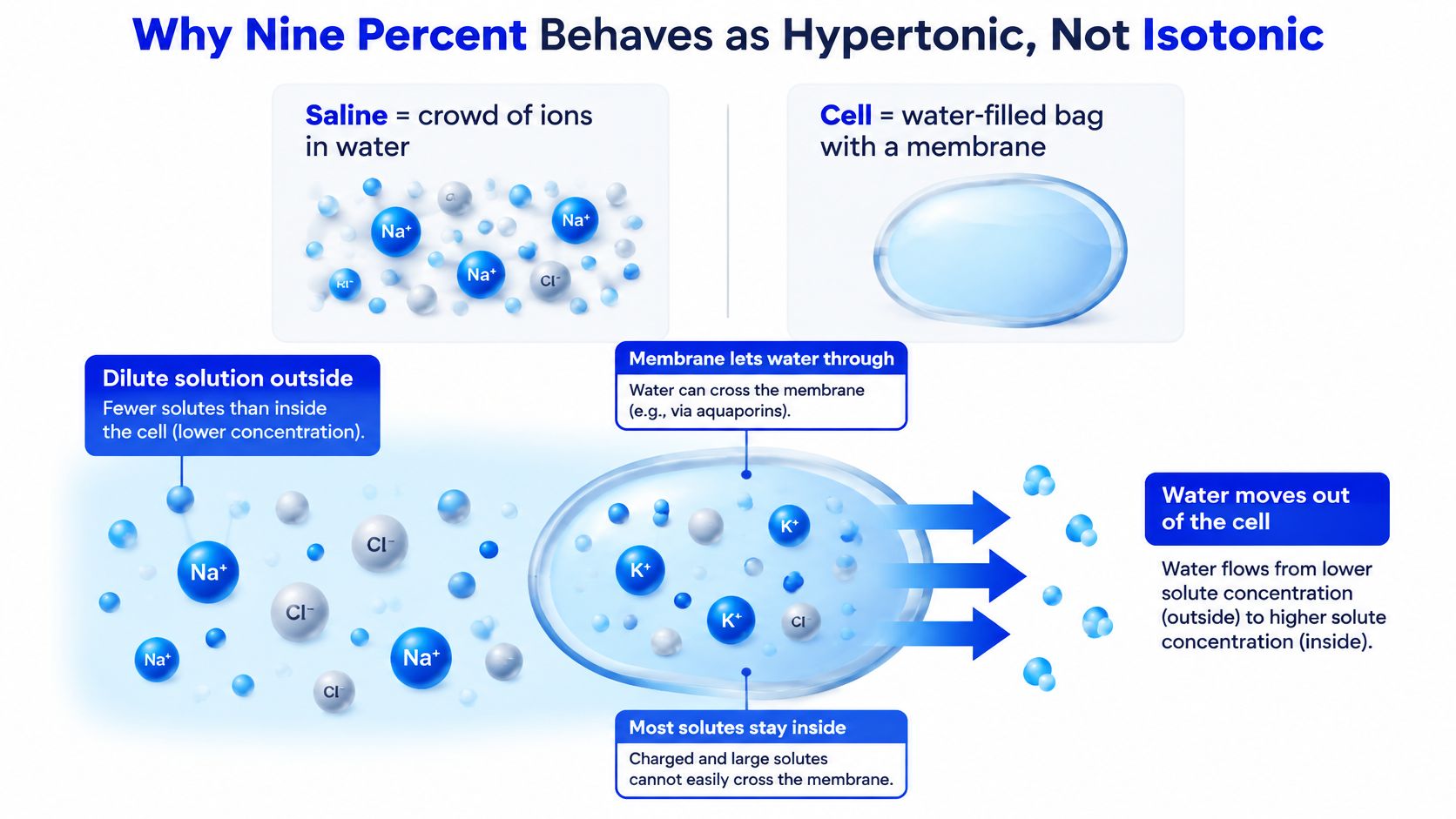
Saline can be pictured as a crowd of dissolved ions in water. A cell resembles a water-filled bag whose membrane allows water to move more readily than many dissolved substances. That analogy simplifies a complicated membrane, but it captures the direction of osmotic water movement.
If the surrounding medium has a lower effective solute concentration, water tends to enter the cell. If the surrounding medium is strongly hypertonic, water tends to leave. A concentrated external salt solution can therefore shrink a cell rather than hydrate it.
The membrane diagram illustrates that distinction. The important direction for hypertonic exposure is water moving outward toward the more concentrated environment.
From salt mass to osmotic particles
Sodium chloride separates into sodium and chloride ions in solution. Both contribute to the osmotic particle concentration, so counting only intact salt formula units would understate the ideal osmotic contribution.
Using the normal-saline composition in DailyMed's sodium chloride labeling as the baseline, 9% sodium chloride corresponds to approximately 1.54 mol/L NaCl and an ideal theoretical osmolarity of approximately 3,080 mOsmol/L, compared with 308 mOsmol/L for 0.9% saline. This calculation assumes near-complete dissociation and ideal particle behavior.
That difference matters during cell and vesicle work. Shrinkage changes geometry and membrane mechanics, so a researcher might measure the response to an unintended osmotic challenge instead of the response to the experimental treatment.
Protein preparations can also behave differently in a high-salt environment. Changes in solubility aren't proof that a material was contaminated or weighed incorrectly. The vehicle itself may be unsuitable.
Calculated osmolarity isn't measured osmolality
Osmolarity expresses osmotic particle concentration per volume of solution. Osmolality expresses it per mass of solvent. These terms shouldn't be substituted casually in preparation records.
At high salt concentration, ions interact, and the ideal calculation doesn't fully describe the measured behavior. A measured result should therefore retain its actual units, measurement temperature and method rather than being relabeled as the theoretical value.
Useful formulation records distinguish:
- Nominal concentration: The mass-per-volume specification used to prepare the solution.
- Measured property: The actual osmolality result when the experiment depends on osmotic conditions.
- Preparation role: Whether the material is a stock, a working reagent or a physiological preparation.
A visual explanation can help connect membrane behavior with the preparation decision.
The decisive protocol question is whether the experiment requires an intentional osmotic challenge or an isotonic environment. A high-salt stock isn't automatically the correct stress medium, and 9% saline must never be called isotonic or substituted directly for normal saline.
Where Labs Use Nine Percent Sodium Chloride
A concentrated sodium chloride solution belongs in a laboratory because a documented method requires its salt content, not because saline sounds like a generally gentle vehicle. Its usefulness depends on the final assay environment, the material being exposed and the purpose of the step.
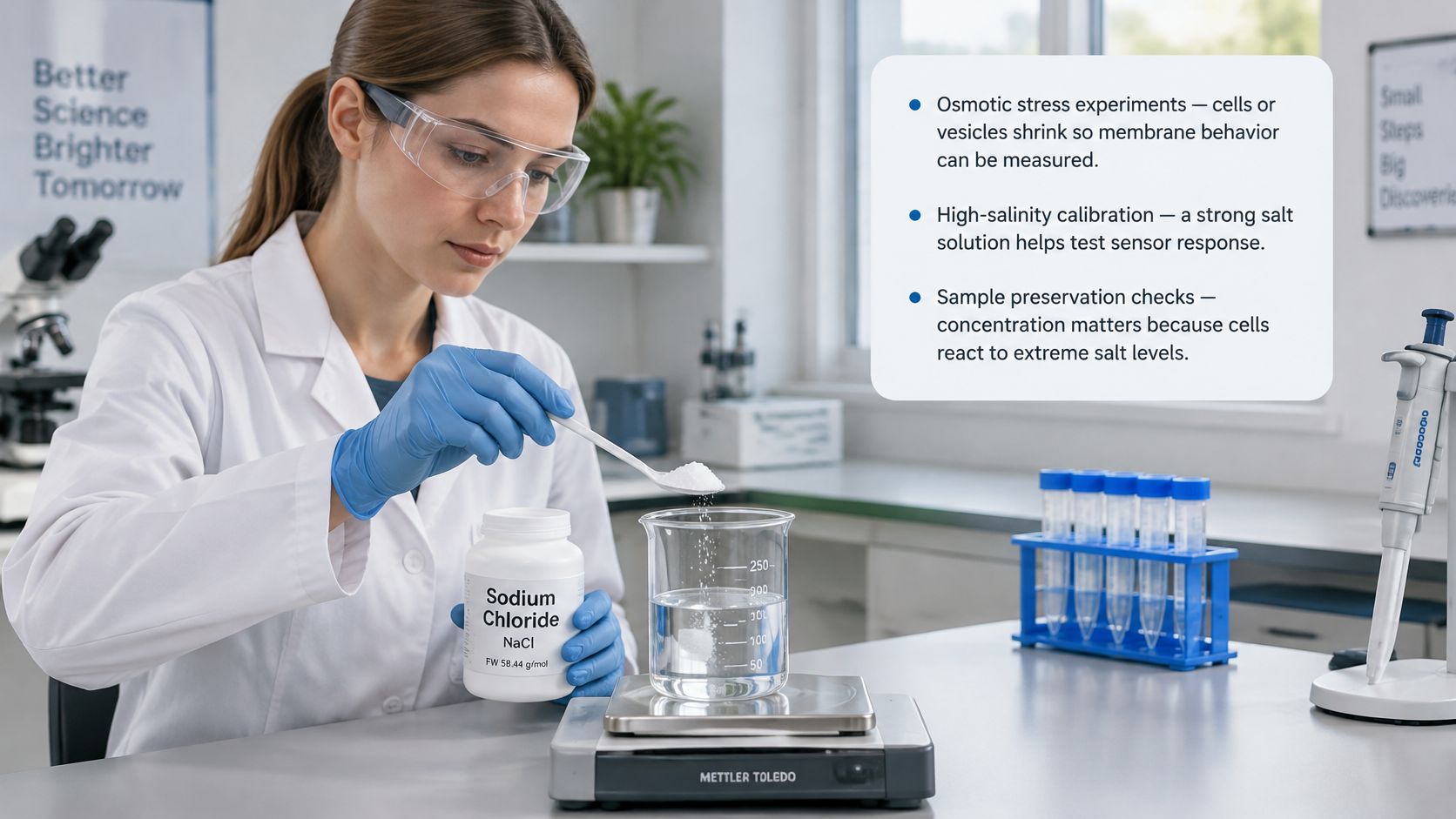
A bench preparation should begin with a balance, a suitable mixing vessel and a defined final-volume procedure. The image below shows salt handling during laboratory preparation, not evidence that any particular formulation is appropriate for every assay.
Applications depend on the method
Potential roles for concentrated NaCl include the following, only where the protocol validates the chosen strength:
- Osmotic-stress experiments: Researchers can deliberately expose cells or vesicles to a hypertonic environment to investigate membrane response. The wrong working concentration can turn a controlled challenge into an uninterpretable injury response.
- Protein and salt-solubility work: Salt can alter protein solubility and association. An unsuitable concentration may cause precipitation where the method requires a soluble preparation.
- Stock-solution preparation: A concentrated stock can supply salt to later working solutions. The final formulation must include salt contributed by buffers and other reagents, not just the stock addition.
- Membrane and vesicle studies: Defined ionic conditions help distinguish a membrane's response to salt from its response to another treatment. Uncontrolled ionic strength introduces an additional experimental variable.
- Validated regeneration steps: Some salt-based procedures use concentrated solutions to displace bound material from a resin or other surface. The resin manufacturer's regeneration method governs suitability; sodium chloride isn't a universal regeneration reagent.
These are workflow categories, not a recommendation that every example requires this particular concentrate. A method that calls for concentrated salt may require a different composition, buffer system or exposure period.
The saline concentration and purity considerations help distinguish a solution's chemical role from its quality specifications.
The clinical boundary stays separate
9 percent sodium chloride isn't a routine intravenous replacement fluid. Clinical hypertonic-saline treatment involves specifically selected formulations, indications and monitoring, rather than an improvised substitution from laboratory inventory.
Even a labeled medical diluent has limits. A DailyMed reconstitution-product label directs users to the drug manufacturer's instructions, illustrating why the identity of the salt alone doesn't authorize a mixture or route of administration.
Laboratory dilution doesn't convert a research reagent into a clinical product. Sterility, endotoxin control, packaging, compatibility and intended route remain independent requirements. The research applications described here apply to documented non-clinical workflows, not administration to people or animals.
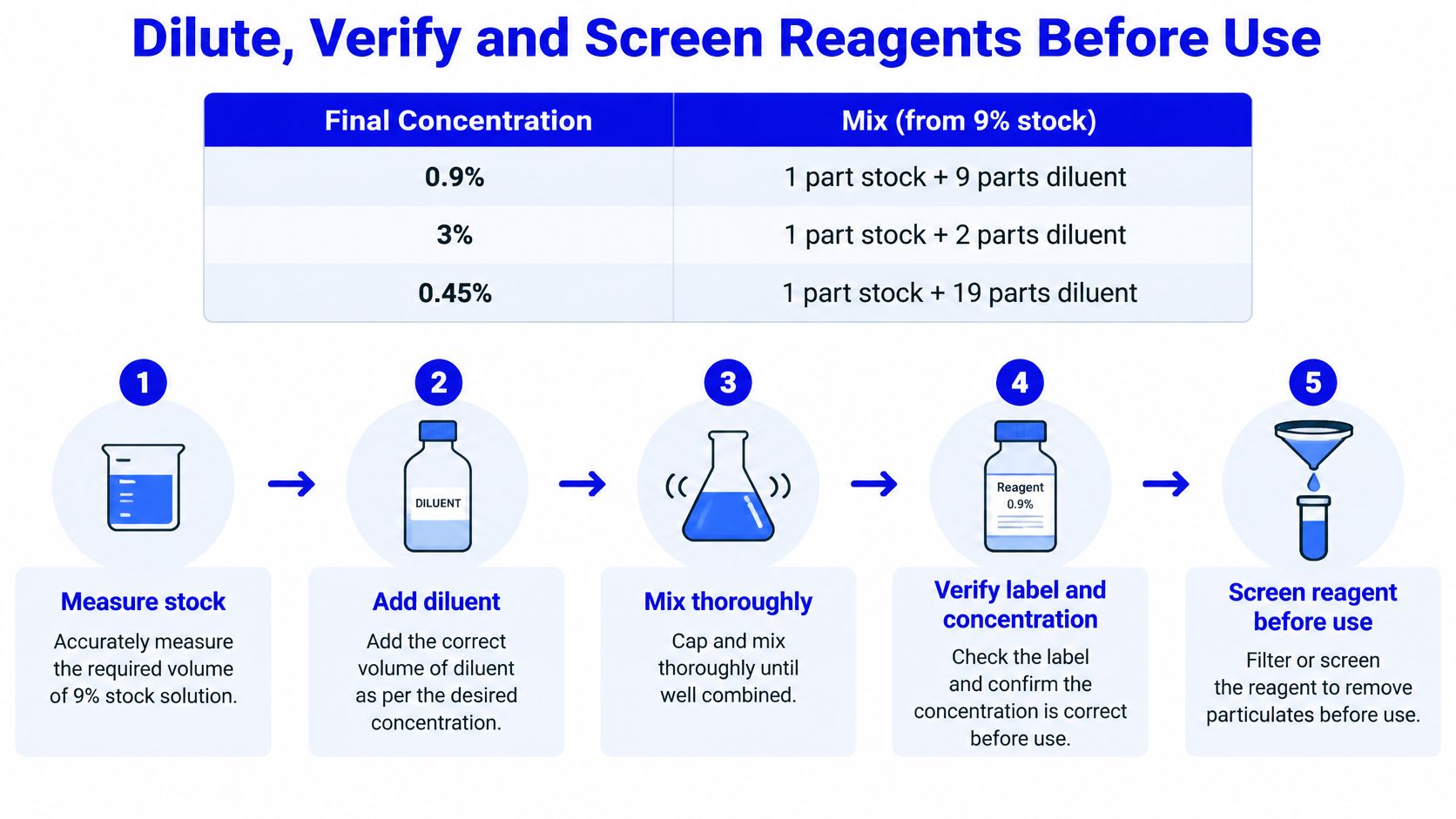
Dilute, Verify and Screen Reagents Before Use
Dilution ratios from a 9% sodium chloride stock
| Target concentration | Parts of 9% stock | Parts of diluent | Check |
|---|---|---|---|
| 0.9% | 1 | 9 | 9% divided by 10 gives 0.9% |
| 3% | 1 | 2 | 9% divided by 3 gives 3% |
| 0.45% | 1 | 19 | 9% divided by 20 gives 0.45% |
These ratios are calculated using C₁V₁ = C₂V₂, with a salt-free diluent and controlled final volume; the NCBI hypertonic-saline reference explains the osmotic water redistribution that makes concentration control important. The ratios are a preparation lookup, not instructions for clinical compounding.
The workflow pairs measurement with verification rather than leaving the concentration check until after use.
A controlled dilution routine
- Confirm the starting material. Verify the weight-per-volume basis against the original label. Record the stock lot, expiry, starting concentration and solvent quality before transferring material.
- Calculate the stock volume. Rearrange the dilution equation to V₁ = C₂V₂/C₁. The target volume means the final solution volume, not the volume of diluent added.
- Select suitable measuring equipment. Use calibrated pipettes for stock transfers and volumetric glassware for the final volume. Gravimetric checks can support precision when the procedure accounts for solution density.
- Mix and establish final volume. Add stock to a portion of the diluent, mix, then bring the preparation to the required final volume. Calculate final sodium and chloride contributions from all ingredients.
- Label and document. Include final concentration, preparation date, diluent and research-use status. Record stock volume, diluent addition, final volume, appearance, relevant pH, storage conditions and freeze-thaw history.
- Verify assay-critical properties. Measure osmolality when tonicity affects interpretation, documenting temperature and instrument method. An arithmetic check doesn't replace a required analytical measurement.
A worksheet or calculator can help calculate concentration after reconstitution, but the operator still has to enter the correct starting formulation. Reading the concentrate as normal saline makes an otherwise correct calculation wrong at its starting point.
For teams reviewing measurement quality, the experimental results guidance from Polymerize offers additional context for organizing reliable experimental measurements.
Screen compatibility before committing a batch
The FDA diluent labeling warns that some products are incompatible with saline and directs preparation according to the product manufacturer's vehicle, dilution and volume instructions. It also supports inspection for unexpected appearance changes.
A small-scale screen should proceed in a defined sequence:
- Read the reagent datasheet. Identify the specified vehicle, permitted salt conditions and any concentration limits.
- Prepare a test portion. Use the intended working formulation rather than testing only the stock or an unrelated buffer.
- Inspect immediately and after storage. Check for precipitation, cloudiness, discoloration and particles over the planned holding period.
- Test function. Run an assay-specific stability or activity check before scaling up.
Sterile doesn't mean chemically compatible, and a clear solution doesn't prove that a protein retained its activity.
Evaporation and incomplete mixing can change the working concentration. Adsorption to container surfaces can reduce available reagent even when the salt calculation remains correct. Small-scale screening separates these questions before valuable material is committed.
Safety and Handling Rules for Concentrated Saline
Concentration, volume and exposure route determine the hazard. A laboratory splash, an accidental ingestion and an intravenous exposure aren't interchangeable events, and the response must match the incident.
The FDA sodium chloride safety label warns that even 0.9% sodium chloride can cause fluid and solute overload, hypernatremia, overhydration and congested states including pulmonary edema, particularly in people with heart failure, severe renal insufficiency or sodium-retention conditions. The same label also reports hyponatremia and associated neurologic complications, demonstrating why patient condition, administered volume and monitoring matter.
These are medical-administration warnings, not a claim that ordinary bench contact causes all those outcomes. They establish a narrower, important point: isotonic doesn't mean risk-free, and a concentrated stock shouldn't receive less control because its ingredient is familiar.
Prevent the wrong-container error
At the bench, the most preventable serious mistake is allowing a concentrate to resemble a ready-to-use diluent. A well-written label helps, but physical separation provides another barrier when someone is rushed or working from an incomplete handover.
- Keep the original container sealed. Follow the datasheet's storage instructions and inspect the closure before use.
- Separate incompatible roles. Store concentrated salt stocks away from ready-to-use diluents and anything that could be mistaken for infusion fluid.
- Protect eyes and skin. Wear safety glasses and suitable gloves while pouring, transferring or diluting.
- Contain transfers. Use a spill tray, a stable rack and vessels appropriate for the volume being handled.
- Identify every aliquot. Mark concentration and preparation date clearly, retaining traceability to the parent stock.
- Use the institutional waste route. Send concentrate through the designated chemical-waste system unless local rules explicitly permit the relevant saline waste to enter the drain.
A color-coded cap may supplement a written label, but it shouldn't replace one. Shared laboratories need labels that remain understandable to someone outside the immediate project team.
Respond to the actual exposure
For a skin or eye splash, begin rinsing with water and follow the product safety data sheet and institutional exposure procedure. Remove contaminated gloves or clothing when appropriate, and obtain medical assessment for eye exposure, persistent symptoms or significant contact.
Suspected ingestion or accidental administration requires prompt medical advice. The product label, concentration and available exposure details should accompany the report; improvised correction with another fluid isn't an appropriate laboratory response.
Handling principle: Familiar chemistry still needs controlled identification, storage and transfer.
Higher concentrations justify tighter safeguards around access and preparation. The goal isn't to treat sodium chloride as an exotic chemical. It's to prevent an ordinary reagent from being used in an extraordinary and unintended way.
If your protocol calls for a preserved diluent, see our bacteriostatic water for research use, supplied with a COA for every lot.
Choose the Right Saline Strength for Your Work
Saline strengths on one scale
| Formulation | Salt per liter | Calculated osmolarity | Tonicity |
|---|---|---|---|
| 0.45% sodium chloride (half-normal) | 4.5 g | About 154 mOsmol/L | Hypotonic |
| 0.9% sodium chloride (normal saline) | 9 g | About 308 mOsmol/L | Isotonic |
| 3% sodium chloride | 30 g | About 1,027 mOsmol/L | Hypertonic |
| 5% sodium chloride | 50 g | About 1,711 mOsmol/L | Hypertonic |
| 9% sodium chloride | 90 g | About 3,080 mOsmol/L (theoretical) | Hypertonic |
The reference values use ideal NaCl dissociation and proportional mass-concentration calculations. They are calculated comparisons, not measured osmolality specifications, and their purpose is to distinguish formulations rather than authorize a substitution.
Match the protocol before matching the bottle
A formulation decision should begin with the exact method wording:
- Normal saline or isotonic saline: The intended sodium chloride formulation is 0.9%, unless the method explicitly defines a different complete medium.
- Half-normal saline: The named sodium chloride formulation is 0.45%. It shouldn't be selected merely because a researcher wants a vaguely gentler diluent.
- Hypertonic medium or osmotic stress: Confirm the exact composition, target concentration and exposure conditions. Use 9% only when a documented calculation and validated method support it.
The table doesn't establish biological equivalence between salt solutions and complete assay media. Buffers, sugars and other dissolved components can contribute to osmotic conditions, so sodium chloride concentration alone may not describe the finished preparation.
A procurement record should therefore include the full chemical name and concentration basis. An order reading only saline leaves too much room for interpretation.
A preservative percentage isn't a salt percentage
Another label trap appears on bacteriostatic water. The percentage may describe benzyl alcohol, not sodium chloride. The ingredient beside the number matters as much as the number itself.
Herbilabs Reconstitution Solution 10 mL is a sterile, non-pyrogenic, ready-to-use water solution containing 0.9% (9 mg/mL) benzyl alcohol as a bacteriostatic preservative. Its composition is WFI water (99.1%) and benzyl alcohol (0.9%); it is supplied for research use only and is not for administration to humans or animals.
That formulation is a preserved water diluent, not normal saline. Its multi-dose format supports repeated withdrawals under appropriate aseptic handling, but the preservative doesn't establish compatibility with every peptide, protein or antibody.
Before ordering a bacteriostatic diluent for research reconstitution, the researcher should match the preservative, sterility requirements and research-use labeling to the reagent protocol. When the method specifies preservative-free water, buffered saline or another vehicle, the presence of benzyl alcohol is a meaningful formulation difference, not an optional detail.
The correct purchase is the formulation the experiment requires, not the product with the most familiar percentage.
Herbilabs offers sterile bacteriostatic reconstitution solutions and related labware for research-use workflows. Researchers can visit Herbilabs to review formulation details and select a diluent that matches the protocol's preservative, packaging and intended-use requirements rather than relying on the word saline.