Private Label, White Label, Wholesale partnerships available - EU, USA and UK - Free shipping from €75

Is Acetic Acid Water Soluble? a Lab Guide
How freely does acetic acid dissolve in water? Completely: its reported solubility is approximately 602.9 g/L at 25 °C per its safety data sheet, and the two liquids merge into a single phase in any ratio. Water never runs out of room for it.
That answer covers the easy part. What a clear, uniform solution still leaves open is whether acetic acid keeps the same molecular behavior once dissolved, whether the mixture suits a sensitive substrate or living system, and whether it can serve as a sterile diluent for a given procedure. Dilution also leaves the acid's corrosive and flammable hazards in place, so concentration, compatibility, and handling each deserve separate attention before the flask goes on the bench.
Table of Contents
- Acetic Acid and Water Solubility
- Miscibility Versus Ordinary Solubility
- What Happens When Acetic Acid Mixes With Water
- Glacial and Aqueous Acetic Acid Compared
- How to Dilute Acetic Acid Safely
- Why Miscibility Doesn't Guarantee Compatibility
- Choosing the Right Diluent for Research Work
Acetic Acid and Water Solubility
Does a crystal-clear mixture prove the chemistry stayed simple? Acetic acid and water are fully miscible, so a researcher can combine them in any proportion and get one uniform phase.
Treat that result as a mixing check. The experiment still needs separate approval. Once dissolved, acetic acid releases H+ to water and sits in an acetate/acetic acid balance set by pH. A buffer, protein, metal surface, or solvent-sensitive assay may respond to that equilibrium even though the liquid looks homogeneous.
Full miscibility also leaves practical limits in place. It does not make water a sterile diluent, remove corrosion, or erase flammability. Concentrated acid still needs ventilation, compatible materials, eye protection, and controlled addition during dilution. Performance in a different setting is a separate question too; the debate summarized in this household disinfectant efficacy evidence should not be read as proof that a vinegar-derived dilution suits lab work.
Practical rule: judge the final medium, not the clarity. Concentration, pH, other ingredients, sterility, and handling risks remain live variables after the layers disappear.
Miscibility Versus Ordinary Solubility
Solubility describes whether one substance can dissolve in another. For instance, sugar dissolves in water, producing a mixture in which the sugar is distributed through the liquid.
Miscibility is a more specific term for two liquids that form one uniform phase when mixed. Acetic acid and water are miscible, while oil and water typically separate into layers. That visual comparison is useful when reading a reagent label or an SDS: “miscible” describes the relationship between two liquids, not the behavior of every material that might later be added.
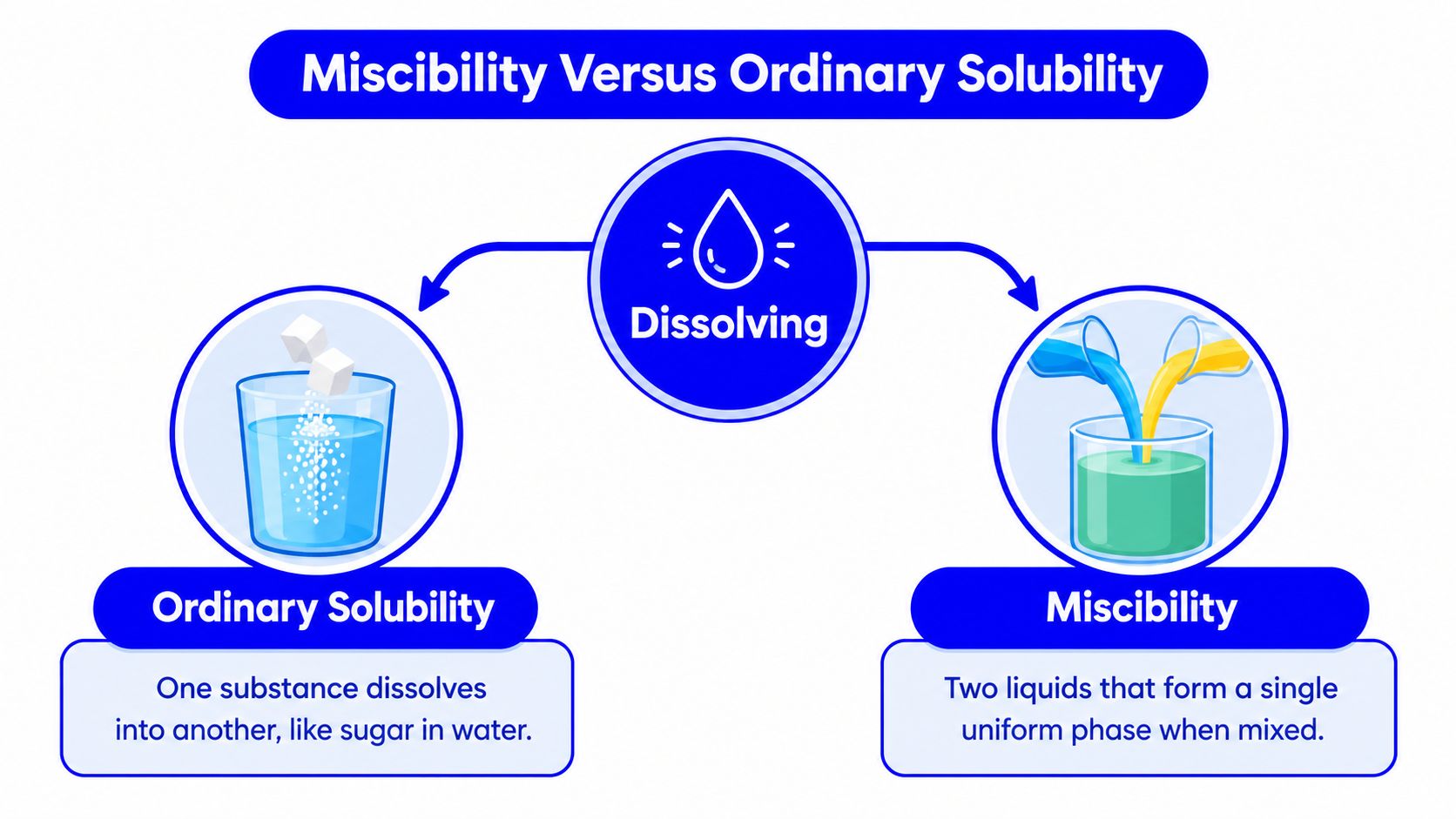
The common search phrase “water soluble” is understandable, but miscible more precisely describes acetic acid's behavior as a liquid mixed with water. The terms don't tell a researcher whether the resulting medium will dissolve a second substance. Acetic acid's ability to mix with water and its ability to dissolve another compound are separate questions.
This distinction helps make sense of labels and protocols. “Aqueous” indicates that water is part of the solution; “concentrated” describes the reagent's condition; and “miscible” describes how two liquids behave together. None of these descriptions, by itself, guarantees that a peptide, salt, or other added material will remain dissolved.
What Happens When Acetic Acid Mixes With Water
A clear mixture can still hold more than one chemical form. Once acetic acid enters water, its molecules begin exchanging protons with the surrounding water molecules, and the system settles into an acid-base equilibrium containing undissociated acetic acid, acetate ions, and hydrogen ions. The eye sees one uniform liquid; at the molecular level, several species share the space.
As noted earlier, the reported pKa of acetic acid is about 4.756 at 25 °C. That value places acetic acid among the weak acids, meaning most molecules keep their proton while a fraction hand one to water at any given moment. It cannot predict the pH of a particular preparation on its own, because the final acidity depends on the concentration and everything else dissolved in the mixture.
For laboratory work, the properties worth checking include:
- pH, which describes the solution's acidity.
- Buffer capacity, which concerns how the solution responds to added acid or base.
- Ionic strength, which reflects the presence and concentration of ions.
- Compatibility, which depends on the materials and conditions involved.
These properties shift with acid concentration and with the surrounding solution. A preparation containing other reagents can behave differently from a simple acid-and-water mixture, even when both look equally clear.
The safe reading is simple: a single visible phase proves that mixing happened, nothing more. It does not show that every dissolved species kept its original behavior, that the mixture can serve as a sterile diluent, or that the handling hazards disappeared. Those judgments require information about the full formulation and the intended procedure.
Glacial and Aqueous Acetic Acid Compared
The bottle label matters. Glacial acetic acid refers to the concentrated form; aqueous acetic acid has already been mixed with water. Both belong to the same acetic-acid-and-water system, but their concentrations and handling implications differ.
| Form | Relationship With Water | Handling Implication | Record In the Protocol |
|---|---|---|---|
| Glacial acetic acid | Miscible with water | Treat as concentrated, corrosive, flammable reagent; dilute with care | Record that the starting reagent was glacial and document the prepared concentration |
| Aqueous acetic acid | Already mixed with water; remains miscible with additional water | Follow precautions appropriate to the actual concentration and procedure | Record the reagent concentration and any further dilution |
A researcher transferring a reagent to a colleague should preserve the concentration information, not just write “acetic acid.” The same name can refer to a concentrated starting reagent or a prepared aqueous solution, and those aren't interchangeable descriptions in a protocol.
Concentration also affects how the material should be handled. Aqueous dilution doesn't erase the need to consult the applicable safety documentation or follow the laboratory's approved procedure. Keep the reagent's form clear in labels, preparation records, and handoffs so that another researcher can understand what was used and how the working solution was made.
How to Dilute Acetic Acid Safely
A clear, repeatable dilution procedure starts with the correct container, the required quantities, and appropriate protective equipment. Concentrated acetic acid can create heat when mixed with water, so the order of addition and control of the mixing process matter.
- Prepare the setup. Use an appropriate container and follow the laboratory's risk assessment. Wear suitable protective equipment and work with controlled laboratory ventilation.
- Add water first. Measure the required aqueous component into the container before adding acid.
- Add acid slowly to water. Stir gently while allowing heat to dissipate. Cool the mixture when needed, rather than rushing the preparation.
- Verify and label. Check the prepared concentration using the method specified by the protocol, then label the solution and record how it was made.
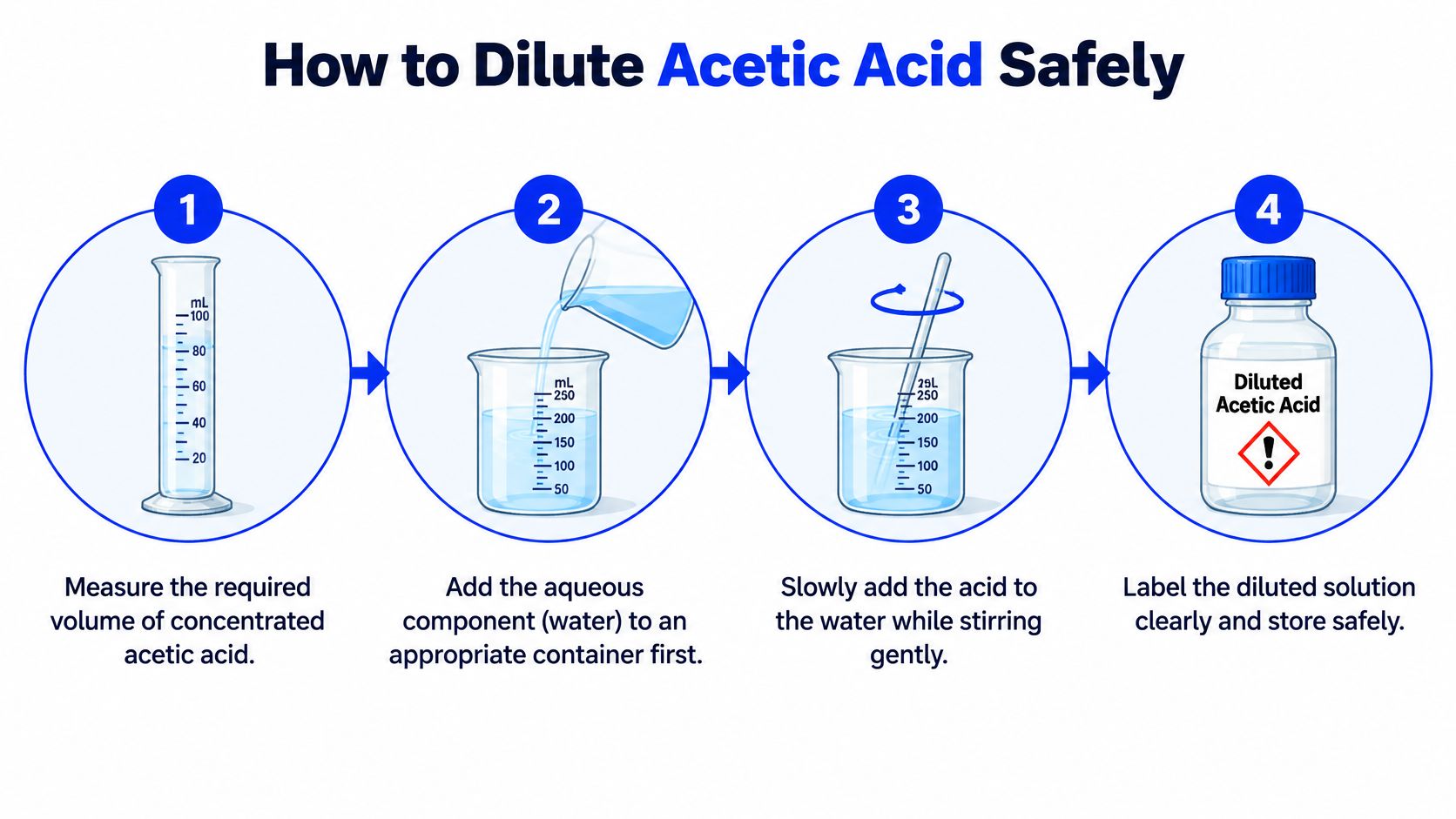
The addition order is important because mixing concentrated acid and water can release heat. Adding the acid gradually to the water gives the researcher more control over the mixing and heat dissipation. Don't treat heating as a general shortcut for improving dissolution: high temperature can increase handling hazards and may affect sensitive materials.
A solution's clear appearance isn't a concentration check. The prepared amount should be verified and documented according to the relevant procedure, with any cooling or other preparation conditions recorded when they affect reproducibility.
For broader laboratory handling practices, consult the Herbilabs reagent safety guide. The laboratory's own approved procedure and the reagent's safety documentation should guide the specific controls used.
Why Miscibility Doesn't Guarantee Compatibility
Acetic acid's miscibility with water tells researchers how those two liquids combine. It doesn't predict how a third substance will behave. A material may become less soluble as the composition of the solvent changes, even when the solvent itself mixes fully with water.
A published phase study of oxalic acid in acetic-acid-and-water mixtures reported that oxalic acid solubility decreased at higher acetic-acid concentrations (phase study of oxalic acid in acetic-acid and water mixtures). That finding applies to the studied system; it isn't a universal rule for every compound. Its broader lesson is that solvent composition can affect a second solute in ways that the word “miscible” cannot capture.
The same caution applies when researchers work with peptides, proteins, salts, excipients, or analytical standards. Each material needs a separate compatibility and stability assessment under the intended formulation conditions. A clear solution doesn't establish that an added substance remains dissolved or retains the properties required for the work.
A reproducible decision process records the identity of the second solute, the target concentration, and the relevant solution conditions. Then the researcher verifies compatibility rather than assuming it from acetic acid's behavior with water. For researchers considering peptide preparation, this guide for peptide reconstitution addresses the separate question of choosing an appropriate diluent.
Choosing the Right Diluent for Research Work
Three decisions should stay separate: Will acetic acid mix with water? Will the material being added remain compatible? Is the resulting solution appropriate for the intended application? A yes to the first question doesn't answer the other two.
Acetic acid isn't interchangeable with sterile water, bacteriostatic water, or a validated reconstitution diluent. Introducing it changes the formulation environment, even when the mixture appears uniform. Researchers should follow the relevant protocol or compatibility assessment to determine whether a particular diluent is suitable for their work.
The term “dilution ratio” can also mean different things across applications. For a general comparison of how ratios are discussed in another formulation context, see this explanation of vape formulation dilution ratios. That resource doesn't establish compatibility for laboratory materials; it illustrates why a ratio needs to be tied to a defined formulation and purpose.
Before preparing a solution, confirm that the record identifies:
- The material being diluted and the purpose of the preparation.
- The acid form and concentration used, if acetic acid is part of the procedure.
- The addition order and heat control needed for safe preparation.
- The final concentration, verified and recorded before use.
- The required diluent, including a sterile or validated option when the workflow calls for one.
When a procedure specifies a dedicated product, use the named reconstitution solution rather than treating acetic acid and water as a substitute. This keeps solvent mixing, material compatibility, and application suitability distinct in the preparation record.
Herbilabs offers sterile bacteriostatic water and reconstitution solutions in multiple vial formats for research-use-only workflows. Review the product and documentation details at Herbilabs to identify a diluent suited to the applicable protocol.