Private Label, White Label, Wholesale partnerships available - EU, USA and UK - Free shipping from €75

Bacteriostatic Water with Sodium Chloride: A Practical Guide
The most popular advice about peptide reconstitution is also the least precise: “Just use bacteriostatic water.” That shortcut treats plain bacteriostatic water and bacteriostatic water with sodium chloride as interchangeable, even though one is a water-based vehicle and the other adds an isotonic saline matrix.
That distinction matters in research workflows. The solute can affect tonicity, ionic strength, compatibility, solubility, and downstream assay behavior. Bacteriostatic sodium chloride is also labeled for a narrow purpose, dilution or dissolution of drugs intended for intravenous, intramuscular, or subcutaneous use, rather than fluid or sodium chloride replacement, as described in the product description for bacteriostatic sodium chloride injection. The right question isn't which product is more popular. It's which vehicle matches the lyophilized material and the final workflow.
Table of Contents
- Why Sodium Chloride Changes the Bacteriostatic Water Decision
- What Bacteriostatic Water With Sodium Chloride Actually Contains
- Plain Bac Water Versus Bacteriostatic Saline Compared
- Reconstitution Use Cases for Peptides Proteins and Antibodies
- Multi-Dose Handling and the 28-Day In-Use Window
- Procurement Quality Documentation and Supply Considerations
- Which Product to Choose for Your Research Workflow
- Common Questions About Bacteriostatic Sodium Chloride
- Is bacteriostatic sodium chloride the same as bacteriostatic water?
- Is it a replacement for ordinary saline?
- Can the reconstituted material be frozen?
- Does benzyl alcohol suit every protein formulation?
- Why does the 28-day window matter if liquid remains?
- Is bacteriostatic saline appropriate for every cell culture workflow?
Why Sodium Chloride Changes the Bacteriostatic Water Decision
Plain bacteriostatic water contains a sterile water vehicle and a preservative. Bacteriostatic water with sodium chloride contains the same general preservation concept, but it also introduces sodium chloride at 0.9%, changing the chemical environment surrounding the reconstituted material.
That difference can be easy to miss because both products are supplied for repeated withdrawals and both are commonly used as reconstitution diluents. Yet the preservative isn't the only variable. The saline version creates an isotonic matrix, while plain bacteriostatic water begins as a water-only vehicle with benzyl alcohol. Once a compound dissolves, the final tonicity depends on the compound, the diluent, and any additional buffer or excipients.
The default choice can create a compatibility problem
A concentrated research peptide may dissolve adequately in plain bacteriostatic water, especially when the final assay transfers the material into a separately prepared buffer. In that workflow, adding sodium and chloride may offer no practical advantage and can introduce an unnecessary formulation variable.
Other materials need a different starting point. Tonicity-sensitive cell assays, protein preparations, and workflows designed around saline-based matrices may behave more consistently when the reconstitution vehicle already contains sodium chloride. The choice should follow the compound's documented compatibility requirements, not a general rule repeated by suppliers or consumer-facing pages.
The distinction is especially important for proteins and antibodies. Charged molecules respond to their ionic environment, and a change in ionic strength can influence solubility, association, or handling. That doesn't mean saline is automatically safer for every protein. It means the saline formulation deserves explicit consideration rather than being dismissed as plain bac water with a different label.
Practical rule: Treat sodium chloride as an active formulation variable, not as a cosmetic addition to bacteriostatic water.
The historical standardization of 0.9% saline is associated with a formulation whose use is believed to trace back to the 1831 cholera pandemic in Europe. The modern USP framework distinguishes bacteriostatic sodium chloride from plain sodium chloride injection by specifying an isotonic sodium chloride solution with one or more antimicrobial agents, with sodium chloride content between 0.85% and 0.95%. The USP monograph for bacteriostatic sodium chloride injection also reflects the critical neonatal warning for benzyl alcohol-containing products.
What Bacteriostatic Water With Sodium Chloride Actually Contains
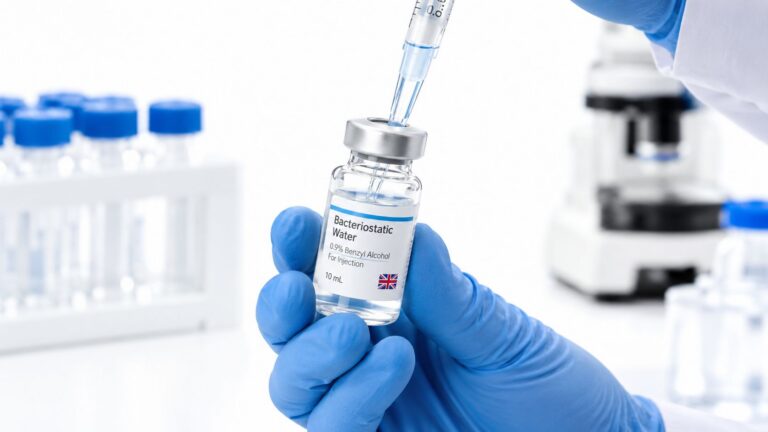
The phrase bacteriostatic water with sodium chloride can sound like a hybrid product assembled from two separate solutions. In practice, it describes a sterile, nonpyrogenic, isotonic sodium chloride solution in water for injection that contains benzyl alcohol as the antimicrobial preservative.
The core formulation contains sodium chloride at 9 mg/mL, or 0.9%, and benzyl alcohol at 9 mg/mL, or 0.9%. The labeled pH range is 4.5 to 7.0, and the product is supplied as a multiple-dose container for repeated withdrawals. The manufacturer safety documentation for bacteriostatic sodium chloride describes the composition and the product's role as a diluent or solvent used according to the instructions for the drug being reconstituted.
Ingredient Breakdown Bacteriostatic Saline vs Bacteriostatic Water
| Component | Bacteriostatic Water (Plain) | Bacteriostatic Water with Sodium Chloride |
|---|---|---|
| Water vehicle | Sterile, nonpyrogenic water | Sterile, nonpyrogenic water |
| Sodium chloride | Absent | 9 mg/mL, or 0.9% |
| Benzyl alcohol | 0.9% preservative | 0.9% preservative |
| Tonicity | Water-only starting vehicle, generally hypotonic before solute contribution | Isotonic saline matrix |
| Container format | Multiple-dose presentation when labeled as bacteriostatic | Multiple-dose presentation |
| Primary role | Dilution or dissolution of compatible drugs and research materials | Dilution or dissolution where an isotonic saline vehicle is appropriate |
| Labeled pH | Product-specific, check the vial documentation | 4.5 to 7.0 on the referenced product labeling |
The sodium chloride changes more than the measured salt content. It alters ionic strength and osmotic conditions, which can affect how charged peptides, proteins, and antibodies behave after reconstitution. A material that dissolves clearly in plain bac water may still require a different vehicle for a cell-based assay or a saline-compatible downstream application.
Benzyl alcohol serves a separate function. It helps suppress microbial growth in a multi-dose container after repeated vial entry under aseptic conditions. It doesn't make the reconstituted compound chemically stable indefinitely, and it doesn't compensate for poor handling, contamination, or an unsuitable formulation.
For teams comparing product specifications, a bacteriostatic water for labs resource can help establish the baseline composition of plain bac water before a saline formulation is selected. The procurement record should still identify the exact SKU, because a generic “bac water” description doesn't establish whether sodium chloride is present.
Why the chloride content matters
Plain bac water and bacteriostatic saline can look similar in a purchasing catalogue, but they don't create the same starting conditions. The saline version may better match a protocol that expects an isotonic vehicle. Plain bac water may be preferable when the assay buffer supplies the required tonicity later or when the formulation needs the fewest added solutes.
Neither option should be selected solely because it has a preservative. Benzyl alcohol determines the bacteriostatic feature, while sodium chloride determines the saline character. Those are separate decisions packed into one vial.
Plain Bac Water Versus Bacteriostatic Saline Compared
The most useful comparison starts by separating preservation from tonicity. Both products can use 0.9% benzyl alcohol as the preservative, so antimicrobial preservation isn't the main reason to choose one over the other. The deciding factor is usually the composition of the vehicle surrounding the reconstituted material.
Plain bacteriostatic water offers a water-only base with preservative. Bacteriostatic saline offers that preservation approach plus 0.9% sodium chloride, creating a near-physiological saline matrix. The difference can influence solute compatibility, assay conditions, and how much formulation adjustment is needed later.
Plain Bac Water vs Bacteriostatic Saline Feature Comparison
| Criterion | Plain Bacteriostatic Water | Bacteriostatic Water with NaCl |
|---|---|---|
| Vehicle | Sterile water with benzyl alcohol | Sterile 0.9% sodium chloride solution with benzyl alcohol |
| Tonicity | Does not begin as an isotonic saline vehicle | Isotonic saline starting matrix |
| Preservative mechanism | Benzyl alcohol suppresses microbial growth | Benzyl alcohol suppresses microbial growth |
| Ionic environment | Minimal added ionic content from the diluent | Sodium and chloride ions are present from the start |
| Useful starting point | Concentrated peptide solutions and workflows that add assay buffer later | Saline-compatible proteins, antibodies, and tonicity-sensitive applications |
| Main formulation risk | Hypotonic conditions may be unsuitable for some downstream uses | Added salt may be incompatible with some compounds or analytical methods |
| Label interpretation | Use only according to the applicable product and drug instructions | Labeled only as a diluent or solvent, not for fluid or sodium chloride replacement |
| Multi-dose status | Depends on the labeled product presentation | Designed as a multiple-dose container when so labeled |
A common mistake is to describe the two solutions as functionally equivalent because both can dissolve a powder. Dissolution is only the first checkpoint. The resulting solution may then enter a cell assay, a protein-binding workflow, an analytical instrument, or another buffer system. A diluent that works at the vial stage can still create trouble downstream if its ionic environment conflicts with the assay.
What remains the same
The preservative does not become stronger just because sodium chloride is present. Bacteriostatic saline still depends on aseptic access, appropriate storage, intact packaging, and correct in-use dating. The saline component doesn't extend the practical life of an opened vial.
The label also matters more than the informal name. Bacteriostatic sodium chloride is not ordinary 0.9% sodium chloride injection, because plain saline contains no bacteriostatic antimicrobial agent. It also isn't bacteriostatic water, because plain bac water lacks sodium chloride. A purchasing system that collapses all three into “saline” or “bac water” creates avoidable traceability problems.
Reconstitution Use Cases for Peptides Proteins and Antibodies
The compound should determine the diluent. Vendor habit, forum advice, and the fact that a powder dissolves visibly aren't sufficient formulation criteria.
Peptides in concentrated research solutions
Many lyophilized research peptides are selected for a concentrated working solution. If the downstream assay transfers the reconstituted material into a prepared buffer, plain bacteriostatic water can be a logical starting vehicle. It keeps the initial formulation simple and avoids adding sodium or chloride when those ions aren't needed.
That doesn't make plain bac water universally correct. Some peptide sequences are sensitive to pH, ionic strength, or the final assay environment. A peptide that appears clear immediately after reconstitution can still perform differently after dilution into the working matrix. The protocol should therefore specify both the reconstitution vehicle and the destination buffer.
A suitable lyophilized powder reconstitution protocol should be treated as a starting reference, not as permission to substitute diluents without checking the material's documentation.
Proteins and antibodies
Proteins and antibodies deserve a more deliberate screen because their activity depends on conformation, surface charge, concentration, and the surrounding solution. A saline-based vehicle can be useful when the study requires an isotonic environment immediately after reconstitution or when the working solution will remain in a saline-compatible matrix.
The opposite decision can also be correct. Some protein formulations contain carefully selected buffers, sugars, surfactants, or stabilizers, and adding sodium chloride may alter the intended balance. The product insert or supplier specification should take priority over a general assumption that saline is gentler.
Diluent Choice by Compound Class
| Compound Class | Recommended Diluent | Reason |
|---|---|---|
| Research peptides for buffered analytical workflows | Plain bacteriostatic water, when compatible | Keeps the starting vehicle simple when tonicity is supplied later |
| Peptides for saline-based downstream use | Bacteriostatic saline, if specified as compatible | Begins with a saline matrix rather than requiring later tonicity adjustment |
| Soluble proteins | Either formulation, selected from compatibility data | Protein solubility can respond to ionic strength and excipient content |
| Monoclonal or polyclonal antibodies | Often saline-based when isotonic conditions are required immediately | Supports a saline-compatible working environment, subject to the antibody's instructions |
| Cell-based assay reagents | The formulation specified by the assay or reagent documentation | Cells can respond to osmotic and ionic changes |
| Materials with chloride sensitivity | Plain bacteriostatic water, if the preservative is acceptable | Avoids adding chloride when chloride exposure is a known concern |
A practical laboratory review asks three questions before the vial is opened:
- What is the intended final matrix? If the material will end up in a saline-based assay, starting with bacteriostatic saline may reduce a later formulation change.
- Does the compound have documented excipient restrictions? Benzyl alcohol and sodium chloride are separate variables, and either can matter.
- Will the solution be held for repeated withdrawals? A multi-dose workflow requires both a suitable formulation and disciplined handling.
The assay owner, not the diluent vendor, should make the final compatibility decision.
Multi-Dose Handling and the 28-Day In-Use Window
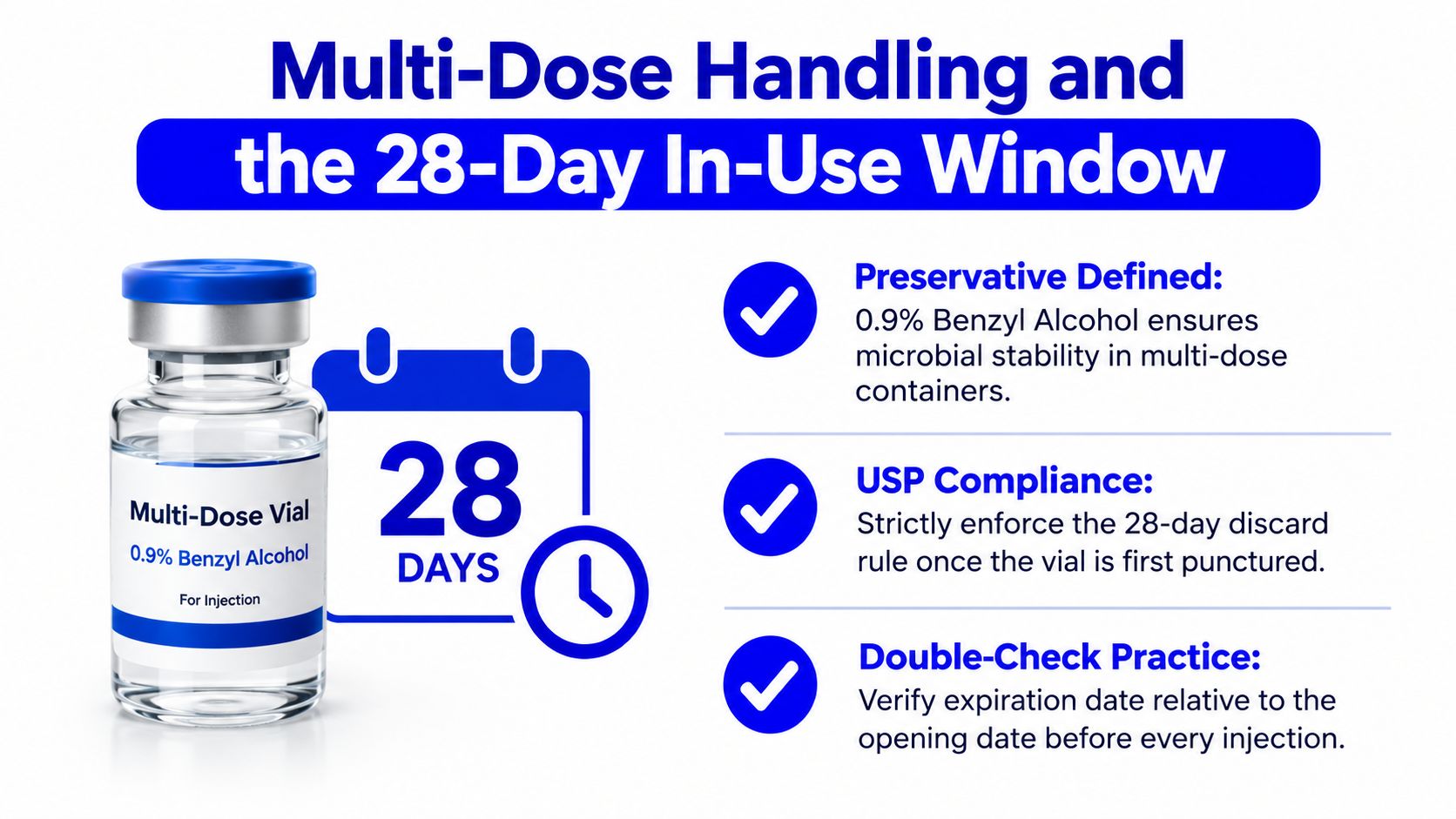
A multi-dose vial is not a guarantee that every withdrawal remains safe. The 0.9% benzyl alcohol preservative suppresses microbial growth, but repeated punctures still create contamination opportunities. The preservative doesn't regenerate after each entry, and it doesn't remove the need for aseptic technique.
The commonly applied 28-day in-use window begins when the vial is first punctured, not when the printed expiration date is reached. That convention is tied to multi-dose vial guidance and should not be interpreted as a guarantee of sterility for every preparation. The practical comparison of bacteriostatic water and bacteriostatic sodium chloride also emphasizes that preserved saline remains dependent on handling, storage, and the specific reconstituted solution.
What the preservative does and doesn't do
Benzyl alcohol is intended to inhibit microbial growth. It isn't a sterilization step performed after contamination, and it isn't a safeguard against endotoxin accumulation, particles, or chemical degradation of a reconstituted peptide or protein.
The sodium chloride concentration doesn't lengthen or shorten the in-use window. Plain bac water and bacteriostatic saline follow the same preservation logic when both are labeled as multi-dose bacteriostatic products.
- Date the first puncture: Record the opening date directly on the vial or in the batch record.
- Use sterile access equipment: A new sterile syringe and needle should be used for each withdrawal.
- Control storage: Follow the product label and avoid unnecessary temperature cycling.
- Inspect before use: Persistent cloudiness, particles, discoloration, or a damaged closure warrants quarantine and investigation.
- Discard on schedule: Remove the vial at the applicable in-use limit, even if liquid remains.
A laboratory handling reference on bacteriostatic water can support standard operating procedures, but it can't replace the specific product label or the laboratory's contamination-control requirements.
Handling principle: Preserved means growth is inhibited under intended conditions. It doesn't mean contaminated handling becomes acceptable.
Procurement Quality Documentation and Supply Considerations
A reliable diluent purchase starts with the documentation, not the product photograph. A saline formulation should be distinguishable from plain bac water on the label, the Certificate of Analysis, the shipment record, and the internal inventory system.
The CoA should identify the lot and confirm the characteristics relevant to the SKU. For bacteriostatic water with sodium chloride, that normally means checking sodium chloride content, benzyl alcohol content, pH, sterility, and endotoxin results where those tests are part of the supplier's release documentation. A generic certificate that confirms only sterility doesn't fully document the formulation.
Documents that should travel with the lot
- Certificate of Analysis: Confirms the tested attributes for the specific lot, including the saline and preservative components where applicable.
- Safety Data Sheet: Describes handling, storage, and hazard information associated with the product and its ingredients.
- Lot traceability: Connects the vial label, CoA, purchase record, and shipping paperwork to the same manufacturing run.
- Product specification: States whether the item is plain bacteriostatic water, bacteriostatic sodium chloride, or another sterile diluent.
- Research-use labeling: Keeps the intended non-clinical application clear within procurement and laboratory records.
Fill volume and packaging also affect workflow planning. Research groups commonly compare smaller and larger vial presentations based on projected use, the in-use window, storage capacity, and the risk of opening more material than a study can consume. A sealed, sterile, clearly labeled vial is more useful than a lower-cost container with unclear origin or incomplete lot records.
Procurement errors worth catching early
The most preventable error is SKU confusion. A purchase order may say “bacteriostatic water,” while the warehouse receives bacteriostatic sodium chloride, or the reverse. The mistake may not become visible until a formulation behaves differently in an assay.
Before release to the laboratory, the receiving check should compare:
- The product name on the purchase order.
- The ingredient list on the vial.
- The formulation named on the CoA.
- The lot number across every document.
- The labeled intended use and storage instructions.
Laboratory and reseller buyers looking to find reliable bacteriostatic water from Herbilabs should still match the selected product against the study protocol and required documentation. Supplier availability doesn't remove the need for formulation verification.
Which Product to Choose for Your Research Workflow
A practical decision starts with the final application, then works backward to the vial. The following framework keeps the choice tied to formulation rather than brand familiarity.
Choose plain bacteriostatic water when
- The research peptide is compatible with a water-based vehicle and will be transferred into a defined assay buffer.
- The protocol calls for minimal added solutes.
- Chloride or elevated ionic strength could interfere with the analytical method.
- The supplier's instructions specifically name plain bacteriostatic water.
- The laboratory needs a straightforward diluent for a concentrated intermediate solution.
Choose bacteriostatic saline when
- The material must enter an isotonic saline matrix immediately after reconstitution.
- The assay or working solution is sensitive to osmotic changes.
- A protein or antibody protocol specifies saline as the vehicle.
- The downstream formulation already depends on sodium chloride compatibility.
- The study benefits from keeping the reconstitution and working matrix chemically aligned.
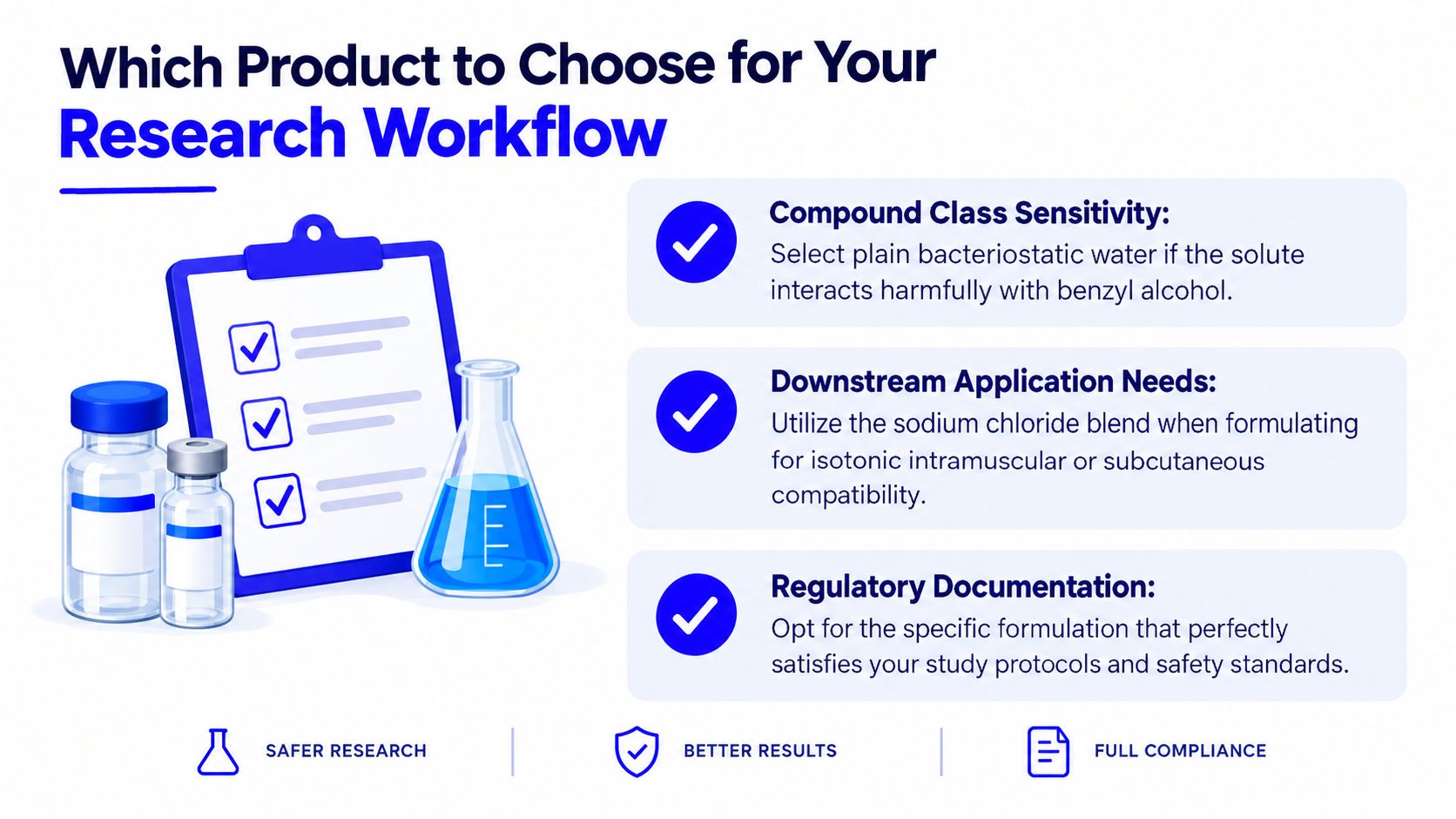
Check the formulation before choosing the vial
The protocol should identify the compound, the intended concentration, the final matrix, the storage plan, and the acceptable excipients. It should also state whether the work is analytical, cell-based, or focused on a protein or antibody reagent.
A useful compatibility record includes:
- The lyophilizate's supplier instructions.
- The selected diluent and exact formulation.
- The observed appearance after reconstitution.
- The assay buffer or downstream matrix.
- The lot number and CoA reference.
- The opening date and disposal date for the multi-dose vial.
If the documentation doesn't resolve the choice, the laboratory should pause rather than substitute based on availability. Plain bac water and bacteriostatic saline can both be suitable, but they solve different formulation problems.
Common Questions About Bacteriostatic Sodium Chloride
Is bacteriostatic sodium chloride the same as bacteriostatic water?
No. Bacteriostatic sodium chloride contains 0.9% sodium chloride plus benzyl alcohol, while plain bacteriostatic water contains the sterile water vehicle and benzyl alcohol without sodium chloride. Both may be multi-dose bacteriostatic products, but their ionic environments differ.
Is it a replacement for ordinary saline?
No. The product is labeled as a diluent or solvent for compatible drugs, not for fluid or sodium chloride replacement. It should be used only according to the applicable product and drug instructions.
Can the reconstituted material be frozen?
Freezing shouldn't be assumed to preserve peptide, protein, or antibody quality. The compound-specific stability data and supplier instructions should control the decision, because the diluent alone doesn't establish the storage stability of the final preparation.
Does benzyl alcohol suit every protein formulation?
No. Benzyl alcohol is the preservative, but protein formulations can respond differently to excipients and ionic conditions. Compatibility should be established from the material's documentation or validated in the intended workflow rather than inferred from the fact that the powder dissolves.
Why does the 28-day window matter if liquid remains?
The in-use period begins at first puncture and reflects multi-dose handling guidance. The preservative suppresses microbial growth, but it doesn't guarantee sterility after repeated access or prevent chemical and particulate problems.
Is bacteriostatic saline appropriate for every cell culture workflow?
No. Cell culture work may require a defined, preservative-free, serum-free, or otherwise specified medium. Bacteriostatic saline shouldn't be treated as a universal sterile-water substitute, and post-reconstitution filter sterilization shouldn't be used as an improvised way to correct a mismatched formulation or remove the preservative system.
Herbilabs supplies sterile research diluents and related labware for peptide, protein, and antibody workflows, with product documentation intended to support lot-level records. Visit Herbilabs to compare available bacteriostatic formulations and select a documented vehicle that matches the study protocol.