Private Label, White Label, Wholesale partnerships available - EU, USA and UK - Free shipping from €75

Define Custom Solution Manufacturing for Lab Applications
Learn how to define custom solution manufacturing for lab applications. Discover tailored production that meets precise engineering needs.
TL;DR:
- Custom solution manufacturing produces parts strictly according to detailed engineering requirements, not standard designs. It differs from mass production by emphasizing flexibility, low-to-medium volume, and design variation, ensuring precise specifications for scientific applications. Proper processes, thorough DFM reviews, and strict change control are vital for successful, reliable custom manufacturing projects.
Custom solution manufacturing is defined as the production of components, assemblies, or complete systems built strictly to customer-specified engineering requirements, including CAD models, material specifications, dimensional tolerances, and performance criteria, rather than from standard catalog designs. In scientific and laboratory contexts, this approach is also referred to as bespoke manufacturing or specification-driven production. The distinction matters because researchers, lab managers, and manufacturers working with microfluidic assemblies, precision instruments, or sterile reagent systems cannot rely on off-the-shelf products to meet their exact application requirements. Custom manufacturing produces parts strictly to customer engineering requirements such as CAD models and material specs, not standard designs. Understanding what this model entails, how it differs from mass production, and how it applies to scientific environments is the foundation for making sound sourcing and production decisions.
How does custom solution manufacturing differ from mass production?
Custom solution manufacturing and mass production represent fundamentally different production philosophies, and confusing the two leads to misaligned cost expectations and failed project timelines. Mass production optimizes for volume, using dedicated fixed tooling, standardized designs, and high-throughput processes to reduce per-unit cost. Custom manufacturing, by contrast, favors flexibility and low-to-medium volume runs with adaptable design variation, contrasting mass production’s volume optimization.
The table below summarizes the primary operational differences between the two models:
| Attribute | Custom solution manufacturing | Mass production |
|---|---|---|
| Volume | Low to medium, often one-off | High volume, continuous runs |
| Tooling | Flexible, minimal dedicated tooling | Fixed, high-investment dedicated tooling |
| Design variation | High, spec-driven per order | Low, standardized across all units |
| Cost per unit | Higher at low volumes | Lower at scale |
| Design change cost | Manageable, lower retooling cost | High, requires tooling rework |
The cost implications are significant for lab managers evaluating sourcing options. Because flexible manufacturing processes with minimal dedicated tooling help keep costs and timelines manageable in custom manufacturing, changing a design parameter mid-project does not require scrapping an entire production line. This is the operational reality that makes custom manufacturing the correct choice for scientific instruments, specialty assemblies, and research-grade reagent systems where specifications evolve during development.
Industries that consistently favor custom over mass production include:
- Medical device development, where regulatory requirements demand exact material and dimensional compliance
- Microfluidics and lab-on-chip systems, where channel geometries are application-specific
- Scientific instrumentation, where sensor housings, flow cells, and optical mounts require unique geometries
- Specialty chemical and reagent manufacturing, where formulation parameters are defined per protocol
Custom manufacturing also supports both one-off prototypes and scaled production runs when volume doesn’t justify standard tooling investments, meaning a research institution can commission a single prototype and scale to a small production run using the same manufacturing partner without a fundamental process change.
What are the typical workflows and quality considerations in custom solution manufacturing?
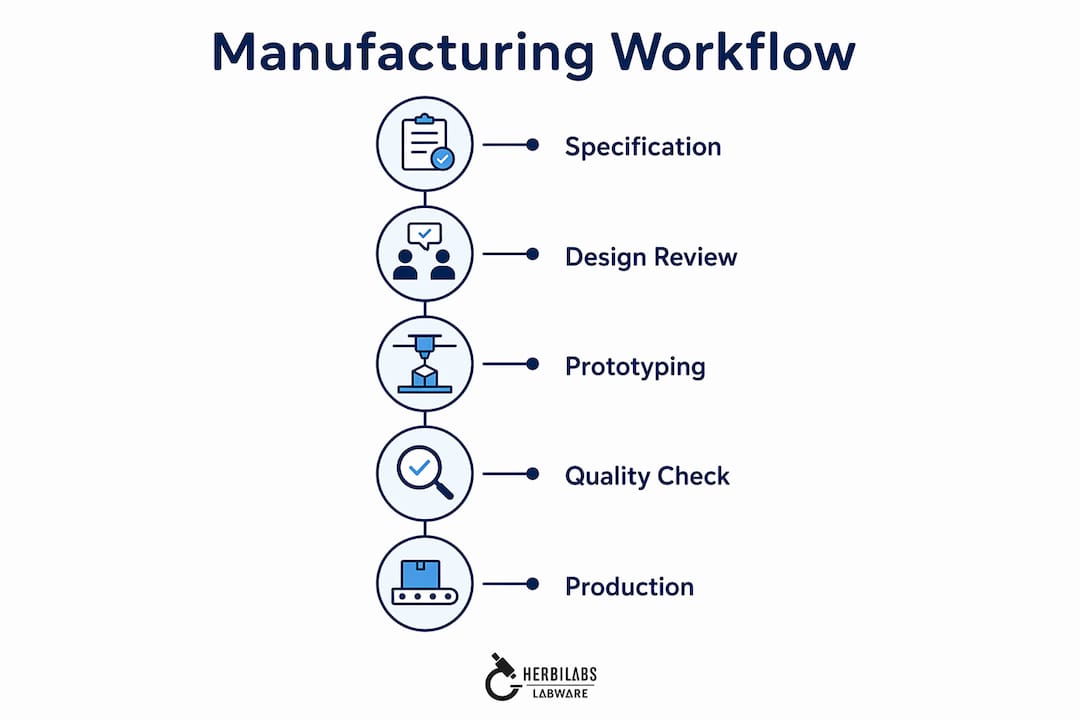
The workflow in custom solution manufacturing is more complex than placing a standard purchase order. It requires systematic translation of customer requirements into manufacturable and testable designs before any production commitment is made. The following sequence describes the standard process flow for a specification-driven manufacturing engagement:
- Requirements capture. The customer provides engineering documentation, including CAD files, material specifications, tolerance callouts, and performance acceptance criteria. Incomplete documentation at this stage is the single most common cause of rework.
- Design for manufacturability (DFM) review. The manufacturer evaluates whether the specified design can be produced within the stated tolerances using available processes. DFM and feasibility assessments reduce risk of costly rework by identifying conflicts between design intent and production capability before tooling or materials are committed.
- Feasibility and cost modeling. Process selection, material sourcing, and lead time are modeled against the customer’s volume and timeline requirements.
- Production commitment and specification freeze. Both parties agree on a frozen specification set. Changes after this point require formal change control.
- Production and in-process inspection. Parts or assemblies are produced with in-process quality checks against the documented acceptance criteria.
- Final inspection and delivery. Finished goods are inspected against the original specification, with documentation provided to the customer.
Contract manufacturing is the most common commercial model for executing custom solution manufacturing. Contract manufacturing involves OEMs outsourcing production to manufacturers who build parts and products to exact specs under formal agreements with quality obligations. The OEM retains design IP and receives real-time process monitoring benefits, which is particularly relevant for research institutions that own proprietary assay or instrument designs but lack in-house production capability.
Successful contract manufacturing of custom solutions includes managed change control and integration into client quality and procurement workflows. This goes well beyond simple build-to-print execution. A manufacturer that cannot integrate with the customer’s quality management system or respond to specification changes through a formal controlled process is a liability, not an asset.
Pro Tip: Before signing a contract manufacturing agreement, request a sample DFM report from the prospective manufacturer. A well-structured DFM report demonstrates that the manufacturer understands specification translation, not just fabrication, and will flag design issues before they become production failures.
For lab managers overseeing lab quality control processes, integrating the manufacturer’s inspection documentation into your internal QA records is a non-negotiable requirement for maintaining research integrity.
Which manufacturing processes and materials are most commonly used?
Process selection in custom solution manufacturing is determined by the combination of required tolerances, material properties, production volume, and cost constraints. No single process is universally optimal, and the most experienced manufacturers evaluate multiple options before committing to a production method.
The most commonly applied processes in custom manufacturing for scientific and technical applications include:
- CNC machining: Produces high-precision metal and polymer components from solid stock. Tolerances of ±0.005 mm are achievable, making CNC the standard for optical mounts, flow cell bodies, and instrument housings.
- Additive manufacturing (3D printing): Technologies such as selective laser sintering (SLS), stereolithography (SLA), and direct metal laser sintering (DMLS) enable complex geometries that are impractical to machine. Particularly useful for prototype iterations and low-volume specialty parts.
- Sheet metal fabrication: Appropriate for enclosures, brackets, and structural components where tight tolerances are secondary to form and function.
- Injection molding: Cost-effective for medium-volume production of polymer components once tooling investment is justified, though tooling costs make it unsuitable for true one-off custom work.
Material selection follows directly from application requirements. The table below outlines common material categories and their typical applications in custom scientific manufacturing:
| Material category | Typical applications | Key property driver |
|---|---|---|
| Stainless steel (316L) | Fluid handling, instrument bodies | Corrosion resistance, biocompatibility |
| PEEK polymer | Chromatography fittings, flow cells | Chemical resistance, dimensional stability |
| Borosilicate glass | Optical components, reaction vessels | Thermal stability, optical clarity |
| Titanium alloys | Implantable devices, high-load structures | Strength-to-weight ratio, biocompatibility |
| PTFE | Seals, tubing, chemical-resistant liners | Broad chemical inertness |
For medical device prototyping and custom manufacturing with emphasis on DFM and feasibility review, process selection must also account for regulatory material traceability requirements, particularly when components will contact biological samples or reagents.
Limiting changes to manufacturing platforms while meeting custom specs reduces costs and keeps timelines predictable in precision scientific applications. This principle guides experienced manufacturers to select the most capable process that requires the fewest platform changes across a project’s lifecycle.
How does custom solution manufacturing support scientific and lab applications?
Scientific and laboratory applications represent one of the most demanding use cases for custom solution manufacturing. Instruments, assemblies, and reagent systems used in research environments must meet precise specifications that standard commercial products cannot satisfy. A microfluidic chip designed for a specific cell-sorting protocol, for example, requires channel dimensions, surface chemistry, and bonding methods defined entirely by the experimental parameters, not by a product catalog.
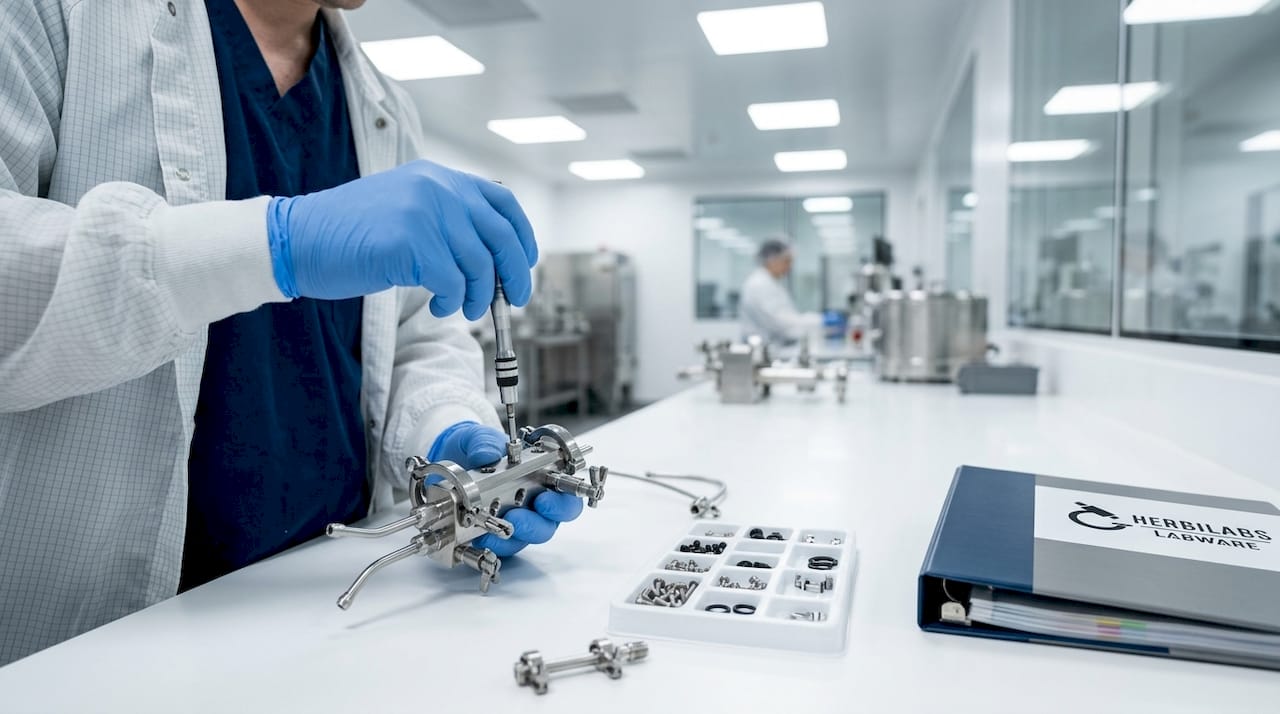
Custom manufacturing requires precise process engineering, rigorous requirement freeze, and QA enforcement to avoid cascading rework in lab-related builds. Acceptable tolerances, surface finish criteria, and inspection plans must be documented before production begins. For a lab manager commissioning a custom flow cell or sample holder, this means providing not just a drawing but a complete acceptance test procedure that the manufacturer can execute and document.
The challenge of balancing custom specifications with cost and timeline constraints is real. Researchers often request tolerances tighter than the application actually requires, which drives up machining time and cost without improving experimental outcomes. A productive collaboration between the research team and the manufacturer includes a tolerance review that distinguishes between functionally critical dimensions and those where standard commercial tolerances are sufficient.
Pro Tip: When specifying surface finish requirements for lab components that will contact biological samples or reagents, define the Ra value (arithmetic mean roughness) explicitly in your engineering documentation rather than using qualitative terms like “smooth” or “polished.” Ra values of 0.8 µm or better are typically required for surfaces in contact with cell cultures or sensitive assay reagents, and specifying this numerically prevents ambiguity during inspection.
Specialty assemblies such as custom reconstitution systems, sterile filling manifolds, and precision dispensing components are produced through tailored manufacturing services that integrate material qualification, sterility testing, and dimensional inspection into a single delivery package. For researchers working with aseptic manufacturing standards in biotech and pharma, the manufacturer’s ability to demonstrate sterility compliance is as important as dimensional accuracy.
Rigorous quality testing in biotech labs must extend to every custom-manufactured component that enters the research environment, not just to the reagents and consumables those components handle.
Key takeaways
Custom solution manufacturing succeeds when specifications are frozen before production, DFM reviews are completed before commitment, and quality obligations are formally integrated into the contract manufacturing agreement.
| Point | Details |
|---|---|
| Definition is specification-driven | Custom manufacturing produces parts strictly to CAD models, material specs, and tolerance requirements, not standard designs. |
| DFM review is non-negotiable | Feasibility and DFM assessments before production commitment are the primary mechanism for avoiding costly rework. |
| Contract manufacturing requires change control | Formal change control processes must be integrated into the manufacturing agreement to maintain quality across evolving specifications. |
| Process selection drives cost and precision | CNC machining, additive manufacturing, and injection molding each suit different volume and tolerance profiles in scientific applications. |
| Lab applications demand documented acceptance criteria | Surface finish, dimensional tolerance, and inspection plans must be explicitly documented for all lab-adjacent custom builds. |
Why specification discipline separates successful custom manufacturing projects from failed ones
I have reviewed enough custom manufacturing projects in scientific and research contexts to identify a consistent pattern in the ones that fail. The failure almost never originates in the manufacturing process itself. It originates in the specification. Researchers and lab managers who approach a contract manufacturer with a concept rather than a documented engineering requirement set are setting up a project for rework, cost overruns, and timeline slippage.
The most underestimated risk in custom solution manufacturing is translating specifications into manufacturable and testable designs before production commitment. I have seen projects where the customer provided a hand sketch and a verbal description of the required performance, then expressed surprise when the first article inspection failed. The manufacturer built what was described. The description was incomplete.
My consistent advice to lab managers and researchers entering a custom manufacturing engagement is to treat the DFM review as a collaborative engineering session, not a formality. Bring your application engineer and your QA lead to that review. The manufacturer’s process engineers will identify constraints you have not considered, and that conversation is far less expensive before tooling than after it.
Contract manufacturing of custom products requires robust change management and integration with client processes beyond mere build-to-print execution. The manufacturers who deliver reliably are those who have invested in change control infrastructure and who treat a specification revision as a formal engineering event, not an informal conversation. Selecting a manufacturing partner based on price alone, without evaluating their change management capability, is the second most common mistake I observe.
— Ragnar
Precision lab solutions from Herbilabs to support your research
Herbilabs manufactures research-grade reconstitution solutions and sterile diluents to strict purity standards, providing the high-quality consumables that custom lab manufacturing workflows depend on.
When your research protocol requires precisely formulated sterile solutions to complement custom-manufactured instrumentation or assemblies, the quality of those consumables is as critical as the dimensional accuracy of the hardware. Herbilabs supplies bacteriostatic water, sterile diluents, and specialty reconstitution solutions manufactured under rigorous quality control to serve research institutions, universities, and independent researchers across the UK and Europe. Explore the top high-purity reconstitution solutions available from Herbilabs, or contact the team directly for wholesale pricing and institutional supply arrangements.
FAQ
What does “define custom solution manufacturing” mean?
Custom solution manufacturing is defined as the production of parts, assemblies, or systems built strictly to customer-specified engineering requirements, including CAD models, material specifications, and dimensional tolerances, rather than from standard catalog designs.
How is custom manufacturing different from standard manufacturing?
Standard manufacturing produces identical parts from fixed designs at high volume, while custom manufacturing uses flexible tooling and adaptable processes to produce low-to-medium volume parts built to unique customer specifications.
What is a DFM review in custom manufacturing?
A design for manufacturability (DFM) review is a pre-production assessment in which the manufacturer evaluates whether the customer’s design can be produced within specified tolerances using available processes, reducing the risk of costly rework after production begins.
Why is specification freeze important in custom solution manufacturing?
Specification freeze establishes a documented, agreed-upon set of engineering requirements before production begins. Changes after this point require formal change control, which prevents uncontrolled specification drift that leads to inspection failures and rework.
What processes are most common in custom scientific manufacturing?
CNC machining, additive manufacturing (SLS, SLA, DMLS), sheet metal fabrication, and injection molding are the most commonly used processes, with selection determined by required tolerances, material properties, and production volume.